
Sources of nursing knowledge 1 Tradition The handling

- Slides: 27
Sources of nursing knowledge 1. Tradition: The handling down of Knowledge from one generation to another leads to actions that occur because “we’ve always done it that way” certain “truths’’ are accepted as given.
Tradition �Advantages: Each individual is not required to begin anew in an attempt to understand the world or certain aspects of it. B. Facilitates communication by providing a common foundation of accepted “truth’’. C. Disadvantages: Many traditions have never been evaluated for their validity. • Critical appraisal should be done to custom and tradition before accepting them as truth. A.
2. Authority: Experts or authorities in a given filed often provide Knowledge for other people: - Limitations: based on personal experience.
3. Experience and trial and error. - Experience; our own experiences represent a familiar and functional source of Knowledge. So, human beings must be able to learn about their environment form their experiences.
limitations: � a) Each individual’s experiences may be too restricted to develop generalization. � b) the same objective event generally is experienced or perceived differently be two individuals “ colored by subjective values and prejudices”. v Trial and error: - Alternatives are tried until we find one that answer our questions or solves our problems. v Limitations: - It is fallible and inefficient, haphazard and unsystematic “the goal was “if it works, we’ll use it”
4 -logical reasoning: logical thought processes. - Combines experience, our systems of thought v There are two types of reasoning: a- Inductive reasoning: is the process of developing generalizations from specific observations. b- Deductive reasoning: is the process of developing specific predictions from general principles. �
Limitations: 1 -The quality of Knowledge arrived at through inductive reasoning is highly inductive upon the representative-ness of the specific. Examples used as the basis for generalization. 2 -Has no self correction. 3 -Deductive reasoning: not it self a source of new information. It is an approach to illuminating relationships as one proceeds from the general to the specific.
5. Scientific Method: �The most objective & reliable source of nursing knowledge. �Has capacity for self evaluation. �Scientific research uses checks & balance which minimize the possibility that the researcher’s emotion or biases will affect the conclusions. �Uses empirical data, which are data gathered through the sense organs.
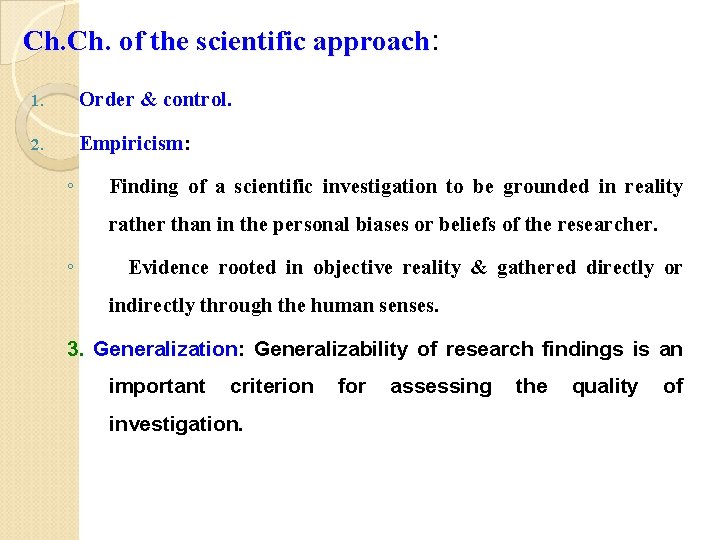
Ch. of the scientific approach: 1. Order & control. 2. Empiricism: ◦ Finding of a scientific investigation to be grounded in reality rather than in the personal biases or beliefs of the researcher. ◦ Evidence rooted in objective reality & gathered directly or indirectly through the human senses. 3. Generalization: Generalizability of research findings is an important criterion investigation. for assessing the quality of
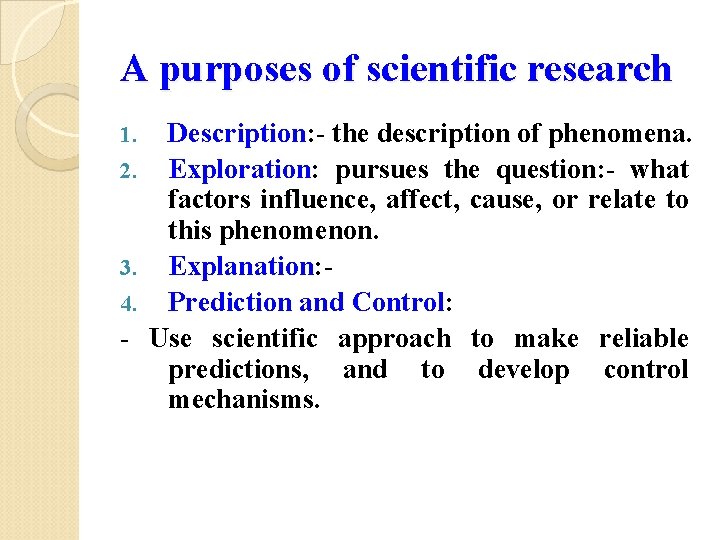
A purposes of scientific research 1. 2. 3. 4. - Description: - the description of phenomena. Exploration: pursues the question: - what factors influence, affect, cause, or relate to this phenomenon. Explanation: Prediction and Control: Use scientific approach to make reliable predictions, and to develop control mechanisms.
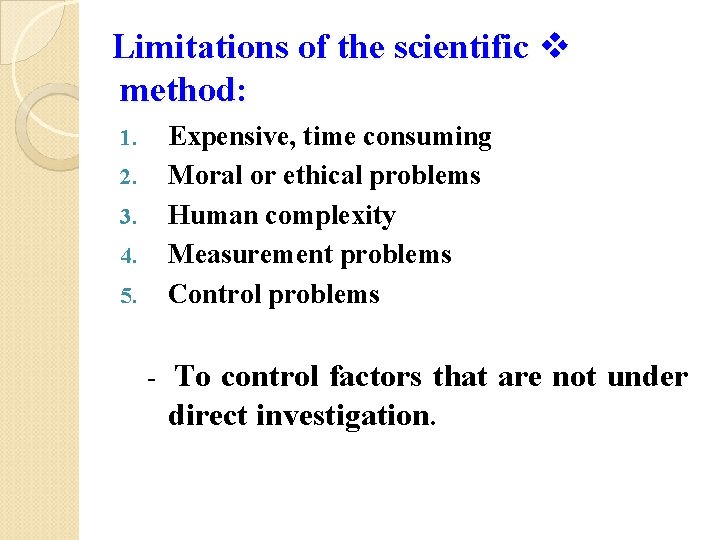
Limitations of the scientific v method: 1. 2. 3. 4. 5. Expensive, time consuming Moral or ethical problems Human complexity Measurement problems Control problems - To control factors that are not under direct investigation.
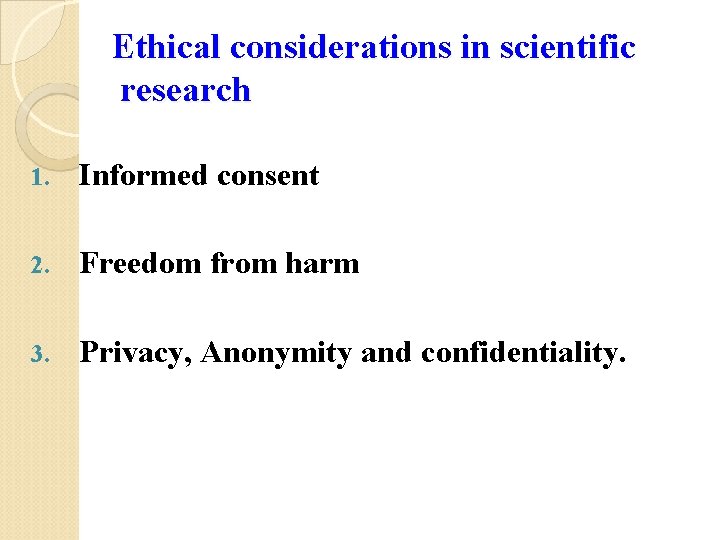
Ethical considerations in scientific research 1. Informed consent 2. Freedom from harm 3. Privacy, Anonymity and confidentiality.
Reasons for conducting nursing research: 1. Improvement in nursing care. 2. Growth of the Nursing profession. 3. Accountability for nursing practice. 4. Documentation of the cost-effectiveness of nursing care.
Basic Research Terminology - A study, investigation, or a research project. § -Subjects (sometimes abbreviated as ss) or the study participants: the people who are being studied. § -Respondents or, sometimes, informants: when the subjects provide information to the researchers.
- Researcher , investigator, or scientist : is the person who undertakes the research. - Principal investigator or project director; the main person directing the investigation when a study is under taken by a research team.
Concepts: -Ø Ø - Conceptualization refers to the process of developing and refining abstract ideas. Ø Scientific research. Is almost always concerned with abstract rather than tangible phenomena.
Ø Variables: - - Within the context of a research investigation, concepts are referred to as variables. - Is something that varies or differs from one person to another. - All research activity is aimed at trying to understand how or why things vary and to learn how differences in one variable are related to differences in another.
- Attribute variables: are often inherent ch. Such as age, blood type, health beliefs. Ø Heterogeneity: when an attribute is extremely varied in the group under study, the group is said to be heterogeneous with respect to that variable.
Ø Homogeneity: when the members of the group are highly similar to one another with respect to that variable, the group is described as homogeneous. Ø Demographic - variables: - Are ch. ch or attributes of the subject that are collected to describe the sample.
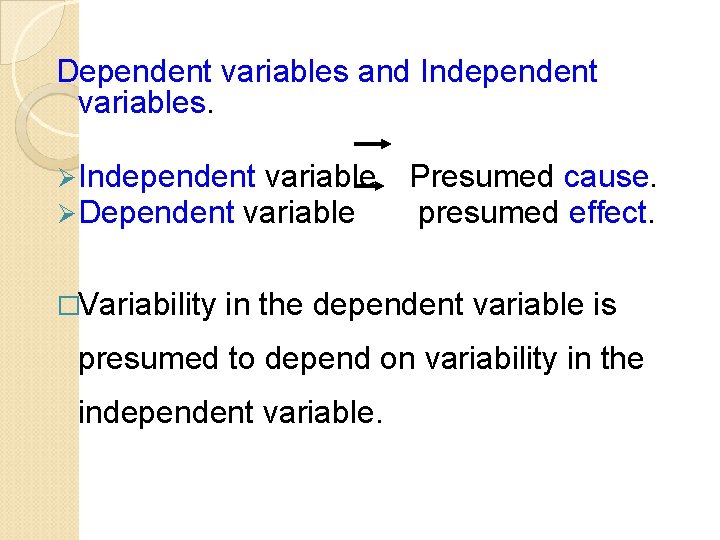
Dependent variables and Independent variables. Ø Independent variable Ø Dependent variable �Variability Presumed cause. presumed effect. in the dependent variable is presumed to depend on variability in the independent variable.
Ø The dependent variable is the variable the researcher is interested in understanding explaining, or predicating. Ø Dependent is the response, behaviors or out come that the researcher wants to predict or explain.
Ø The dependent variable is the “effect’’ or the variable that is influenced by the researcher’s manipulation (Control) of the independent variable. Ø The designation of a variables as independent or dependent is a function of the role that the variable plays in a particular investigation.
Operational Definitions: Ø The researcher usually clarifies and define the variable under investigation. Ø The definition must specify how the variable will be observed and measured in the actual research situation. Ø It is a specification of the operations that the researcher must perform to collect the required information.
Ø This operational definition clearly indicated to both the investigator and to the consumer what is meant by the variable weight. Ø Precision in defining the terms has the advantage of communicating exactly what the terms mean. -Data: - singular, datum) Are the pieces of information obtained in the course of the investigation
Relationship: �Refers to a bond or connection between two variables or more. Ø Example: v Height: taller people will weigh more than shorter people. v Metabolism: the lower a person’s metabolic rate, the more he or she will weigh. v Caloric intake: people with higher caloric intake will be heavier than those with lower caloric intake. v Exercise: the greater the amount of exercise, the lower the person’s weight.
Variables can be related to one • another in different ways: 1. Cause – and – effect (or causal relationships). ( as natural phenomena) – eating more calories causes weight gain. 2. Functional relationship � Control - Research control attempts to eliminate any contaminating factors that might obscure the relationship between the variables that are of central interest.