
Sources of Magnetic Fields Chapter 30 BiotSavart Law
Sources of Magnetic Fields Chapter 30 Biot-Savart Law Lines of Magnetic Field Ampere’s Law Solenoids and Toroids
Sources of Magnetic Fields • Magnetic fields exert forces on moving charges. • Something reciprocal happens: moving charges give rise to magnetic fields (which can then exert a force on other moving charges). • We will look at the easiest case: the magnetic field created by currents in wires. • The magnetism of permanent magnets also comes from moving charges (the electrons in the atoms).
Magnetic Interaction Rather than discussing moving charges in general, restrict attention to currents in wires. Then: • A current generates a magnetic field. • A magnetic field exerts a force on a current. • Two conductors, carrying currents, will exert forces on each other.

Biot-Savart Law • The mathematical description of the magnetic field B due to a current-carrying wire is called the Biot-Savart law. It gives B at a selected position. • A current I is moving all through the wire. We need to add up the bits of magnetic field d. B arising from each infinitesimal length dl. dl I q r d. B Add up all the bits!
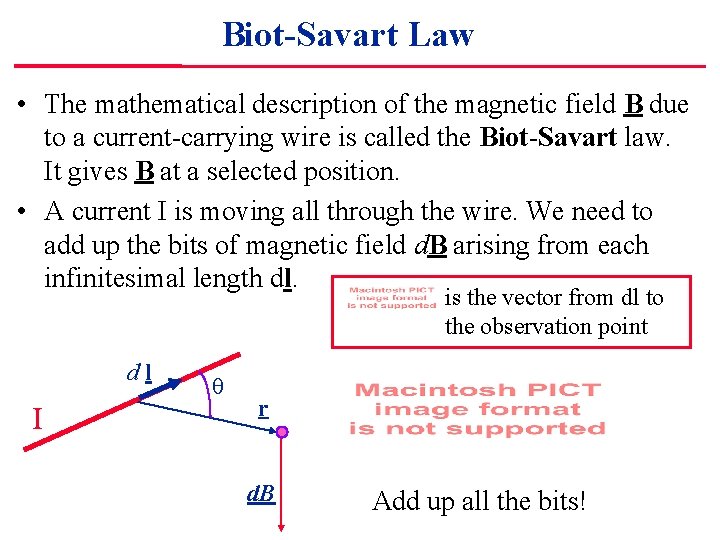
Biot-Savart Law • The mathematical description of the magnetic field B due to a current-carrying wire is called the Biot-Savart law. It gives B at a selected position. • A current I is moving all through the wire. We need to add up the bits of magnetic field d. B arising from each infinitesimal length dl. is the vector from dl to the observation point dl I q r d. B Add up all the bits!
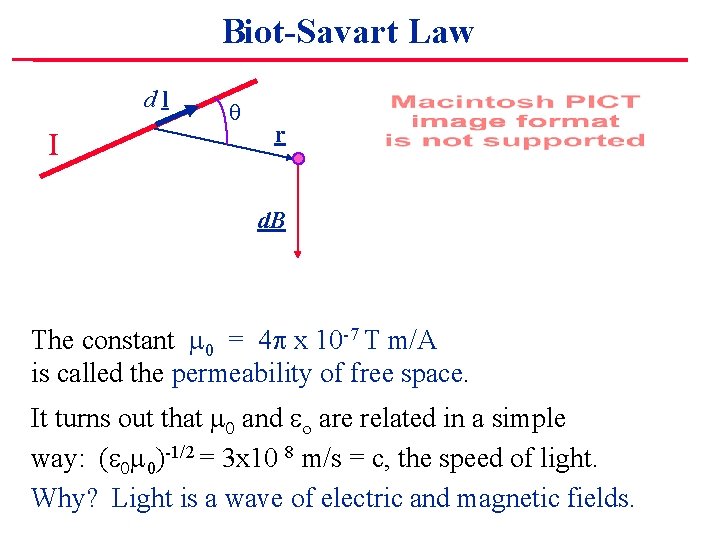
Biot-Savart Law dl I q r d. B The constant m 0 = 4 p x 10 -7 T m/A is called the permeability of free space. It turns out that m 0 and eo are related in a simple way: (e 0 m 0)-1/2 = 3 x 10 8 m/s = c, the speed of light. Why? Light is a wave of electric and magnetic fields.
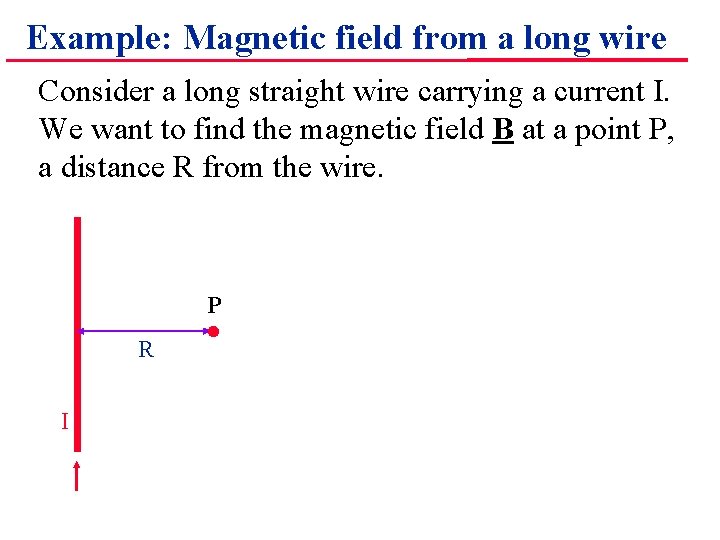
Example: Magnetic field from a long wire Consider a long straight wire carrying a current I. We want to find the magnetic field B at a point P, a distance R from the wire. P R I
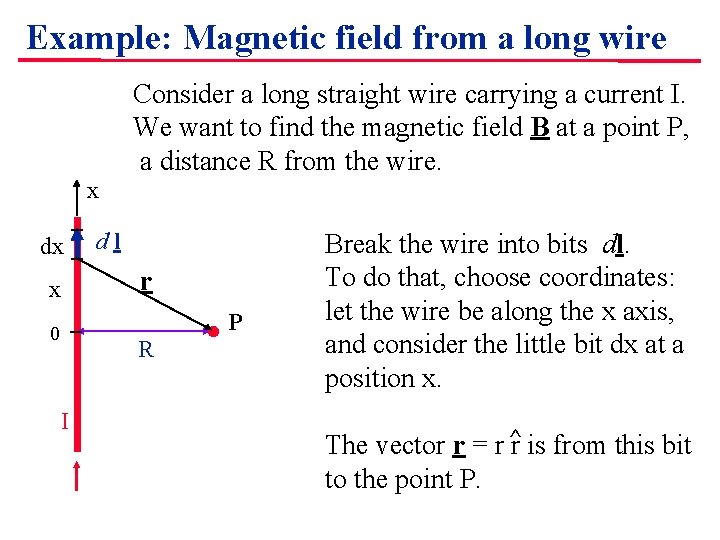
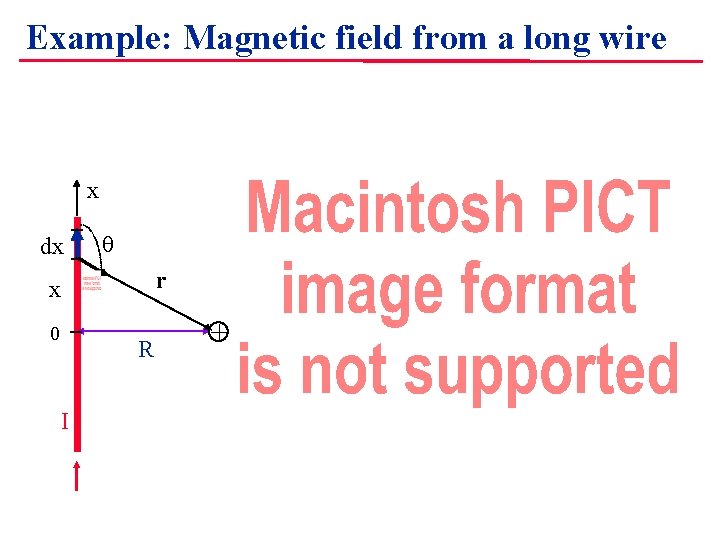
Example: Magnetic field from a long wire Consider a long straight wire carrying a current I. We want to find the magnetic field B at a point P, a distance R from the wire. x dx dl r x P 0 R I Break the wire into bits dl. To do that, choose coordinates: let the wire be along the x axis, and consider the little bit dx at a position x. The vector r = r ^r is from this bit to the point P.
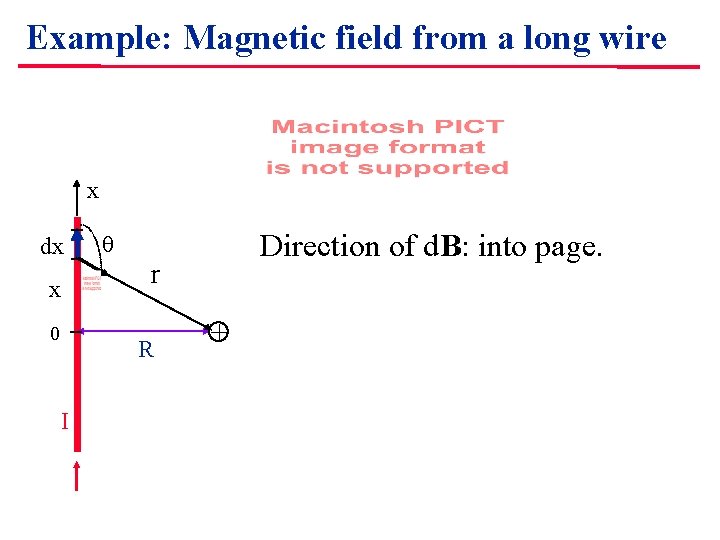
Example: Magnetic field from a long wire x dx x 0 r R I Direction of d. B: into page. q +
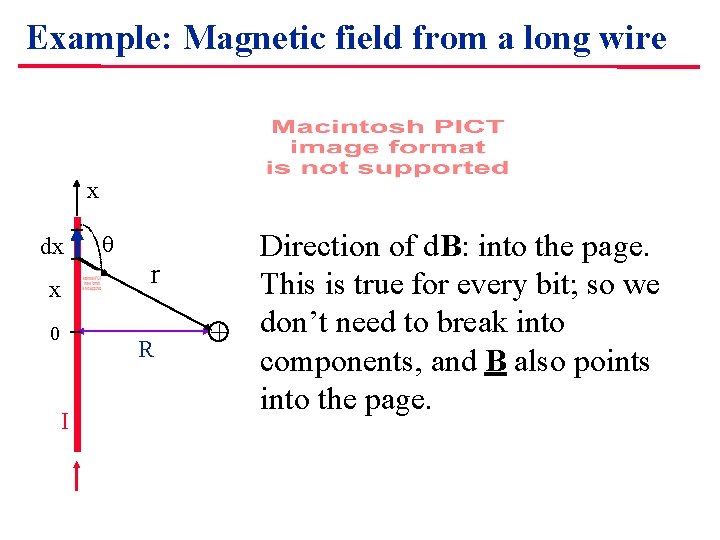
Example: Magnetic field from a long wire x dx x 0 q r R I Direction of d. B: into the page. This is true for every bit; so we + don’t need to break into components, and B also points into the page.
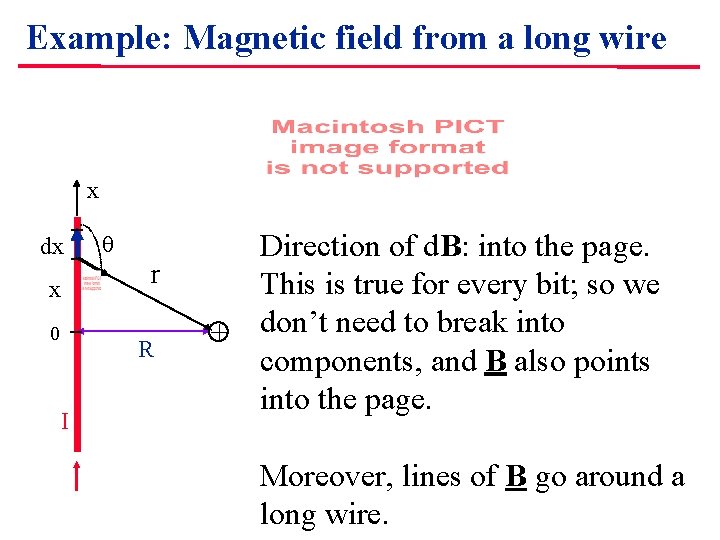
Example: Magnetic field from a long wire x dx x 0 q r R I Direction of d. B: into the page. This is true for every bit; so we + don’t need to break into components, and B also points into the page. Moreover, lines of B go around a long wire.
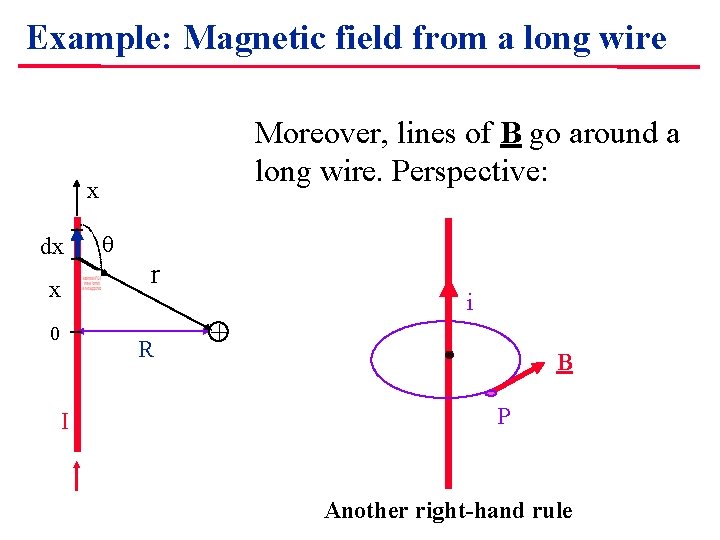
Example: Magnetic field from a long wire Moreover, lines of B go around a long wire. Perspective: x dx x 0 q r R I + i B P Another right-hand rule
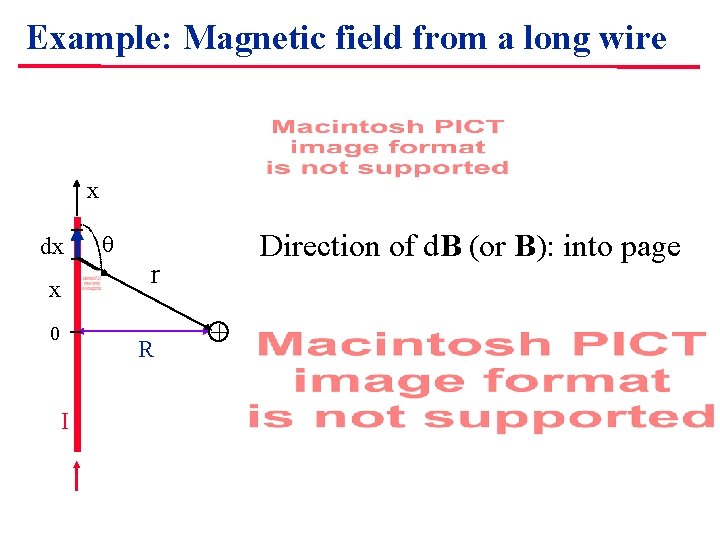
Example: Magnetic field from a long wire x dx x 0 r R I Direction of d. B (or B): into page q +
Example: Magnetic field from a long wire x dx q r x 0 R I +
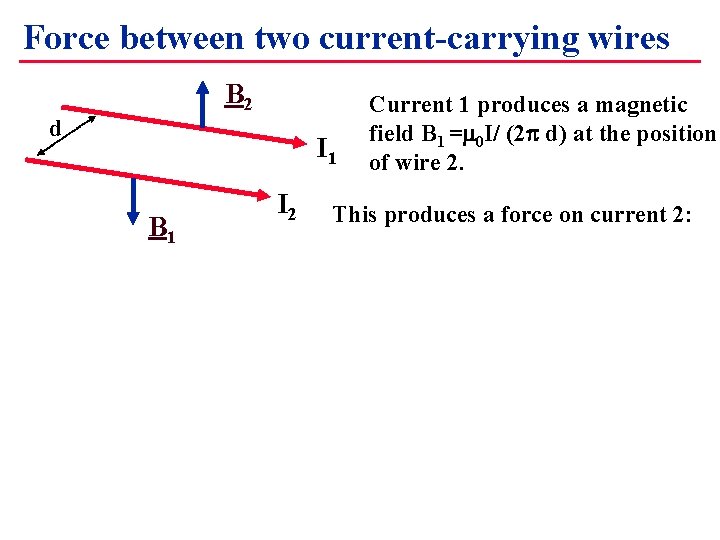
Force between two current-carrying wires B 2 d I 1 B 1 I 2 Current 1 produces a magnetic field B 1 =m 0 I/ (2 p d) at the position of wire 2. This produces a force on current 2:
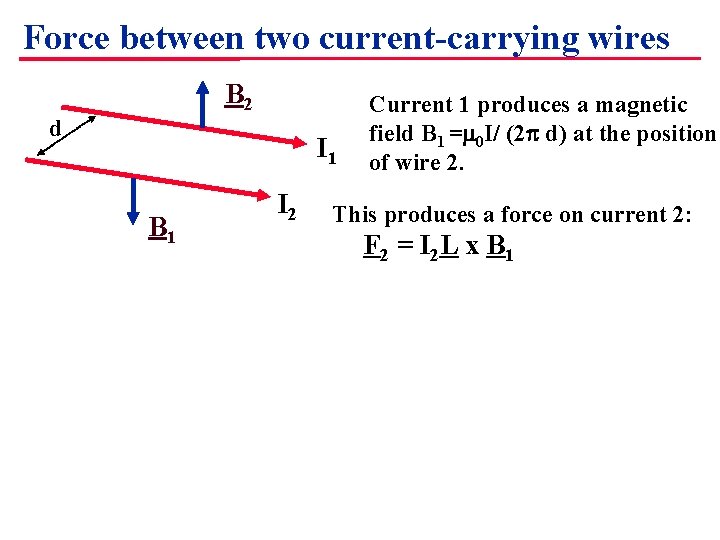
Force between two current-carrying wires B 2 d I 1 B 1 I 2 Current 1 produces a magnetic field B 1 =m 0 I/ (2 p d) at the position of wire 2. This produces a force on current 2: F 2 = I 2 L x B 1
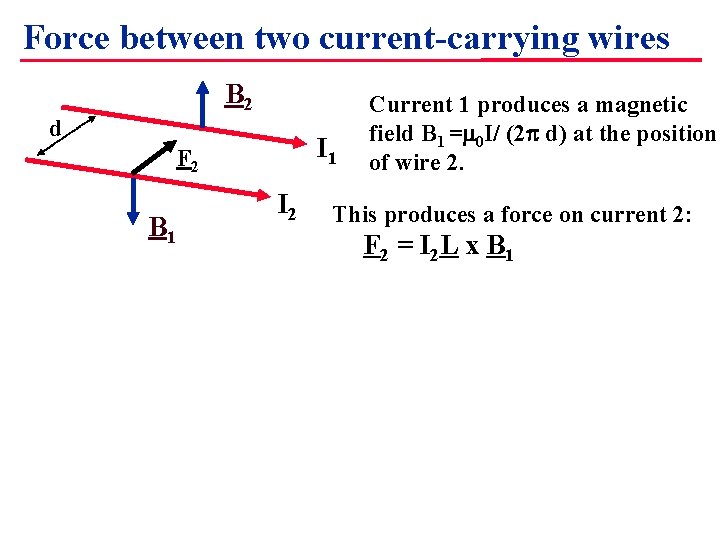
Force between two current-carrying wires B 2 d I 1 F 2 B 1 I 2 Current 1 produces a magnetic field B 1 =m 0 I/ (2 p d) at the position of wire 2. This produces a force on current 2: F 2 = I 2 L x B 1
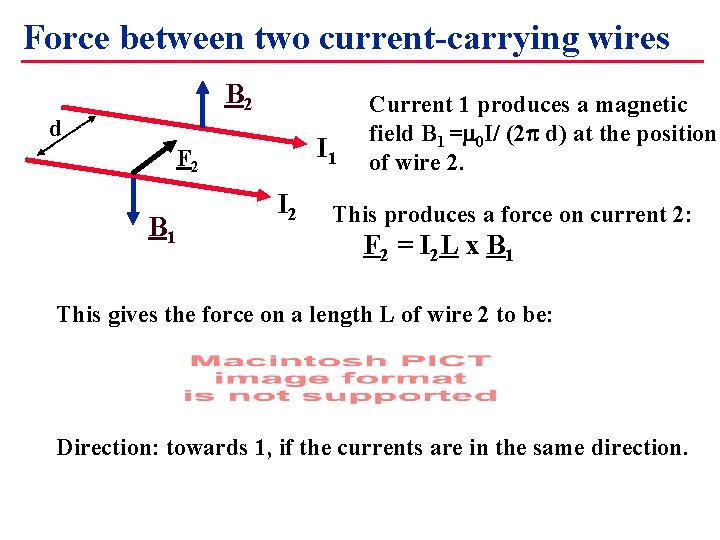
Force between two current-carrying wires B 2 d I 1 F 2 B 1 I 2 Current 1 produces a magnetic field B 1 =m 0 I/ (2 p d) at the position of wire 2. This produces a force on current 2: F 2 = I 2 L x B 1 This gives the force on a length L of wire 2 to be: Direction: towards 1, if the currents are in the same direction.
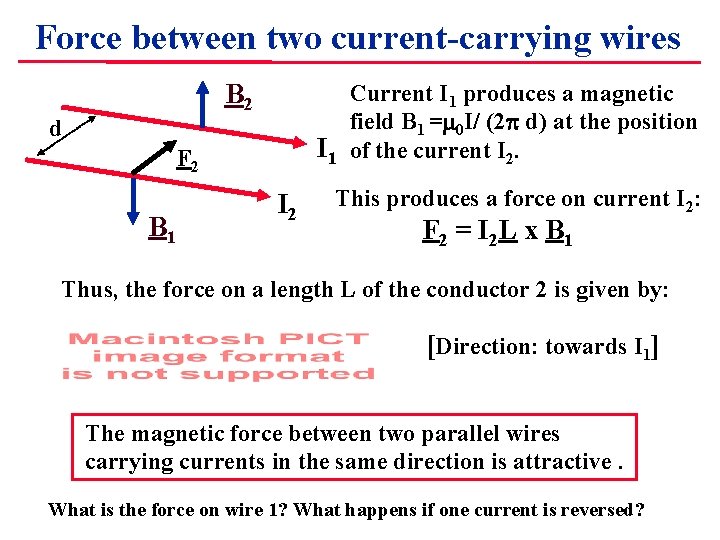
Force between two current-carrying wires B 2 Current I 1 produces a magnetic field B 1 =m 0 I/ (2 p d) at the position I 1 of the current I 2. d F 2 B 1 I 2 This produces a force on current I 2: F 2 = I 2 L x B 1 Thus, the force on a length L of the conductor 2 is given by: [Direction: towards I 1] The magnetic force between two parallel wires carrying currents in the same direction is attractive. What is the force on wire 1? What happens if one current is reversed?
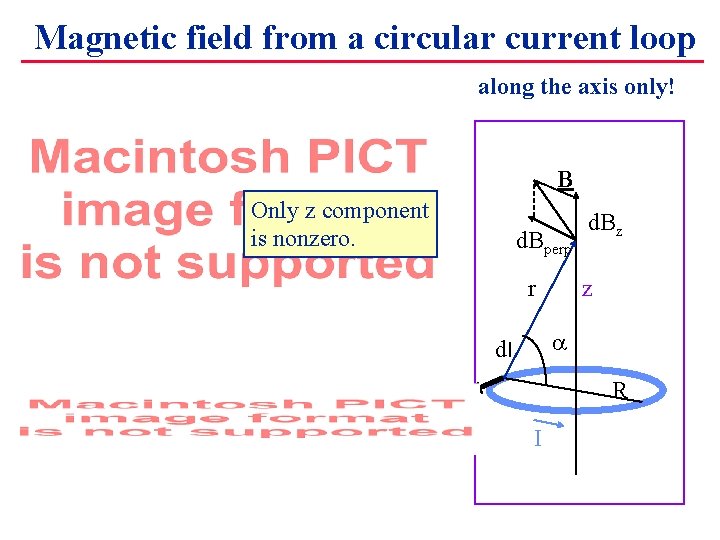
Magnetic field from a circular current loop along the axis only! B Only z component is nonzero. d. Bperp r d. Bz z a dl R I
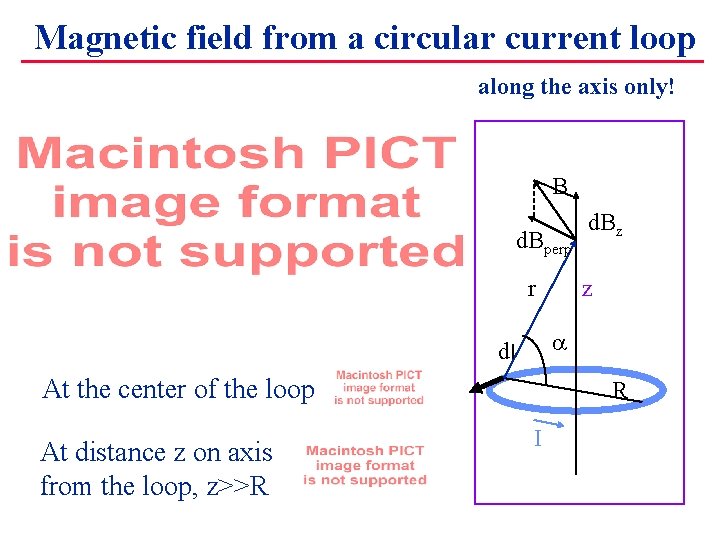
Magnetic field from a circular current loop along the axis only! B d. Bperp r z a dl At the center of the loop At distance z on axis from the loop, z>>R d. Bz R I
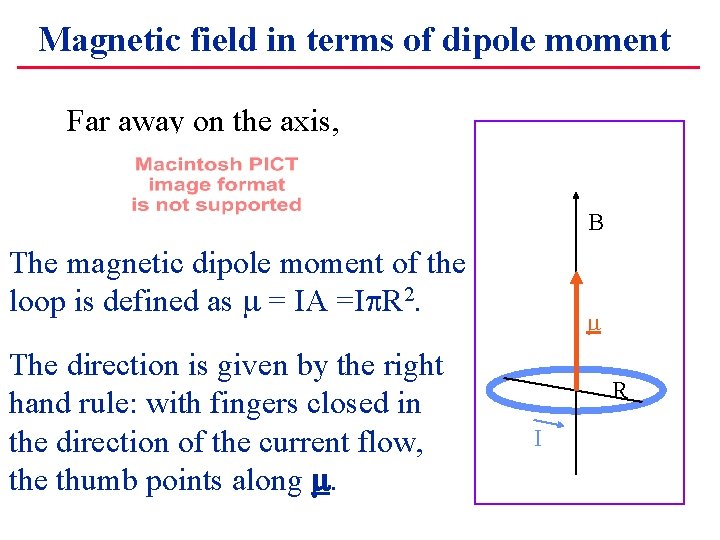
Magnetic field in terms of dipole moment Far away on the axis, B The magnetic dipole moment of the loop is defined as m = IA =Ip. R 2. The direction is given by the right hand rule: with fingers closed in the direction of the current flow, the thumb points along m. z m R I
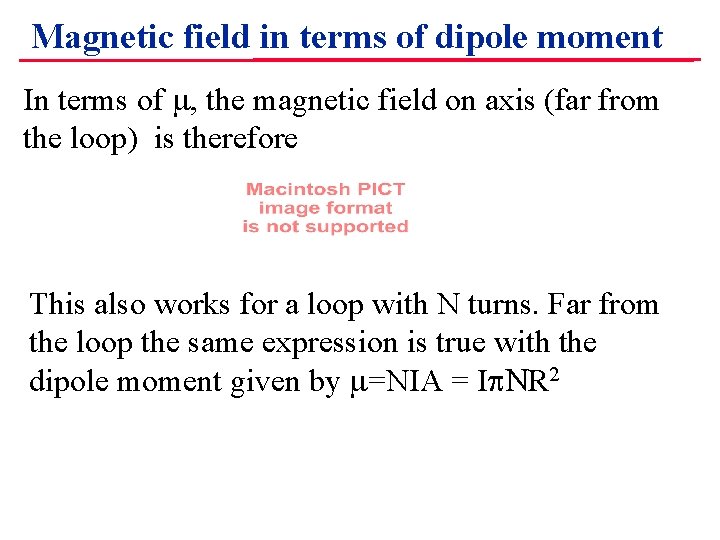
Magnetic field in terms of dipole moment In terms of m, the magnetic field on axis (far from the loop) is therefore This also works for a loop with N turns. Far from the loop the same expression is true with the dipole moment given by m=NIA = Ip. NR 2
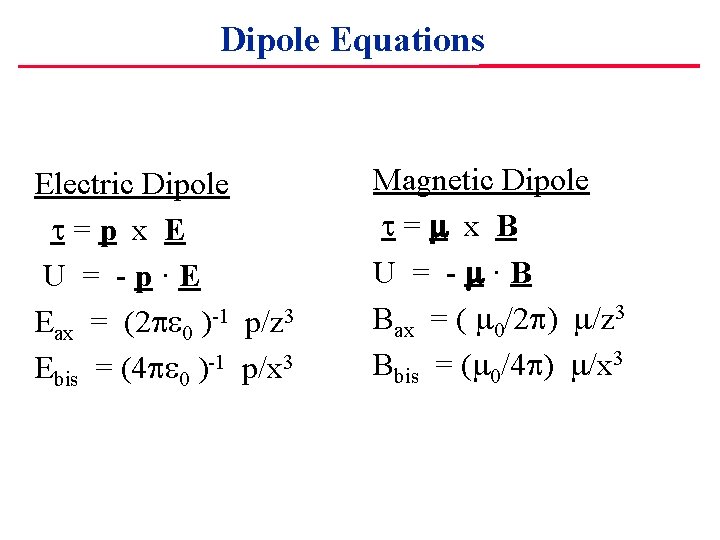
Dipole Equations Electric Dipole t=p x E U = -p·E Eax = (2 pe 0 )-1 p/z 3 Ebis = (4 pe 0 )-1 p/x 3 Magnetic Dipole t=m x B U = -m·B Bax = ( m 0/2 p) m/z 3 Bbis = (m 0/4 p) m/x 3
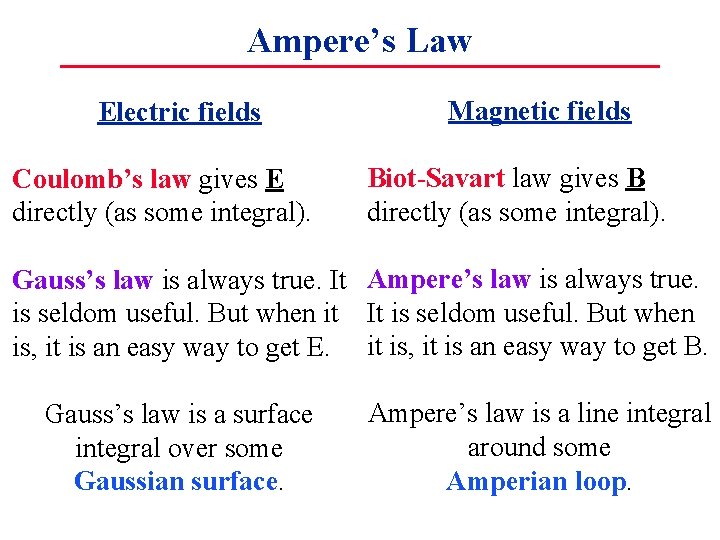
Ampere’s Law Electric fields Coulomb’s law gives E directly (as some integral). Magnetic fields Biot-Savart law gives B directly (as some integral). Gauss’s law is always true. It Ampere’s law is always true. is seldom useful. But when it It is seldom useful. But when is, it is an easy way to get E. it is, it is an easy way to get B. Gauss’s law is a surface integral over some Gaussian surface. Ampere’s law is a line integral around some Amperian loop.
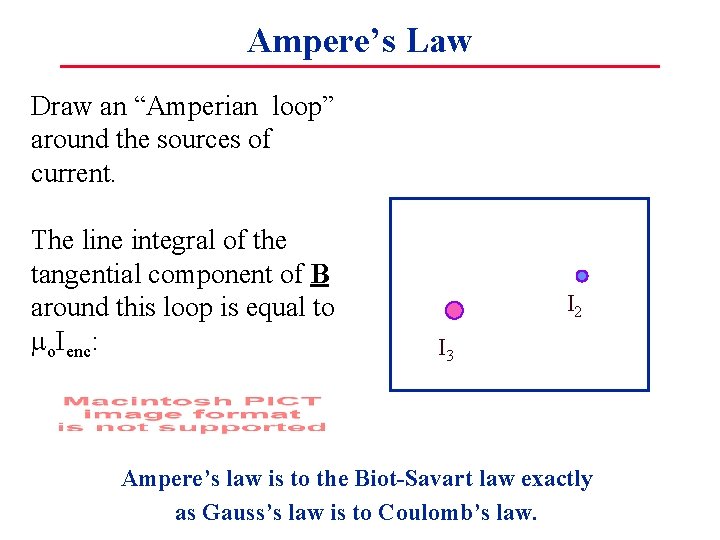
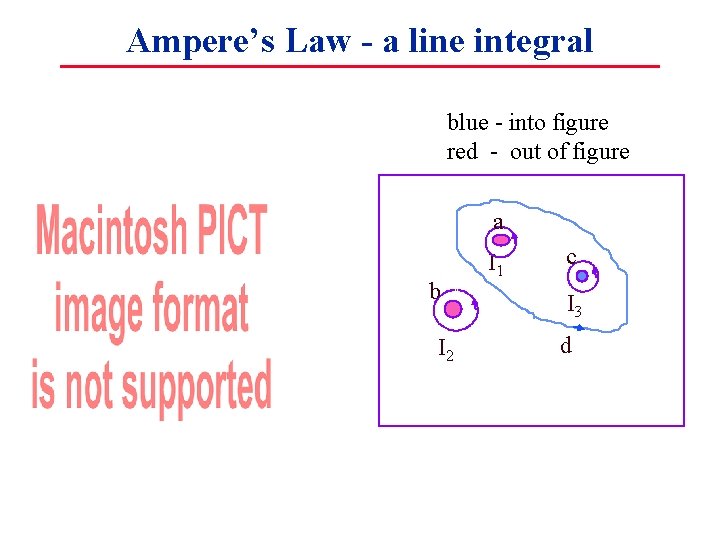
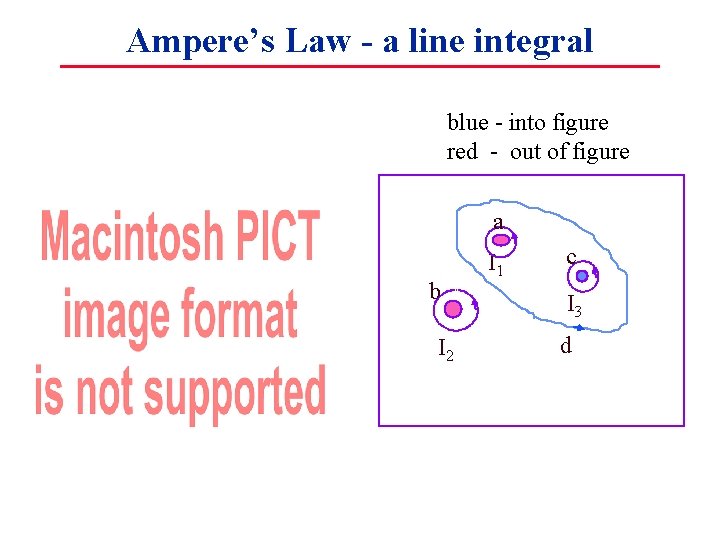
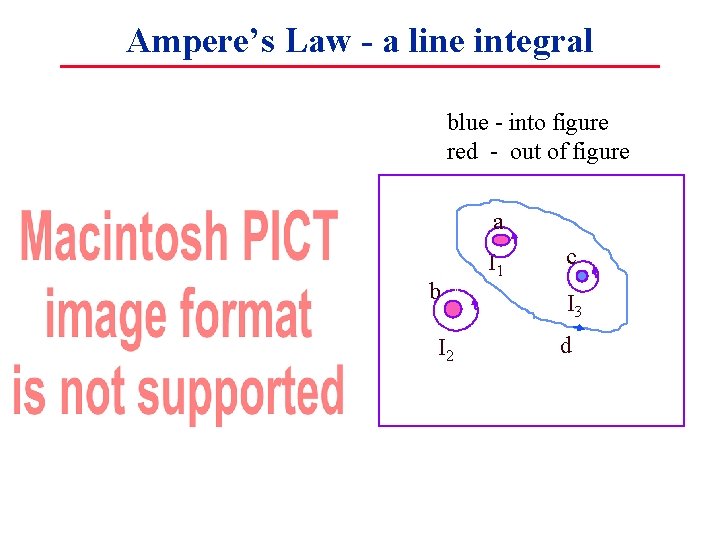
Ampere’s Law Draw an “Amperian loop” around the sources of current. The line integral of the tangential component of B around this loop is equal to mo. Ienc: I 2 I 3 Ampere’s law is to the Biot-Savart law exactly as Gauss’s law is to Coulomb’s law.
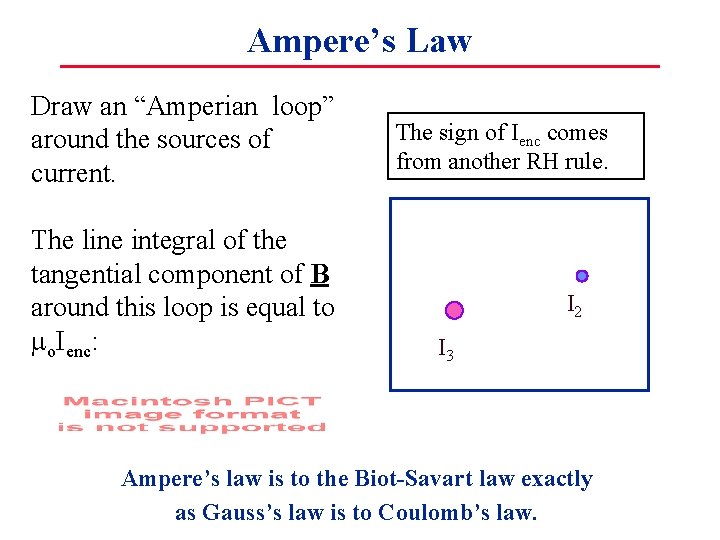
Ampere’s Law Draw an “Amperian loop” around the sources of current. The line integral of the tangential component of B around this loop is equal to mo. Ienc: The sign of Ienc comes from another RH rule. I 2 I 3 Ampere’s law is to the Biot-Savart law exactly as Gauss’s law is to Coulomb’s law.
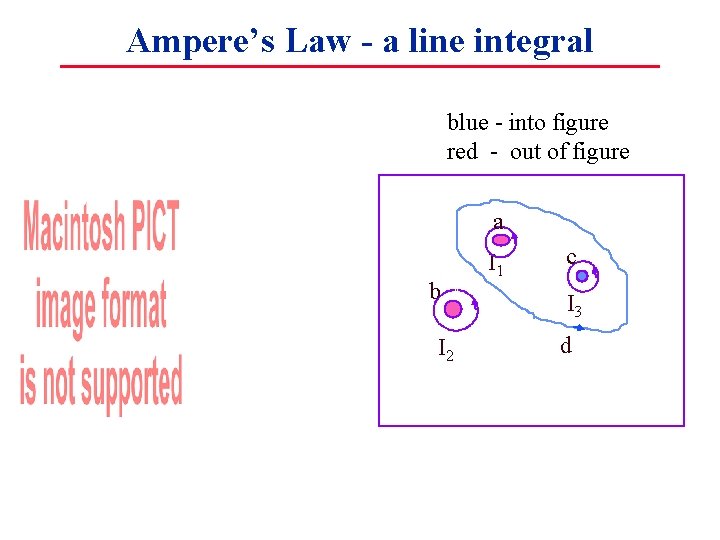
Ampere’s Law - a line integral blue - into figure red - out of figure a b I 2 I 1 c I 3 d
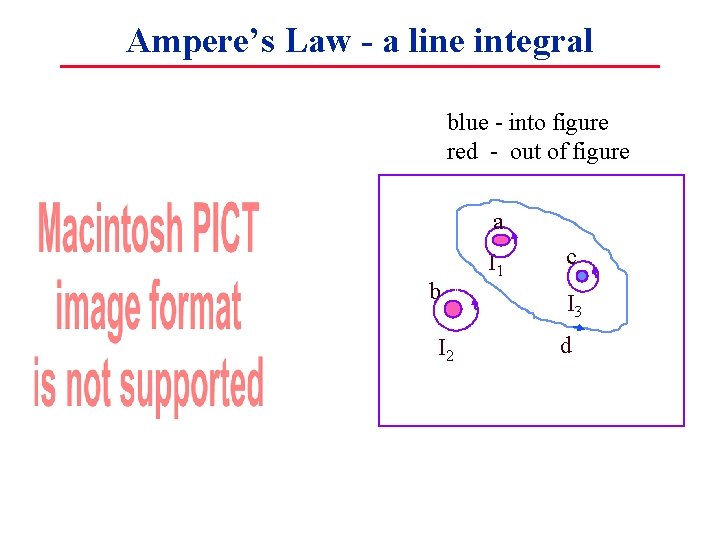
Ampere’s Law - a line integral blue - into figure red - out of figure a b I 2 I 1 c I 3 d
Ampere’s Law - a line integral blue - into figure red - out of figure a b I 2 I 1 c I 3 d
Ampere’s Law - a line integral blue - into figure red - out of figure a b I 2 I 1 c I 3 d
Ampere’s Law - a line integral blue - into figure red - out of figure a b I 2 I 1 c I 3 d
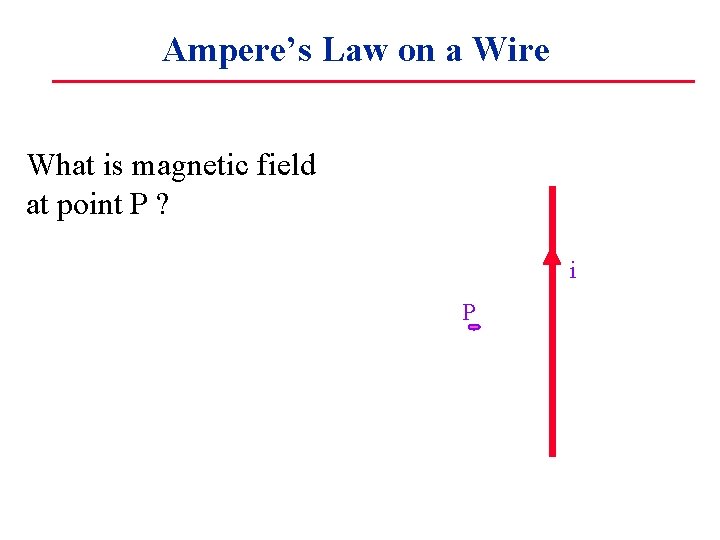
Ampere’s Law on a Wire What is magnetic field at point P ? i P
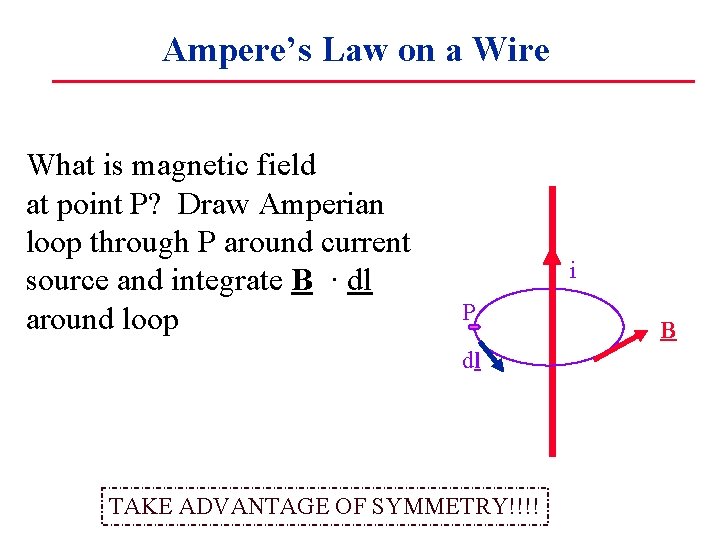
Ampere’s Law on a Wire What is magnetic field at point P? Draw Amperian loop through P around current source and integrate B · dl around loop i P dl TAKE ADVANTAGE OF SYMMETRY!!!! B
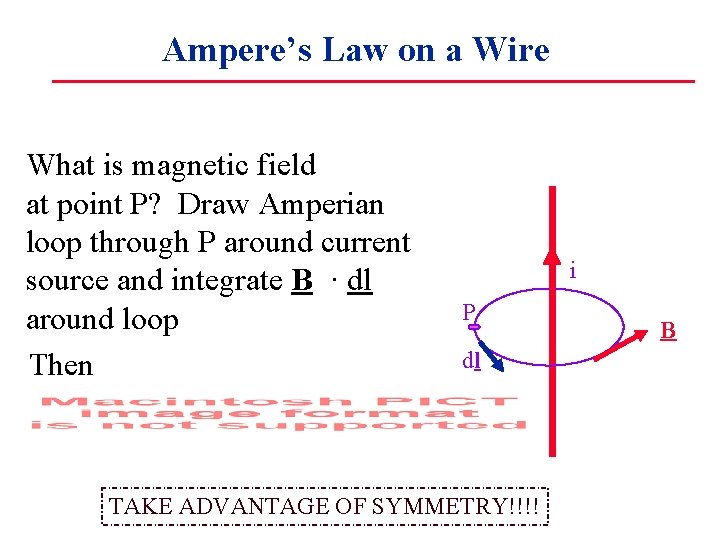
Ampere’s Law on a Wire What is magnetic field at point P? Draw Amperian loop through P around current source and integrate B · dl around loop Then i P dl TAKE ADVANTAGE OF SYMMETRY!!!! B
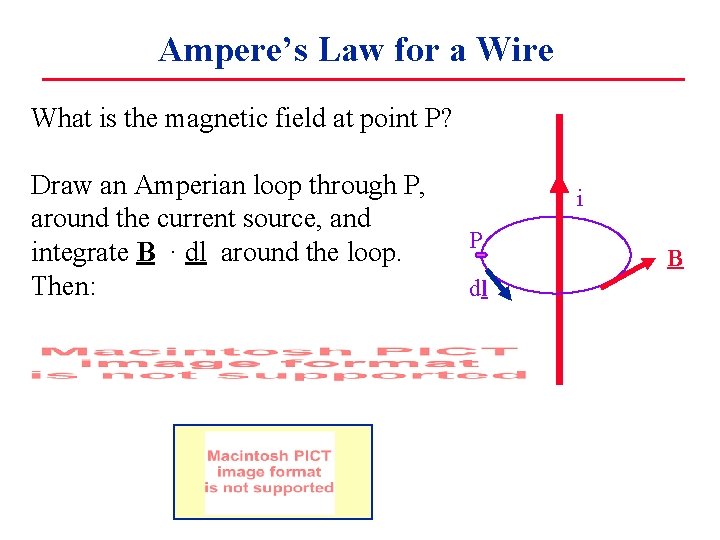
Ampere’s Law for a Wire What is the magnetic field at point P? Draw an Amperian loop through P, around the current source, and integrate B · dl around the loop. Then: i P dl B
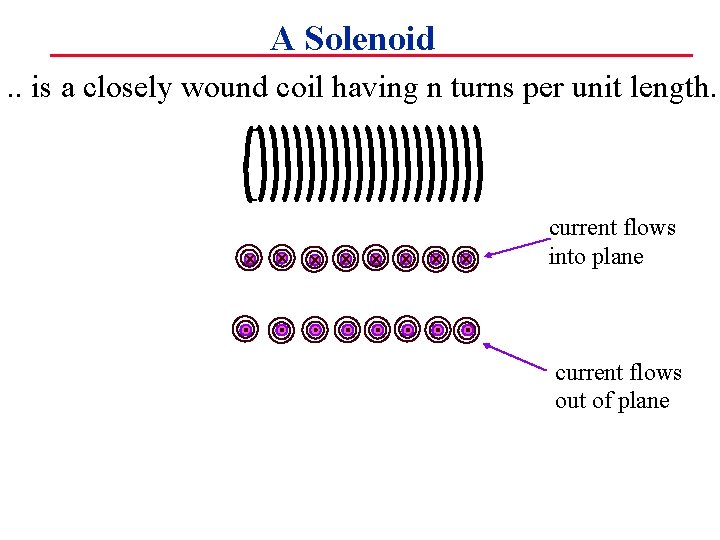
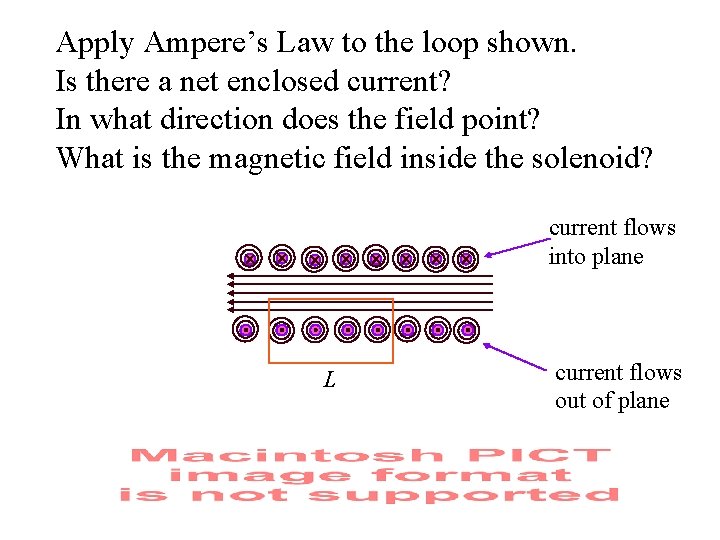
A Solenoid. . is a closely wound coil having n turns per unit length. current flows into plane current flows out of plane
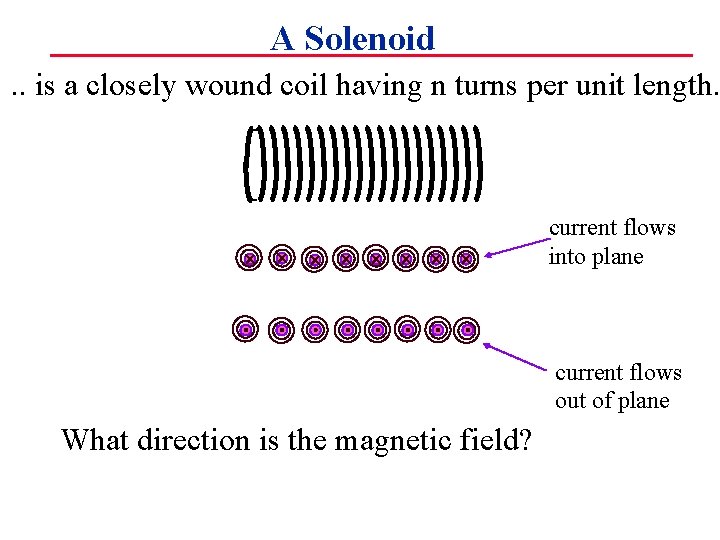
A Solenoid . . is a closely wound coil having n turns per unit length. current flows into plane current flows out of plane What direction is the magnetic field?
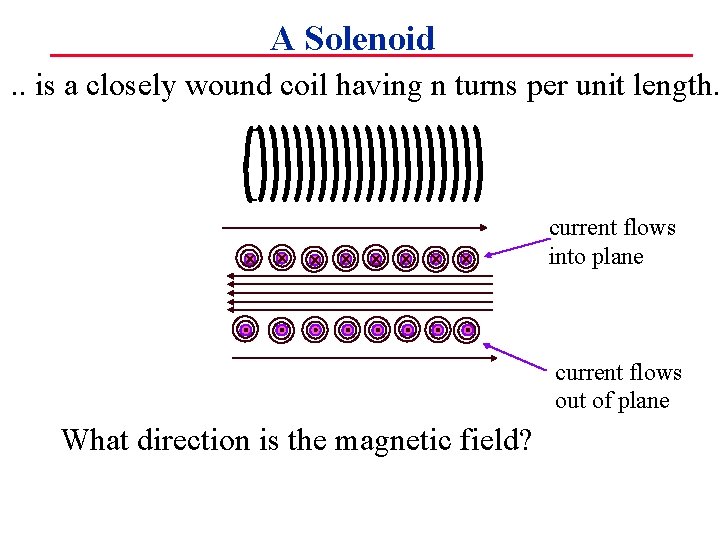
A Solenoid . . is a closely wound coil having n turns per unit length. current flows into plane current flows out of plane What direction is the magnetic field?
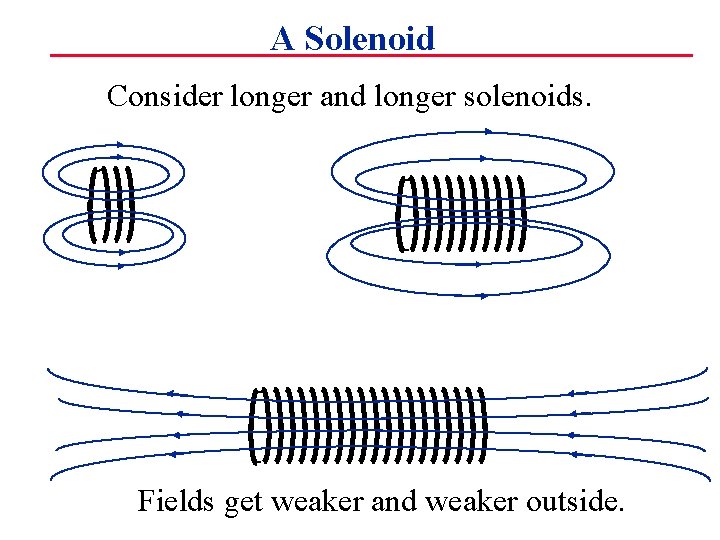
A Solenoid Consider longer and longer solenoids. Fields get weaker and weaker outside.
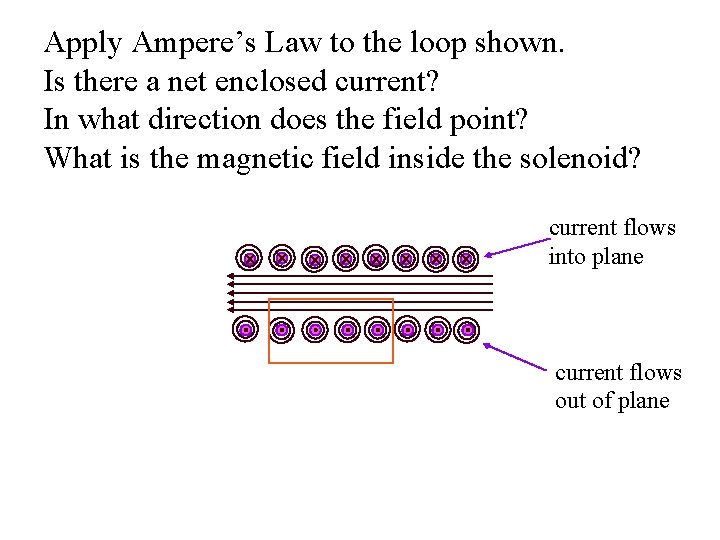
Apply Ampere’s Law to the loop shown. Is there a net enclosed current? In what direction does the field point? What is the magnetic field inside the solenoid? current flows into plane current flows out of plane
Apply Ampere’s Law to the loop shown. Is there a net enclosed current? In what direction does the field point? What is the magnetic field inside the solenoid? current flows into plane L current flows out of plane
Gauss’s Law for Magnetism For electric charges Gauss’s Law is: because there are single electric charges. On the other hand, we have never detected a single magnetic charge, only dipoles. Since there are no magnetic monopoles there is no place for magnetic field lines to begin or end. Thus, Gauss’s Law for magnetic charges must be:
Laws of Electromagnetism We have now 2. 5 of Maxwell’s 4 fundamental laws of electromagnetism. They are: Gauss’s law for electric charges Gauss’s law for magnetic charges Ampere’s law (it is still incomplete as it only applies to steady currents in its present form. Therefore, the 0. 5 of a law. )
Magnetic Materials The phenomenon of magnetism is due mainly to the orbital motion of electrons inside materials, as well as to the intrinsic magnetic moment of electrons (spin). There are three types of magnetic behavior in bulk matter: Ferromagnetism Paramagnetism Diamagnetism
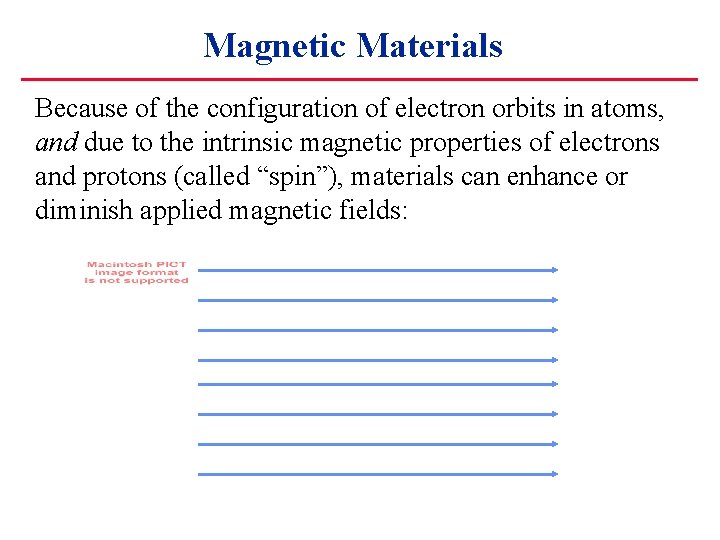
Magnetic Materials Because of the configuration of electron orbits in atoms, and due to the intrinsic magnetic properties of electrons and protons (called “spin”), materials can enhance or diminish applied magnetic fields:
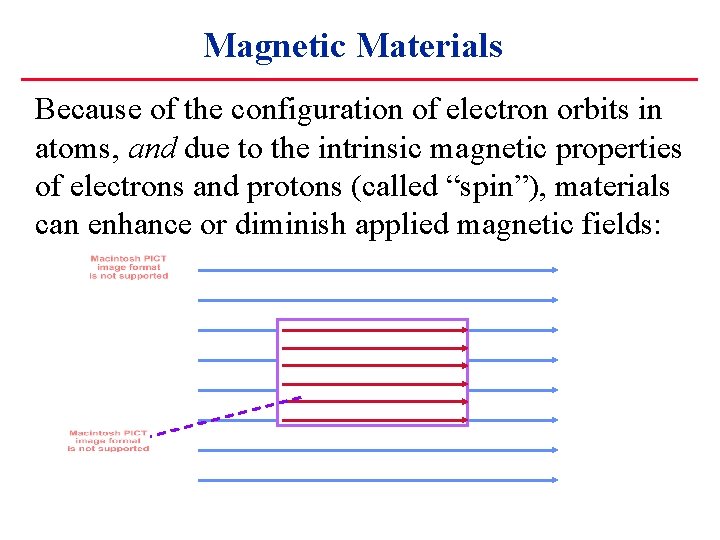
Magnetic Materials Because of the configuration of electron orbits in atoms, and due to the intrinsic magnetic properties of electrons and protons (called “spin”), materials can enhance or diminish applied magnetic fields:
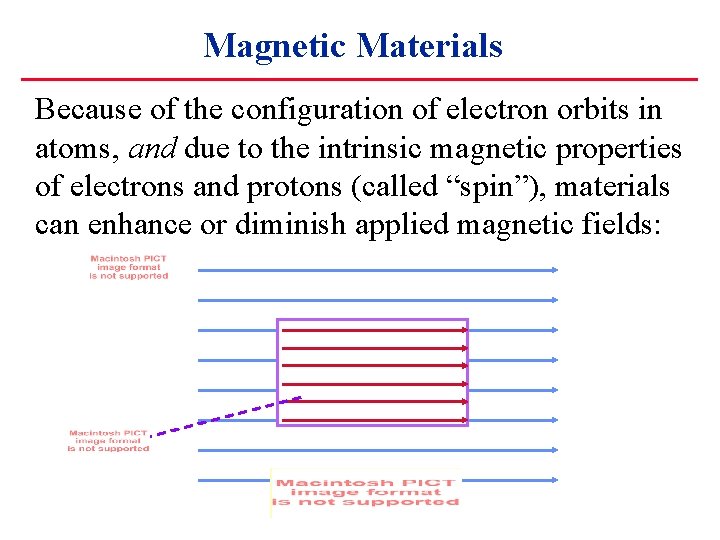
Magnetic Materials Because of the configuration of electron orbits in atoms, and due to the intrinsic magnetic properties of electrons and protons (called “spin”), materials can enhance or diminish applied magnetic fields:
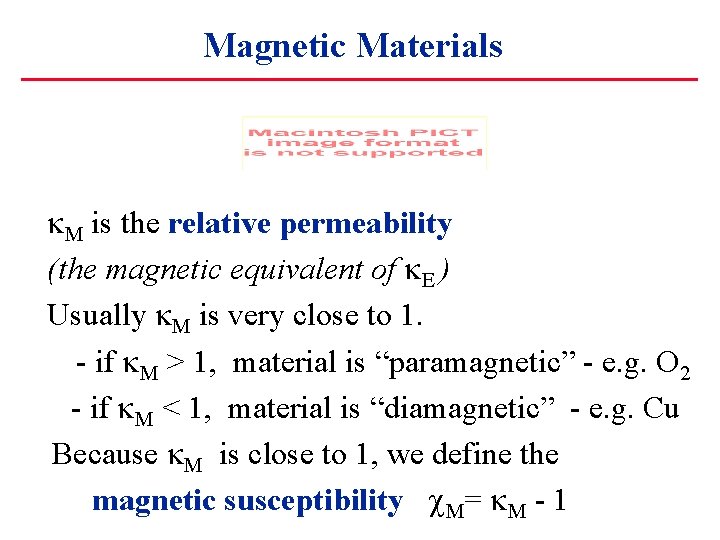
Magnetic Materials k. M is the relative permeability (the magnetic equivalent of k. E ) Usually k. M is very close to 1. - if k. M > 1, material is “paramagnetic” - e. g. O 2 - if k. M < 1, material is “diamagnetic” - e. g. Cu Because k. M is close to 1, we define the magnetic susceptibility c. M= k. M - 1
Magnetic Materials Hence: For paramagnetic materials c. M is positive - so Bint > Bapp For diamagnetic materials c. M is negative - so Bint < Bapp Typically, c. M ~ +10 -5 for paramagnetics, c. M ~ -10 -6 for diamagnetics. (For both k. M is very close to 1)
Magnetic Materials Ferromagnetic Materials: These are the stuff permanent magnets are made of. These materials can have huge susceptibilities: c. M as big as +104
Magnetic Materials Ferromagnetic Materials: These are the stuff permanent magnets are made of. These materials can have huge susceptibilities: c. M as big as +104 But ferromagnets have “memory” - when you turn off the Bapp, the internal field, Bint , remains!
Magnetic Materials Ferromagnetic Materials: These are the stuff permanent magnets are made of. These materials can have huge susceptibilities: c. M as big as +104 But ferromagnets have “memory” - when you turn off the Bapp, the internal field, Bint , remains! permanent magnets!
- Slides: 53