
Sources of international law treaties and international custom
- Slides: 25
Sources of international law – treaties and international custom Krzysztof Trnka
Sources of public international law - Sources of law – forms of creating, amending and abolishing legal norms - Material, formal and cognitive sources PIL sources: - International agreements (treaties, charters, covenants, conventions) - International custom - Resolutions of international organizations (EU, WHO)
Hierarchy of sources What is the hierarchy of laws? Lex superior derogat legi inferiori. Article 87 of the Constitution of the Polish Republic Section 1: The sources of universally binding law of the Republic of Poland shall be: the Constitution, statutes, ratified international agreements, and regulations. Section 2: Enactments of local law issued by the operation of organs shall be a source of universally binding law of the Republic of Poland in the territory of the organ issuing such enactments.
Hierarchy of sources Article 91 Section 1: After promulgation thereof in the Journal of Laws of the Republic of Poland (Dziennik Ustaw), a ratified international agreement shall constitute part of the domestic legal order and shall be applied directly, unless its application depends on the enactment of a statute. Section 2: An international agreement ratified upon prior consent granted by statute shall have precedence over statutes if such an agreement cannot be reconciled with the provisions of such statutes. Section 3: If an agreement, ratified by the Republic of Poland, establishing an international organization so provides, the laws established by it shall be applied directly and have precedence in the event of a conflict of laws.
Hierarchy of sources Is there an exhaustive, universally binding catalouge of international law sources? Article 38 of the ICJ Statute 1. The Court, whose function is to decide in accordance with international law such disputes as are submitted to it, shall apply: international conventions, whether general or particular, establishing rules expressly recognized by the contesting states; international custom, as evidence of a general practice accepted as law;
Hierarchy of sources the general principles of law recognized by civilized nations; subject to the provisions of Article 59, judicial decisions and the teachings of the most highly qualified publicists of the various nations, as subsidiary means for the determination of rules of law. 2. This provision shall not prejudice the power of the Court to decide a case ex aequo et bono, if the parties agree thereto. Ex aequo et bono – principles of fairness and equity, 1982 Tunisia/Libya continental shelf case, 1969 North Sea continental shelf case Is the above catalogue exhaustive and universally binding?
Hierarchy of sources 1951 Anglo-Iranian Oil Company case Article 3 of the 1969 Vienna Convention on the law of Treaties, 1986 Vienna Convention Is there a hierarchy to the sources of international law? All of the sources mentioned in article 38 are of equal importance. Their array is purely practical (prof. Białocerkiewicz). Article 38 – primary and secondary sources. Secondary sources can only be used to determine whether primary sources exist and how they should be intepreted. They cannot be the sole basis of an ICJ ruling.
Hierarchy of sources ICJ Statute article 59 – binding between parties and in relation to the particular case Treaty registration – article 18 of the League of Nations Covenant, article 102 of the UN Charter; UN Secretariat Article 102 Every treaty and every international agreement entered into by any Member of the United Nations after the present Charter comes into force shall as soon as possible be registered with the Secretariat and published by it. No party to any such treaty or international agreement which has not been registered in accordance with the provisions of paragraph 1 of this Article may invoke that treaty or agreement before any organ of the United Nations.
Hierarchy of sources No hierarchy between formal sources of international law. Article 53. TREATIES CONFLICTING WITH A PEREMPTORY NORM OF GENERAL INTERNATIONAL LAW ("JUS COGENS") A treaty is void if, at the time of its conclusion, it conflicts with a peremptory norm of general international law. For the purposes of the present Convention, a peremptory norm of general international law is a norm accepted and recognized by the international community of States as a whole as a norm from which no derogation is permitted and which can be modified only by a subsequent norm of general international law having the same character.
Hierarchy of sources Article 103 In the event of a conflict between the obligations of the Members of the United Nations under the present Charter and their obligations under any other international agreement, their obligations under the present Charter shall prevail. Article 2 Section 6: The Organization shall ensure that states which are not Members of the United Nations act in accordance with these Principles so far as may be necessary for the maintenance of international peace and security.
International custom as a source of law Custom in domestic law – articles 65, 354 and 394 of the Polish Civil Code In international law – the most important source until the Congress of Vienna Preamble to the 1969 Vienna convention Polish Supreme Court Case III CR 1272/57 ICJ Statute, article 38 section 1: international custom, as evidence of a general practice accepted as law
International custom as a source of law Customary norms: primary and secondary, universal and particular How does customary law comes to be? Praxis (usus) – objective element The belief, that praxis is lawful (opinio iuris sive necessitatis) – subjective element, spatial and temporal factors How long should the praxis be? Sputnik case. Who can express opinio iuris? Action and inaction – 1951 Norwegian fisheries case, expressly, implied, per facta concludentia
International custom as a source of law Most important universal customary norms: the prohibition of the use and threat of force, pacta sunt servanda, the prohibition of interfering with another state's internal affairs, privileges and immunities for heads of state
Treaties Extremely long traditions – the oldest preserved treaties date back to 3000 b. c. Capitulation treaties – equal sovereignty as a ius cogens norm Parties to an agreement: states, international organizations, protectorates, belligerents, peoples, guerillas etc. Form – written or oral, 1933 Ihlen case What is the difference between an international agreement and a treaty?
Treaties UN International Law Comission, 1969 and 1986 Vienna Conventions, article 4 – lex retro non agit, Poland 1990 Article 2. USE OF TERMS 1. For the purposes of the present Convention: (a) "Treaty" means an international agreement concluded between States in written form and governed by international law, whether embodied in a single instrument or in two or more related instruments and whatever its particular designation; Two or more states (1974 French atomic tests case) Compatible expression of will, establishing all the essentialia negotii
Treaties Written form (the Big Three agreement re the Security Council) Is a source of international law – as opposed to agreements in which states act solely in the area of dominium More than one document (complex agreements) – one agreement spread over multiple documents or a multi-part agreement (GATT) Varied names
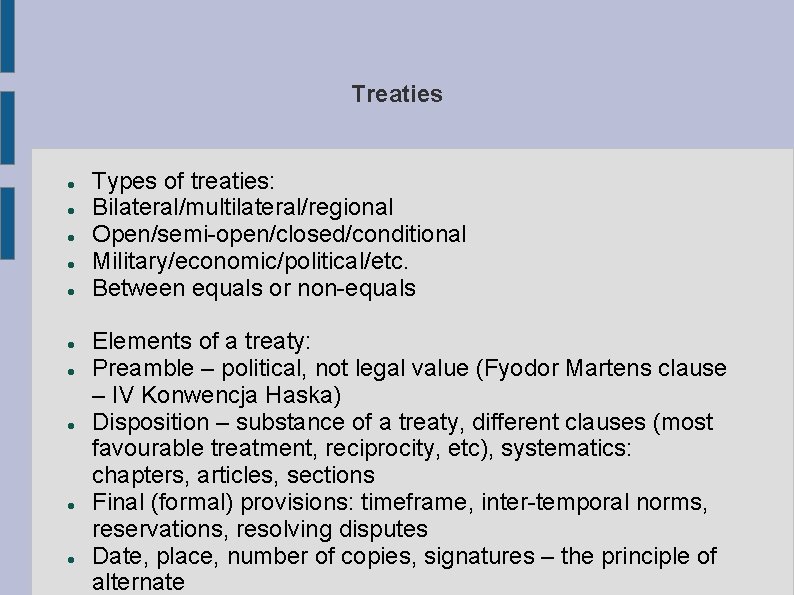
Treaties Types of treaties: Bilateral/multilateral/regional Open/semi-open/closed/conditional Military/economic/political/etc. Between equals or non-equals Elements of a treaty: Preamble – political, not legal value (Fyodor Martens clause – IV Konwencja Haska) Disposition – substance of a treaty, different clauses (most favourable treatment, reciprocity, etc), systematics: chapters, articles, sections Final (formal) provisions: timeframe, inter-temporal norms, reservations, resolving disputes Date, place, number of copies, signatures – the principle of alternate
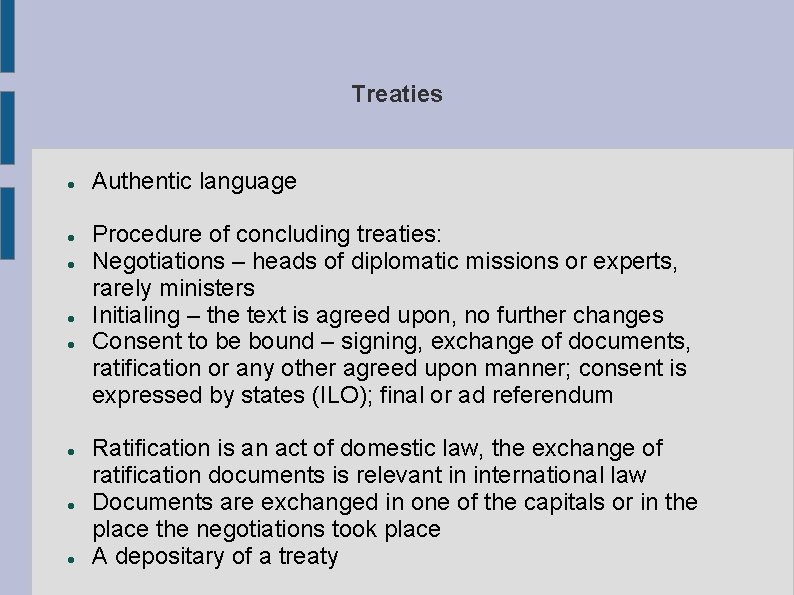
Treaties Authentic language Procedure of concluding treaties: Negotiations – heads of diplomatic missions or experts, rarely ministers Initialing – the text is agreed upon, no further changes Consent to be bound – signing, exchange of documents, ratification or any other agreed upon manner; consent is expressed by states (ILO); final or ad referendum Ratification is an act of domestic law, the exchange of ratification documents is relevant in international law Documents are exchanged in one of the capitals or in the place the negotiations took place A depositary of a treaty
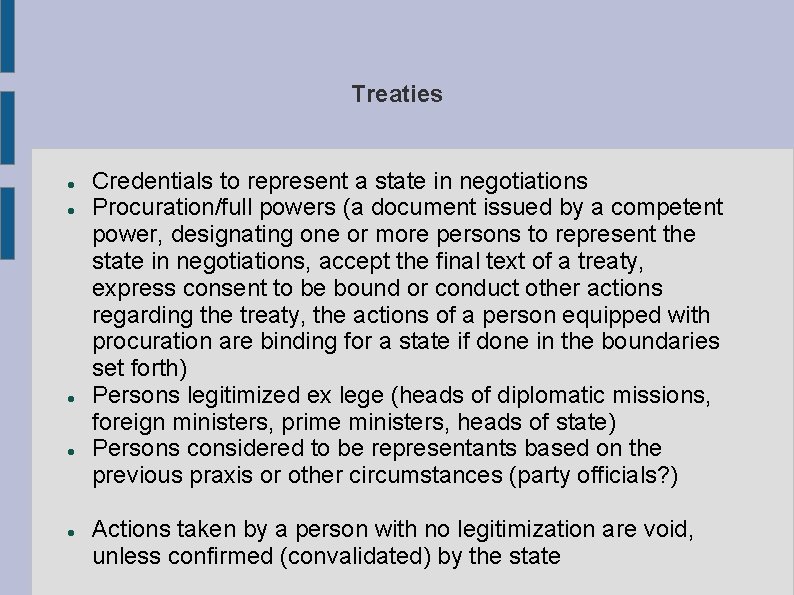
Treaties Credentials to represent a state in negotiations Procuration/full powers (a document issued by a competent power, designating one or more persons to represent the state in negotiations, accept the final text of a treaty, express consent to be bound or conduct other actions regarding the treaty, the actions of a person equipped with procuration are binding for a state if done in the boundaries set forth) Persons legitimized ex lege (heads of diplomatic missions, foreign ministers, prime ministers, heads of state) Persons considered to be representants based on the previous praxis or other circumstances (party officials? ) Actions taken by a person with no legitimization are void, unless confirmed (convalidated) by the state
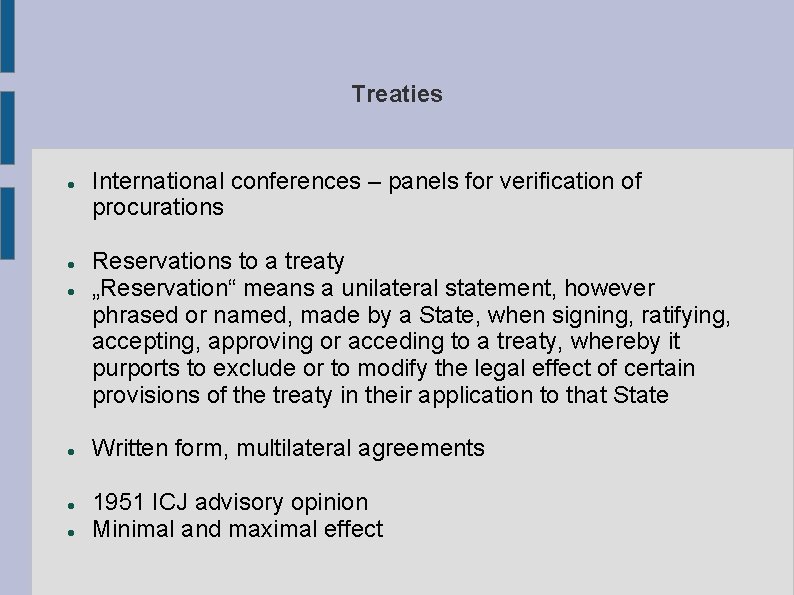
Treaties International conferences – panels for verification of procurations Reservations to a treaty „Reservation“ means a unilateral statement, however phrased or named, made by a State, when signing, ratifying, accepting, approving or acceding to a treaty, whereby it purports to exclude or to modify the legal effect of certain provisions of the treaty in their application to that State Written form, multilateral agreements 1951 ICJ advisory opinion Minimal and maximal effect
Treaties Restrictions cannot be made if they are forbidden by the treaty or if they are contrary to the goal and subject of the treaty Treaty and third parties In favorem tertii/in odium tertii Pacta tertiis nec nocent nec prosunt (article 34 of the 1969 Vienna Convention) Articles 35 and 36 – a third party may be bound if the parties to the agreement intended it and the third party accepted the duty/right
Treaties Invalidation of a treaty Relative: Violation of competence (obvious violation of domestic law in regards to representing the state) The authority of a representative have been restrained and this fact has been notified to the other parties An important error regarding facts or situation, if they were relevant to the state's decision to be bound (not if the state contributed to the error or the circumstances pointed to an error) Fraud – a deceitful act aimed at inducing a state to make a disadvantageous decision (only the part affected by fraud is invalid) Corruption (direct/indirect; financial/personal)
Treaties Absolute: Coercion Use or threat of force Collison with ius cogens Termination of a treaty (absolute and relative; by treaty, convention, war): Consent of all parties Permanent disappearance of a party Permanent disappearance of a subject Rebus sic stantibus (changed circumstances existed at the time the treaty was signed, the change couldn't have been predicted with due dilligence, rights and duties of parties radically changed)
Treaties The treaty served its purpose A condition has been met A new treaty has been formed between parties regarding the same subject War (sleeping treaties, war clauses, effect on bilateral and multilateral treaties)
Treaties Interpretation of treaties: Article 31 Good faith, ordinary meaning of the terms, context, purpose Context – preamble, annexes, previous agreements, subsequent practice and agreements, relevenat rules of law Special meaning must be granted by parties