
Sources of Instability in Data Center Multicast Dmitry
Sources of Instability in Data Center Multicast Dmitry Basin Ken Birman Idit Keidar Ymir Vigfusson 1 LADIS 2010
Multicast is Important �Replication is used in data centers and clouds: �to provision financial servers of read-mostly requests �to parallelize computation �to cache important data �for fault-tolerance �Reliable multicast is a basis for consistent replication �Transactions that update replicated data �Atomic broadcast 2 LADIS 2010
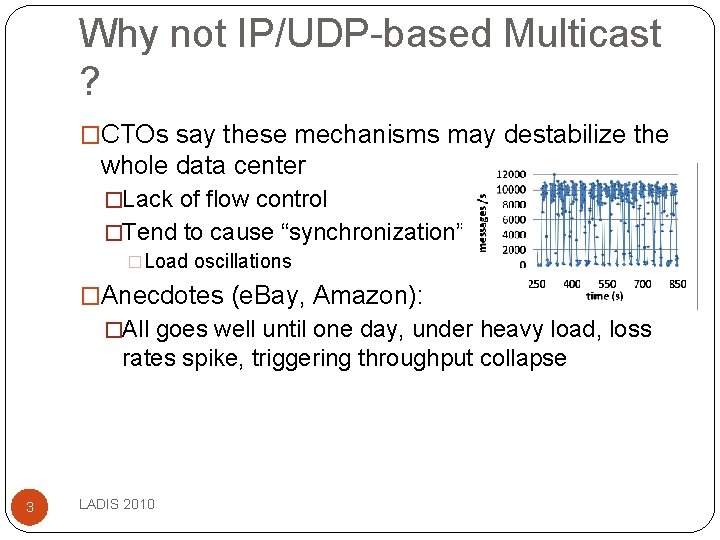
Why not IP/UDP-based Multicast ? �CTOs say these mechanisms may destabilize the whole data center �Lack of flow control �Tend to cause “synchronization” �Load oscillations �Anecdotes (e. Bay, Amazon): �All goes well until one day, under heavy load, loss rates spike, triggering throughput collapse 3 LADIS 2010
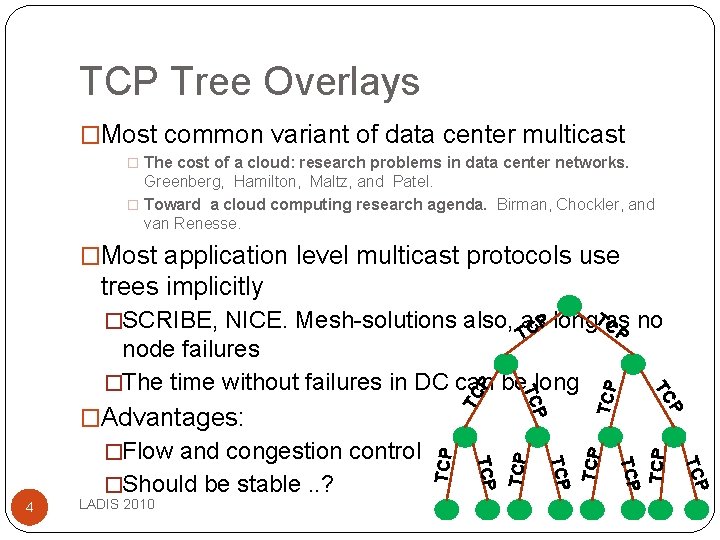
TCP Tree Overlays �Most common variant of data center multicast � The cost of a cloud: research problems in data center networks. Greenberg, Hamilton, Maltz, and Patel. � Toward a cloud computing research agenda. Birman, Chockler, and van Renesse. �Most application level multicast protocols use trees implicitly TCP TCP P TC LADIS 2010 TCP 4 TCP �Should be stable. . ? TCP �Flow and congestion control P �Advantages: TC node failures �The time without failures in DC can be long TCP �SCRIBE, NICE. Mesh-solutions also, as P long. TCas C P no T
Suppose We Had a Perfect Tree �Suppose we had a perfect multicast tree: �High throughput - low latency links �Very rare node failures Would it work fine? Would the multicast have high throughput? �Theory / simulations papers say: YES! � [Baccelli, Chaintreau, Liu, Riabov. 2005] �Data center operators say: NO! �Observed throughput collapse and oscillations when the system became large 5 LADIS 2010
Our Goal: Explain the GAP �Our hypothesis: instability stems from disturbances �Very rare, short events �OS scheduling, network congestion, Java GC stalls, … �Never modeled or simulated before �Become significant when system grows What if there were one pea per mattress? 6 LADIS 2010
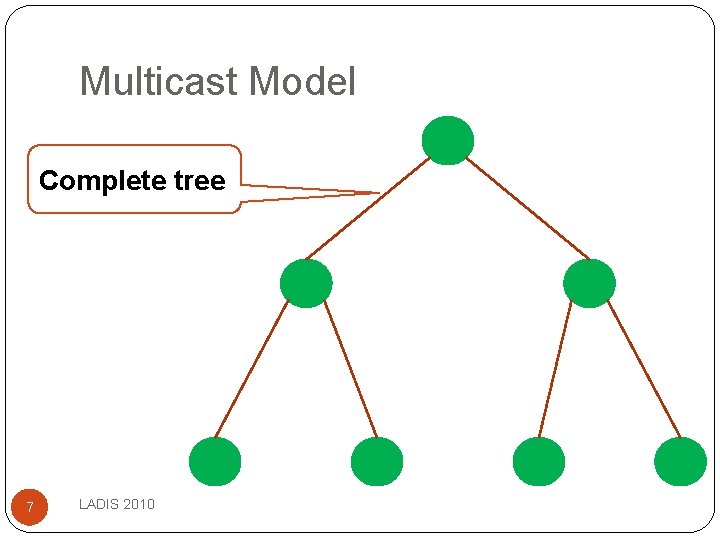
Multicast Model Complete tree 7 LADIS 2010

Multicast Model Reliable links with congestion and flow control (e. g. TCP links) 8 LADIS 2010
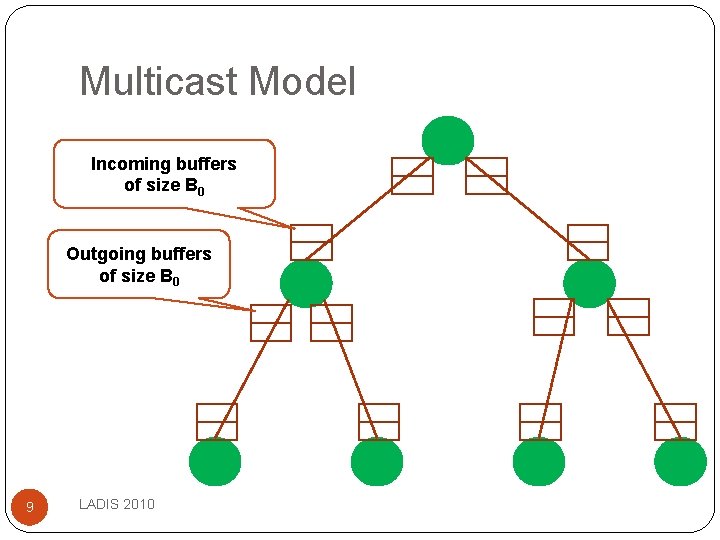
Multicast Model Incoming buffers of size B 0 Outgoing buffers of size B 0 9 LADIS 2010
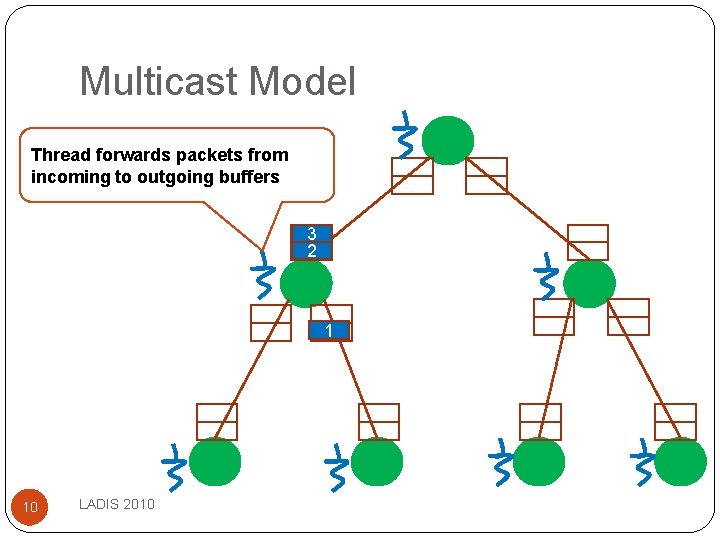
Multicast Model Thread forwards packets from incoming to outgoing buffers 3 2 1 10 LADIS 2010

Multicast Model Root forwards packets from application to outgoing buffers 11 LADIS 2010 Application 2 1
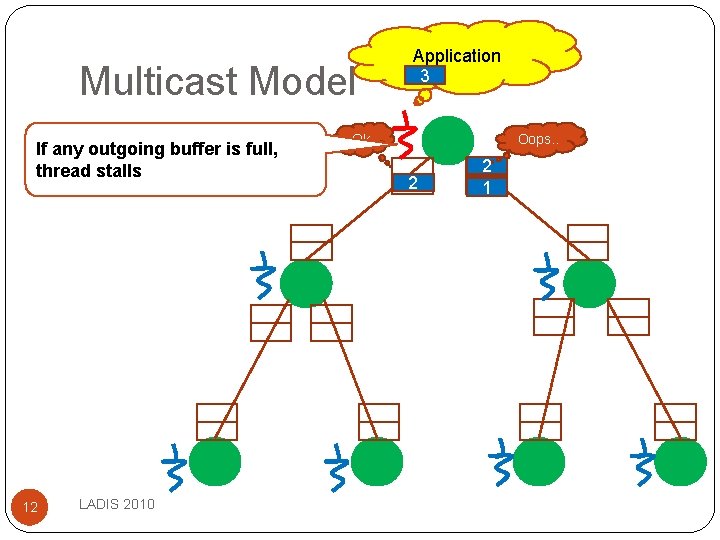
Multicast Model If any outgoing buffer is full, thread stalls 12 LADIS 2010 Application 3 Ok Oops. . 2 2 1
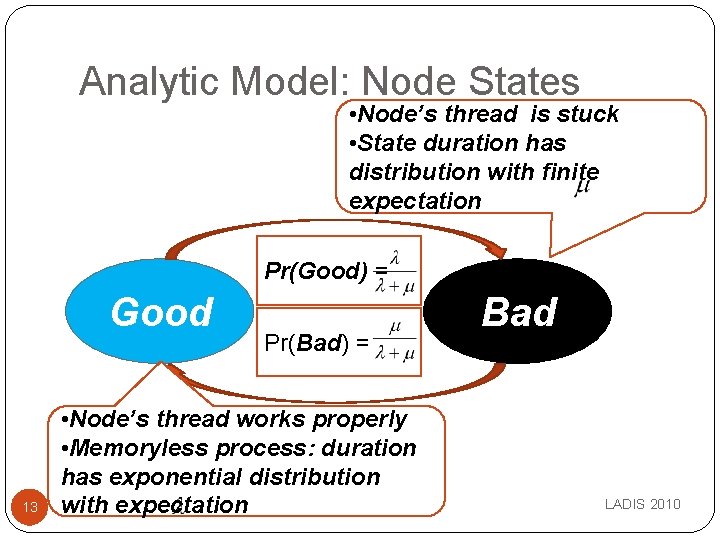
Analytic Model: Node States • Node’s thread is stuck • State duration has distribution with finite expectation Pr(Good) = Good 13 Pr(Bad) = • Node’s thread works properly • Memoryless process: duration has exponential distribution with expectation Bad LADIS 2010
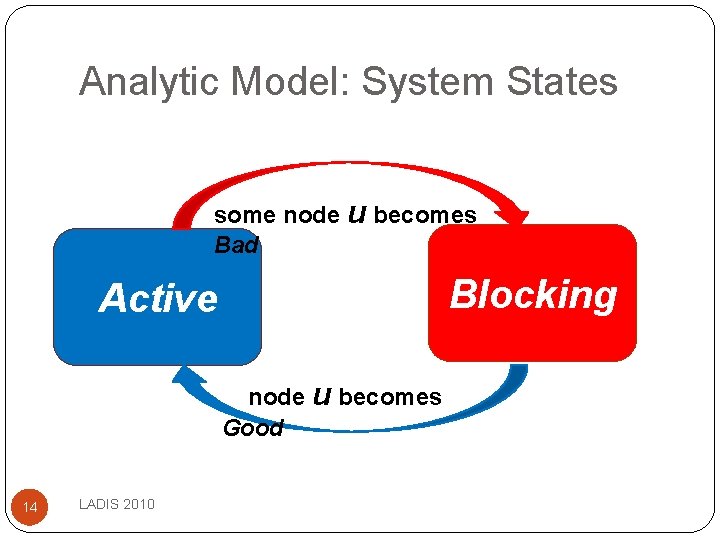
Analytic Model: System States some node u becomes Bad Blocking Active node u becomes Good 14 LADIS 2010
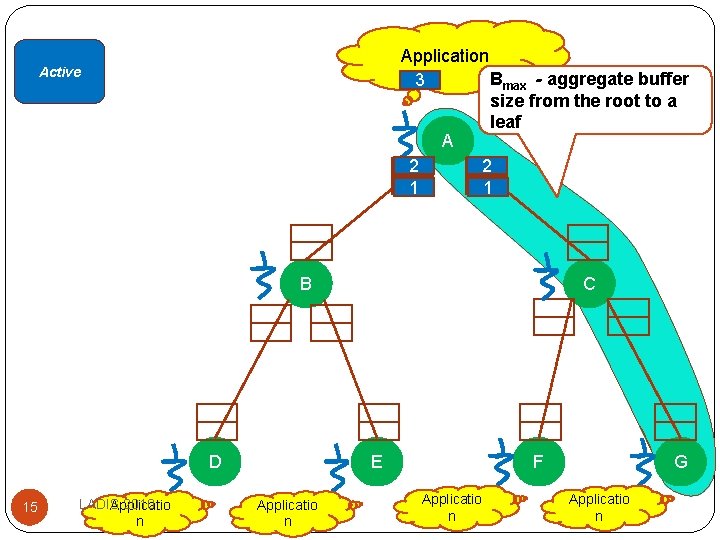
Application Bmax - aggregate buffer 3 size from the root to a leaf A 2 2 1 1 Active B D 15 LADIS 2010 Applicatio n C E Applicatio n F Applicatio n G Applicatio n
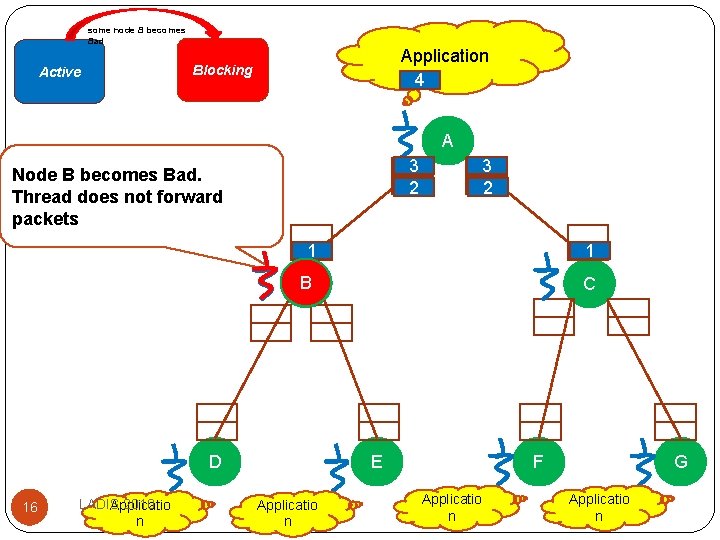
some node B becomes Bad Active Application 4 Blocking A 3 2 Node B becomes Bad. Thread does not forward packets 1 1 B C D 16 LADIS 2010 Applicatio n 3 2 E Applicatio n F Applicatio n G Applicatio n
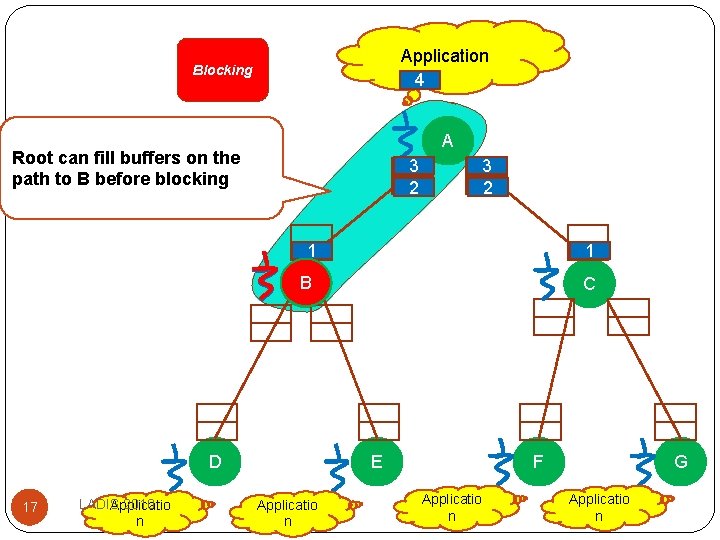
Application 4 Blocking A Root can fill buffers on the path to B before blocking 3 2 1 1 B C D 17 LADIS 2010 Applicatio n 3 2 E Applicatio n F Applicatio n G Applicatio n
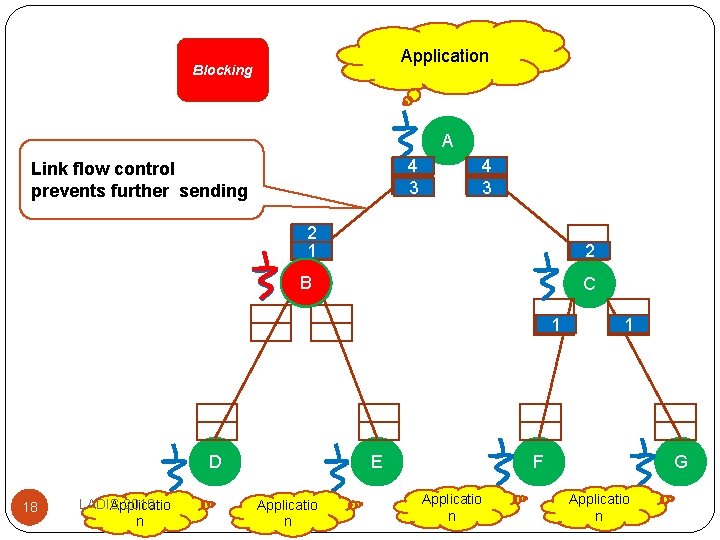
Application Blocking A 4 3 Link flow control prevents further sending 4 3 2 1 2 B C 1 D 18 LADIS 2010 Applicatio n E Applicatio n 1 F Applicatio n G Applicatio n
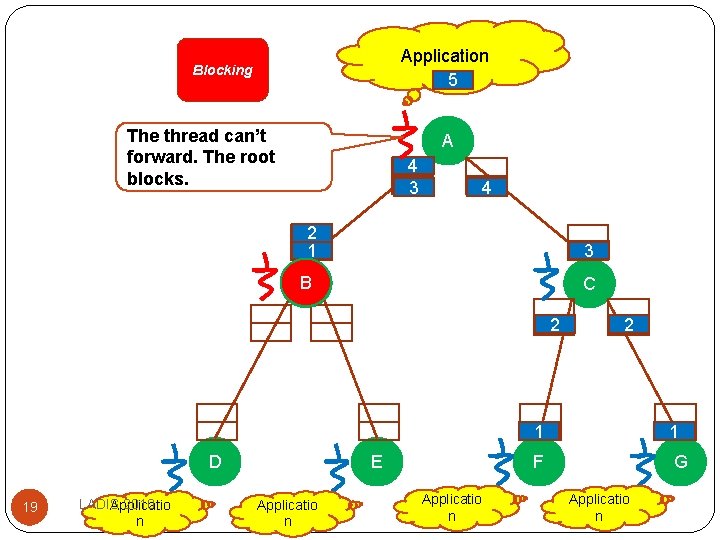
Application 5 Blocking The thread can’t forward. The root blocks. A 4 3 4 2 1 3 B C 2 D 19 LADIS 2010 Applicatio n E Applicatio n 2 1 1 F G Applicatio n
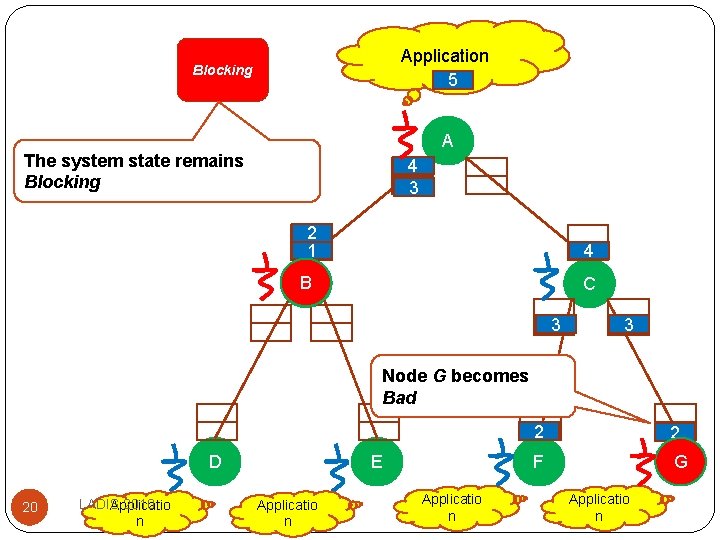
Application 5 Blocking A The system state remains Blocking 4 3 2 1 4 B C 3 3 Node G becomes Bad D 20 LADIS 2010 Applicatio n E Applicatio n 2 2 F G Applicatio n
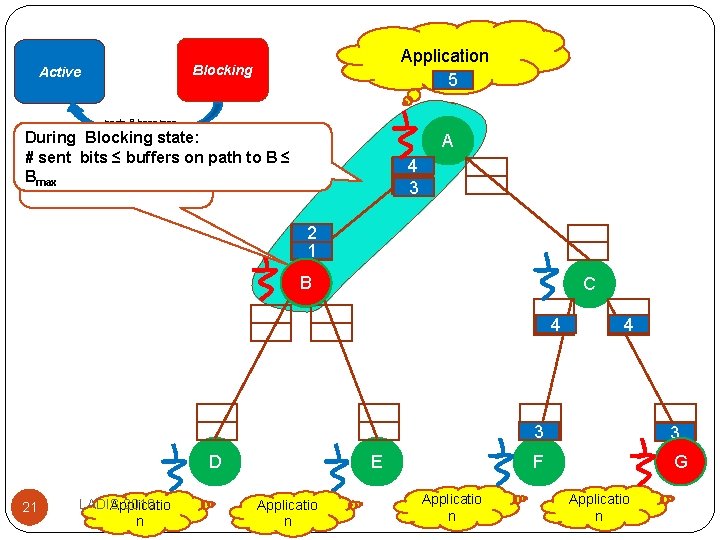
Application 5 Blocking Active node B becomes During Blocking state: #Node sent bits ≤ buffers on path to B ≤ B becomes Bmax Good A 4 3 Good 2 1 B C 4 D 21 LADIS 2010 Applicatio n E Applicatio n 4 3 3 F G Applicatio n
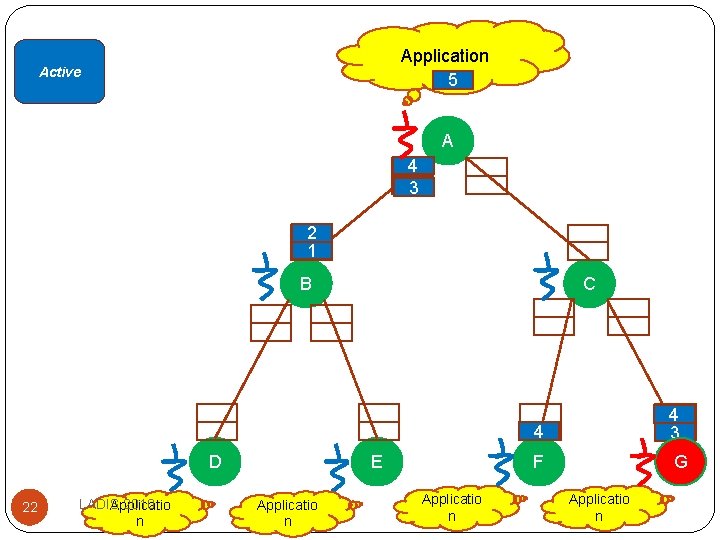
Application 5 Active A 4 3 2 1 B D 22 LADIS 2010 Applicatio n C E Applicatio n 4 4 3 F G Applicatio n
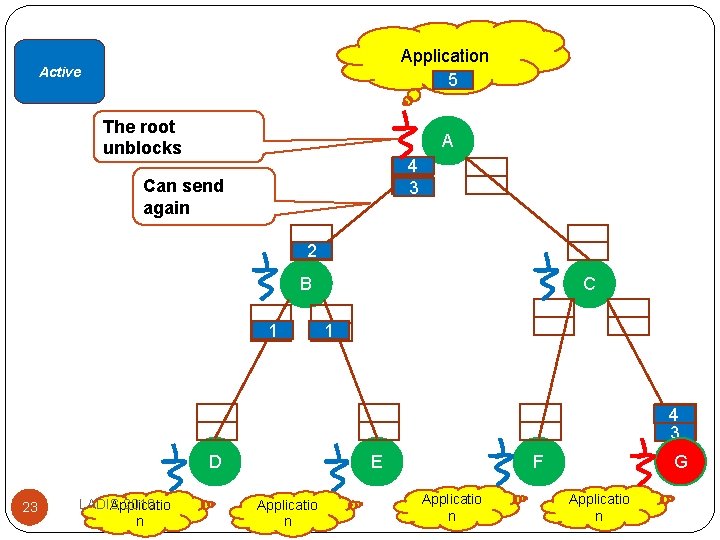
Application 5 Active The root unblocks A 4 3 Can send again 2 B 1 C 1 4 3 D 23 LADIS 2010 Applicatio n E Applicatio n G F Applicatio n
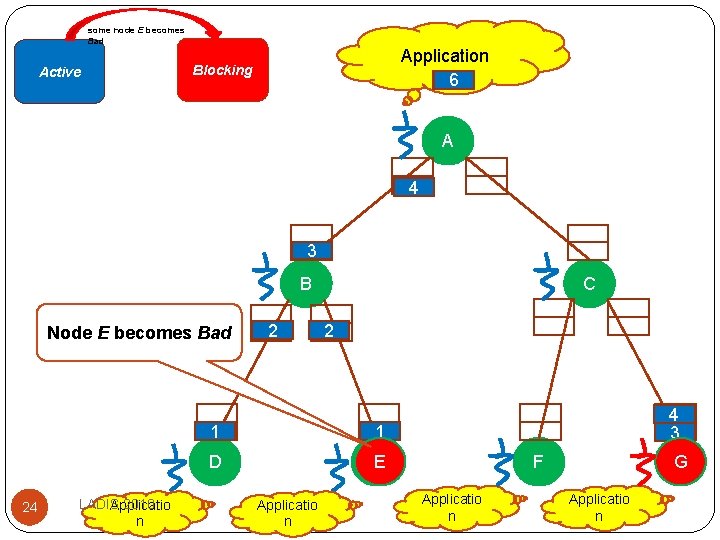
some node E becomes Bad Active Application 6 5 Blocking A 4 3 B Node E becomes Bad 24 LADIS 2010 Applicatio n 2 C 2 1 1 D EE Applicatio n 4 3 G F Applicatio n
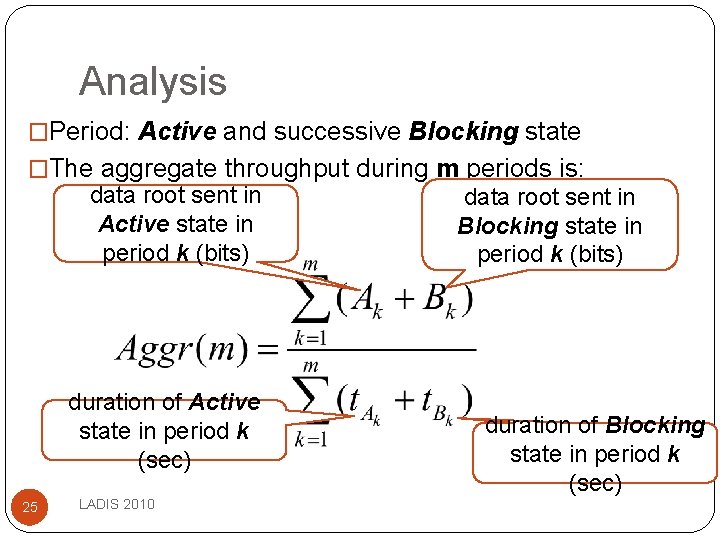
Analysis �Period: Active and successive Blocking state �The aggregate throughput during m periods is: data root sent in Active state in period k (bits) duration of Active state in period k (sec) 25 LADIS 2010 data root sent in Blocking state in period k (bits) duration of Blocking state in period k (sec)
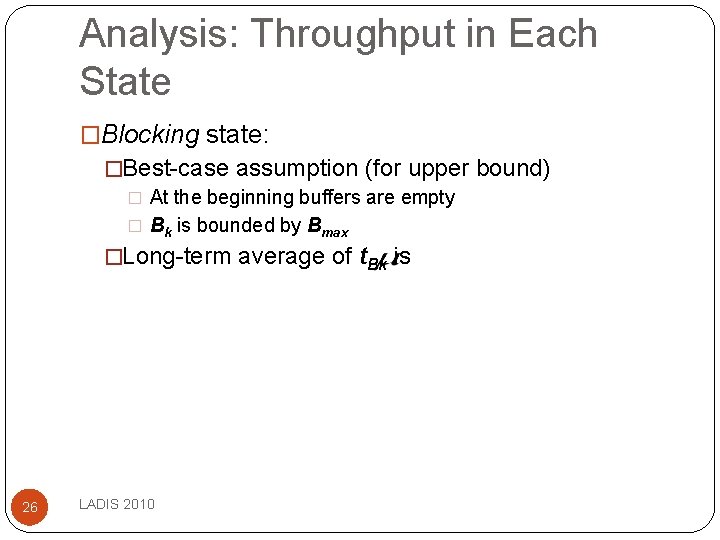
Analysis: Throughput in Each State �Blocking state: �Best-case assumption (for upper bound) � At the beginning buffers are empty � Bk is bounded by Bmax �Long-term average of t. Bk is 26 LADIS 2010
Analysis: Throughput in Each State �Active state: �Best-case assumption (for upper bound) �Root always sends at maximal throughput �Flow control is perfect – no slow start �State duration (t. Ak) analysis is complex (see paper) 27 LADIS 2010
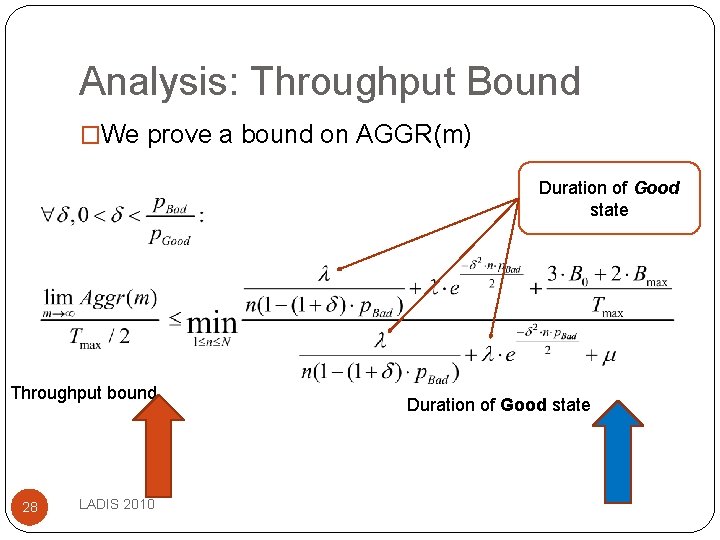
Analysis: Throughput Bound �We prove a bound on AGGR(m) Duration of Good state Throughput bound 28 LADIS 2010 Duration of Good state
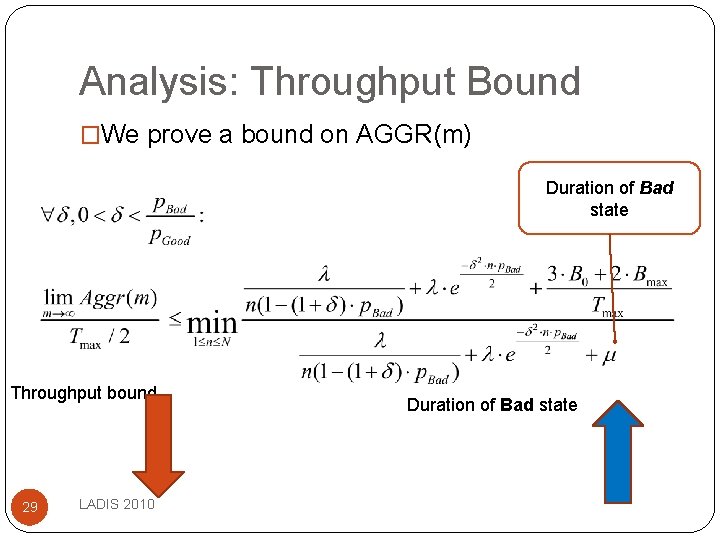
Analysis: Throughput Bound �We prove a bound on AGGR(m) Duration of Bad state Throughput bound 29 LADIS 2010 Duration of Bad state
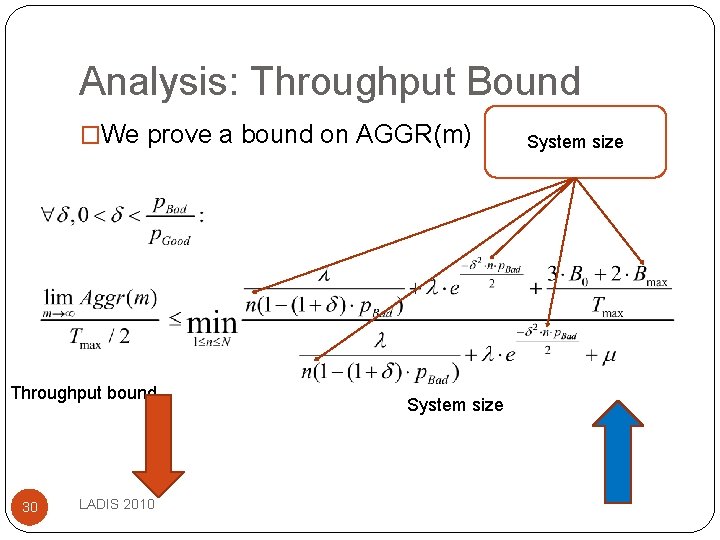
Analysis: Throughput Bound �We prove a bound on AGGR(m) Throughput bound 30 LADIS 2010 System size
Simulations �Remove the assumption of empty buffers �Use real buffers �At nodes close to the root, measured to be full half the time �Still assume perfect flow control �No slow start �Hence still upper bound on real network �Our simulations �Big trees (10, 000 s of nodes) �Small trees (10 s of nodes) 31 LADIS 2010
Use Case 1: Big Trees �Tree spanning an entire data center � 10, 000 s of nodes �Used for control 32 LADIS 2010
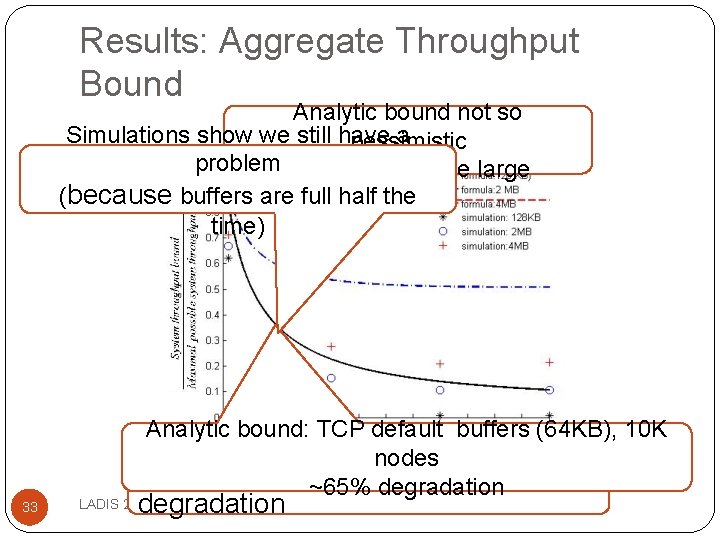
Results: Aggregate Throughput Bound Analytic bound not so Simulations show we still have a pessimistic Disturbances every hour for 1 sec problem when buffers are large (because buffers are full half the time) 33 Analytic bound: TCP default buffers (64 KB), 10 K nodes Simulations much worse: ~90% ~65% degradation LADIS 2010
Use Case 2: Small Trees 34 LADIS 2010
Average Node in DC �Has many different applications using network: � 50% of the time - more than 10 concurrent flows � 5% of the time - more than 80 concurrent flows �[Greenberg, Hamilton, Jain, Kandula, Kim, Lahiri, Maltz, Patel, Sengupta, 2009] �Can’t use too big buffers �Switch port might congest 35 LADIS 2010
TCP Time-Outs as Disturbances �Temporary switch congestion cause a loss burst on a TCP link �The following TCP link time-out can be modeled as a disturbance �Default TCP implementations �Min. time-out 200 ms �Network RTT can be ~200 us �The source of well-known Incast problem �[Nagle, Serenyi, Matthews 2004] 36 LADIS 2010
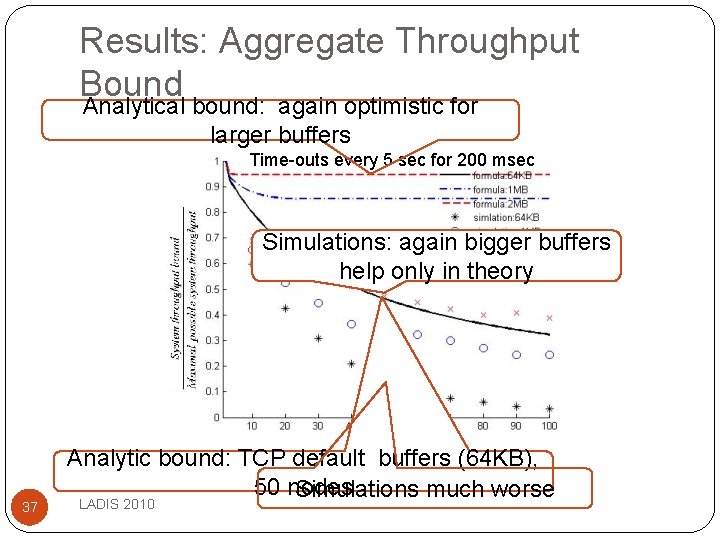
Results: Aggregate Throughput Bound Analytical bound: again optimistic for larger buffers Time-outs every 5 sec for 200 msec Simulations: again bigger buffers help only in theory 37 Analytic bound: TCP default buffers (64 KB), 50 nodes Simulations much worse LADIS 2010
Conclusions � We explain why supposedly perfect tree-based multicast inevitably collapses in data centers: �Rare and short disruption events (disturbances) can cause throughput collapse when system grows �Frequent disturbances can cause throughput collapse even for small system sizes �Reality is even worse than our analytic bound: �Disturbances cause buffers to fill up �The main reason of the gap between simulation and analysis 38 LADIS 2010
Thank you. 39 PODC 2010
- Slides: 39