
Sources of income and the relationship between income

Sources of income and the relationship between income and career preparation.
Review Statements 1. Education & skills, economy conditions, supply and demand, plus the value of the work to society are factors that influence potential income. 2. Opportunity Cost is the cost of something in terms of an opportunity forgone (and the benefits that could be received from that opportunity), or the most valuable forgone alternative, i. e. the second best alternative. Or the cost of a missed opportunity.

Sources of Income? ? Source of Income
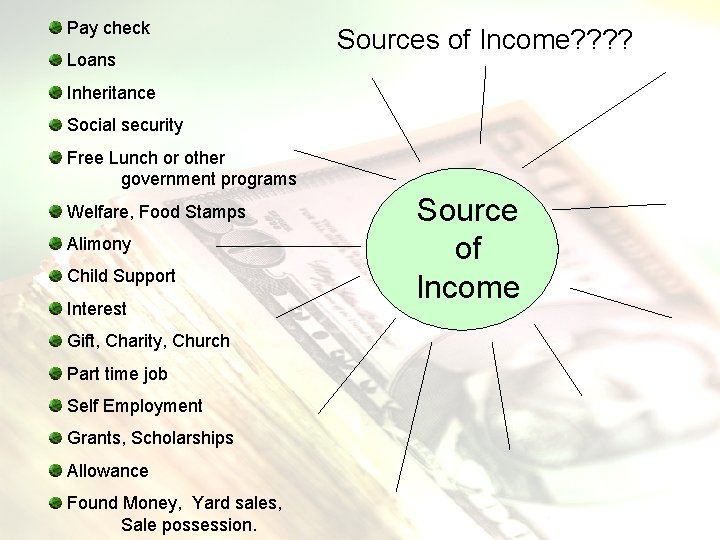
Pay check Loans Sources of Income? ? Inheritance Social security Free Lunch or other government programs Welfare, Food Stamps Alimony Child Support Interest Gift, Charity, Church Part time job Self Employment Grants, Scholarships Allowance Found Money, Yard sales, Sale possession. Source of Income
Factors that Influence Income Earning Power: A persons ability to earn money. Analyze factors that affect income. 1. Income vs. Education o Lack of education limits your career choice and earning power
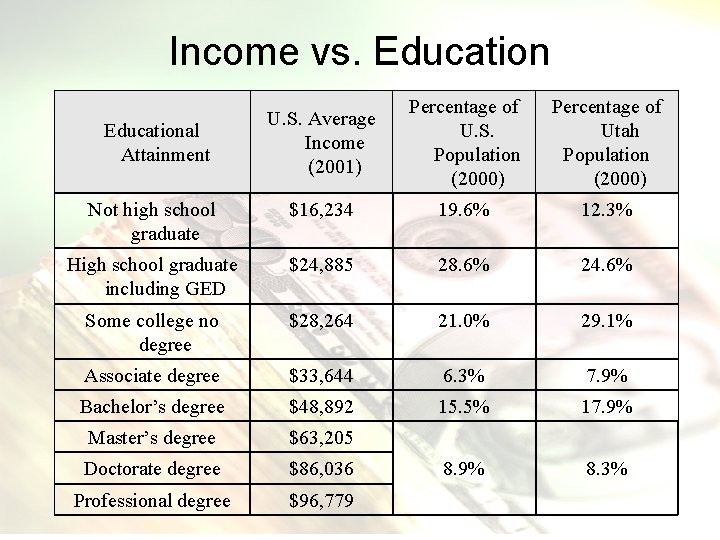
Income vs. Education U. S. Average Income (2001) Percentage of U. S. Population (2000) Percentage of Utah Population (2000) Not high school graduate $16, 234 19. 6% 12. 3% High school graduate including GED $24, 885 28. 6% 24. 6% Some college no degree $28, 264 21. 0% 29. 1% Associate degree $33, 644 6. 3% 7. 9% Bachelor’s degree $48, 892 15. 5% 17. 9% Master’s degree $63, 205 Doctorate degree $86, 036 8. 9% 8. 3% Professional degree $96, 779 Educational Attainment
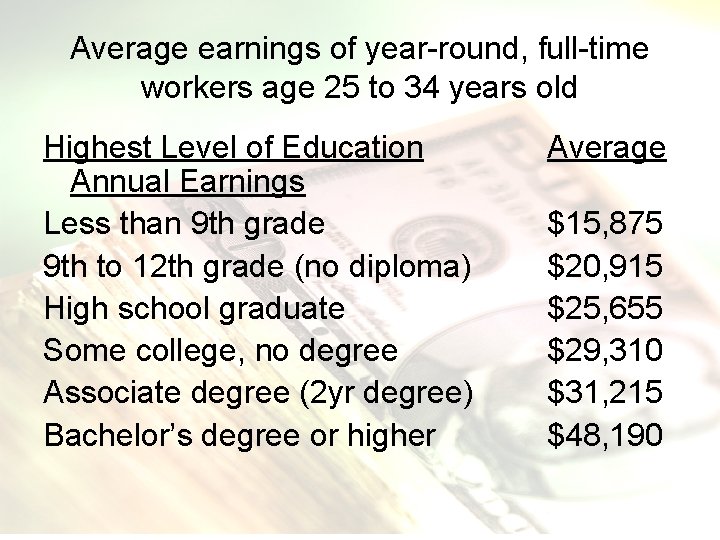
Average earnings of year-round, full-time workers age 25 to 34 years old Highest Level of Education Annual Earnings Less than 9 th grade 9 th to 12 th grade (no diploma) High school graduate Some college, no degree Associate degree (2 yr degree) Bachelor’s degree or higher Average $15, 875 $20, 915 $25, 655 $29, 310 $31, 215 $48, 190
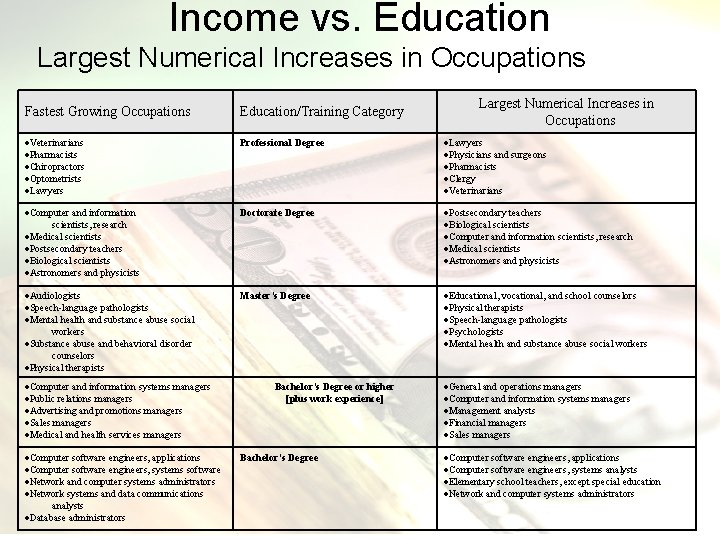
Income vs. Education Largest Numerical Increases in Occupations Fastest Growing Occupations Education/Training Category Veterinarians Pharmacists Chiropractors Optometrists Lawyers Professional Degree Lawyers Physicians and surgeons Pharmacists Clergy Veterinarians Computer and information scientists, research Medical scientists Postsecondary teachers Biological scientists Astronomers and physicists Doctorate Degree Postsecondary teachers Biological scientists Computer and information scientists, research Medical scientists Astronomers and physicists Audiologists Speech-language pathologists Mental health and substance abuse social workers Substance abuse and behavioral disorder counselors Physical therapists Master’s Degree Educational, vocational, and school counselors Physical therapists Speech-language pathologists Psychologists Mental health and substance abuse social workers Computer and information systems managers Public relations managers Advertising and promotions managers Sales managers Medical and health services managers Computer software engineers, applications Computer software engineers, systems software Network and computer systems administrators Network systems and data communications analysts Database administrators Bachelor’s Degree or higher [plus work experience] Bachelor’s Degree General and operations managers Computer and information systems managers Management analysts Financial managers Sales managers Computer software engineers, applications Computer software engineers, systems analysts Elementary school teachers, except special education Network and computer systems administrators
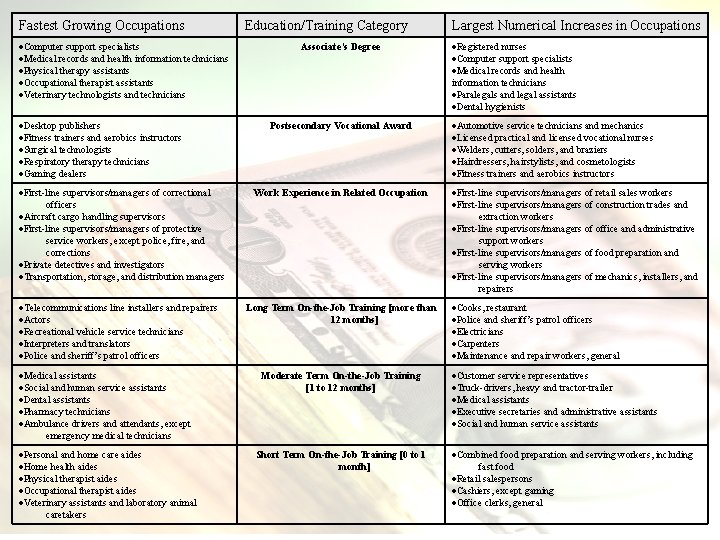
Fastest Growing Occupations Computer support specialists Medical records and health information technicians Physical therapy assistants Occupational therapist assistants Veterinary technologists and technicians Desktop publishers Fitness trainers and aerobics instructors Surgical technologists Respiratory therapy technicians Gaming dealers First-line supervisors/managers of correctional officers Aircraft cargo handling supervisors First-line supervisors/managers of protective service workers, except police, fire, and corrections Private detectives and investigators Transportation, storage, and distribution managers Telecommunications line installers and repairers Actors Recreational vehicle service technicians Interpreters and translators Police and sheriff’s patrol officers Education/Training Category Associate’s Degree Postsecondary Vocational Award Work Experience in Related Occupation Long Term On-the-Job Training [more than 12 months] Medical assistants Social and human service assistants Dental assistants Pharmacy technicians Ambulance drivers and attendants, except emergency medical technicians Moderate Term On-the-Job Training [1 to 12 months] Personal and home care aides Home health aides Physical therapist aides Occupational therapist aides Veterinary assistants and laboratory animal caretakers Short Term On-the-Job Training [0 to 1 month] Largest Numerical Increases in Occupations Registered nurses Computer support specialists Medical records and health information technicians Paralegals and legal assistants Dental hygienists Automotive service technicians and mechanics Licensed practical and licensed vocational nurses Welders, cutters, solders, and braziers Hairdressers, hairstylists, and cosmetologists Fitness trainers and aerobics instructors First-line supervisors/managers of retail sales workers First-line supervisors/managers of construction trades and extraction workers First-line supervisors/managers of office and administrative support workers First-line supervisors/managers of food preparation and serving workers First-line supervisors/managers of mechanics, installers, and repairers Cooks, restaurant Police and sheriff’s patrol officers Electricians Carpenters Maintenance and repair workers, general Customer service representatives Truck-drivers, heavy and tractor-trailer Medical assistants Executive secretaries and administrative assistants Social and human service assistants Combined food preparation and serving workers, including fast food Retail salespersons Cashiers, except gaming Office clerks, general
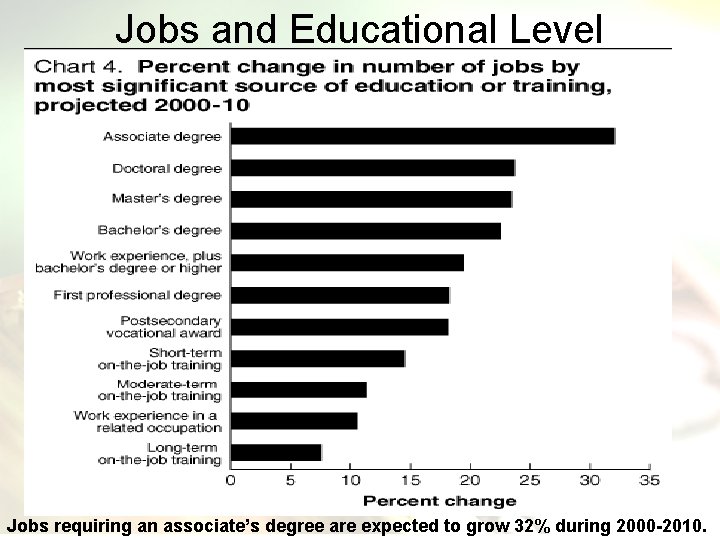
Jobs and Educational Level Jobs requiring an associate’s degree are expected to grow 32% during 2000 -2010.
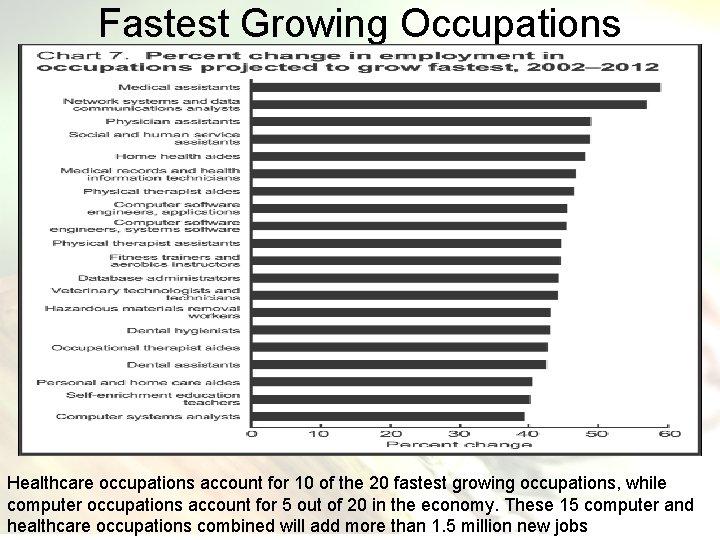
Fastest Growing Occupations Healthcare occupations account for 10 of the 20 fastest growing occupations, while computer occupations account for 5 out of 20 in the economy. These 15 computer and healthcare occupations combined will add more than 1. 5 million new jobs
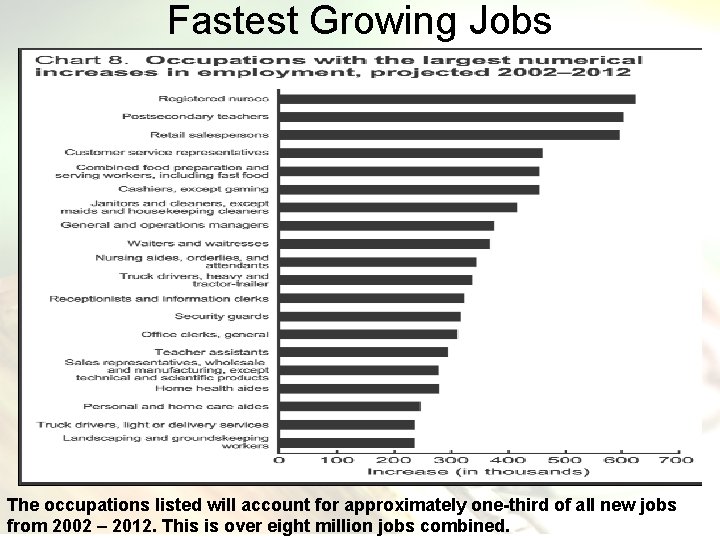
Fastest Growing Jobs The occupations listed will account for approximately one-third of all new jobs from 2002 – 2012. This is over eight million jobs combined.
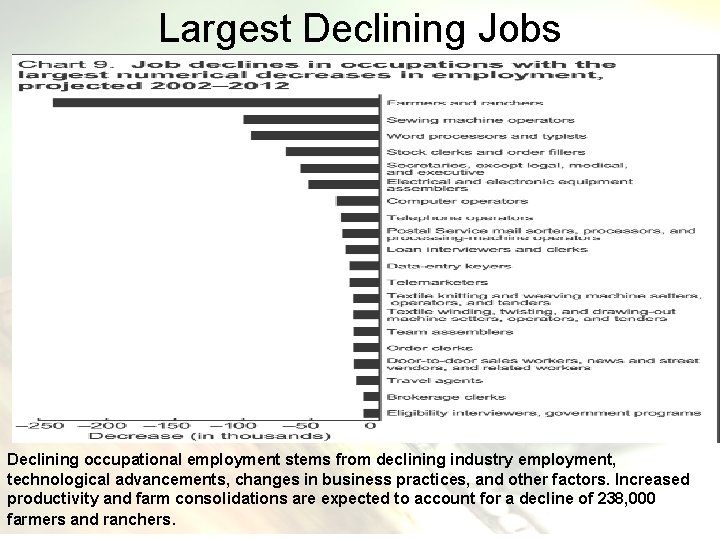
Largest Declining Jobs Declining occupational employment stems from declining industry employment, technological advancements, changes in business practices, and other factors. Increased productivity and farm consolidations are expected to account for a decline of 238, 000 farmers and ranchers.
Factors that Influence Income Earning Power: A persons ability to earn money. 1. 2. • • Income vs. Education Workers Skills competent work, produce a good product, ability to operate equipment, implement knowledge and abilities
Factors that Influence Income Earning Power: A persons ability to earn money. 1. Income vs. Education 2. Workers Skills 3. Conditions of the economy, • War, • terror, • unemployment, • scarcity, • acts of God
Factors that Influence Income Earning Power: A persons ability to earn money. 1. Income vs. Education 2. Workers Skills 3. Conditions of the economy 4. Supply and Demand • • Scarcity and Abundance World Trade
Factors that Influence Income Earning Power: A persons ability to earn money. 1. 2. 3. 4. Income vs. Education Workers Skills Conditions of the economy Supply and Demand 5. Value of the work to society: How important is your profession or skill. • If you were to be on a deserted island for 15 years, what occupations would you like the four people with you, to have?

Review Career Plan • What are the educational requirements? Ø Traits for the work place Worksheet. (Color in your skill level) • Income Potential • What skills will I need? – What will the cost and benefits of developing new skills be? • Time, energy, and money

How Do You Find The Career Of Your Dreams? • Study what interests you, and learn how that applies to life/careers. • Look at different jobs options, and figure out which job best fits you (intellectually, physically, and financially) • Once you figure out a career path you want to take, be aggressive in following it. Don’t let opportunity pass you by.

Opportunity Cost • How does this relate to Opportunity Cost? – Making the effort right now for a good career and education will cost you time, energy, and money, but in the long run it will pay off and you will have more time and money. Hopefully that will give you energy to enjoy it. • Choosing one option may mean giving up altogether another goal. • It’s a trade off! • Remember: Invest in Yourself, it is Well Worth the Effort!!!
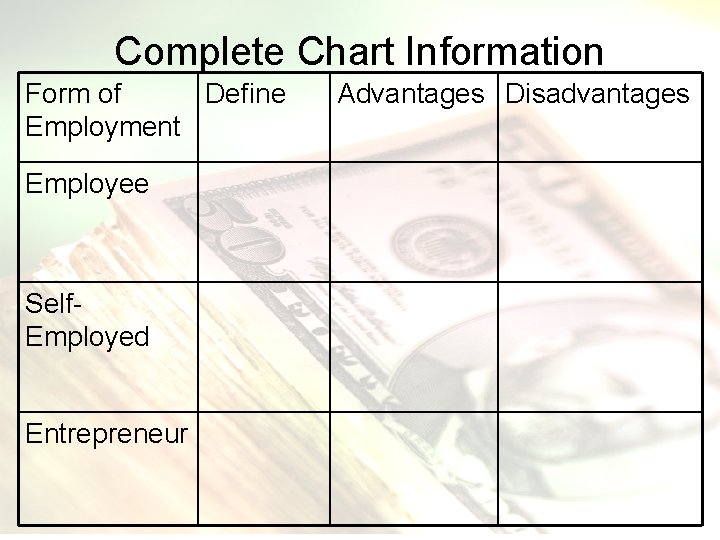
Complete Chart Information Form of Define Employment Employee Self. Employed Entrepreneur Advantages Disadvantages
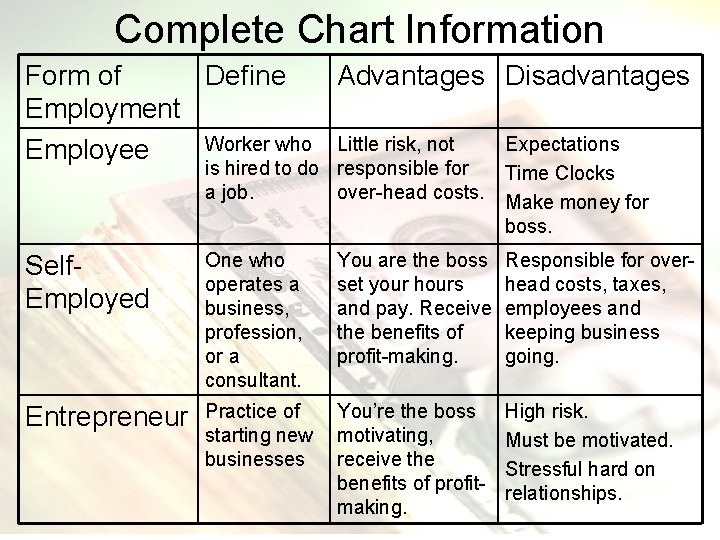
Complete Chart Information Form of Define Advantages Disadvantages Employment Worker who Little risk, not Expectations Employee is hired to do responsible for a job. over-head costs. Time Clocks Make money for boss. Self. Employed One who operates a business, profession, or a consultant. You are the boss set your hours and pay. Receive the benefits of profit-making. Responsible for overhead costs, taxes, employees and keeping business going. Entrepreneur Practice of starting new businesses You’re the boss motivating, receive the benefits of profitmaking. High risk. Must be motivated. Stressful hard on relationships.
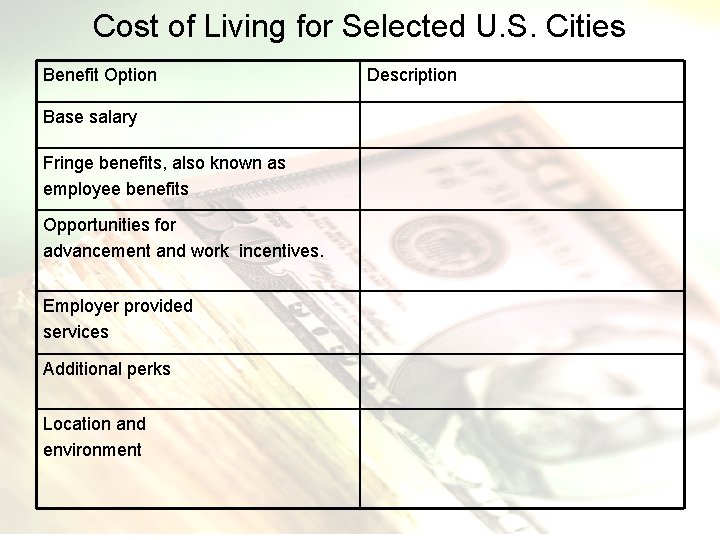
Cost of Living for Selected U. S. Cities Benefit Option Base salary Fringe benefits, also known as employee benefits Opportunities for advancement and work incentives. Employer provided services Additional perks Location and environment Description
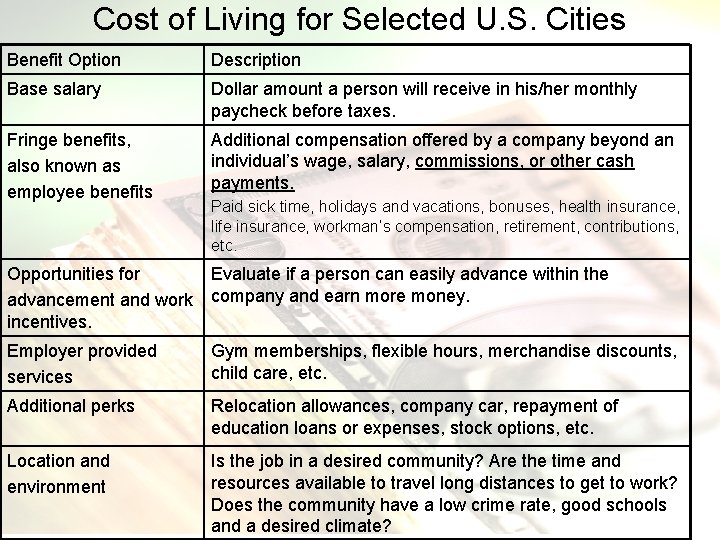
Cost of Living for Selected U. S. Cities Benefit Option Description Base salary Dollar amount a person will receive in his/her monthly paycheck before taxes. Fringe benefits, also known as employee benefits Additional compensation offered by a company beyond an individual’s wage, salary, commissions, or other cash payments. Paid sick time, holidays and vacations, bonuses, health insurance, life insurance, workman’s compensation, retirement, contributions, etc. Opportunities for Evaluate if a person can easily advance within the advancement and work company and earn more money. incentives. Employer provided services Gym memberships, flexible hours, merchandise discounts, child care, etc. Additional perks Relocation allowances, company car, repayment of education loans or expenses, stock options, etc. Location and environment Is the job in a desired community? Are the time and resources available to travel long distances to get to work? Does the community have a low crime rate, good schools and a desired climate?
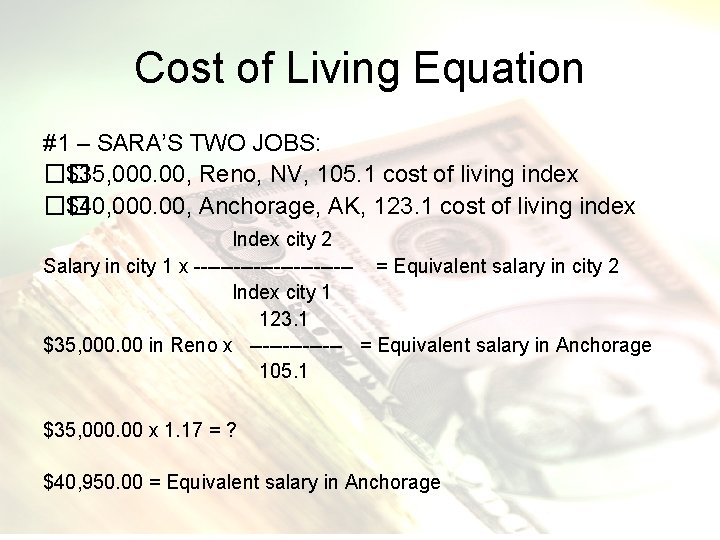
Cost of Living Equation #1 – SARA’S TWO JOBS: �� $35, 000. 00, Reno, NV, 105. 1 cost of living index �� $40, 000. 00, Anchorage, AK, 123. 1 cost of living index Index city 2 Salary in city 1 x ------------ = Equivalent salary in city 2 Index city 1 123. 1 $35, 000. 00 in Reno x ------- = Equivalent salary in Anchorage 105. 1 $35, 000. 00 x 1. 17 = ? $40, 950. 00 = Equivalent salary in Anchorage
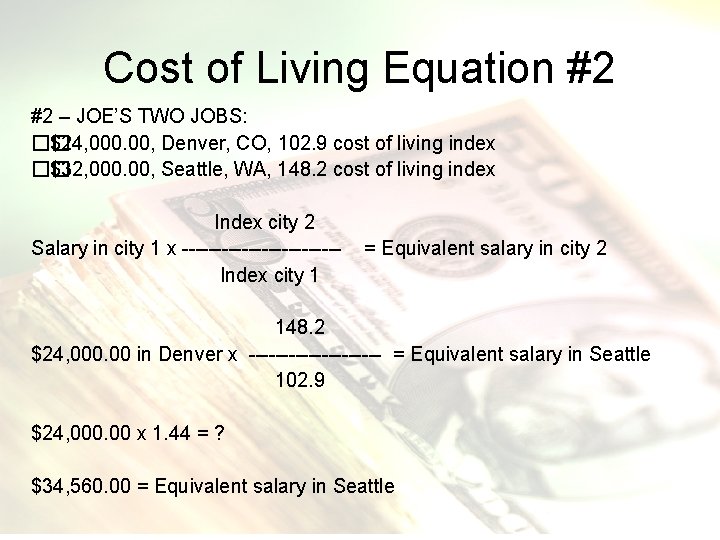
Cost of Living Equation #2 #2 – JOE’S TWO JOBS: �� $24, 000. 00, Denver, CO, 102. 9 cost of living index �� $32, 000. 00, Seattle, WA, 148. 2 cost of living index Index city 2 Salary in city 1 x ------------Index city 1 = Equivalent salary in city 2 148. 2 $24, 000. 00 in Denver x ---------- = Equivalent salary in Seattle 102. 9 $24, 000. 00 x 1. 44 = ? $34, 560. 00 = Equivalent salary in Seattle

Cost of Living for Selected U. S. Cities • Refer to hand out

Complete the Comparing Job Offers worksheet
- Slides: 28