
Sources of Fish Decline Habitat disruption Breeding areas
Sources of Fish Decline Habitat disruption • Breeding areas • Larval development areas • Bottom structure
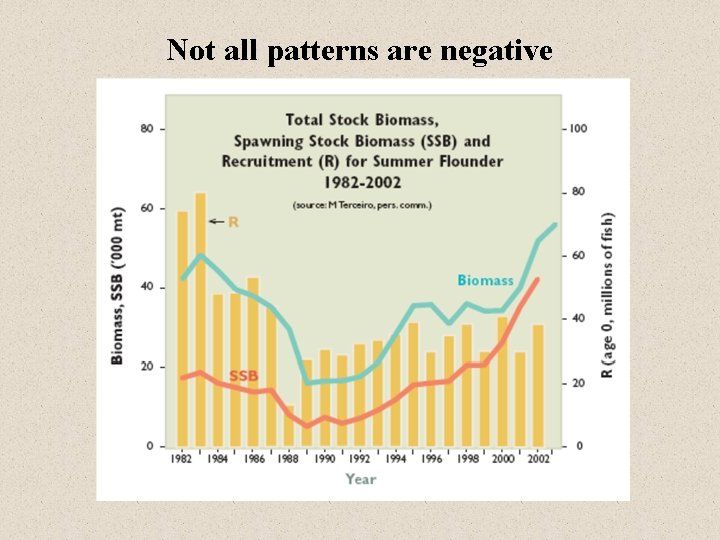
Not all patterns are negative
Population processes: aid to intelligent management? • 1830’s – concerns about fluctuations in catch in North Sea • Disbelief that humans could cause this • C. D. J. Petersen (Denmark) applied science – mark-recapture to estimate population size – collected data on age-dependent reproduction – applied population model to predict connection between fishing mortality & fish populations • Criticized as “irrational” (not “profitable”) • Tested during WW I and WW II
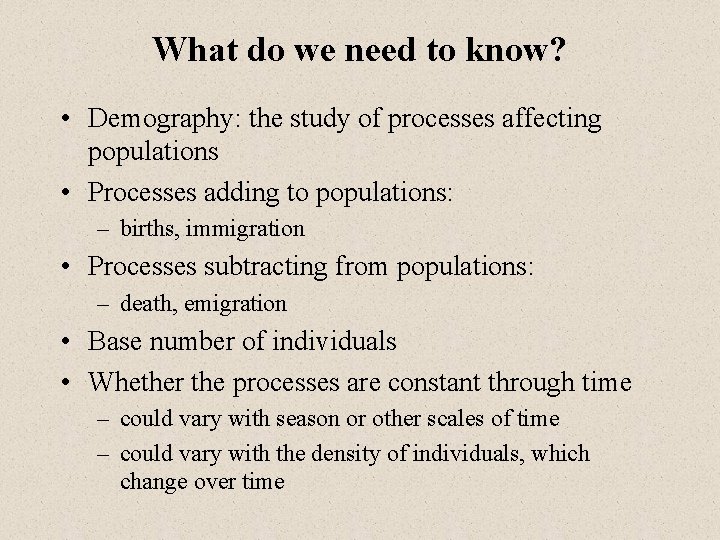
What do we need to know? • Demography: the study of processes affecting populations • Processes adding to populations: – births, immigration • Processes subtracting from populations: – death, emigration • Base number of individuals • Whether the processes are constant through time – could vary with season or other scales of time – could vary with the density of individuals, which change over time
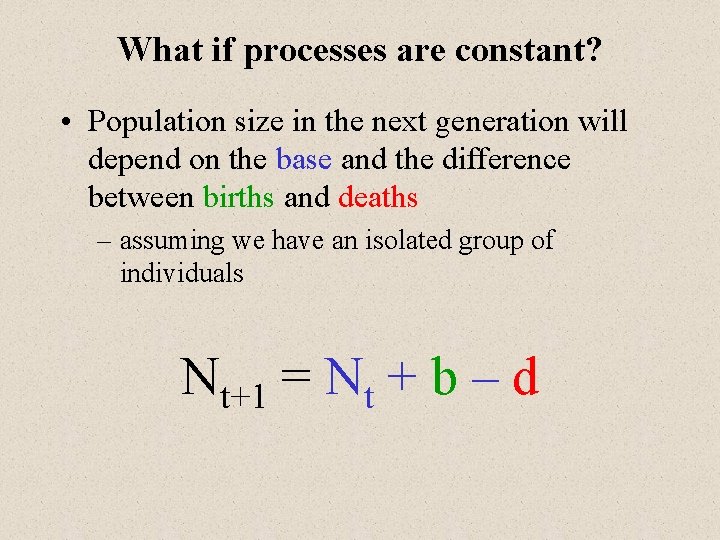
What if processes are constant? • Population size in the next generation will depend on the base and the difference between births and deaths – assuming we have an isolated group of individuals Nt+1 = Nt + b – d
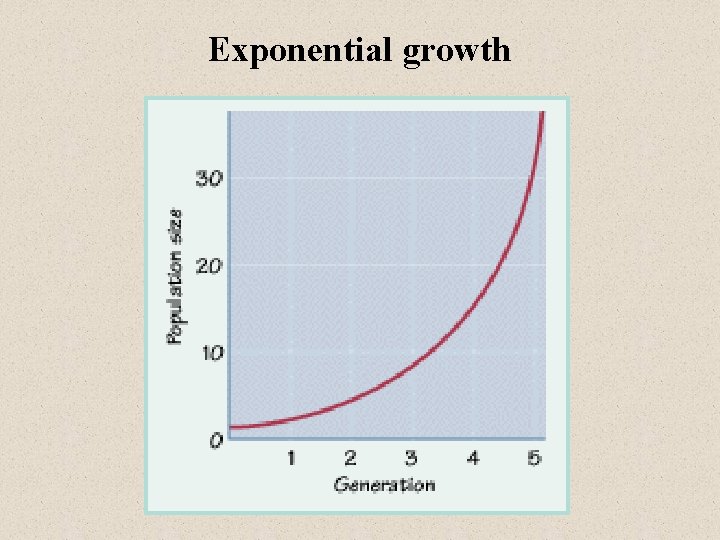
Exponential growth
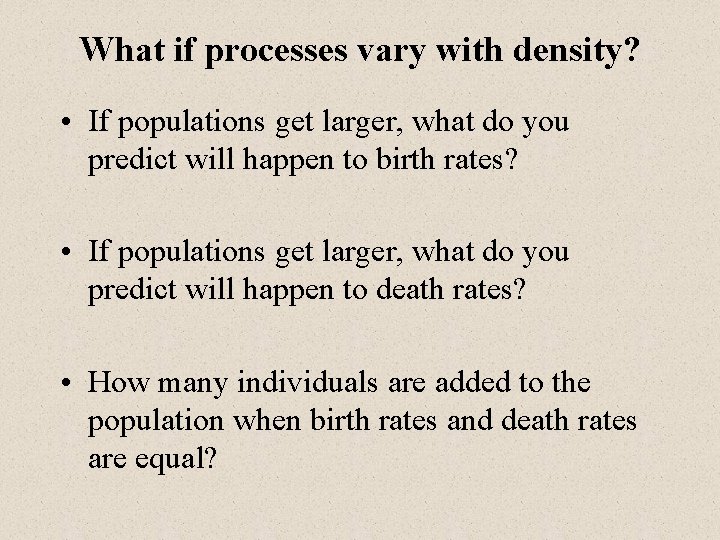
What if processes vary with density? • If populations get larger, what do you predict will happen to birth rates? • If populations get larger, what do you predict will happen to death rates? • How many individuals are added to the population when birth rates and death rates are equal?
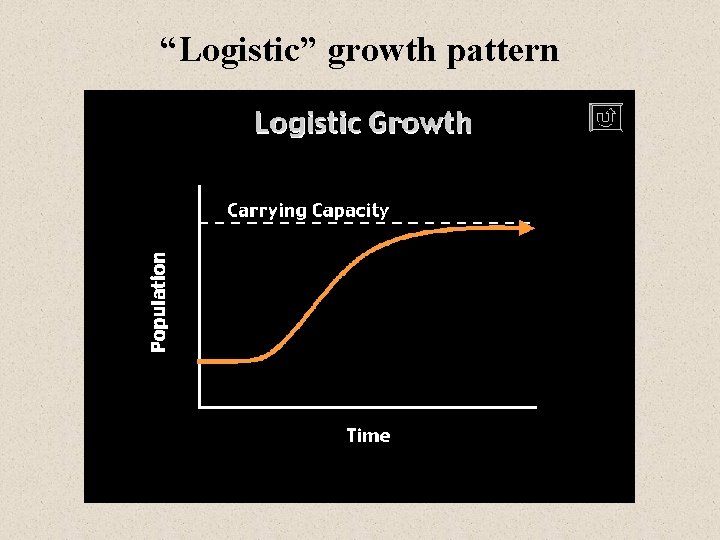
“Logistic” growth pattern
Summary of population models • The Logistic model of density dependence predicts maximal sustainable yield at ½ K • “S-shape” curve of population growth may not be seen when – The response to density lags changes in the environment – For populations with large excesses of births (r>2) and where generations are distinct
Added realism: individuals vary in “b” and “d” • Size (or age) influences – Reproductive capacity (# of offspring likely) – The risk of being eaten by a predator – The probability of being captured in a net • Age-specific demographic processes – Fecundity – Survivorship
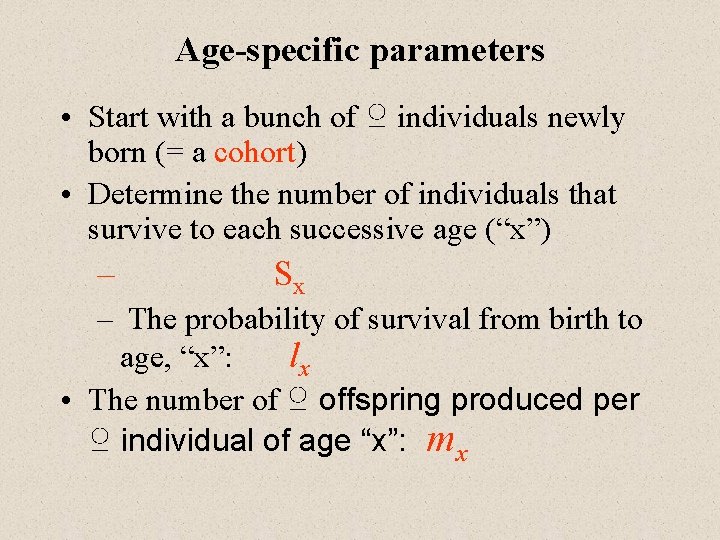
Age-specific parameters • Start with a bunch of ♀ individuals newly born (= a cohort) • Determine the number of individuals that survive to each successive age (“x”) – Sx – The probability of survival from birth to age, “x”: lx • The number of ♀ offspring produced per ♀ individual of age “x”: mx
Life Table = collection of data on Sx, lx, mx • We can then project how each cohort will contribute to the population through its lifetime • Some values derived from a life table: – Net Reproductive Rate, R 0 = the number of ♀ progeny expected to accumulate during the entire lifetime of an average ♀ – Intrinsic growth rate, r – Reproductive Value (Vx) = the expected number of future ♀ progeny for a ♀ of age “x” (relative to that of a newborn, = R 0)
The real world is not a set of simple equations • Randomness is a factor – “Deterministic” models always follow the same path given the same conditions – “Stochastic” models include chance • How is this done? – Use an average value for a parameter – But for any generation, the value used can deviate somewhat from that average – “Coefficient of Variation” and “distribution” define the limits of deviation
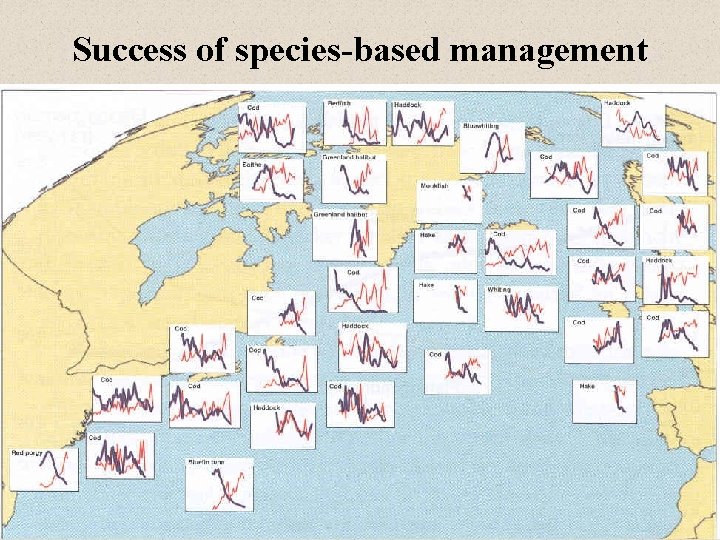
Success of species-based management
What are the connections between food web and demographic approaches? • What demographic parameters are influenced? • Are models still useful and how?
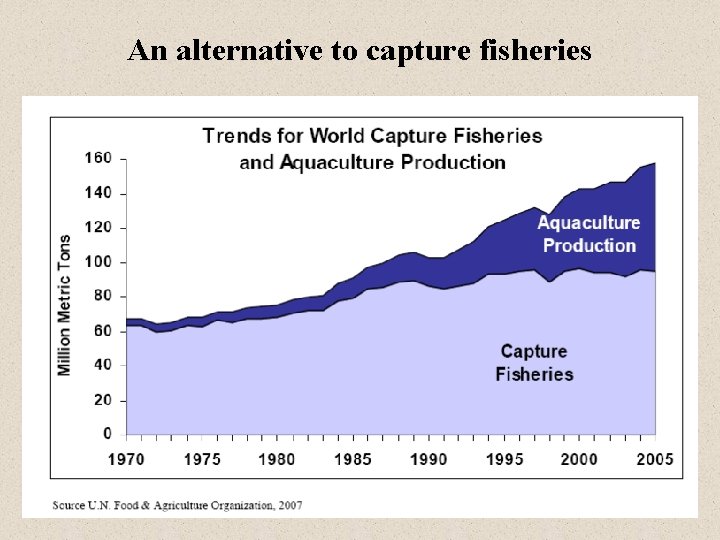
An alternative to capture fisheries
- Slides: 17