
Sources of End Face Contamination on Fiber Optical
Sources of End Face Contamination on Fiber Optical Interconnects and Recommended Best Practices for Removing the Contaminates Brian Teague – Product Line Manager November 2016
Program Agenda 1. Do It Right The First Time 2. Residues Contamination 3. Dust Contamination 4. Electrostatic Charge 5. Solve the Problem
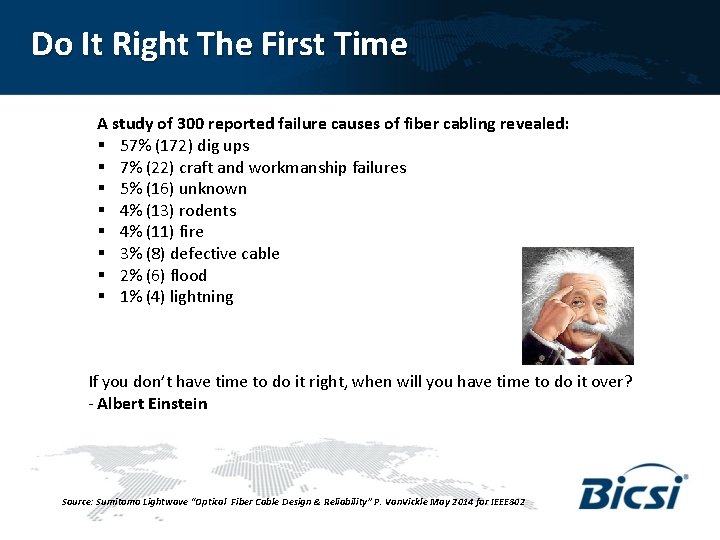
Do It Right The First Time A study of 300 reported failure causes of fiber cabling revealed: § 57% (172) dig ups § 7% (22) craft and workmanship failures § 5% (16) unknown § 4% (13) rodents § 4% (11) fire § 3% (8) defective cable § 2% (6) flood § 1% (4) lightning If you don’t have time to do it right, when will you have time to do it over? - Albert Einstein Source: Sumitomo Lightwave “Optical Fiber Cable Design & Reliability” P. Van. Vickle May 2014 for IEEE 802
Industry Statics on Fiber Connector Cleaning HTI Martin Technical Research Survey of 89 network owners and network contactors study on network failure. § 80% of Network Owners and 98% of Network Contractors have experienced fiber failures during the installation process § 82% of Network Owners and 92% of Network Contractors use IPA as the cleaning agent § 12% of Network Owners and 30% of Network Contractors use compressed air for cleaning Truck Roll Back Expense Stats: § “The average truck roll is ~ $150 NOT including labor. Labor $50/hour. The average PRISM truck roll results in a three hour visit. ” Matt Olson, Principal Architect at Century. Link at CONF 2014 § National Association of Regulatory Utility Commissioners estimates a truck roll costs upwards of $275 in 2014 and that does not take into consideration the cost of parts.
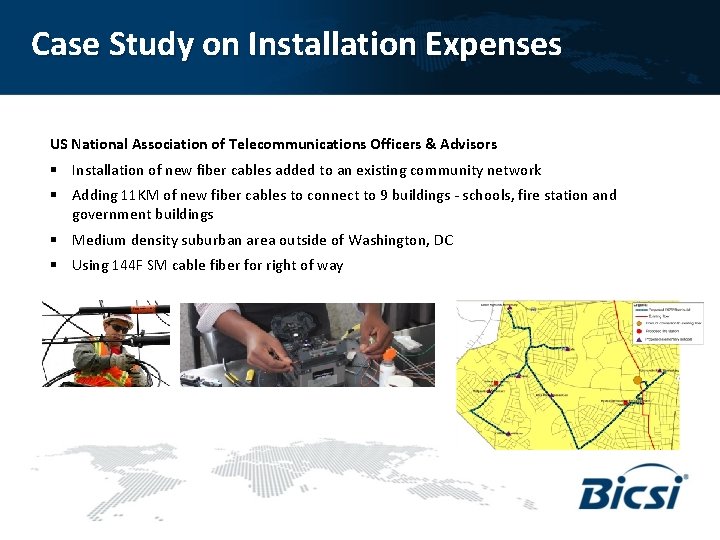
Case Study on Installation Expenses US National Association of Telecommunications Officers & Advisors § Installation of new fiber cables added to an existing community network § Adding 11 KM of new fiber cables to connect to 9 buildings - schools, fire station and government buildings § Medium density suburban area outside of Washington, DC § Using 144 F SM cable fiber for right of way
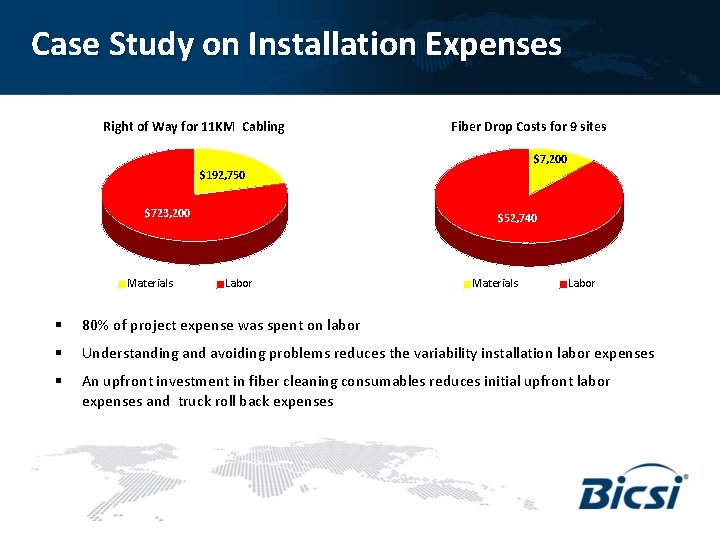
Case Study on Installation Expenses Right of Way for 11 KM Cabling Fiber Drop Costs for 9 sites $7, 200 $192, 750 $723, 200 Materials $52, 740 Labor Materials Labor § 80% of project expense was spent on labor § Understanding and avoiding problems reduces the variability installation labor expenses § An upfront investment in fiber cleaning consumables reduces initial upfront labor expenses and truck roll back expenses
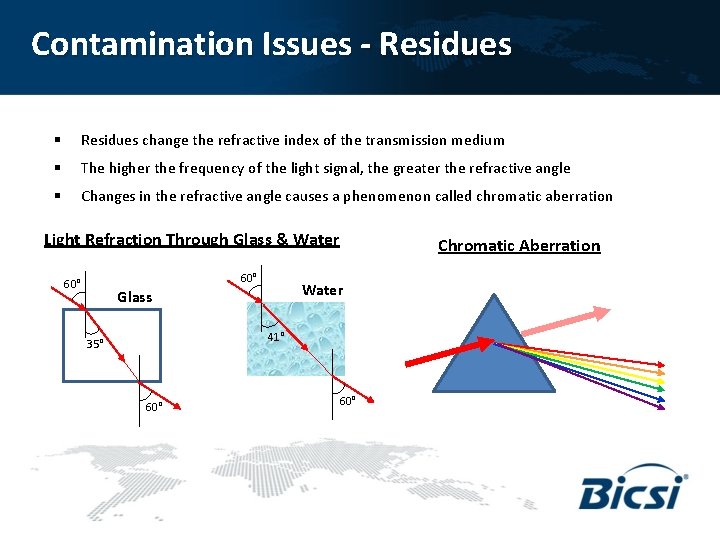
Contamination Issues - Residues § Residues change the refractive index of the transmission medium § The higher the frequency of the light signal, the greater the refractive angle § Changes in the refractive angle causes a phenomenon called chromatic aberration Light Refraction Through Glass & Water 60° Chromatic Aberration Water Glass 41° 35° 60°
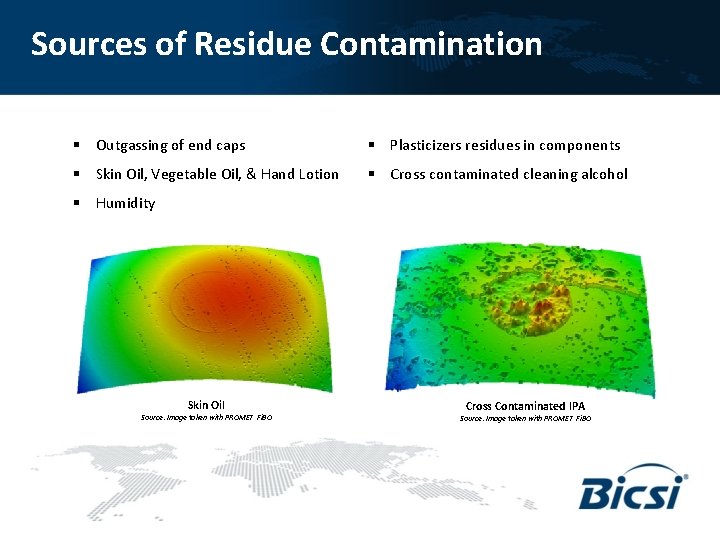
Sources of Residue Contamination § Outgassing of end caps § Plasticizers residues in components § Skin Oil, Vegetable Oil, & Hand Lotion § Cross contaminated cleaning alcohol § Humidity Skin Oil Source: Image taken with PROMET Fi. BO Cross Contaminated IPA Source: Image taken with PROMET Fi. BO
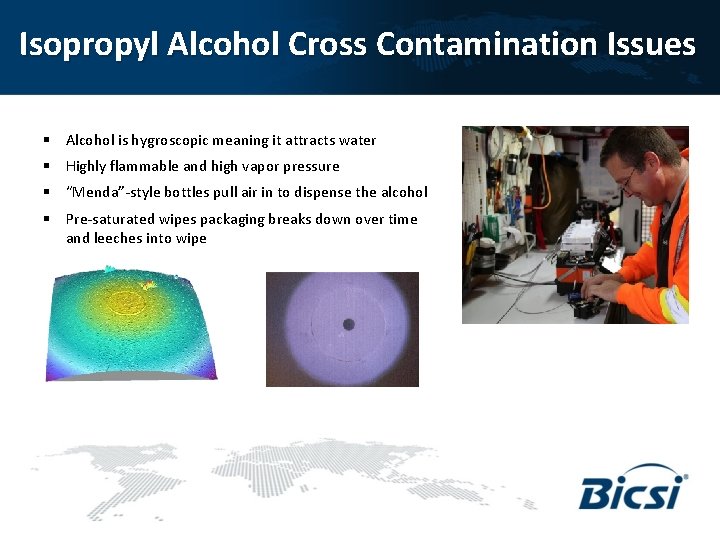
Isopropyl Alcohol Cross Contamination Issues § Alcohol is hygroscopic meaning it attracts water § Highly flammable and high vapor pressure § “Menda”-style bottles pull air in to dispense the alcohol § Pre-saturated wipes packaging breaks down over time and leeches into wipe
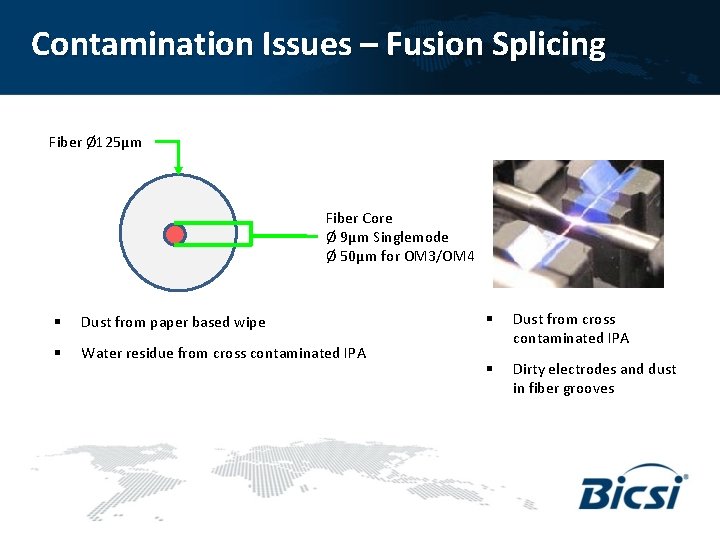
Contamination Issues – Fusion Splicing Fiber Ø 125μm Fiber Core Ø 9μm Singlemode Ø 50μm for OM 3/OM 4 § Dust from paper based wipe § Water residue from cross contaminated IPA § Dust from cross contaminated IPA § Dirty electrodes and dust in fiber grooves

Dust Contamination is Common Source: RSM using RSM 1 scope

Contaminations Issues – Dust Particulates Back Reflectance Absorption Loss Insertion Loss § Dust interferes with physical contact creating small air gaps and permanent end face defects § Residues in signal path change index of refraction between the connector pair causing signal loss

Sources of Dust Contamination Common Internal Contributors: § Dead skin, hair, and clothing lint § Packaging and construction materials § Foam based swabs and paper based wipes § Connector wear debris and dirty test assemblies § Zinc whiskers from electroplated surfaces § Protective end caps for connectors and adapters Zinc Whiskers Source: NASA Electronics Parts & Packaging Program Left: Dust from top of cabinet. Right: Paper Fiber(wood) from inside drawer Source: Karen Brynjolf Pedersen & Morten Ryhl-Svendsen National Museum of Denmark
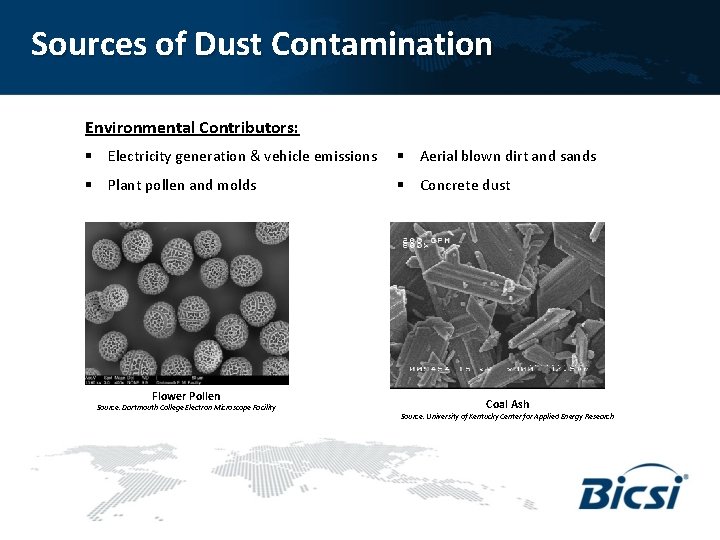
Sources of Dust Contamination Environmental Contributors: § Electricity generation & vehicle emissions § Aerial blown dirt and sands § Plant pollen and molds § Concrete dust Flower Pollen Source: Dartmouth College Electron Microscope Facility Coal Ash Source: University of Kentucky Center for Applied Energy Research
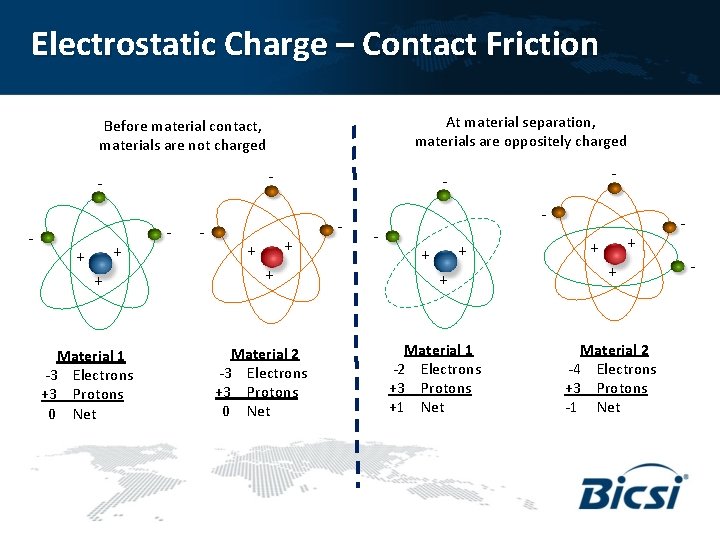
Electrostatic Charge – Contact Friction At material separation, materials are oppositely charged Before material contact, materials are not charged - - + + + Material 1 -3 Electrons +3 Protons 0 Net - - + + - - + Material 2 -3 Electrons +3 Protons 0 Net - - + + + Material 1 -2 Electrons +3 Protons +1 Net + + + Material 2 -4 Electrons +3 Protons -1 Net -

Electrostatic Charge - Attraction The Role of Electrostatic Charge Effect on Contamination of Fiber Optic Connectors and Ways of Eliminating it by T. Berdinskikh, A. Fisenko, J. Daniel, J. Bragg, D. Phillips of Celestica Applications of Photonics Technology 5, 420 (Feb 2003) 1. ST Connector is cleaned and image captured 2. ST placed 2 mm above iron dust 3. ST placed 4 mm above iron dust 4. ST placed 2 mm above nickel dust Conclusions: § The contact friction of the dry wipe created an electrostatic charge on the ceramic ferrule surface § The oppositely charged dust particles bonded on the ferrule surface quickly
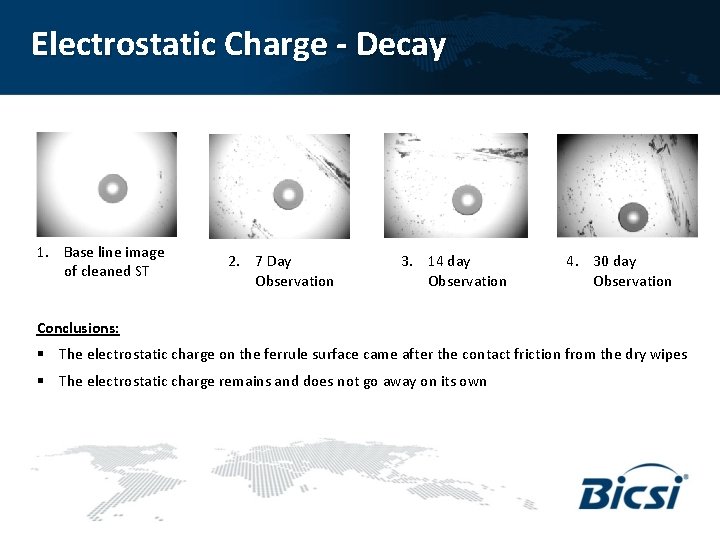
Electrostatic Charge - Decay 1. Base line image of cleaned ST 2. 7 Day Observation 3. 14 day Observation 4. 30 day Observation Conclusions: § The electrostatic charge on the ferrule surface came after the contact friction from the dry wipes § The electrostatic charge remains and does not go away on its own
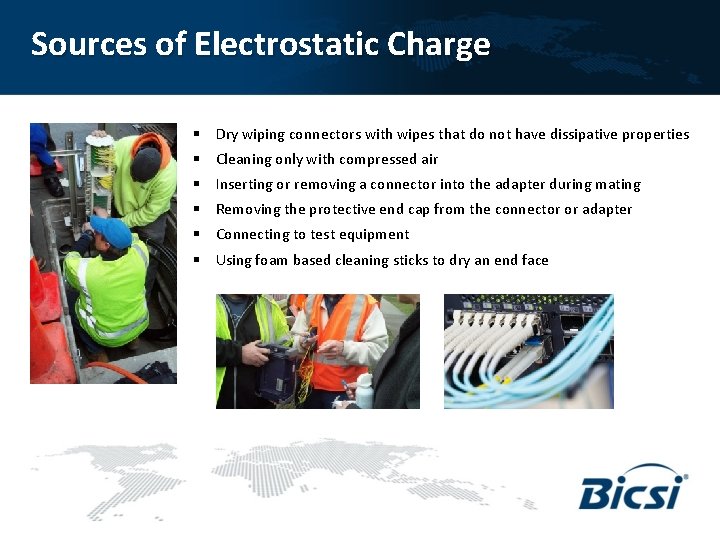
Sources of Electrostatic Charge § Dry wiping connectors with wipes that do not have dissipative properties § Cleaning only with compressed air § Inserting or removing a connector into the adapter during mating § Removing the protective end cap from the connector or adapter § Connecting to test equipment § Using foam based cleaning sticks to dry an end face
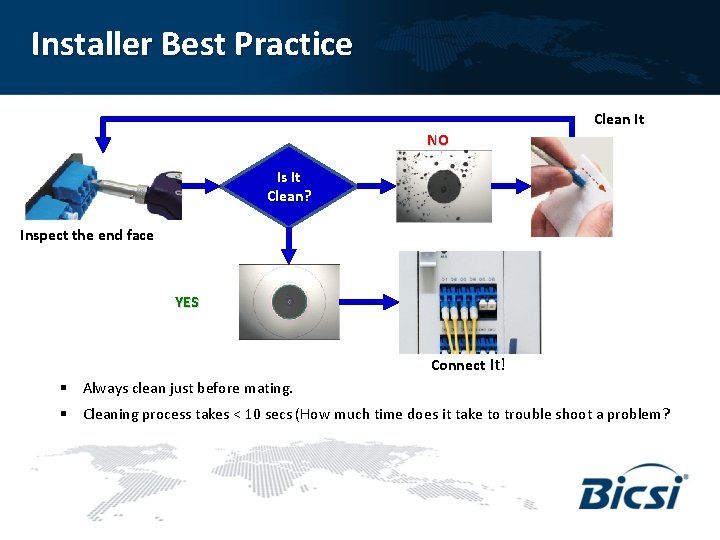
Installer Best Practice Clean It NO Is It Clean? Inspect the end face YES Connect It! § Always clean just before mating. § Cleaning process takes < 10 secs (How much time does it take to trouble shoot a problem?
Best Practices for Removing Contamination § Wet-dry cleaning is most effective for removing all forms of contamination and eliminates electrostatic charge § Use optical grade cleaning fluids that are zero residue and fast evaporating § Use cleaning fluids in hermitically sealed packaging to prevent cross contamination § If you must use IPA, change it out frequently and thoroughly wash and dry (no water) the container § When using stick cleaners, one stick per end face to avoid cross contamination § When using sticks, rotate them in the same direction 6 x to 8 x times § Mechanical cleaners are good for light and medium levels of contamination levels § Boxes and tubs of optical grade wipes plus cleaning fluid are best for splicing pigtails to bulk cable § Clean your test assemblies and ports of the test gear § Always clean both ends of a mated connector pair just before mating
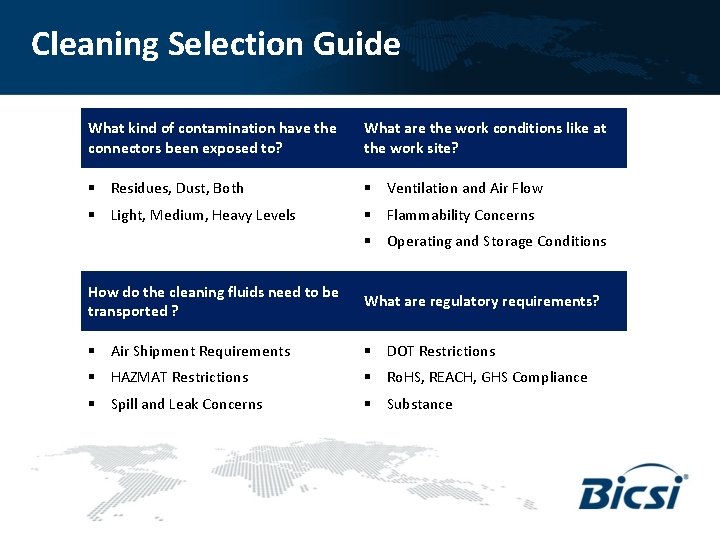
Cleaning Selection Guide What kind of contamination have the connectors been exposed to? What are the work conditions like at the work site? § Residues, Dust, Both § Ventilation and Air Flow § Light, Medium, Heavy Levels § Flammability Concerns § Operating and Storage Conditions How do the cleaning fluids need to be transported ? What are regulatory requirements? § Air Shipment Requirements § DOT Restrictions § HAZMAT Restrictions § Ro. HS, REACH, GHS Compliance § Spill and Leak Concerns § Substance
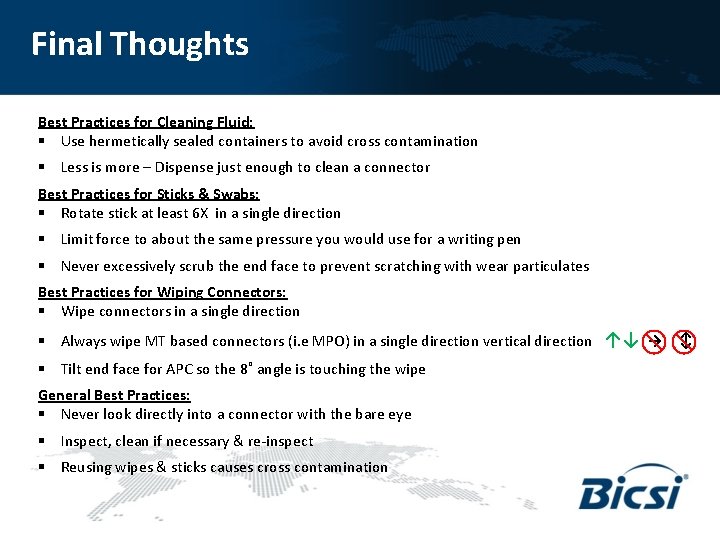
Final Thoughts Best Practices for Cleaning Fluid: § Use hermetically sealed containers to avoid cross contamination § Less is more – Dispense just enough to clean a connector Best Practices for Sticks & Swabs: § Rotate stick at least 6 X in a single direction § Limit force to about the same pressure you would use for a writing pen § Never excessively scrub the end face to prevent scratching with wear particulates Best Practices for Wiping Connectors: § Wipe connectors in a single direction § Always wipe MT based connectors (i. e MPO) in a single direction vertical direction § Tilt end face for APC so the 8˚ angle is touching the wipe General Best Practices: § Never look directly into a connector with the bare eye § Inspect, clean if necessary & re-inspect § Reusing wipes & sticks causes cross contamination ↑↓ → ↕

Thank You for your time. Questions? Technical Support Local Contact Brian Teague Product Line Manager C: +1. 860. 406. 2576 (US Based) Jerald Chan Asia Market Manager C: +65. 9688. 7451 (Singapore Based)
- Slides: 23