
Sources of electronic noises The two most commonly



- Slides: 25
Sources of electronic noises • The two most commonly encountered types of noise are thermal noises and shot noises. • Thermal noise arise from the random velocity fluctuation of the charge carriers (electron and/or holes) in a resistive material. • The mechanism is sometimes said to be the Brownian motion of the charge carriers due to thermal energy of the materials.
The thermal noise is often referred to as Johnson noises (or Nyquist noise) in recognition of two early investigators.
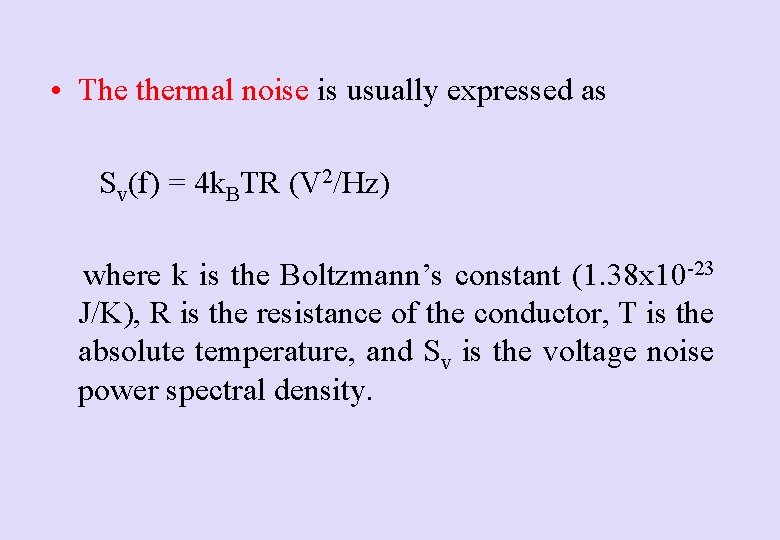
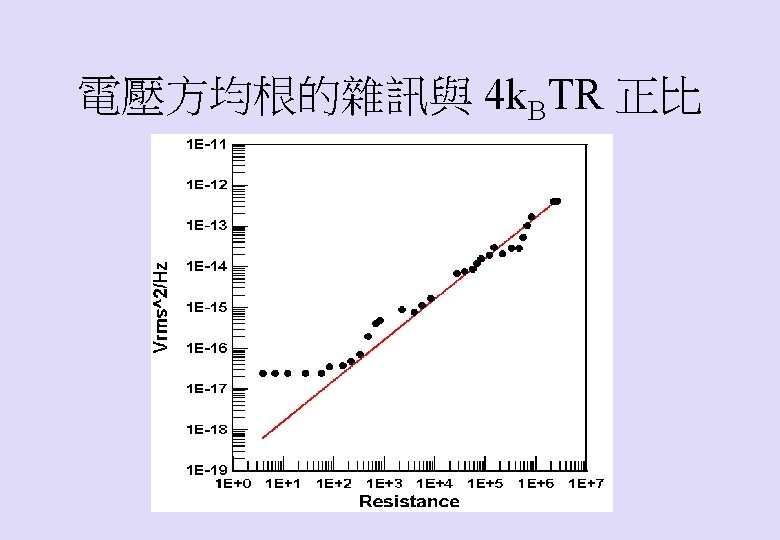
• The thermal noise is usually expressed as Sv(f) = 4 k. BTR (V 2/Hz) where k is the Boltzmann’s constant (1. 38 x 10 -23 J/K), R is the resistance of the conductor, T is the absolute temperature, and Sv is the voltage noise power spectral density.
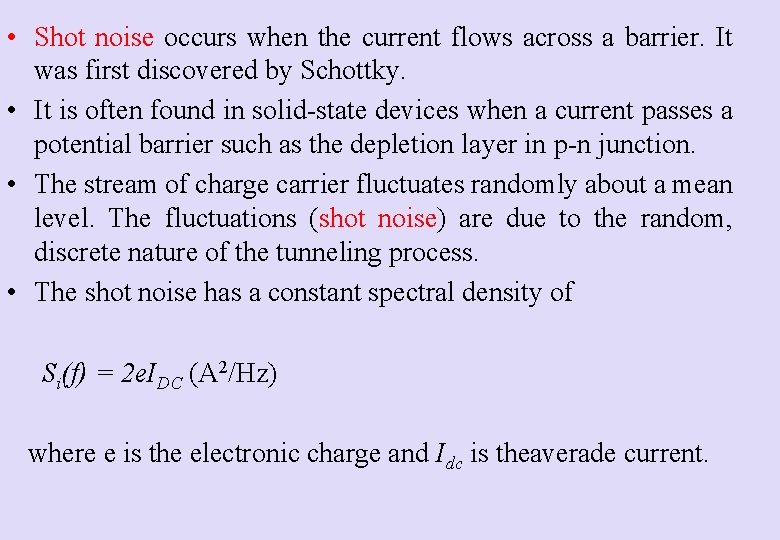
• Shot noise occurs when the current flows across a barrier. It was first discovered by Schottky. • It is often found in solid-state devices when a current passes a potential barrier such as the depletion layer in p-n junction. • The stream of charge carrier fluctuates randomly about a mean level. The fluctuations (shot noise) are due to the random, discrete nature of the tunneling process. • The shot noise has a constant spectral density of Si(f) = 2 e. IDC (A 2/Hz) where e is the electronic charge and Idc is theaverade current.
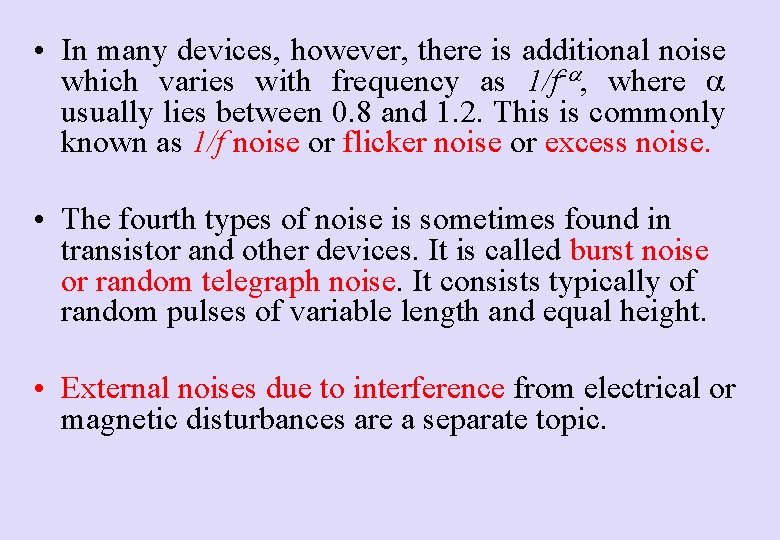
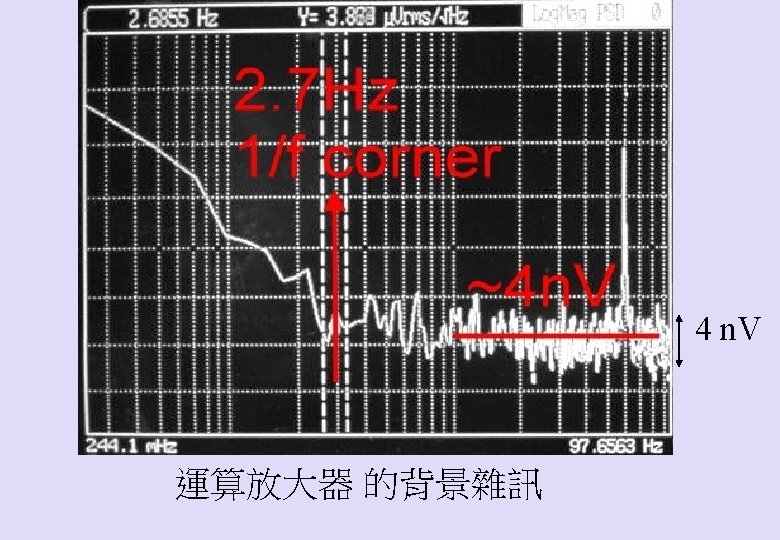
• In many devices, however, there is additional noise which varies with frequency as 1/f- , where usually lies between 0. 8 and 1. 2. This is commonly known as 1/f noise or flicker noise or excess noise. • The fourth types of noise is sometimes found in transistor and other devices. It is called burst noise or random telegraph noise. It consists typically of random pulses of variable length and equal height. • External noises due to interference from electrical or magnetic disturbances are a separate topic.
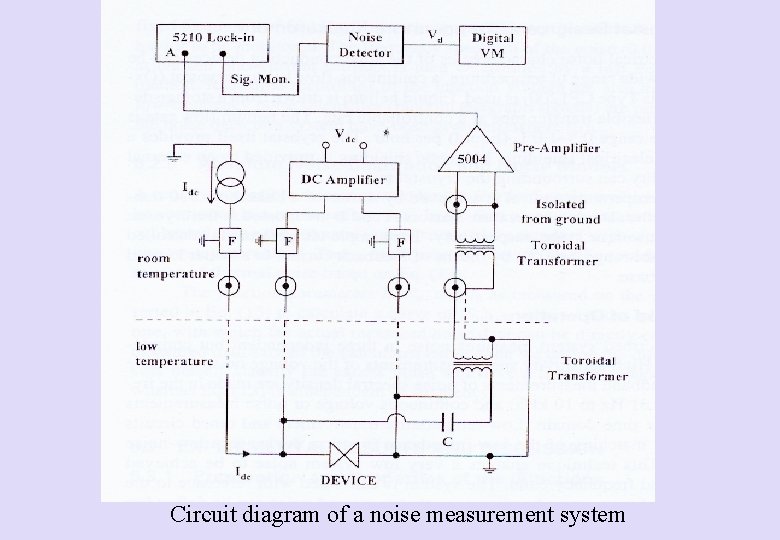
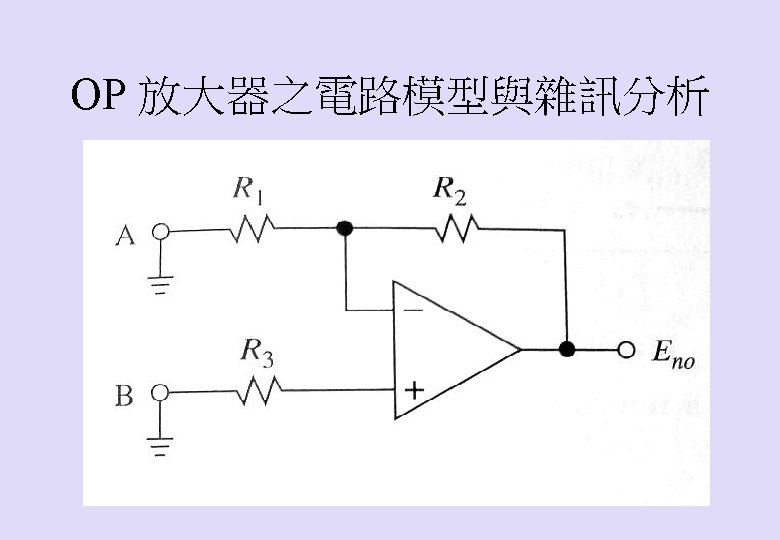
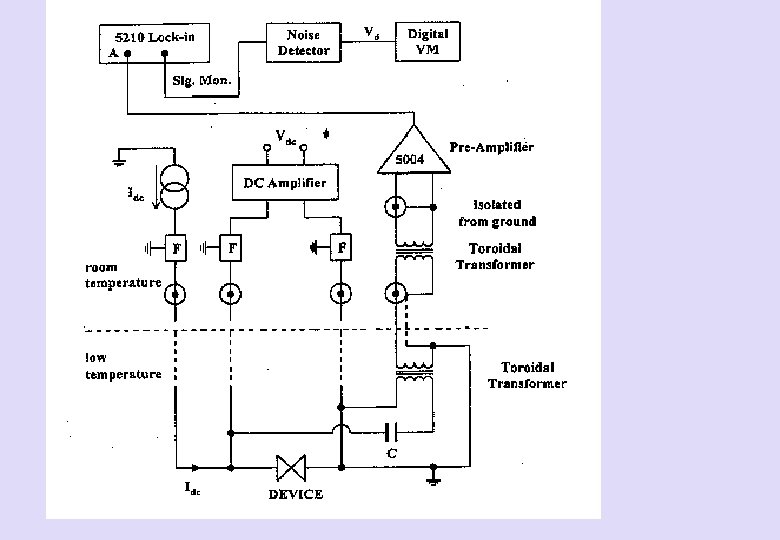
Circuit diagram of a noise measurement system
Noises of superconducting device
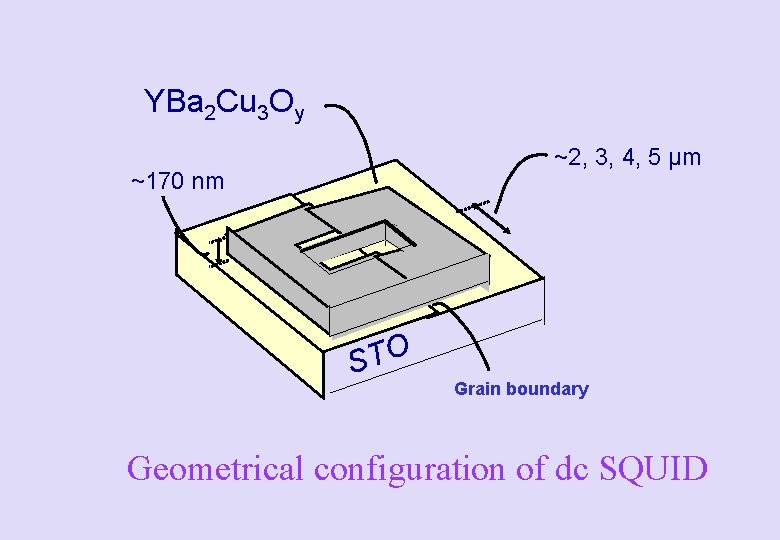
YBa 2 Cu 3 Oy ~2, 3, 4, 5 µm ~170 nm STO Grain boundary Geometrical configuration of dc SQUID
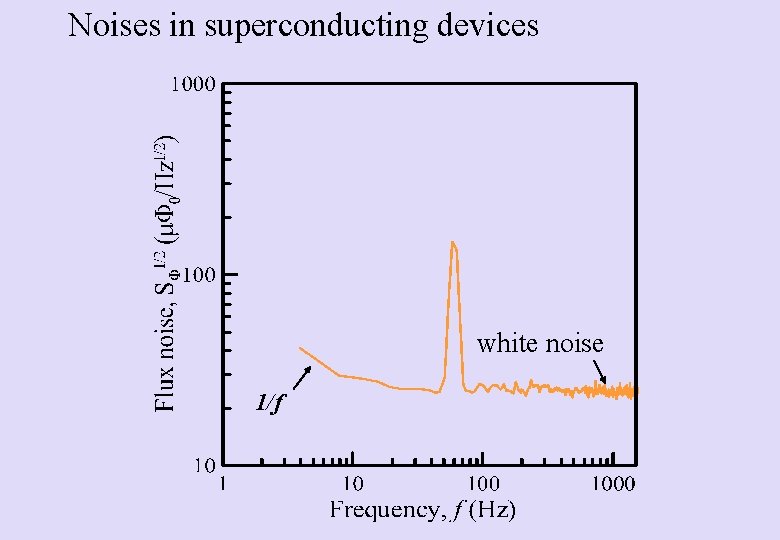
Noises in superconducting devices white noise 1/f
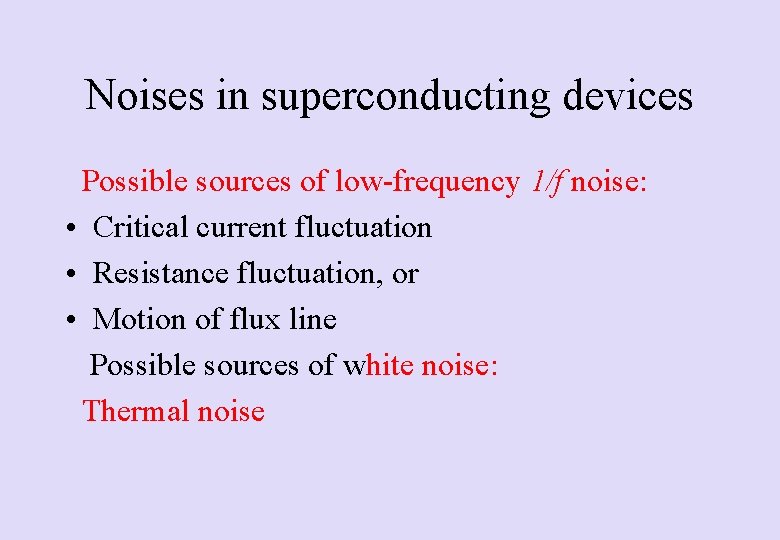
Noises in superconducting devices Possible sources of low-frequency 1/f noise: • Critical current fluctuation • Resistance fluctuation, or • Motion of flux line Possible sources of white noise: Thermal noise
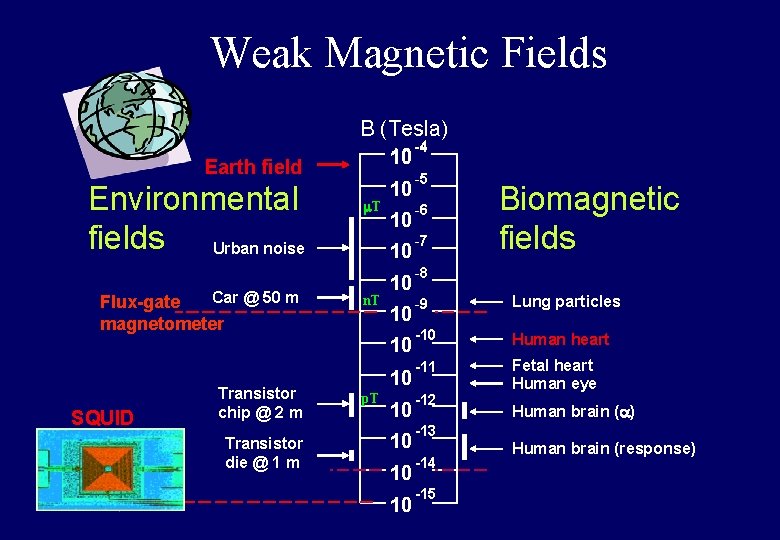
Weak Magnetic Fields B (Tesla) 10 Earth field Environmental fields Urban noise Car @ 50 m Flux-gate magnetometer m. T 10 10 10 n. T 10 10 10 SQUID Transistor chip @ 2 m Transistor die @ 1 m SQUID 10 p. T 10 10 -4 -5 -6 -7 Biomagnetic fields -8 -9 Lung particles -10 Human heart -11 Fetal heart Human eye -12 Human brain (a) -13 -14 -15 Human brain (response)
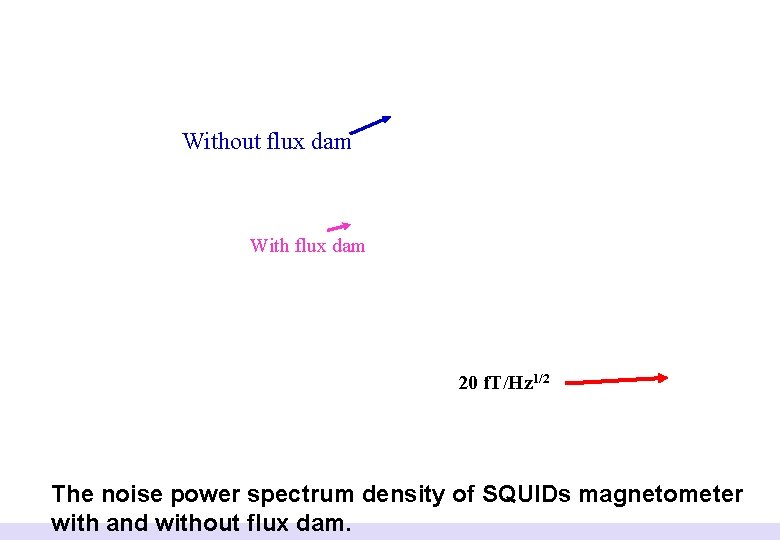
Without flux dam With flux dam 20 f. T/Hz 1/2 The noise power spectrum density of SQUIDs magnetometer with and without flux dam.
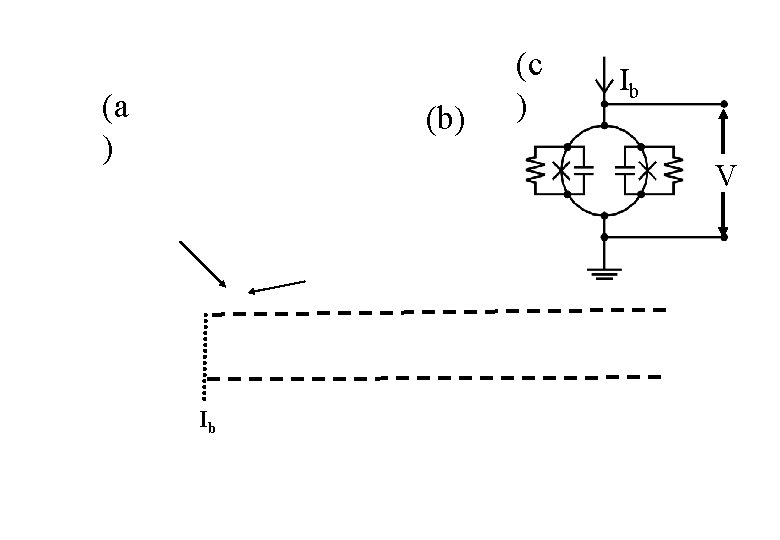
(a ) (b) (c ) Ib V Ib
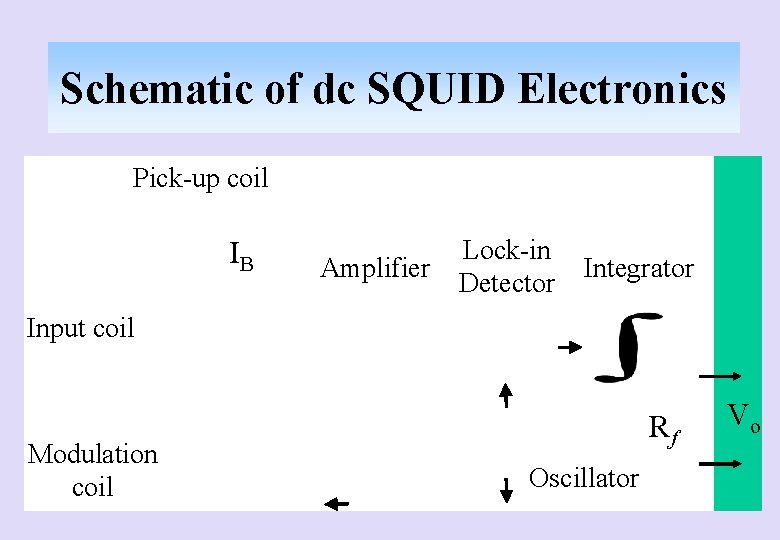
Schematic of dc SQUID Electronics Pick-up coil IB Amplifier Lock-in Detector Integrator Input coil Modulation coil Rf Oscillator Vo
u o y r o f s k n a h T ! n o i t n e t r at ng a Y ng H a h C ong