
Sources of Cosmic Rays E G Berezhko Yu
Sources of Cosmic Rays E. G. Berezhko Yu. G. Shafer Institute of Cosmophysical Research and Aeronomy Yakutsk, Russia • CR astrophysics with Yakutsk Extensive Air Shower (EAS) array • Determination of CRs sources with gamma-ray telescopes • Conclusions
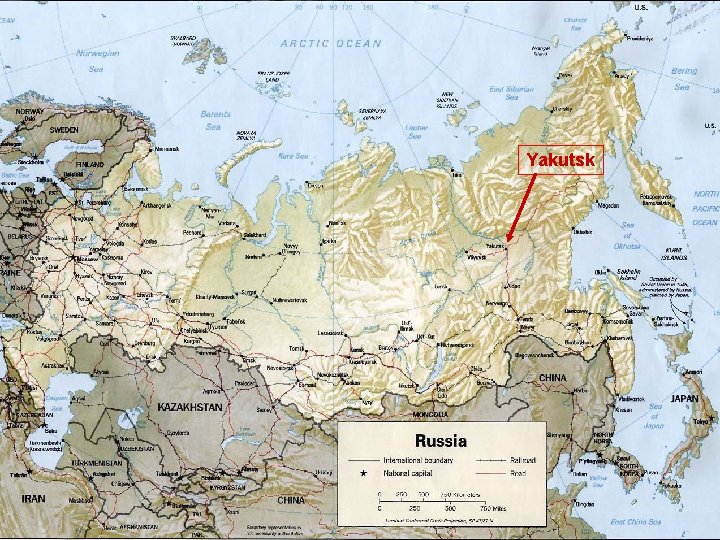
Yakutsk
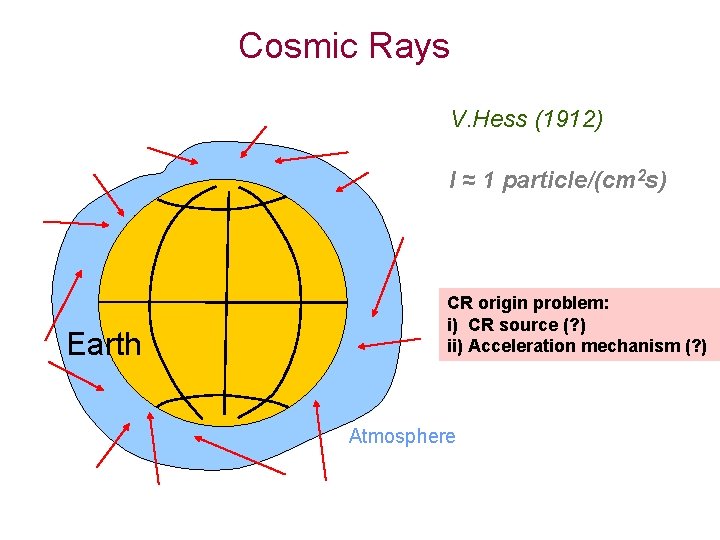
Cosmic Rays V. Hess (1912) I ≈ 1 particle/(cm 2 s) Earth CR origin problem: i) CR source (? ) ii) Acceleration mechanism (? ) Atmosphere

CR sources: Galactic SNRs knee Galactic SNRs Confirmations are still needed Cosmic Ray Flux Transition from Galactic to Extragalactic CRs ankle Extragalactic (AGNs ? ) end of CR spectrum (GZK cutoff? )
Yakutsk Extensive Air Shower Array • Operates since 1973 • Designed for registration of Extensive Air Showers of secondary particles, produced by high energy Cosmic Ray particle in the Earth atmosphere • Includes electron, muon and Cherenkov light detectors • Purpose: Investigation of Cosmic Rays properties – energy spectrum, composition, anisotropy – within the energy range 10 15 -1020 e. V in order to determine CR sources
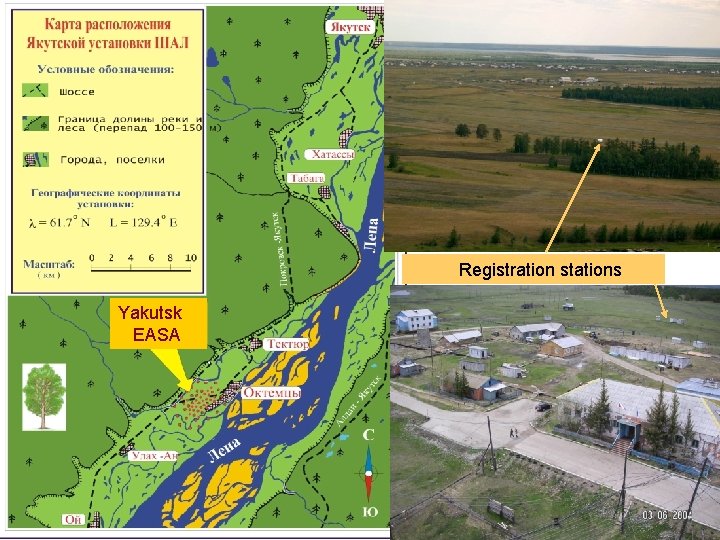
Registration stations Yakutsk EASA
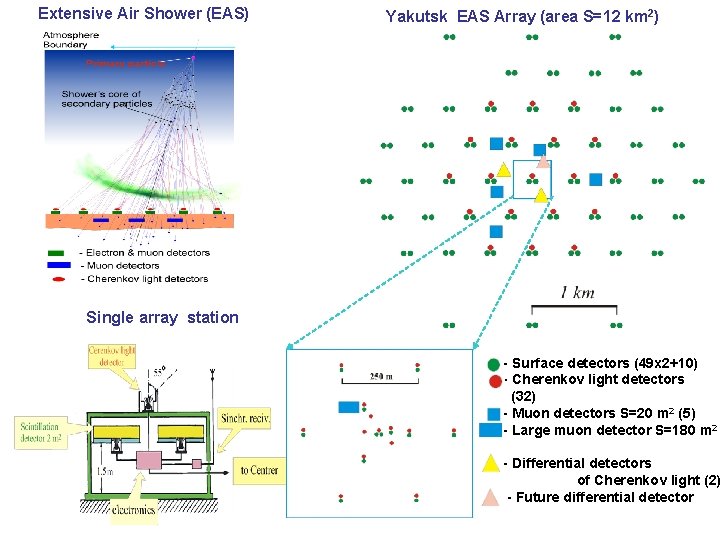
Extensive Air Shower (EAS) Yakutsk EAS Array (area S=12 km 2) Single array station - Surface detectors (49 x 2+10) - Cherenkov light detectors (32) - Muon detectors S=20 m 2 (5) - Large muon detector S=180 m 2 - Differential detectors of Cherenkov light (2) - Future differential detector
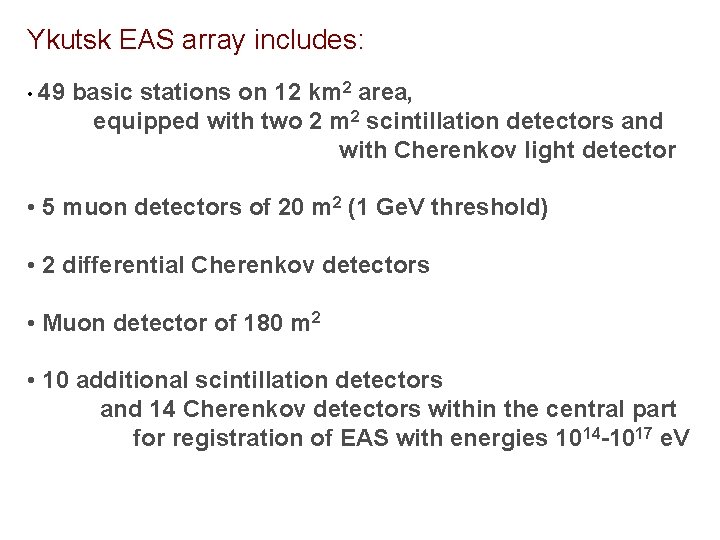
Ykutsk EAS array includes: • 49 basic stations on 12 km 2 area, equipped with two 2 m 2 scintillation detectors and with Cherenkov light detector • 5 muon detectors of 20 m 2 (1 Ge. V threshold) • 2 differential Cherenkov detectors • Muon detector of 180 m 2 • 10 additional scintillation detectors and 14 Cherenkov detectors within the central part for registration of EAS with energies 10 14 -1017 e. V
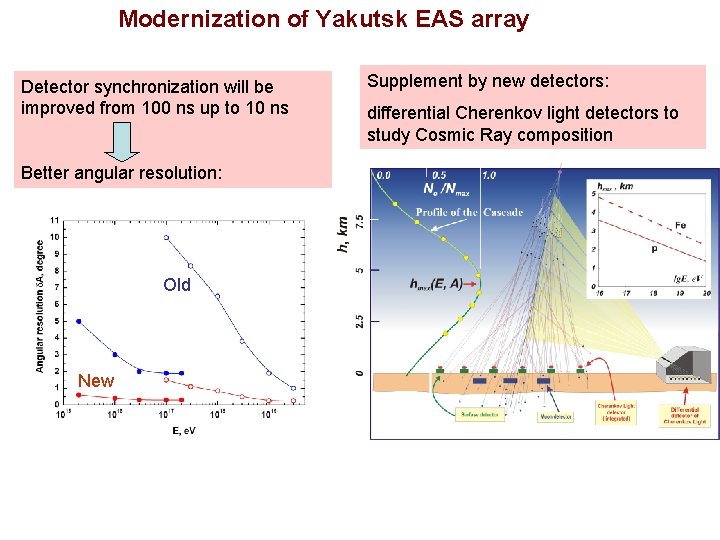
Modernization of Yakutsk EAS array Detector synchronization will be improved from 100 ns up to 10 ns Better angular resolution: Old New Supplement by new detectors: differential Cherenkov light detectors to study Cosmic Ray composition
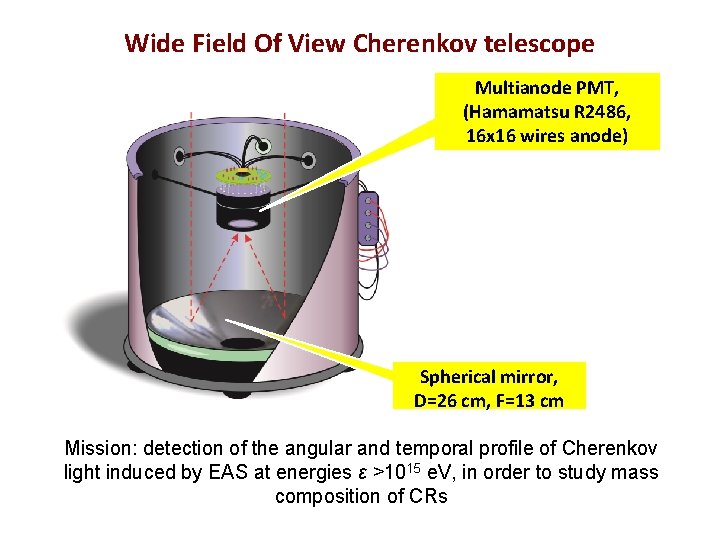
Wide Field Of View Cherenkov telescope Multianode PMT, (Hamamatsu R 2486, 16 x 16 wires anode) Spherical mirror, D=26 cm, F=13 cm Mission: detection of the angular and temporal profile of Cherenkov light induced by EAS at energies ε >1015 e. V, in order to study mass composition of CRs
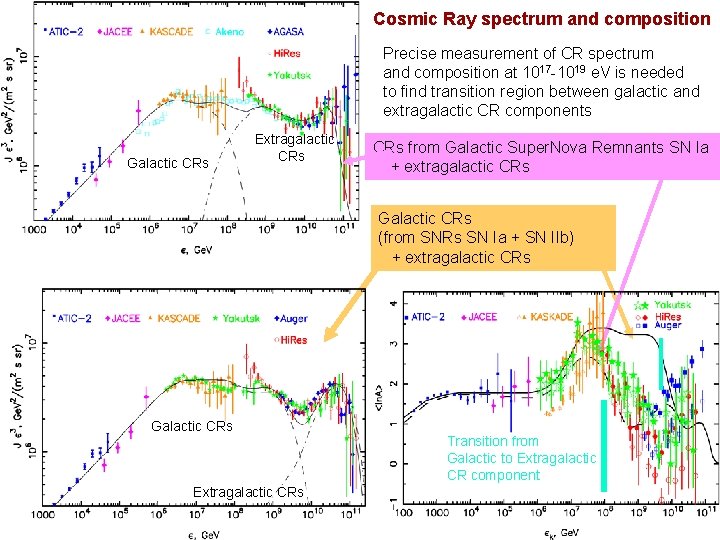
Cosmic Ray spectrum and composition Precise measurement of CR spectrum and composition at 1017 -1019 e. V is needed to find transition region between galactic and extragalactic CR components Galactic CRs Extragalactic CRs from Galactic Super. Nova Remnants SN Ia + extragalactic CRs Galactic CRs (from SNRs SN Ia + SN IIb) + extragalactic CRs Galactic CRs Extragalactic CRs Transition from Galactic to Extragalactic CR component
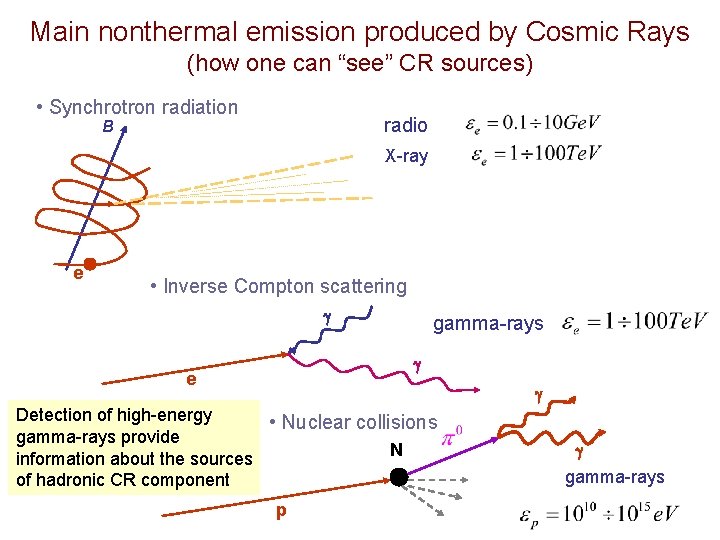
Main nonthermal emission produced by Cosmic Rays (how one can “see” CR sources) • Synchrotron radiation radio B X-ray e • Inverse Compton scattering gamma-rays e Detection of high-energy • Nuclear collisions gamma-rays provide N information about the sources of hadronic CR component p gamma-rays
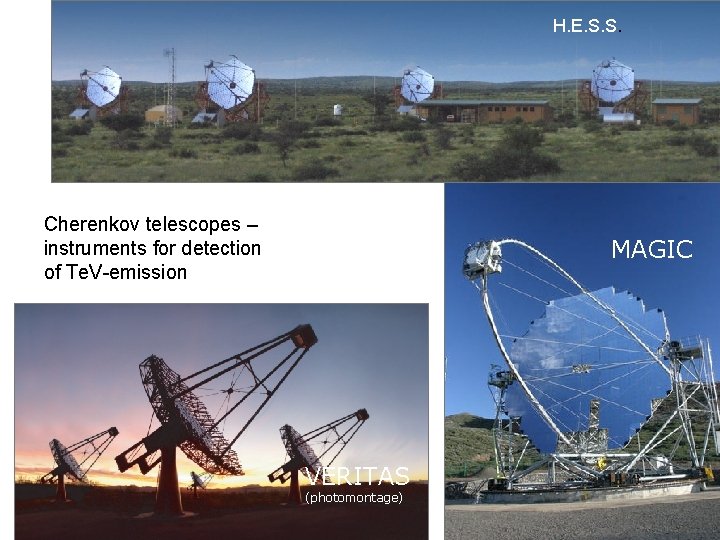
H. E. S. S. Cherenkov telescopes – instruments for detection of Te. V-emission MAGIC VERITAS (photomontage)
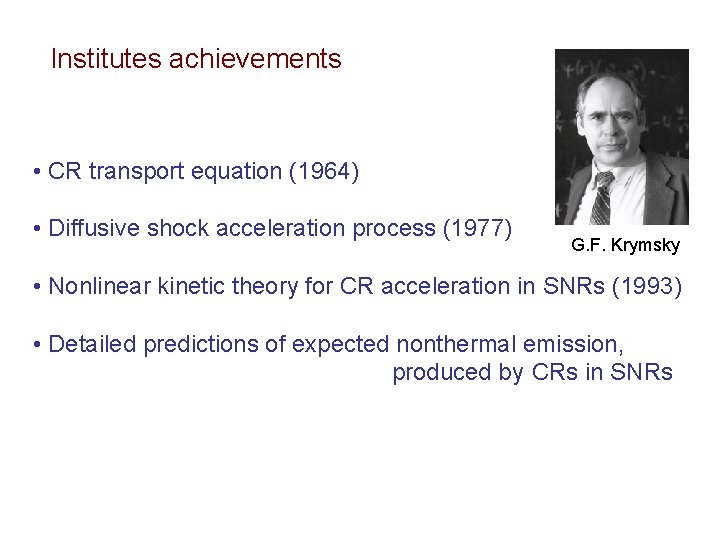
Institutes achievements • CR transport equation (1964) • Diffusive shock acceleration process (1977) G. F. Krymsky • Nonlinear kinetic theory for CR acceleration in SNRs (1993) • Detailed predictions of expected nonthermal emission, produced by CRs in SNRs
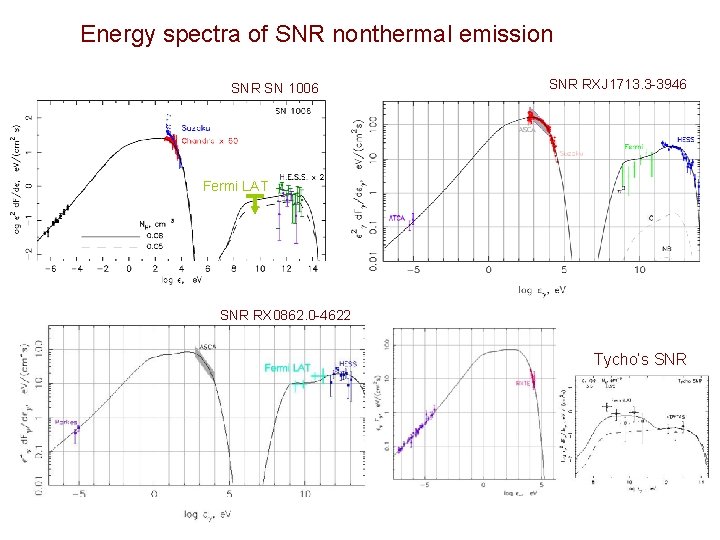
Energy spectra of SNR nonthermal emission SNR SN 1006 SNR RXJ 1713. 3 -3946 Fermi LAT SNR RX 0862. 0 -4622 Tycho’s SNR
Conclusions • Existing data are consistent with SNRs as the main source of CRs with energies ε < 1017 e. V • Transition energy region from Galactic to Extragalactic CR components is not determined yet, since the existing estimates of CR composition are rather contradictory • The progress in resolving of CR origin problem will be achieved on the basis of new generation of ground based instruments (Cherenkov telescopes and EASAs) as well as space gamma-ray telescopes with better characteristics
Spatially integrated energy spectrum of nonthermal emission of SN 1006 Berezhko, Ksenofontov, Völk (2012) NE rim SW rim
Energy spectrum of nonthermal emission of RXJ 1713 Berezhko & Völk (2006) SN II/Ib age T ≈ 1600 yr distance d ≈ 1 kpc
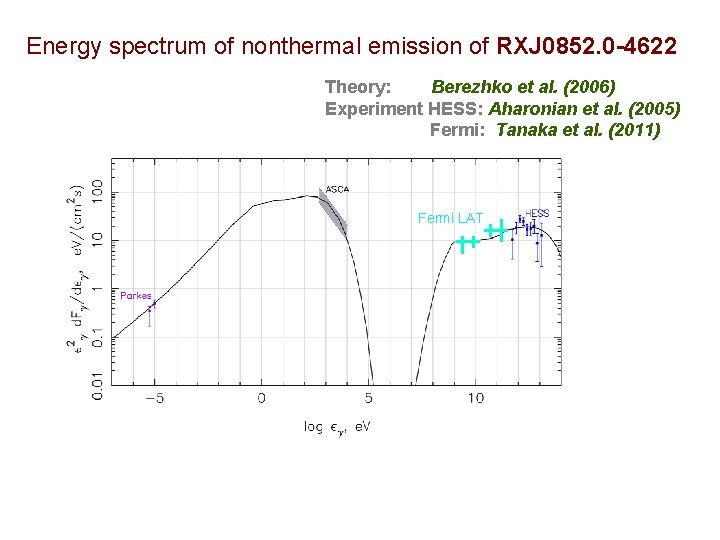
Energy spectrum of nonthermal emission of RXJ 0852. 0 -4622 Theory: Berezhko et al. (2006) Experiment HESS: Aharonian et al. (2005) Fermi: Tanaka et al. (2011) Fermi LAT
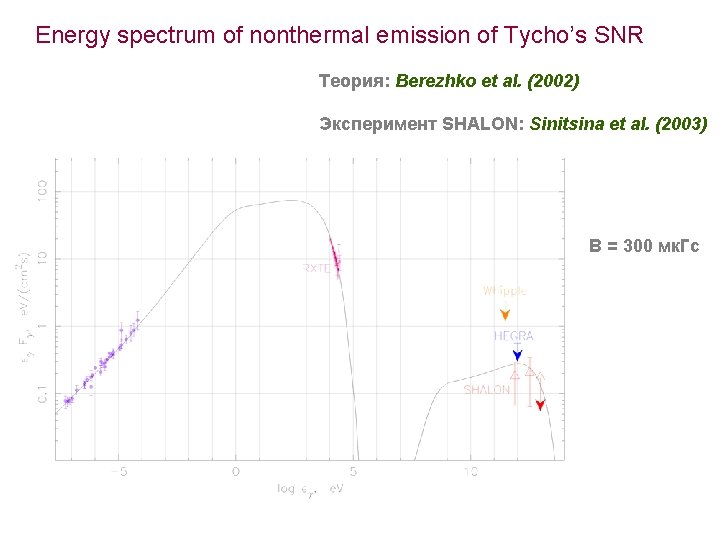
Energy spectrum of nonthermal emission of Tycho’s SNR Теория: Berezhko et al. (2002) Эксперимент SHALON: Sinitsina et al. (2003) В = 300 мк. Гс
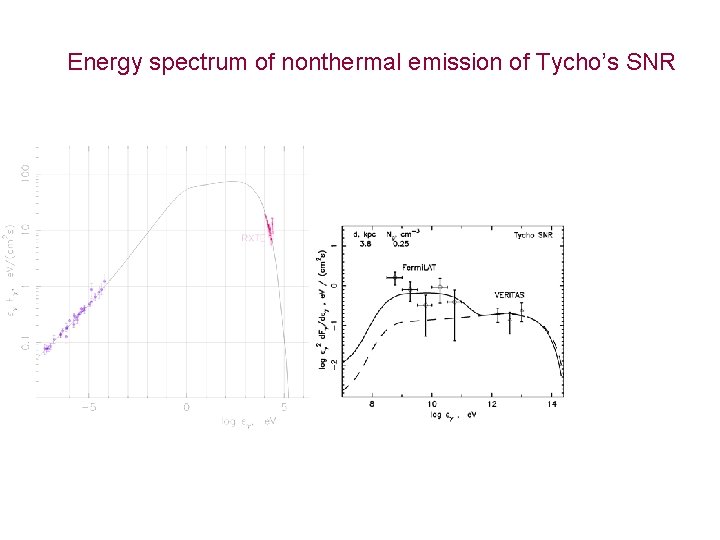
Energy spectrum of nonthermal emission of Tycho’s SNR
- Slides: 21