
SOURCEBASED QUESTIONS RELIABILITY Lesson Focus Breaking down complex
SOURCE-BASED QUESTIONS: RELIABILITY
Lesson Focus… • Breaking down complex sources of information • Discussing how to determine the reliability of sources. • Writing exam style answers to Reliability questions

Reliability Questions In this type of question you are asked to determine the reliability of three different sources of information individually and then make a decision as to which of the three sources is the MOST reliable overall. • There will always be three sources (A, B, C) • Always worth 8 marks • The actual question will always be the same • The sources will all discuss the same topic – which could be any Modern Studies topic.
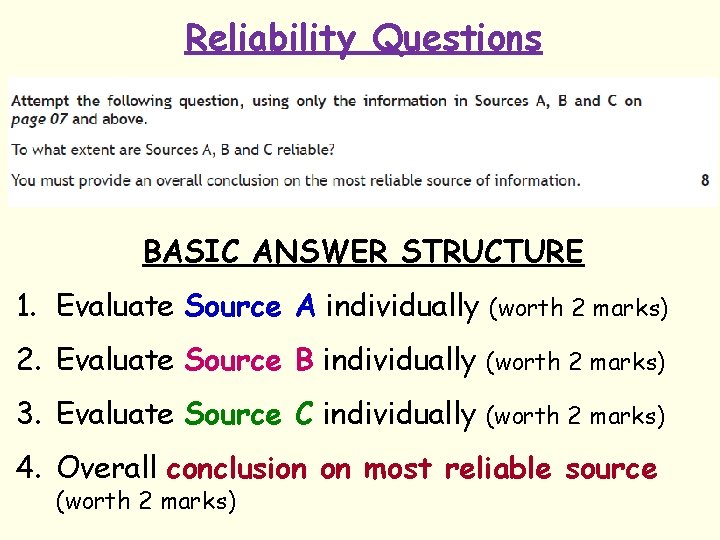
Reliability Questions BASIC ANSWER STRUCTURE 1. Evaluate Source A individually (worth 2 marks) 2. Evaluate Source B individually (worth 2 marks) 3. Evaluate Source C individually (worth 2 marks) 4. Overall conclusion on most reliable source (worth 2 marks)
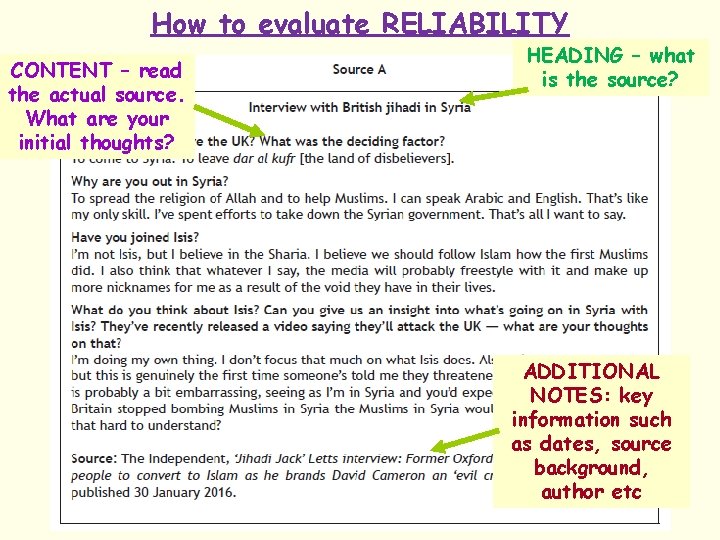
How to evaluate RELIABILITY CONTENT – read the actual source. What are your initial thoughts? HEADING – what is the source? ADDITIONAL NOTES: key information such as dates, source background, author etc
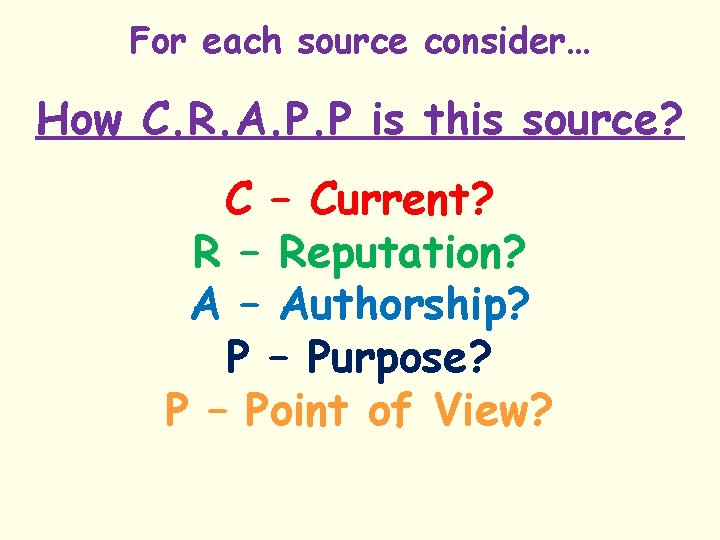
For each source consider… How C. R. A. P. P is this source? C – Current? R – Reputation? A – Authorship? P – Purpose? P – Point of View?
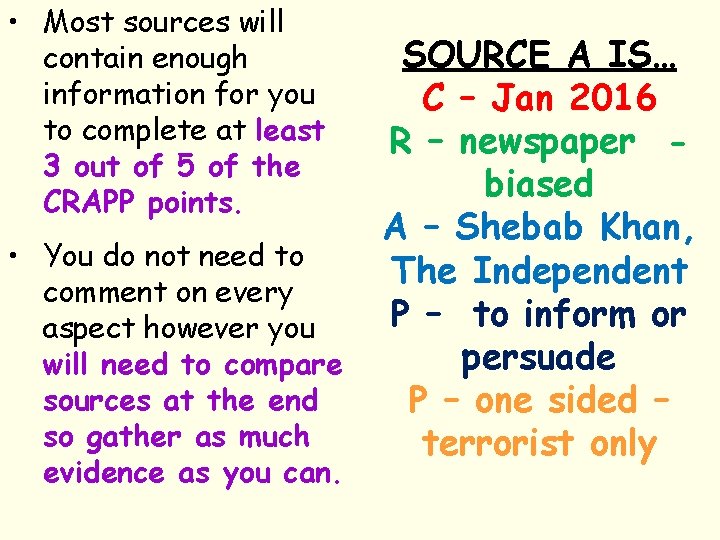
• Most sources will contain enough information for you to complete at least 3 out of 5 of the CRAPP points. • You do not need to comment on every aspect however you will need to compare sources at the end so gather as much evidence as you can. SOURCE A IS… C – Jan 2016 R – newspaper biased A – Shebab Khan, The Independent P – to inform or persuade P – one sided – terrorist only
SOURCE B IS… C – Jan 2016 R – poll of sample In pairs evaluate quota of UK adults Source B using A – the Ipsos MORI CRAPP P – mnemonic. informative P – neutral polling data
SOURCE C IS… C – July 2009 R – Channel 4 In pairs evaluate website – publicly Source C using the funded CRAPPorganisation mnemonic. A – Jon Snow, Channel 4 P – informative? P – ?
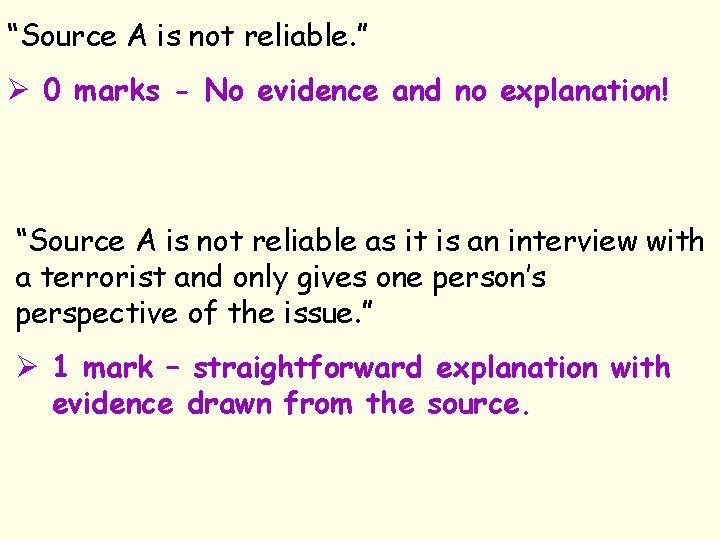
“Source A is not reliable. ” Ø 0 marks - No evidence and no explanation! “Source A is not reliable as it is an interview with a terrorist and only gives one person’s perspective of the issue. ” Ø 1 mark – straightforward explanation with evidence drawn from the source.
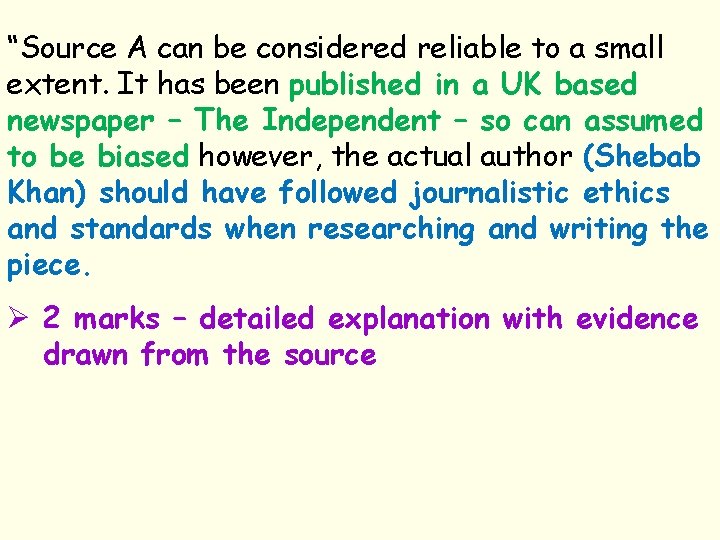
“Source A can be considered reliable to a small extent. It has been published in a UK based newspaper – The Independent – so can assumed to be biased however, the actual author (Shebab Khan) should have followed journalistic ethics and standards when researching and writing the piece. Ø 2 marks – detailed explanation with evidence drawn from the source
SOURCE B IS… C – Jan 2016 R – poll of sample In pairs evaluate quota of UK adults Source B using the A – Ipsos MORI CRAPP mnemonic. P – informative P – neutral polling data
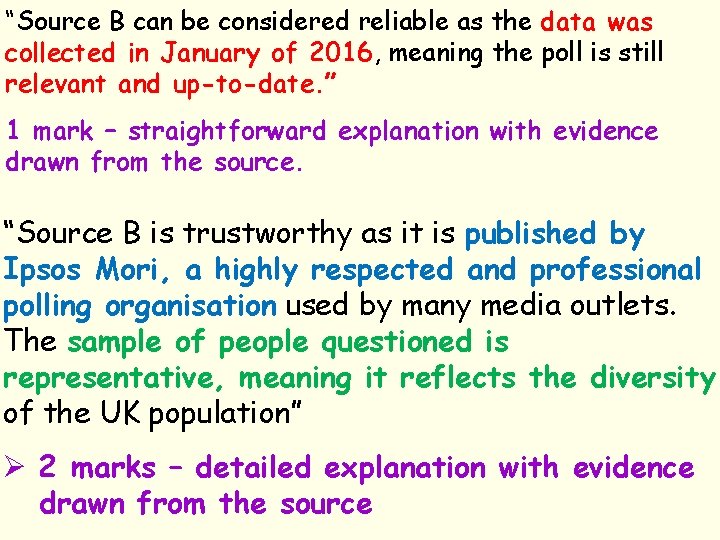
“Source B can be considered reliable as the data was collected in January of 2016, meaning the poll is still relevant and up-to-date. ” 1 mark – straightforward explanation with evidence drawn from the source. “Source B is trustworthy as it is published by Ipsos Mori, a highly respected and professional polling organisation used by many media outlets. The sample of people questioned is representative, meaning it reflects the diversity of the UK population” Ø 2 marks – detailed explanation with evidence drawn from the source
SOURCE C IS… C – July 2009 R – Channel 4 In pairs evaluate website – publicly Source C using the funded organisation CRAPP mnemonic. A – Jon Snow, Channel 4 P – informative? P – ?
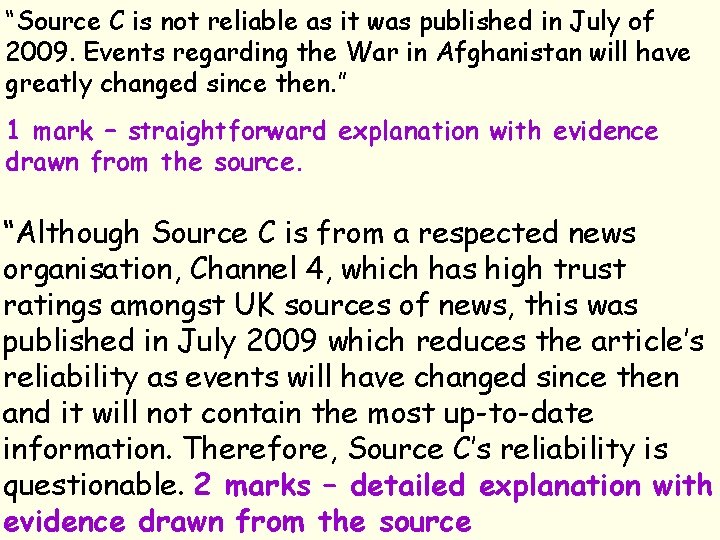
“Source C is not reliable as it was published in July of 2009. Events regarding the War in Afghanistan will have greatly changed since then. ” 1 mark – straightforward explanation with evidence drawn from the source. “Although Source C is from a respected news organisation, Channel 4, which has high trust ratings amongst UK sources of news, this was published in July 2009 which reduces the article’s reliability as events will have changed since then and it will not contain the most up-to-date information. Therefore, Source C’s reliability is questionable. 2 marks – detailed explanation with evidence drawn from the source
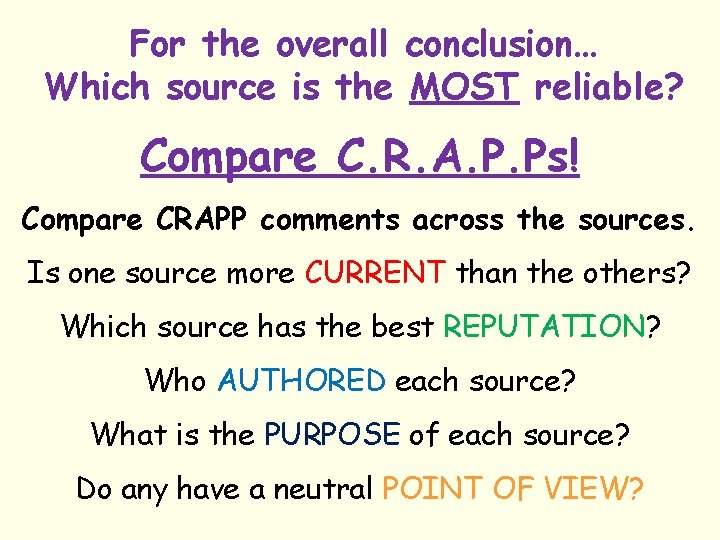
For the overall conclusion… Which source is the MOST reliable? Compare C. R. A. P. Ps! Compare CRAPP comments across the sources. Is one source more CURRENT than the others? Which source has the best REPUTATION? Who AUTHORED each source? What is the PURPOSE of each source? Do any have a neutral POINT OF VIEW?
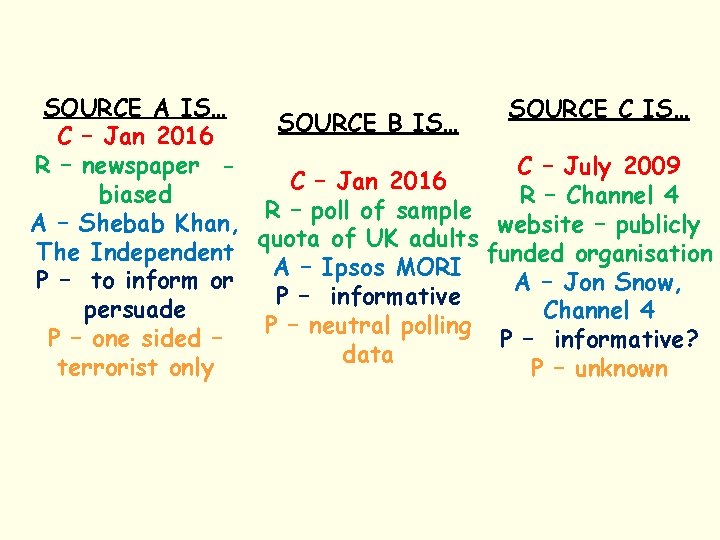
SOURCE A IS… SOURCE C IS… SOURCE B IS… C – Jan 2016 R – newspaper C – July 2009 C – Jan 2016 biased R – Channel 4 R – poll of sample A – Shebab Khan, website – publicly quota of UK adults The Independent funded organisation A – Ipsos MORI P – to inform or A – Jon Snow, P – informative persuade Channel 4 P – neutral polling P – one sided – P – informative? data terrorist only P – unknown
Source B is the most reliable source as the survey was carried out in January 2016 and is more up-to-date than Source C which was published in 2009. Moreover, Source B is also likely to be more objective than Source A which is from a newspaper and likely to be biased in nature. 2 marks – overall conclusion, supported by detailed evidence from all 3 sources. CLEAR OVERALL CONCLUSION STATING THE MOST RELIABLE SOURCE. COMPARISON BETWEEN FIRST TWO SOURCES, USING EVIDENCE COMPARISON BETWEEN SECOND TWO SOURCES, USING EVIDENCE
Reliability of Sources General Hints and Tips Looking for: Where does the info come from? - Charity, Government, Business, Newspapers…could they have an agenda or are they legally bound to produce accurate information? Has it been adapted or is it representative? - Adapting suggests that information has been changed/removed/tampered with, therefore, is it reliable? When was the information published? - Is the information up-to-date? Does it accurately reflect the current situation?
“Source A is not reliable as it very outdated – the information was first published in March of 2013. Also, although the information comes directly from the New South government, it is portrayed in a misleading manner as the infographic makes the jump in the number of nurses between 2010/11 and 2011/12 seem far greater an increase than it actually is, making the source unreliable in another manner. – 2 marks
- Slides: 20