
Source Selection In a Contingency Environment Lesson Objectives
Source Selection In a Contingency Environment
Lesson Objectives Terminal Learning Objective: • Given a situation requiring the need to select the Best Value offer in response to a Government requirement; specify the necessary steps in the source selection process. Enabling Learning Objectives: • Define the term “Source Selection. ” • Explain the elements of the formal source selection process. • Develop instructions to offeror’s and evaluation factors for a best value source selection. Learn. Perform. Succeed. 2
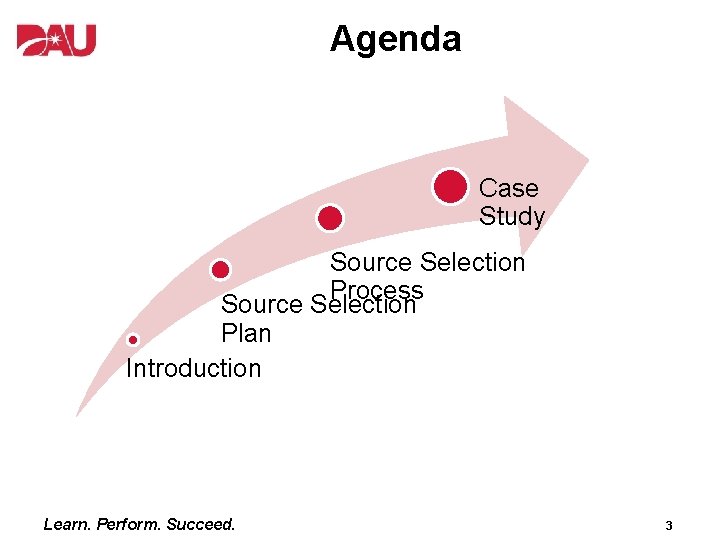
Agenda Case Study Source Selection Process Source Selection Plan Introduction Learn. Perform. Succeed. 3
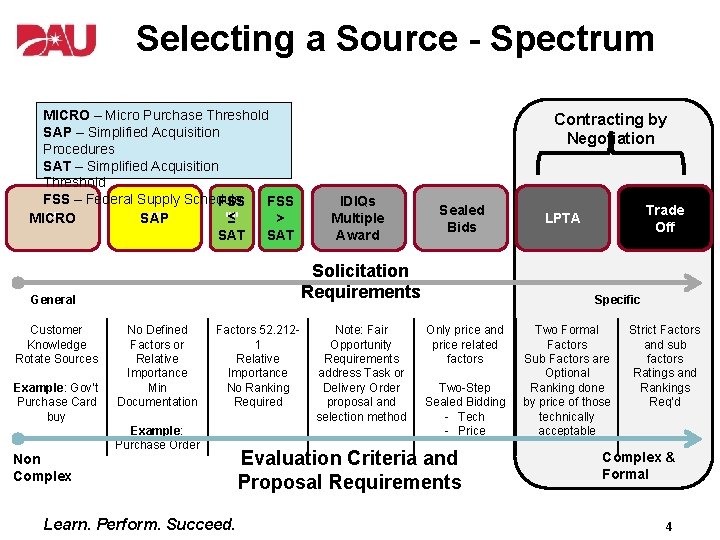
Selecting a Source - Spectrum MICRO – Micro Purchase Threshold SAP – Simplified Acquisition Procedures SAT – Simplified Acquisition Threshold FSS – Federal Supply Schedule FSS ≤ > MICRO SAP "" "" "" SAT Example: Gov’t Purchase Card buy Non Complex IDIQs Multiple Award Sealed Bids Solicitation Requirements General Customer Knowledge Rotate Sources Contracting by Negotiation No Defined Factors or Relative Importance Min Documentation Factors 52. 2121 Relative Importance No Ranking Required Example: Purchase Order Learn. Perform. Succeed. Note: Fair Opportunity Requirements address Task or Delivery Order proposal and selection method Trade Off LPTA Specific Only price and price related factors Two-Step Sealed Bidding - Tech - Price Evaluation Criteria and Proposal Requirements Two Formal Factors Sub Factors are Optional Ranking done by price of those technically acceptable Strict Factors and sub factors Ratings and Rankings Req’d Complex & Formal 4
Formal Source Selection • What is Formal Source Selection? – Portion of the federal acquisition process that allows the Government to assess the offerors’ ability to meet the Government’s needs and evaluate the relative merits of competing proposals • Why Formal Source Selection? – Factors in addition to price – Superior performance or faster delivery – Best value – expected outcome… greatest benefit – Acquisition system still open and fair – Trade off – not necessarily low price or best technical Learn. Perform. Succeed. 5
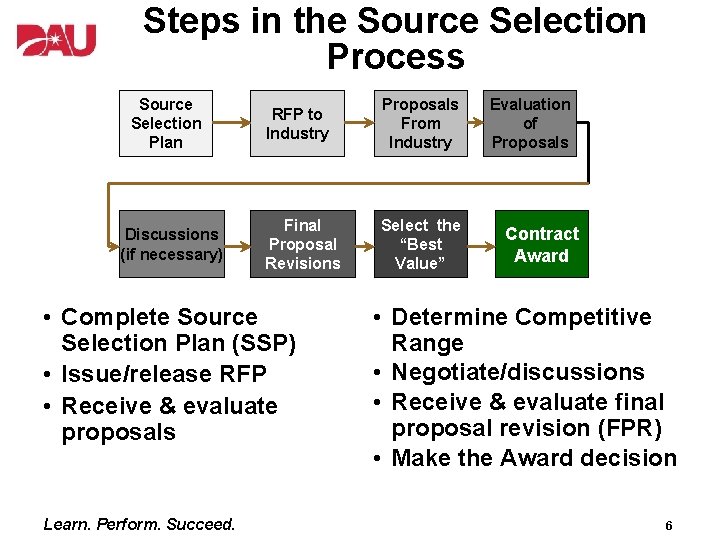
Steps in the Source Selection Process Source Selection Plan Discussions (if necessary) RFP to Industry Proposals From Industry Final Proposal Revisions Select the “Best Value” • Complete Source Selection Plan (SSP) • Issue/release RFP • Receive & evaluate proposals Learn. Perform. Succeed. Evaluation of Proposals Contract Award • Determine Competitive Range • Negotiate/discussions • Receive & evaluate final proposal revision (FPR) • Make the Award decision 6
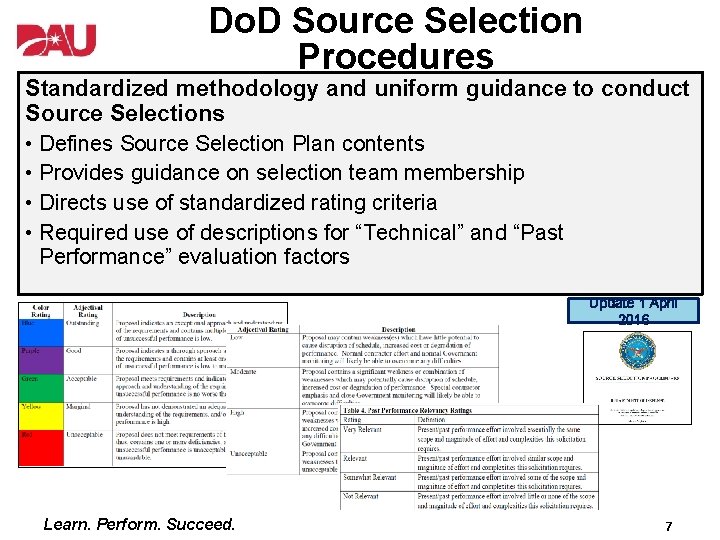
Do. D Source Selection Procedures Standardized methodology and uniform guidance to conduct Source Selections • Defines Source Selection Plan contents • Provides guidance on selection team membership • Directs use of standardized rating criteria • Required use of descriptions for “Technical” and “Past Performance” evaluation factors Update 1 April 2016 Learn. Perform. Succeed. 7
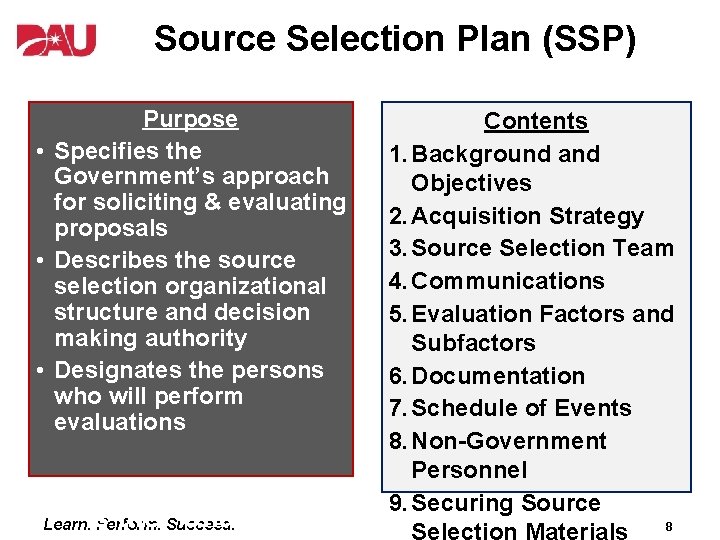
Source Selection Plan (SSP) Purpose • Specifies the Government’s approach for soliciting & evaluating proposals • Describes the source selection organizational structure and decision making authority • Designates the persons who will perform evaluations After SSA approval, it the Succeed. “Charter” Learn. is Perform. Contents 1. Background and Objectives 2. Acquisition Strategy 3. Source Selection Team 4. Communications 5. Evaluation Factors and Subfactors 6. Documentation 7. Schedule of Events 8. Non-Government Personnel 9. Securing Source 8 Selection Materials
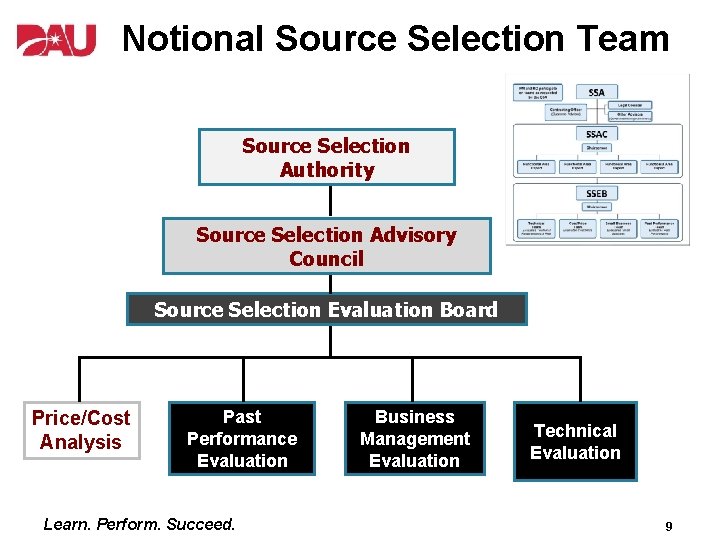
Notional Source Selection Team Source Selection Authority Source Selection Advisory Council Source Selection Evaluation Board Price/Cost Analysis Past Performance Evaluation Learn. Perform. Succeed. Business Management Evaluation Technical Evaluation 9
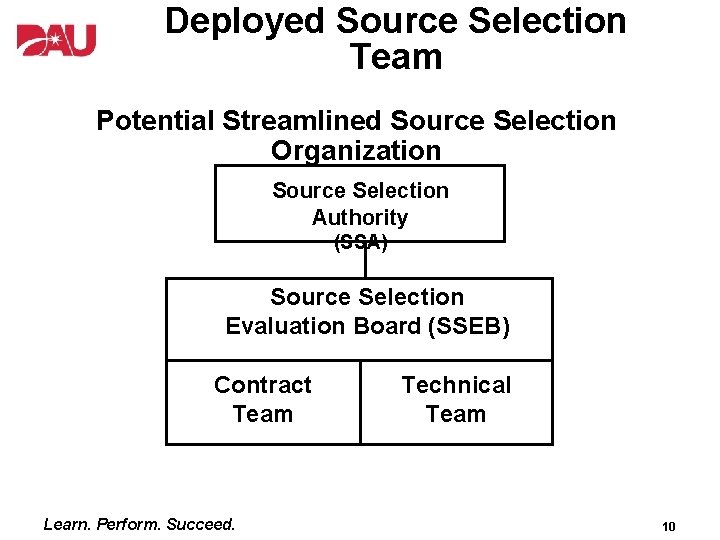
Deployed Source Selection Team Potential Streamlined Source Selection Organization Source Selection Authority (SSA) Source Selection Evaluation Board (SSEB) Contract Team Learn. Perform. Succeed. Technical Team 10
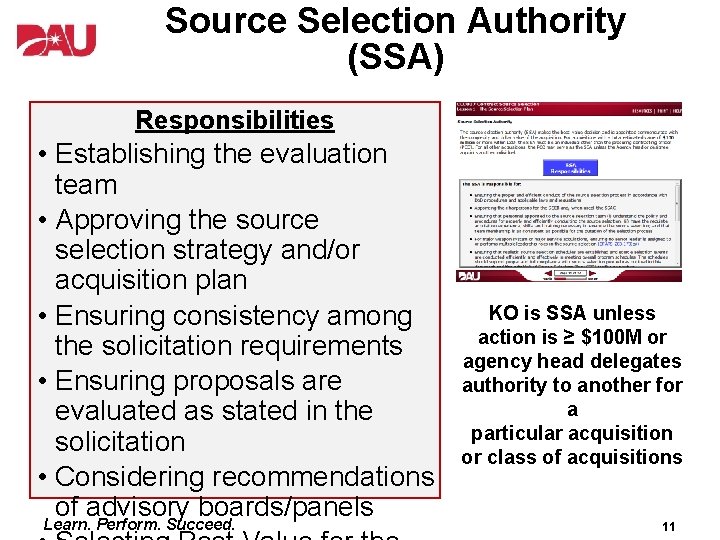
Source Selection Authority (SSA) Responsibilities • Establishing the evaluation team • Approving the source selection strategy and/or acquisition plan • Ensuring consistency among the solicitation requirements • Ensuring proposals are evaluated as stated in the solicitation • Considering recommendations of advisory boards/panels Learn. Perform. Succeed. KO is SSA unless action is ≥ $100 M or agency head delegates authority to another for a particular acquisition or class of acquisitions 11
Source Selection Advisory Council • • Roles & Responsibilities Assure resources & time are not excessive Review & recommend approval of evaluation factors Determine importance of the factors Approve membership of SSEB Ensure training of SSEB Review analysis of SSEB evaluation results Recommend sources if requested Review source selection decision document Learn. Perform. Succeed. Group of Professional or Managerial Government Personnel Chosen From Functional Fields Related to the SSAC Chair is Acquisition appointed by the SSA 12
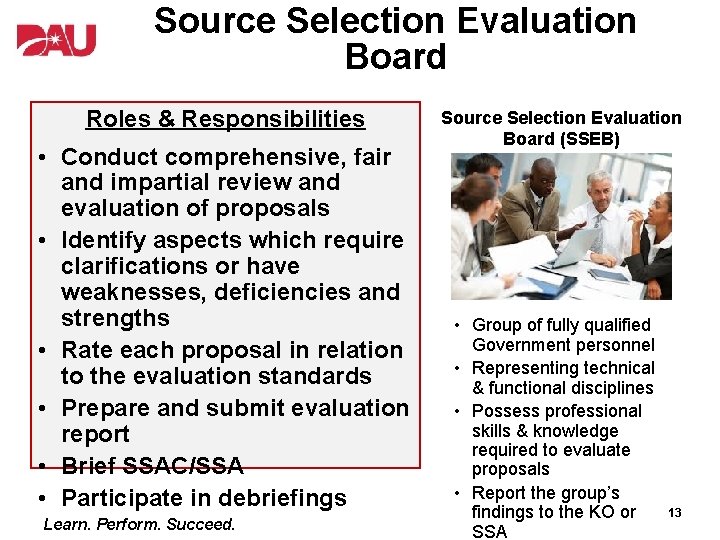
Source Selection Evaluation Board Roles & Responsibilities • Conduct comprehensive, fair and impartial review and evaluation of proposals • Identify aspects which require clarifications or have weaknesses, deficiencies and strengths • Rate each proposal in relation to the evaluation standards • Prepare and submit evaluation report • Brief SSAC/SSA • Participate in debriefings Learn. Perform. Succeed. Source Selection Evaluation Board (SSEB) • Group of fully qualified Government personnel • Representing technical & functional disciplines • Possess professional skills & knowledge required to evaluate proposals • Report the group’s findings to the KO or SSA 13
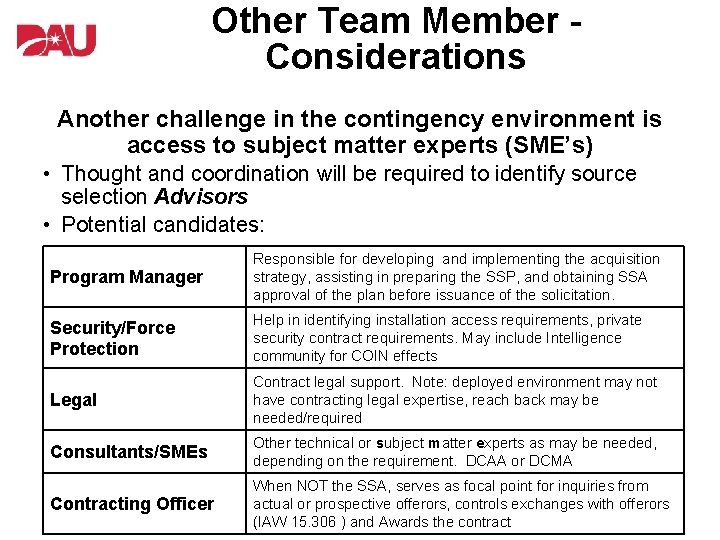
Other Team Member Considerations Another challenge in the contingency environment is access to subject matter experts (SME’s) • Thought and coordination will be required to identify source selection Advisors • Potential candidates: Program Manager Responsible for developing and implementing the acquisition strategy, assisting in preparing the SSP, and obtaining SSA approval of the plan before issuance of the solicitation. Security/Force Protection Help in identifying installation access requirements, private security contract requirements. May include Intelligence community for COIN effects Legal Contract legal support. Note: deployed environment may not have contracting legal expertise, reach back may be needed/required Consultants/SMEs Other technical or subject matter experts as may be needed, depending on the requirement. DCAA or DCMA Contracting Officer When NOT the SSA, serves as focal point for inquiries from actual or prospective offerors, controls exchanges with offerors 14 (IAW 15. 306 ) and Awards the contract Learn. Perform. Succeed.
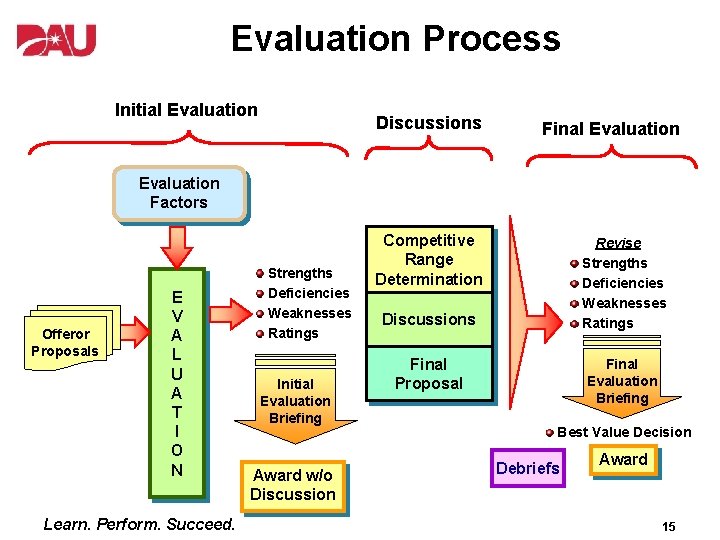
Evaluation Process Initial Evaluation Discussions Final Evaluation Factors Offeror Proposals E V A L U A T I O N Learn. Perform. Succeed. Strengths Deficiencies Weaknesses Ratings Initial Evaluation Briefing Award w/o Discussion Competitive Range Determination Revise Strengths Deficiencies Weaknesses Ratings Discussions Final Proposal Final Evaluation Briefing Best Value Decision Debriefs Award 15
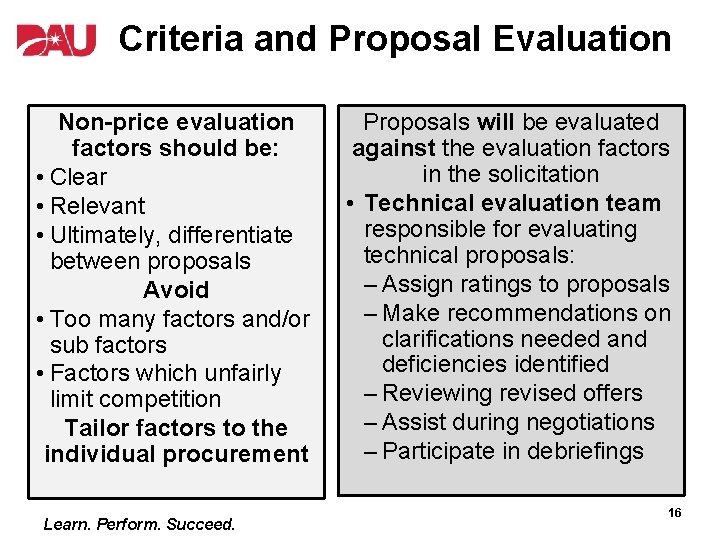
Criteria and Proposal Evaluation Non-price evaluation factors should be: • Clear • Relevant • Ultimately, differentiate between proposals Avoid • Too many factors and/or sub factors • Factors which unfairly limit competition Tailor factors to the individual procurement Learn. Perform. Succeed. Proposals will be evaluated against the evaluation factors in the solicitation • Technical evaluation team responsible for evaluating technical proposals: – Assign ratings to proposals – Make recommendations on clarifications needed and deficiencies identified – Reviewing revised offers – Assist during negotiations – Participate in debriefings 16
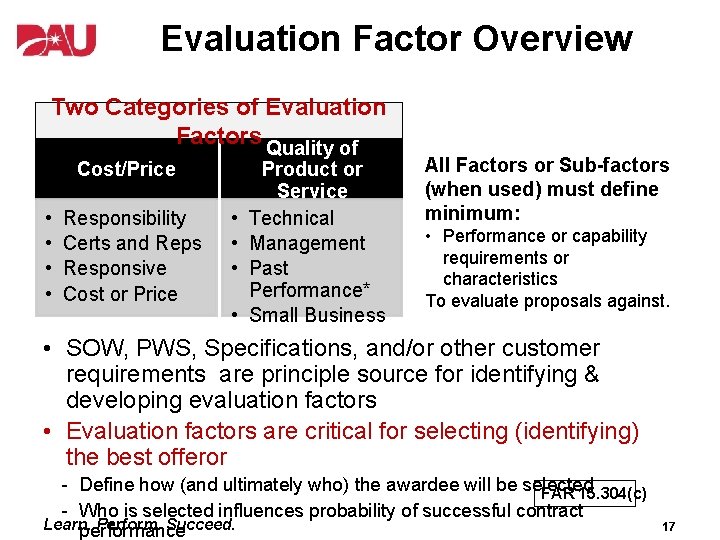
Evaluation Factor Overview Two Categories of Evaluation Factors Quality of Cost/Price • • Responsibility Certs and Reps Responsive Cost or Price • • Product or Service Technical Management Past Performance* Small Business All Factors or Sub-factors (when used) must define minimum: • Performance or capability requirements or characteristics To evaluate proposals against. • SOW, PWS, Specifications, and/or other customer requirements are principle source for identifying & developing evaluation factors • Evaluation factors are critical for selecting (identifying) the best offeror - Define how (and ultimately who) the awardee will be selected FAR 15. 304(c) - Who is selected influences probability of successful contract Learn. Perform. Succeed. performance 17
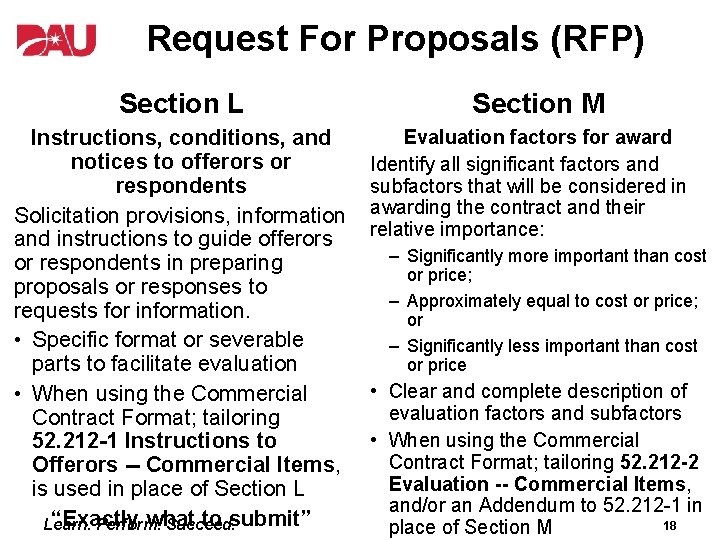
Request For Proposals (RFP) Section L Instructions, conditions, and notices to offerors or respondents Solicitation provisions, information and instructions to guide offerors or respondents in preparing proposals or responses to requests for information. • Specific format or severable parts to facilitate evaluation • When using the Commercial Contract Format; tailoring 52. 212 -1 Instructions to Offerors -- Commercial Items, is used in place of Section L “Exactly what to submit” Learn. Perform. Succeed. Section M Evaluation factors for award Identify all significant factors and subfactors that will be considered in awarding the contract and their relative importance: – Significantly more important than cost or price; – Approximately equal to cost or price; or – Significantly less important than cost or price • Clear and complete description of evaluation factors and subfactors • When using the Commercial Contract Format; tailoring 52. 212 -2 Evaluation -- Commercial Items, and/or an Addendum to 52. 212 -1 in 18 place of Section M
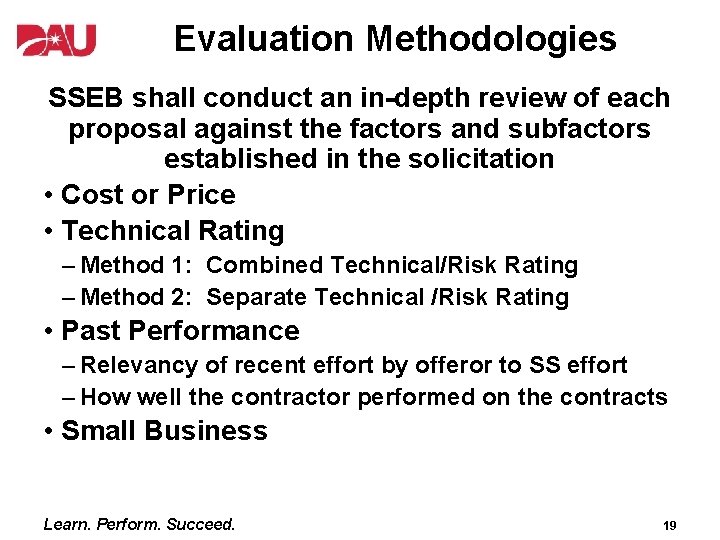
Evaluation Methodologies SSEB shall conduct an in-depth review of each proposal against the factors and subfactors established in the solicitation • Cost or Price • Technical Rating – Method 1: Combined Technical/Risk Rating – Method 2: Separate Technical /Risk Rating • Past Performance – Relevancy of recent effort by offeror to SS effort – How well the contractor performed on the contracts • Small Business Learn. Perform. Succeed. 19
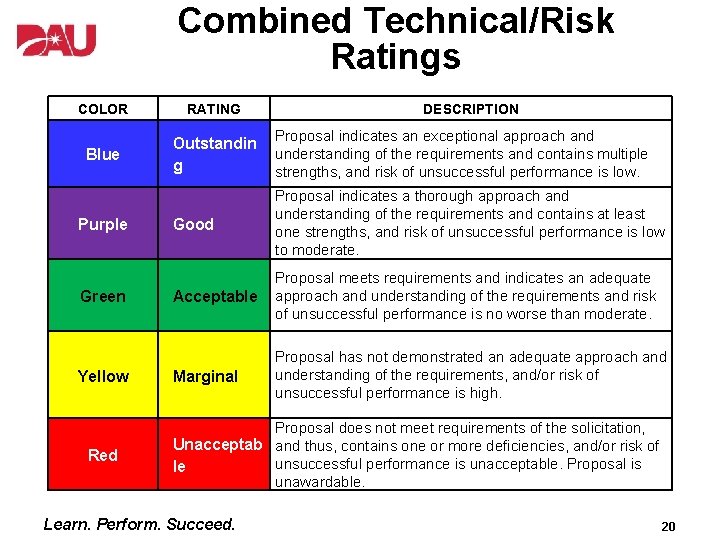
Combined Technical/Risk Ratings COLOR RATING Blue Outstandin g Proposal indicates an exceptional approach and understanding of the requirements and contains multiple strengths, and risk of unsuccessful performance is low. Good Proposal indicates a thorough approach and understanding of the requirements and contains at least one strengths, and risk of unsuccessful performance is low to moderate. Acceptable Proposal meets requirements and indicates an adequate approach and understanding of the requirements and risk of unsuccessful performance is no worse than moderate. Marginal Proposal has not demonstrated an adequate approach and understanding of the requirements, and/or risk of unsuccessful performance is high. Purple Green Yellow Red DESCRIPTION Proposal does not meet requirements of the solicitation, Unacceptab and thus, contains one or more deficiencies, and/or risk of unsuccessful performance is unacceptable. Proposal is le unawardable. Learn. Perform. Succeed. 20
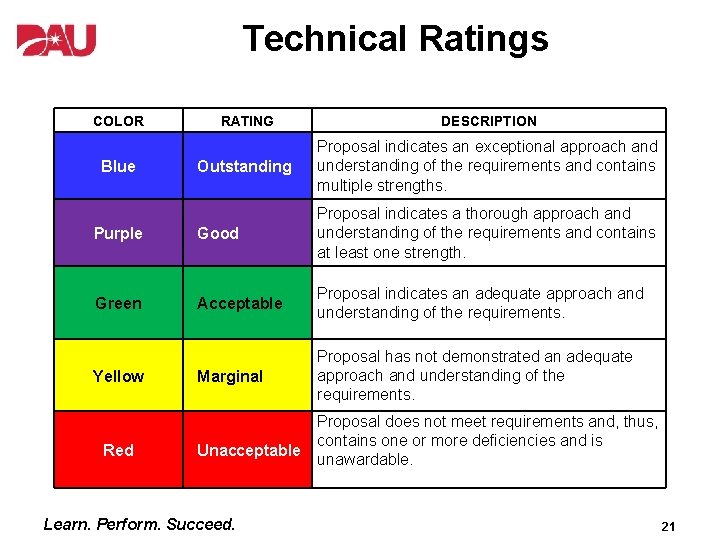
Technical Ratings COLOR RATING DESCRIPTION Outstanding Proposal indicates an exceptional approach and understanding of the requirements and contains multiple strengths. Purple Good Proposal indicates a thorough approach and understanding of the requirements and contains at least one strength. Green Acceptable Proposal indicates an adequate approach and understanding of the requirements. Marginal Proposal has not demonstrated an adequate approach and understanding of the requirements. Blue Yellow Red Unacceptable Learn. Perform. Succeed. Proposal does not meet requirements and, thus, contains one or more deficiencies and is unawardable. 21
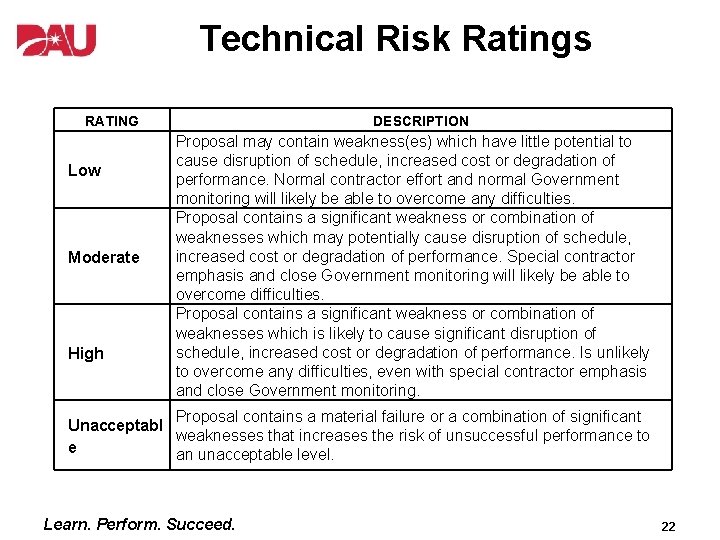
Technical Risk Ratings RATING Low Moderate High DESCRIPTION Proposal may contain weakness(es) which have little potential to cause disruption of schedule, increased cost or degradation of performance. Normal contractor effort and normal Government monitoring will likely be able to overcome any difficulties. Proposal contains a significant weakness or combination of weaknesses which may potentially cause disruption of schedule, increased cost or degradation of performance. Special contractor emphasis and close Government monitoring will likely be able to overcome difficulties. Proposal contains a significant weakness or combination of weaknesses which is likely to cause significant disruption of schedule, increased cost or degradation of performance. Is unlikely to overcome any difficulties, even with special contractor emphasis and close Government monitoring. Proposal contains a material failure or a combination of significant Unacceptabl weaknesses that increases the risk of unsuccessful performance to e an unacceptable level. Learn. Perform. Succeed. 22
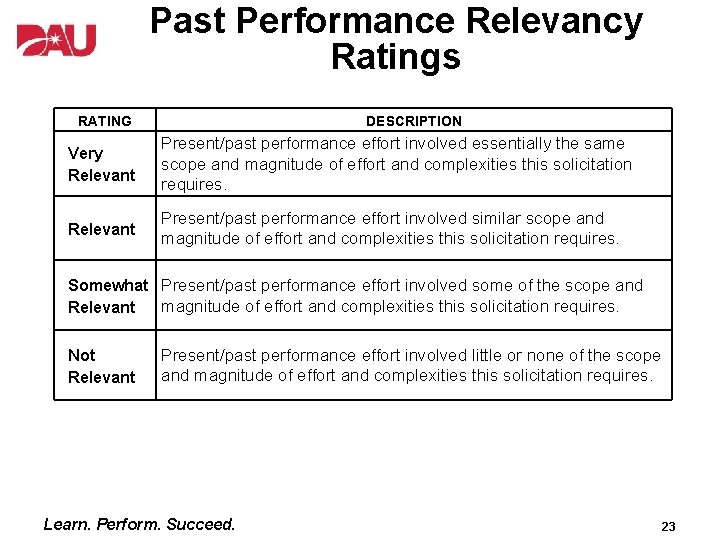
Past Performance Relevancy Ratings RATING DESCRIPTION Very Relevant Present/past performance effort involved essentially the same scope and magnitude of effort and complexities this solicitation requires. Relevant Present/past performance effort involved similar scope and magnitude of effort and complexities this solicitation requires. Somewhat Present/past performance effort involved some of the scope and magnitude of effort and complexities this solicitation requires. Relevant Not Relevant Present/past performance effort involved little or none of the scope and magnitude of effort and complexities this solicitation requires. Learn. Perform. Succeed. 23
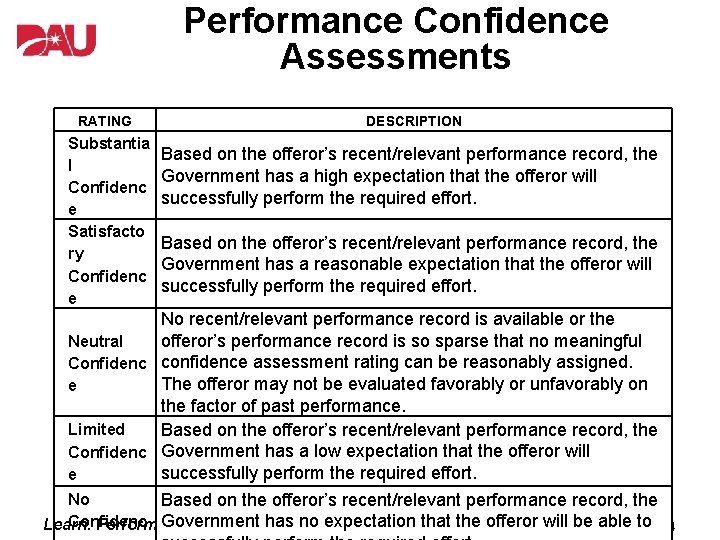
Performance Confidence Assessments RATING Substantia l Confidenc e Satisfacto ry Confidenc e DESCRIPTION Based on the offeror’s recent/relevant performance record, the Government has a high expectation that the offeror will successfully perform the required effort. Based on the offeror’s recent/relevant performance record, the Government has a reasonable expectation that the offeror will successfully perform the required effort. No recent/relevant performance record is available or the Neutral offeror’s performance record is so sparse that no meaningful Confidenc confidence assessment rating can be reasonably assigned. The offeror may not be evaluated favorably or unfavorably on e the factor of past performance. Limited Based on the offeror’s recent/relevant performance record, the Confidenc Government has a low expectation that the offeror will successfully perform the required effort. e No Based on the offeror’s recent/relevant performance record, the has no expectation that the offeror will be able to 24 Confidenc Learn. Perform. Government Succeed.
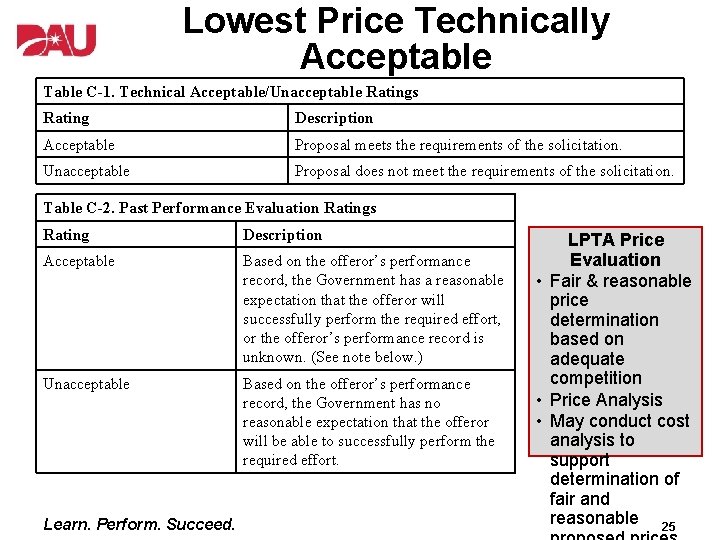
Lowest Price Technically Acceptable Table C-1. Technical Acceptable/Unacceptable Ratings Rating Description Acceptable Proposal meets the requirements of the solicitation. Unacceptable Proposal does not meet the requirements of the solicitation. Table C-2. Past Performance Evaluation Ratings Rating Description Acceptable Based on the offeror’s performance record, the Government has a reasonable expectation that the offeror will successfully perform the required effort, or the offeror’s performance record is unknown. (See note below. ) Unacceptable Based on the offeror’s performance record, the Government has no reasonable expectation that the offeror will be able to successfully perform the required effort. Learn. Perform. Succeed. LPTA Price Evaluation • Fair & reasonable price determination based on adequate competition • Price Analysis • May conduct cost analysis to support determination of fair and reasonable 25
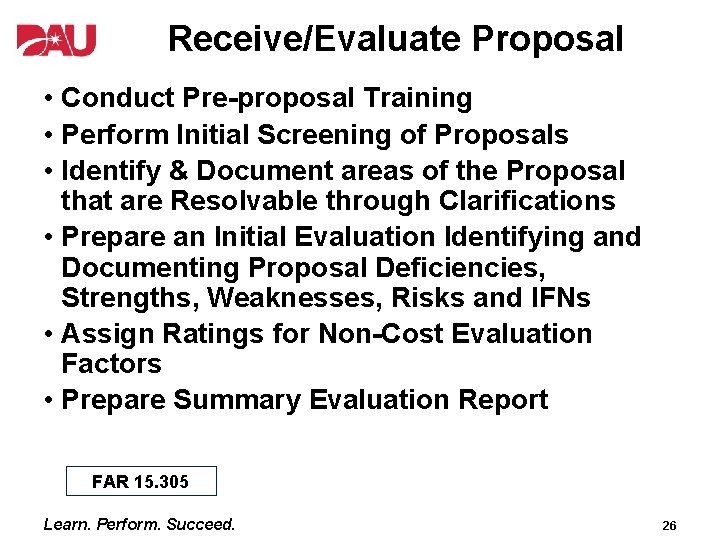
Receive/Evaluate Proposal • Conduct Pre-proposal Training • Perform Initial Screening of Proposals • Identify & Document areas of the Proposal that are Resolvable through Clarifications • Prepare an Initial Evaluation Identifying and Documenting Proposal Deficiencies, Strengths, Weaknesses, Risks and IFNs • Assign Ratings for Non-Cost Evaluation Factors • Prepare Summary Evaluation Report FAR 15. 305 Learn. Perform. Succeed. 26
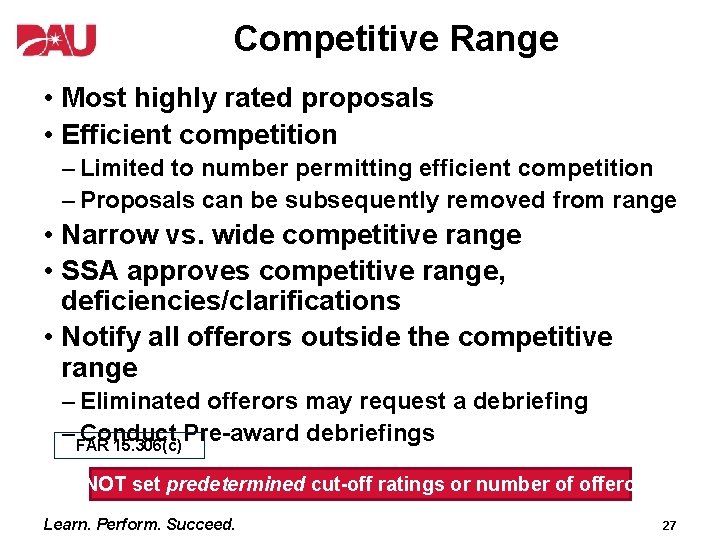
Competitive Range • Most highly rated proposals • Efficient competition – Limited to number permitting efficient competition – Proposals can be subsequently removed from range • Narrow vs. wide competitive range • SSA approves competitive range, deficiencies/clarifications • Notify all offerors outside the competitive range – Eliminated offerors may request a debriefing – FAR Conduct Pre-award debriefings 15. 306(c) Do NOT set predetermined cut-off ratings or number of offerors!! Learn. Perform. Succeed. 27
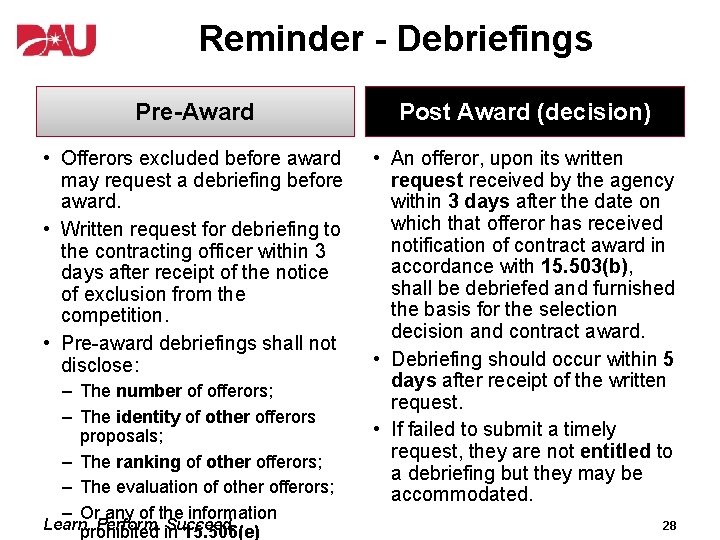
Reminder - Debriefings Pre-Award Post Award (decision) • Offerors excluded before award may request a debriefing before award. • Written request for debriefing to the contracting officer within 3 days after receipt of the notice of exclusion from the competition. • Pre-award debriefings shall not disclose: • An offeror, upon its written request received by the agency within 3 days after the date on which that offeror has received notification of contract award in accordance with 15. 503(b), shall be debriefed and furnished the basis for the selection decision and contract award. • Debriefing should occur within 5 days after receipt of the written request. • If failed to submit a timely request, they are not entitled to a debriefing but they may be accommodated. – The number of offerors; – The identity of other offerors proposals; – The ranking of other offerors; – The evaluation of other offerors; – Or any of the information Learn. Perform. in Succeed. prohibited 15. 506(e) 28
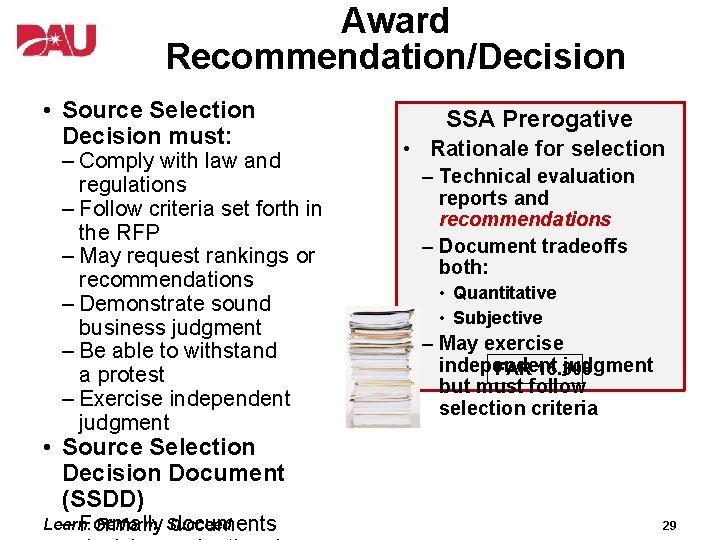
Award Recommendation/Decision • Source Selection Decision must: – Comply with law and regulations – Follow criteria set forth in the RFP – May request rankings or recommendations – Demonstrate sound business judgment – Be able to withstand a protest – Exercise independent judgment SSA Prerogative • Rationale for selection – Technical evaluation reports and recommendations – Document tradeoffs both: • Quantitative • Subjective – May exercise independent judgment FAR 15. 308 but must follow selection criteria • Source Selection Decision Document (SSDD) Learn. Perform. Succeed. – Formally documents 29
Source Selection Information • Acquisition plan • Source selection plan • Solicitation • Evaluations • Competitive range determinations • Discussions • Final proposal revisions • Source selection decision memorandum • Debriefings Learn. Perform. Succeed. 30
Contingency Location CHALLENGES • Limited Subject Matter Expertise • Inability to have personnel – full time SSEB members • Transient nature of requiring organizations • Local Vendor knowledge of process • CAAF + Conflicts of Interest • Use of Oral Proposals/Presentations – How will they be evaluated? (must be clear in RFP) – When & where – AT/FP concerns? • Safeguarding SS information – Unauthorized disclosure of information – Appearance of, or actual conflicts of interest – Physical Security Learn. Perform. Succeed. 31
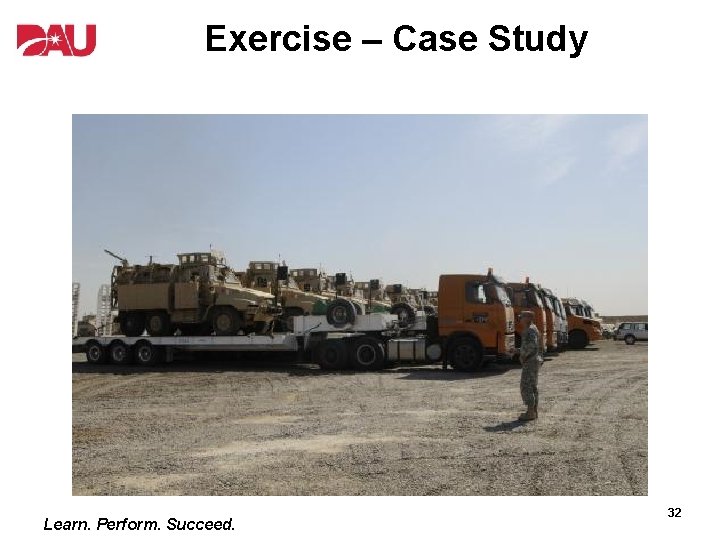
Exercise – Case Study Learn. Perform. Succeed. 32
- Slides: 32