
Source Frontend IR Optimizer IR Machine Backend code
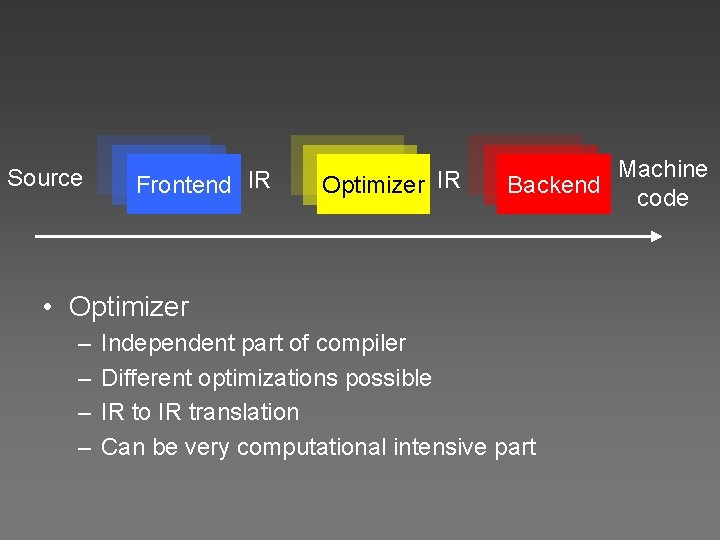
Source Frontend IR Optimizer IR Machine Backend code • Optimizer – – Independent part of compiler Different optimizations possible IR to IR translation Can be very computational intensive part
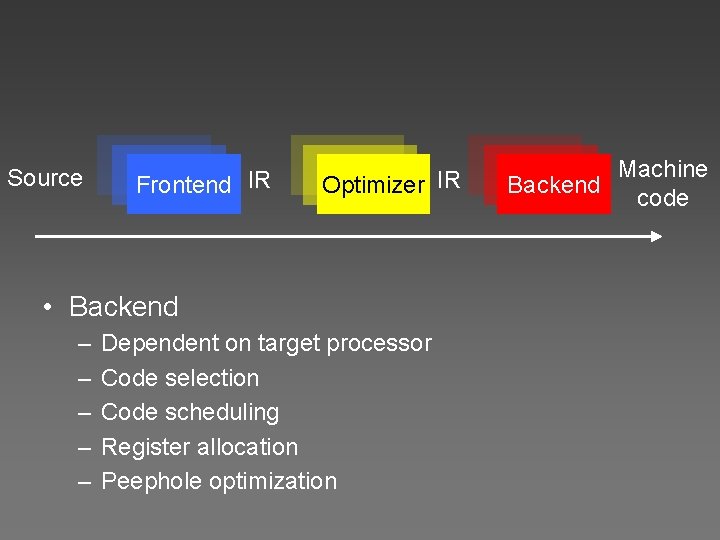
Source Frontend IR Optimizer IR • Backend – – – Dependent on target processor Code selection Code scheduling Register allocation Peephole optimization Machine Backend code
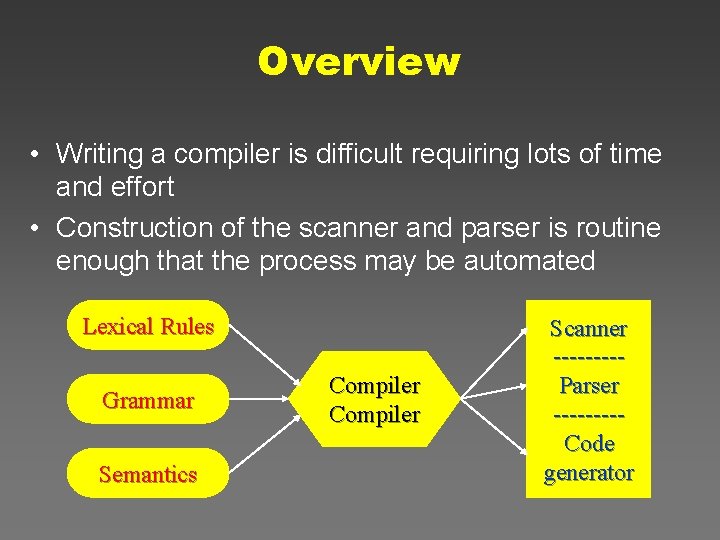
Overview • Writing a compiler is difficult requiring lots of time and effort • Construction of the scanner and parser is routine enough that the process may be automated Lexical Rules Grammar Semantics Compiler Scanner ----Parser ----Code generator
YACC • What is YACC ? – Tool which will produce a parser for a given grammar. – YACC (Yet Another Compiler) is a program designed to compile a LALR(1) grammar and to produce the source code of the syntactic analyzer of the language produced by this grammar – Input is a grammar (rules) and actions to take upon recognizing a rule – Output is a C program and optionally a header file of tokens
LEX • Lex is a scanner generator – Input is description of patterns and actions – Output is a C program which contains a function yylex() which, when called, matches patterns and performs actions per input – Typically, the generated scanner performs lexical analysis and produces tokens for the (YACC-generated) parser
![LEX and YACC: a team call yylex() [0 -9]+ next token is NUM ‘+’](http://slidetodoc.com/presentation_image/2b46a8cd32d8770402e8335cfe80583d/image-6.jpg "LEX and YACC: a team call yylex() [0 -9]+ next token is NUM ‘+’")
LEX and YACC: a team call yylex() [0 -9]+ next token is NUM ‘+’ NUM
Availability • • • lex, yacc on most UNIX systems bison: a yacc replacement from GNU flex: fast lexical analyzer BSD yacc Windows/MS-DOS versions exist
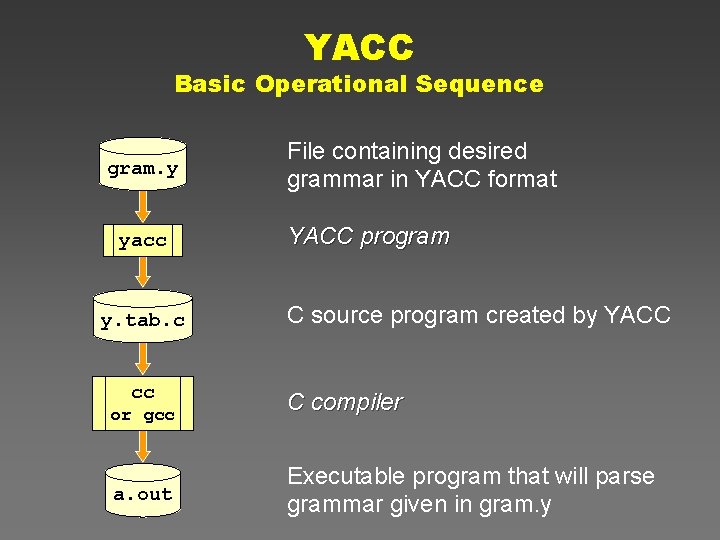
YACC Basic Operational Sequence gram. y yacc y. tab. c cc or gcc a. out File containing desired grammar in YACC format YACC program C source program created by YACC C compiler Executable program that will parse grammar given in gram. y
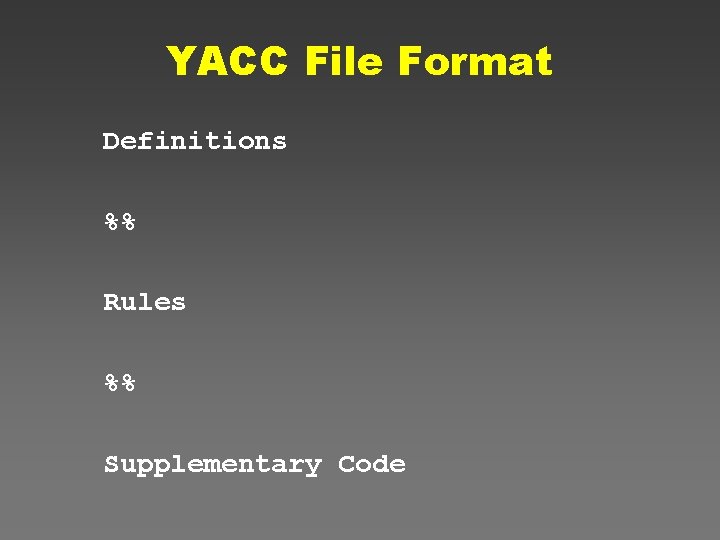
YACC File Format Definitions %% Rules %% Supplementary Code
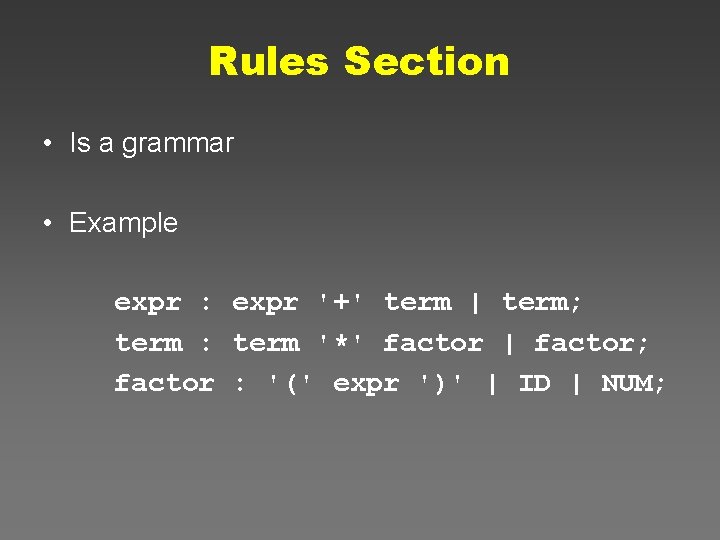
Rules Section • Is a grammar • Example expr : expr '+' term | term; term : term '*' factor | factor; factor : '(' expr ')' | ID | NUM;
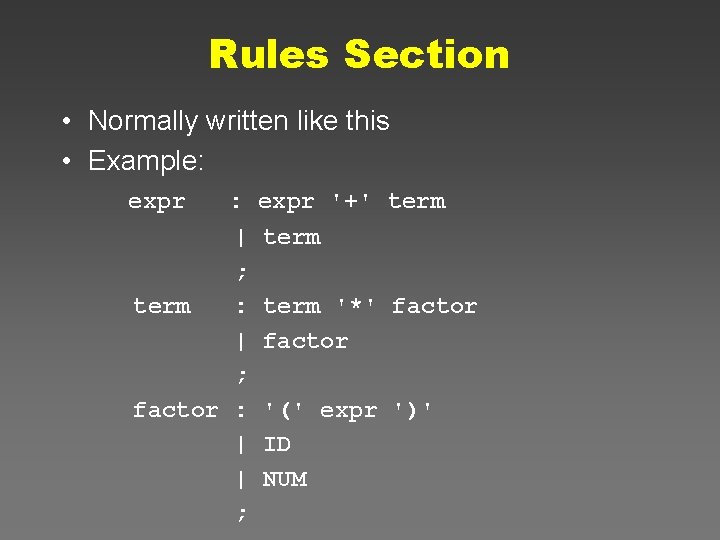
Rules Section • Normally written like this • Example: expr : | ; term : | ; factor : | | ; expr '+' term '*' factor '(' expr ')' ID NUM
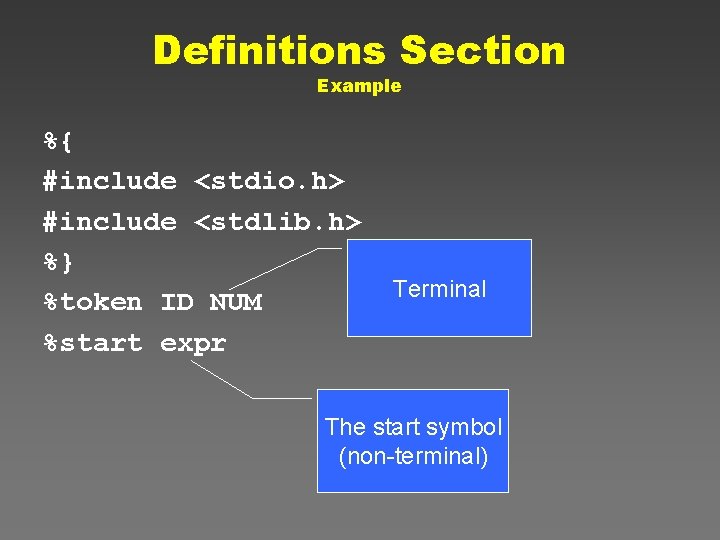
Definitions Section Example %{ #include <stdio. h> #include <stdlib. h> %} %token ID NUM %start expr Terminal The start symbol (non-terminal)
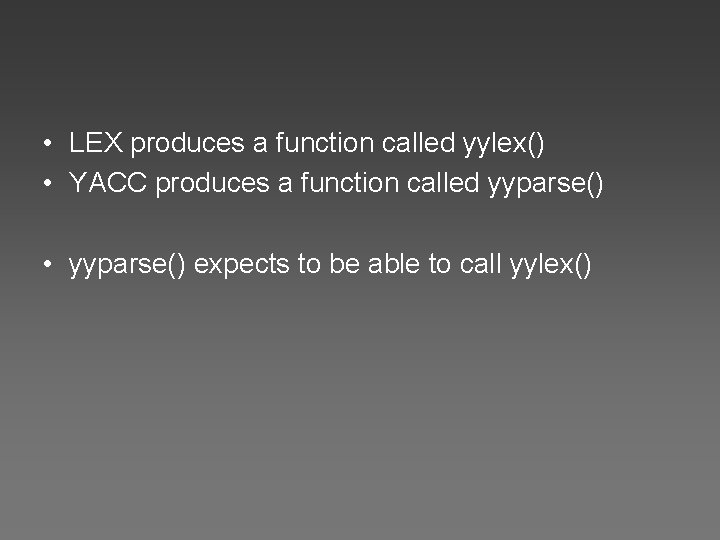
• LEX produces a function called yylex() • YACC produces a function called yyparse() • yyparse() expects to be able to call yylex()
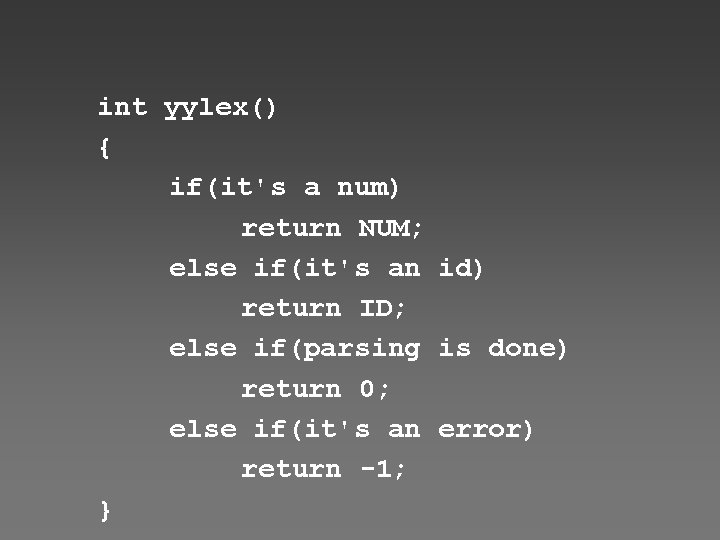
int yylex() { if(it's a num) return NUM; else if(it's an id) return ID; else if(parsing is done) return 0; else if(it's an error) return -1; }
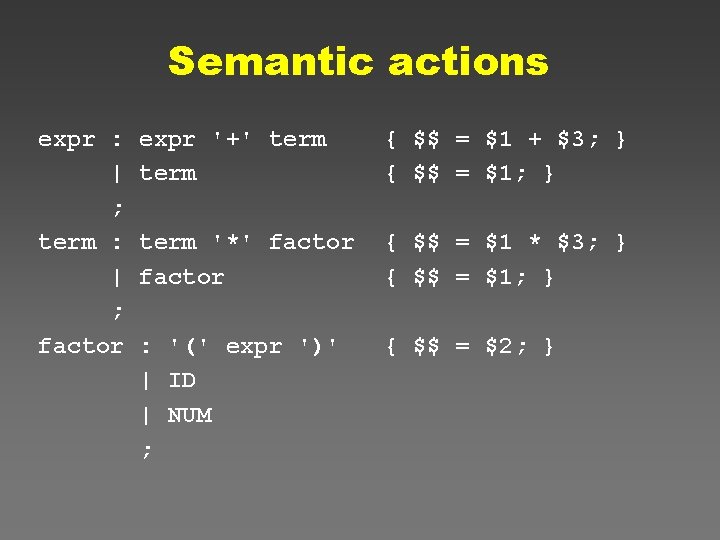
Semantic actions expr : | ; term : | ; factor expr '+' term { $$ = $1 + $3; } { $$ = $1; } term '*' factor { $$ = $1 * $3; } { $$ = $1; } : '(' expr ')' | ID | NUM ; { $$ = $2; }
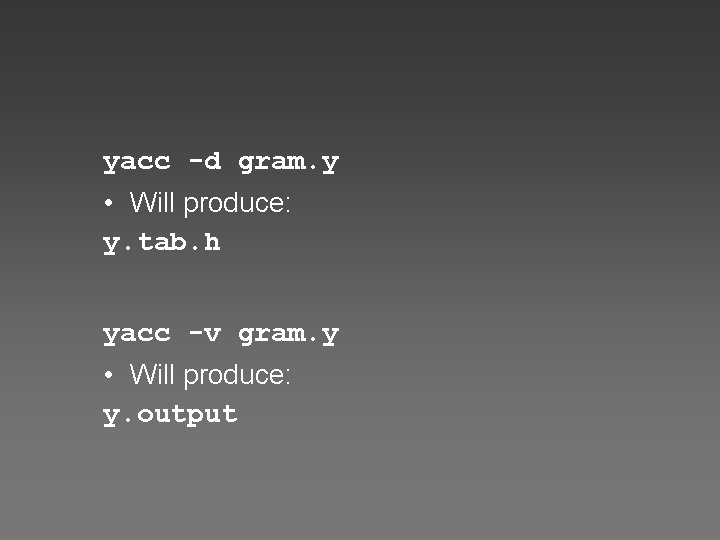
yacc -d gram. y • Will produce: y. tab. h yacc -v gram. y • Will produce: y. output
![Example: LEX %{ #include <stdio. h> #include "y. tab. h" %} id [_a-z. A-Z][_a-z.](http://slidetodoc.com/presentation_image/2b46a8cd32d8770402e8335cfe80583d/image-17.jpg "Example: LEX %{ #include <stdio. h> #include \"y. tab. h\" %} id [_a-z. A-Z][_a-z.")
Example: LEX %{ #include <stdio. h> #include "y. tab. h" %} id [_a-z. A-Z][_a-z. A-Z 0 -9]* wspc [ tn]+ semi [; ] comma [, ] %% int { return INT; } char { return CHAR; } float { return FLOAT; } {comma} { return COMMA; } {semi} { return SEMI; } {id} { return ID; } {wspc} {; } scanner. l
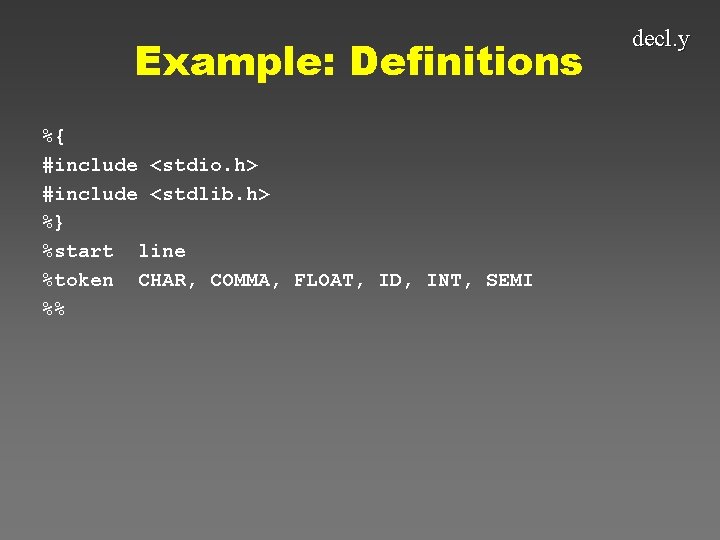
Example: Definitions %{ #include <stdio. h> #include <stdlib. h> %} %start line %token CHAR, COMMA, FLOAT, ID, INT, SEMI %% decl. y
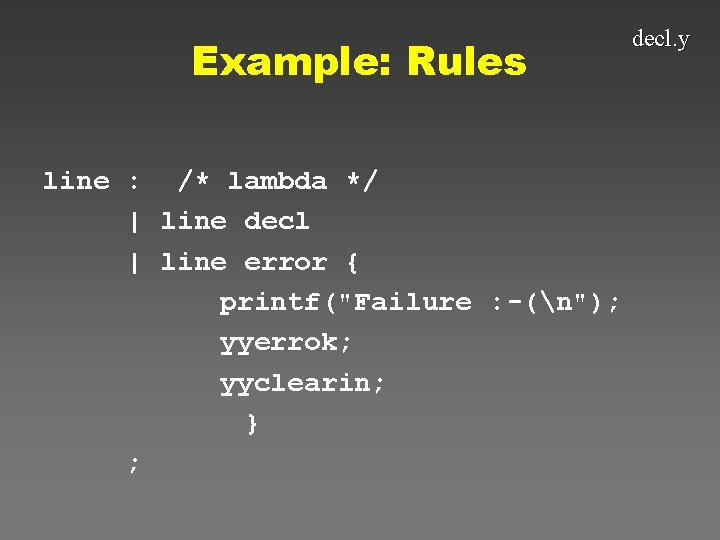
Example: Rules line : /* lambda */ | line decl | line error { printf("Failure : -(n"); yyerrok; yyclearin; } ; decl. y
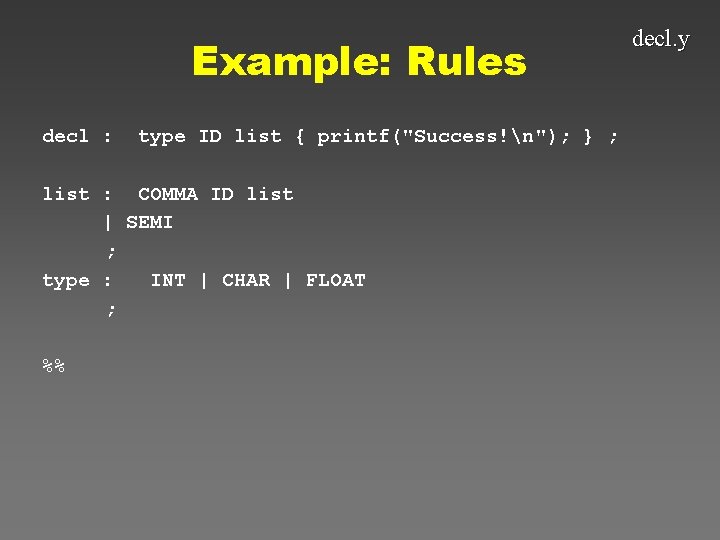
Example: Rules decl : type ID list { printf("Success!n"); } ; list : COMMA ID list | SEMI ; type : INT | CHAR | FLOAT ; %% decl. y
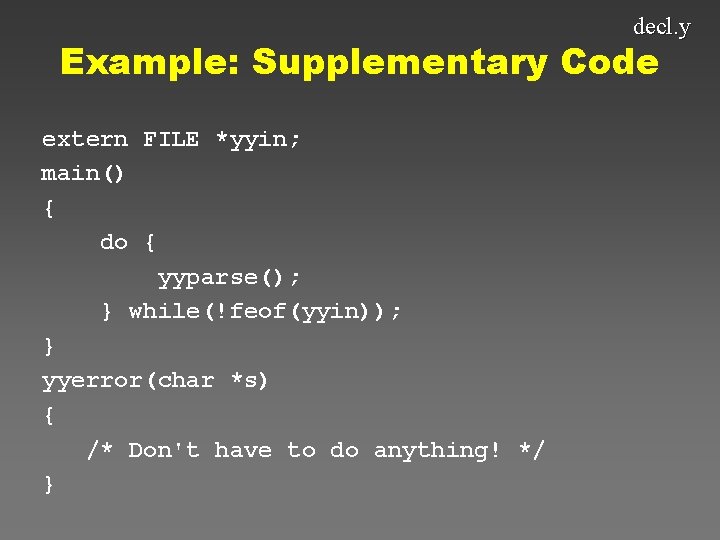
decl. y Example: Supplementary Code extern FILE *yyin; main() { do { yyparse(); } while(!feof(yyin)); } yyerror(char *s) { /* Don't have to do anything! */ }
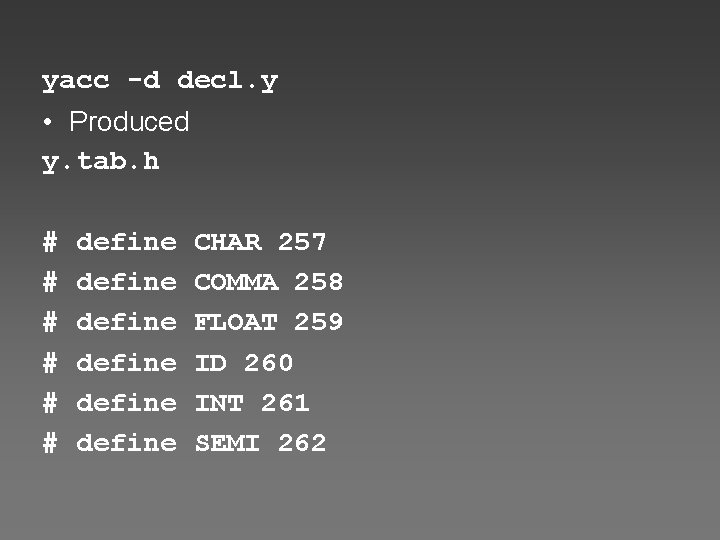
yacc -d decl. y • Produced y. tab. h # # # define define CHAR 257 COMMA 258 FLOAT 259 ID 260 INT 261 SEMI 262
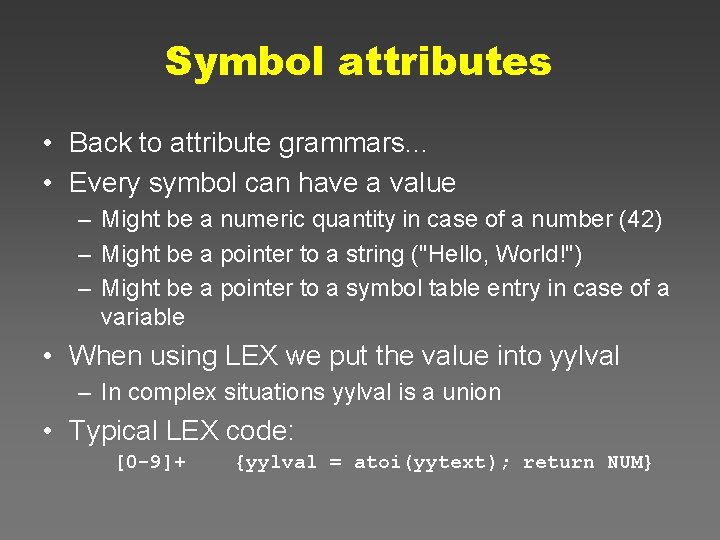
Symbol attributes • Back to attribute grammars. . . • Every symbol can have a value – Might be a numeric quantity in case of a number (42) – Might be a pointer to a string ("Hello, World!") – Might be a pointer to a symbol table entry in case of a variable • When using LEX we put the value into yylval – In complex situations yylval is a union • Typical LEX code: [0 -9]+ {yylval = atoi(yytext); return NUM}
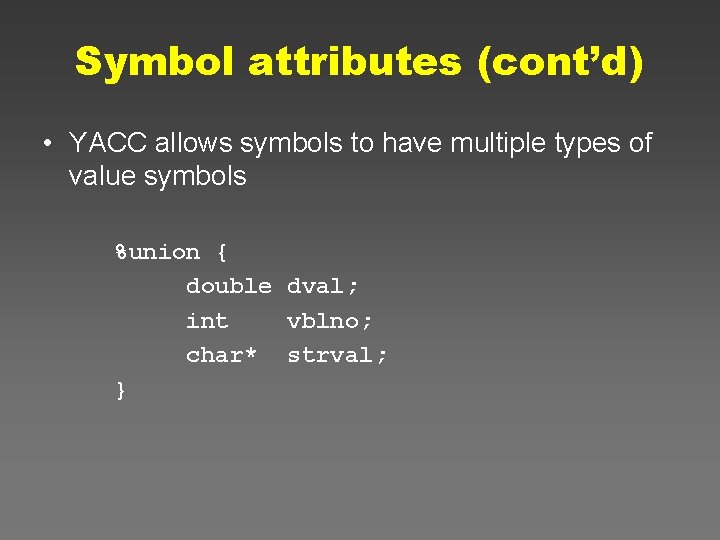
Symbol attributes (cont’d) • YACC allows symbols to have multiple types of value symbols %union { double dval; int vblno; char* strval; }
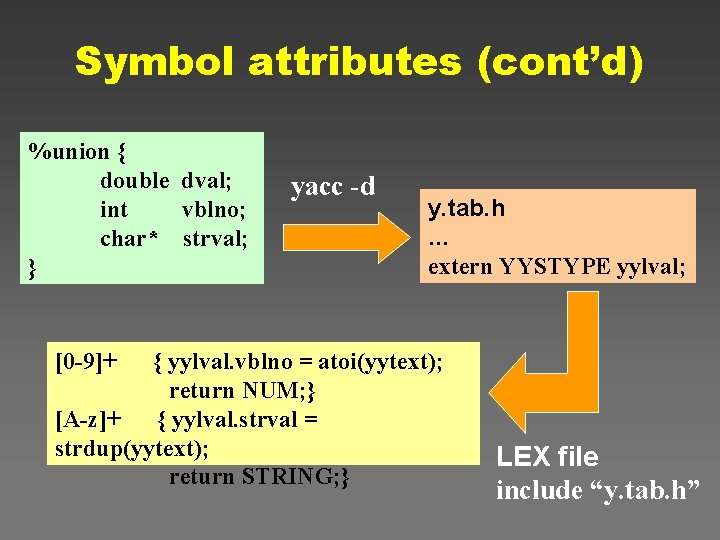
Symbol attributes (cont’d) %union { double dval; int vblno; char* strval; } yacc -d y. tab. h … extern YYSTYPE yylval; [0 -9]+ { yylval. vblno = atoi(yytext); return NUM; } [A-z]+ { yylval. strval = strdup(yytext); return STRING; } LEX file include “y. tab. h”
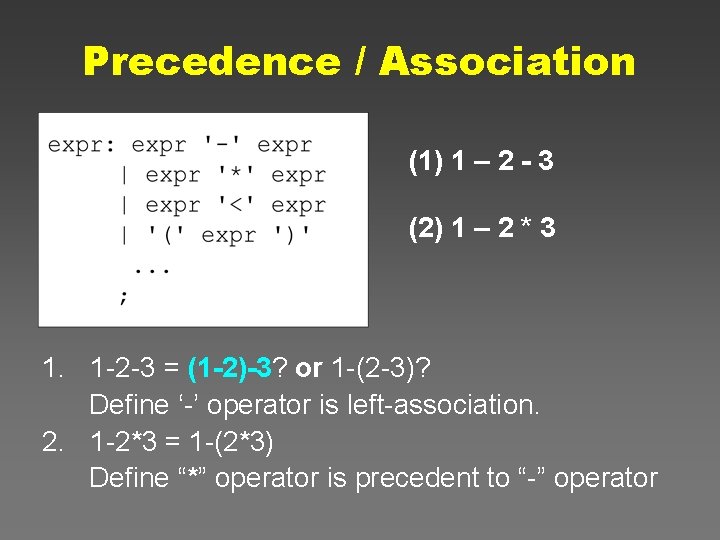
Precedence / Association (1) 1 – 2 - 3 (2) 1 – 2 * 3 1. 1 -2 -3 = (1 -2)-3? or 1 -(2 -3)? Define ‘-’ operator is left-association. 2. 1 -2*3 = 1 -(2*3) Define “*” operator is precedent to “-” operator
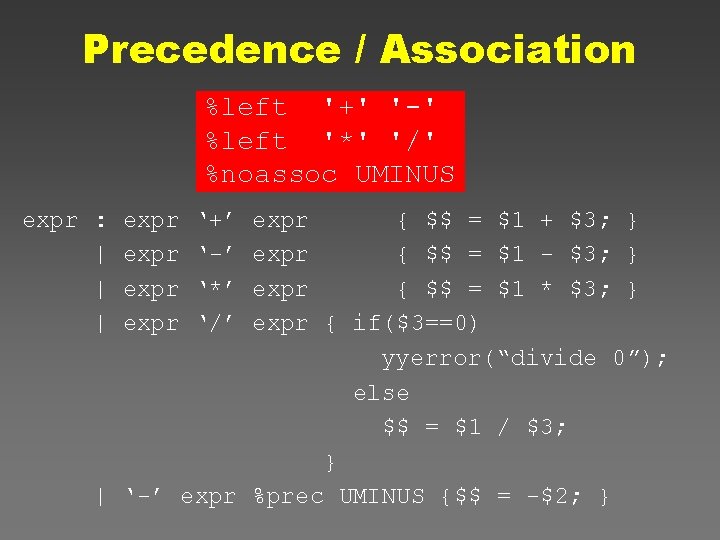
Precedence / Association %left '+' '-' %left '*' '/' %noassoc UMINUS expr : | | | expr ‘+’ ‘-’ ‘*’ ‘/’ expr { $$ = $1 + $3; } expr { $$ = $1 - $3; } expr { $$ = $1 * $3; } expr { if($3==0) yyerror(“divide 0”); else $$ = $1 / $3; } | ‘-’ expr %prec UMINUS {$$ = -$2; }
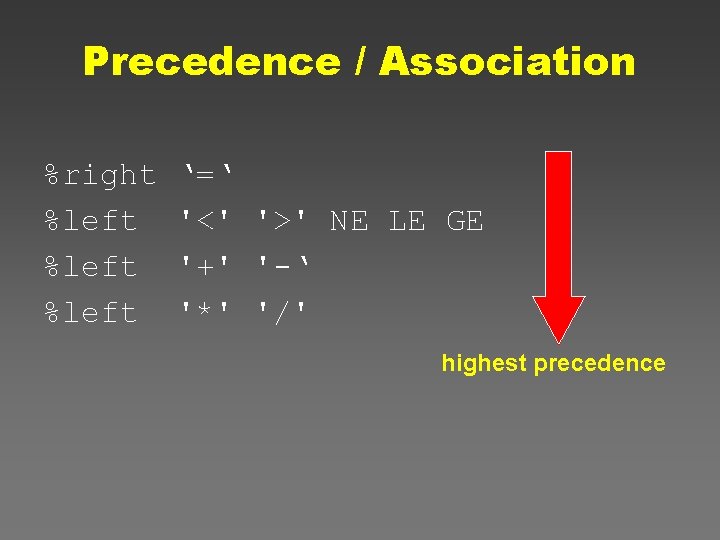
Precedence / Association %right %left ‘=‘ '<' '>' NE LE GE '+' '-‘ '*' '/' highest precedence
- Slides: 28