
Source Control Planning for Municipal Wastewater System Permit
![Prohibited Discharges to POTWs [40 CFR § 403. 5(b)] Pollutants which create a Fire](https://slidetodoc.com/presentation_image_h2/f5927f37a00d3ce09b458b6c74690a63/image-5.jpg "Prohibited Discharges to POTWs [40 CFR § 403. 5(b)] Pollutants which create a Fire")
![Prohibited Discharges to POTWs [40 CFR § 403. 5(b)] Heat in amounts which will](https://slidetodoc.com/presentation_image_h2/f5927f37a00d3ce09b458b6c74690a63/image-6.jpg "Prohibited Discharges to POTWs [40 CFR § 403. 5(b)] Heat in amounts which will")
- Slides: 51
Source Control Planning for Municipal Wastewater System Permit Compliance Water Quality Seminar Austin, TX. October 13, 2016 David James Water Quality Division Texas Commission on Environmental Quality
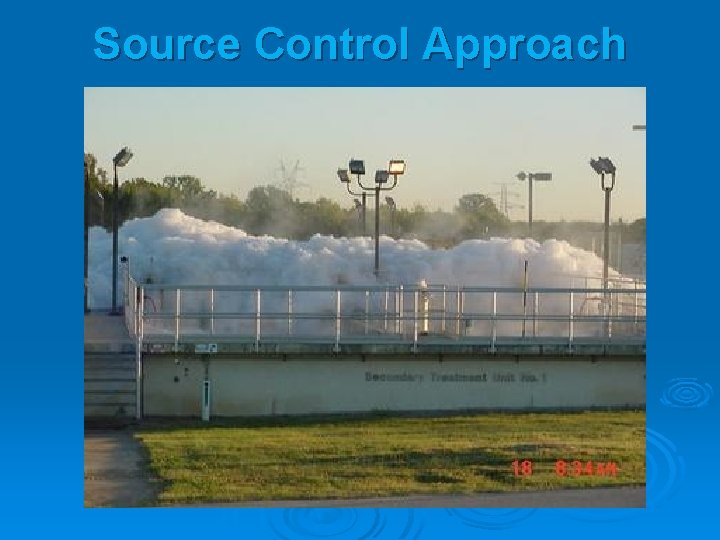
Source Control Approach
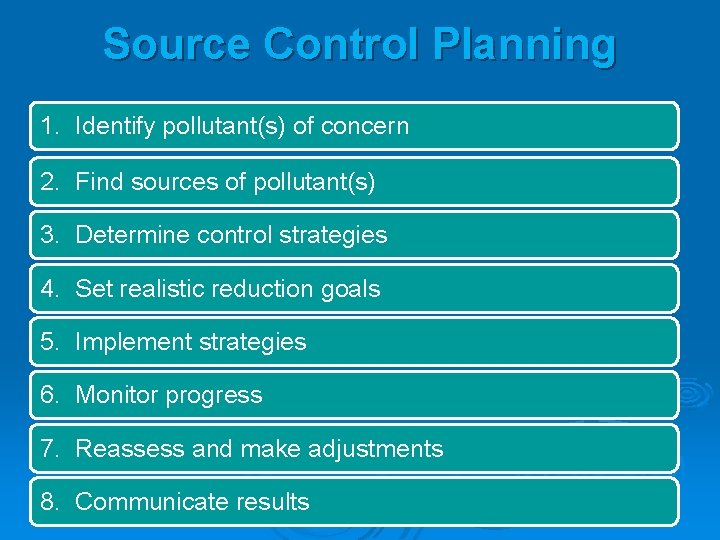
Source Control Planning 1. Identify pollutant(s) of concern 2. Find sources of pollutant(s) 3. Determine control strategies 4. Set realistic reduction goals 5. Implement strategies 6. Monitor progress 7. Reassess and make adjustments 8. Communicate results
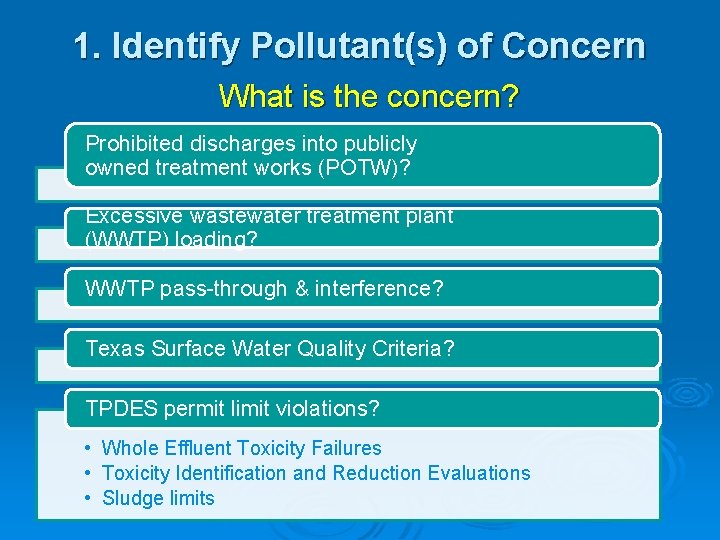
1. Identify Pollutant(s) of Concern What is the concern? Prohibited discharges into publicly owned treatment works (POTW)? Excessive wastewater treatment plant (WWTP) loading? WWTP pass-through & interference? Texas Surface Water Quality Criteria? TPDES permit limit violations? • Whole Effluent Toxicity Failures • Toxicity Identification and Reduction Evaluations • Sludge limits
Prohibited Discharges to POTWs [40 CFR § 403. 5(b)] Pollutants which create a Fire or Explosion Hazard Pollutants which will cause corrosive damage & not below p. H 5. 0 Solid or viscous pollutants in amounts which will cause flow obstructions Any pollutants discharged at a flow rate and/or concentration that will cause interference
Prohibited Discharges to POTWs [40 CFR § 403. 5(b)] Heat in amounts which will inhibit biological activities Oil, non-biodegradable cutting oil, or products of mineral oil origin in amounts which will cause interference or pass through Pollutants that cause toxic gases, vapors or fumes within the POTW Any trucked or hauled pollutants, except at
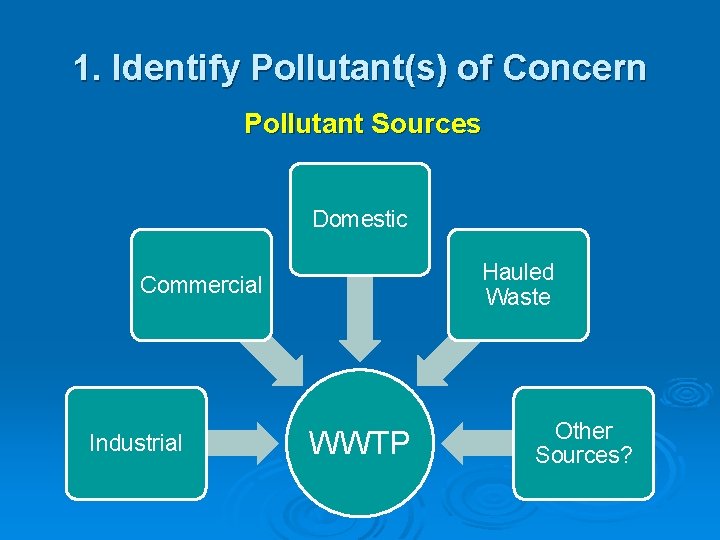
1. Identify Pollutant(s) of Concern Pollutant Sources Domestic Hauled Waste Commercial Industrial WWTP Other Sources?
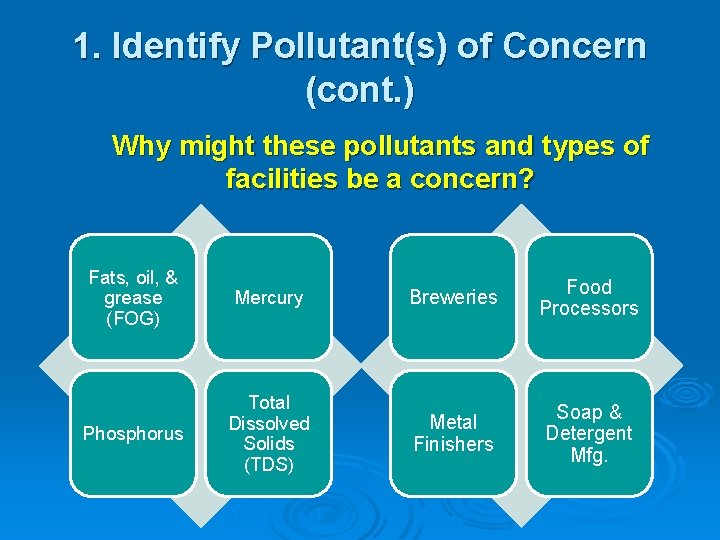
1. Identify Pollutant(s) of Concern (cont. ) Why might these pollutants and types of facilities be a concern? Fats, oil, & grease (FOG) Mercury Breweries Food Processors Phosphorus Total Dissolved Solids (TDS) Metal Finishers Soap & Detergent Mfg.
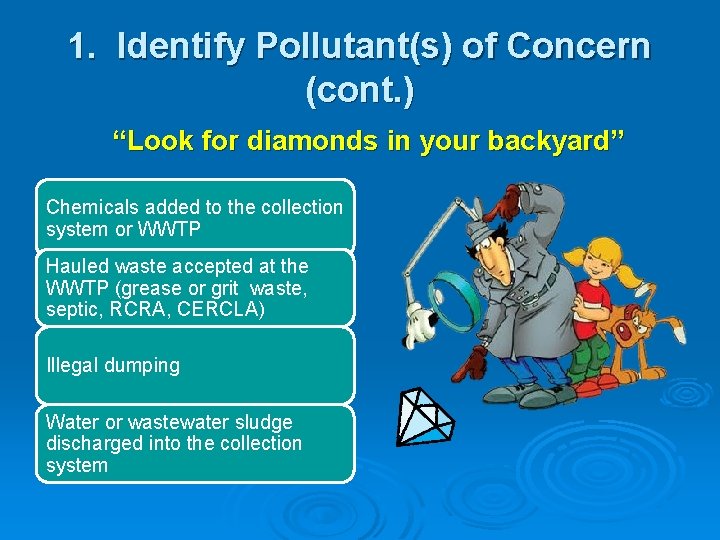
1. Identify Pollutant(s) of Concern (cont. ) “Look for diamonds in your backyard” Chemicals added to the collection system or WWTP Hauled waste accepted at the WWTP (grease or grit waste, septic, RCRA, CERCLA) Illegal dumping Water or wastewater sludge discharged into the collection system
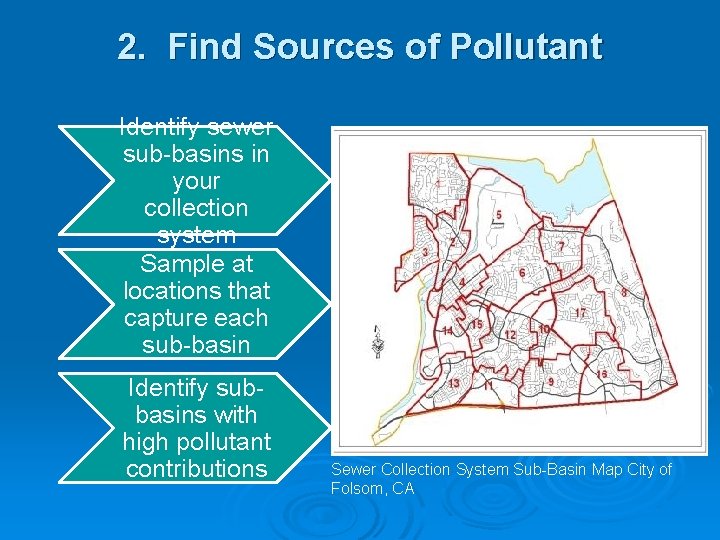
2. Find Sources of Pollutant Identify sewer sub-basins in your collection system Sample at locations that capture each sub-basin Identify subbasins with high pollutant contributions Sewer Collection System Sub-Basin Map City of Folsom, CA
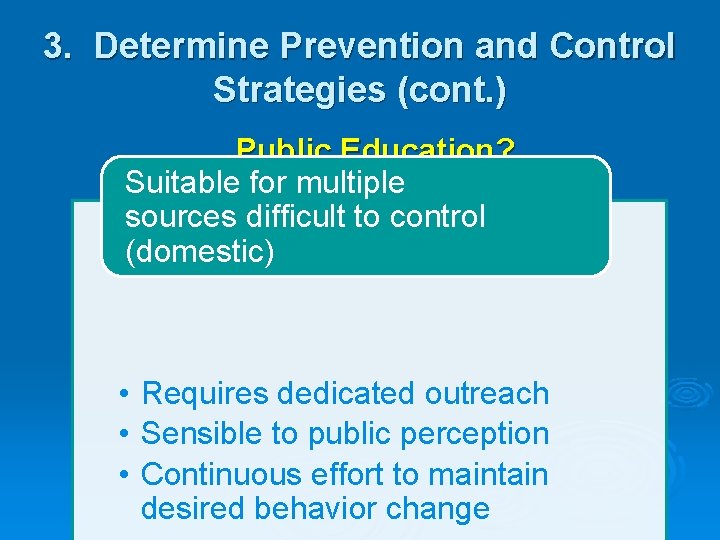
3. Determine Prevention and Control Strategies (cont. ) Public Education? Suitable for multiple sources difficult to control (domestic) • Requires dedicated outreach • Sensible to public perception • Continuous effort to maintain desired behavior change
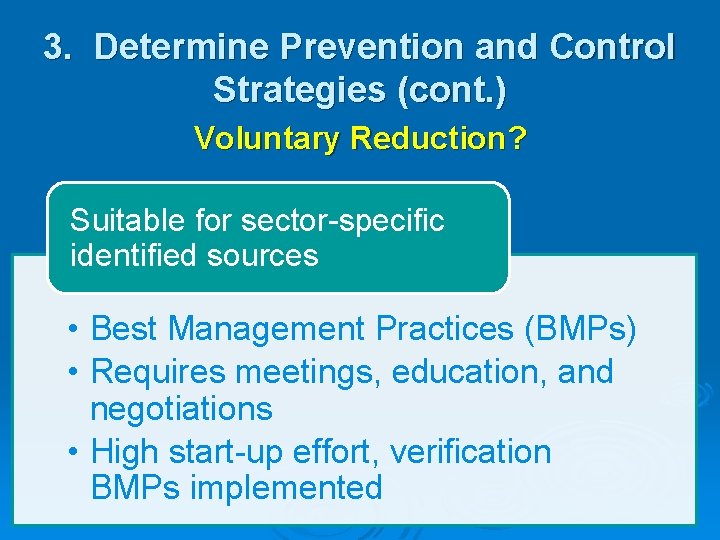
3. Determine Prevention and Control Strategies (cont. ) Voluntary Reduction? Suitable for sector-specific identified sources • Best Management Practices (BMPs) • Requires meetings, education, and negotiations • High start-up effort, verification BMPs implemented
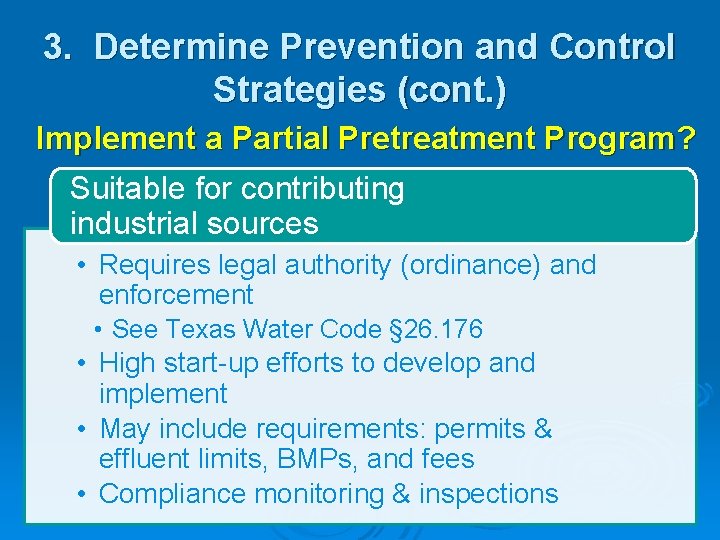
3. Determine Prevention and Control Strategies (cont. ) Implement a Partial Pretreatment Program? Suitable for contributing industrial sources • Requires legal authority (ordinance) and enforcement • See Texas Water Code § 26. 176 • High start-up efforts to develop and implement • May include requirements: permits & effluent limits, BMPs, and fees • Compliance monitoring & inspections
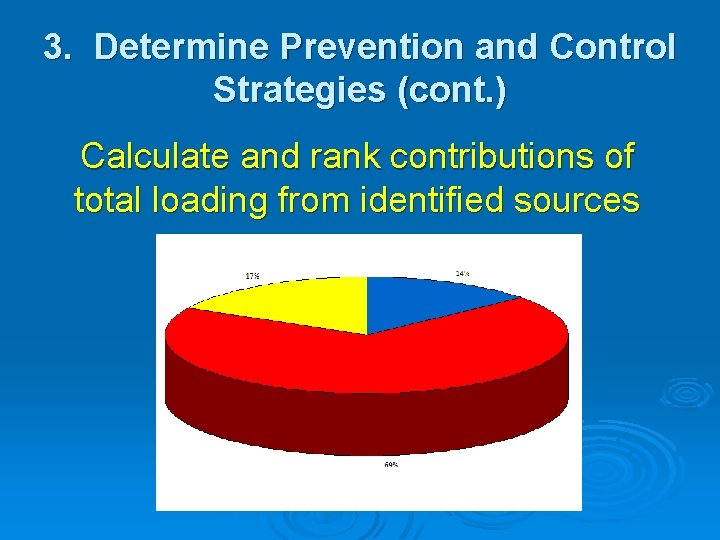
3. Determine Prevention and Control Strategies (cont. ) Calculate and rank contributions of total loading from identified sources
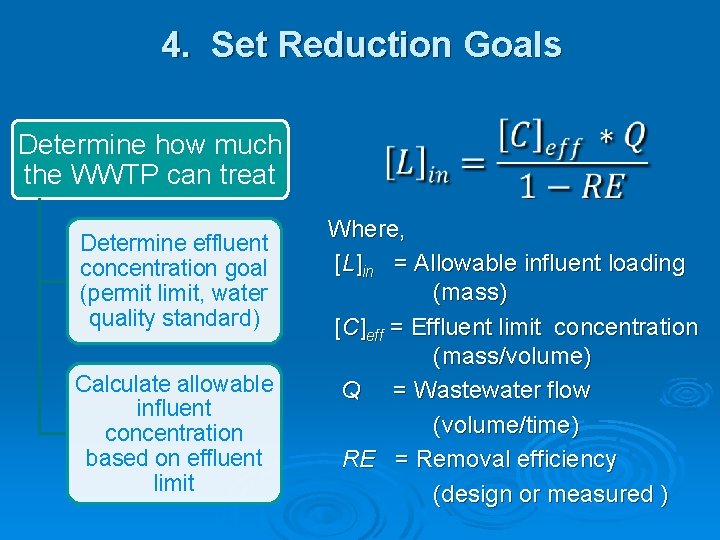
4. Set Reduction Goals Determine how much the WWTP can treat Determine effluent concentration goal (permit limit, water quality standard) Calculate allowable influent concentration based on effluent limit Where, [L]in = Allowable influent loading (mass) [C]eff = Effluent limit concentration (mass/volume) Q = Wastewater flow (volume/time) RE = Removal efficiency (design or measured )
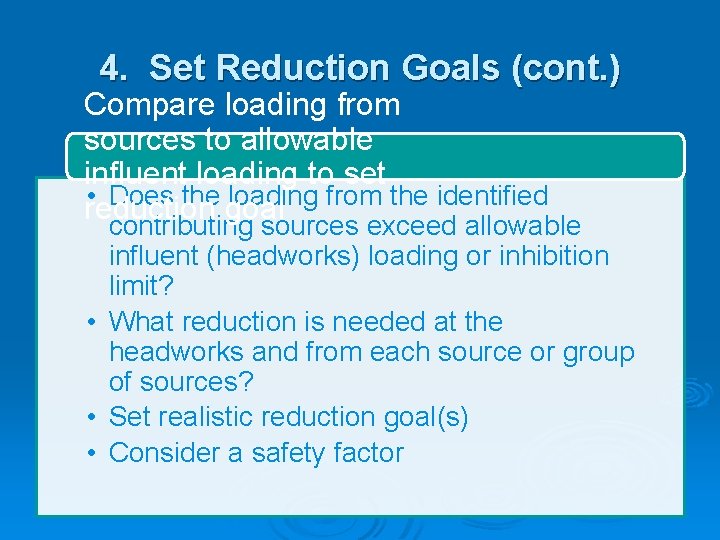
4. Set Reduction Goals (cont. ) Compare loading from sources to allowable influent loading to set • Does the loading from the identified reduction goal contributing sources exceed allowable influent (headworks) loading or inhibition limit? • What reduction is needed at the headworks and from each source or group of sources? • Set realistic reduction goal(s) • Consider a safety factor
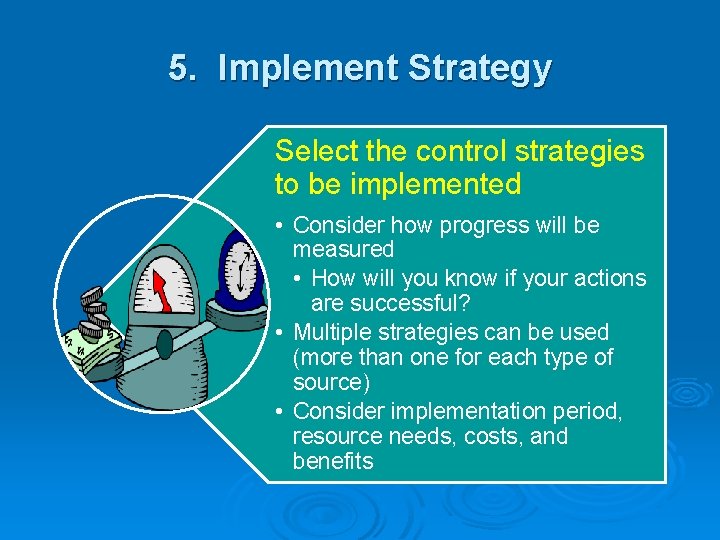
5. Implement Strategy Select the control strategies to be implemented • Consider how progress will be measured • How will you know if your actions are successful? • Multiple strategies can be used (more than one for each type of source) • Consider implementation period, resource needs, costs, and benefits
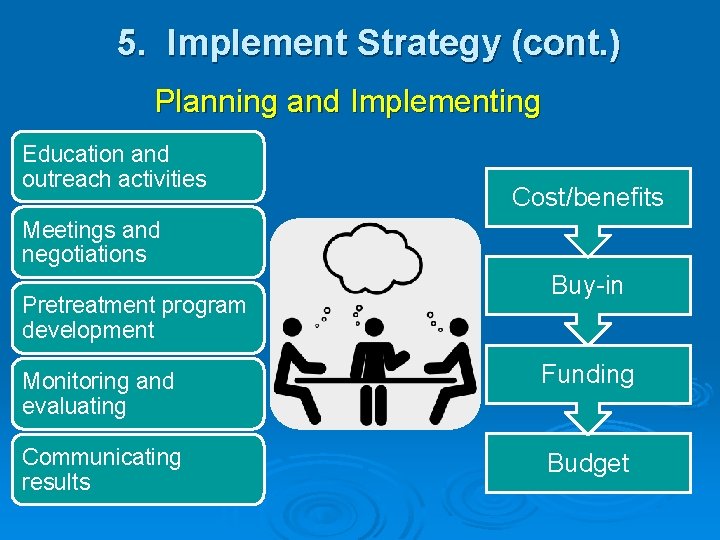
5. Implement Strategy (cont. ) Planning and Implementing Education and outreach activities Cost/benefits Meetings and negotiations Pretreatment program development Buy-in Monitoring and evaluating Funding Communicating results Budget
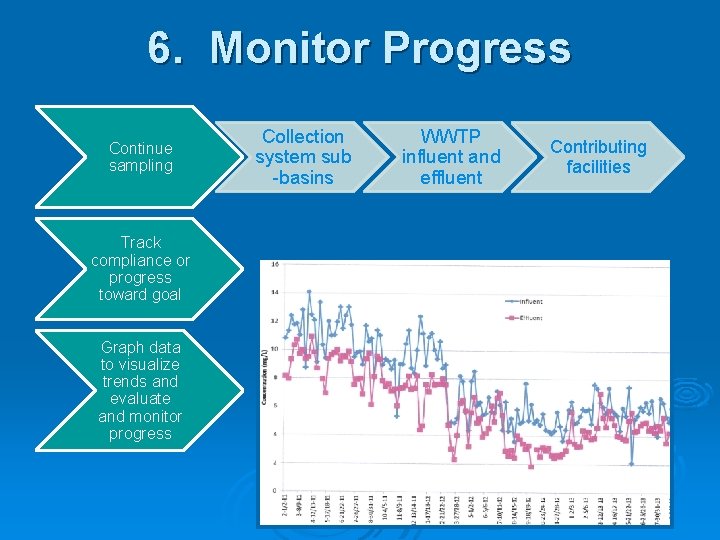
6. Monitor Progress Continue sampling Track compliance or progress toward goal Graph data to visualize trends and evaluate and monitor progress Collection system sub -basins WWTP influent and effluent Contributing facilities
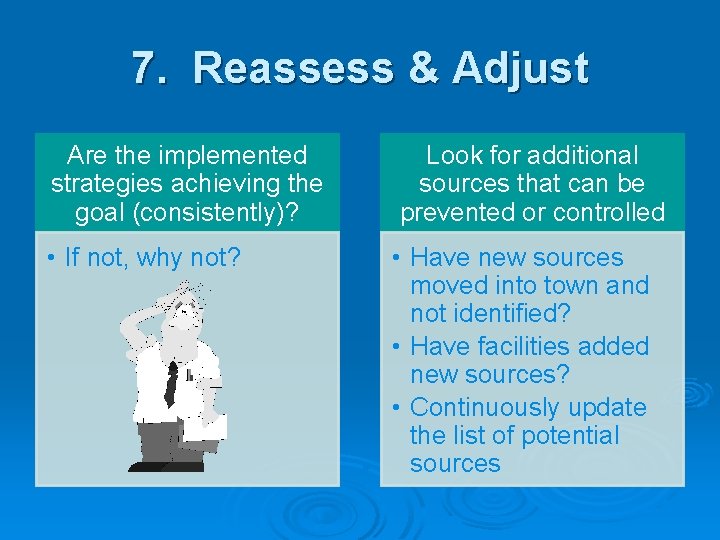
7. Reassess & Adjust Are the implemented strategies achieving the goal (consistently)? Look for additional sources that can be prevented or controlled • If not, why not? • Have new sources moved into town and not identified? • Have facilities added new sources? • Continuously update the list of potential sources
8. Communicate Results Management Public Facilities
Source Control Case Studies
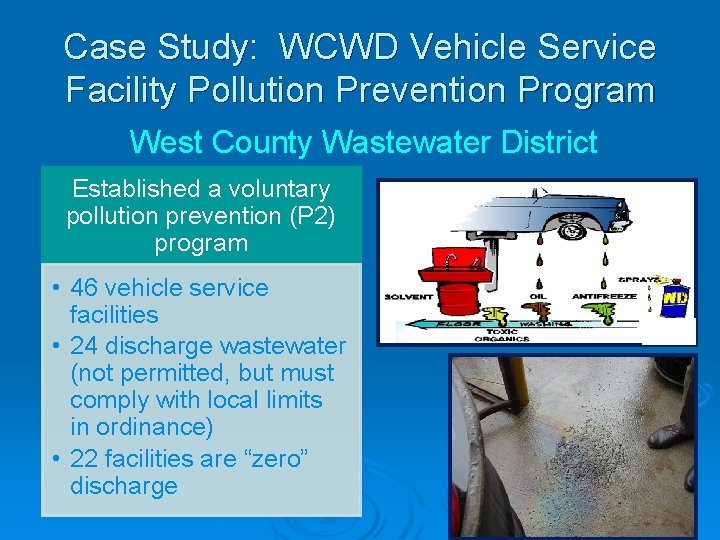
Case Study: WCWD Vehicle Service Facility Pollution Prevention Program West County Wastewater District Established a voluntary pollution prevention (P 2) program • 46 vehicle service facilities • 24 discharge wastewater (not permitted, but must comply with local limits in ordinance) • 22 facilities are “zero” discharge
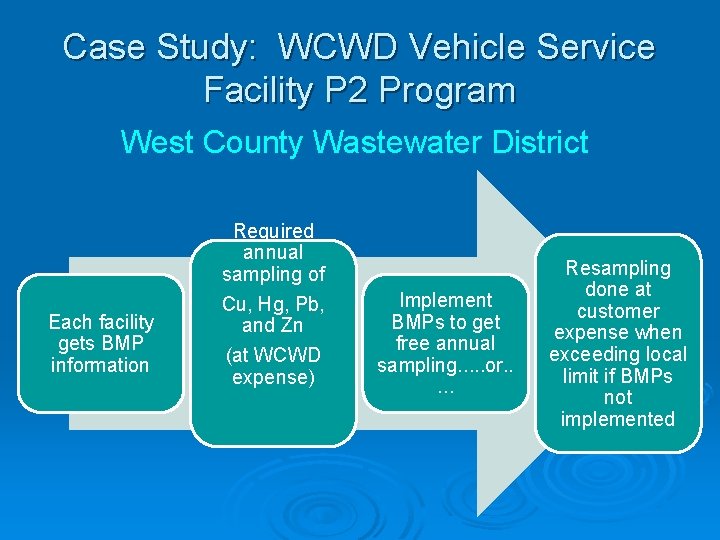
Case Study: WCWD Vehicle Service Facility P 2 Program West County Wastewater District Required annual sampling of Each facility gets BMP information Cu, Hg, Pb, and Zn (at WCWD expense) Implement BMPs to get free annual sampling. . . or. . . Resampling done at customer expense when exceeding local limit if BMPs not implemented
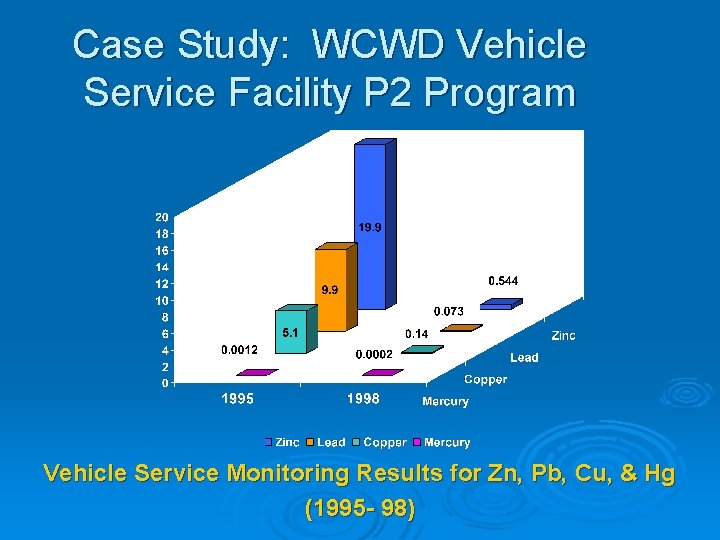
Case Study: WCWD Vehicle Service Facility P 2 Program Vehicle Service Monitoring Results for Zn, Pb, Cu, & Hg (1995 - 98)
Case Study: 2013 City of Cleburne Feb. 2013 - POTW failed sublethal WET tests (Water Flea - Ceriodaphnia dubia) Began investigating potential sources in the industrial park Sampled sewer system • Found high selenium levels downstream from an industry, power plant, and the POTW, but no known sources ? ? ?
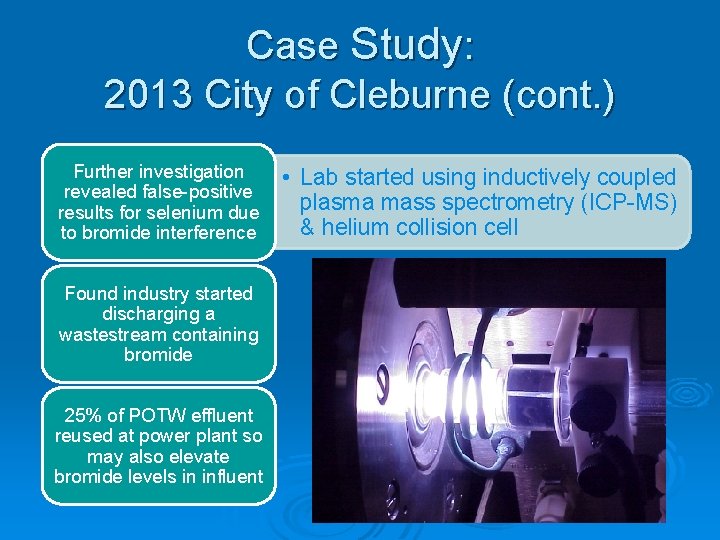
Case Study: 2013 City of Cleburne (cont. ) Further investigation revealed false-positive results for selenium due to bromide interference Found industry started discharging a wastestream containing bromide 25% of POTW effluent reused at power plant so may also elevate bromide levels in influent • Lab started using inductively coupled plasma mass spectrometry (ICP-MS) & helium collision cell
Case Study: 2013 City of Cleburne (cont. ) The City did NOT want a WET limit in permit • Conducted study to demonstrate WET failures due to bromide • TPDES permit and City required industry to not discharge wastestream containing bromide
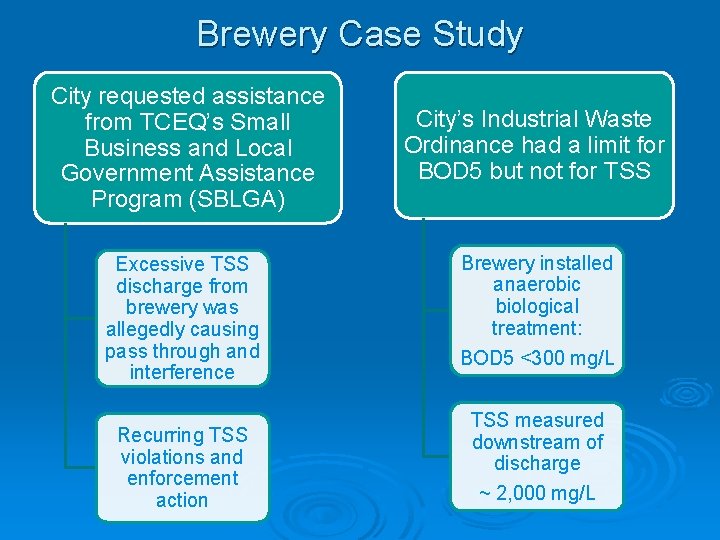
Brewery Case Study City requested assistance from TCEQ’s Small Business and Local Government Assistance Program (SBLGA) City’s Industrial Waste Ordinance had a limit for BOD 5 but not for TSS Excessive TSS discharge from brewery was allegedly causing pass through and interference Brewery installed anaerobic biological treatment: BOD 5 <300 mg/L Recurring TSS violations and enforcement action TSS measured downstream of discharge ~ 2, 000 mg/L
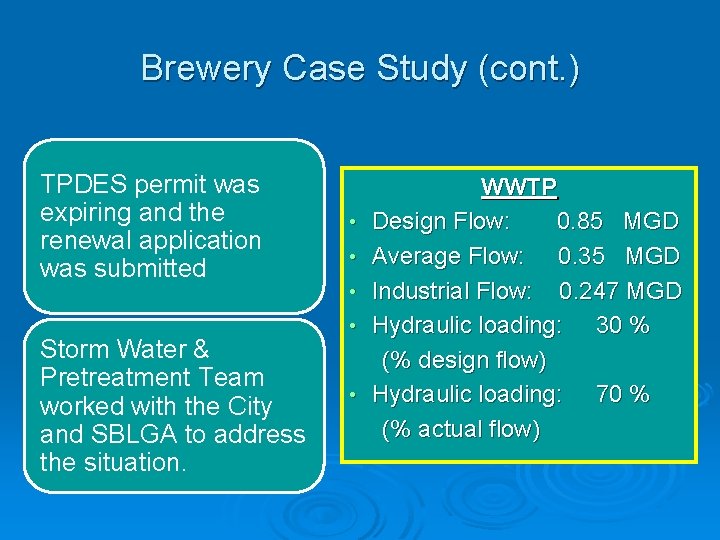
Brewery Case Study (cont. ) TPDES permit was expiring and the renewal application was submitted Storm Water & Pretreatment Team worked with the City and SBLGA to address the situation. • • • WWTP Design Flow: 0. 85 MGD Average Flow: 0. 35 MGD Industrial Flow: 0. 247 MGD Hydraulic loading: 30 % (% design flow) Hydraulic loading: 70 % (% actual flow)
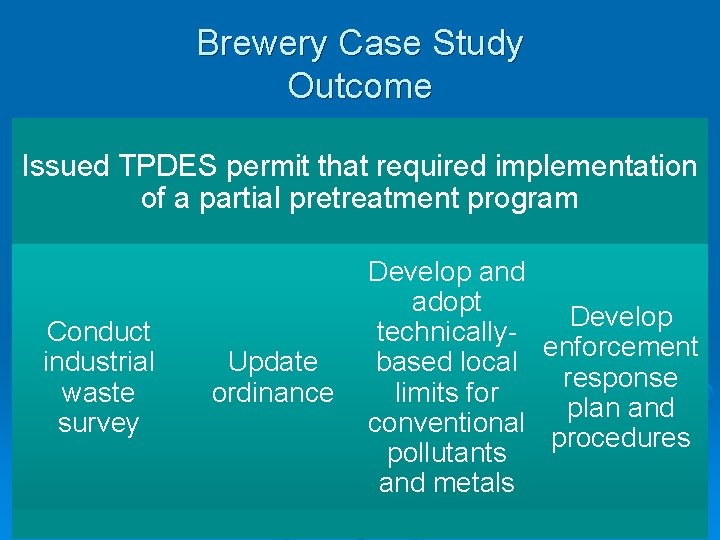
Brewery Case Study Outcome Issued TPDES permit that required implementation of a partial pretreatment program Conduct industrial waste survey Update ordinance Develop and adopt Develop technicallyenforcement based local response limits for plan and conventional procedures pollutants and metals
Source Control and Reduction of Phosphorous
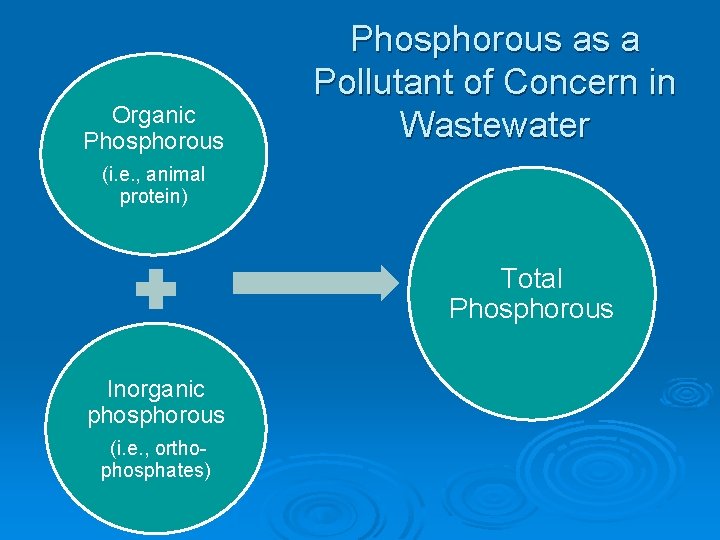
Organic Phosphorous as a Pollutant of Concern in Wastewater (i. e. , animal protein) Total Phosphorous Inorganic phosphorous (i. e. , orthophosphates)
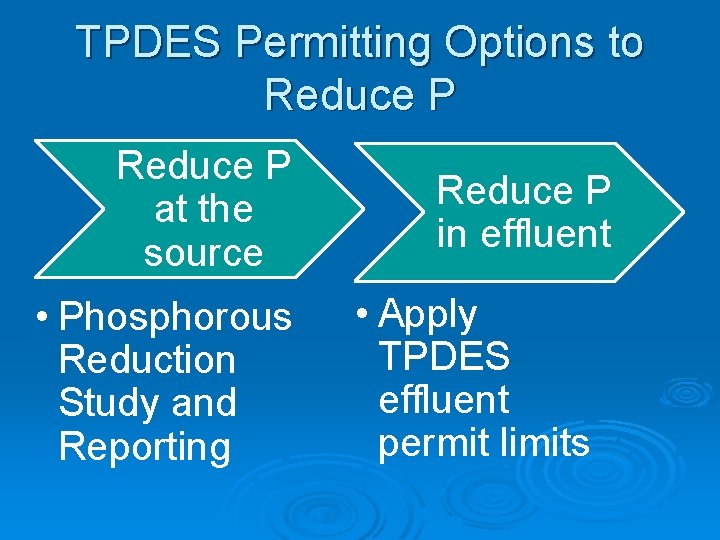
TPDES Permitting Options to Reduce P at the source • Phosphorous Reduction Study and Reporting Reduce P in effluent • Apply TPDES effluent permit limits
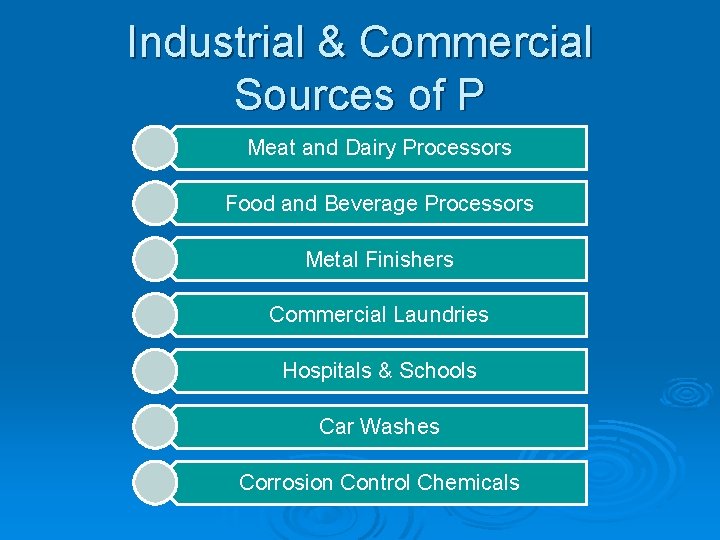
Industrial & Commercial Sources of P Meat and Dairy Processors Food and Beverage Processors Metal Finishers Commercial Laundries Hospitals & Schools Car Washes Corrosion Control Chemicals
Other Sources of P Animal and human wastes Detergents, cleaners, and disinfectants Personal care products Fertilizers & Pesticides Flame Retardants
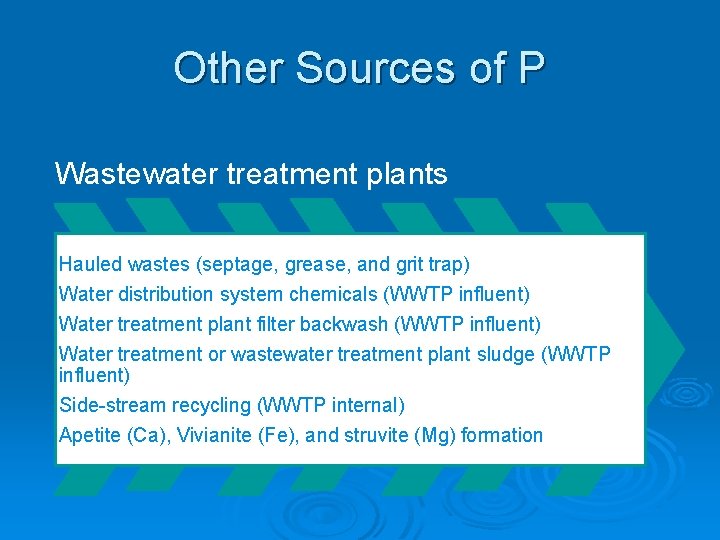
Other Sources of P Wastewater treatment plants Hauled wastes (septage, grease, and grit trap) Water distribution system chemicals (WWTP influent) Water treatment plant filter backwash (WWTP influent) Water treatment or wastewater treatment plant sludge (WWTP influent) Side-stream recycling (WWTP internal) Apetite (Ca), Vivianite (Fe), and struvite (Mg) formation
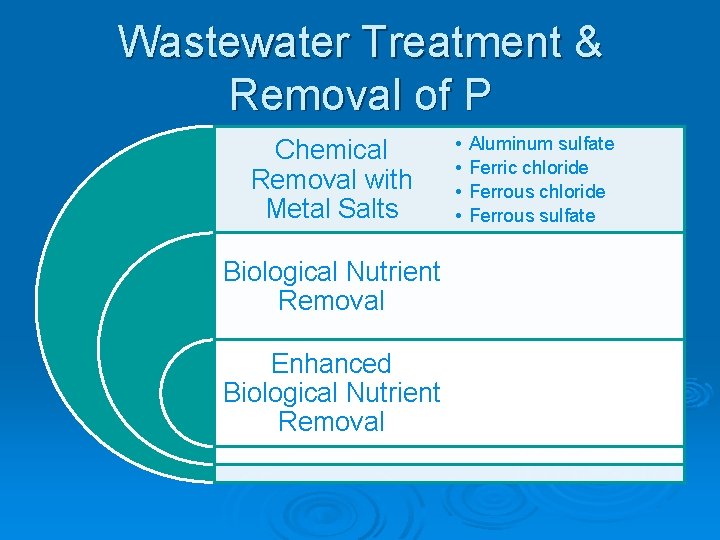
Wastewater Treatment & Removal of P Chemical Removal with Metal Salts Biological Nutrient Removal Enhanced Biological Nutrient Removal • • Aluminum sulfate Ferric chloride Ferrous sulfate
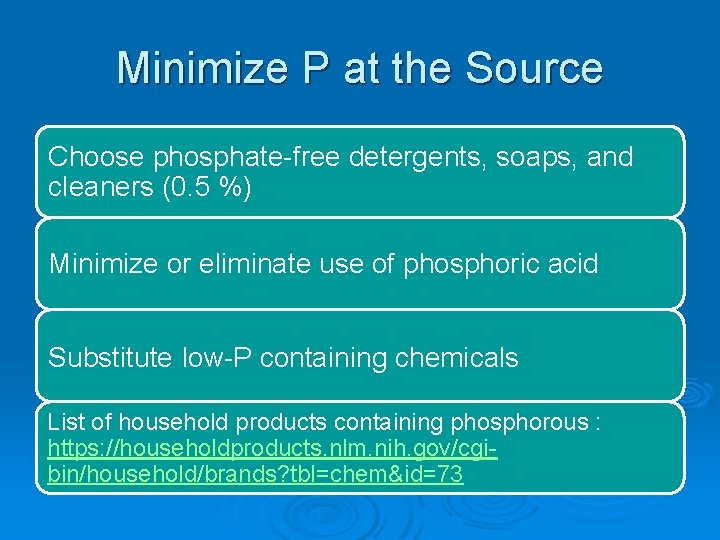
Minimize P at the Source Choose phosphate-free detergents, soaps, and cleaners (0. 5 %) Minimize or eliminate use of phosphoric acid Substitute low-P containing chemicals List of household products containing phosphorous : https: //householdproducts. nlm. nih. gov/cgibin/household/brands? tbl=chem&id=73
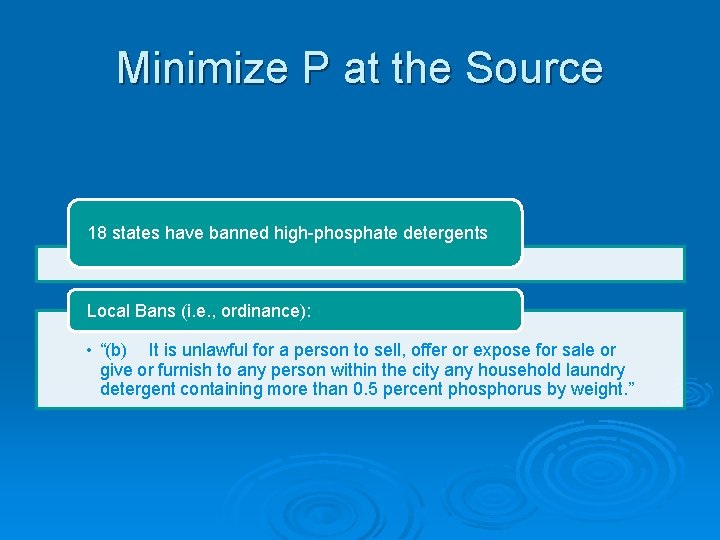
Minimize P at the Source 18 states have banned high-phosphate detergents Local Bans (i. e. , ordinance): • “(b) It is unlawful for a person to sell, offer or expose for sale or give or furnish to any person within the city any household laundry detergent containing more than 0. 5 percent phosphorus by weight. ”
SOME SECTOR-SPECIFIC RESOURCES FOR: • Food Processing • Mercury • Breweries • Phosphorus
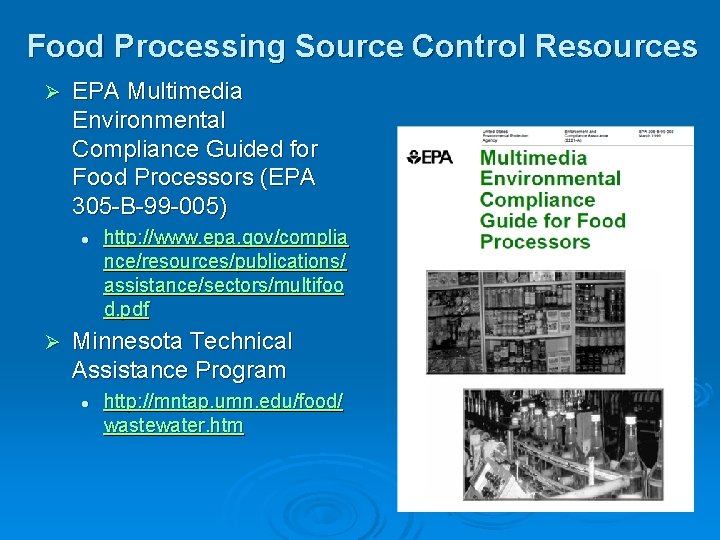
Food Processing Source Control Resources Ø EPA Multimedia Environmental Compliance Guided for Food Processors (EPA 305 -B-99 -005) l Ø http: //www. epa. gov/complia nce/resources/publications/ assistance/sectors/multifoo d. pdf Minnesota Technical Assistance Program l http: //mntap. umn. edu/food/ wastewater. htm
Food Processing Source Control Resources Ø Waste Reduction in Food Processing l Ø Wastewater Reduction and Recycling in Food Processing Operations l Ø http: //infohouse. p 2 ric. org/ref/02/01228. pdf http: //infohouse. p 2 ric. org/ref/24/23261. htm Meat, Food, and Dairy Processing Industry. Waste Streams & Pollution. Prevention l http: //www. waterboards. ca. gov/coloradoriver/water_is sues/programs/pretreatment/docs/rev_food_processo rs. pdf
Mercury Reduction Resources Ø Mercury-Added Products Found at Drinking Water & Wastewater Treatment Facilities l l The Northeast Waste Management Officials’ Association (NEWMOA) http: //www. newmoa. org/prevention/mercury/pr ojects/WWT/Mercury. Added. Productsat. WWTPlants. pdf Ø EPA Dental Amalgam l http: //www. epa. gov/hg/dentalamalgam. html
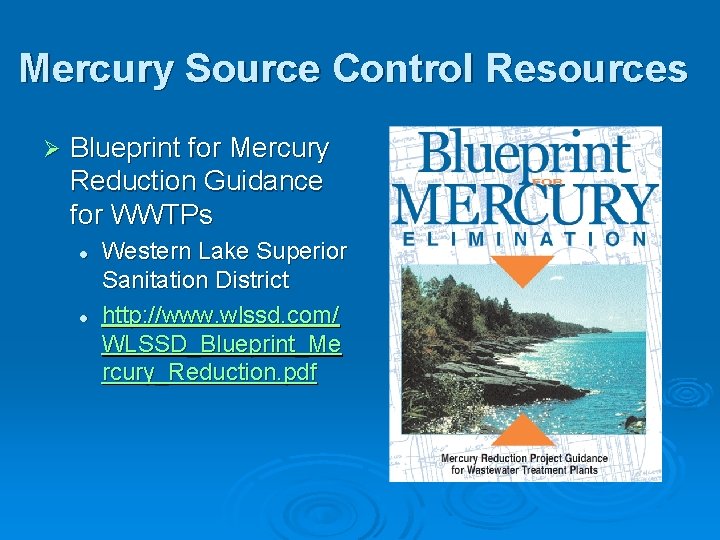
Mercury Source Control Resources Ø Blueprint for Mercury Reduction Guidance for WWTPs l l Western Lake Superior Sanitation District http: //www. wlssd. com/ WLSSD_Blueprint_Me rcury_Reduction. pdf
Mercury Source Control Resources Ø EPA Recommended Management and Disposal Options for Mercury-Containing Products l l l Consumer products: home items Medical pharmaceutical products Consumer products: automotive parts Commercial products Alternatives to Mercury-Containing Products http: //www. epa. gov/mercury/mgmt_options. ht ml#commercial
Brewery Source Control Resources Ø Examples of EPA Brewery Inspections l l http: //www. epa. gov/region 9/water/pretreatmen t/files/firestone-brewery-ins. pdf http: //www. epa. gov/region 09/water/pretreatme nt/files/sierra_nevada_brewery_2004 -1008_inspection. pdf
Phosphorus Source Control Resources Ø Phosphorus Management Plan Guide (Minnesota Pollution Control Agency, 2006) Ø Six Municipalities, One Watershed: A Collaborative Approach to Remove Phosphorus in the Assabet River Watershed (EPA 820 -R-15 -097, 2015)
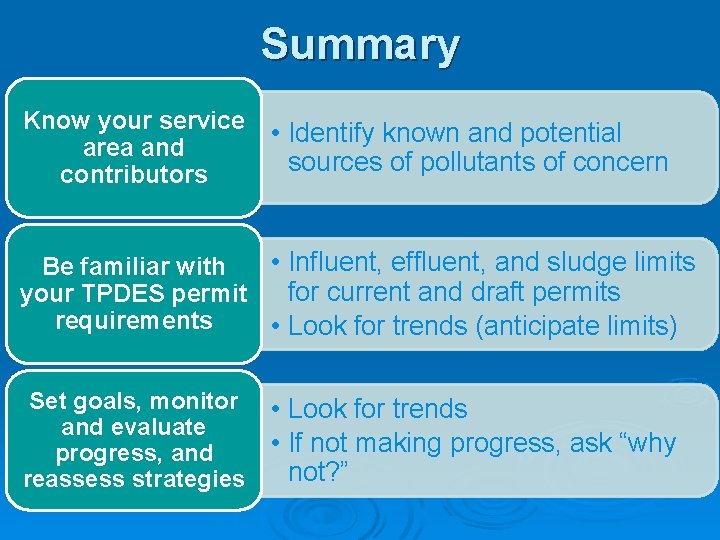
Summary Know your service area and contributors • Identify known and potential sources of pollutants of concern • Influent, effluent, and sludge limits Be familiar with for current and draft permits your TPDES permit requirements • Look for trends (anticipate limits) Set goals, monitor and evaluate progress, and reassess strategies • Look for trends • If not making progress, ask “why not? ”
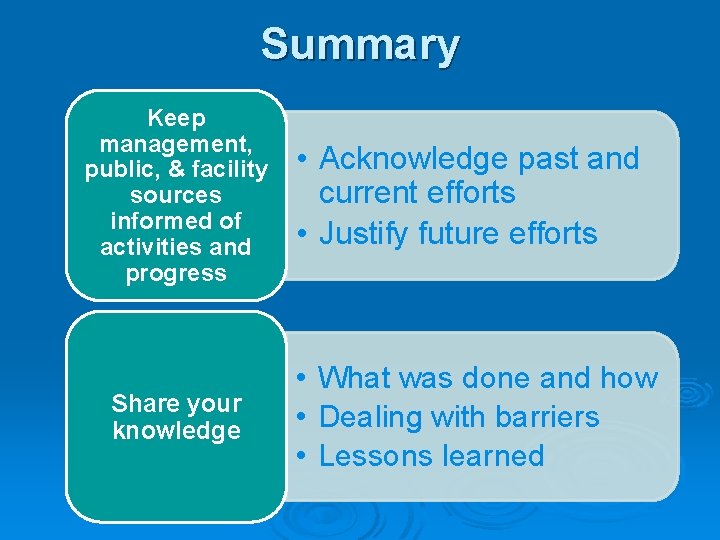
Summary Keep management, public, & facility sources informed of activities and progress Share your knowledge • Acknowledge past and current efforts • Justify future efforts • What was done and how • Dealing with barriers • Lessons learned
Questions?