
Source Based Questions A Guide Purpose of SourceBased
Source Based Questions A Guide
Purpose of Source-Based Questions n Demonstrate understanding of source n Demonstrate ability to analyze a source n Interpret the meaning of a source n Apply Social Studies concepts to new material (the sources) n Compare and contrast concepts across multiple sources
What you want to do n Show you understand social studies concepts n Use social studies vocabulary n Relate each of the sources to the material we have studied in class n Explain the PERSPECTIVE of each source
What you DON’T want to do n Simply state what the source says in your own words n Write in point form n Write an essay
Nature of Task n Three sources n At least one will be a visual (non-print) source n Examine each source. n Write a response in paragraph form in which you must: n interpret each source, explain the ideological perspective(s) presented in each source, and discuss the links between the principles of liberalism and each source n identify and explain one or more of the relationships that exist among all three sources
Sources n Brief paragraphs n Excerpts from speeches n Editorial cartoons n Graphs/charts
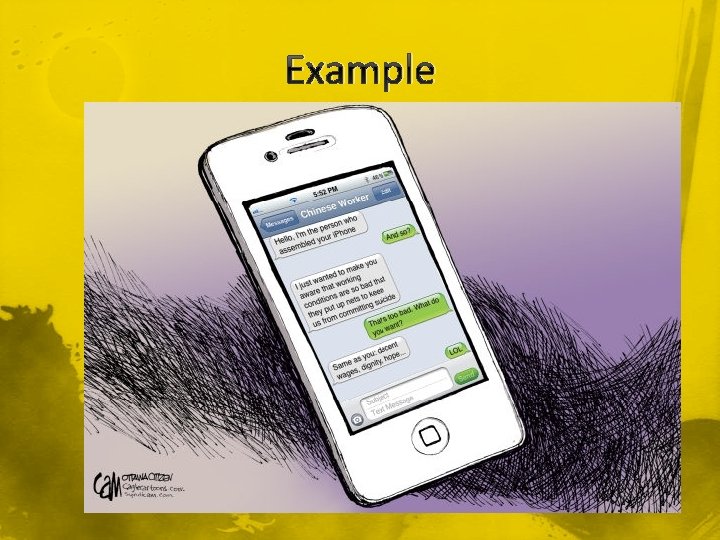
Example
Format(s) n Option 1 n 4 paragraphs n 1 paragraph interpreting each source n 1 paragraph explain the relationship between the sources n Option 2 n 3 paragraphs n Integrating relationships into each of the paragraphs
Strategies n Active reading n Rephrase complicated sentences n Meaning from context n What type of Liberalism is being discussed? n For editorial cartoons, decide who is being made fun of
Strategies n Establish a PERSPECTIVE for each source (who would say this or support this? ) n What do all three sources have in common? How do they differ? n For relationships find a theme that links all three – Liberalism, Freedom, Private property, etc. n Put the perspective on a spectrum
Strategies n For visual sources establish: n Denotation – what do you see? n Connotation – what is being implied, suggested, etc. n Take clues from the speaker of the source
Scoring INTERPRETATION OF SOURCES (12 marks) n When marking Interpretation of Sources, markers should consider how effectively the student n interprets and explains each source to identify an ideological perspective(s) n links the principles of liberalism and each source Excellent n Interpretation and explanation of the source is sophisticated, insightful, and precise. The links to the principles of liberalism are accurate, perceptive, and comprehensively developed. Proficient n Interpretation and explanation of the source is sound, specific, and adept. The links to the principles of liberalism are consistent, logical, and capably developed. Satisfactory n Interpretation and explanation of the source is adequate, straightforward, and conventional. The links to the principles of liberalism are relevant and developed in a generalized fashion. Limited n Interpretation and explanation of the source is confused, vague, and simplistic. The links to the principles of liberalism may be incomplete, superficial, and imprecise. Poor n Interpretation and explanation of the source is minimal, inaccurate and simply copied from the source. The links to the principles of liberalism are disjointed, irrelevant, and demonstrate little or no understanding of the assigned task.
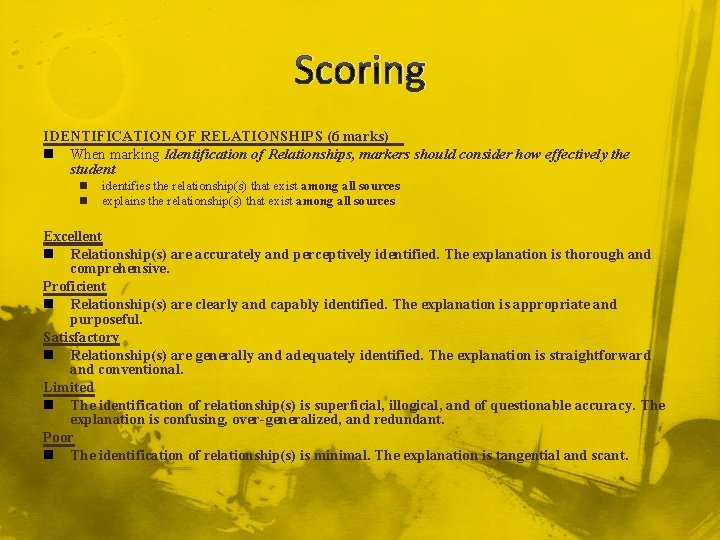
Scoring IDENTIFICATION OF RELATIONSHIPS (6 marks) n When marking Identification of Relationships, markers should consider how effectively the student n n identifies the relationship(s) that exist among all sources explains the relationship(s) that exist among all sources Excellent n Relationship(s) are accurately and perceptively identified. The explanation is thorough and comprehensive. Proficient n Relationship(s) are clearly and capably identified. The explanation is appropriate and purposeful. Satisfactory n Relationship(s) are generally and adequately identified. The explanation is straightforward and conventional. Limited n The identification of relationship(s) is superficial, illogical, and of questionable accuracy. The explanation is confusing, over-generalized, and redundant. Poor n The identification of relationship(s) is minimal. The explanation is tangential and scant.
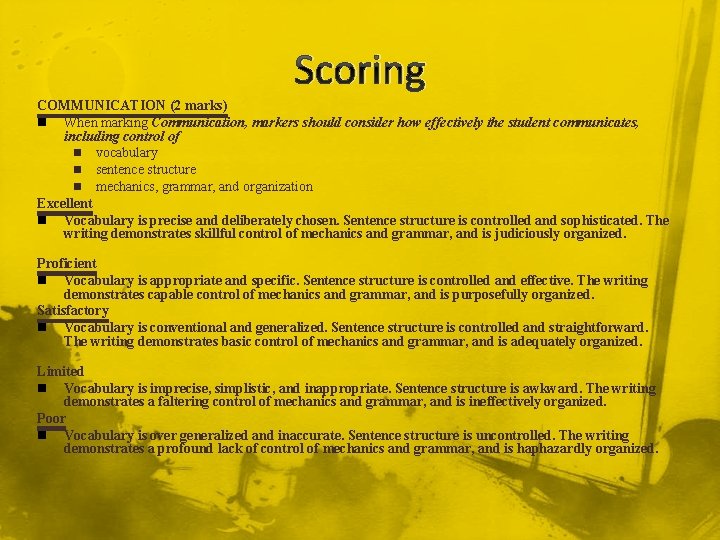
Scoring COMMUNICATION (2 marks) n When marking Communication, markers should consider how effectively the student communicates, including control of n vocabulary n sentence structure n mechanics, grammar, and organization Excellent n Vocabulary is precise and deliberately chosen. Sentence structure is controlled and sophisticated. The writing demonstrates skillful control of mechanics and grammar, and is judiciously organized. Proficient n Vocabulary is appropriate and specific. Sentence structure is controlled and effective. The writing demonstrates capable control of mechanics and grammar, and is purposefully organized. Satisfactory n Vocabulary is conventional and generalized. Sentence structure is controlled and straightforward. The writing demonstrates basic control of mechanics and grammar, and is adequately organized. Limited n Vocabulary is imprecise, simplistic, and inappropriate. Sentence structure is awkward. The writing demonstrates a faltering control of mechanics and grammar, and is ineffectively organized. Poor n Vocabulary is over generalized and inaccurate. Sentence structure is uncontrolled. The writing demonstrates a profound lack of control of mechanics and grammar, and is haphazardly organized.
- Slides: 14