
Source 1 DissolvingDissociation Solute and Solvent n When
- Slides: 25
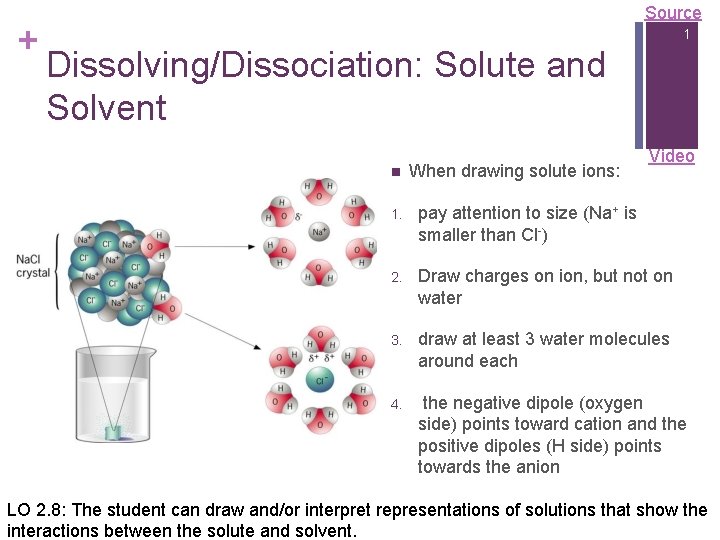
+ Source 1 Dissolving/Dissociation: Solute and Solvent n When drawing solute ions: Video 1. pay attention to size (Na+ is smaller than Cl-) 2. Draw charges on ion, but not on water 3. draw at least 3 water molecules around each 4. the negative dipole (oxygen side) points toward cation and the positive dipoles (H side) points towards the anion LO 2. 8: The student can draw and/or interpret representations of solutions that show the interactions between the solute and solvent.
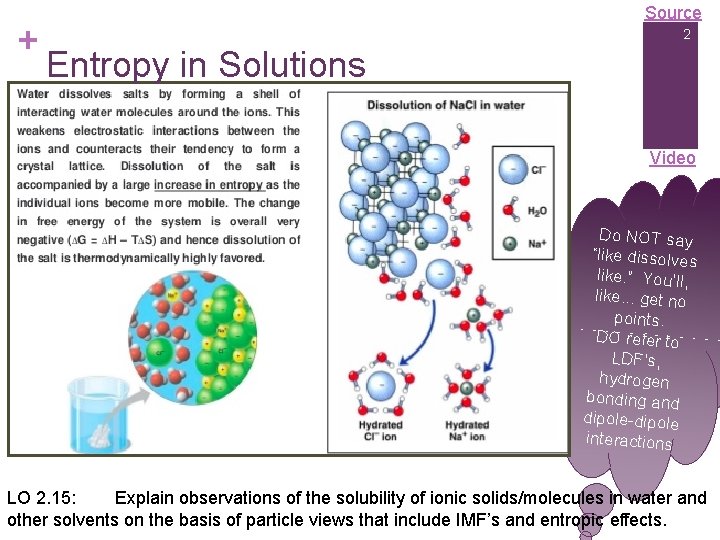
+ Source 2 Entropy in Solutions Video Do NOT say “like dissolves like. ” You’ll, like. . . get no points. DO refer to LDF’s, hydrogen bonding and dipole-dipole interactions LO 2. 15: Explain observations of the solubility of ionic solids/molecules in water and other solvents on the basis of particle views that include IMF’s and entropic effects.
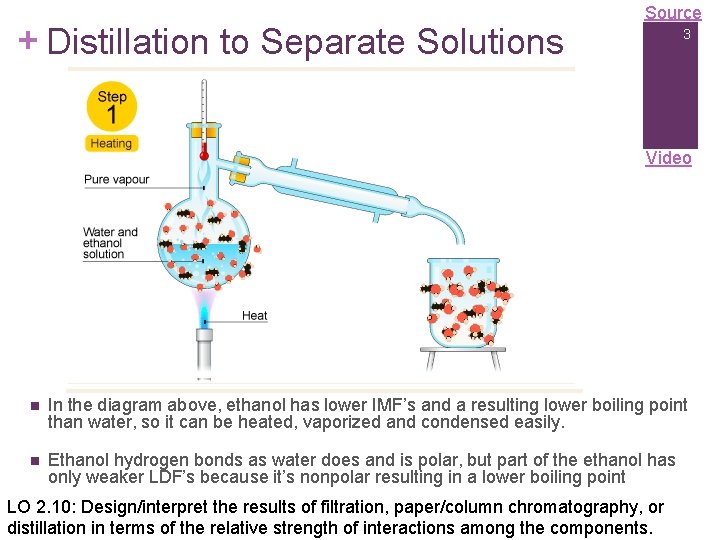
+ Distillation to Separate Solutions Source 3 Video n In the diagram above, ethanol has lower IMF’s and a resulting lower boiling point than water, so it can be heated, vaporized and condensed easily. n Ethanol hydrogen bonds as water does and is polar, but part of the ethanol has only weaker LDF’s because it’s nonpolar resulting in a lower boiling point LO 2. 10: Design/interpret the results of filtration, paper/column chromatography, or distillation in terms of the relative strength of interactions among the components.
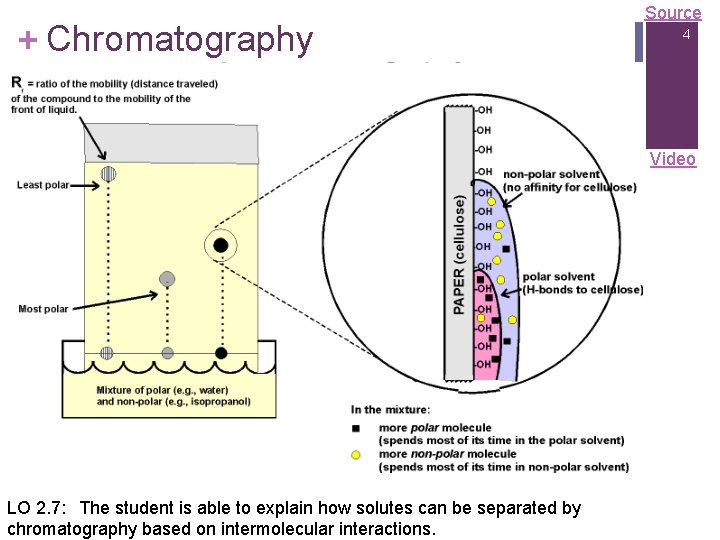
+ Chromatography Source 4 Video LO 2. 7: The student is able to explain how solutes can be separated by chromatography based on intermolecular interactions.
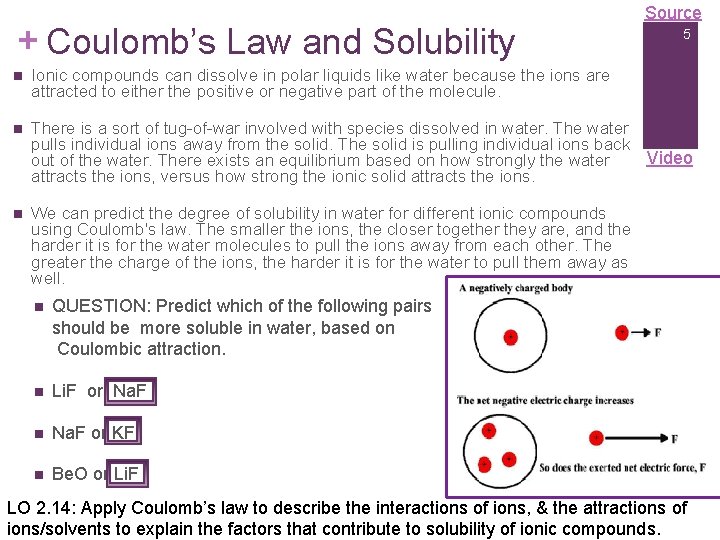
+ Coulomb’s Law and Solubility Source 5 n Ionic compounds can dissolve in polar liquids like water because the ions are attracted to either the positive or negative part of the molecule. n There is a sort of tug-of-war involved with species dissolved in water. The water pulls individual ions away from the solid. The solid is pulling individual ions back Video out of the water. There exists an equilibrium based on how strongly the water attracts the ions, versus how strong the ionic solid attracts the ions. n We can predict the degree of solubility in water for different ionic compounds using Coulomb's law. The smaller the ions, the closer together they are, and the harder it is for the water molecules to pull the ions away from each other. The greater the charge of the ions, the harder it is for the water to pull them away as well. n QUESTION: Predict which of the following pairs should be more soluble in water, based on Coulombic attraction. n Li. F or Na. F n Na. F or KF n Be. O or Li. F LO 2. 14: Apply Coulomb’s law to describe the interactions of ions, & the attractions of ions/solvents to explain the factors that contribute to solubility of ionic compounds.
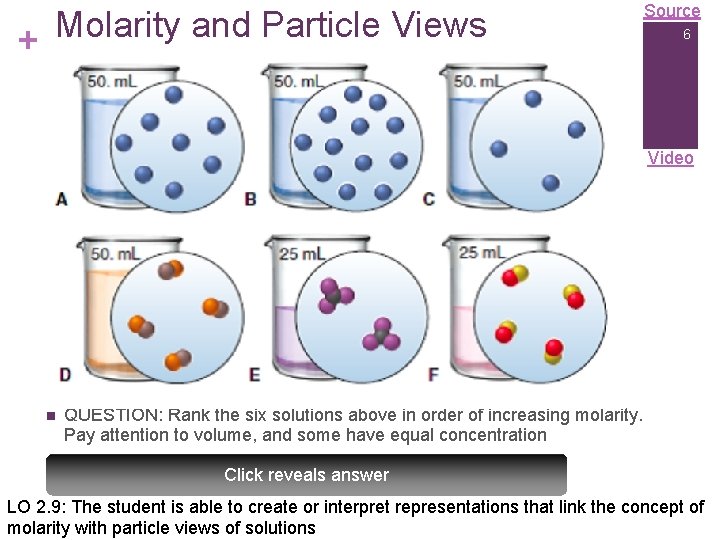
Molarity and Particle Views + Source 6 Video n QUESTION: Rank the six solutions above in order of increasing molarity. Pay attention to volume, and some have equal concentration n C, D, and E (tied); A Click and Freveals (tied); most concentrated is B answer LO 2. 9: The student is able to create or interpret representations that link the concept of molarity with particle views of solutions
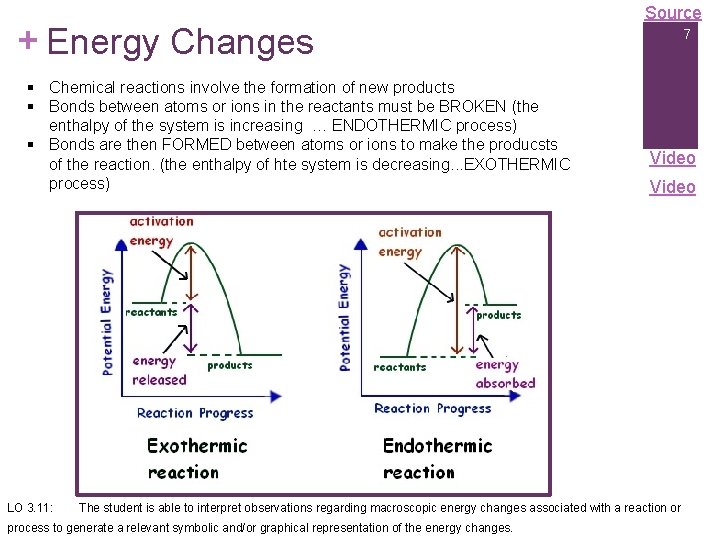
+ Energy Changes § Chemical reactions involve the formation of new products § Bonds between atoms or ions in the reactants must be BROKEN (the enthalpy of the system is increasing … ENDOTHERMIC process) § Bonds are then FORMED between atoms or ions to make the producsts of the reaction. (the enthalpy of hte system is decreasing. . . EXOTHERMIC process) LO 3. 11: Source 7 Video The student is able to interpret observations regarding macroscopic energy changes associated with a reaction or process to generate a relevant symbolic and/or graphical representation of the energy changes.
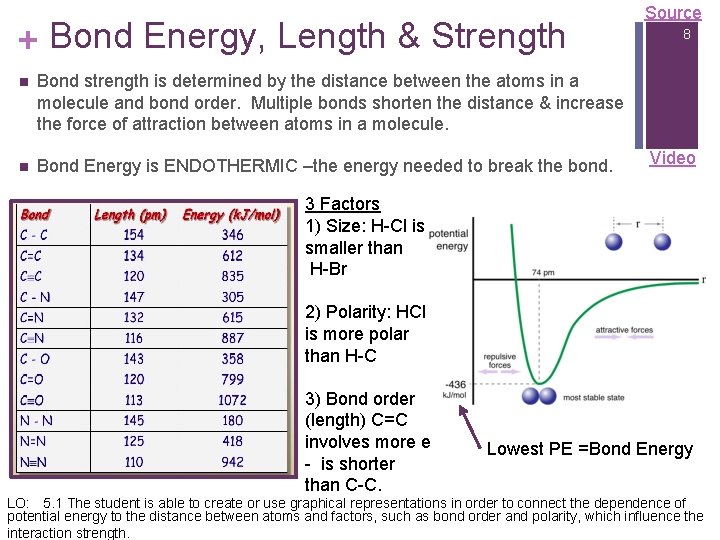
+ Bond Energy, Length & Strength n Bond strength is determined by the distance between the atoms in a molecule and bond order. Multiple bonds shorten the distance & increase the force of attraction between atoms in a molecule. n Bond Energy is ENDOTHERMIC –the energy needed to break the bond. Source 8 Video 3 Factors 1) Size: H-Cl is smaller than H-Br 2) Polarity: HCl is more polar than H-C 3) Bond order (length) C=C involves more e - is shorter than C-C. Lowest PE =Bond Energy LO: 5. 1 The student is able to create or use graphical representations in order to connect the dependence of potential energy to the distance between atoms and factors, such as bond order and polarity, which influence the interaction strength.
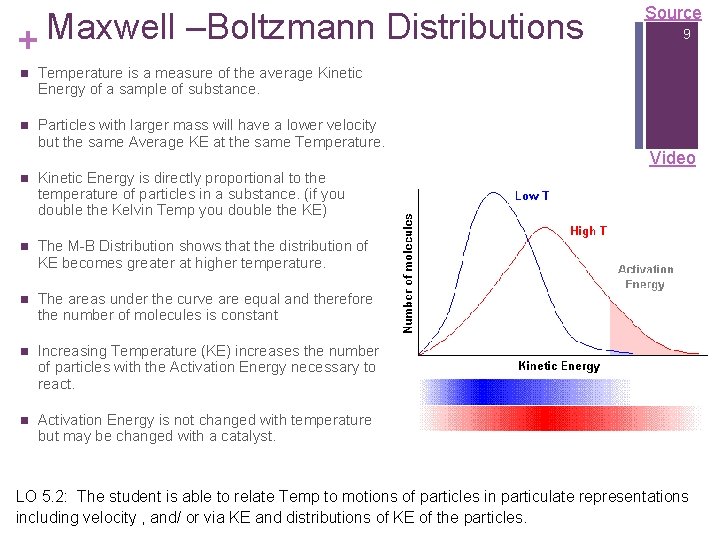
Maxwell –Boltzmann Distributions + n Temperature is a measure of the average Kinetic Energy of a sample of substance. n Particles with larger mass will have a lower velocity but the same Average KE at the same Temperature. n Kinetic Energy is directly proportional to the temperature of particles in a substance. (if you double the Kelvin Temp you double the KE) n The M-B Distribution shows that the distribution of KE becomes greater at higher temperature. n The areas under the curve are equal and therefore the number of molecules is constant n Increasing Temperature (KE) increases the number of particles with the Activation Energy necessary to react. n Activation Energy is not changed with temperature but may be changed with a catalyst. Source 9 Video LO 5. 2: The student is able to relate Temp to motions of particles in particulate representations including velocity , and/ or via KE and distributions of KE of the particles.
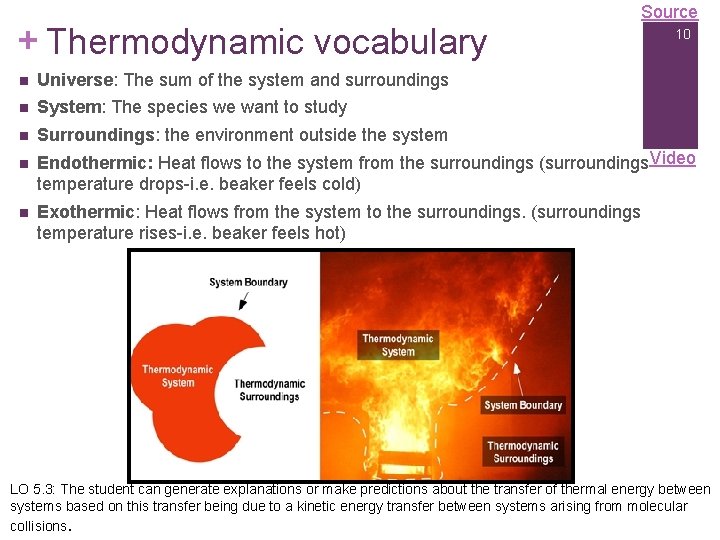
+ Thermodynamic vocabulary n Universe: The sum of the system and surroundings n System: The species we want to study n Surroundings: the environment outside the system n n Source 10 Endothermic: Heat flows to the system from the surroundings (surroundings Video temperature drops-i. e. beaker feels cold) Exothermic: Heat flows from the system to the surroundings. (surroundings temperature rises-i. e. beaker feels hot) LO 5. 3: The student can generate explanations or make predictions about the transfer of thermal energy between systems based on this transfer being due to a kinetic energy transfer between systems arising from molecular collisions.
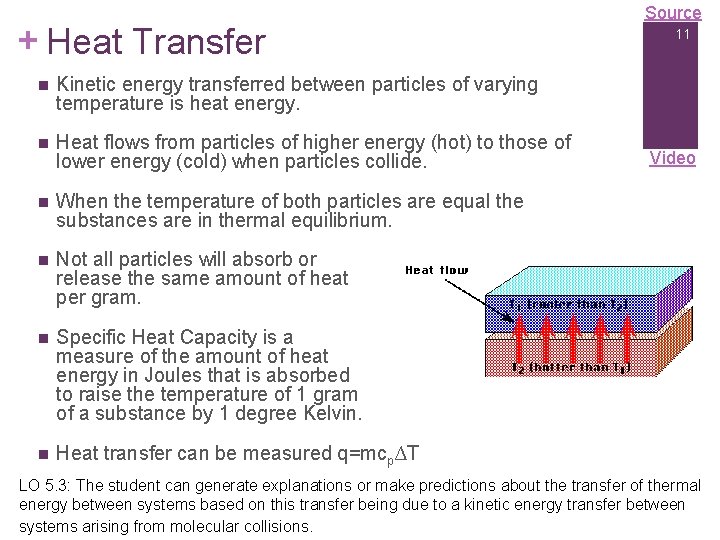
+ Heat Transfer n Kinetic energy transferred between particles of varying temperature is heat energy. n Heat flows from particles of higher energy (hot) to those of lower energy (cold) when particles collide. n When the temperature of both particles are equal the substances are in thermal equilibrium. n Not all particles will absorb or release the same amount of heat per gram. n Specific Heat Capacity is a measure of the amount of heat energy in Joules that is absorbed to raise the temperature of 1 gram of a substance by 1 degree Kelvin. n Heat transfer can be measured q=mcp∆T Source 11 Video LO 5. 3: The student can generate explanations or make predictions about the transfer of thermal energy between systems based on this transfer being due to a kinetic energy transfer between systems arising from molecular collisions.
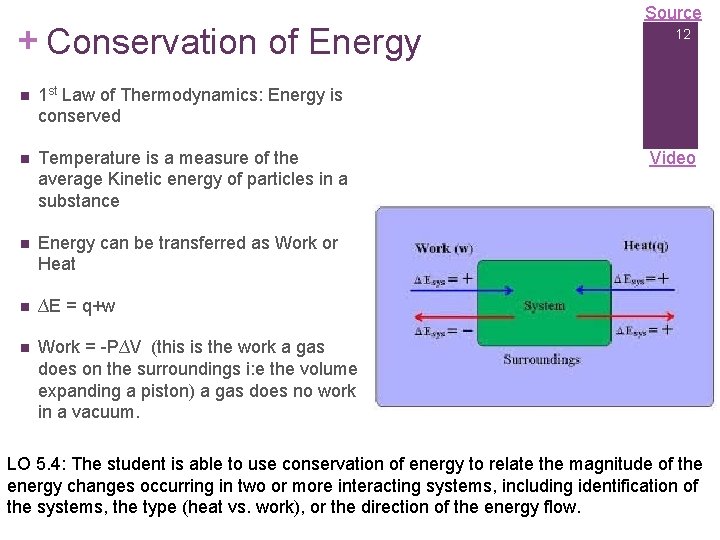
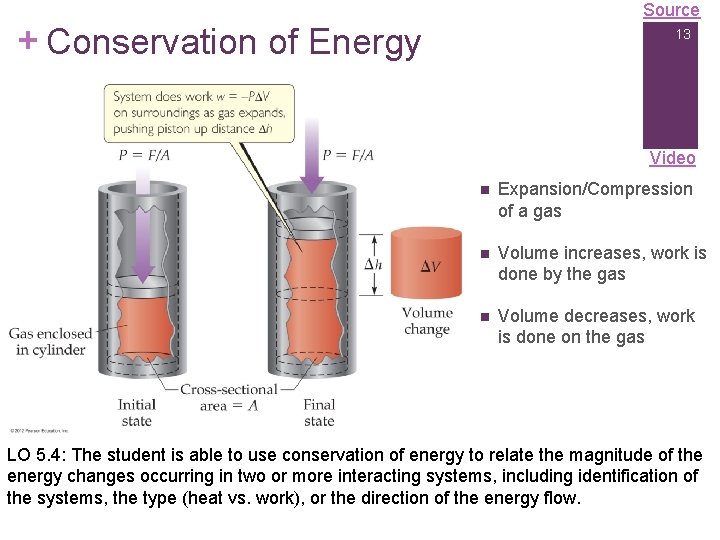
+ Conservation of Energy n 1 st Law of Thermodynamics: Energy is conserved n Temperature is a measure of the average Kinetic energy of particles in a substance n Energy can be transferred as Work or Heat n ∆E = q+w n Work = -P∆V (this is the work a gas does on the surroundings i: e the volume expanding a piston) a gas does no work in a vacuum. Source 12 Video LO 5. 4: The student is able to use conservation of energy to relate the magnitude of the energy changes occurring in two or more interacting systems, including identification of the systems, the type (heat vs. work), or the direction of the energy flow.
Source + Conservation of Energy 13 Video n Expansion/Compression of a gas n Volume increases, work is done by the gas n Volume decreases, work is done on the gas LO 5. 4: The student is able to use conservation of energy to relate the magnitude of the energy changes occurring in two or more interacting systems, including identification of the systems, the type (heat vs. work), or the direction of the energy flow.
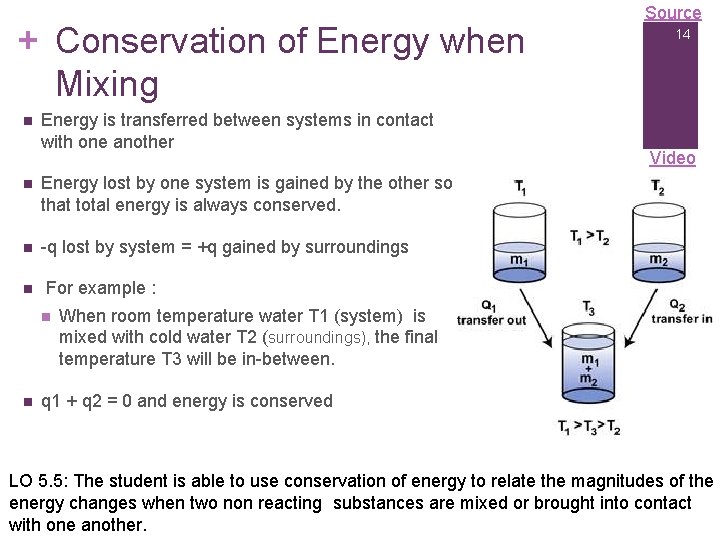
+ Conservation of Energy when Mixing n Energy is transferred between systems in contact with one another n Energy lost by one system is gained by the other so that total energy is always conserved. n -q lost by system = +q gained by surroundings n 14 Video For example : n n Source When room temperature water T 1 (system) is mixed with cold water T 2 (surroundings), the final temperature T 3 will be in-between. q 1 + q 2 = 0 and energy is conserved LO 5. 5: The student is able to use conservation of energy to relate the magnitudes of the energy changes when two non reacting substances are mixed or brought into contact with one another.
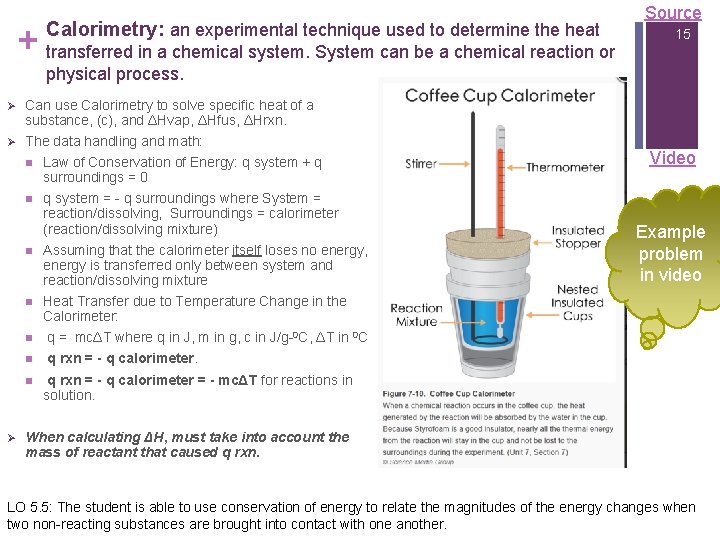
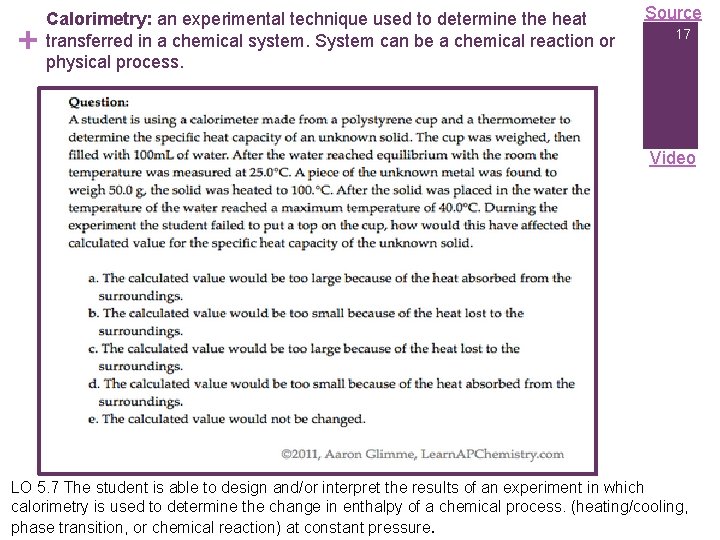
Calorimetry: an experimental technique used to determine the heat + transferred in a chemical system. System can be a chemical reaction or Source 15 physical process. Ø Can use Calorimetry to solve specific heat of a substance, (c), and ΔHvap, ΔHfus, ΔHrxn. Ø The data handling and math: n Law of Conservation of Energy: q system + q surroundings = 0 n q system = - q surroundings where System = reaction/dissolving, Surroundings = calorimeter (reaction/dissolving mixture) n Assuming that the calorimeter itself loses no energy, energy is transferred only between system and reaction/dissolving mixture n Heat Transfer due to Temperature Change in the Calorimeter: n q = mcΔT where q in J, m in g, c in J/g-0 C, ΔT in 0 C n q rxn = - q calorimeter. n Ø Video Example problem in video q rxn = - q calorimeter = - mcΔT for reactions in solution. When calculating ΔH, must take into account the mass of reactant that caused q rxn. LO 5. 5: The student is able to use conservation of energy to relate the magnitudes of the energy changes when two non-reacting substances are brought into contact with one another.
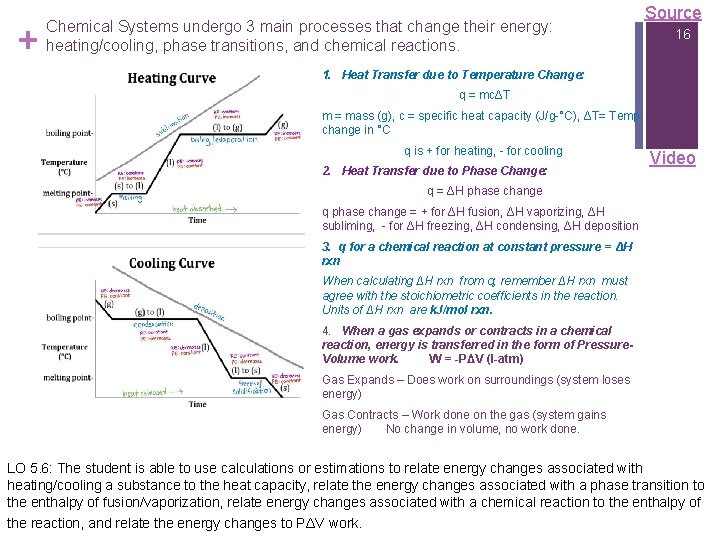
+ Chemical Systems undergo 3 main processes that change their energy: heating/cooling, phase transitions, and chemical reactions. Source 16 1. Heat Transfer due to Temperature Change: q = mcΔT m = mass (g), c = specific heat capacity (J/g-°C), ΔT= Temp. change in °C q is + for heating, - for cooling 2. Heat Transfer due to Phase Change: Video q = ΔH phase change q phase change = + for ΔH fusion, ΔH vaporizing, ΔH subliming, - for ΔH freezing, ΔH condensing, ΔH deposition 3. q for a chemical reaction at constant pressure = ΔH rxn When calculating ΔH rxn from q, remember ΔH rxn must agree with the stoichiometric coefficients in the reaction. Units of ΔH rxn are k. J/mol rxn. 4. When a gas expands or contracts in a chemical reaction, energy is transferred in the form of Pressure. Volume work. W = -PΔV (l-atm) Gas Expands – Does work on surroundings (system loses energy) Gas Contracts – Work done on the gas (system gains energy) No change in volume, no work done. LO 5. 6: The student is able to use calculations or estimations to relate energy changes associated with heating/cooling a substance to the heat capacity, relate the energy changes associated with a phase transition to the enthalpy of fusion/vaporization, relate energy changes associated with a chemical reaction to the enthalpy of the reaction, and relate the energy changes to PΔV work.
+ Calorimetry: an experimental technique used to determine the heat transferred in a chemical system. System can be a chemical reaction or physical process. Source 17 Video LO 5. 7 The student is able to design and/or interpret the results of an experiment in which calorimetry is used to determine the change in enthalpy of a chemical process. (heating/cooling, phase transition, or chemical reaction) at constant pressure.
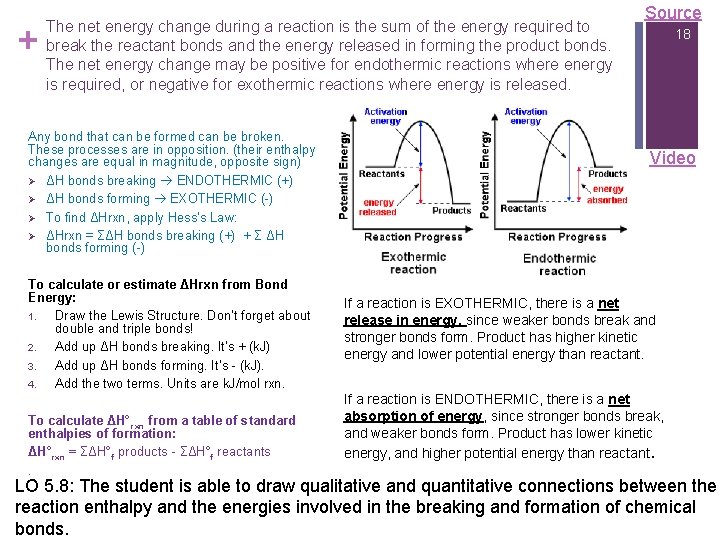
+ The net energy change during a reaction is the sum of the energy required to break the reactant bonds and the energy released in forming the product bonds. The net energy change may be positive for endothermic reactions where energy is required, or negative for exothermic reactions where energy is released. Any bond that can be formed can be broken. These processes are in opposition. (their enthalpy changes are equal in magnitude, opposite sign) Ø ΔH bonds breaking ENDOTHERMIC (+) Ø ΔH bonds forming EXOTHERMIC (-) Ø To find ΔHrxn, apply Hess’s Law: Ø ΔHrxn = ΣΔH bonds breaking (+) + Σ ΔH bonds forming (-) To calculate or estimate ΔHrxn from Bond Energy: 1. Draw the Lewis Structure. Don’t forget about double and triple bonds! 2. Add up ΔH bonds breaking. It’s + (k. J) 3. Add up ΔH bonds forming. It’s - (k. J). 4. Add the two terms. Units are k. J/mol rxn. To calculate ΔH° rxn from a table of standard enthalpies of formation: ΔH°rxn = ΣΔH°f products - ΣΔH°f reactants. Source 18 Video If a reaction is EXOTHERMIC, there is a net release in energy, since weaker bonds break and stronger bonds form. Product has higher kinetic energy and lower potential energy than reactant. If a reaction is ENDOTHERMIC, there is a net absorption of energy, since stronger bonds break, and weaker bonds form. Product has lower kinetic energy, and higher potential energy than reactant. LO 5. 8: The student is able to draw qualitative and quantitative connections between the reaction enthalpy and the energies involved in the breaking and formation of chemical bonds.
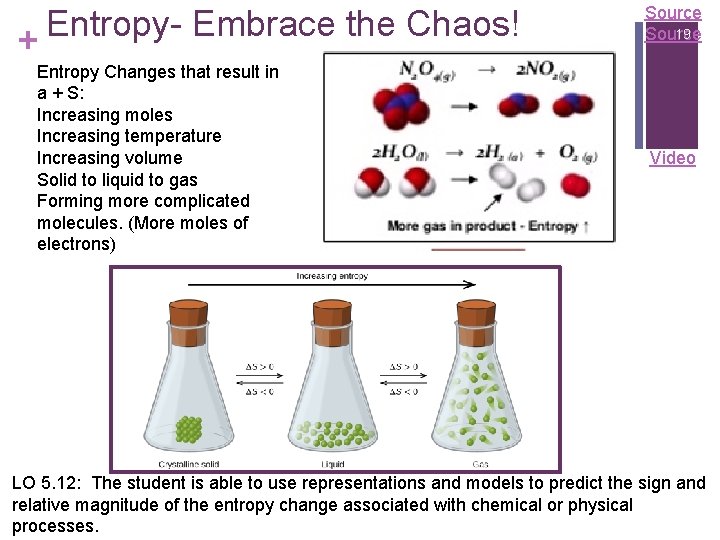
Entropy. Embrace the Chaos! + Entropy Changes that result in a + S: Increasing moles Increasing temperature Increasing volume Solid to liquid to gas Forming more complicated molecules. (More moles of electrons) Source 19 Source Video LO 5. 12: The student is able to use representations and models to predict the sign and relative magnitude of the entropy change associated with chemical or physical processes.
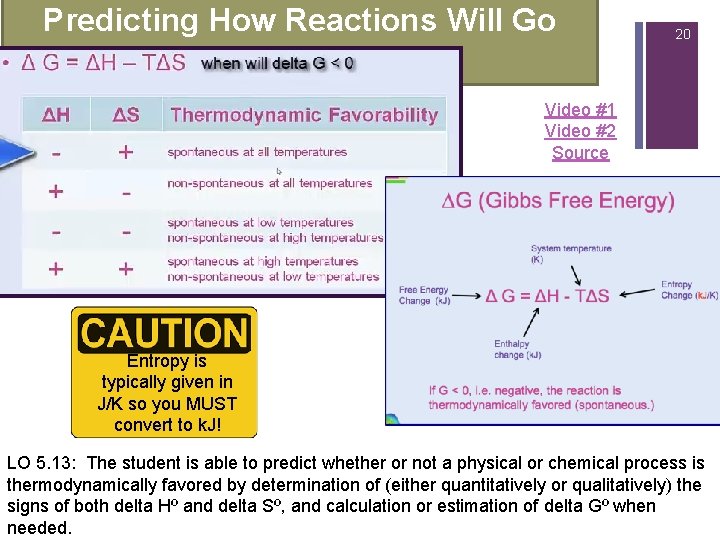
+ Predicting How Reactions Will Go 20 Video #1 Video #2 Source Entropy is typically given in J/K so you MUST convert to k. J! LO 5. 13: The student is able to predict whether or not a physical or chemical process is thermodynamically favored by determination of (either quantitatively or qualitatively) the signs of both delta Hº and delta Sº, and calculation or estimation of delta Gº when needed.
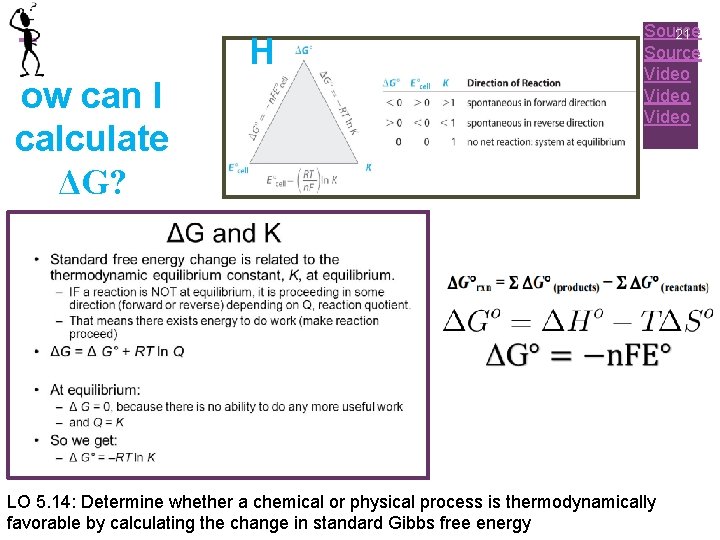
+ ow can I calculate ΔG? H Source 21 Source Video LO 5. 14: Determine whether a chemical or physical process is thermodynamically favorable by calculating the change in standard Gibbs free energy
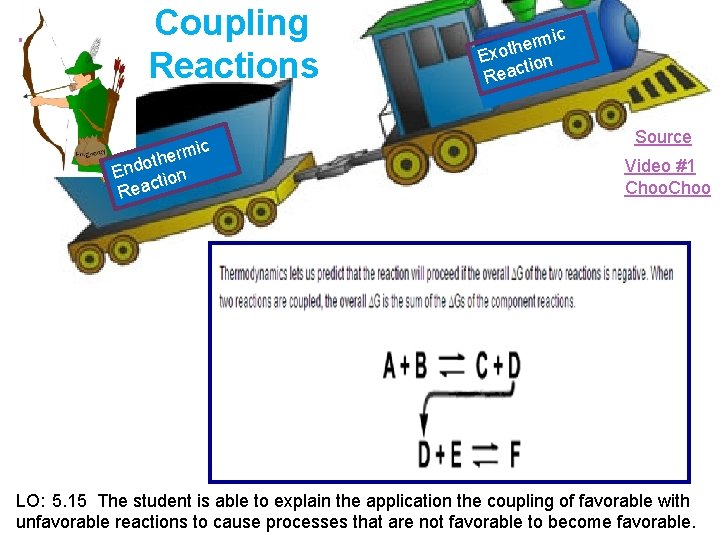
+ Coupling Reactions c ermi oth End tion c Rea rmic e h t Exo ion ct Rea 22 Source Video #1 Choo LO: 5. 15 The student is able to explain the application the coupling of favorable with unfavorable reactions to cause processes that are not favorable to become favorable.
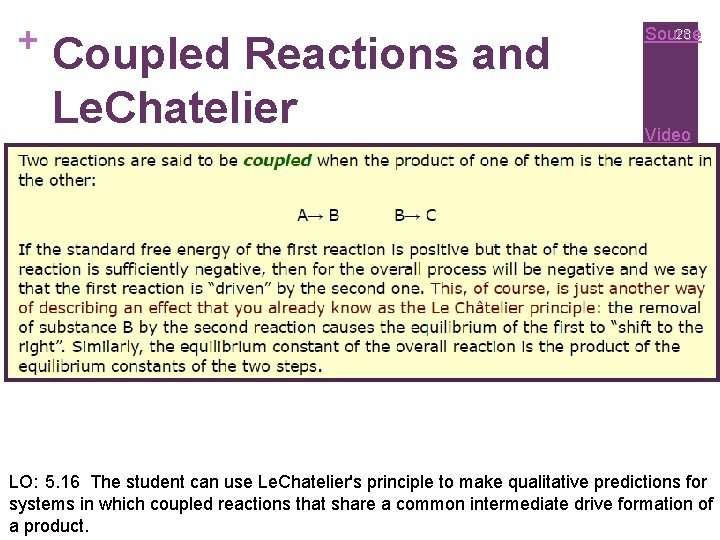
+ Coupled Reactions and Le. Chatelier 23 Source Video LO: 5. 16 The student can use Le. Chatelier's principle to make qualitative predictions for systems in which coupled reactions that share a common intermediate drive formation of a product.
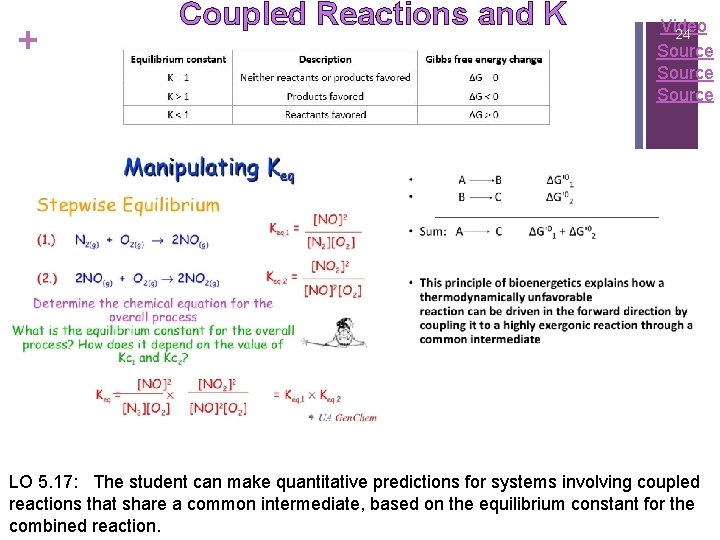
+ Coupled Reactions and K Video 24 Source LO 5. 17: The student can make quantitative predictions for systems involving coupled reactions that share a common intermediate, based on the equilibrium constant for the combined reaction.
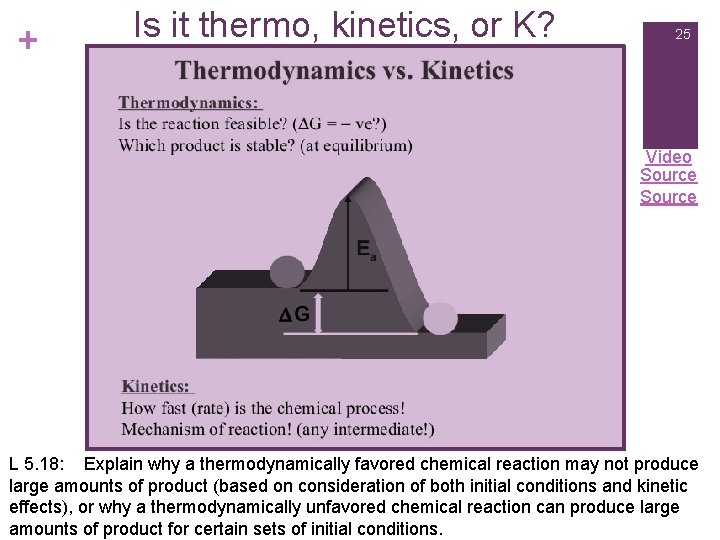
+ Is it thermo, kinetics, or K? 25 Video Source L 5. 18: Explain why a thermodynamically favored chemical reaction may not produce large amounts of product (based on consideration of both initial conditions and kinetic effects), or why a thermodynamically unfavored chemical reaction can produce large amounts of product for certain sets of initial conditions.