
Sound Waves Three things to know about sound
Sound Waves Three things to know about sound waves: 1) There must be a source for a sound wave, that source will be a vibrating object. 2) The energy transferred from the source is longitudinal. 3) The sound is detected by an ear or an instrument.
Characteristics of Sound waves • Sound can travel in different materials besides for air. • In air, the speed of sound is 343 m/s. • Does the temperature of air effect the speed of sound? • Which type of material do you think will have the greatest speed of sound? • Why would someone put their ear to the ground to determine if someone is coming towards them?
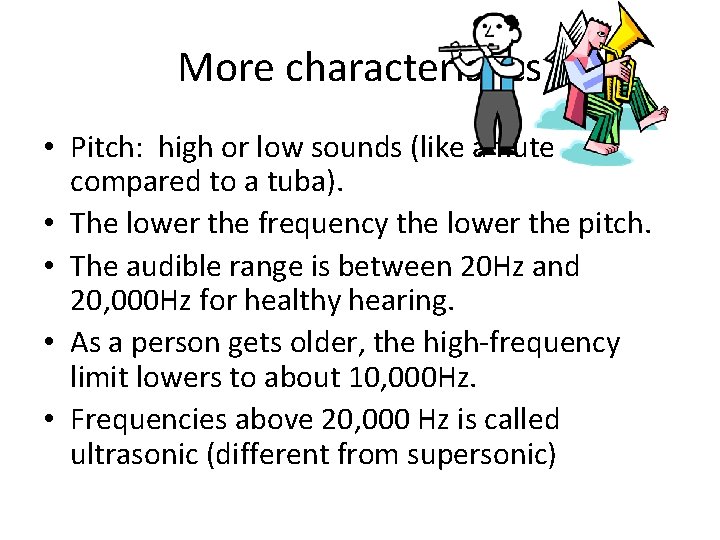
More characteristics • Pitch: high or low sounds (like a flute compared to a tuba). • The lower the frequency the lower the pitch. • The audible range is between 20 Hz and 20, 000 Hz for healthy hearing. • As a person gets older, the high-frequency limit lowers to about 10, 000 Hz. • Frequencies above 20, 000 Hz is called ultrasonic (different from supersonic)
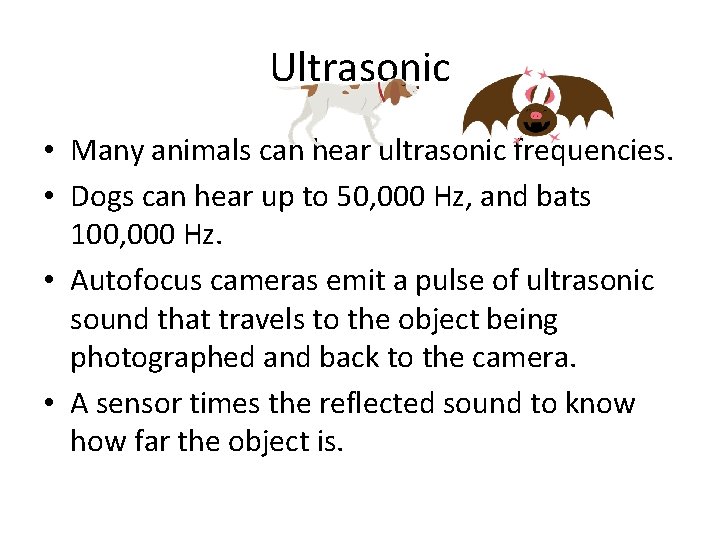
Ultrasonic • Many animals can hear ultrasonic frequencies. • Dogs can hear up to 50, 000 Hz, and bats 100, 000 Hz. • Autofocus cameras emit a pulse of ultrasonic sound that travels to the object being photographed and back to the camera. • A sensor times the reflected sound to know how far the object is.

Infrasonic • Sound waves that are below the audible range (20 Hz) • Earthquakes, thunder, volcanoes, and waves produced by vibrating heavy machinery can produce infrasonic waves. • Infrasonic waves, like ones that can be produced by heavy machinery can harm the human body.

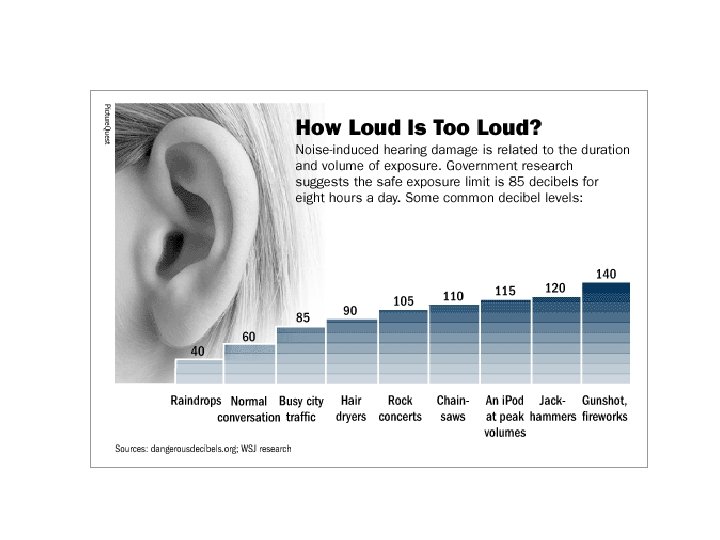
Characteristics of sound • Loudness: This is the intensity of the sound wave. • As stated earlier, intensity varies with the inverse square of the distance. • The human ear can detect sounds with an intensity as low as 10 -12 W/m^2 and as loud as 1 W/m^2 (larger will cause pain) • This is a huge range…

Alexander Graham Bell • Used a logarithmic scale to measure the intensity of a sound. We call this unit of measurement a Bel (or more commonly a decibel, 10 d. B = 1 bel).
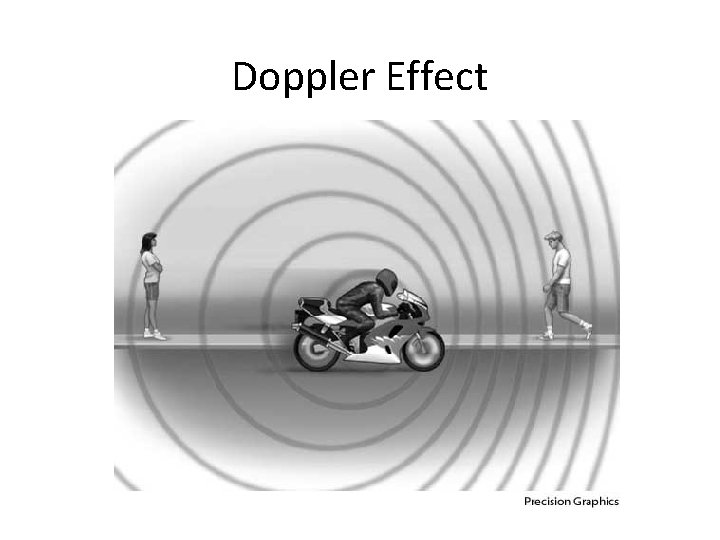
Doppler Effect
Doppler effect • As an object that emits a sound is moving towards an observer, the frequency of the sound appears to increase. • As an object that emits sound is moving away from an observer, the frequency of the sound decreases. • The Doppler effect has applications with sound, but will also have applications next week when we discuss light waves in more detail.

Sheldon Cooper Explains the Doppler Effect • Big Bang Theory Clip
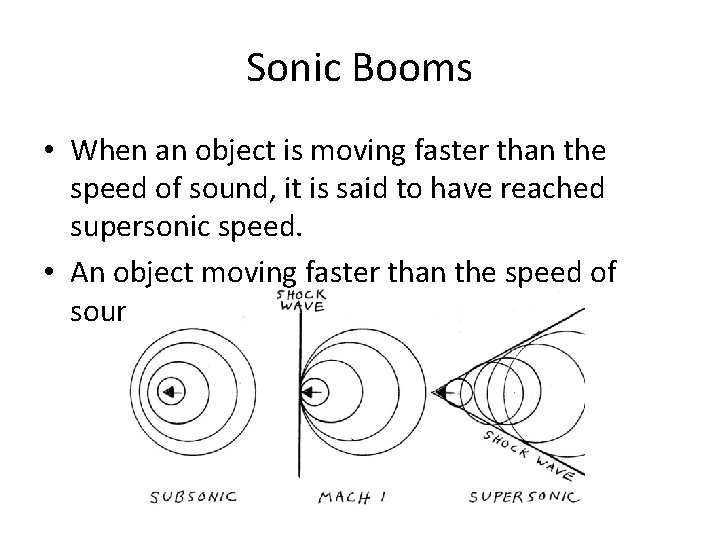
Sonic Booms • When an object is moving faster than the speed of sound, it is said to have reached supersonic speed. • An object moving faster than the speed of sound has “outrun” its sound waves.

• http: //library. thinkquest. org/19537/ • Doppler effect
Thought Experiment • Can there be a phenomena similar to a “sonic boom” for E&M waves? • Why or why not?
Interference • When two waves pass through the same region of space at the same time. • Principle of Superposition – The region where waves overlap, the resultant is the algebraic sum of their separate amplitudes. – This could be constructive or destructive interference.

Interference
Phases and interference for continuous waves • For constructive interference to occur, waves are said to be “in phase”. • For destructive interference to occur, waves are said to be “out of phase”

• wave interference simulation
Sound “beats” and interference • When two sounds (or more) of different frequencies are played at the same time, there is both constructive and destructive interference. • This causes a “beat”. • http: //library. thinkquest. org/19537/java/Beats. h tml • http: //www. loncapa. org/~mmp/applist/beats/b. htm And the best for last… http: //www. falstad. com/interference/
Standing waves • If you have a fixed end of a cord and you can vibrate it at a certain frequency so it just looks like it is oscillating up and down without traveling down the cord, this is called a standing wave. • Places where there is complete destructive interference are called nodes, and places where there is constructive interference are called anti-nodes.
Resonance • Frequencies at which standing waves are produced are called “natural frequencies” or “resonant frequencies”. • Resonance occurs because everything in nature has a natural frequency. In vibrating objects, there is only one resonant frequency. • If this frequency is hit, then it causes the amplitude of the wave to increase… sometimes catastrophically.

• Galloping Gerdie!
Resonance in cords • Cords are different because they have many natural resonant frequencies. Each of which is a whole-number multiple of the lowest resonant frequency.
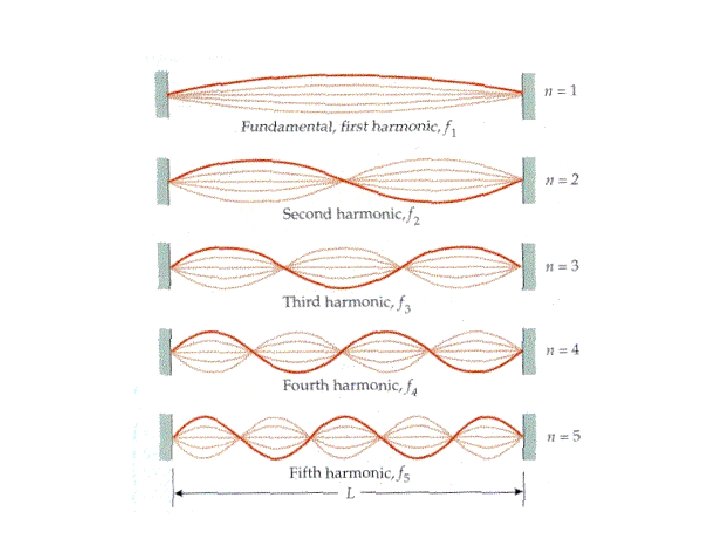
Harmonics • First, notice that the different resonant frequency depends on the length of the cord. • The lowest frequency, the fundamental frequency, corresponds to one half of a wavelength, L = 1/2λ 1. • When a frequency is an integral multiple of the fundamental frequency, they are called harmonics. • The fundamental frequency is the first harmonic
• harmonics demonstration
- Slides: 26