
Sound waves Sound is a form of energy
- Slides: 11
Sound waves Sound is a form of energy produced and transmitted by vibrating matter Medium- The stuff (matter) through which waves move
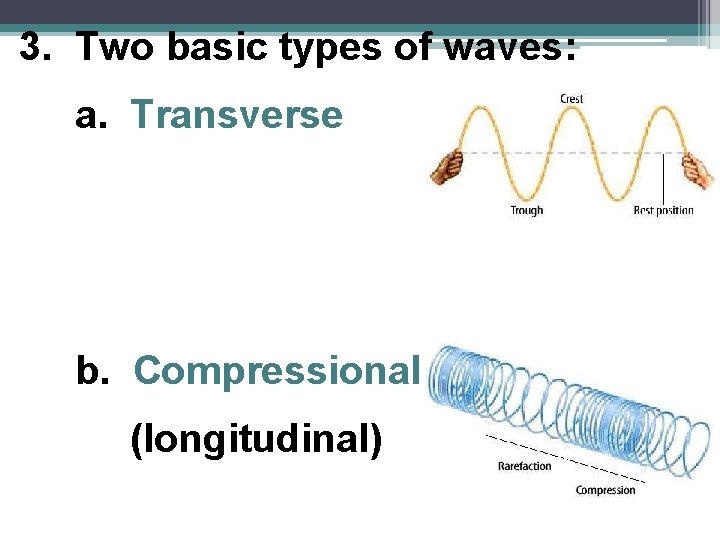
3. Two basic types of waves: a. Transverse b. Compressional (longitudinal)
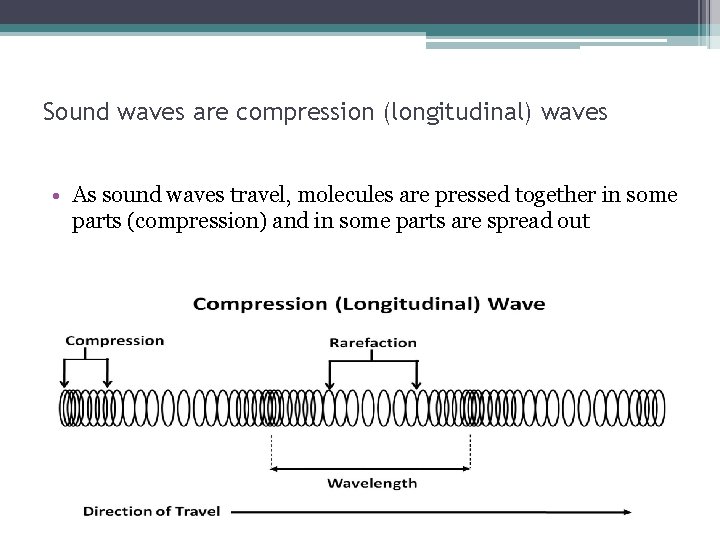
Sound waves are compression (longitudinal) waves • As sound waves travel, molecules are pressed together in some parts (compression) and in some parts are spread out •
4. Wave properties: a. Wavelength - distance from a point on a wave to the same corresponding point on the next wave. b. Frequency - number of waves that pass a point in one second (expressed in Hz).
Pitch • Pitch is determined by the frequency of a vibrating object. Objects vibrating faster have a higher pitch than objects vibrating slower. • You can hear a difference in pitch, it’s the higher and lower notes produced by instruments
Amplitude • Amplitude is the amount of energy in a compression (longitudinal) wave and is related to intensity and volume. • A louder sound has more amplitude and a softer sound has less amplitude • A louder sound moves more molecules and softer sounds move less
Animals • Some animals make and hear ranges of sound vibrations different from those that humans can make and hear. • Many animals can hear sounds humans cannot
instruments • Musical instruments vibrate to produce sound. There are many different types of musical instruments and each instrument causes the vibrations in different ways • We classify instruments into four groups ▫ Percussion (drums) ▫ String (violin, guitar) ▫ Wind (flute, trumpet) ▫ Electronic (Electric Guitar)
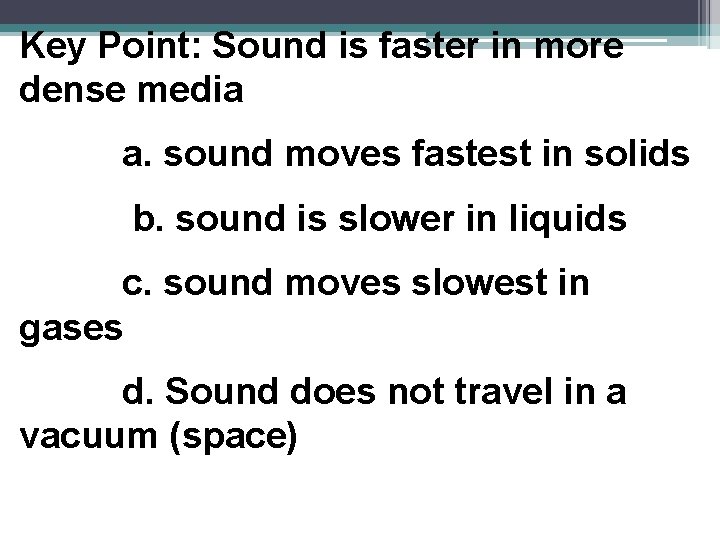
Key Point: Sound is faster in more dense media a. sound moves fastest in solids b. sound is slower in liquids c. sound moves slowest in gases d. Sound does not travel in a vacuum (space)
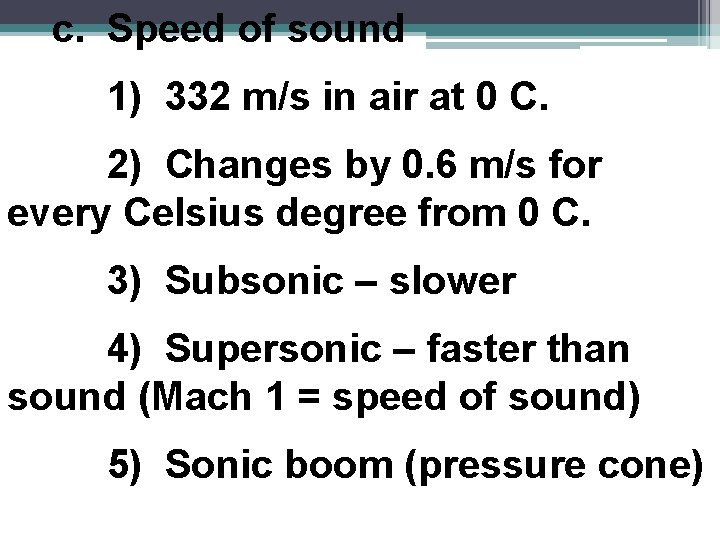
c. Speed of sound 1) 332 m/s in air at 0 C. 2) Changes by 0. 6 m/s for every Celsius degree from 0 C. 3) Subsonic – slower 4) Supersonic – faster than sound (Mach 1 = speed of sound) 5) Sonic boom (pressure cone)
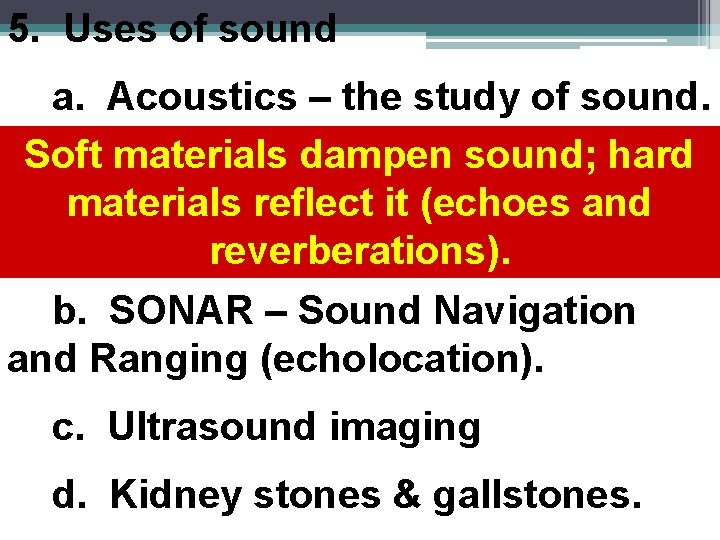
5. Uses of sound a. Acoustics – the study of sound. Soft materials dampen sound; hard materials reflect it (echoes and reverberations). b. SONAR – Sound Navigation and Ranging (echolocation). c. Ultrasound imaging d. Kidney stones & gallstones.