
SOUND The vibrations of molecules in the air
SOUND The vibrations of molecules in the air consisting of compressions and rarefactions.

SOUND PARTS • Compressions where the molecules are pushed together. Compressions
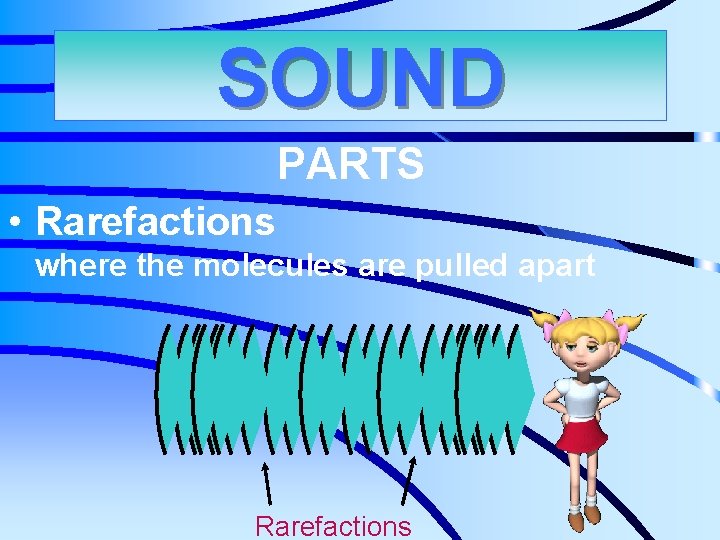
SOUND PARTS • Rarefactions where the molecules are pulled apart Rarefactions
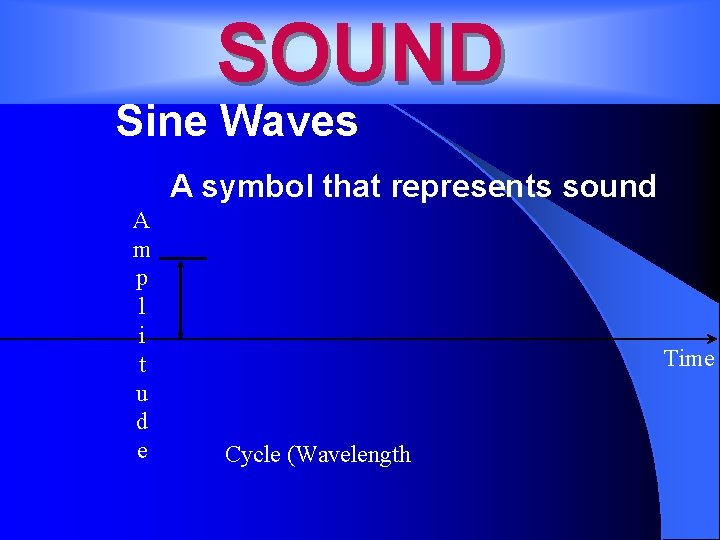
SOUND Sine Waves A symbol that represents sound A m p l i t u d e Time Cycle (Wavelength
SOUND • Cycle(Wavelength) Each time a wave goes through its pattern and returns to its starting point • Amplitude The height of the wave. Indicates the volume of the sound. The higher the amplitude the louder the sound. • Decibel (d. B) A complex measure of sound volume.
SOUND • Frequency Expressed in hertz (Hz); a frequency of 1 Hz means that there is 1 cycle or oscillation per second. The unit is named in honor of the German physicist Heinrich Rudolf Hertz, who first demonstrated the nature of electromagnetic wave propagation. Kilohertz (k. Hz), or thousands of cycles per second, megahertz (MHz), or millions of cycles per second, and gigahertz (GHz), or billions of cycles per second, are employed in describing radio waves. Radio waves and other types of electromagnetic radiation may be characterized either by their wavelengths, or by their frequencies.
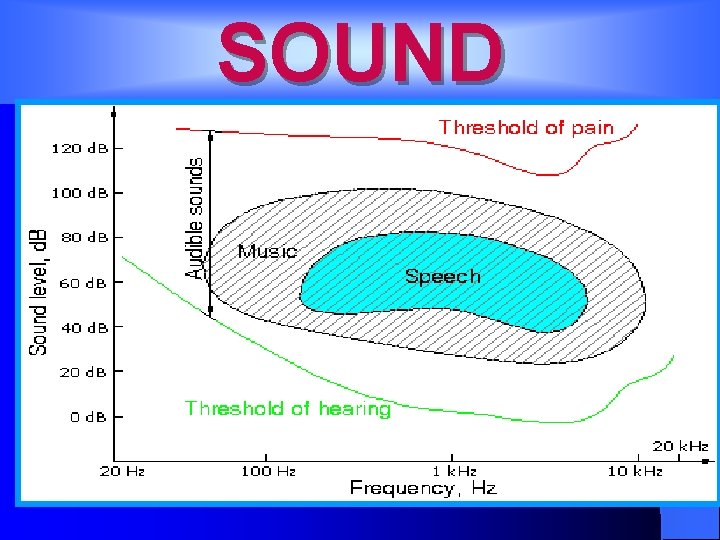
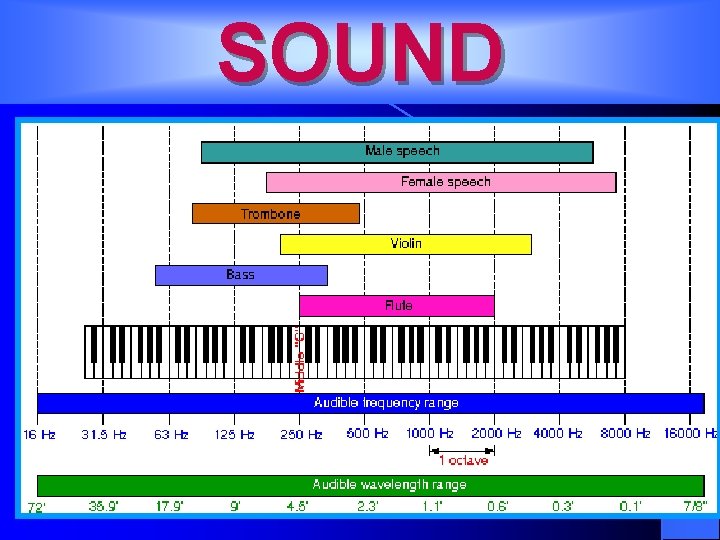
SOUND • The human ear can hear frequencies from about 35 to 20, 000 Hz • The fundamental frequency of an average male voice is typically around 300 Hz. • Consonant sounds such as p and d are much higher at about the 1, 000 Hz range • Very high, hissy consonants, such as s, can be well into the 4, 000 Hz range
SOUND
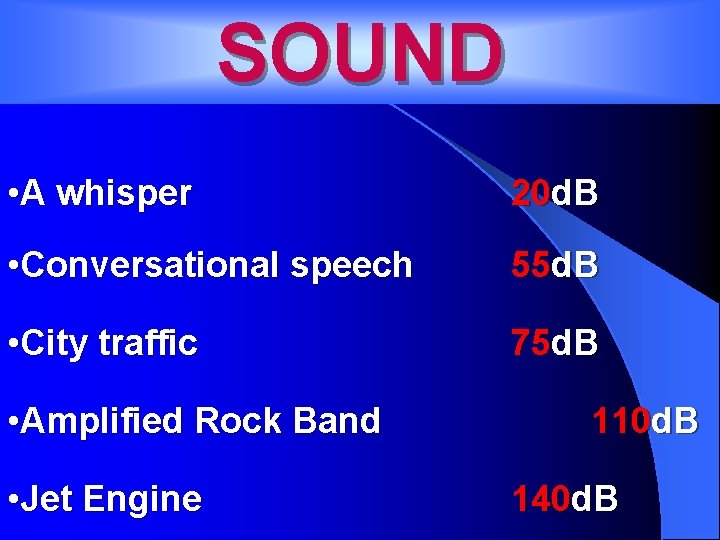
SOUND • A whisper 20 d. B • Conversational speech 55 d. B • City traffic 75 d. B • Amplified Rock Band • Jet Engine 110 d. B 140 d. B
SOUND
- Slides: 10