
Sound The Facts Sound 1 Is a form

- Slides: 17
Sound
The Facts Sound … 1. Is a form of energy produced & transmitted by vibrating matter. 2. Travels in longitudinal waves. 3. Travels more quickly through solids than liquids or gases – these are called mediums.
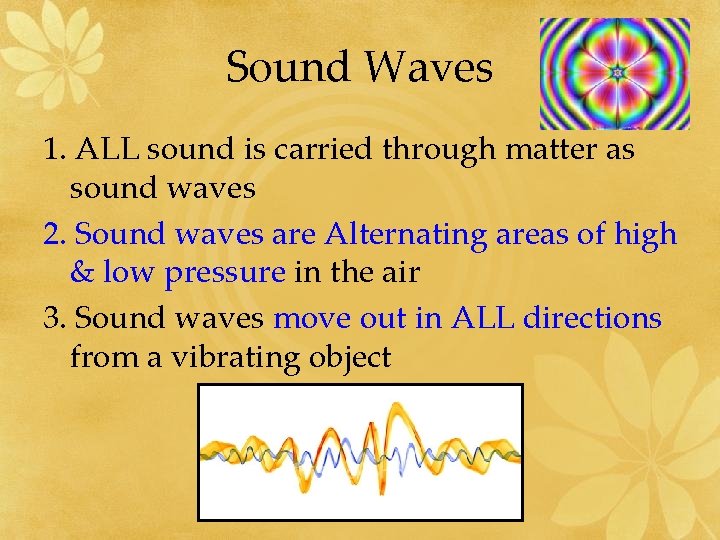
Sound Waves 1. ALL sound is carried through matter as sound waves 2. Sound waves are Alternating areas of high & low pressure in the air 3. Sound waves move out in ALL directions from a vibrating object
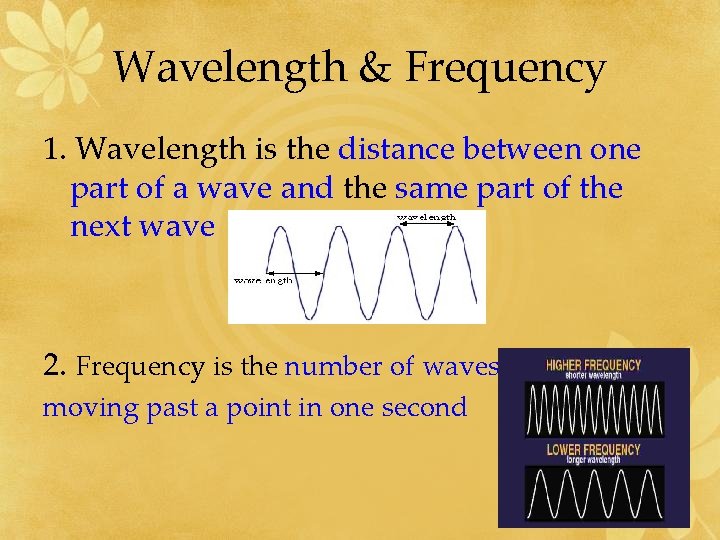
Wavelength & Frequency 1. Wavelength is the distance between one part of a wave and the same part of the next wave 2. Frequency is the number of waves moving past a point in one second
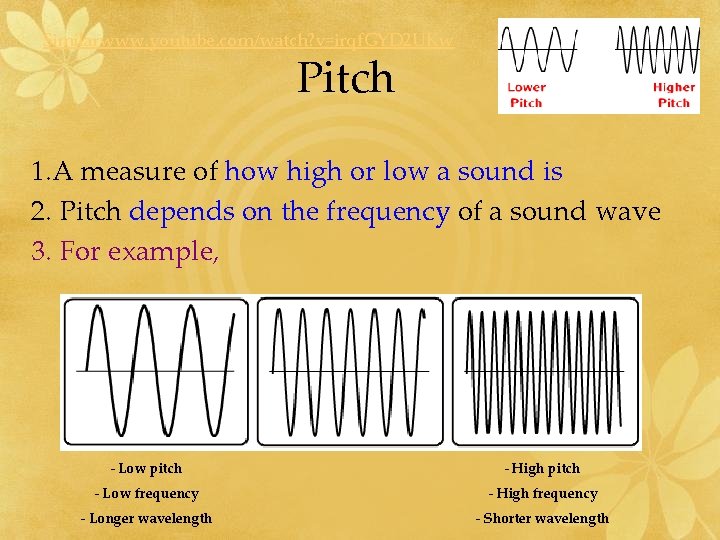
Similarwww. youtube. com/watch? v=irqf. GYD 2 UKw Pitch 1. A measure of how high or low a sound is 2. Pitch depends on the frequency of a sound wave 3. For example, - Low pitch - High pitch - Low frequency - High frequency - Longer wavelength - Shorter wavelength
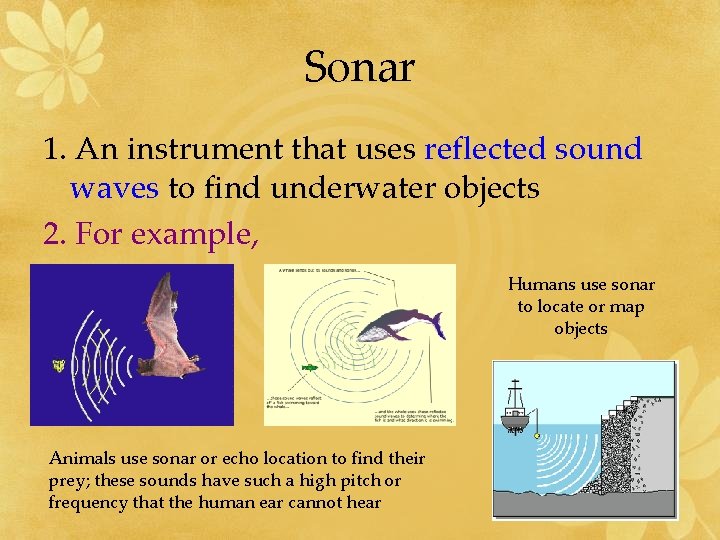
Sonar 1. An instrument that uses reflected sound waves to find underwater objects 2. For example, Humans use sonar to locate or map objects Animals use sonar or echo location to find their prey; these sounds have such a high pitch or frequency that the human ear cannot hear
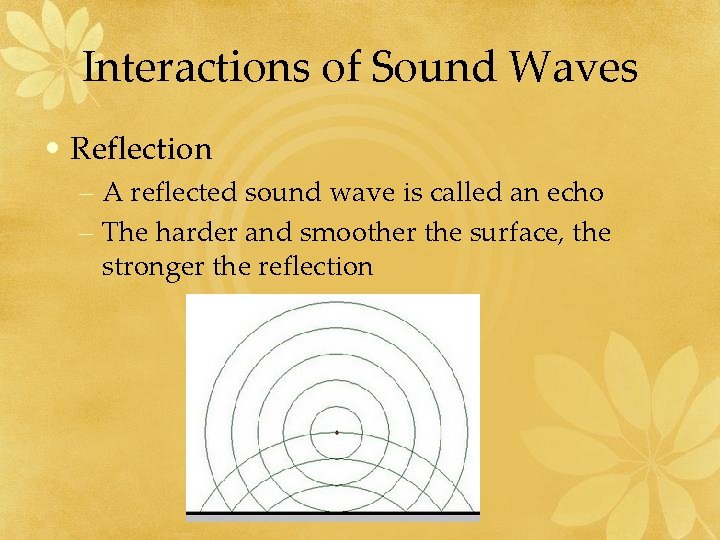
Interactions of Sound Waves • Reflection – A reflected sound wave is called an echo – The harder and smoother the surface, the stronger the reflection
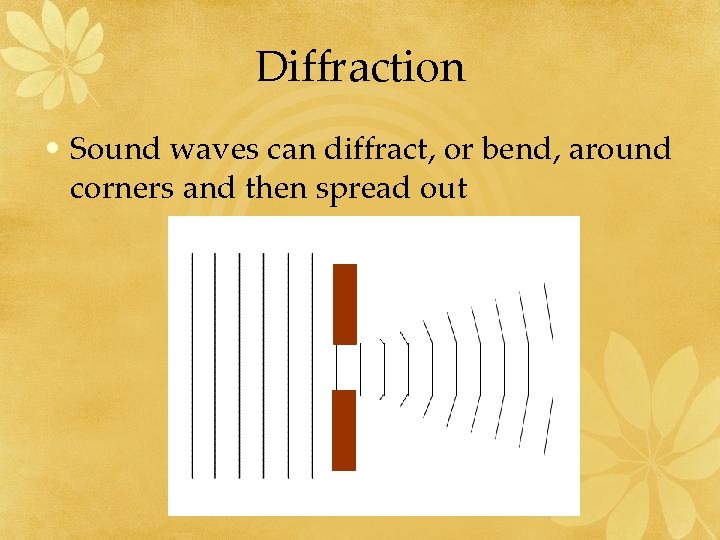
Diffraction • Sound waves can diffract, or bend, around corners and then spread out
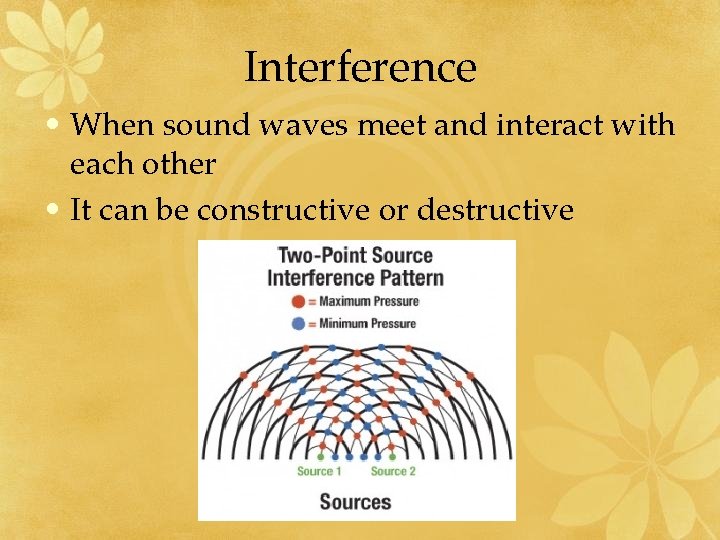
Interference • When sound waves meet and interact with each other • It can be constructive or destructive
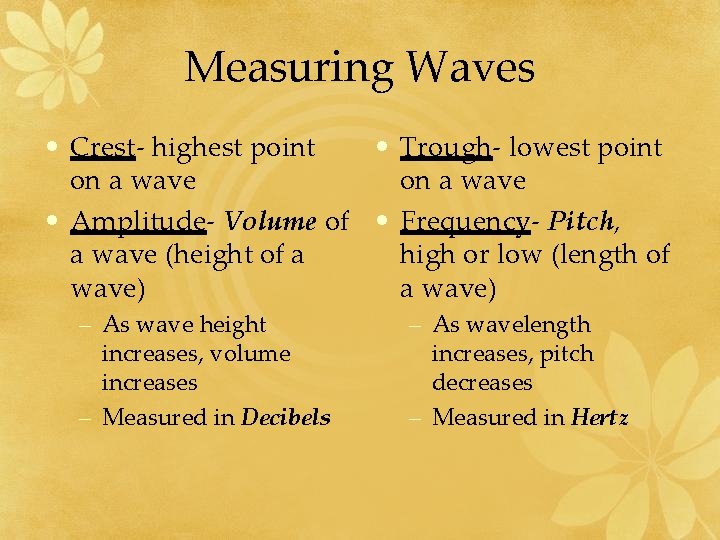
Measuring Waves • Crest- highest point • Trough- lowest point on a wave • Amplitude- Volume of • Frequency- Pitch, a wave (height of a high or low (length of wave) a wave) – As wave height increases, volume increases – Measured in Decibels – As wavelength increases, pitch decreases – Measured in Hertz
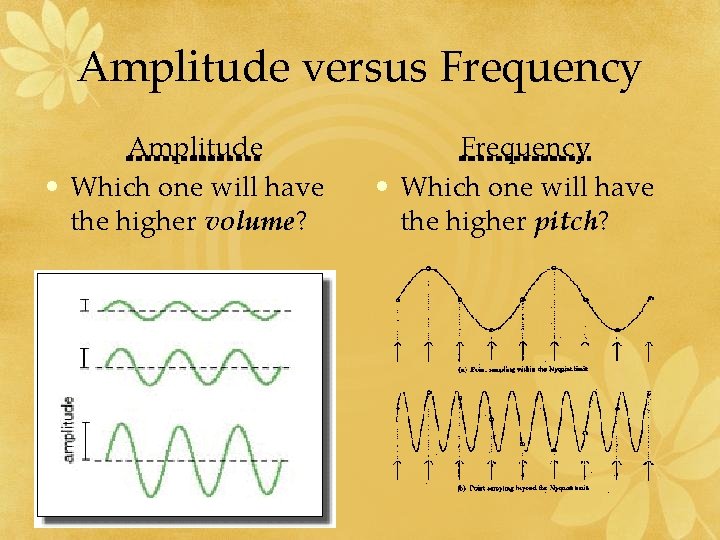
Amplitude versus Frequency Amplitude • Which one will have the higher volume? Frequency • Which one will have the higher pitch?
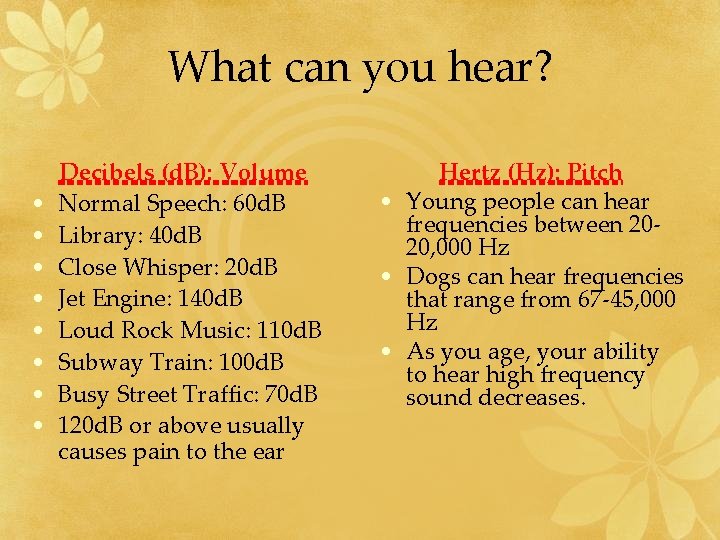
What can you hear? • • Decibels (d. B): Volume Normal Speech: 60 d. B Library: 40 d. B Close Whisper: 20 d. B Jet Engine: 140 d. B Loud Rock Music: 110 d. B Subway Train: 100 d. B Busy Street Traffic: 70 d. B 120 d. B or above usually causes pain to the ear Hertz (Hz): Pitch • Young people can hear frequencies between 2020, 000 Hz • Dogs can hear frequencies that range from 67 -45, 000 Hz • As you age, your ability to hear high frequency sound decreases.
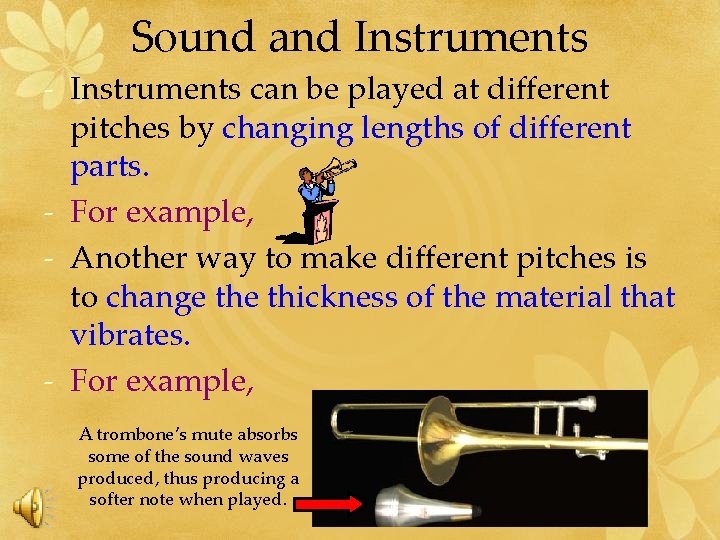
Sound and Instruments - Instruments can be played at different pitches by changing lengths of different parts. - For example, - Another way to make different pitches is to change thickness of the material that vibrates. - For example, A trombone’s mute absorbs some of the sound waves produced, thus producing a softer note when played.
Video demonstration on frequency and pitch using instruments • http: //www. youtube. com/watch? v=np. GM ha. OR 7 Rw
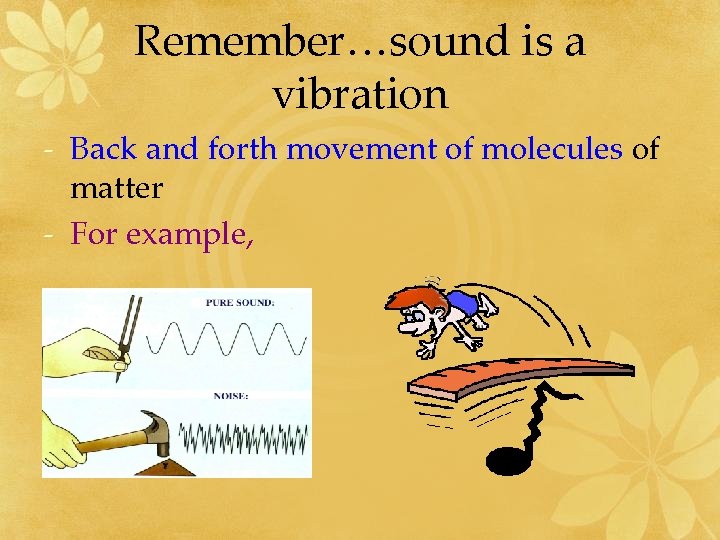
Remember…sound is a vibration - Back and forth movement of molecules of matter - For example,
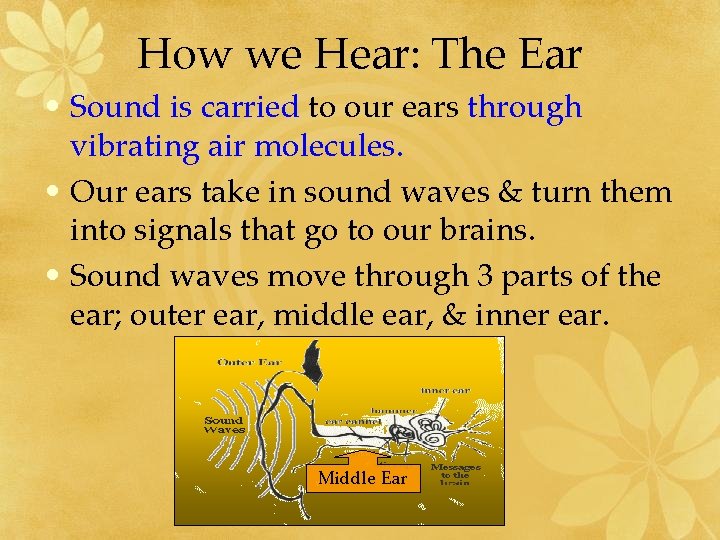
How we Hear: The Ear • Sound is carried to our ears through vibrating air molecules. • Our ears take in sound waves & turn them into signals that go to our brains. • Sound waves move through 3 parts of the ear; outer ear, middle ear, & inner ear. Middle Ear
That’s all folks!