
Sound Sound Waves Sound waves produced by a

Sound!!

Sound Waves • Sound waves produced by a vibrating object are compressional (or longitudinal) waves. • Sound waves can only travel through matter. • The energy is transferred by collisions between the particles in the material. • Faster thru solids, then liquids, then gases. -
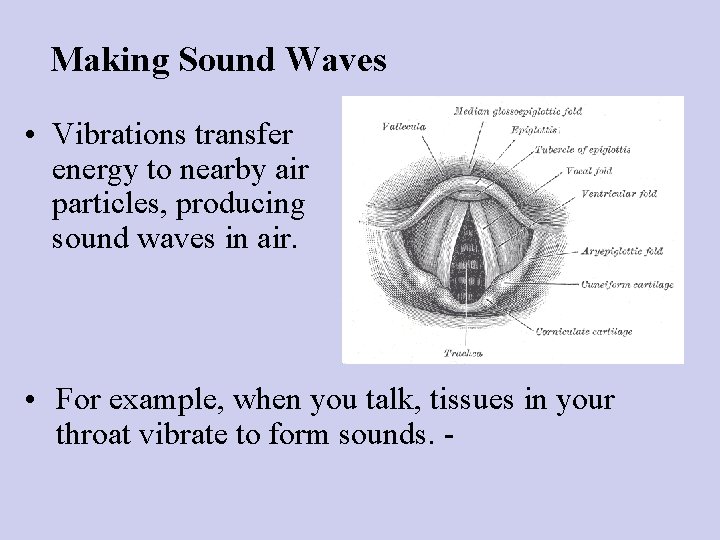
Making Sound Waves • Vibrations transfer energy to nearby air particles, producing sound waves in air. • For example, when you talk, tissues in your throat vibrate to form sounds. -

Amplitude of a Compressional Wave • The amplitude of a compressional wave depends on the density of compressions. • Also depends on what it is traveling through. Greater Amplitude Lesser Amplitude
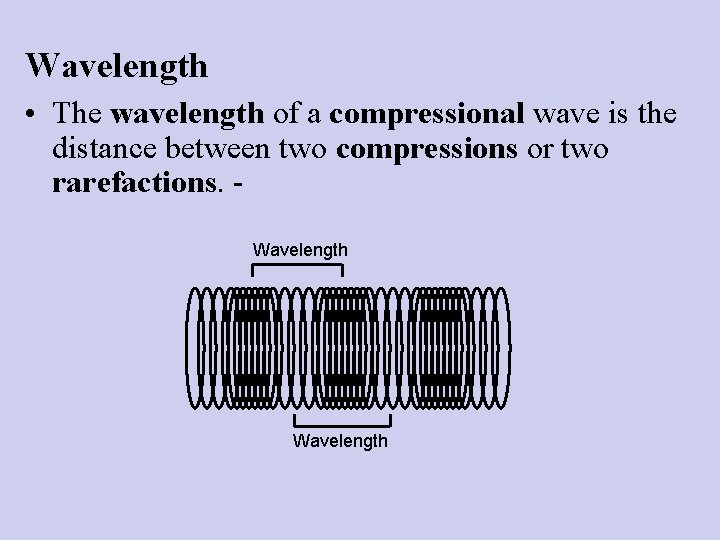
Wavelength • The wavelength of a compressional wave is the distance between two compressions or two rarefactions. Wavelength
The Speed of Sound • The speed of sound depends on the matter through which it travels. • Through air, 771 mph (at about 70 o. F. ) • Through water, 3, 333 mph. • Through iron, 11, 475 mph. • Through diamond, 26, 840 mph! • It will not travel at all through empty space (a vacuum). -
Sonic BOOM! • As an object approaches the speed of sound, it can actually overtake the sound waves it creates. • This causes a thunderous “boom” as the waves collide together and a shockwave is created. • Happens often when jets fly “supersonic. ”-

Sonic BOOM!
Sound and Temperature • The speed of sound through a material increases as the temperature of the material increases. • Ex: Sound travels through the air faster on a hot day versus a cold day. -
The Loudness of Sound • What makes a sound loud or soft? • The difference is the amount of energy. • Loud sounds have more energy than soft sounds. -

Intensity • The amount of energy that a wave carries is the intensity of the sound. -

Intensity • The intensity of sound waves is related to the amplitude. • High frequency or greater amplitude means a greater intensity. • The further away you are from a sound, the lower the amplitude and frequency. -

Frequency and Pitch • Pitch is the human perception of the frequency of sound. • Sounds with low frequencies have low pitch and sounds with high frequencies have high pitch. -

Human Ear
Interference • Two different sound waves moving in the same medium may interact with each other. – Constructive Interference: The waves make one big wave. – Destructive Interference: The waves cancel each other out. • This is why auditoriums must be designed well or you get echoes or dead spots. -
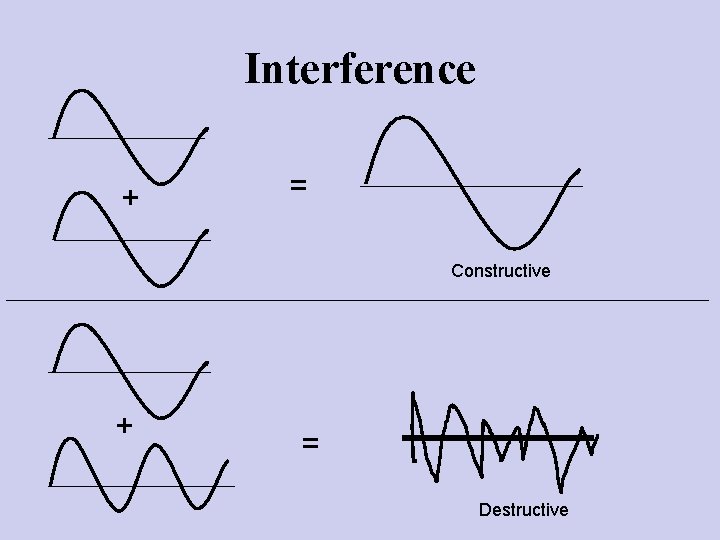
Interference + = Constructive + = Destructive

Doppler Effect • The effect created by the movement of a sound source. – Ex: A police car with its siren on sounds different here versus here. -
Doppler Effect • The source of sound always emits the same frequency. • If the distance is large, then the waves will spread apart. • If the distance is small, the waves must be compressed. -
Sound Waves – Source Not Moving
Doppler Effect – Source Moving
Doppler Effect– Source Faster than Sound
Doppler Effect– Source Much Faster than Sound
Reflection of Sound • Echoes are sounds that reflect off surfaces. • Repeated echoes are called reverberation. • The reflection of sound can be used to locate or identify objects. -
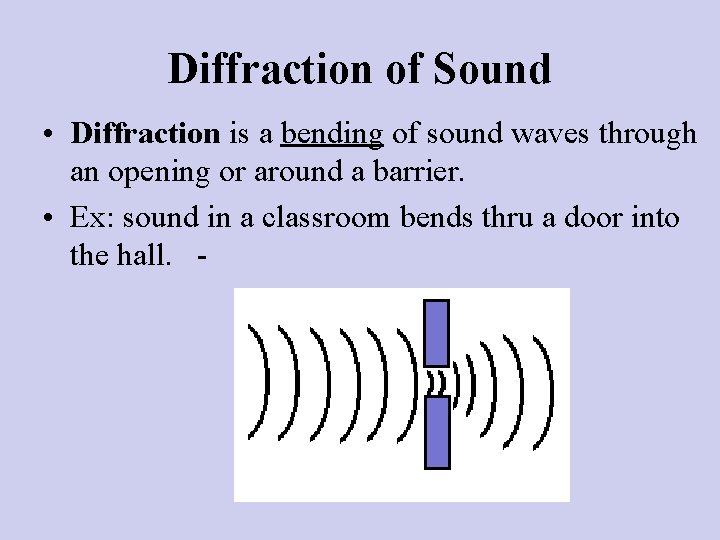
Diffraction of Sound • Diffraction is a bending of sound waves through an opening or around a barrier. • Ex: sound in a classroom bends thru a door into the hall. -

Refraction of Sound • Change of direction of sound waves thru a medium. – Ex: Walls are solid then gas or insulation then solid again. • Changes most thru different mediums. • Most evident as sound travels over water. -
- Slides: 25