
Sound Loop Parallelization Christian J Bell Princeton University
Sound Loop Parallelization Christian J. Bell Princeton University 1
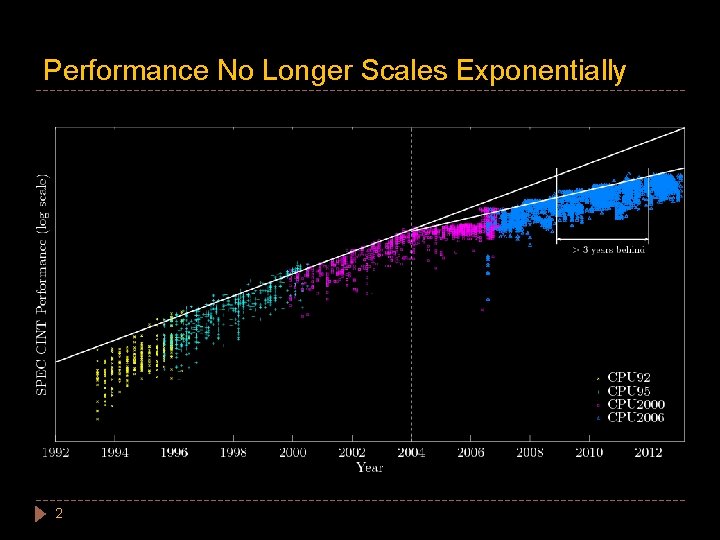
Performance No Longer Scales Exponentially 2
Problem � Need to rely on concurrency for performance gains � multithreading � Compilers � are is hard to do correctly can do some automatic parallelization big and complex; bugs are hard to detect � General techniques to formally prove correctness of parallelization have not received much attention 3
Goals � Sound loop parallelization � prove equivalence between source and parallelized programs � DOALL, DOACROSS, DSWP, … � termination of the loop is not assumed � Foundational � what is a strong, but reasonable equivalence? � can we find a general technique? � Develop � high the proofs in the Coq Proof Assistant assurance � helps manage the high proof complexity � possible integration with certified compilers (e. g. , 4 Comp. Cert)
Non-Goals Automation (for now) � there is already a large body of research on automation � we found plenty of challenges proving correctness alone 5
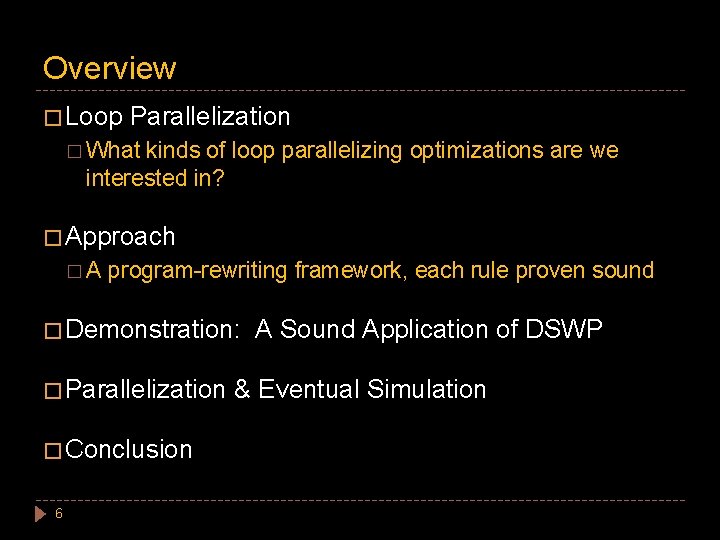
Overview � Loop Parallelization � What kinds of loop parallelizing optimizations are we interested in? � Approach �A program-rewriting framework, each rule proven sound � Demonstration: � Parallelization � Conclusion 6 A Sound Application of DSWP & Eventual Simulation
Loop Parallelization What kinds of loop parallelizing optimizations are we interested in? 7
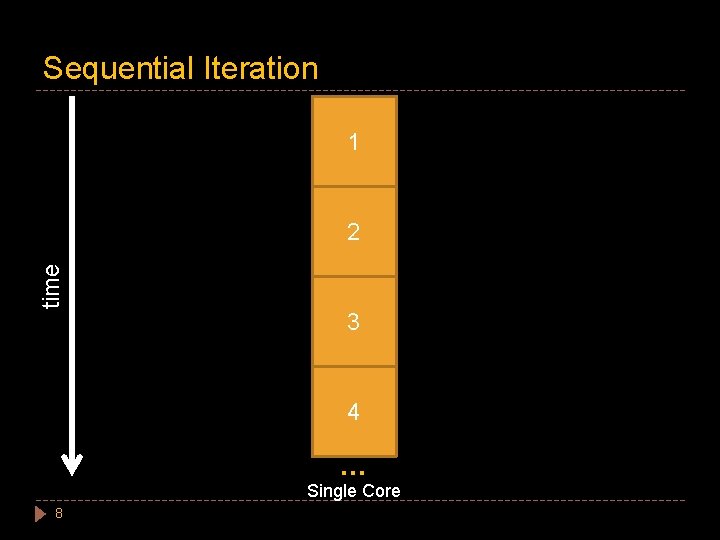
Sequential Iteration 1 time 2 3 4 … Single Core 8
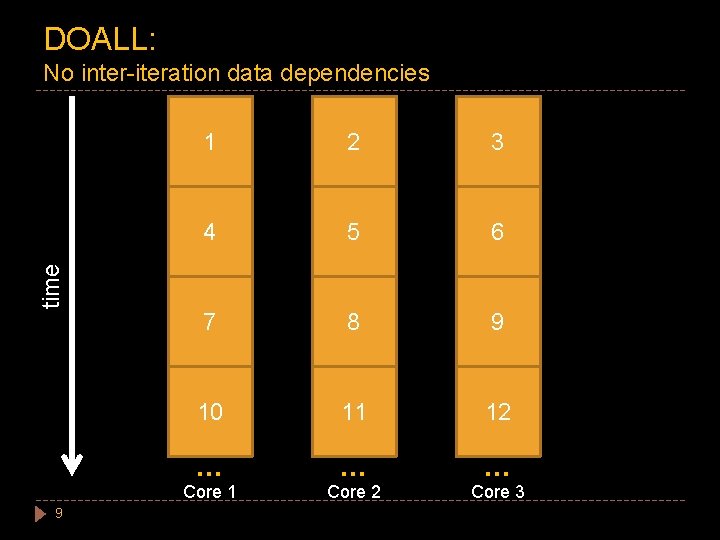
DOALL: time No inter-iteration data dependencies 9 1 2 3 4 5 6 7 8 9 10 11 12 … … … Core 1 Core 2 Core 3
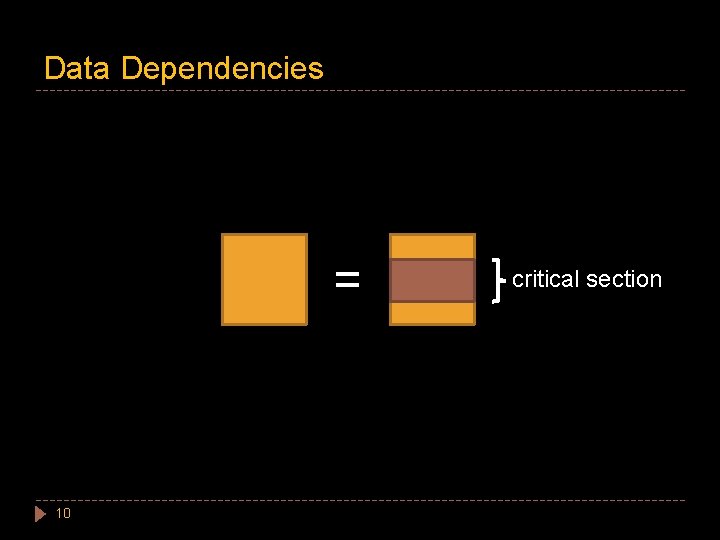
Data Dependencies = 10 9 critical section
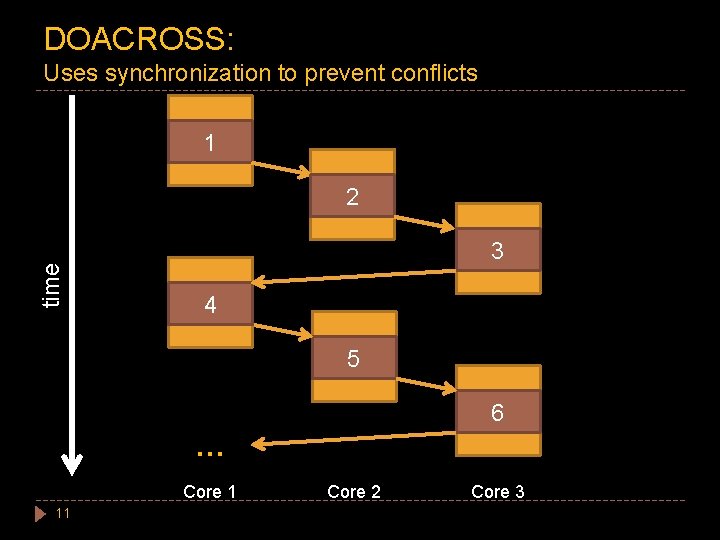
DOACROSS: Uses synchronization to prevent conflicts 9 1 time 2 9 3 9 4 9 5 9 6 … Core 1 11 Core 2 Core 3
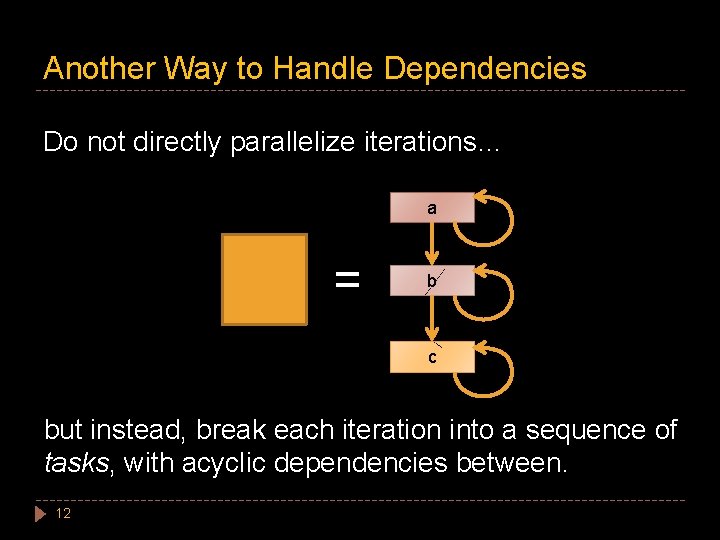
Another Way to Handle Dependencies Do not directly parallelize iterations… a = b c but instead, break each iteration into a sequence of tasks, with acyclic dependencies between. 12
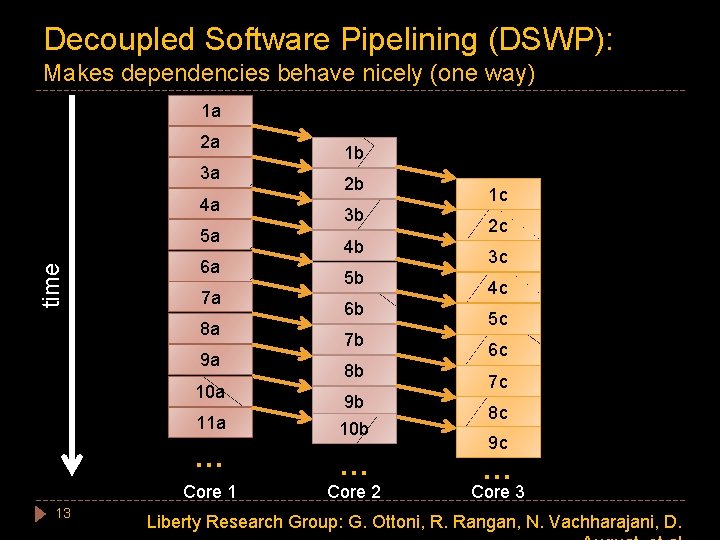
Decoupled Software Pipelining (DSWP): Makes dependencies behave nicely (one way) 1 a 2 a 3 a 4 a time 5 a 6 a 7 a 8 a 9 a 10 a 2 b 3 b 4 b 5 b 6 b 7 b 8 b 1 c 2 c 3 c 4 c 5 c 6 c 7 c 8 c … 9 b 10 b … Core 1 Core 2 … 11 a 13 1 b 9 c Core 3 Liberty Research Group: G. Ottoni, R. Rangan, N. Vachharajani, D.
Approach 14
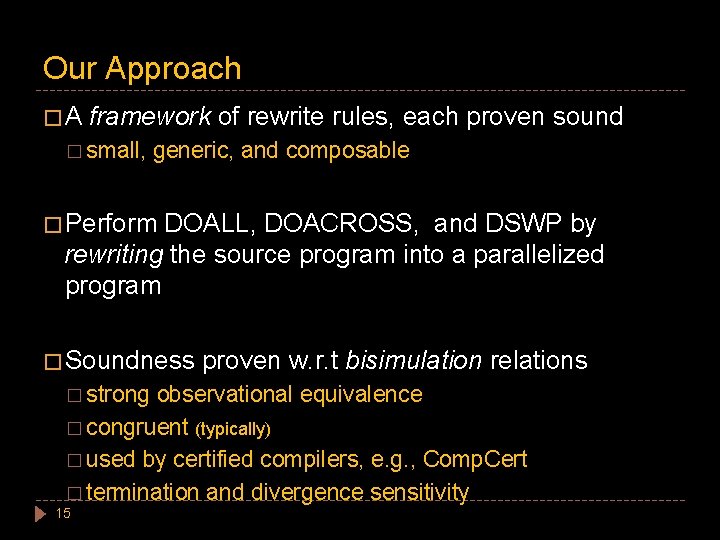
Our Approach �A framework of rewrite rules, each proven sound � small, generic, and composable � Perform DOALL, DOACROSS, and DSWP by rewriting the source program into a parallelized program � Soundness � strong proven w. r. t bisimulation relations observational equivalence � congruent (typically) � used by certified compilers, e. g. , Comp. Cert � termination and divergence sensitivity 15
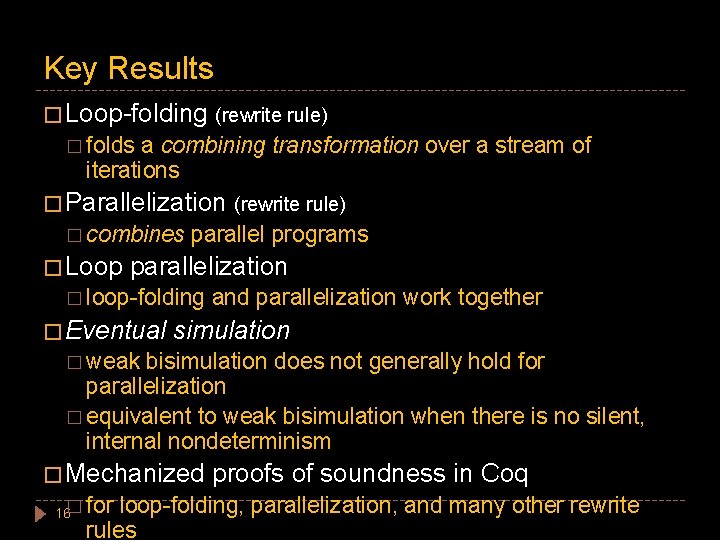
Key Results � Loop-folding (rewrite rule) � folds a combining transformation over a stream of iterations � Parallelization (rewrite rule) � combines � Loop parallel programs parallelization � loop-folding � Eventual and parallelization work together simulation � weak bisimulation does not generally hold for parallelization � equivalent to weak bisimulation when there is no silent, internal nondeterminism � Mechanized 16� proofs of soundness in Coq for loop-folding, parallelization, and many other rewrite rules
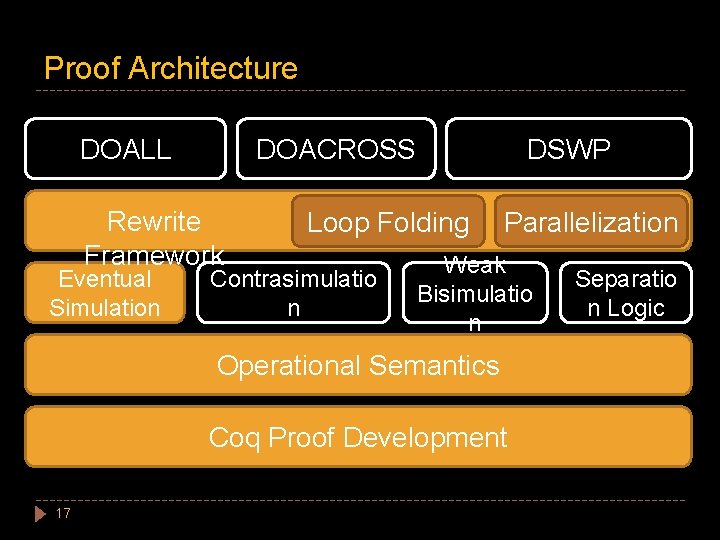
Proof Architecture DOALL DOACROSS Rewrite Framework Eventual Simulation DSWP Loop Folding Contrasimulatio n Parallelization Weak Bisimulatio n Operational Semantics Coq Proof Development 17 Separatio n Logic
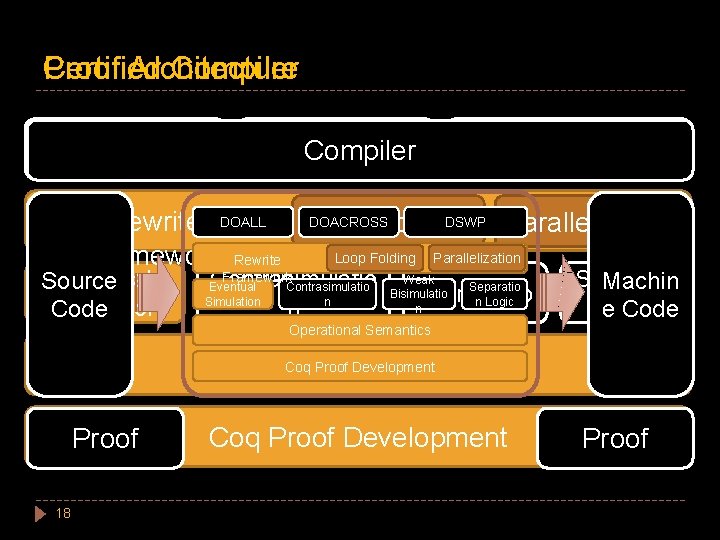
Certified Proof Architecture Compiler DOALL DOACROSS Compiler DSWP DOACROSS DSWP Parallelization Rewrite DOALL Loop Folding Parallelization Framework Rewrite Weak Eventual Source Simulation Code Framework Contrasimulatio n n Eventual Simulation Weak Bisimulatio n Operational Semantics Separatio n Logic Separatio Machin n e. Logic Code Coq Proof Development Operational Semantics Proof 18 Coq Proof Development Proof
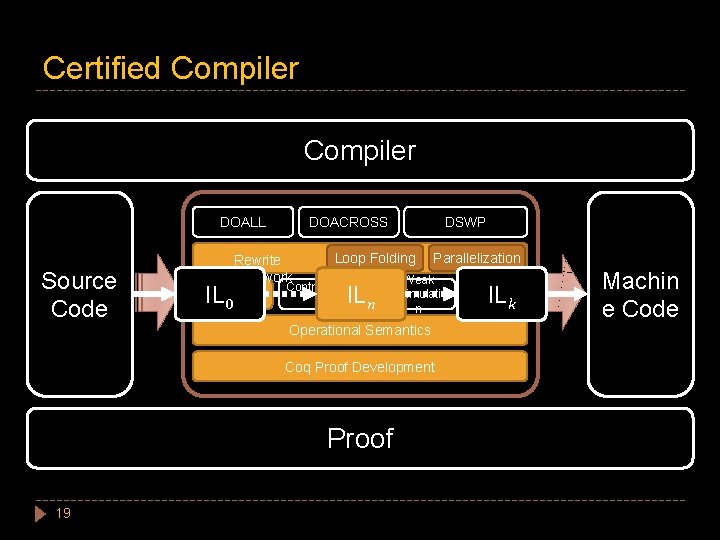
Certified Compiler DOALL Source Code DOACROSS Rewrite Framework Eventual Simulation 0 IL DSWP Loop Folding Contrasimulatio n n IL Parallelization Weak Bisimulatio n Separatio n Logic k IL Machin e Code Operational Semantics Coq Proof Development Proof 19 Proof
Demonstration: A Sound Application of DSWP Loop-parallelization: 20 loop-folding & parallelization
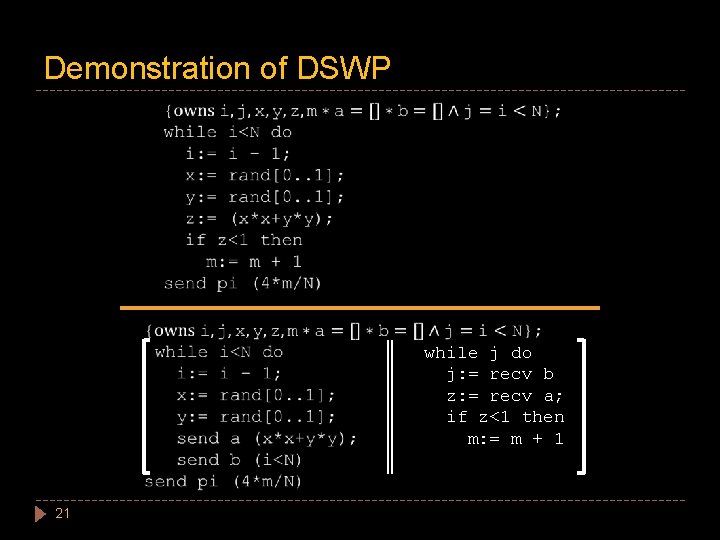
Demonstration of DSWP while j do j: = recv b z: = recv a; if z<1 then m: = m + 1 21
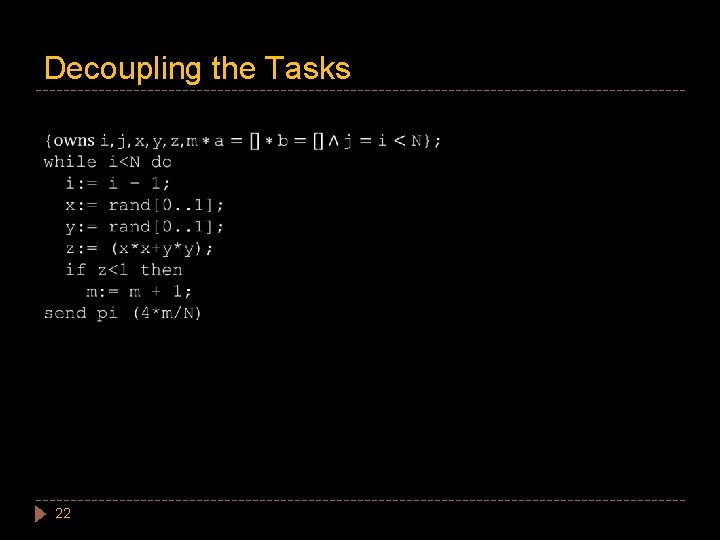
Decoupling the Tasks 22
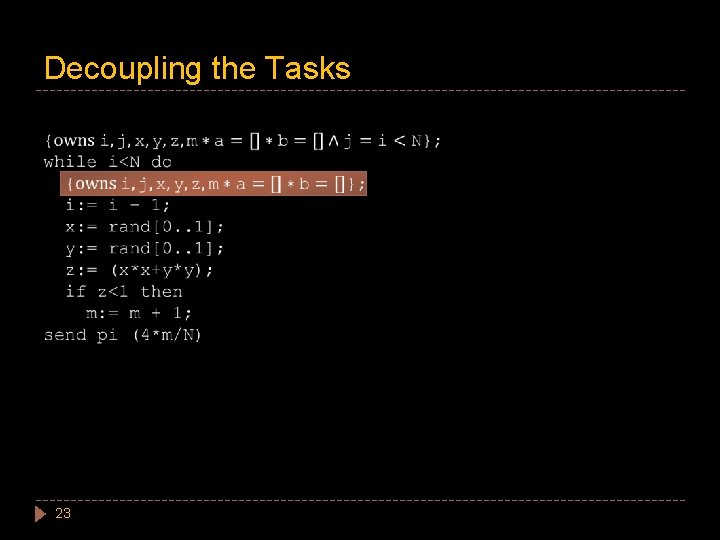
Decoupling the Tasks 23
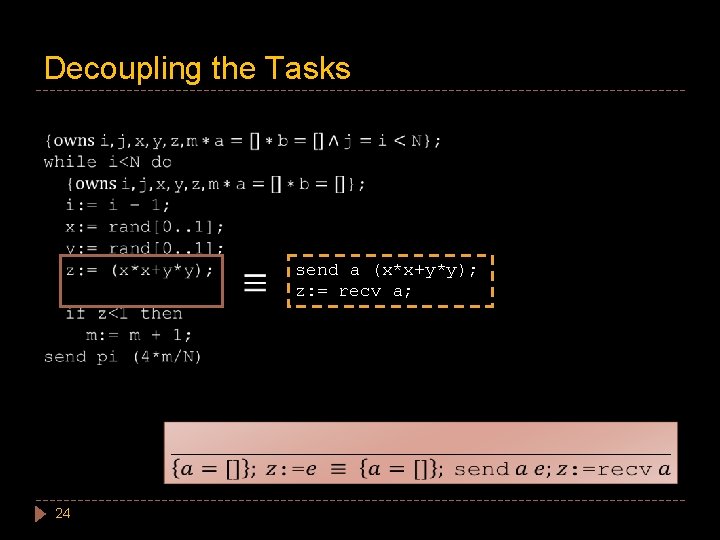
Decoupling the Tasks send a (x*x+y*y); z: = recv a; 24
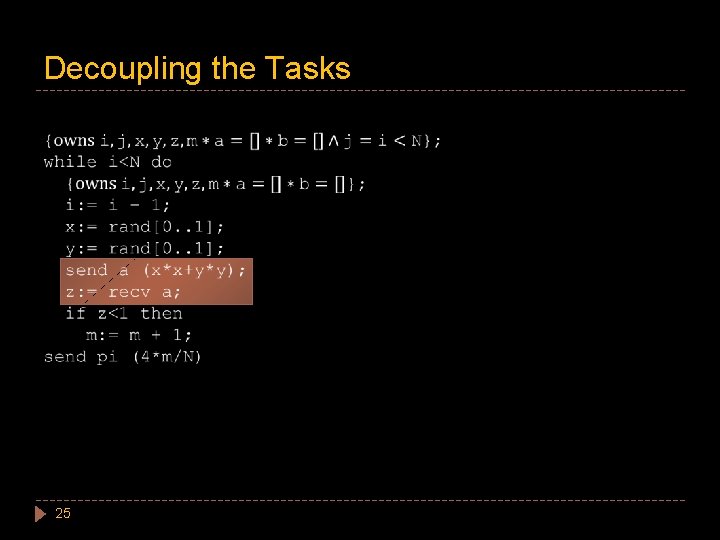
Decoupling the Tasks 25
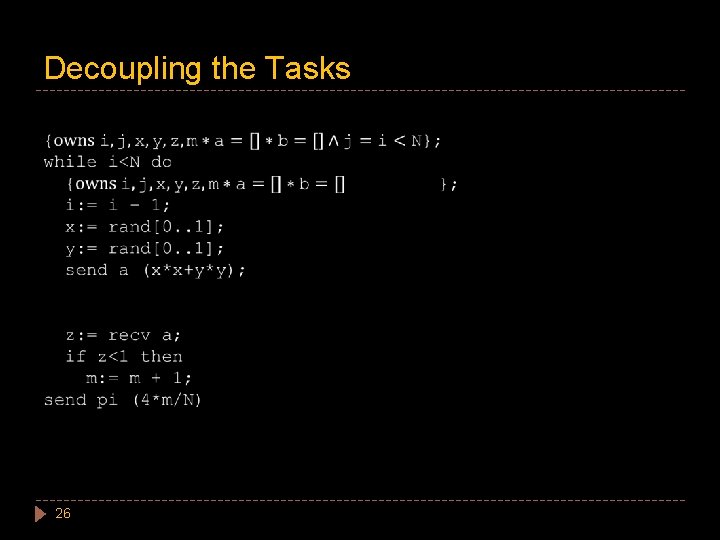
Decoupling the Tasks 26
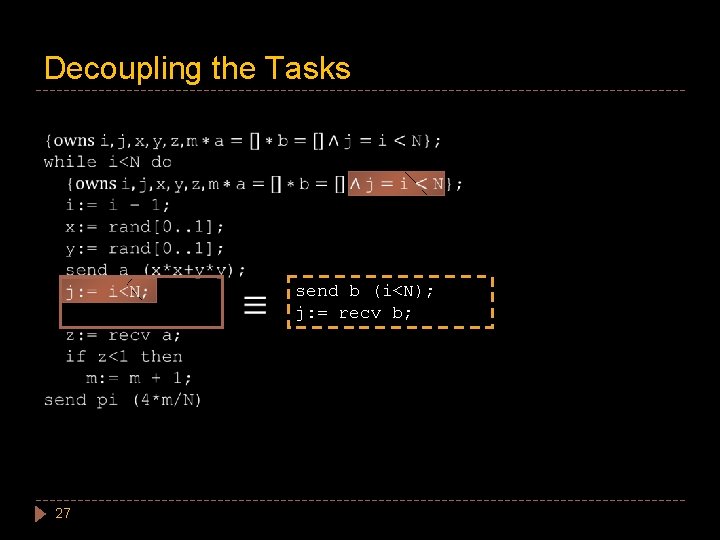
Decoupling the Tasks send b (i<N); j: = recv b; 27
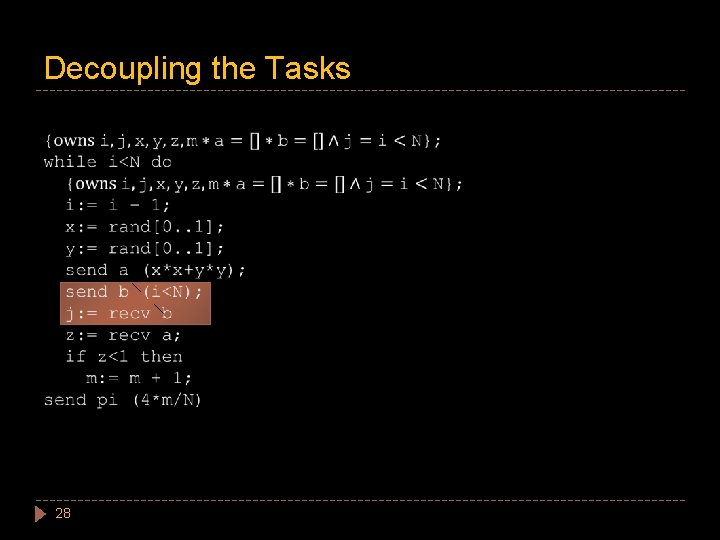
Decoupling the Tasks 28
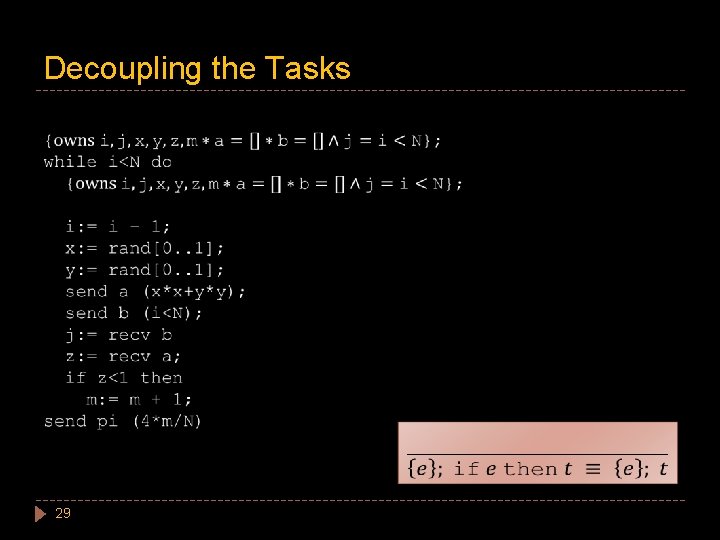
Decoupling the Tasks 29
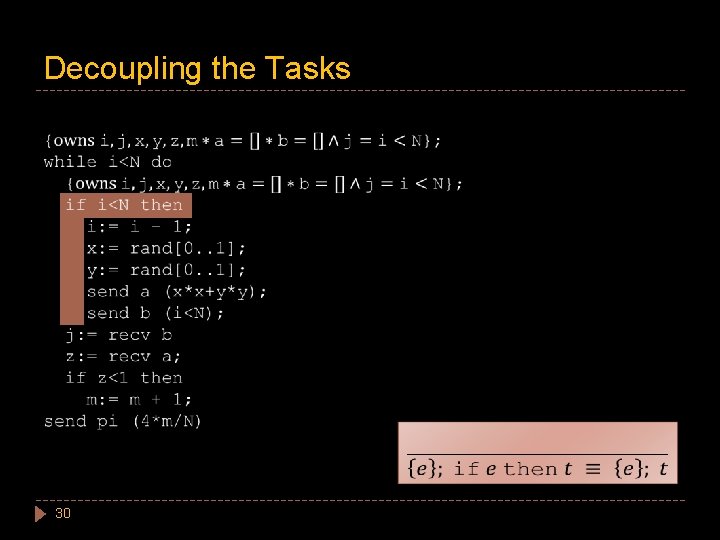
Decoupling the Tasks 30
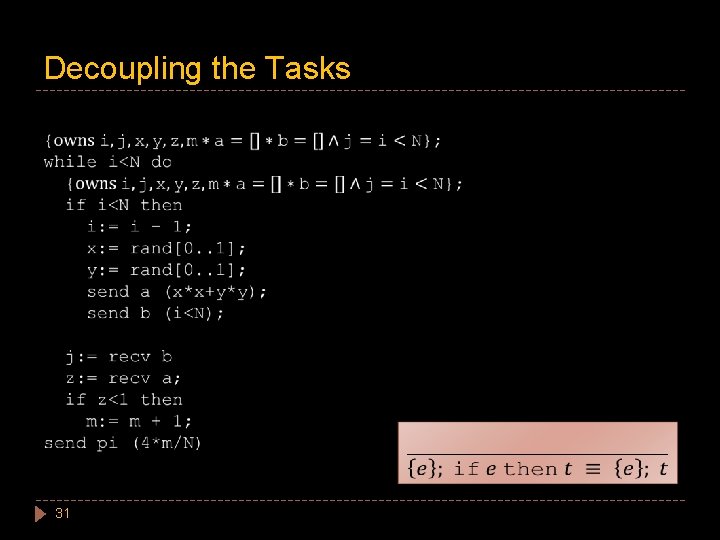
Decoupling the Tasks 31
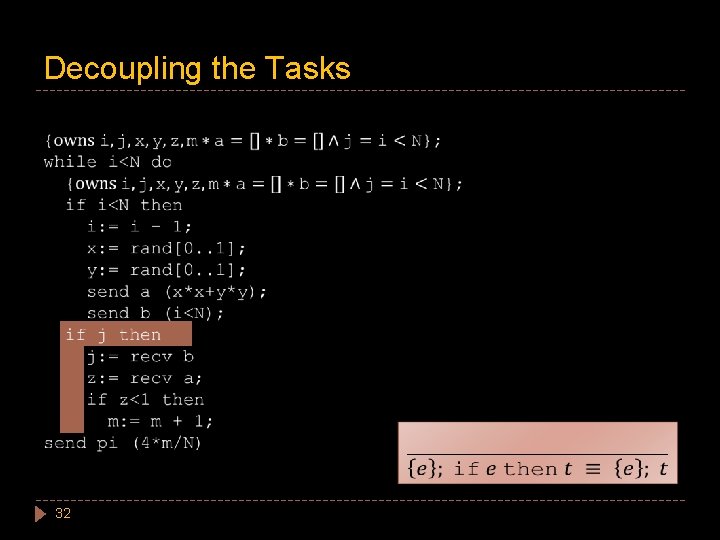
Decoupling the Tasks 32
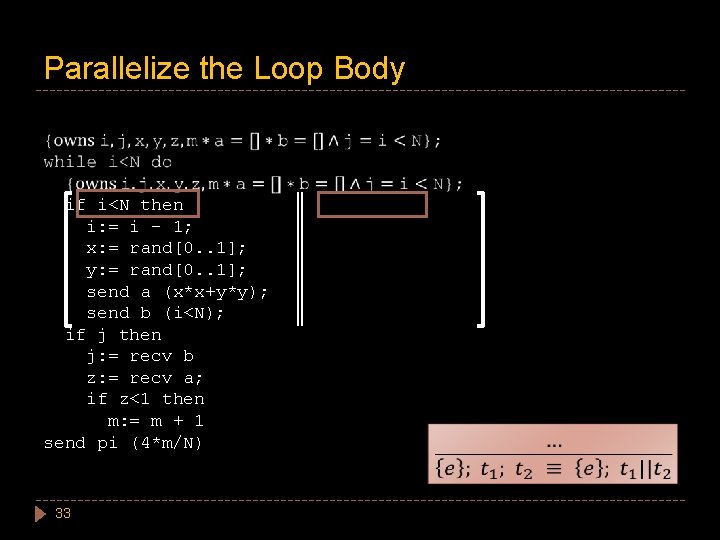
Parallelize the Loop Body if i<N then i: = i – 1; x: = rand[0. . 1]; y: = rand[0. . 1]; send a (x*x+y*y); send b (i<N); if j then j: = recv b z: = recv a; if z<1 then m: = m + 1 send pi (4*m/N) 33
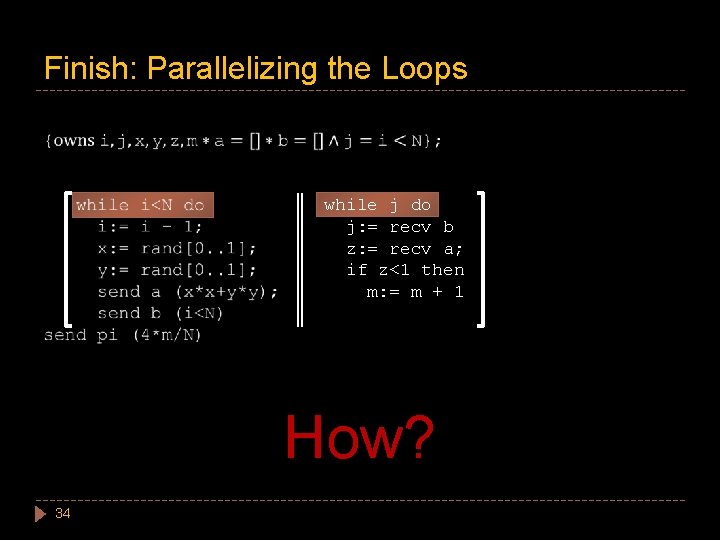
Finish: Parallelizing the Loops while j do j: = recv b z: = recv a; if z<1 then m: = m + 1 How? 34
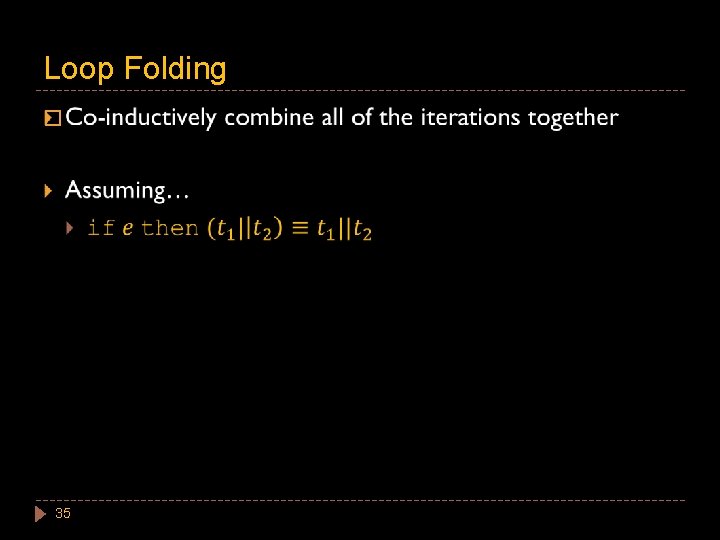
Loop Folding � 35
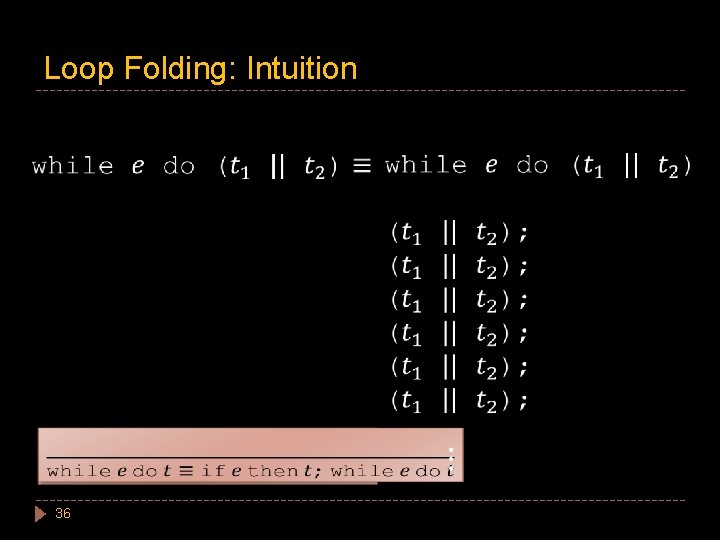
Loop Folding: Intuition 36
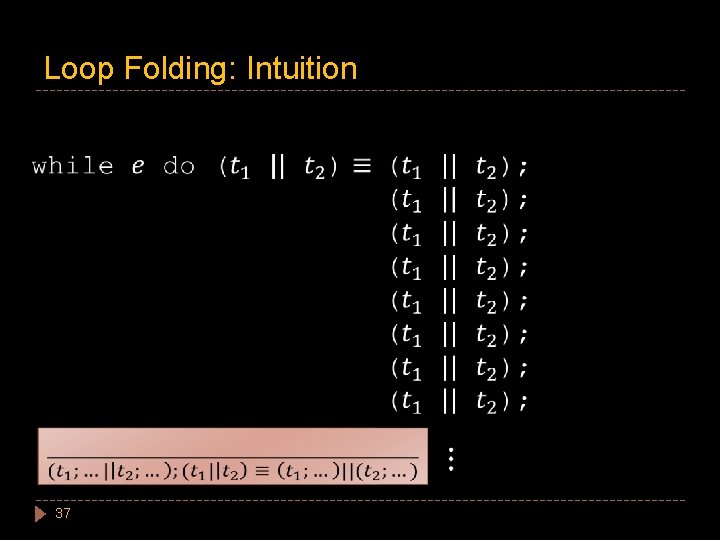
Loop Folding: Intuition 37
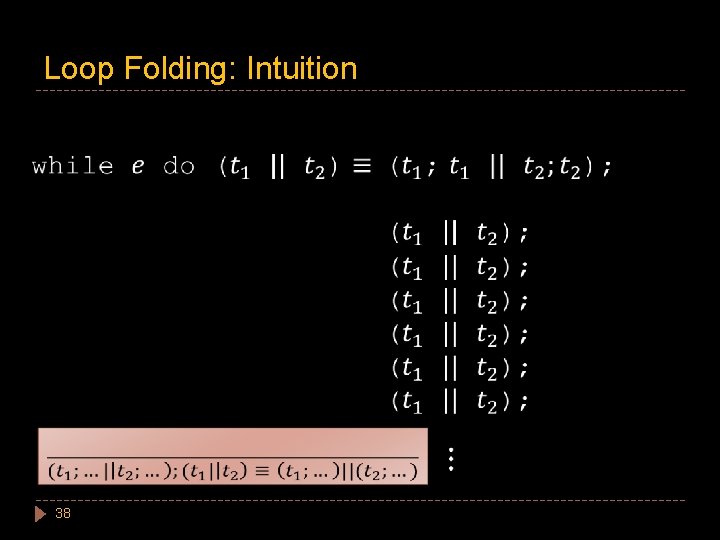
Loop Folding: Intuition 38
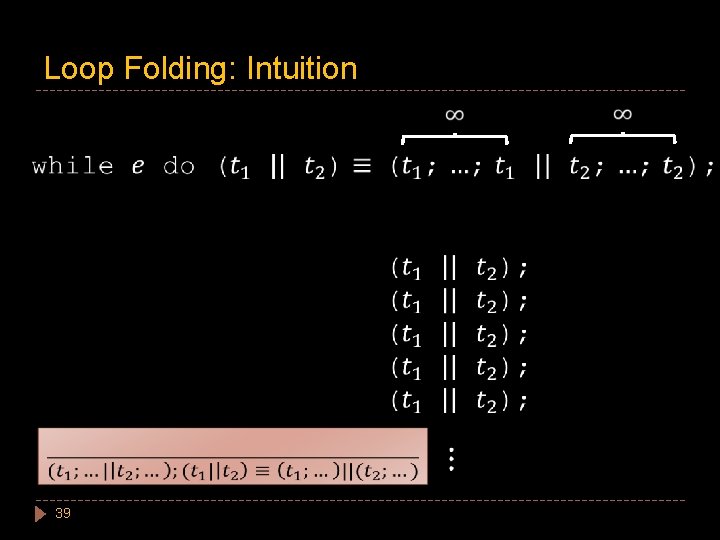
Loop Folding: Intuition 5 7 6 8 4 39 8 6 5 7 4
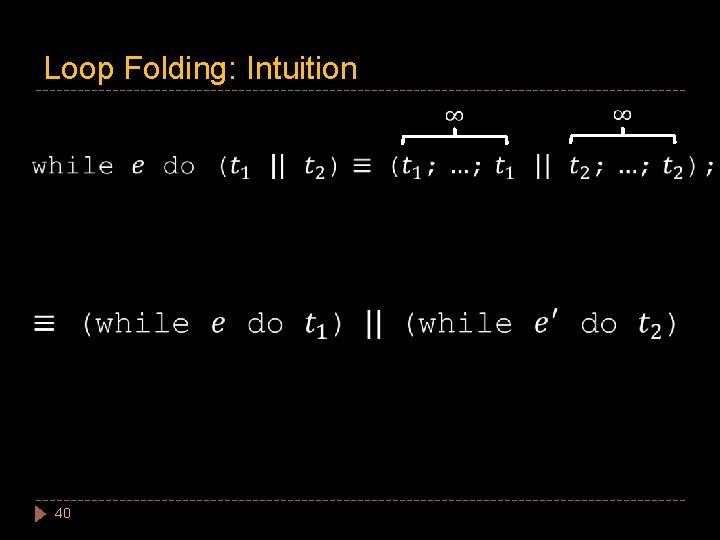
Loop Folding: Intuition 40
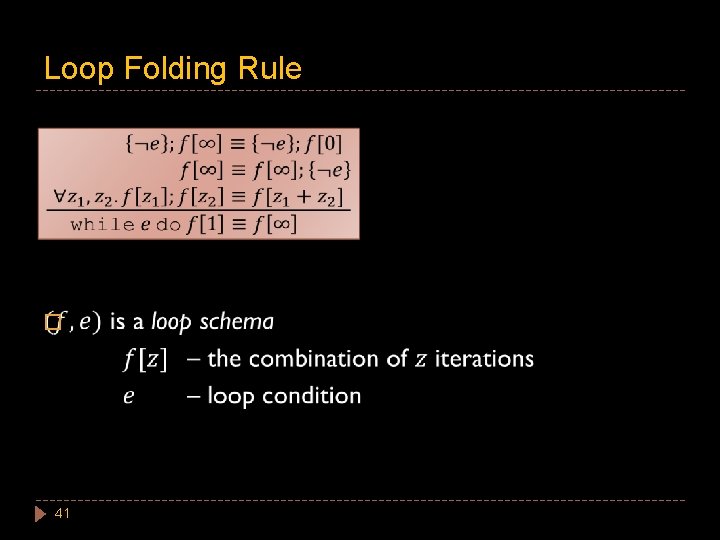
Loop Folding Rule � 41
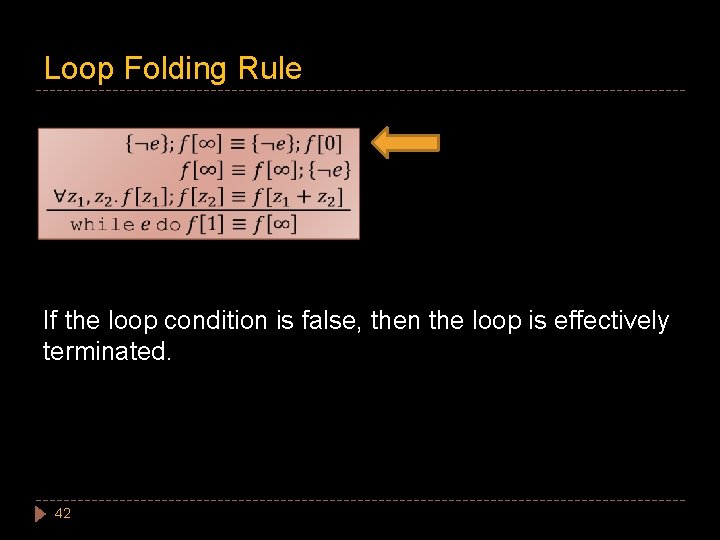
Loop Folding Rule If the loop condition is false, then the loop is effectively terminated. 42
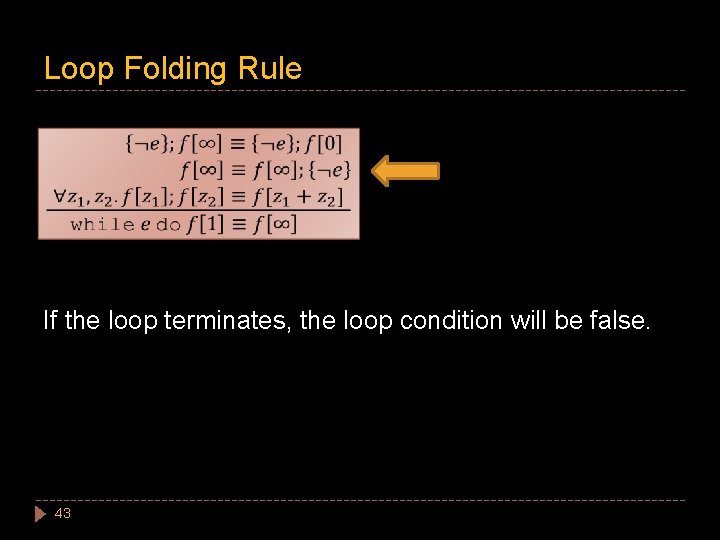
Loop Folding Rule If the loop terminates, the loop condition will be false. 43
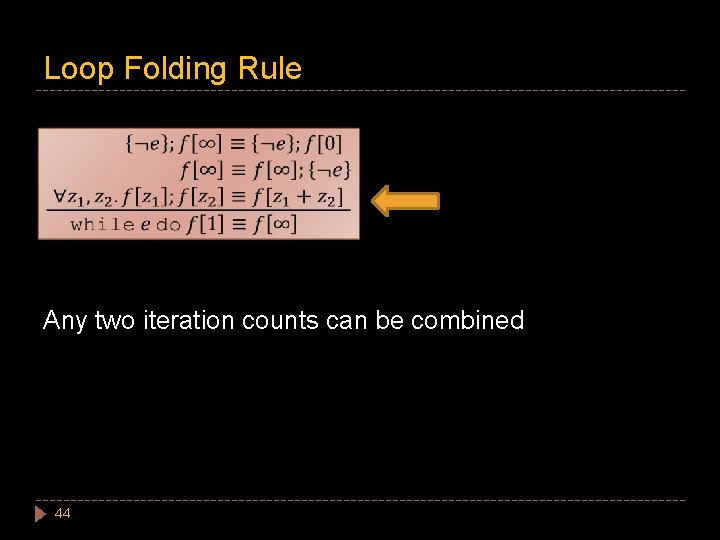
Loop Folding Rule Any two iteration counts can be combined 44
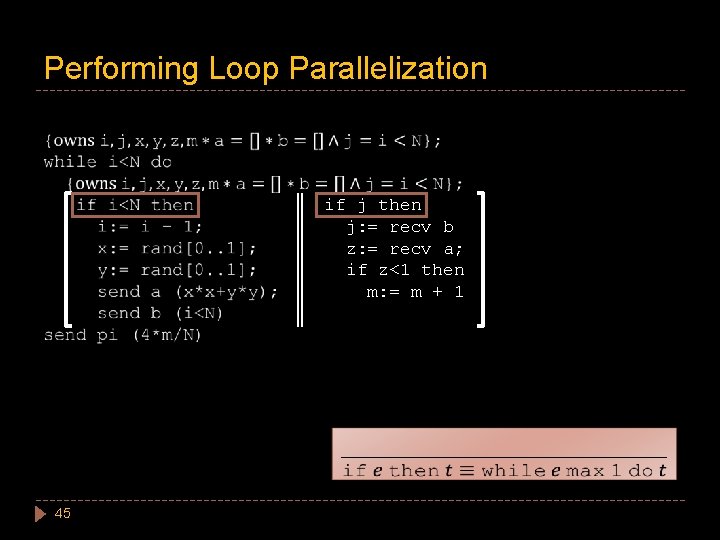
Performing Loop Parallelization if j then j: = recv b z: = recv a; if z<1 then m: = m + 1 45
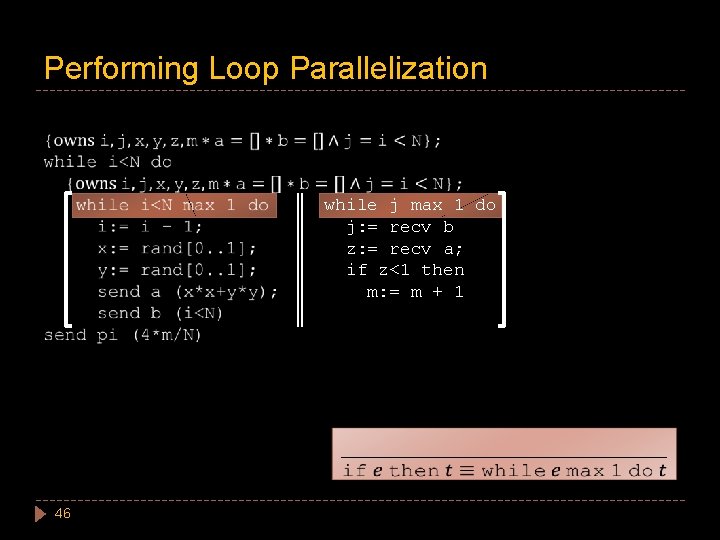
Performing Loop Parallelization while j max 1 do j: = recv b z: = recv a; if z<1 then m: = m + 1 46
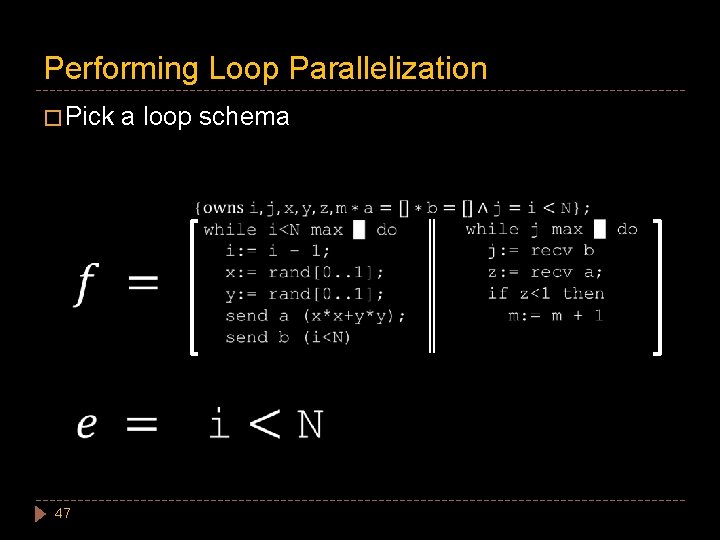
Performing Loop Parallelization � Pick 47 a loop schema
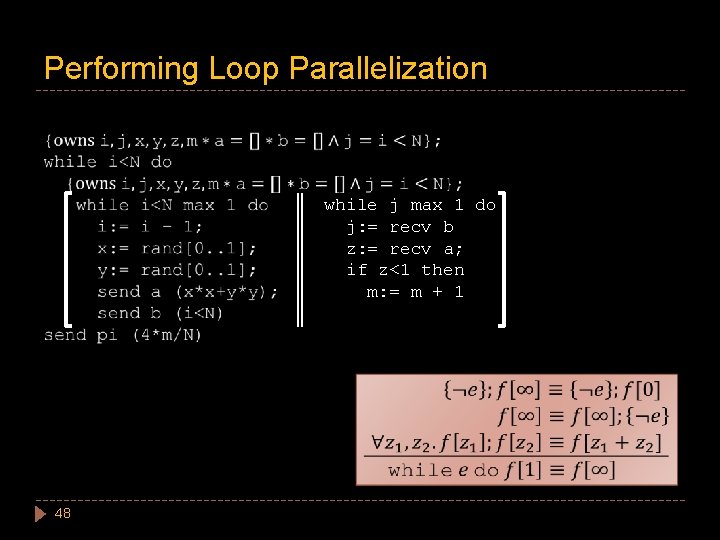
Performing Loop Parallelization while j max 1 do j: = recv b z: = recv a; if z<1 then m: = m + 1 48
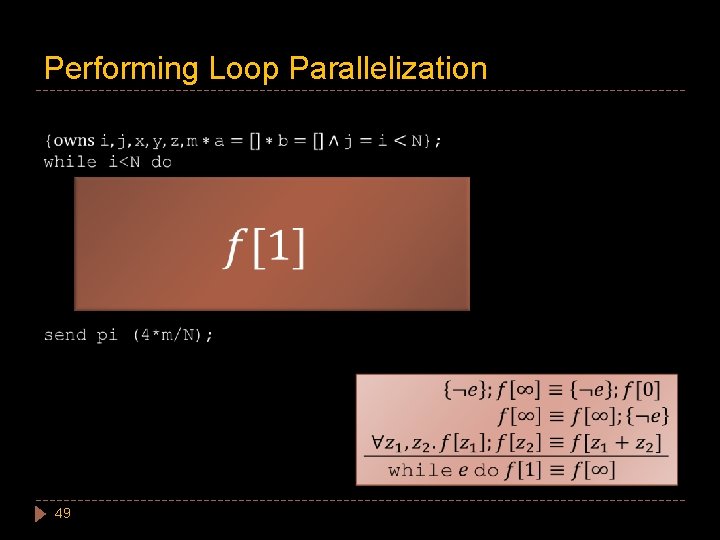
Performing Loop Parallelization 49
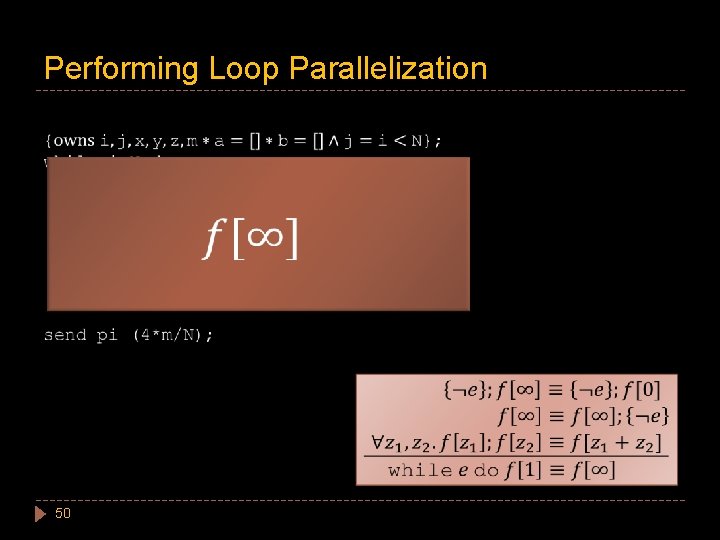
Performing Loop Parallelization 50
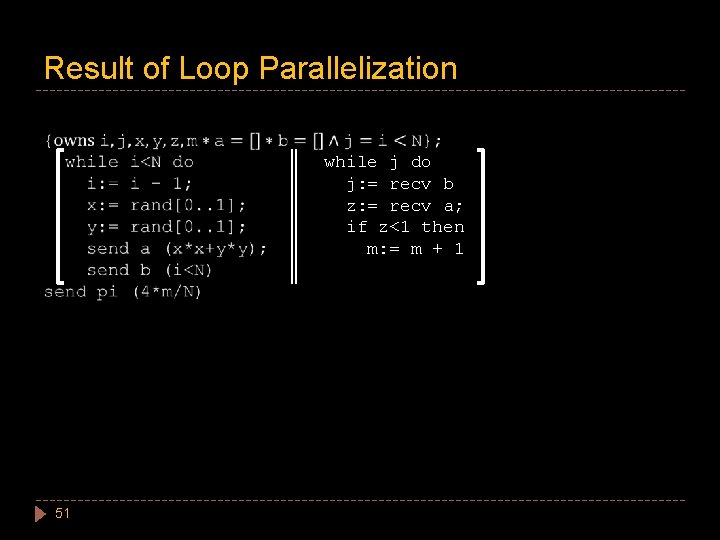
Result of Loop Parallelization while j do j: = recv b z: = recv a; if z<1 then m: = m + 1 51
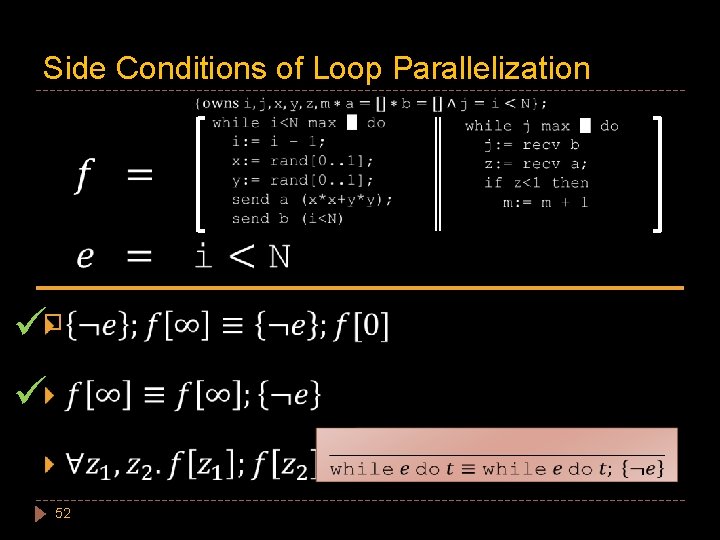
Side Conditions of Loop Parallelization ü� ü 52
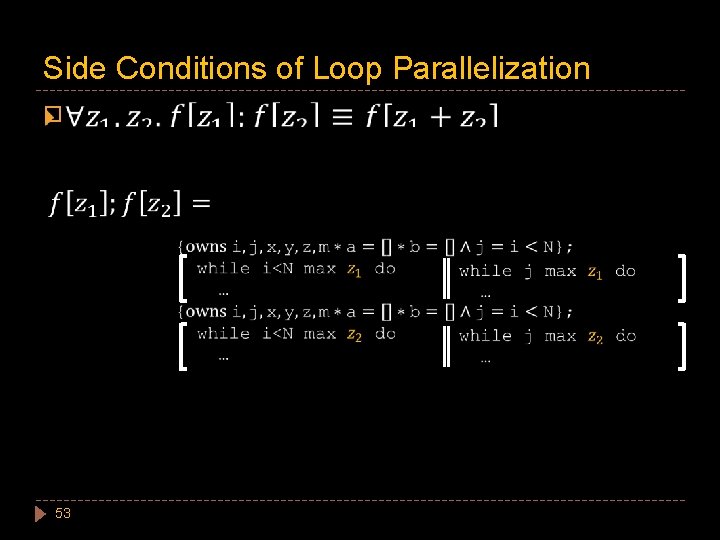
Side Conditions of Loop Parallelization � 53
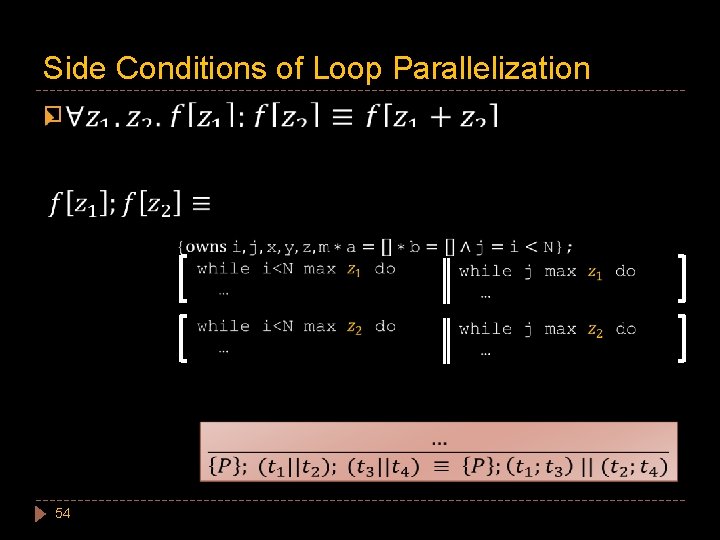
Side Conditions of Loop Parallelization � 54
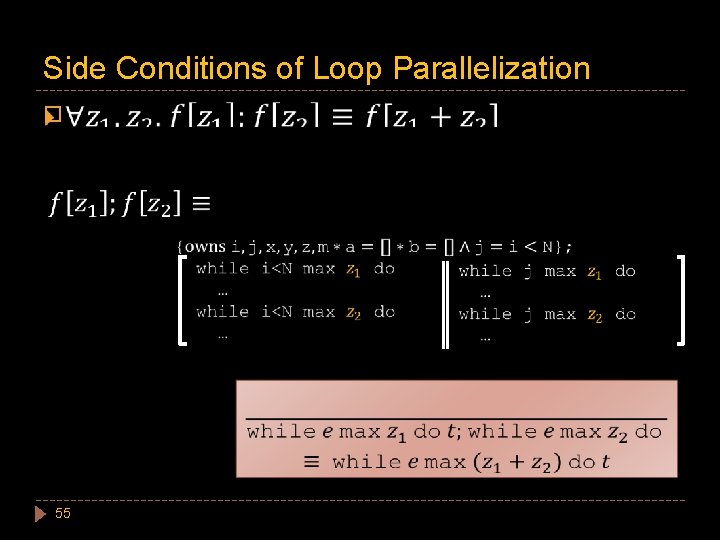
Side Conditions of Loop Parallelization � 55
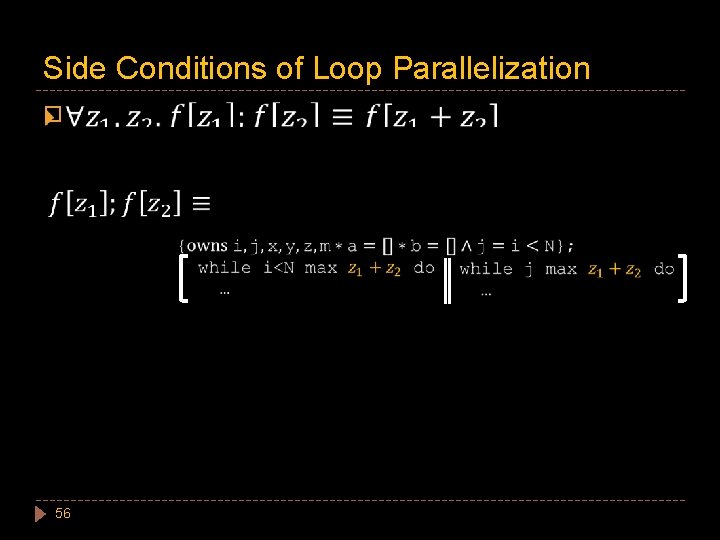
Side Conditions of Loop Parallelization � 56
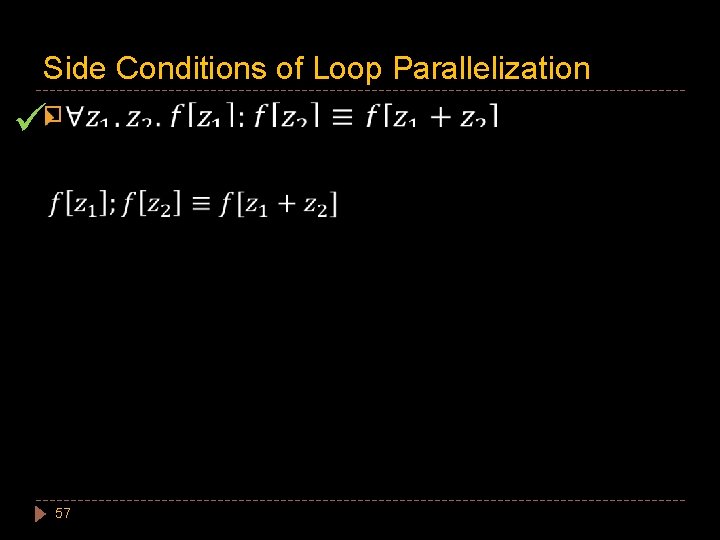
Side Conditions of Loop Parallelization ü� 57
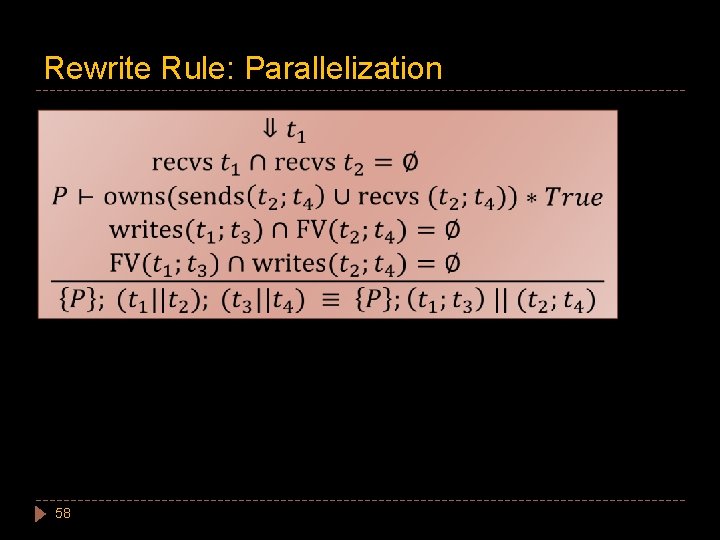
Rewrite Rule: Parallelization 58
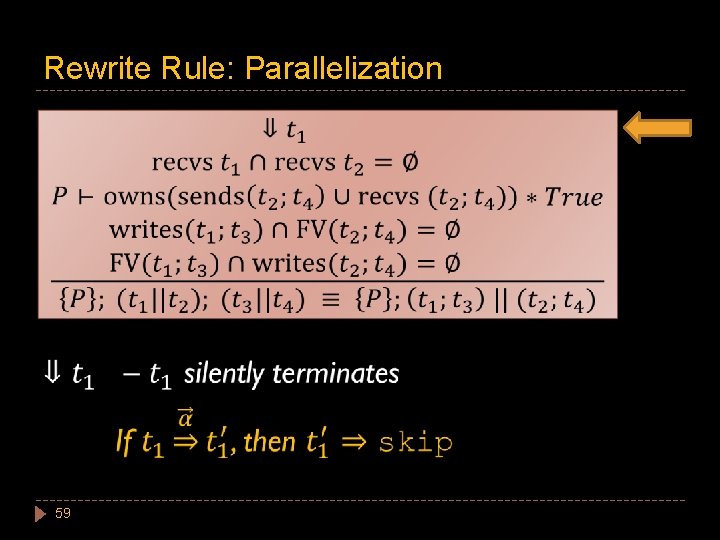
Rewrite Rule: Parallelization 59
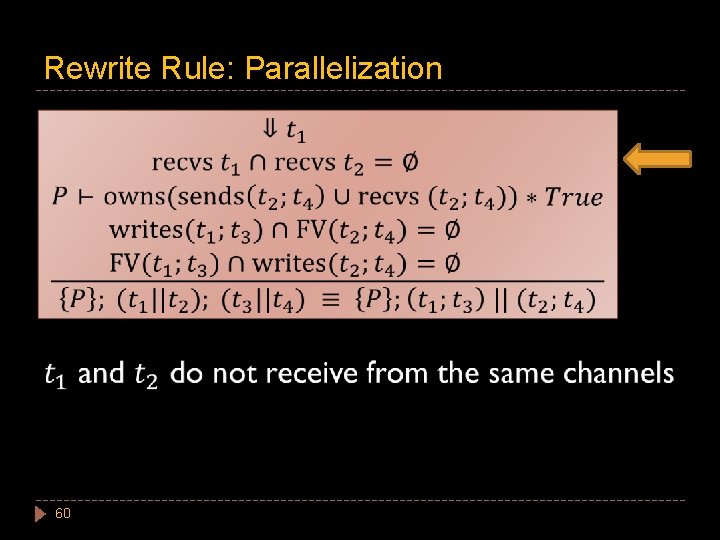
Rewrite Rule: Parallelization 60
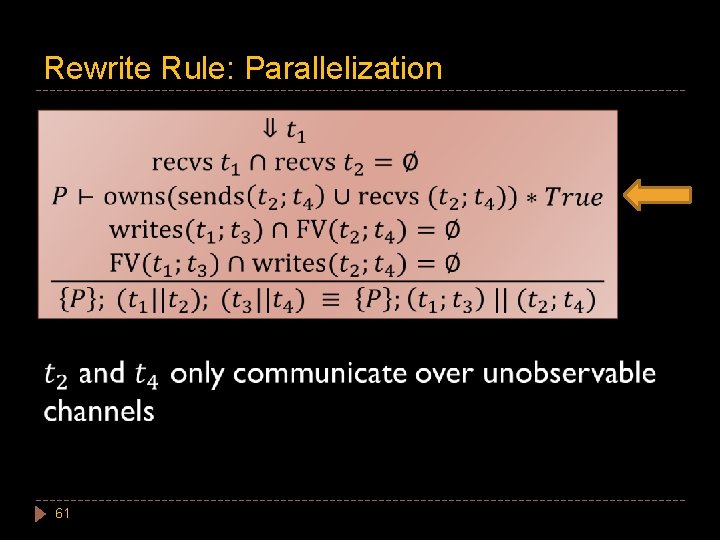
Rewrite Rule: Parallelization 61
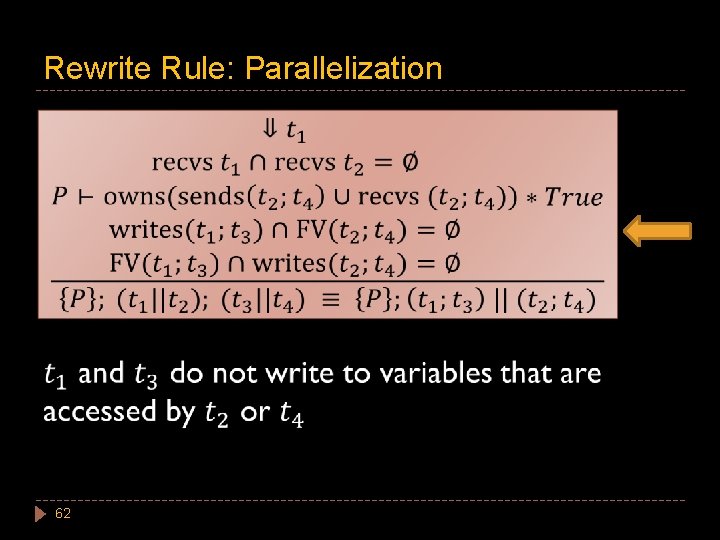
Rewrite Rule: Parallelization 62
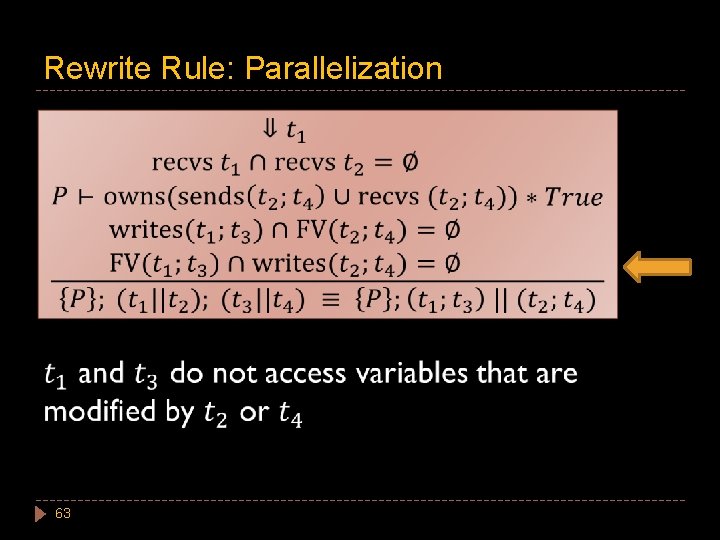
Rewrite Rule: Parallelization 63
Parallelization & Eventual Simulation Certifiably Sound Parallelizing Transformations to appear in Certified Proofs and Programs (CPP) 2013 64
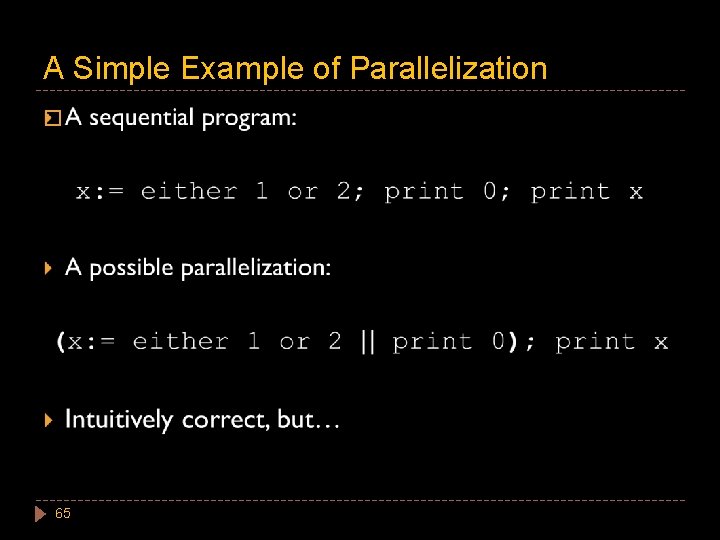
A Simple Example of Parallelization � 65
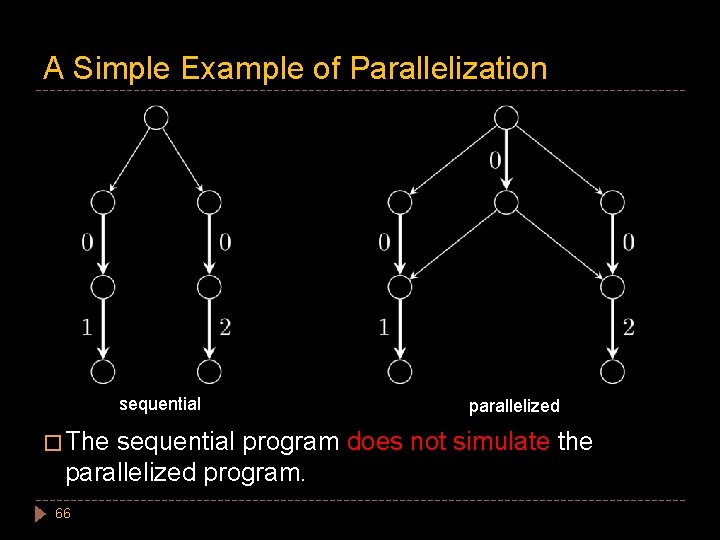
A Simple Example of Parallelization sequential � The parallelized sequential program does not simulate the parallelized program. 66
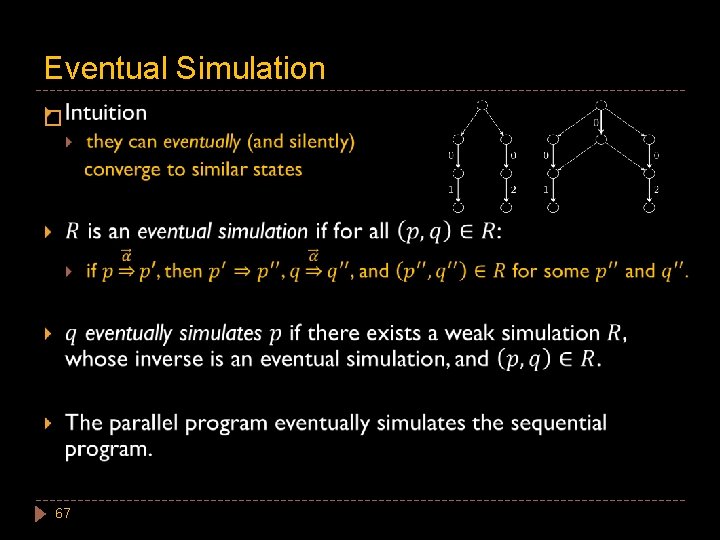
Eventual Simulation � 67
![Eventual Similarity � implied � and by weak bisimulation is strictly weaker than coupled-simulation[1]](http://slidetodoc.com/presentation_image_h2/094f42751b0c3a002101f1f77459de9c/image-68.jpg "Eventual Similarity � implied � and by weak bisimulation is strictly weaker than coupled-simulation[1]")
Eventual Similarity � implied � and by weak bisimulation is strictly weaker than coupled-simulation[1] � compositional � reflexive and transitive � but not symmetric � this is inconvenient for a rewriting framework � requiring an eventual simulation in both directions is not transitive for divergent LTSs J. Sparrow and P. Sjödin. The Complete Axiomatization of CS-Congruence, STACS’ 94 [1] 68
![Contrasimilarity[2, 3] � [2] R. van Glabbeek. The Linear Time – Branching Time Spectrum](http://slidetodoc.com/presentation_image_h2/094f42751b0c3a002101f1f77459de9c/image-69.jpg "Contrasimilarity[2, 3] � [2] R. van Glabbeek. The Linear Time – Branching Time Spectrum")
Contrasimilarity[2, 3] � [2] R. van Glabbeek. The Linear Time – Branching Time Spectrum II, CONCUR’ 93 [3] M. Voorhoeve and S. Mauw. Impossible Futures and Determinism, 2001 69
Conclusion 70
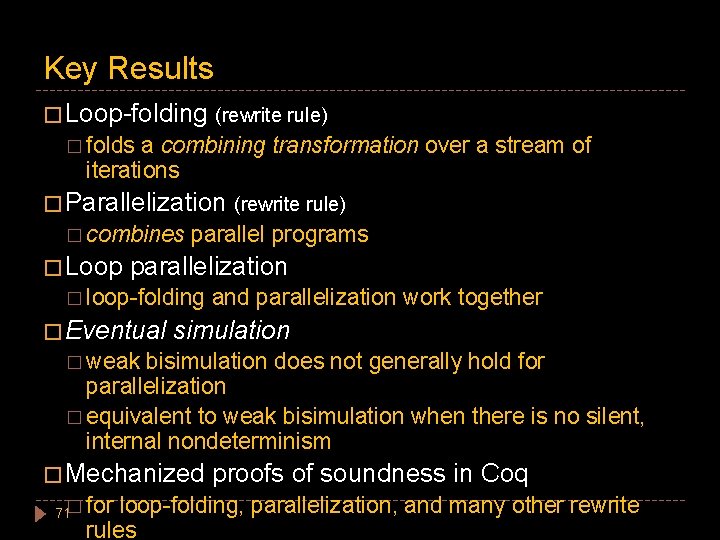
Key Results � Loop-folding (rewrite rule) � folds a combining transformation over a stream of iterations � Parallelization (rewrite rule) � combines � Loop parallel programs parallelization � loop-folding � Eventual and parallelization work together simulation � weak bisimulation does not generally hold for parallelization � equivalent to weak bisimulation when there is no silent, internal nondeterminism � Mechanized 71� proofs of soundness in Coq for loop-folding, parallelization, and many other rewrite rules
End Thanks! 72
73
- Slides: 73