
Sound in an environment Sound wave Compression rarefaction
- Slides: 20
Sound in an environment • Sound wave – Compression / rarefaction • Frequency / Measured in hertz • Amplitude / Measured in decibels (db-spl) – AM/FM, k. Hz / MHz (r. f. ) • Attack/sustain (internal dynamics)/decay -- sound envelope • Acoustics / Psychoacoustics / binaural hearing • Absorbed / Reflected • Direct / Indirect (echo & reverberation)
Some issues with sound • Dynamic range – lowest to loudest sound level range • Equal loudness principle--depending on loudness we don’t hear low and high frequencies as well as we hear middle • Masking--Hiding of some sounds by other sounds when each is a different frequency and they are presented together. Loud over soft / lower-pitched over higher • Acoustical phase--the time relationship between two or more sound waves at a given point in their cycles • Timbre--a sound’s unique tone quality or tone color
Studio / Facility Sound Design • • • Ergonomics – human element in designing room Sound Absorption and Reflection Diffusion--scattering of sound waves Diffraction--spreading or bending Resonance--vibration of an object at the same frequency as the original body’s frequency • Lively or Dead Room • Isolation
Sound Frequency Spectrum • Bass – Low bass, 1 st & 2 nd octaves, 16 -64 Hz – Upper bass, 3 rd& 4 th octaves, 64 -256 Hz • Midrange – 5 th, 6 th & 7 th octaves, 256 - 2, 048 Hz – Upper midrange: 8 th octave, 2, 048 - 4, 096 Hz • Treble – 9 th & 10 th octaves, 4, 096 - 16, 384 Hz
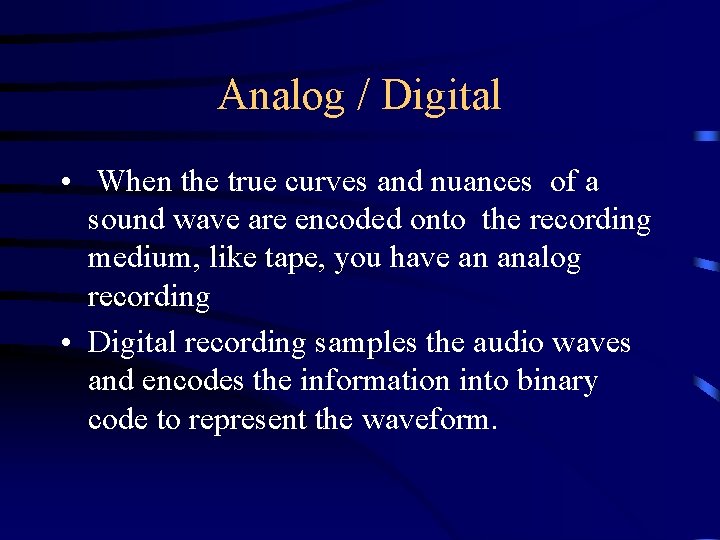
Analog / Digital • When the true curves and nuances of a sound wave are encoded onto the recording medium, like tape, you have an analog recording • Digital recording samples the audio waves and encodes the information into binary code to represent the waveform.
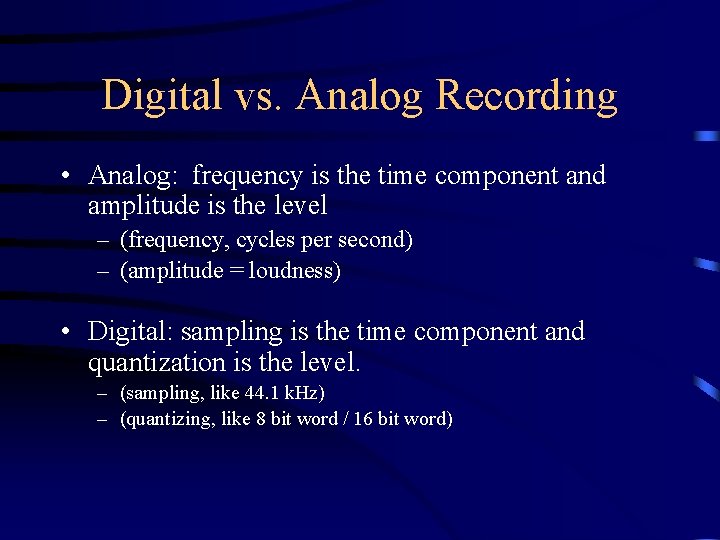
Digital vs. Analog Recording • Analog: frequency is the time component and amplitude is the level – (frequency, cycles per second) – (amplitude = loudness) • Digital: sampling is the time component and quantization is the level. – (sampling, like 44. 1 k. Hz) – (quantizing, like 8 bit word / 16 bit word)
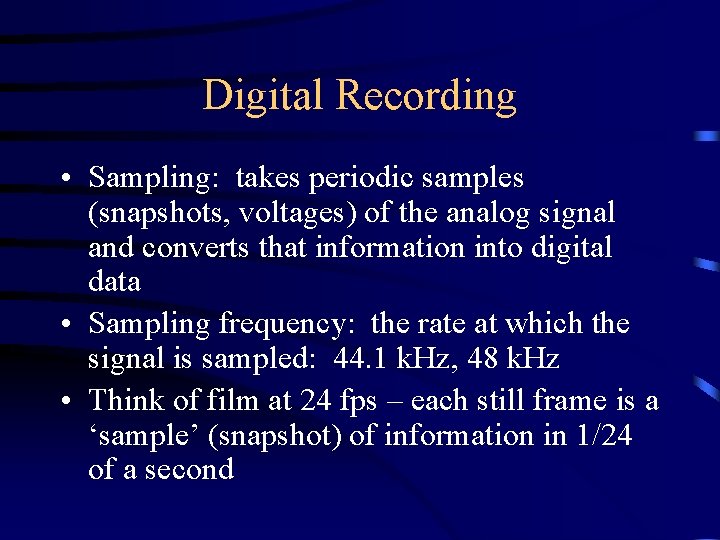
Digital Recording • Sampling: takes periodic samples (snapshots, voltages) of the analog signal and converts that information into digital data • Sampling frequency: the rate at which the signal is sampled: 44. 1 k. Hz, 48 k. Hz • Think of film at 24 fps – each still frame is a ‘sample’ (snapshot) of information in 1/24 of a second
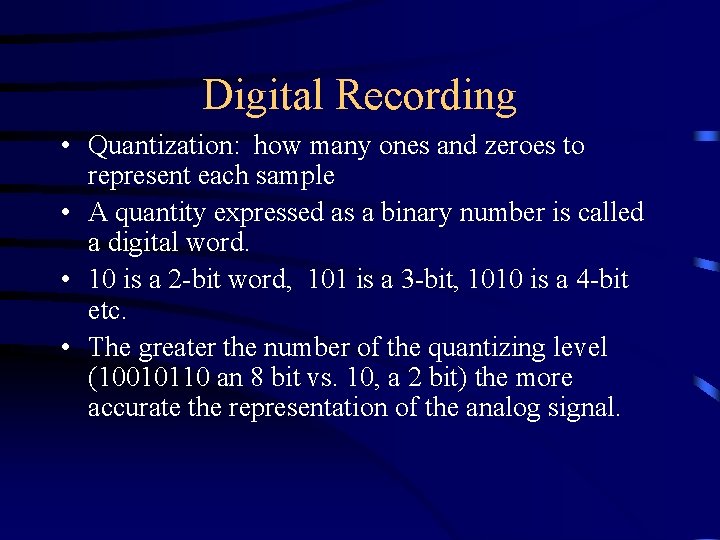
Digital Recording • Quantization: how many ones and zeroes to represent each sample • A quantity expressed as a binary number is called a digital word. • 10 is a 2 -bit word, 101 is a 3 -bit, 1010 is a 4 -bit etc. • The greater the number of the quantizing level (10010110 an 8 bit vs. 10, a 2 bit) the more accurate the representation of the analog signal.
Signal Processing • • • ‘DSP’ (enhancement) Bass roll off Compression Limiter EQ (graphic, parametric) Reverb unit
Mics -- Review Sound • Sound Frequency Spectrum – Bass, midrange, treble • • Frequency / Hertz Amplitude / decibels Acoustics Direct / indirect sound – Echo / reverberations
More issues with sound • Sound envelop -- attack sustain decay – Attack, initial decay, sustain, release • Velocity--speed of the sound wave (examples) – 1, 130 fps at sea level – 11, 700 fps in wood – 18, 000 fps in steel
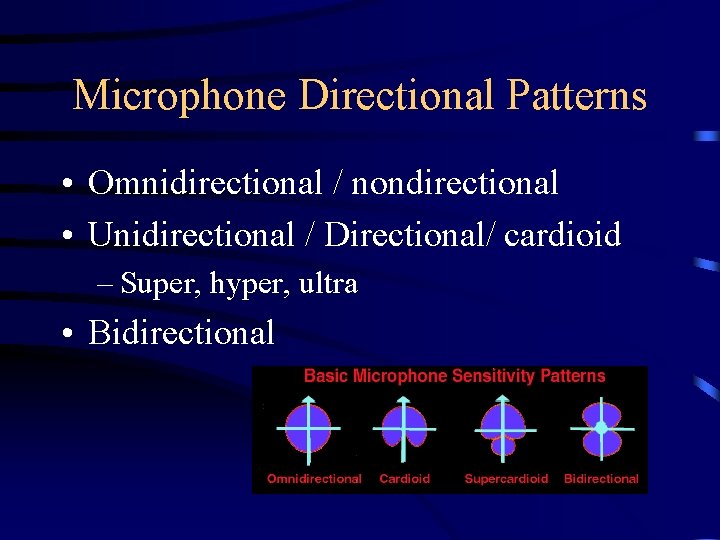
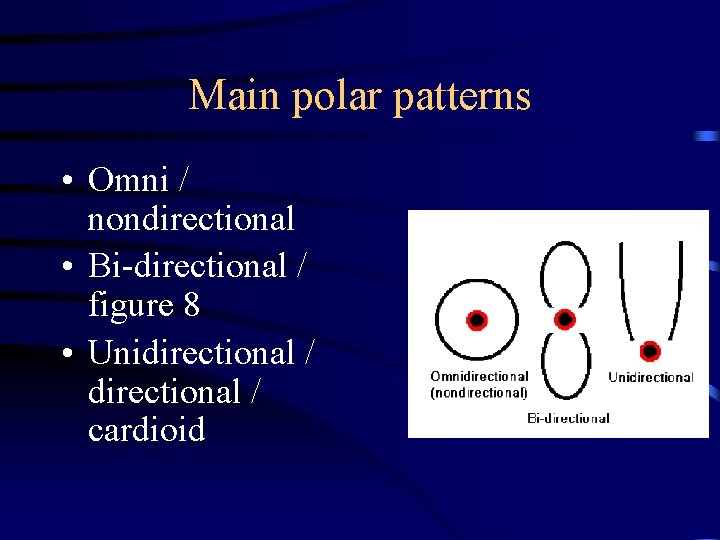
Microphone Directional Patterns • Omnidirectional / nondirectional • Unidirectional / Directional/ cardioid – Super, hyper, ultra • Bidirectional
Main polar patterns • Omni / nondirectional • Bi-directional / figure 8 • Unidirectional / cardioid
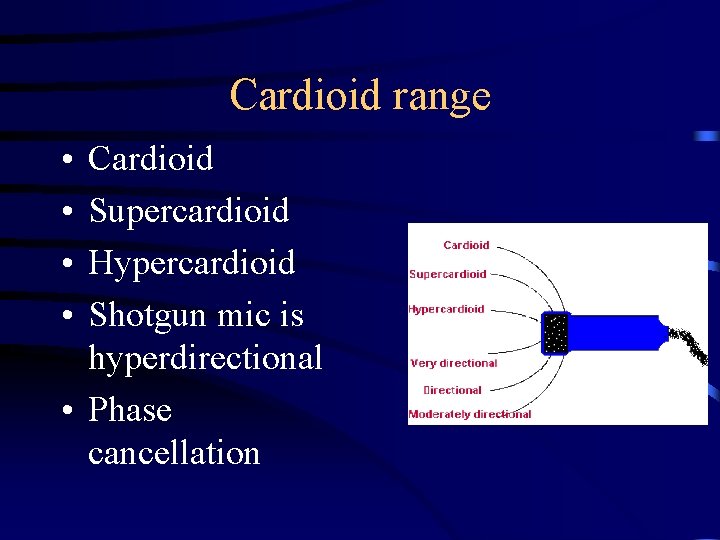
Cardioid range • • Cardioid Supercardioid Hypercardioid Shotgun mic is hyperdirectional • Phase cancellation
Professional Mic types • • Moving coil/dynamic Ribbon Capacitor/condensor Transducer – changes energy from one form to another – in this case sound waves into an electrical current
More about mics and sound • Close vs. distant miking – Cross-pair, mid-side as some distant miking approaches – Close mic speakers on camera / filmmaking wide shots must do ADR • Wide response – range of frequencies the mic will pick up • Flat response – accurately recreates frequencies • Colored response – changes frequencies (lavaliere boosts high frequencies, for example
Close / distant miking • All foreground audio is close-miked • Background (walla, nat sound) audio is distant miked • ADR compensates for long shots, actors rerecord and new dialogue is processed and looped in • Showing / not showing the mic
Common mic types • • • lavaliere headset Handheld (stick) studio/boom mounted TV boom types / largest to smallest – Perambulator boom, giraffes, fishpole • PZM (boundary mic) #
Miking applications • Movie / TV show scene – Boom pole, ADR (how done) • • • News anchor / reporter Talk show host Play by play announcer DJ / audio spot production Orchestra on a stage
Movie sound • Ambience – Walla • Foley – Foley stage, foley artists – Ben Burtt / Sound Design • Score • Layering • Dolby Surround ###