
Sound How are sounds Classified How are sounds

- Slides: 12
Sound • • • How are sounds Classified? How are sounds produced? How are sounds different? How are sounds measured? How fast does sound move?
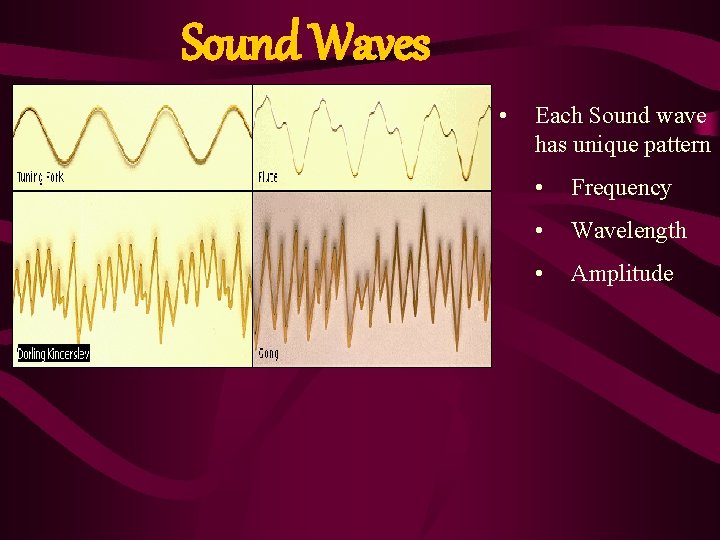
Sound Waves • Each Sound wave has unique pattern • Frequency • Wavelength • Amplitude
Sound mediums • A medium is a material that sound, a form of energy, need to transfer • Speed of sound – Solid : Fast speed – Liquid : Medium speed – Gas : Slow Speed • Standard Temperature and Pressure = 3. 31 x 102 m/s – Vacuum : No Sound
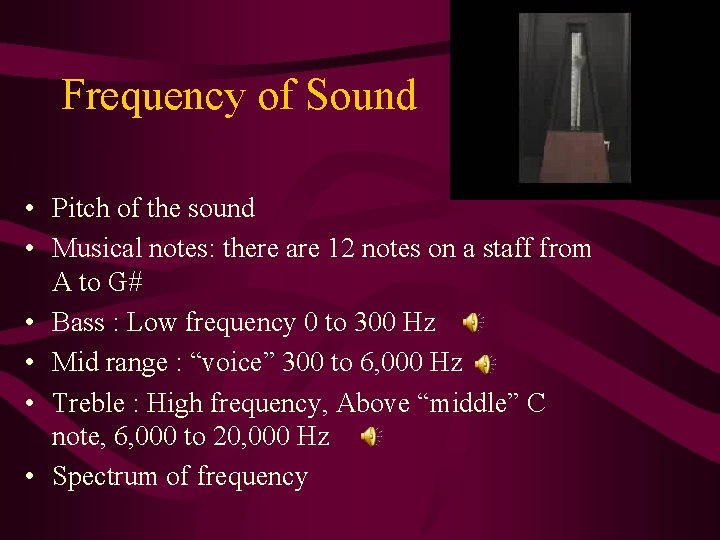
Frequency of Sound • Pitch of the sound • Musical notes: there are 12 notes on a staff from A to G# • Bass : Low frequency 0 to 300 Hz • Mid range : “voice” 300 to 6, 000 Hz • Treble : High frequency, Above “middle” C note, 6, 000 to 20, 000 Hz • Spectrum of frequency
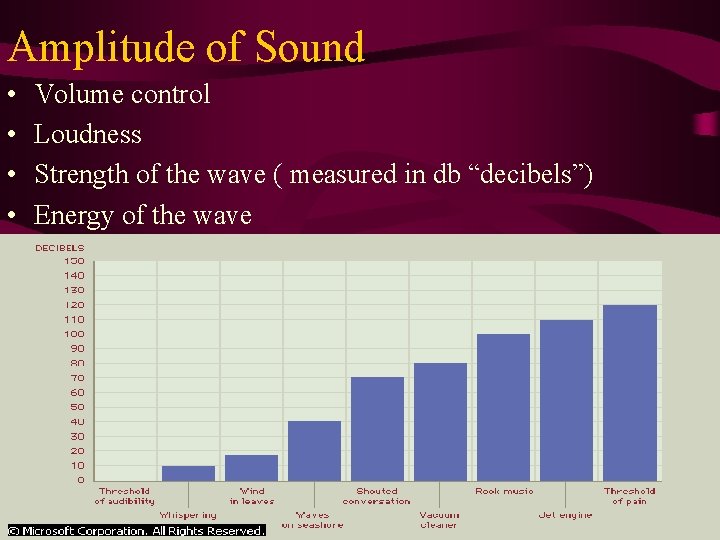
Amplitude of Sound • • Volume control Loudness Strength of the wave ( measured in db “decibels”) Energy of the wave
Reflection and Refractions of Sound waves • Echo – Reflection of sound off a surface (Acoustics (Greek akouein, ”to hear”), . It is more commonly used for the special branch of that PHYSICS that deals with the construction of enclosed areas so as to enhance the hearing of speech or music. • Reverb (Electronic echo) • Resonance – electronic envelope Helmholtz Resonator, spherical vessel of metal or glass with an opening and an earpiece on opposite sides. – The ear canal acts enhancing frequencies in the range from 1000 to 4000 Hz (hertz, or cycles per second).
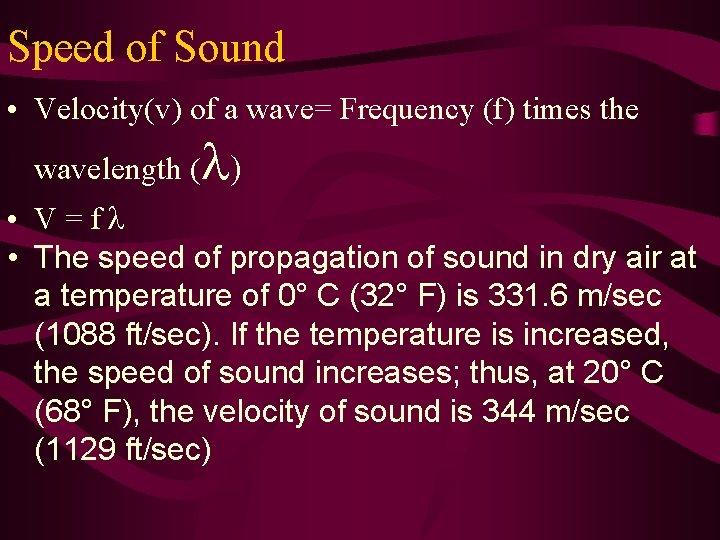
Speed of Sound • Velocity(v) of a wave= Frequency (f) times the l wavelength ( ) • V = fl • The speed of propagation of sound in dry air at a temperature of 0° C (32° F) is 331. 6 m/sec (1088 ft/sec). If the temperature is increased, the speed of sound increases; thus, at 20° C (68° F), the velocity of sound is 344 m/sec (1129 ft/sec)
Resonance of Sound • Any oscillating object has a natural frequency, which is the frequency an oscillating object tends to settle into if it is not disturbed. • The phenomenon in which a relatively small, repeatedly applied force causes the amplitude of an oscillating system to become very large is called resonance
Interference of Sound • Constructive interference – The displacement of the disturbance of 2 waves are the same (Similar sounds • Frequency are the same or multiple. • Destructive interference –The displacement of the disturbance of 2 waves are the different (Unlike sounds) • Frequency are the different or not a direct multiple.
Beats • The pulse, or pattern of regular accents, of a musical piece can be broken into individual pulses, or beats • a fractional symbol in which the numerator specifies the number of beats per bar, and the denominator specifies the relative note value assigned to one beat
Doppler Effect • The frequency of the perceived wave is changed by the motion of the source – Increasing Frequency when the source approaches the sensor – Decreasing Frequency when the source increases the distance from the sensor
Summary • Sounds are created by Moving molecule in the medium ( Solid, Liquid and Gases) • Sounds are measured by Frequency, Wavelength, Speed, and Amplitude. • Sounds can combine by interference • Sounds can be changed by the Acoustics of the Area or the speed of the source (Doppler Effect) • Sounds are used in many devices.