
Sound Field Modeling in Architectural Acoustics using a

- Slides: 16
Sound Field Modeling in Architectural Acoustics using a Diffusion Equation Based Model N. Fortin 1, 2, J. Picaut 2, A. Billon 3, V. Valeau 4, A. Sakout 1 1 LEPTIAB (University of La Rochelle) 2 ESAR (Laboratoire Central des Ponts et Chaussées) 3 INTELSIG group (University of Liège) 4 LEA (University of Poitiers) The authors wish to thank the Agence de l’Environnement et de la Maîtrise de l’Énergie (ADEME) for providing financial support of this work. 1
Introduction l l Sound field modeling in room acoustics l Predicting sound level, reverberation time, acoustical parameters for Concert Hall, dwelling, building… l Many propagation phenomena: reflection, absorption, diffusion, transmission, scattering, diffraction… Solutions: l Solving the wave (or Helmholtz) equation: l l l Others methods (energetic approaches, high frequency) l l l Analytical : no solution for “real rooms” Numerical: finite element method limited for low frequency only Statistical theory of reverberation: “simple” geometries Ray-tracing (and similar): high computational time for “complex” rooms Alternative solution: diffusion model l Good compromise acoustical results/computational time 2
Diffusion model (1) t Diffusion model (MDF) initially proposed by the authors for empty rooms with diffusely reflecting boundaries § following a diffusion process (diffusion equation) § § validated in many room configurations: o rectangular rooms, long rooms, coupled rooms… o by comparison with • others analytical models, • numerical models (ray-tracing) • experimental data 3
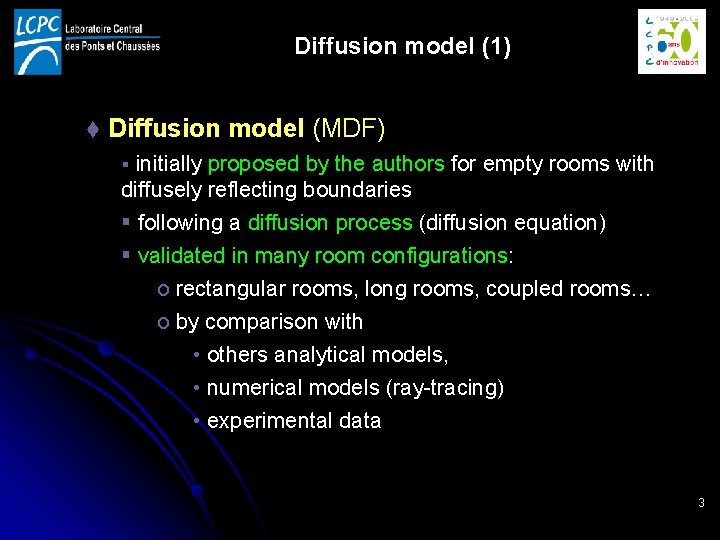
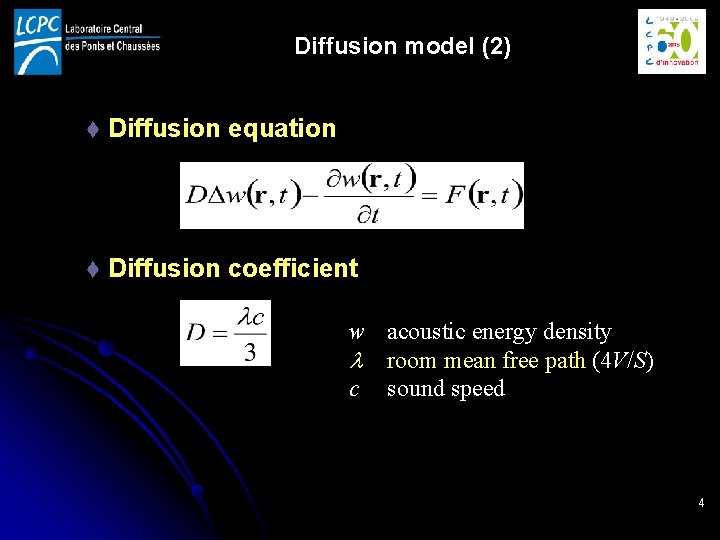
Diffusion model (2) t Diffusion equation t Diffusion coefficient w acoustic energy density l room mean free path (4 V/S) c sound speed 4
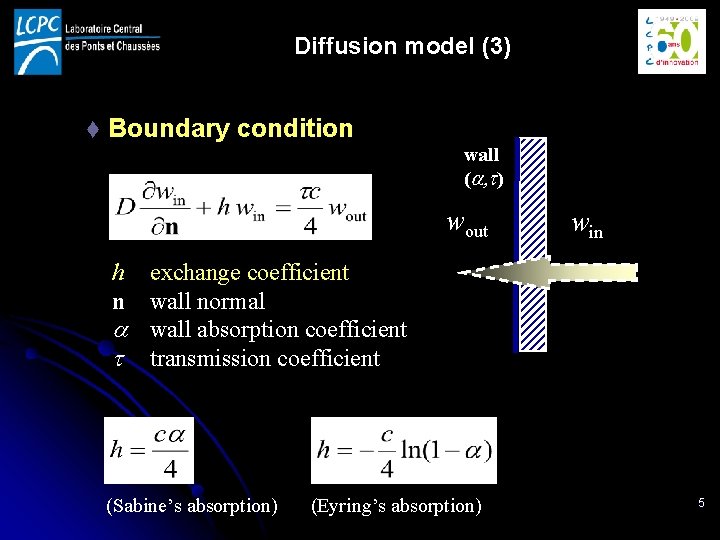
Diffusion model (3) t Boundary condition wall (a, ) wout win h n exchange coefficient wall normal a wall absorption coefficient transmission coefficient (Sabine’s absorption) (Eyring’s absorption) 5
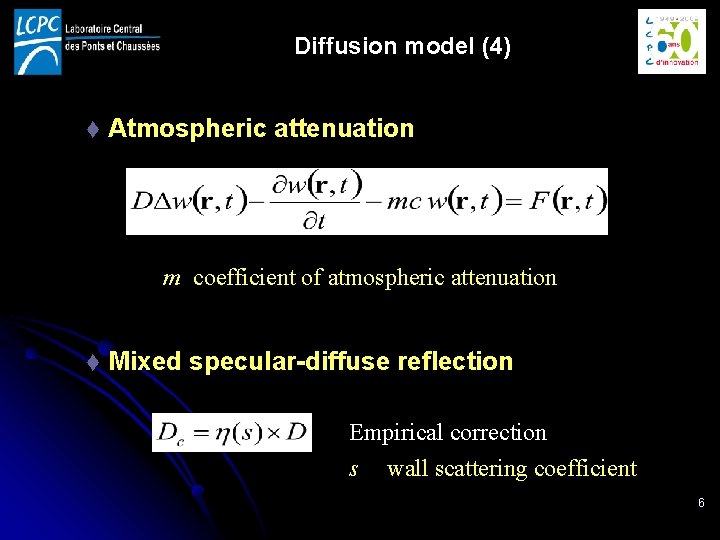
Diffusion model (4) t Atmospheric attenuation m coefficient of atmospheric attenuation t Mixed specular-diffuse reflection Empirical correction s wall scattering coefficient 6
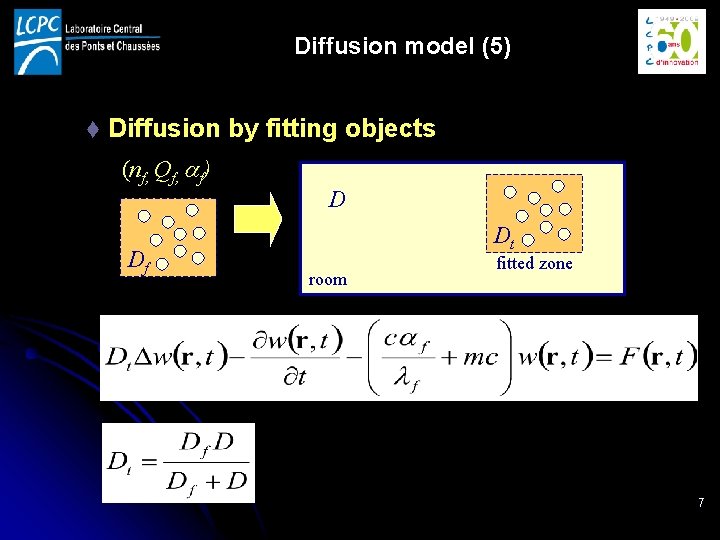
Diffusion model (5) t Diffusion by fitting objects (nf, Qf, af) Df D Dt room fitted zone 7
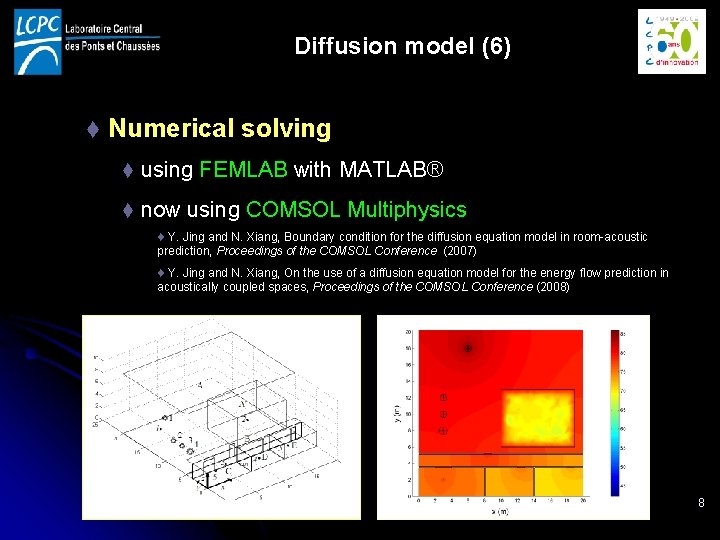
Diffusion model (6) t Numerical solving t using FEMLAB with MATLAB® t now using COMSOL Multiphysics t Y. Jing and N. Xiang, Boundary condition for the diffusion equation model in room-acoustic prediction, Proceedings of the COMSOL Conference (2007) t Y. Jing and N. Xiang, On the use of a diffusion equation model for the energy flow prediction in acoustically coupled spaces, Proceedings of the COMSOL Conference (2008) 8
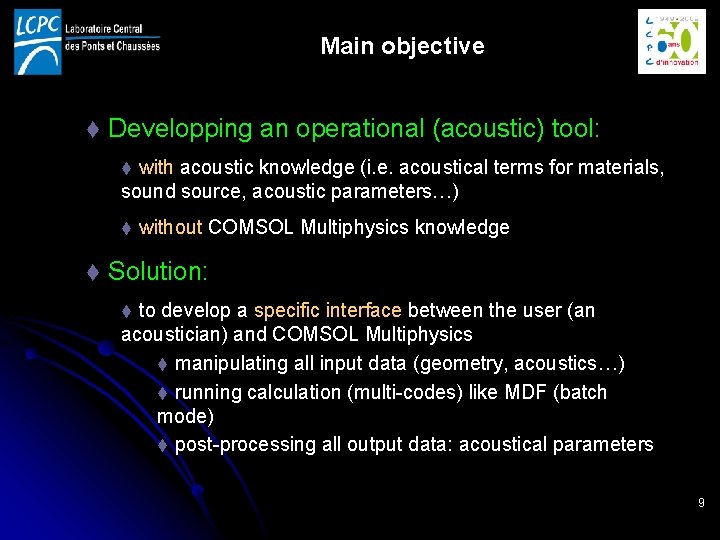
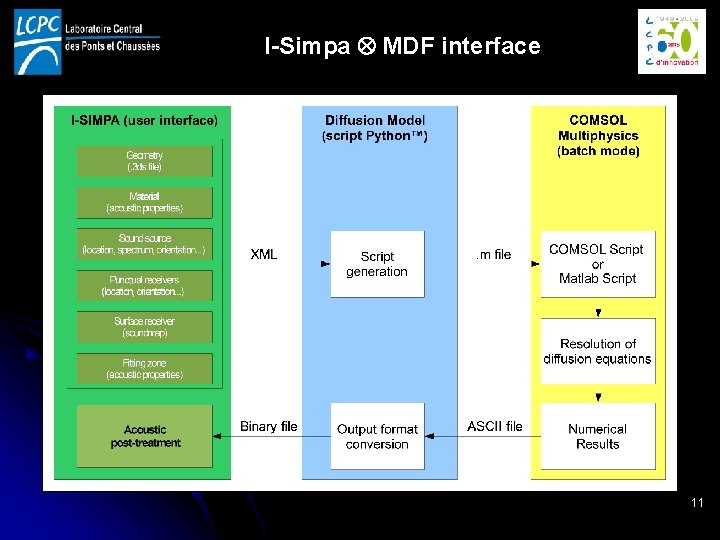
Main objective t Developping an operational (acoustic) tool: with acoustic knowledge (i. e. acoustical terms for materials, sound source, acoustic parameters…) t t t without COMSOL Multiphysics knowledge Solution: to develop a specific interface between the user (an acoustician) and COMSOL Multiphysics t manipulating all input data (geometry, acoustics…) t running calculation (multi-codes) like MDF (batch mode) t post-processing all output data: acoustical parameters t 9
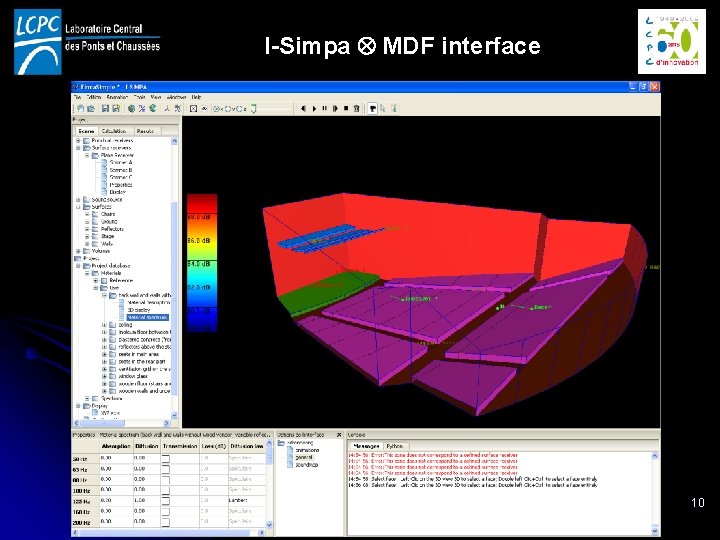
I-Simpa MDF interface 10
I-Simpa MDF interface 11
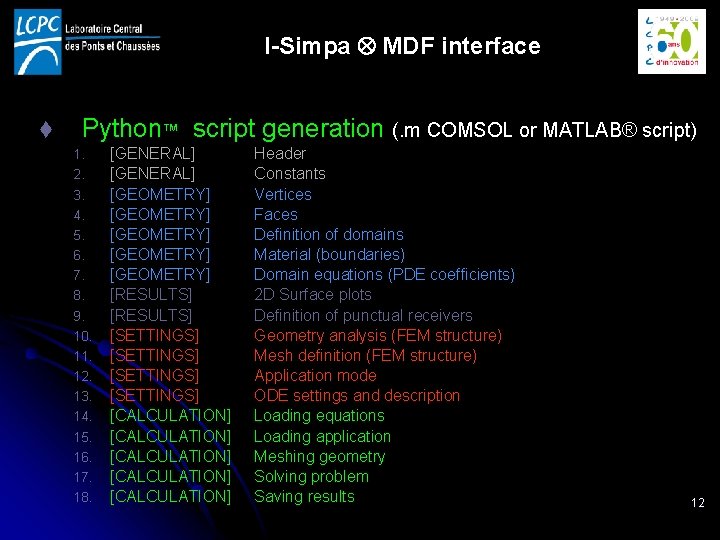
I-Simpa MDF interface t Python™ script generation (. m COMSOL or MATLAB® script) 1. 2. 3. 4. 5. 6. 7. 8. 9. 10. 11. 12. 13. 14. 15. 16. 17. 18. [GENERAL] [GEOMETRY] [GEOMETRY] [RESULTS] [SETTINGS] [CALCULATION] [CALCULATION] Header Constants Vertices Faces Definition of domains Material (boundaries) Domain equations (PDE coefficients) 2 D Surface plots Definition of punctual receivers Geometry analysis (FEM structure) Mesh definition (FEM structure) Application mode ODE settings and description Loading equations Loading application Meshing geometry Solving problem Saving results 12
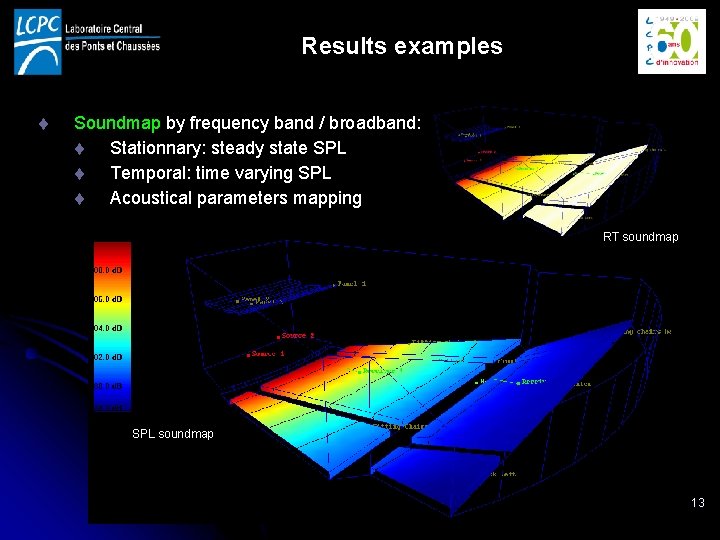
Results examples t Soundmap by frequency band / broadband: t Stationnary: steady state SPL t Temporal: time varying SPL t Acoustical parameters mapping RT soundmap SPL soundmap 13
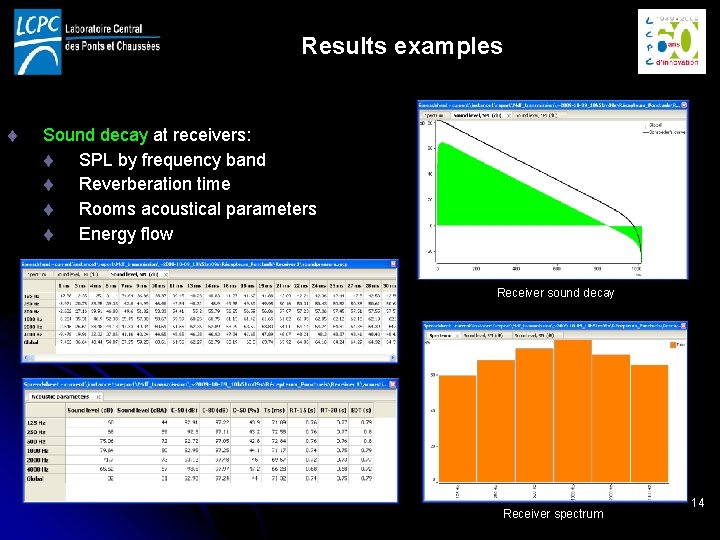
Results examples t Sound decay at receivers: t SPL by frequency band t Reverberation time t Rooms acoustical parameters t Energy flow Receiver sound decay Receiver spectrum 14
Conclusion l A fully operational tool for acoustic prediction in room, concert hall, building… has been developed l Specific interface I-Simpa (user interface) l Diffusion model (transparent) l. m l script generation using Python™ COMSOL Multiphysics in batch mode 15
Thank you for your attention Judicael. Picaut@lcpc. fr 16