
Sound Chapter 17 Wave fronts In a flat

- Slides: 16
Sound Chapter 17
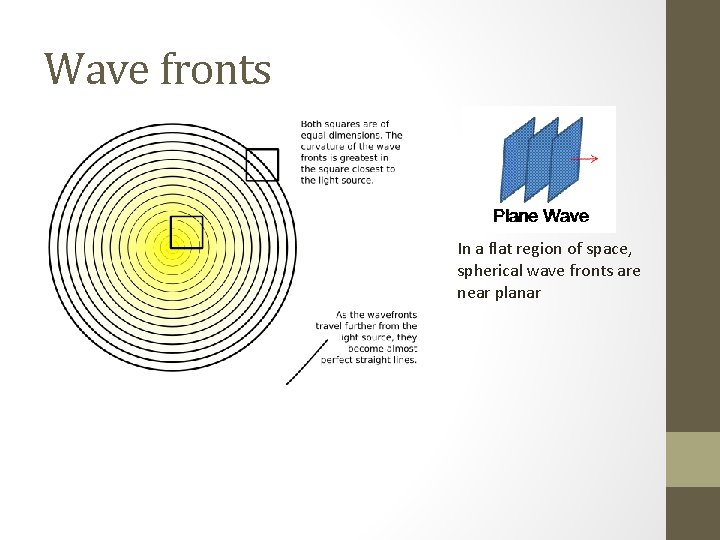
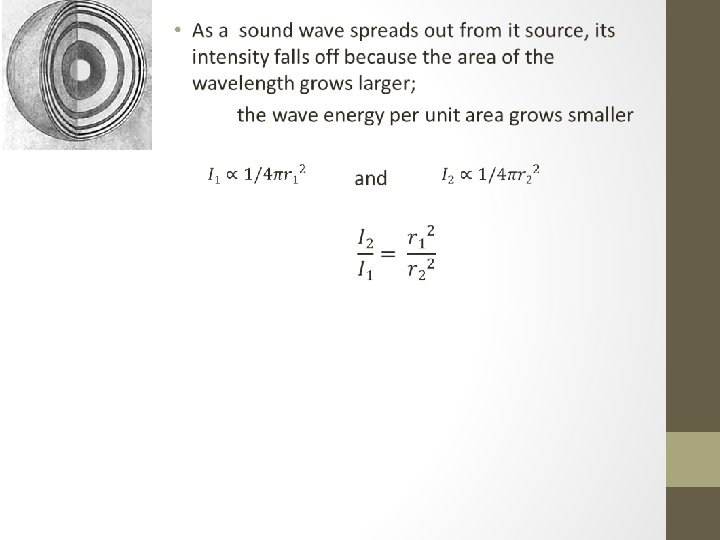
Wave fronts In a flat region of space, spherical wave fronts are near planar
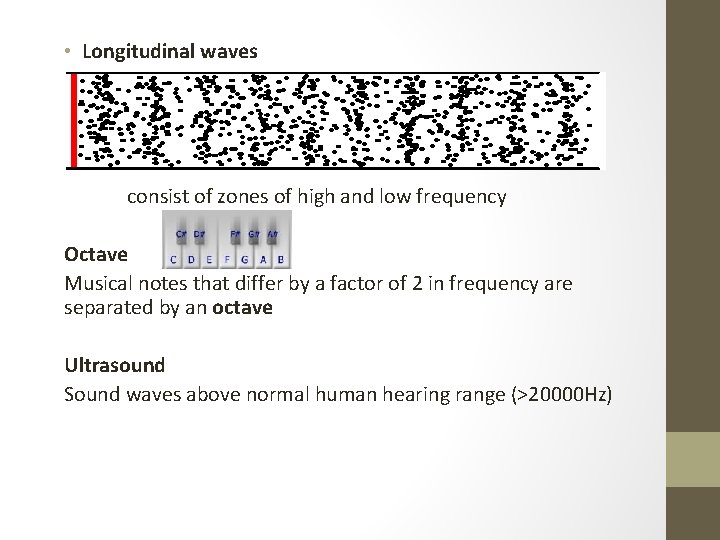
• Longitudinal waves consist of zones of high and low frequency Octave Musical notes that differ by a factor of 2 in frequency are separated by an octave Ultrasound Sound waves above normal human hearing range (>20000 Hz)
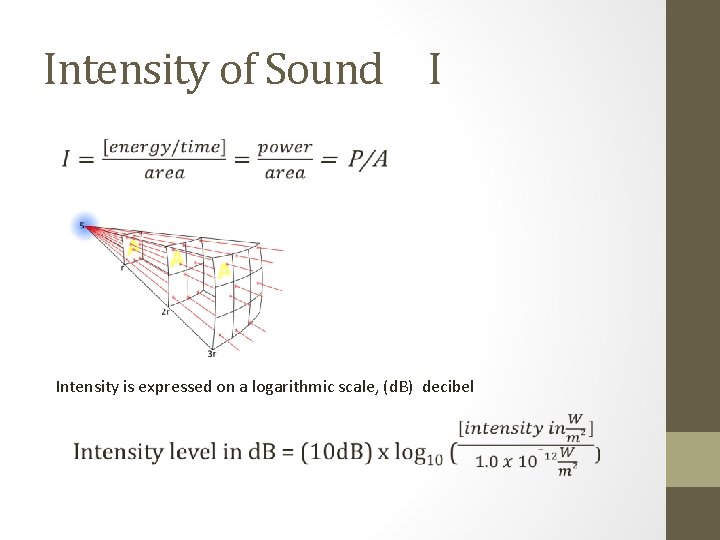
Intensity of Sound I Intensity is expressed on a logarithmic scale, (d. B) decibel
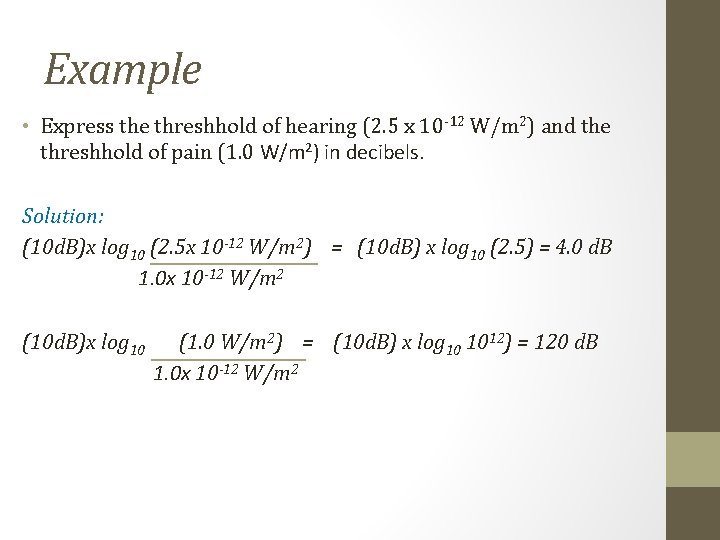
Example • Express the threshhold of hearing (2. 5 x 10 -12 W/m 2) and the threshhold of pain (1. 0 W/m 2) in decibels. Solution: (10 d. B)x log 10 (2. 5 x 10 -12 W/m 2) = (10 d. B) x log 10 (2. 5) = 4. 0 d. B 1. 0 x 10 -12 W/m 2 (10 d. B)x log 10 (1. 0 W/m 2) = (10 d. B) x log 10 1012) = 120 d. B 1. 0 x 10 -12 W/m 2
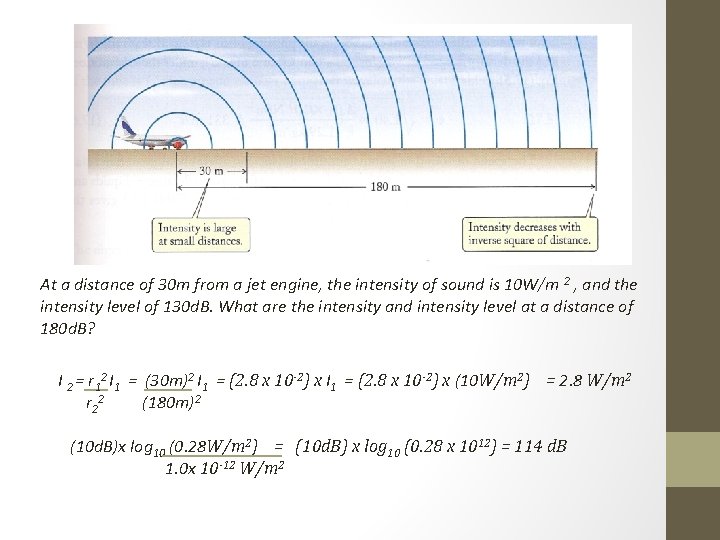
At a distance of 30 m from a jet engine, the intensity of sound is 10 W/m 2 , and the intensity level of 130 d. B. What are the intensity and intensity level at a distance of 180 d. B? I 2 = r 12 I 1 = (30 m)2 I 1 = (2. 8 x 10 -2) x (10 W/m 2) = 2. 8 W/m 2 r 22 (180 m)2 (10 d. B)x log 10 (0. 28 W/m 2) = (10 d. B) x log 10 (0. 28 x 1012) = 114 d. B 1. 0 x 10 -12 W/m 2
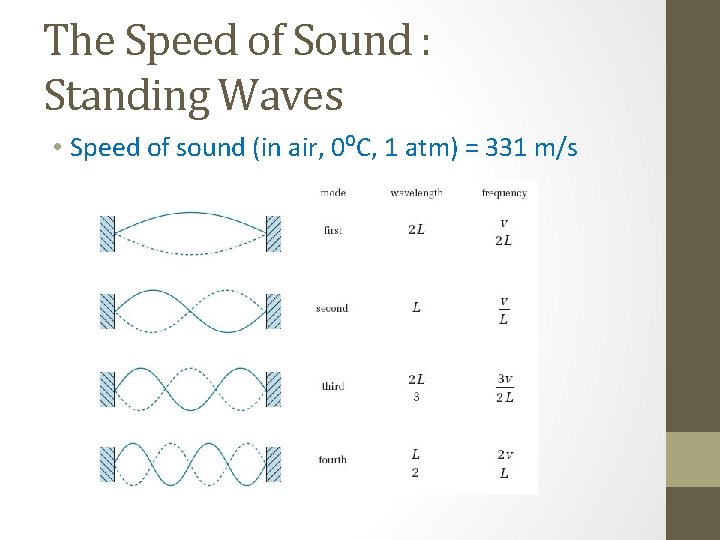
The Speed of Sound : Standing Waves • Speed of sound (in air, 0⁰C, 1 atm) = 331 m/s
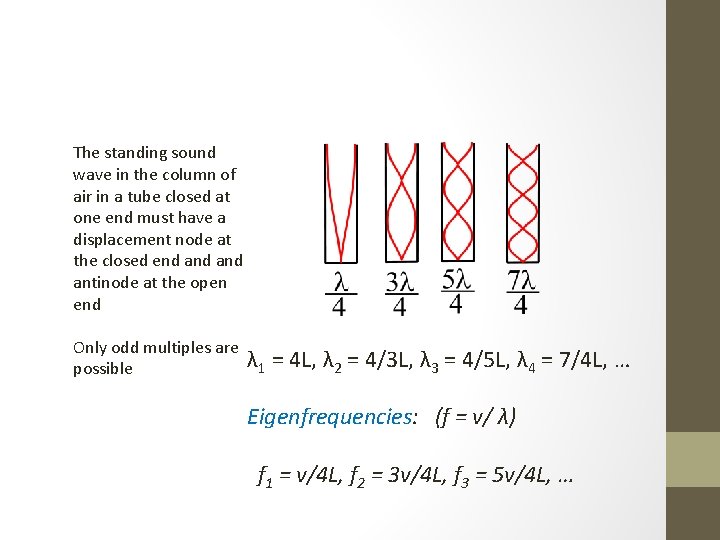
The standing sound wave in the column of air in a tube closed at one end must have a displacement node at the closed end and antinode at the open end Only odd multiples are λ 1 = 4 L, λ 2 = 4/3 L, λ 3 = 4/5 L, λ 4 = 7/4 L, … possible Eigenfrequencies: (f = v/ λ) f 1 = v/4 L, f 2 = 3 v/4 L, f 3 = 5 v/4 L, …
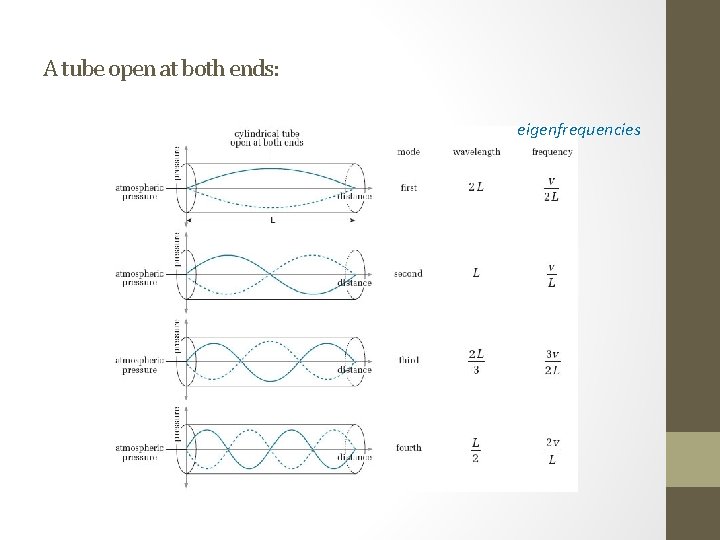
A tube open at both ends: eigenfrequencies
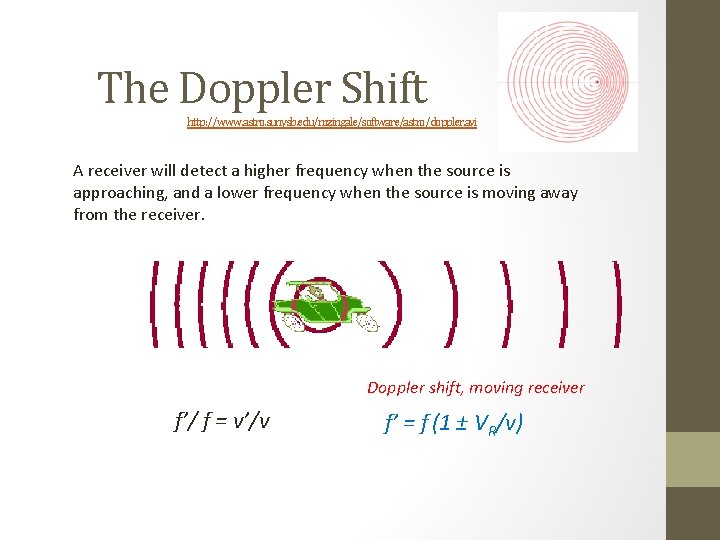
The Doppler Shift http: //www. astro. sunysb. edu/mzingale/software/astro/doppler. avi A receiver will detect a higher frequency when the source is approaching, and a lower frequency when the source is moving away from the receiver. Doppler shift, moving receiver f’/ f = v’/v f’ = f (1 ± VR/v)
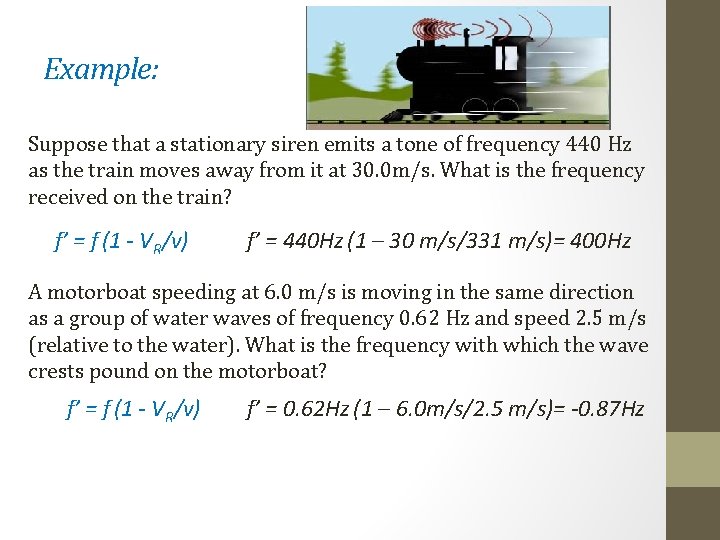
Example: Suppose that a stationary siren emits a tone of frequency 440 Hz as the train moves away from it at 30. 0 m/s. What is the frequency received on the train? f’ = f (1 - VR/v) f’ = 440 Hz (1 – 30 m/s/331 m/s)= 400 Hz A motorboat speeding at 6. 0 m/s is moving in the same direction as a group of water waves of frequency 0. 62 Hz and speed 2. 5 m/s (relative to the water). What is the frequency with which the wave crests pound on the motorboat? f’ = f (1 - VR/v) f’ = 0. 62 Hz (1 – 6. 0 m/s/2. 5 m/s)= -0. 87 Hz
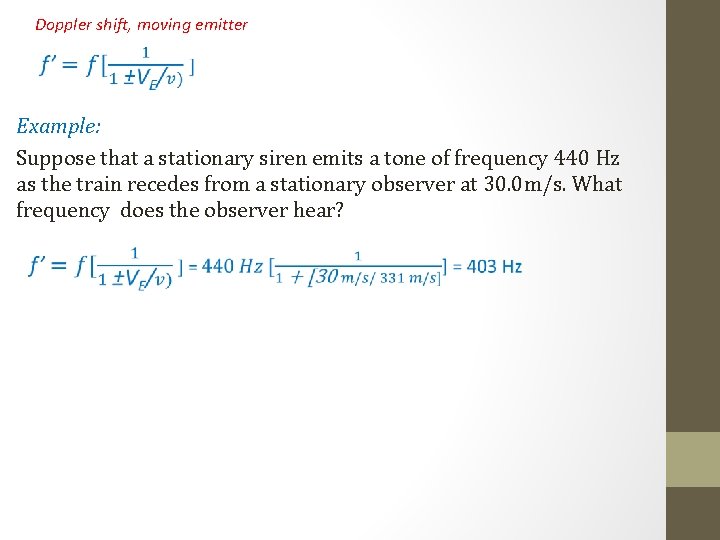
Doppler shift, moving emitter Example: Suppose that a stationary siren emits a tone of frequency 440 Hz as the train recedes from a stationary observer at 30. 0 m/s. What frequency does the observer hear?
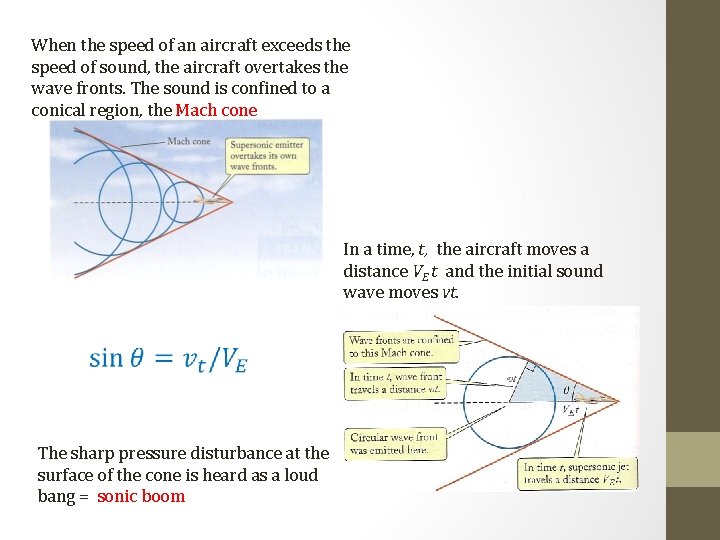
When the speed of an aircraft exceeds the speed of sound, the aircraft overtakes the wave fronts. The sound is confined to a conical region, the Mach cone In a time, t, the aircraft moves a distance VE t and the initial sound wave moves vt. The sharp pressure disturbance at the surface of the cone is heard as a loud bang = sonic boom
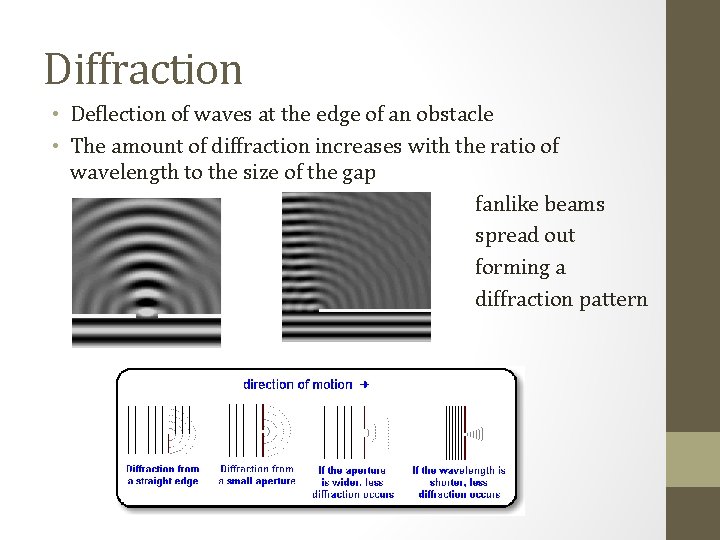
Diffraction • Deflection of waves at the edge of an obstacle • The amount of diffraction increases with the ratio of wavelength to the size of the gap fanlike beams spread out forming a diffraction pattern