
SOUND AND LIGHT Chapter 16 Sound waves are



- Slides: 49
SOUND AND LIGHT Chapter 16
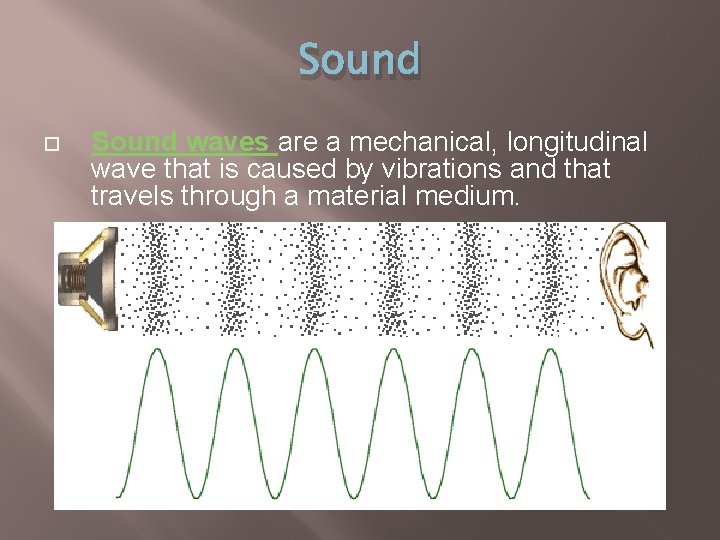
Sound waves are a mechanical, longitudinal wave that is caused by vibrations and that travels through a material medium.
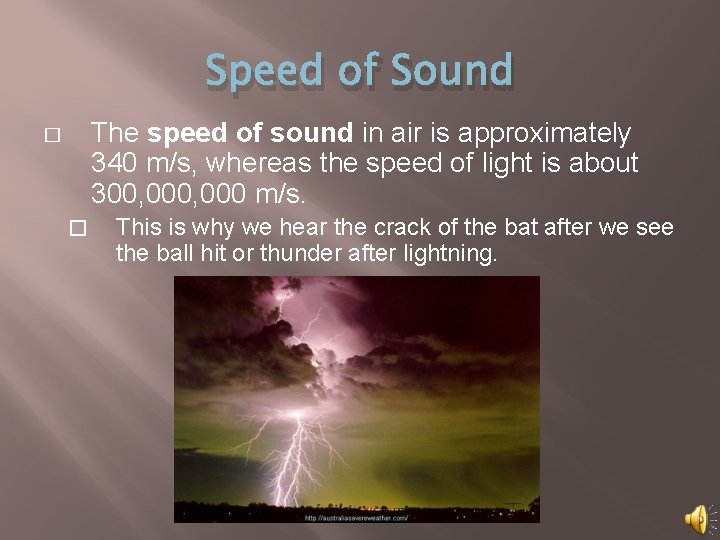
Speed of Sound The speed of sound in air is approximately 340 m/s, whereas the speed of light is about 300, 000 m/s. � � This is why we hear the crack of the bat after we see the ball hit or thunder after lightning.
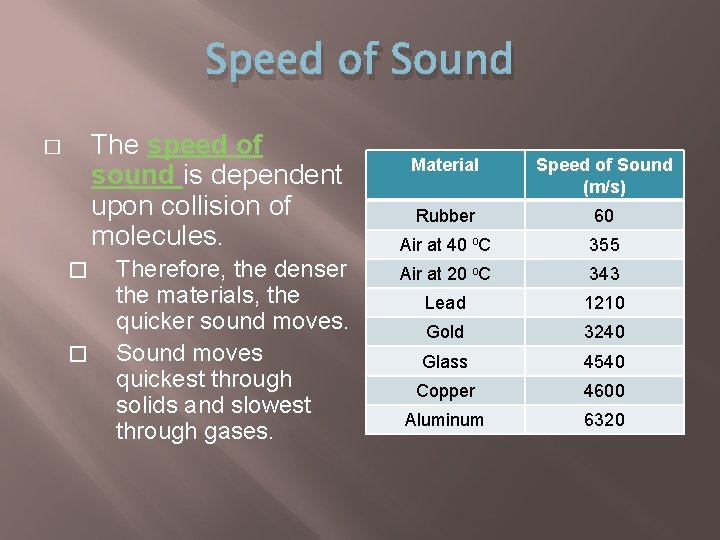
Speed of Sound The speed of sound is dependent upon collision of molecules. � � � Therefore, the denser the materials, the quicker sound moves. Sound moves quickest through solids and slowest through gases. Material Speed of Sound (m/s) Rubber 60 Air at 40 o. C 355 Air at 20 o. C 343 Lead 1210 Gold 3240 Glass 4540 Copper 4600 Aluminum 6320
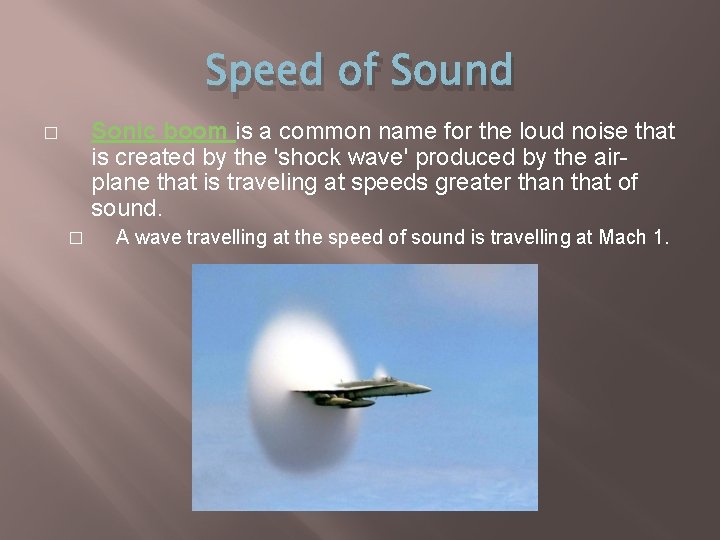
Speed of Sound Sonic boom is a common name for the loud noise that is created by the 'shock wave' produced by the airplane that is traveling at speeds greater than that of sound. � � A wave travelling at the speed of sound is travelling at Mach 1.
Big Bang Theory—Breaking sound barrier https: //www. youtube. com/watch? v=SKt URlmsn. XU
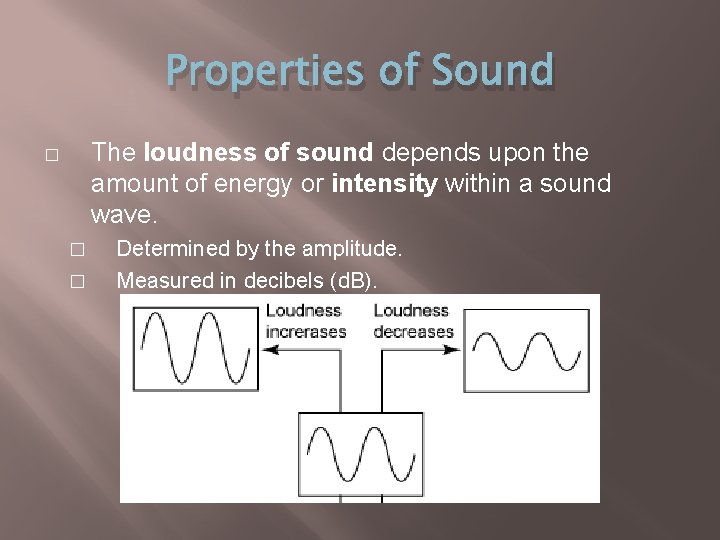
Properties of Sound The loudness of sound depends upon the amount of energy or intensity within a sound wave. � � � Determined by the amplitude. Measured in decibels (d. B).
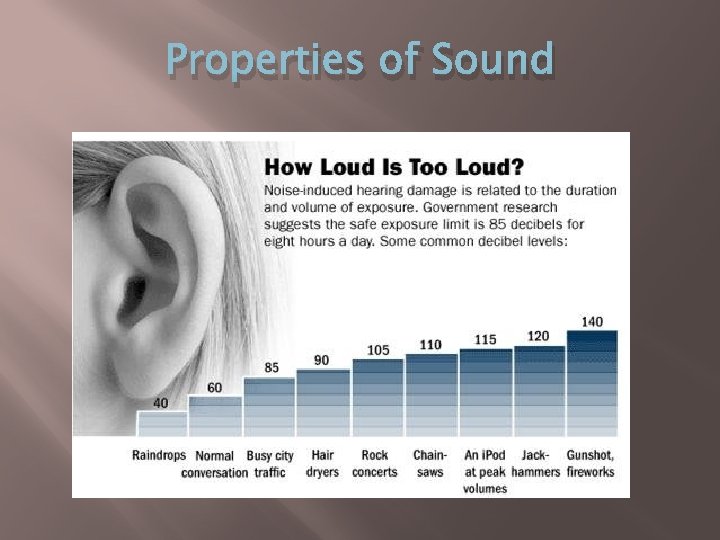
Properties of Sound
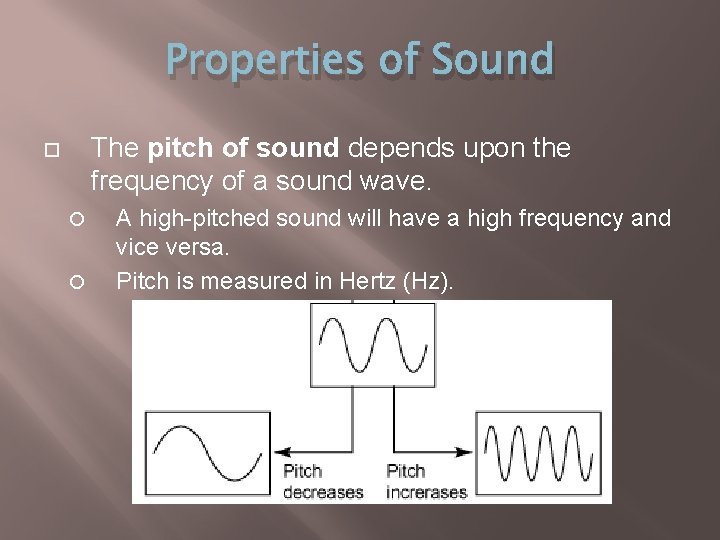
Properties of Sound The pitch of sound depends upon the frequency of a sound wave. A high-pitched sound will have a high frequency and vice versa. Pitch is measured in Hertz (Hz).
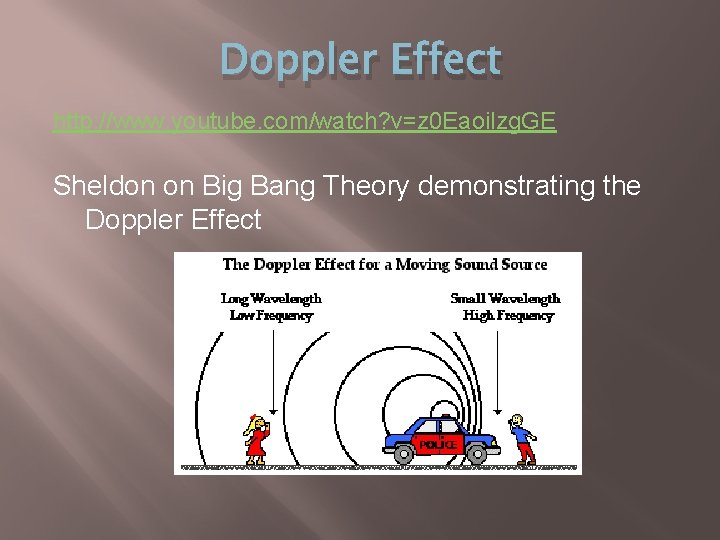
Doppler Effect http: //www. youtube. com/watch? v=z 0 Eaoilzg. GE Sheldon on Big Bang Theory demonstrating the Doppler Effect
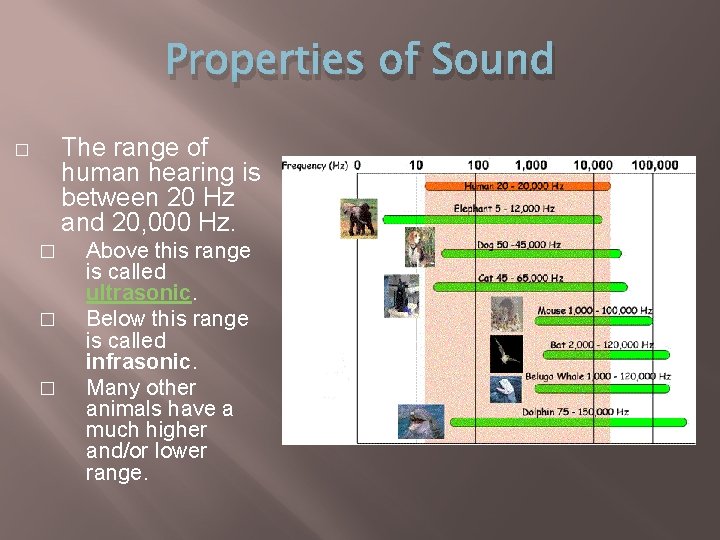
Properties of Sound The range of human hearing is between 20 Hz and 20, 000 Hz. � � Above this range is called ultrasonic. Below this range is called infrasonic. Many other animals have a much higher and/or lower range.
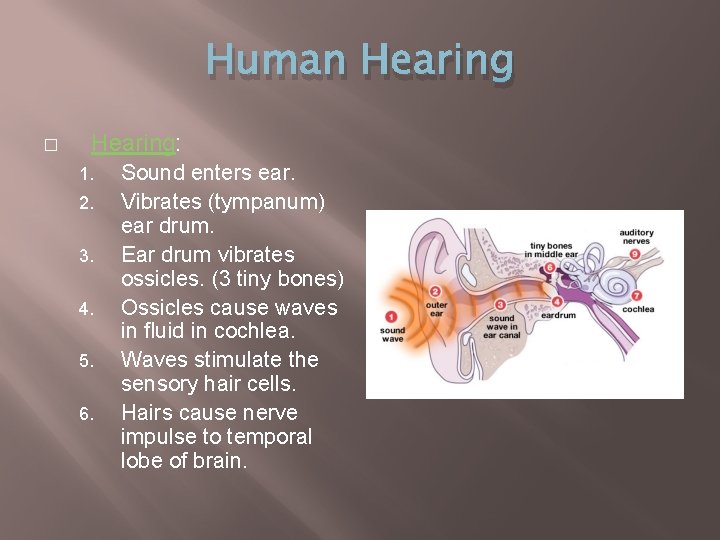
Human Hearing � Hearing: 1. 2. 3. 4. 5. 6. Sound enters ear. Vibrates (tympanum) ear drum. Ear drum vibrates ossicles. (3 tiny bones) Ossicles cause waves in fluid in cochlea. Waves stimulate the sensory hair cells. Hairs cause nerve impulse to temporal lobe of brain.
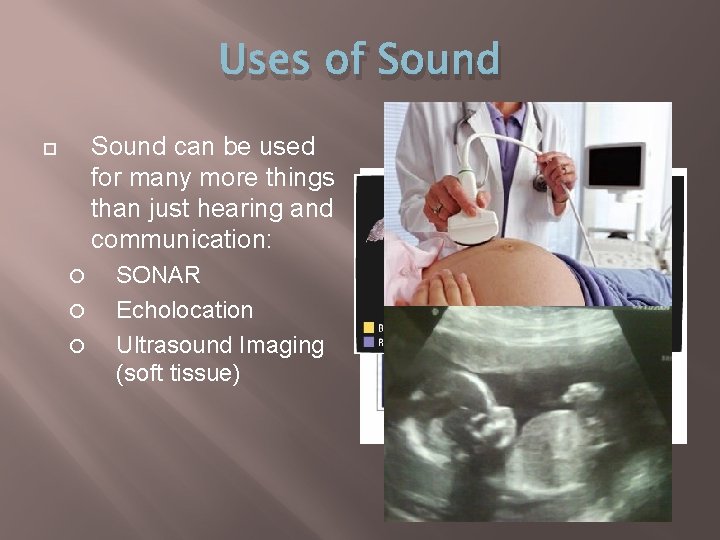
Uses of Sound can be used for many more things than just hearing and communication: SONAR Echolocation Ultrasound Imaging (soft tissue)
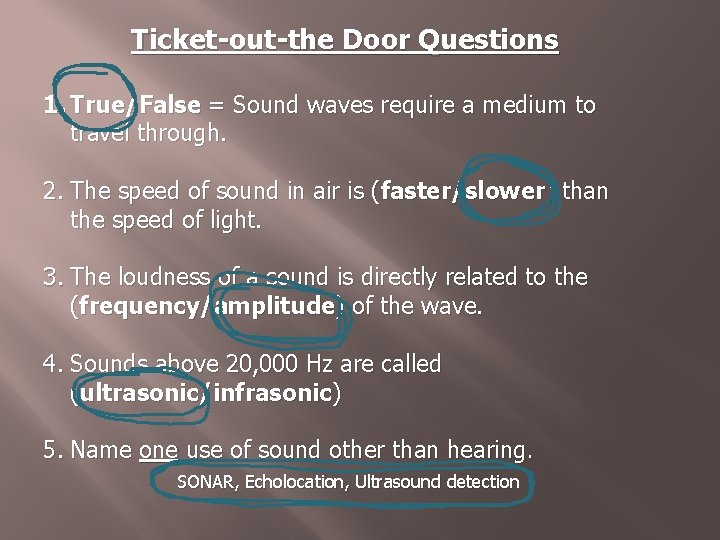
Ticket-out-the Door Questions 1. True/False = Sound waves require a medium to travel through. 2. The speed of sound in air is (faster/slower) than the speed of light. 3. The loudness of a sound is directly related to the (frequency/amplitude) of the wave. 4. Sounds above 20, 000 Hz are called (ultrasonic/infrasonic) 5. Name one use of sound other than hearing. SONAR, Echolocation, Ultrasound detection
How young are your ears? http: //www. freemosquitoringtones. org/
https: //www. youtube. com/watch? v=AIo. YWONKi 4&edufilter=ITEV 1 Ggf. Y 7 r. Uu. Gx. S yy 0 SA – Blind Man using echolocation
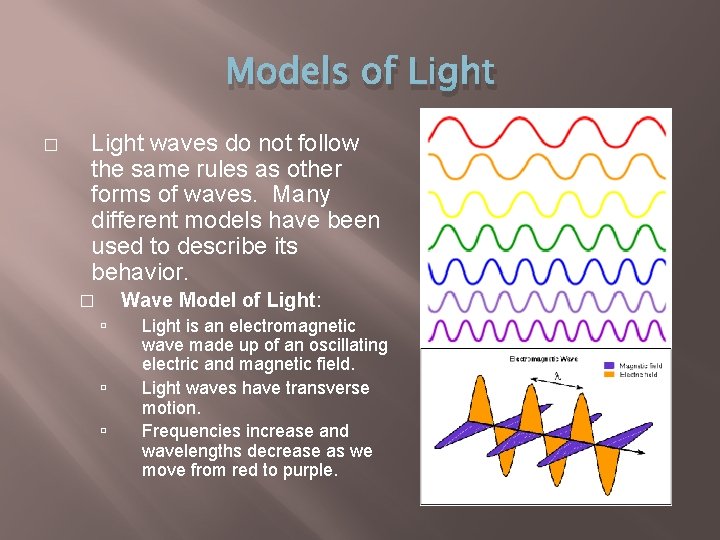
Models of Light � Light waves do not follow the same rules as other forms of waves. Many different models have been used to describe its behavior. Wave Model of Light: � Light is an electromagnetic wave made up of an oscillating electric and magnetic field. Light waves have transverse motion. Frequencies increase and wavelengths decrease as we move from red to purple.
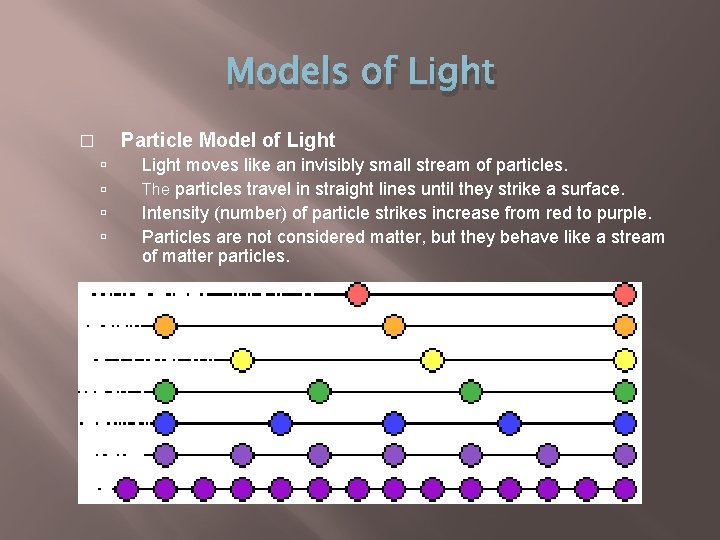
Models of Light Particle Model of Light � Light moves like an invisibly small stream of particles. The particles travel in straight lines until they strike a surface. Intensity (number) of particle strikes increase from red to purple. Particles are not considered matter, but they behave like a stream of matter particles.
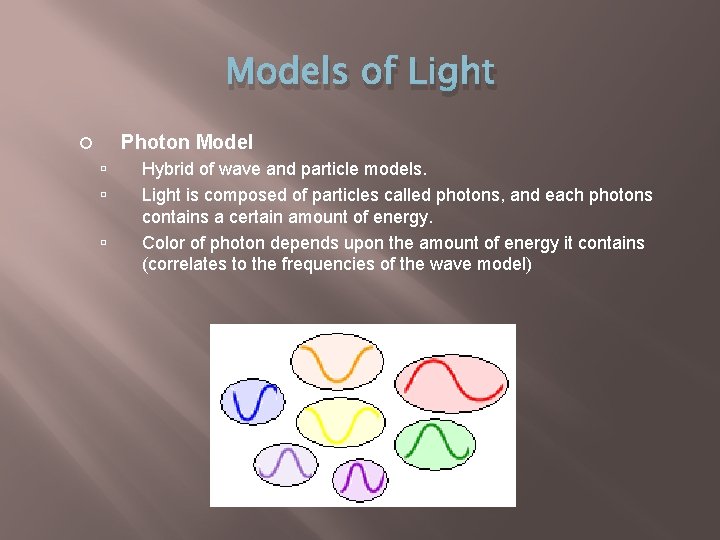
Models of Light Photon Model Hybrid of wave and particle models. Light is composed of particles called photons, and each photons contains a certain amount of energy. Color of photon depends upon the amount of energy it contains (correlates to the frequencies of the wave model)
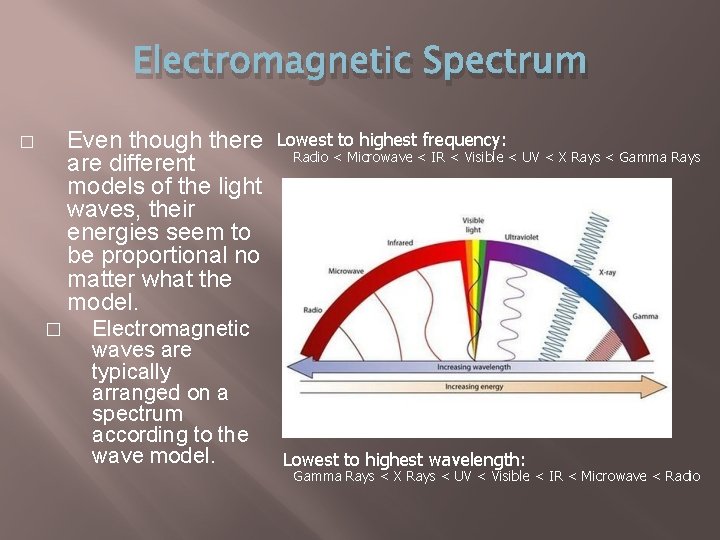
Electromagnetic Spectrum Even though there are different models of the light waves, their energies seem to be proportional no matter what the model. � � Electromagnetic waves are typically arranged on a spectrum according to the wave model. Lowest to highest frequency: Radio < Microwave < IR < Visible < UV < X Rays < Gamma Rays Lowest to highest wavelength: Gamma Rays < X Rays < UV < Visible < IR < Microwave < Radio
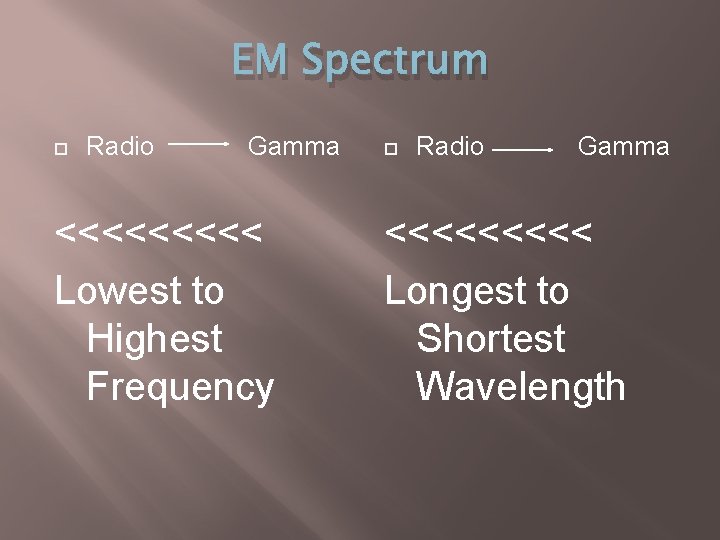
EM Spectrum Radio Gamma <<<<< Lowest to Highest Frequency Radio Gamma <<<<< Longest to Shortest Wavelength
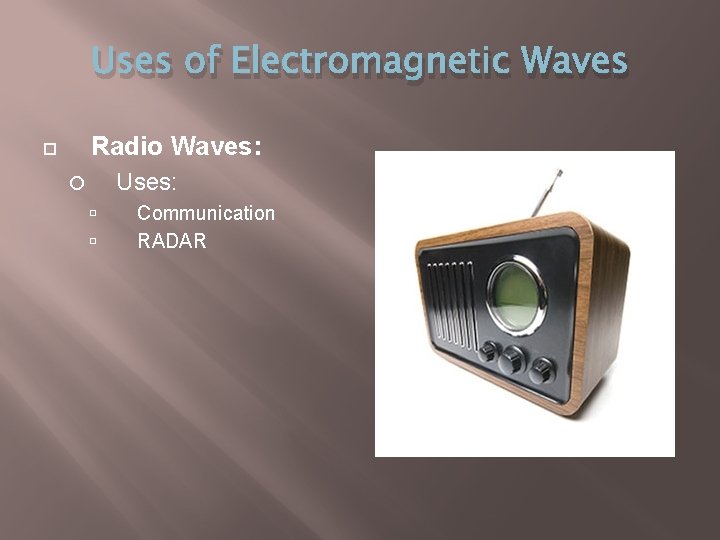
Uses of Electromagnetic Waves Radio Waves: Uses: Communication RADAR
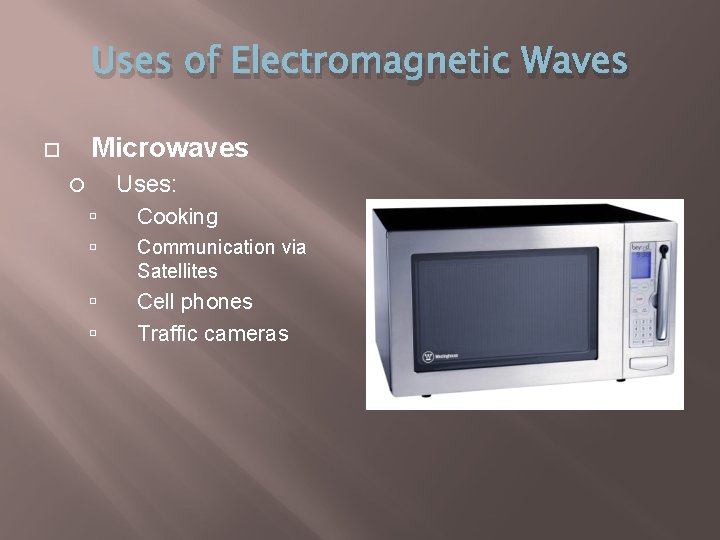
Uses of Electromagnetic Waves Microwaves Uses: Cooking Communication via Satellites Cell phones Traffic cameras
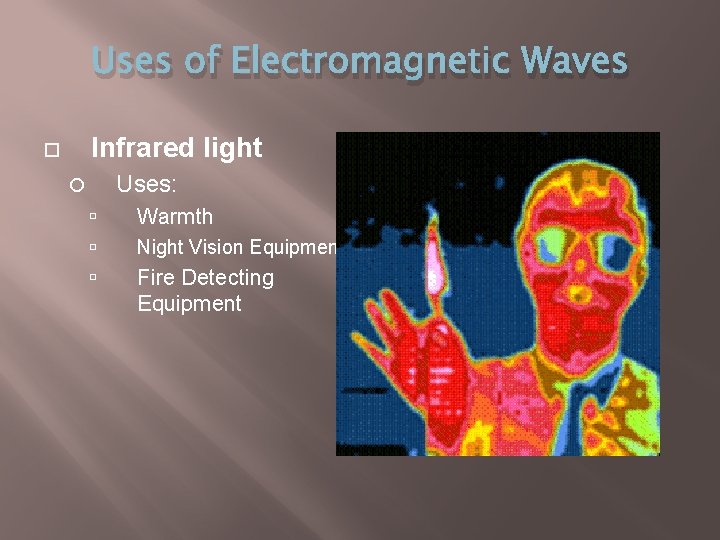
Uses of Electromagnetic Waves Infrared light Uses: Warmth Night Vision Equipment Fire Detecting Equipment
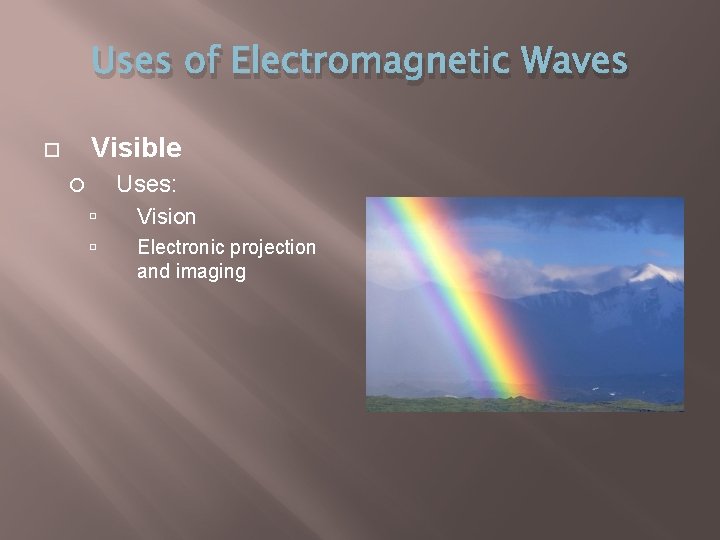
Uses of Electromagnetic Waves Visible Uses: Vision Electronic projection and imaging
Uses of Electromagnetic Waves http: //channel. nationalgeo graphic. com/braingames/episodes/colors/
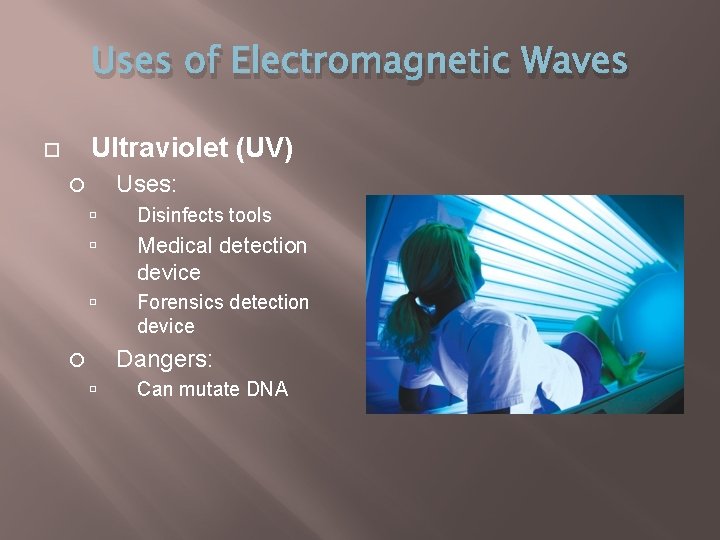
Uses of Electromagnetic Waves Ultraviolet (UV) Uses: Disinfects tools Medical detection device Forensics detection device Dangers: Can mutate DNA
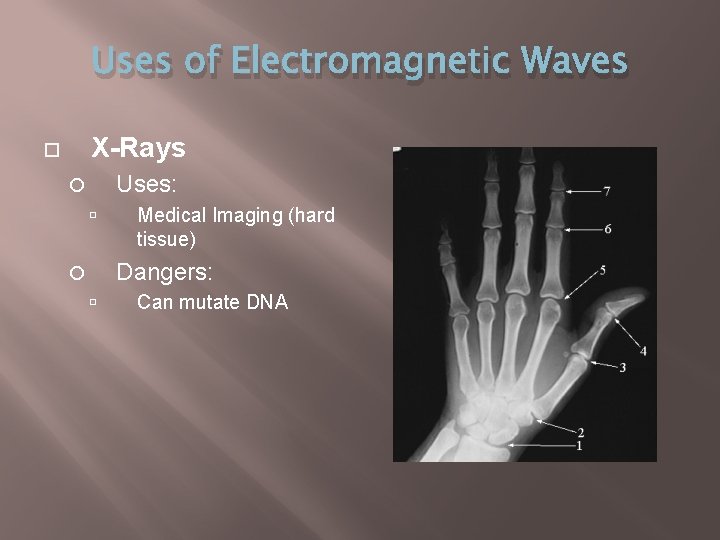
Uses of Electromagnetic Waves X-Rays Uses: Medical Imaging (hard tissue) Dangers: Can mutate DNA
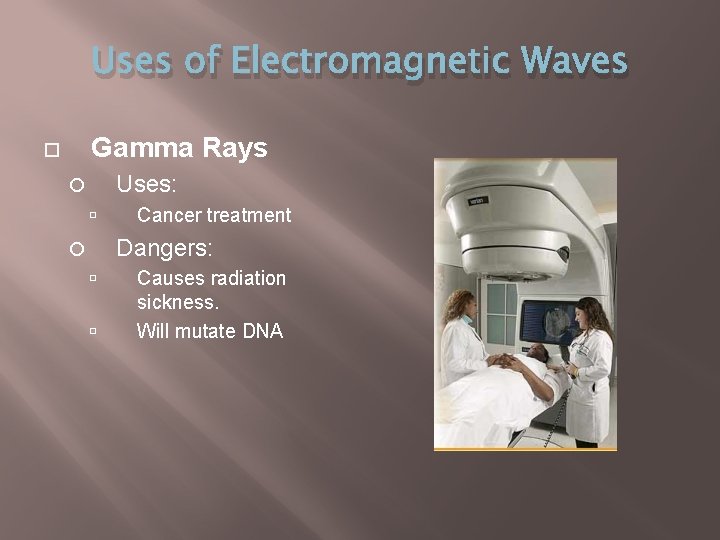
Uses of Electromagnetic Waves Gamma Rays Uses: Cancer treatment Dangers: Causes radiation sickness. Will mutate DNA
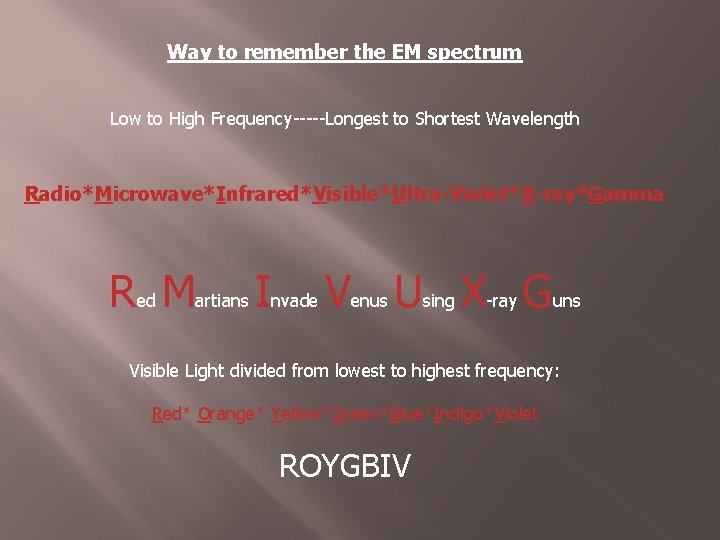
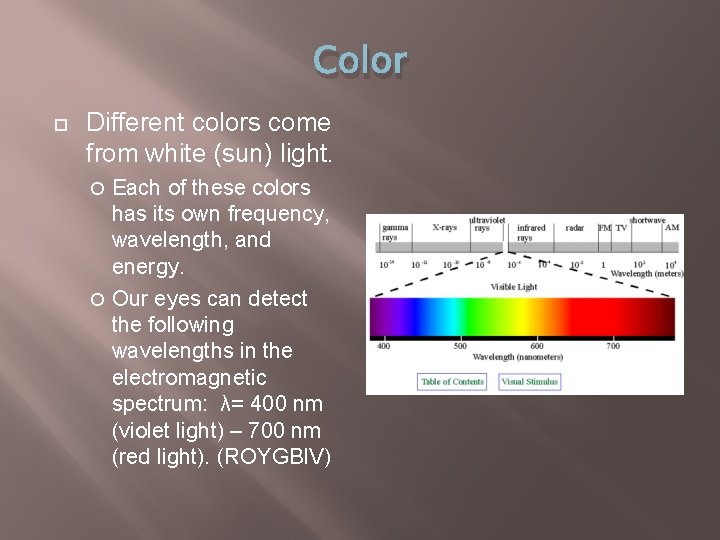
Way to remember the EM spectrum Low to High Frequency-----Longest to Shortest Wavelength Radio*Microwave*Infrared*Visible*Ultra-Violet*X-ray*Gamma Red Martians Invade Venus Using X-ray Guns Visible Light divided from lowest to highest frequency: Red* Orange* Yellow*Green*Blue*Indigo*Violet ROYGBIV
Electromagnetic Spectrum https: //www. youtube. com/watch? v=bj. OGNVH 3 D 4 Y
Speed of Light The speed of light (c) is 3 x 10⁸ m/s (186, 000 mi/s) in a vacuum.
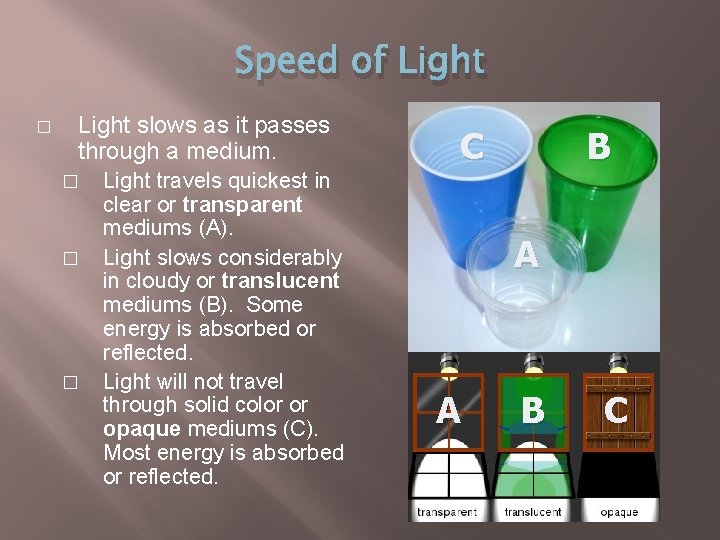
Speed of Light � Light slows as it passes through a medium. � � � Light travels quickest in clear or transparent mediums (A). Light slows considerably in cloudy or translucent mediums (B). Some energy is absorbed or reflected. Light will not travel through solid color or opaque mediums (C). Most energy is absorbed or reflected. C B A A B C
Optics is the field of science that deals with the propagation and behavior of light.
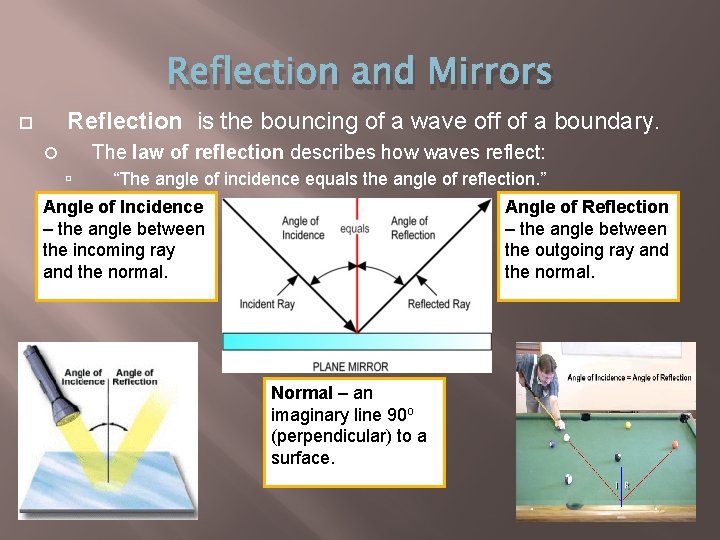
Reflection and Mirrors Reflection is the bouncing of a wave off of a boundary. The law of reflection describes how waves reflect: “The angle of incidence equals the angle of reflection. ” Angle of Incidence – the angle between the incoming ray and the normal. Angle of Reflection – the angle between the outgoing ray and the normal. Normal – an imaginary line 90 o (perpendicular) to a surface.
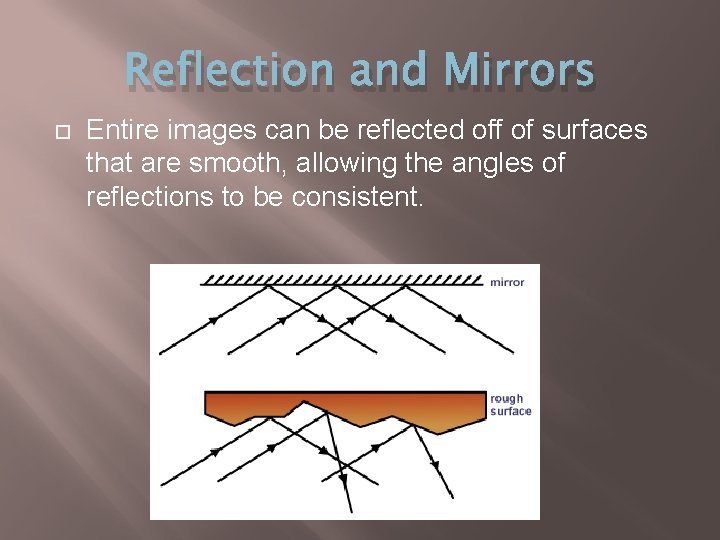
Reflection and Mirrors Entire images can be reflected off of surfaces that are smooth, allowing the angles of reflections to be consistent.
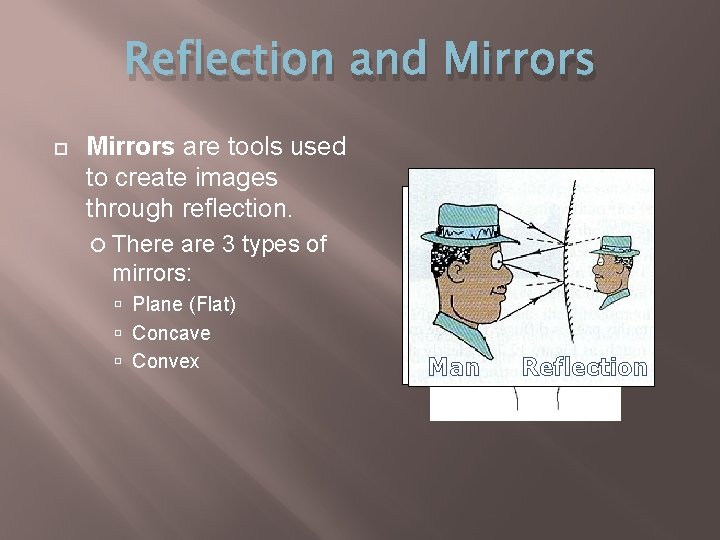
Reflection and Mirrors are tools used to create images through reflection. There are 3 types of mirrors: Plane (Flat) Concave Convex Man Reflection
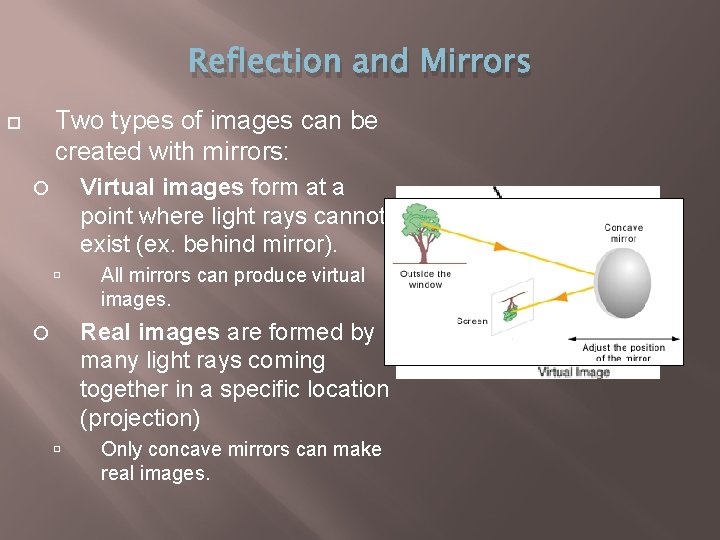
Reflection and Mirrors Two types of images can be created with mirrors: Virtual images form at a point where light rays cannot exist (ex. behind mirror). All mirrors can produce virtual images. Real images are formed by many light rays coming together in a specific location (projection) Only concave mirrors can make real images.
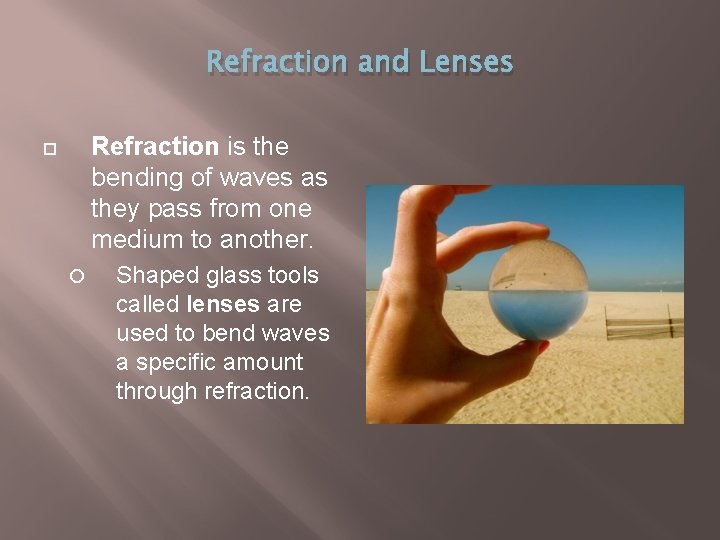
Refraction and Lenses Refraction is the bending of waves as they pass from one medium to another. Shaped glass tools called lenses are used to bend waves a specific amount through refraction.
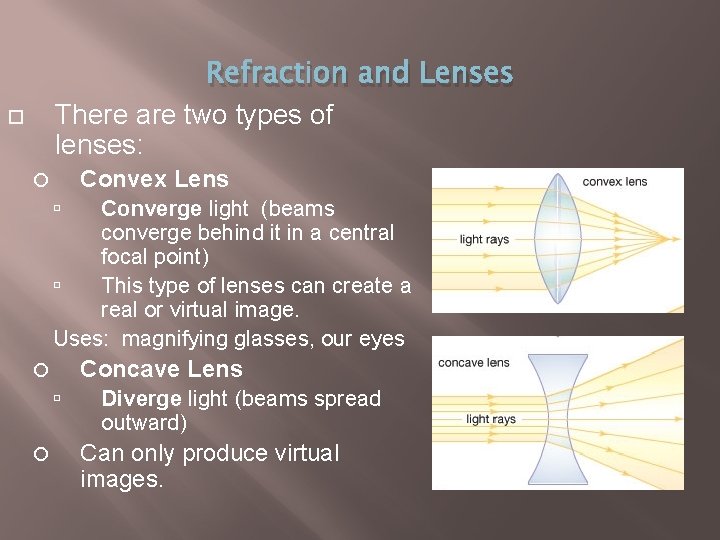
Refraction and Lenses There are two types of lenses: Convex Lens Converge light (beams converge behind it in a central focal point) This type of lenses can create a real or virtual image. Uses: magnifying glasses, our eyes Concave Lens Diverge light (beams spread outward) Can only produce virtual images.
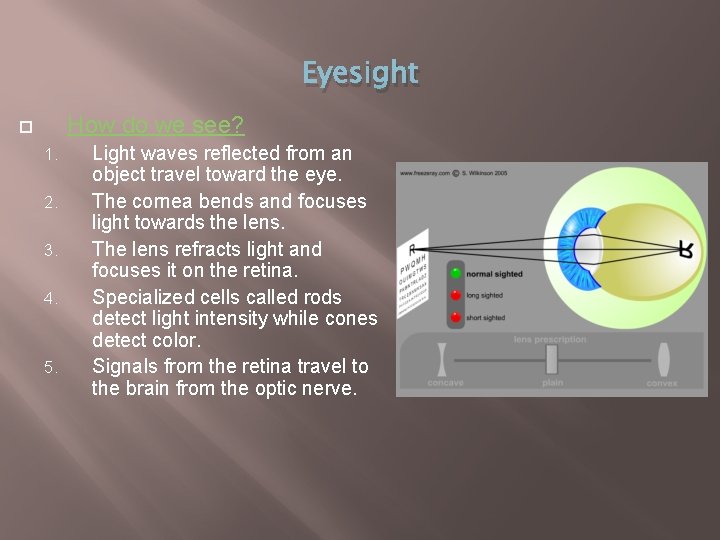
Eyesight How do we see? 1. 2. 3. 4. 5. Light waves reflected from an object travel toward the eye. The cornea bends and focuses light towards the lens. The lens refracts light and focuses it on the retina. Specialized cells called rods detect light intensity while cones detect color. Signals from the retina travel to the brain from the optic nerve.
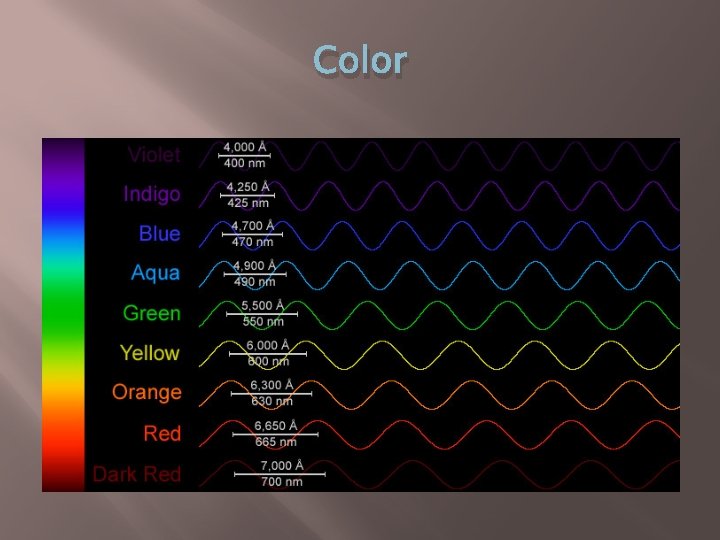
Color Different colors come from white (sun) light. Each of these colors has its own frequency, wavelength, and energy. Our eyes can detect the following wavelengths in the electromagnetic spectrum: λ= 400 nm (violet light) – 700 nm (red light). (ROYGBIV)
Color
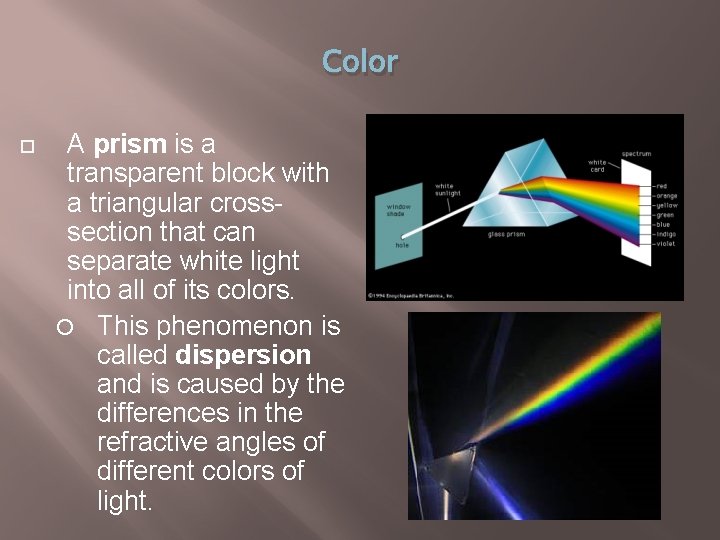
Color A prism is a transparent block with a triangular crosssection that can separate white light into all of its colors. This phenomenon is called dispersion and is caused by the differences in the refractive angles of different colors of light.
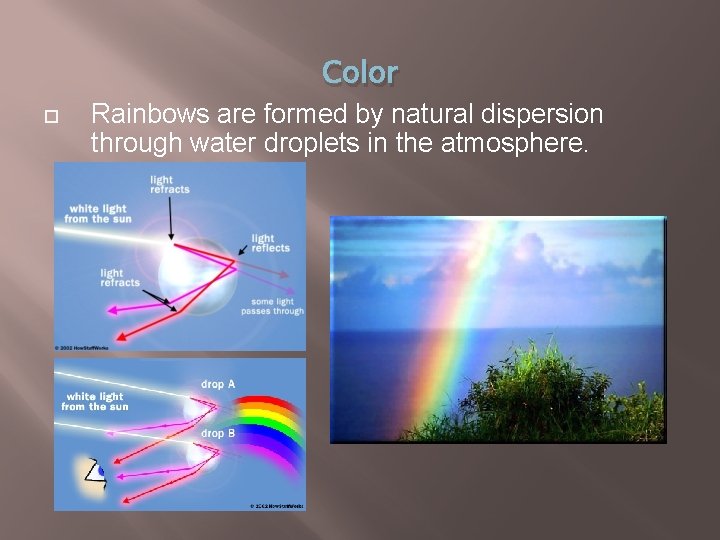
Color Rainbows are formed by natural dispersion through water droplets in the atmosphere.
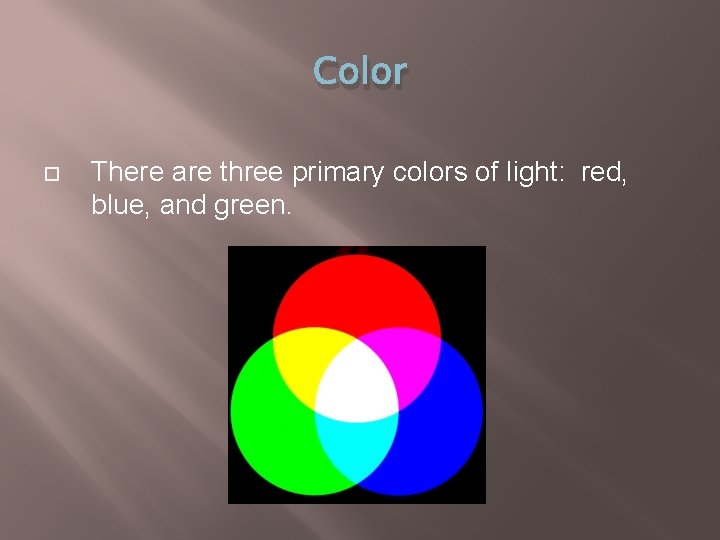
Color There are three primary colors of light: red, blue, and green.
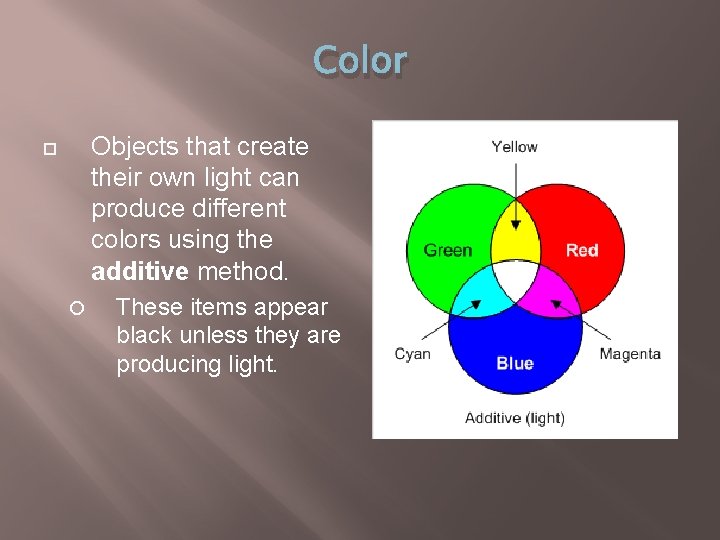
Color Objects that create their own light can produce different colors using the additive method. These items appear black unless they are producing light.
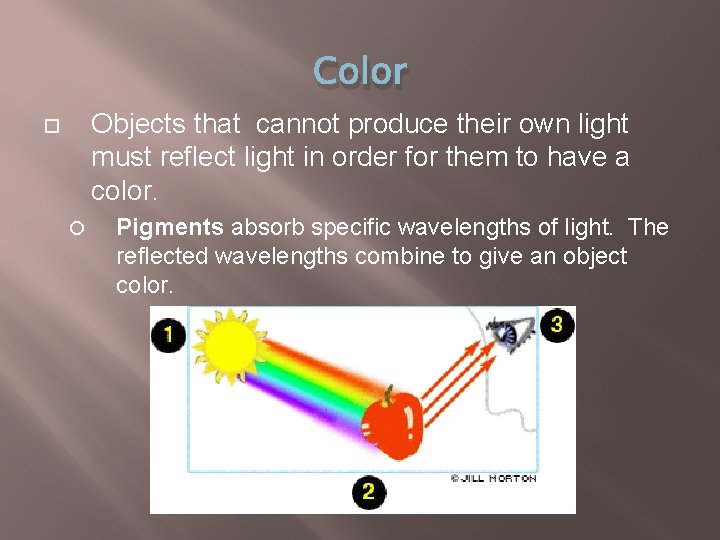
Color Objects that cannot produce their own light must reflect light in order for them to have a color. Pigments absorb specific wavelengths of light. The reflected wavelengths combine to give an object color.
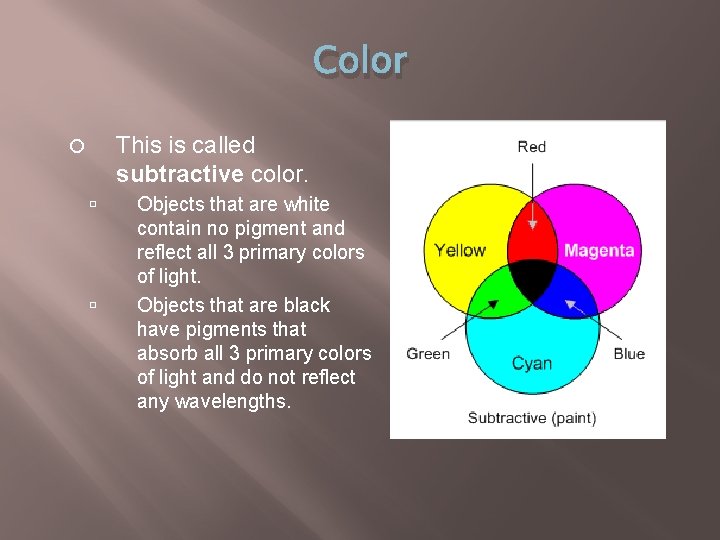
Color This is called subtractive color. Objects that are white contain no pigment and reflect all 3 primary colors of light. Objects that are black have pigments that absorb all 3 primary colors of light and do not reflect any wavelengths.