
Sound adding waves Interference Types of Waves Remember
Sound adding waves Interference

Types of Waves Remember, for waves, there is no net displacement of the medium • Longitudinal – Sound waves – Motion of the medium is parallel to the wave • Transverse – Motion of the medium is perpendicular to the wave – Waves in a string

Two waves at the same place • When multiple waves meet at the same spot in the same medium, they interact. This is called wave interference. • At the moment they overlap, their amplitudes add, so we get a bigger wave for a moment • This only lasts until they pass by each other.

Constructive Interference • Positive (red) combines with positive (blue) and add to result in a bigger amplitude (green) • Negative(red) combines with negative (blue) and add to result in a bigger amplitude (green)
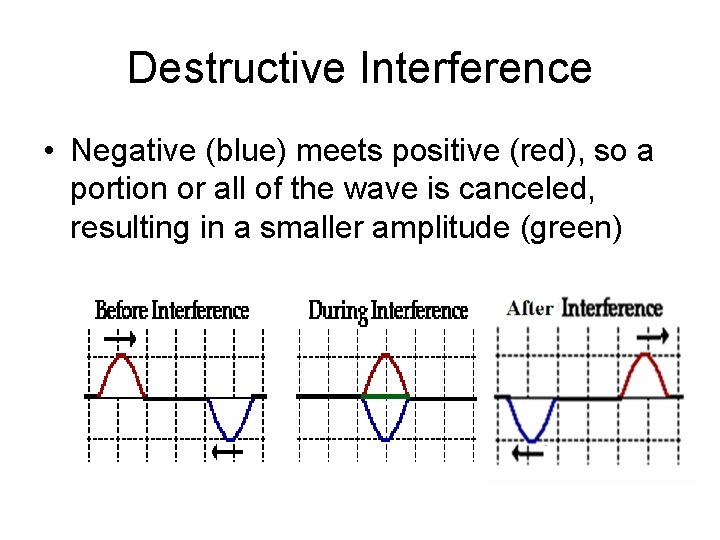
Destructive Interference • Negative (blue) meets positive (red), so a portion or all of the wave is canceled, resulting in a smaller amplitude (green)

Beats • Beats are alternations in loudness, due to interference • Waves have slightly different frequencies and the time between constructive and destructive interference alternates • The beat frequency equals the difference in frequency between the two sources: • Beats make a “wah, wah” sound • Happens only when the two frequencies are close
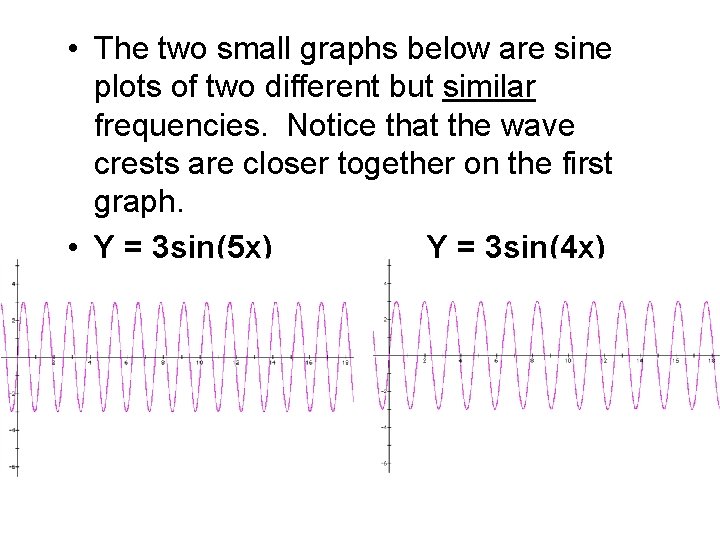
• The two small graphs below are sine plots of two different but similar frequencies. Notice that the wave crests are closer together on the first graph. • Y = 3 sin(5 x) Y = 3 sin(4 x)
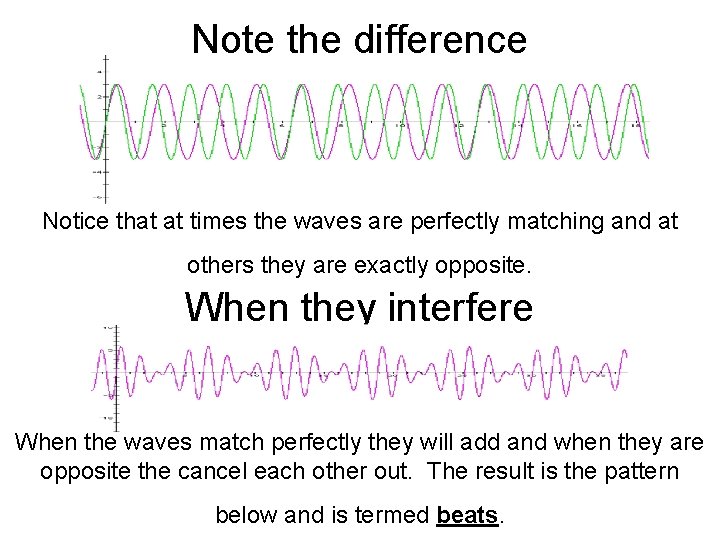
Note the difference Notice that at times the waves are perfectly matching and at others they are exactly opposite. When they interfere When the waves match perfectly they will add and when they are opposite the cancel each other out. The result is the pattern below and is termed beats.
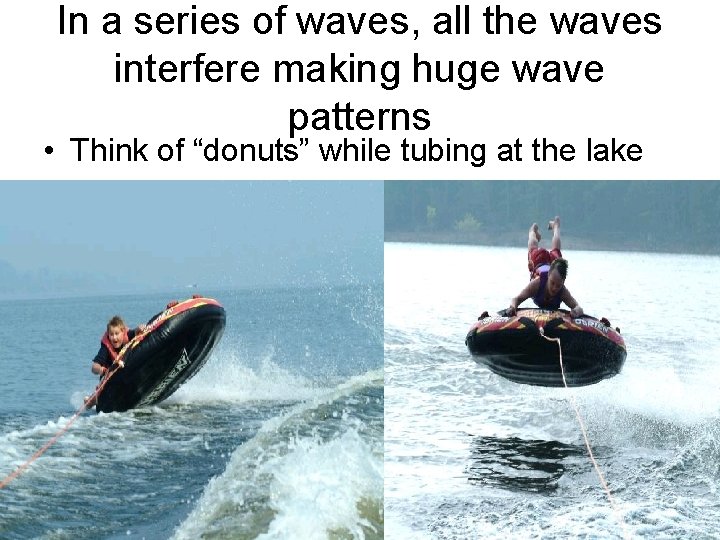
In a series of waves, all the waves interfere making huge wave patterns • Think of “donuts” while tubing at the lake
- Slides: 9