
SOUL CARE for caregivers Nurturing the Mind Body

SOUL CARE for caregivers Nurturing the Mind, Body & Soul By Reverend Michael Duda & Rachael Duda, MA, RYT

Experiential Exercise #1: Grounding

Why we do what we do: The motivation behind the work

Why do we do what we do? - The $$$$$ is sooo good It’s so rewarding… really? ? Making a difference Working for justice Others ______

But the reality is we often. . . • Try to fix the unfixable • Put our clients’ needs above our own • Overextend ourselves • Minimize the impact of our clients’ distress on ourselves • Take our work home with us • View sleep as expendable • Plan to begin exercising. . tomorrow • Engage in unhealthy coping strategies Any others ? _______
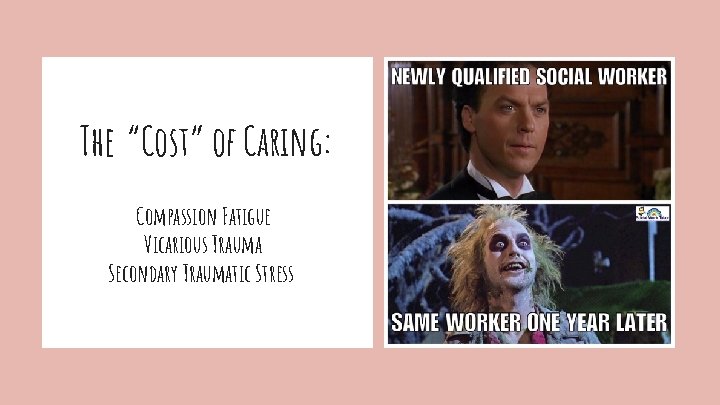
The “Cost” of Caring: Compassion Fatigue Vicarious Trauma Secondary Traumatic Stress
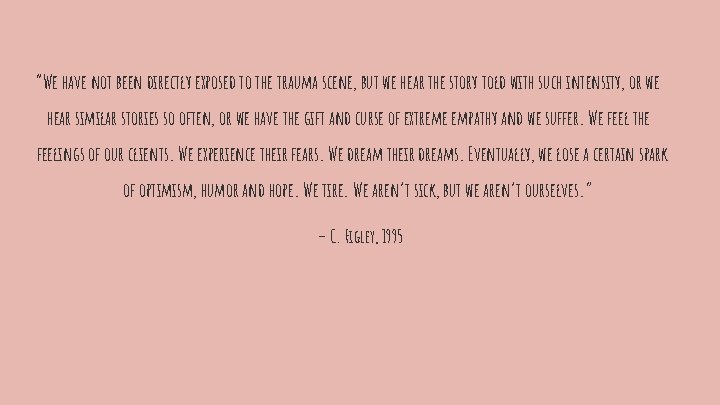
“We have not been directly exposed to the trauma scene, but we hear the story told with such intensity, or we hear similar stories so often, or we have the gift and curse of extreme empathy and we suffer. We feel the feelings of our clients. We experience their fears. We dream their dreams. Eventually, we lose a certain spark of optimism, humor and hope. We tire. We aren’t sick, but we aren’t ourselves. ” – C. Figley, 1995
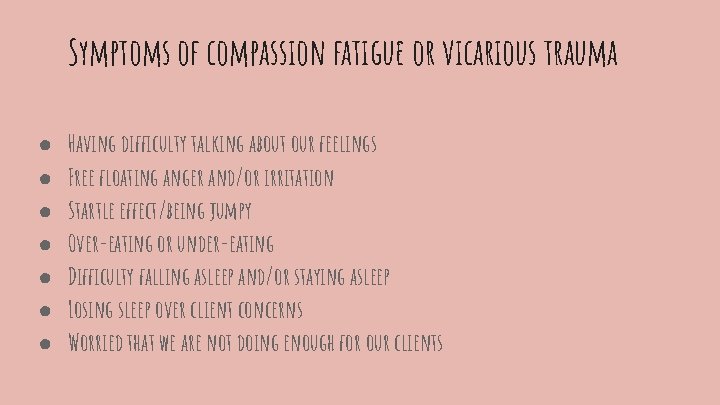
Symptoms of compassion fatigue or vicarious trauma ● ● ● ● Having difficulty talking about our feelings Free floating anger and/or irritation Startle effect/being jumpy Over-eating or under-eating Difficulty falling asleep and/or staying asleep Losing sleep over client concerns Worried that we are not doing enough for our clients
● ● ● ● Dreaming about their clients/their clients’ trauma experienced Diminished joy toward things they once enjoyed Feeling trapped by their work as a counselor Diminished feelings of satisfaction and personal accomplishment Dealing with intrusive thoughts of clients with especially severe trauma histories Feelings of hopelessness associated with their work/clients Blaming others (from american counseling Association)
Vicarious Trauma: The brain & the body ● We remember trauma less in words and more with our body ● Mirror neurons create a resonance to emotions that are not our own, because we may identify the universality of emotions as part of the function of EMPATHY ● Increased stress response
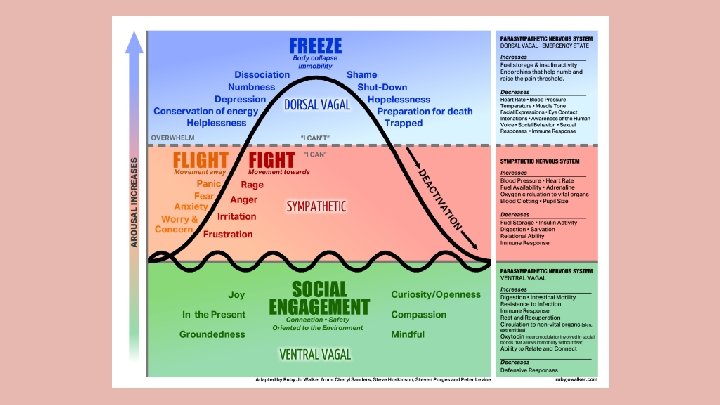
POLYVAGAL THEORY ● ● ● 80% of Vagus Nerve Fibers are afferent (sensory), sending messages from the Body to the Brain. Neuroception: A term coined by Porges to define relating to danger and safety in the environment Ventral Vagal Complex (VVC) and Dorsal Vagal Complex (DVC) work together to regulate arousal and rest Internal Composure is a function of vagal tone Helps to better understand our social engagement system and capacity to monitor input using the body
The “ 8” Senses ● Exteroceptive System (outside body) ● The five senses ● Interoceptive (inside) ● Sensory nerves that respond from cues inside body ● Proprioception and Vestibular
What becomes important is balancing the energy of caring for others with energy caring for ourselves and strengthening all the dimensions of the Self.
Experiential Exercise #2: Body Scan
Are you empathic? ● ● ● ● Do you wonder sometimes which emotions are yours and which are others? In relationships, do you override your own needs for the needs of others? Do you struggle with boundaries? Do you absorb other people’s emotions as if they were your own? Are your senses sensitive (smell, hearing)? Sensitive to certain foods? How is your time management? Most empaths work in a helping profession…

An empath is like an “emotional satellite” that constantly tunes into other people's emotional “stations” and puts the nervous system in overdrive.

What is this boundary stuff all about? Bo forbes, a psychologist and yoga teacher, describes boundaries in 3 1. 2. 3. layers: The outermost layer relates to behaviors a. How much time you give to others i. e. helping someone else figure out their career plan and forgetting about your own b. How much you pile on your plate c. Often this is where we experience guilt when we try and say “no, ” feeling like we are letting others down. The middle layer is interpersonal boundaries a. Ever notice that time you were in a great mood and you get home to find your partner in a cloud of misery? You soon get pulled into the misery and quickly forget that great feeling you had moments ago. The deepest layer is intrapersonal - our connection to our self a. Ever have that “gut” feeling about something? b. This is the space we feel intuition, trust, and feelings that can guide us if we only were to listen c. This is the layer where anxiety or depression kicks in when we just don’t pay attention to what we need
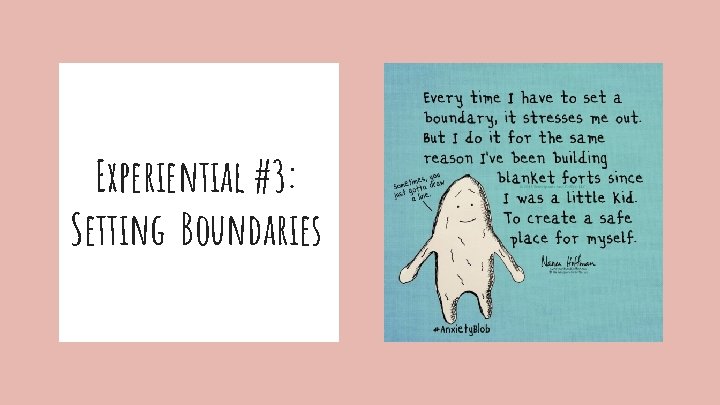
Experiential #3: Setting Boundaries

Sometimes we call it energy, or intuition ~ trusting this thing that is a knowing ~ Being true to you. . . SOUL


Soul Care
Mindfulness: The body & the brain ● According to Daniel Siegel, Author of the Mindful Brain, mindfulness has the potential to create a “self-engagement” system by using more evolved functions of the brain. This not only strengthens relationship to ourselves, but also to others. ● Researchers have found that mindfulness increases empathy, intuition, morality, and advanced communication, as well as fear modulation and greater insight.
● The awareness of breath and deep breathing in yoga activates the parasympathetic nervous system by stimulating vagal afferents using the glottis, pharynx, lungs and abdomen. ● brain areas activated during breathing exercises enable suppressed emotions and thoughts to be processed. ● The function of mirror neurons during mindfulness enables more awareness of the act of empathy, as a felt experience in the moment. ● Mindfulness strengthens resiliency through the brain's capacity to change

It is not about trying to get anywhere or improve or change yourself.

Experiential Exercise #4: Mindful Meditation

How can I be more present in the moment? ● Your senses as you are engaging in a routine or activity ● Notice where your actions and your awareness meet, this minimizes the gap where “reaction” might occur ● Remember that you are not your thoughts ● Breath with intention, deep and slow breaths ● Notice when you are thinking of the past or future, and try and come back to the present, what you are doing in the moment ● Connect to your body, notice sensation. this is the cue of what is happening in the moment

References ● Figley, C. R. (1995). Compassion fatigue: Toward a new understanding of the costs of caring. In B. H. Stamm (Ed. ), Secondary traumatic stress: Self-care issues for clinicians, researchers, and educators (pp. 3 -28). Baltimore, MD: The Sidran Press. ● Forbes, B. (2016, August). The Bliss of Setting Boundaries. Yoga Journal. Retrived from http: //boforbes. com/wp-content/uploads/2013/03/julyaugust-feature-v 2. pdf? 813673&813673. ● Forbes, B. (2011). Yoga for emotional balance: simple practices to help relieve anxiety and depression. Boston, MA: Shambhala Publications, Inc.
References Continued ● Porges, S. W. , & Dana, D. (2018). Clinical Applications of the Polyvagal Theory: The emergence of polyvagal informed therapies. New York, NY: W. W. Norton & Company. ● Rappaport, L. (2014). Mindfulness and the arts therapies: theory and practice. London ; Philadelphia : Jessica Kingsley Publishers, 2014 ● Rothschild, B. (2000). The body remembers: the psychophysiology of trauma and trauma treatment. New York, NY: W. W. Norton & Company. ● Siegel, D. J. (2007). The mindful brain. New York, NY: W. W. Norton & Company.
References Continued ● Van der Kolk, B. A. (2014). The body keeps the score: Brain, mind and body in the healing of trauma. New York, NY: Viking. ● Vicarious Trauma Fact Sheet 9. Retrieved from: https: //www. counseling. org/docs/trauma-disaster/factsheet-9 ---vicarious-trauma. pdf? sfvrsn=f 0 f 03 a 27_2
- Slides: 34