
SOS COALITION AND MEDIA MONITORING AFRICA PRESENTATION ON
- Slides: 22
SOS COALITION AND MEDIA MONITORING AFRICA PRESENTATION ON DISCUSSION DOCUMENT ON THE INQUIRY INTO SUBSCRIPTION TELEVISION BROADCASTING SERVICES 8 MAY 2018
The Submission SOS & MMA are: ▪ Concerned about broadcasting environment as a whole, (most often focus on SABC) ▪Attempting to assist ICASA in realising depth & breadth of challenges facing television sector and; ▪Highlighting the role of the effective monopoly player, Multi. Choice, in creating the landscape we are in ▪Going to focus on key areas rather than a full description of the written submissions
Going back in time… The Discussion Paper (“Paper”) is insufficiently detailed in relation to the licensing history of subscription broadcasters, which undermines understanding of how we got to where we are: ◦ ICASA has a responsibility to avoid revisionist history given the failures that have characterised the regulation of television since the transition to democracy in 1994. ◦ These failures not only include the inability to licence more than one free to air commercial television broadcaster in 20 years but also; ◦ Failure to ensure a competitive subscription broadcasting environment. ◦ ICASA (and its predecessor, the IBA) have allowed Multi. Choice to become not only dominant but indeed virtually monopolistic not only in the subscription television sector but in the television sector as a whole.
Going back in time 2 Remember: ▪DStv launched in 1995 without a licence from the IBA, despite the IBA having a statutory mandate & despite the IBA Act prohibiting the provision of a broadcasting service without a licence. No action was ever taken against it for operating without a licence ▪DStv was left alone, without any regulatory compliance requirements, for the first 12 years of its operation ▪By 2007, M-Net had enjoyed 21 years of its Open Window on SABC, allowing it, during Prime Time, to showcase its terrestrial subscription service and to advertise the DStv subscription offering by its parent company Multi. Choice ▪These key factors defined the playing field
MARKET DEFINITION WHEN CONSIDERING MARKET INTERVENTIONS? ▪It is a mistake to confine suggested pro-competitive measures to subscription broadcasting market only ▪Critical that we examine the subscription broadcasting sector in relation to the impact on free to air broadcasters ▪“Paper” outlines proposals for market analysis. We are broadly in agreement with the process outlined. However, we strongly believe that the Inquiry is too narrowly defined. ▪Inquiry needs to analyse competition issues in terms of the television sector as a whole (and, in many instances, in terms of audio-visual content services as a whole) – not just subscription television.
Regulating OTT services ▪Concerned by the lack of action on the need for appropriate regulation of Over the Top (OTT) services. ▪Despite limitations to access and high data costs: ▪ ▪ ▪ Mounting Evidence that: OTT services are fundamentally changing the way audiences consume audiovisual content – can see it from own mobile operators rush to push data. Critical that Regulators act to prevent cannibalisation of traditional broadcasting by OTT services The national integrated ICT Policy Discussion Paper of 2014, Chapter 5 gives a clear blueprint on coherent regulation for the audio and audio-visual content sector, including broadcasting and OTT services. ▪Essential that inquiry into subscription broadcasting, takes into account the whole television sector, audio-visual sector, & updates the 2010 Position Paper on Internet Protocol Television (IPTV) and Video On Demand (VOD) Services ▪Call on ICASA to expand the scope and terms of the Enquiry.
Regulating OTT services 2 ▪ 3 main services operating in SA – Show. Max (Naspers owned); Netflix (US owned) and DEOD (recently Black by Cell C) ▪“Paper” fails to reflect on fact that other South African OTT services were launched and collapsed. ▪ Points to Naspers’ domination of every sector of the media, bar radio, and that its dominance stretches into new services such as OTT ▪Broadcasting Act & the ECA exclude OTT services from broadcasting definitions which means that they are not subject to regulation by ICASA ▪OTT services should be regulated as they are in the European Union. ▪OTT services in South Africa need to carry certain obligations ▪ e. g. these services need to be taxed, have BEE requirements, have local content requirements including language content and so forth.
Digital Migration ▪No mention made of the near collapse of this programme and the role that Multi. Choice has played in this collapse: ▪ Multi. Choice sought to undermine government’s policy of encryption through 2012 SABC/Multichoice deal: 24 hour SABC news channel & an entertainment channel, Encore, using the SABC’s archive material. ▪ Critical in this confidential ‘deal’ : a clause that stipulated that the SABC needed to reverse its position on encryption & support non-encryption- this was counter government policy at the time ▪ initial proposals for DTT were: the launch of a free-to-air platform with e-TV & community broadcasters. This platform had a real possibility of competing with DStv’s multi-channel subscription platform. ▪No mention of the ongoing vociferous debates on encryption of set top boxes
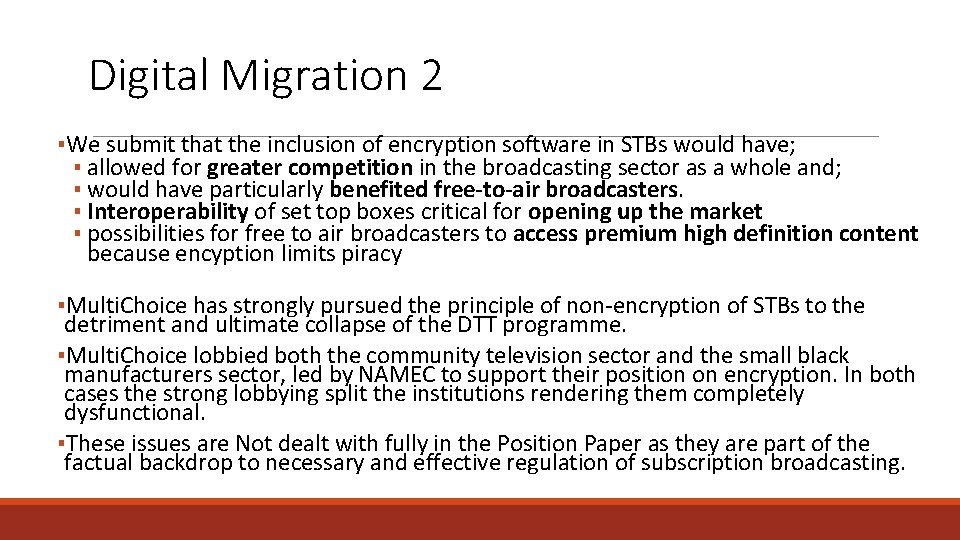
Digital Migration 2 ▪We submit that the inclusion of encryption software in STBs would have; ▪ allowed for greater competition in the broadcasting sector as a whole and; ▪ would have particularly benefited free-to-air broadcasters. ▪ Interoperability of set top boxes critical for opening up the market ▪ possibilities for free to air broadcasters to access premium high definition content because encyption limits piracy ▪Multi. Choice has strongly pursued the principle of non-encryption of STBs to the detriment and ultimate collapse of the DTT programme. ▪Multi. Choice lobbied both the community television sector and the small black manufacturers sector, led by NAMEC to support their position on encryption. In both cases the strong lobbying split the institutions rendering them completely dysfunctional. ▪These issues are Not dealt with fully in the Position Paper as they are part of the factual backdrop to necessary and effective regulation of subscription broadcasting.
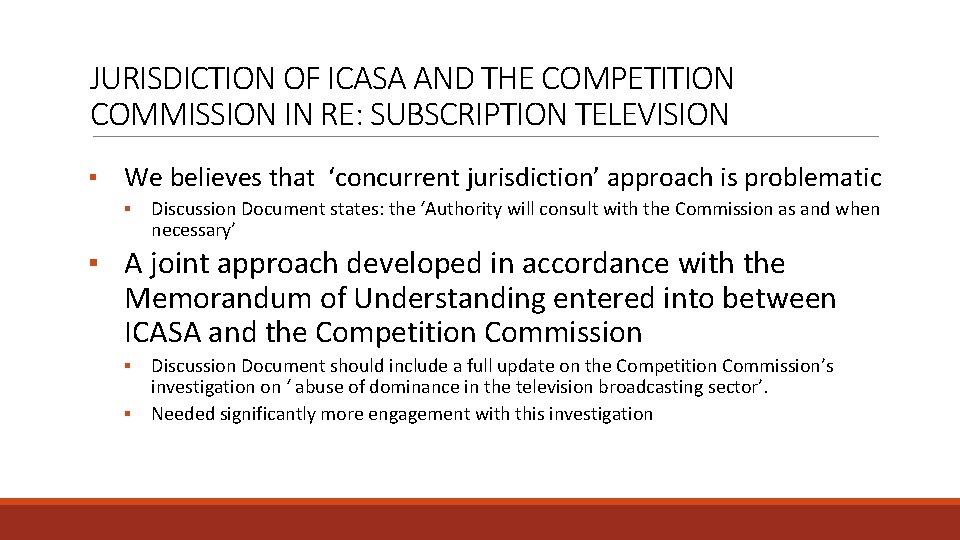
JURISDICTION OF ICASA AND THE COMPETITION COMMISSION IN RE: SUBSCRIPTION TELEVISION ▪ We believes that ‘concurrent jurisdiction’ approach is problematic ▪ Discussion Document states: the ‘Authority will consult with the Commission as and when necessary’ ▪ A joint approach developed in accordance with the Memorandum of Understanding entered into between ICASA and the Competition Commission ▪ Discussion Document should include a full update on the Competition Commission’s investigation on ‘ abuse of dominance in the television broadcasting sector’. ▪ Needed significantly more engagement with this investigation
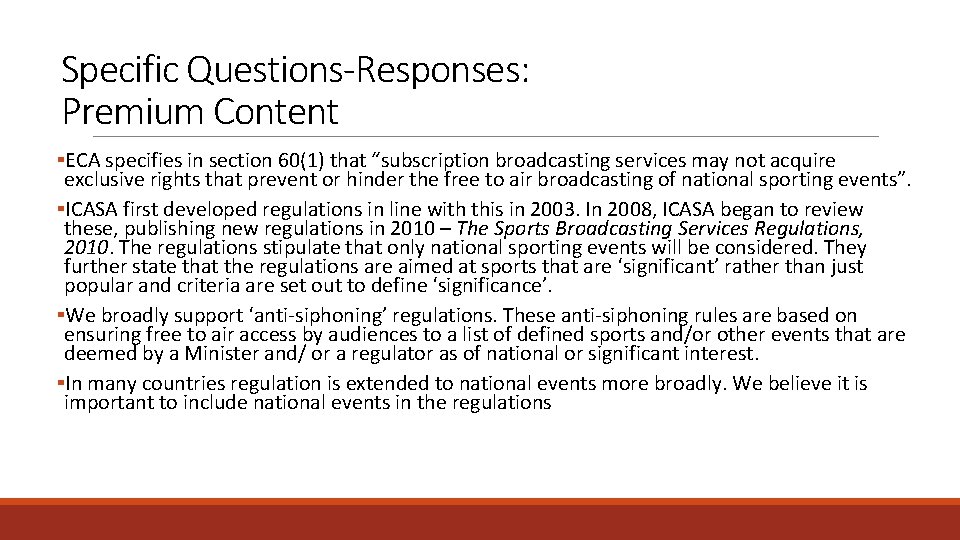
Specific Questions-Responses: Premium Content ▪ECA specifies in section 60(1) that “subscription broadcasting services may not acquire exclusive rights that prevent or hinder the free to air broadcasting of national sporting events”. ▪ICASA first developed regulations in line with this in 2003. In 2008, ICASA began to review these, publishing new regulations in 2010 – The Sports Broadcasting Services Regulations, 2010. The regulations stipulate that only national sporting events will be considered. They further state that the regulations are aimed at sports that are ‘significant’ rather than just popular and criteria are set out to define ‘significance’. ▪We broadly support ‘anti-siphoning’ regulations. These anti-siphoning rules are based on ensuring free to air access by audiences to a list of defined sports and/or other events that are deemed by a Minister and/ or a regulator as of national or significant interest. ▪In many countries regulation is extended to national events more broadly. We believe it is important to include national events in the regulations
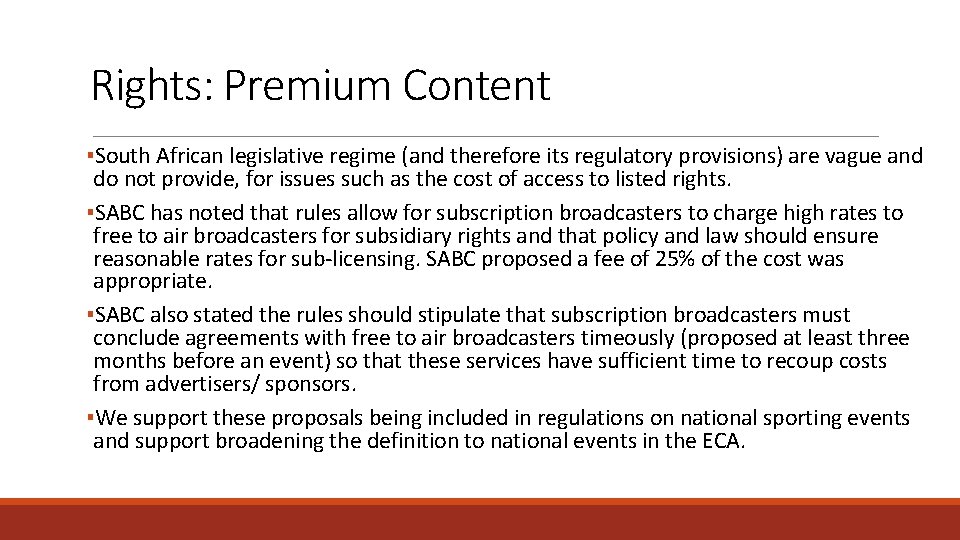
Rights: Premium Content ▪South African legislative regime (and therefore its regulatory provisions) are vague and do not provide, for issues such as the cost of access to listed rights. ▪SABC has noted that rules allow for subscription broadcasters to charge high rates to free to air broadcasters for subsidiary rights and that policy and law should ensure reasonable rates for sub-licensing. SABC proposed a fee of 25% of the cost was appropriate. ▪SABC also stated the rules should stipulate that subscription broadcasters must conclude agreements with free to air broadcasters timeously (proposed at least three months before an event) so that these services have sufficient time to recoup costs from advertisers/ sponsors. ▪We support these proposals being included in regulations on national sporting events and support broadening the definition to national events in the ECA.
Barriers to entry ▪Paper outlines many barriers for new players in the upstream market including scarcity of premium content and rising costs of premium content (including sports rights) ▪A further issue: long term contracts and ‘cosy relationships’ created by these. The problem is that when contracts end it is difficult for new entrants to outbid incumbents e. g. Top. TV in acquiring sports rights ▪ICASA needs to assess interventions for possible implementation: ▪ 2003 European Competition: Conditions imposed included ‘must offer rules’ to ensure wholesale access to premium content (movie and sports rights) held by Newscorp; ▪ 2011 the US Federal Communications Commission approved acquisition by Comcast of content rights holder NBC Universal, on condition: they share programming with competing cable and telecommunications services and web-based services
Premium content Rights ▪We agree that the rights that are listed in Table 1 ‘Key sports and movie rights’ in regard to Question 17 in the Discussion Paper are the premium rights ▪We note of the ten rights listed, eight rights are held by Multi. Choice. ▪We submit that this is untenable and that no competition in subscription broadcasting (or indeed in television as a whole) can take place where premium content is held 80% by a single operator. ▪We agree it makes sense to use the number of rights as one unit of measurement for market share calculation purposes as queries in Question 18
Proposed Remedies ▪Shorten Exclusive Contracts re: premium content ▪ We agree with this proposal and agree that ICASA should explore European Union proposals in this regard. ▪Introduce Unbundling of Rights ▪ We agree with this proposal and are in favour of the European Commission’s approach to the sale of sports rights. Including that rights be sold on open tender, rights must be unbundled allowing for more than one buyer, no excessive exclusivity (a term of three years should be the norm) and no automatic renewal of contracts ▪Impose Rights Splitting ▪ We agree with this proposal. Rights splitting requires a rights owner to split content rights and sell them to more than one broadcaster. We believe that this is an essential intervention in the our market. This will give new entrants to the broadcasting market (both subscription and free to air) the possibility of survival.
Proposed Remedies Cont’d ▪Impose Wholesale Must Offer ▪ We are in agreement with the ‘wholesale must offer’ recommendation. We note the Of. Com and Bsky. B example and the fact that the matter was finally resolved in favour of Bsky. B i. e. Bsky. B eventually not compelled to comply with ‘wholesale must offer’ provisions. ▪ However, market conditions are different in South Africa and online market is not as developed as in the UK and wont be for a number of years. ▪ We note that Top. TV specifically used BSky. B case in its complaint to the Competition’s Commission stating that it was essential to their long-term survival and sustainability that this particular measure – wholesale must offer - was in place. ▪ We thus submit that this recommendation be explored.
Open Up Dominant Player’s Network & introduce STB Interoperability ▪We are of the view that measures to open up network including a number of sub-measures must be implemented. ▪Given Multi. Choice’s dominance throughout the television market (terrestrial and satellite, free to air and subscription), we submit that the opening up of Multi. Choice’s infrastructure should be required & include: ▪ all free to air broadcasters carried on the platform be as the first set of channels on DStv’s EPG ▪ Public ▪ Commercial ▪ Community
Open Up Dominant Player’s Network & introduce STB Interoperability ▪ STB: ensuring access by all broadcasters to DStv’s STB ▪ given that its STB is in nearly 50 percent of households and that it appears from the latest Gupta. Leaks and SABC Minutes that Multi. Choice was instrumental in the failure of the DTT project (thereby stifling the ability of existing broadcasters to grow), ▪ the STB is, in effect, an “essential facility” as defined in section 1 of the ECA. The effect of this will be to provide for regulatory oversight by ICASA and/or the Competition Commission of access to DStv’s STB. ▪ Existing and new subscription broadcasters, whether satellite or terrestrial, as well as existing and new free to air broadcasters, whether satellite or terrestrial, ought to have access to DStv’s STB
Open Up Dominant Player’s Network & introduce STB Interoperability ▪ Transparency: greater transparency re: Multichoice’s channel acquisition policies & payments to channel providers as part of the strategy to open up its Network ▪ Recent Gupta. Leaks revelations as to the amounts paid for ANN 7 vs the e. NCA newschannel and the fluctuations in the amount of those payments which appeared to bear no relation to audience figures make it clear that there is a role for ICASA in this regard. ▪ The idea is not new: the ECA makes provision for ICASA supervision of contractual issues in relation to facilities leasing and interconnection in the electronic communications services sphere to promote competition. ▪ There is no reason not to institute the same in order to support competition in the television sector.
Other critical Issues to Consider ▪To assist ICASA in meeting objective of ensuring viability of the SABC: ▪ICASA should require that Multi. Choice be responsible for the collection of the SABC licence fee (provided for in terms of the Broadcasting Act) from the nearly 6 million subscribers that it has. ▪ICASA should ensure that it regularly collects critical market related broadcasting information. ▪Information is collected for ICASA’s ICT sector review reports however the information gathered for broadcasting and OTT services is extremely limited. ▪The reports need to include: detailed year on year broadcasting market information ▪Information that needs to be included is as follows: ▪ broadcasting revenue disaggregated in terms of subscription, advertising, sponsorships, licence fees etc. ▪ further disaggregated to show subscription revenue, advertising etc. ▪ Needs to include the rights owned by different broadcasters, ownership and control information and viewership figures
Future-Proofing ▪Given the State assisted historically entrenched monopoly in broadcasting: ▪We need all of the pro-competition mechanisms referred to, to avoid a new form of Information Apartheid where access to news and information devolves along class and race lines ▪ICASA has responsibility to avoid new information divide, given its role in failing to licence more than one free to air commercial television broadcaster in 20 years or to ensure a competitive subscription broadcasting environment ▪ICASA must ensure it regulates all audio-visual services sensibly, ensuring that OTT services, too, contribute to South Africa’s growth and prosperity through taxation, broad Based Black Economic Empowerment, local content and cultural industry development ▪Subscription broadcasting is not a small niche service in South Africa. With this massive consumer penetration comes the responsibility to act in ways that protect and promote competition and that create sustainable television broadcasting landscape.
Thank You