
Sorting Write the CODE yourself This slide contains
![Insertion Sort Algorithm public void insertion. Sort(Comparable[] arr) { for (int i = 1;](https://slidetodoc.com/presentation_image_h/ca08dc602bcdee0682c947ed0d3b5a3d/image-6.jpg "Insertion Sort Algorithm public void insertion. Sort(Comparable[] arr) { for (int i = 1;")
![Insertion Sort Analysis public void insertion. Sort(Comparable[] arr) { outer loop for (int i](https://slidetodoc.com/presentation_image_h/ca08dc602bcdee0682c947ed0d3b5a3d/image-7.jpg "Insertion Sort Analysis public void insertion. Sort(Comparable[] arr) { outer loop for (int i")

![void selection_sort(int n, int list[]) { int min, temp; int k, l, index; for(index](https://slidetodoc.com/presentation_image_h/ca08dc602bcdee0682c947ed0d3b5a3d/image-50.jpg "void selection_sort(int n, int list[]) { int min, temp; int k, l, index; for(index")


![N is … // Size of Array Arr_Type definesa Array[1. . N] of Num](https://slidetodoc.com/presentation_image_h/ca08dc602bcdee0682c947ed0d3b5a3d/image-68.jpg "N is … // Size of Array Arr_Type definesa Array[1. . N] of Num")
![Outer loop exitif(to_do = 0) index <- 1 loop exitif(index > to_do) if(A[index] >](https://slidetodoc.com/presentation_image_h/ca08dc602bcdee0682c947ed0d3b5a3d/image-69.jpg "Outer loop exitif(to_do = 0) index <- 1 loop exitif(index > to_do) if(A[index] >")
- Slides: 72
Sorting Write the CODE yourself. This slide contains only theory.
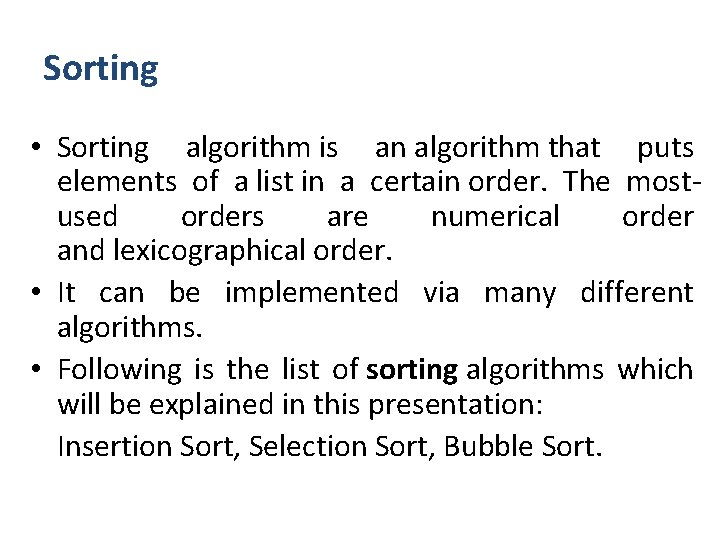
Sorting • Sorting algorithm is an algorithm that puts elements of a list in a certain order. The mostused orders are numerical order and lexicographical order. • It can be implemented via many different algorithms. • Following is the list of sorting algorithms which will be explained in this presentation: Insertion Sort, Selection Sort, Bubble Sort.
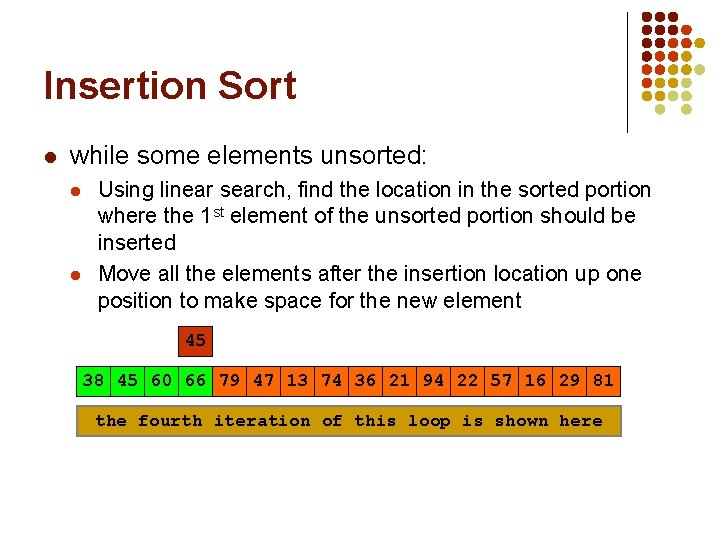
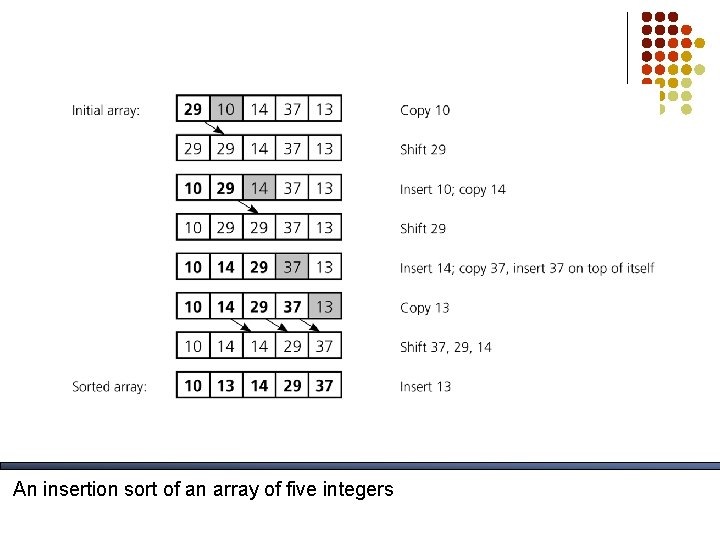
Insertion Sort l while some elements unsorted: l l Using linear search, find the location in the sorted portion where the 1 st element of the unsorted portion should be inserted Move all the elements after the insertion location up one position to make space for the new element 45 38 45 60 60 66 45 66 79 47 13 74 36 21 94 22 57 16 29 81 the fourth iteration of this loop is shown here
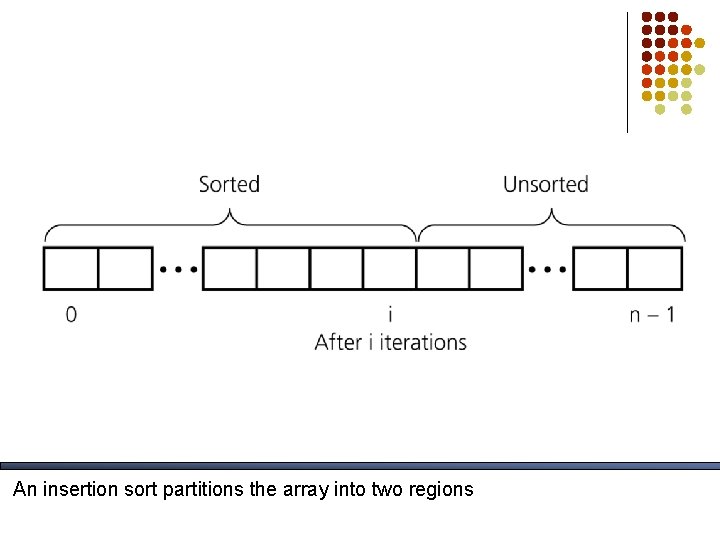
An insertion sort partitions the array into two regions
An insertion sort of an array of five integers
Insertion Sort Algorithm public void insertion. Sort(Comparable[] arr) { for (int i = 1; i < arr. length; ++i) { Comparable temp = arr[i]; int pos = i; // Shuffle up all sorted items > arr[i] while (pos > 0 && arr[pos-1]. compare. To(temp) > 0) { arr[pos] = arr[pos– 1]; pos--; } // end while // Insert the current item arr[pos] = temp; } }
Insertion Sort Analysis public void insertion. Sort(Comparable[] arr) { outer loop for (int i = 1; i < arr. length; ++i) { Comparable temp = arr[i]; outer times int pos = i; // Shuffle up all sorted items > arr[i] while (pos > 0 && arr[pos-1]. compare. To(temp) > 0) { inner loop arr[pos] = arr[pos– 1]; pos--; inner times } // end while // Insert the current item arr[pos] = temp; } }
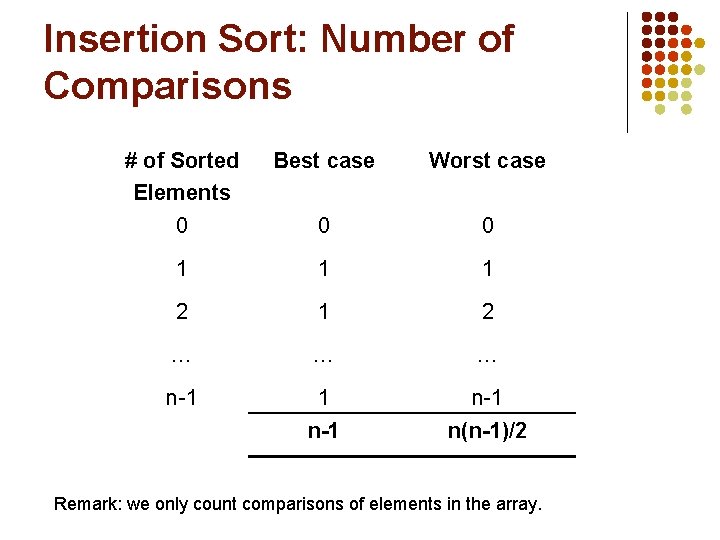
Insertion Sort: Number of Comparisons # of Sorted Elements Best case Worst case 0 0 0 1 1 1 2 … … … n-1 1 n-1 n(n-1)/2 Remark: we only count comparisons of elements in the array.
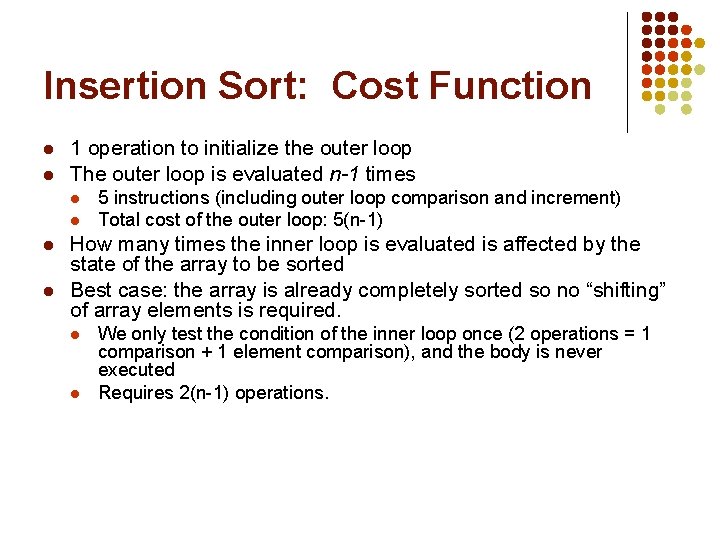
Insertion Sort: Cost Function l l 1 operation to initialize the outer loop The outer loop is evaluated n-1 times l l 5 instructions (including outer loop comparison and increment) Total cost of the outer loop: 5(n-1) How many times the inner loop is evaluated is affected by the state of the array to be sorted Best case: the array is already completely sorted so no “shifting” of array elements is required. l l We only test the condition of the inner loop once (2 operations = 1 comparison + 1 element comparison), and the body is never executed Requires 2(n-1) operations.
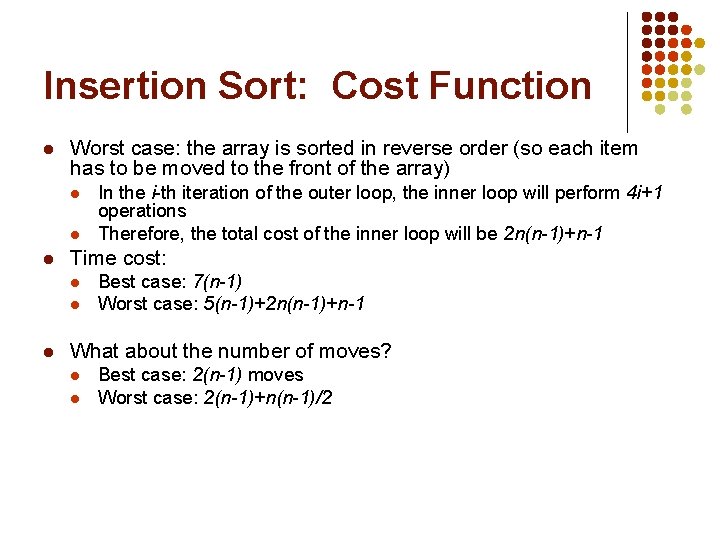
Insertion Sort: Cost Function l Worst case: the array is sorted in reverse order (so each item has to be moved to the front of the array) l l l Time cost: l l l In the i-th iteration of the outer loop, the inner loop will perform 4 i+1 operations Therefore, the total cost of the inner loop will be 2 n(n-1)+n-1 Best case: 7(n-1) Worst case: 5(n-1)+2 n(n-1)+n-1 What about the number of moves? l l Best case: 2(n-1) moves Worst case: 2(n-1)+n(n-1)/2
Insertion Sort: Average Case l l l Is it closer to the best case (n comparisons)? The worst case (n * (n-1) / 2) comparisons? It turns out that when random data is sorted, insertion sort is usually closer to the worst case l l Around n * (n-1) / 4 comparisons Calculating the average number of comparisons more exactly would require us to state assumptions about what the “average” input data set looked like This would, for example, necessitate discussion of how items were distributed over the array Exact calculation of the number of operations required to perform even simple algorithms can be challenging (for instance, assume that each initial order of elements has the same probability to occur)
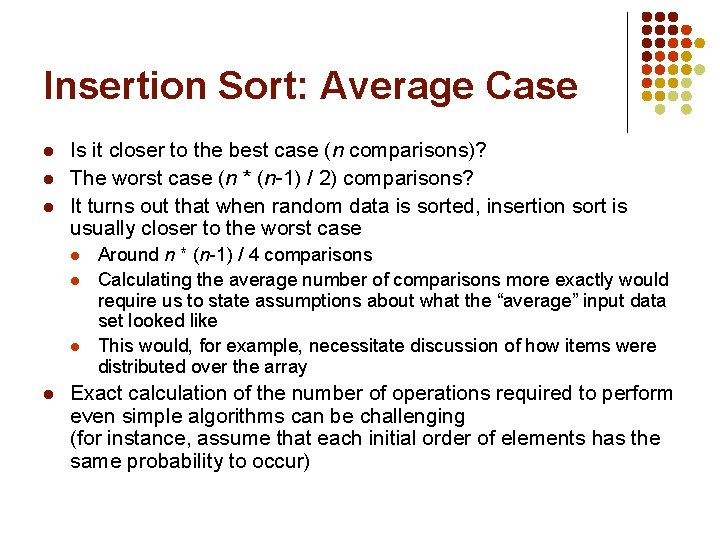
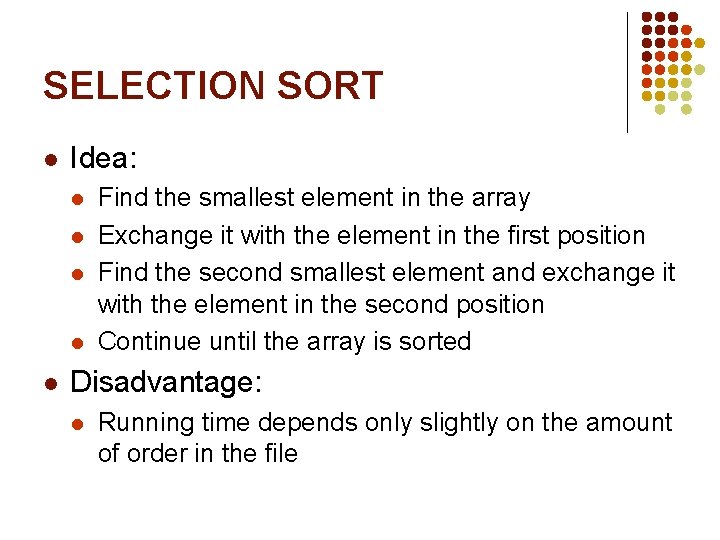
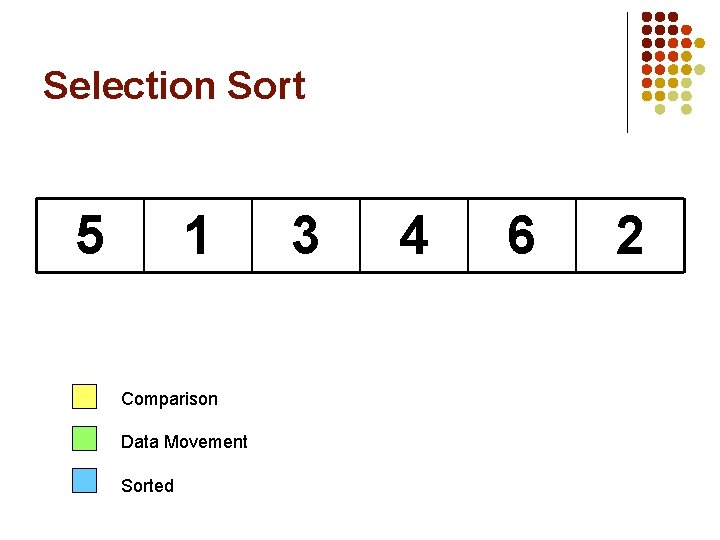
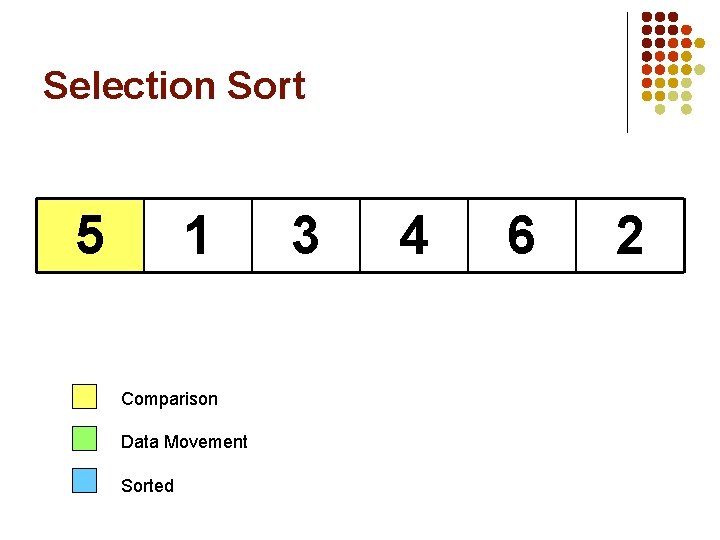
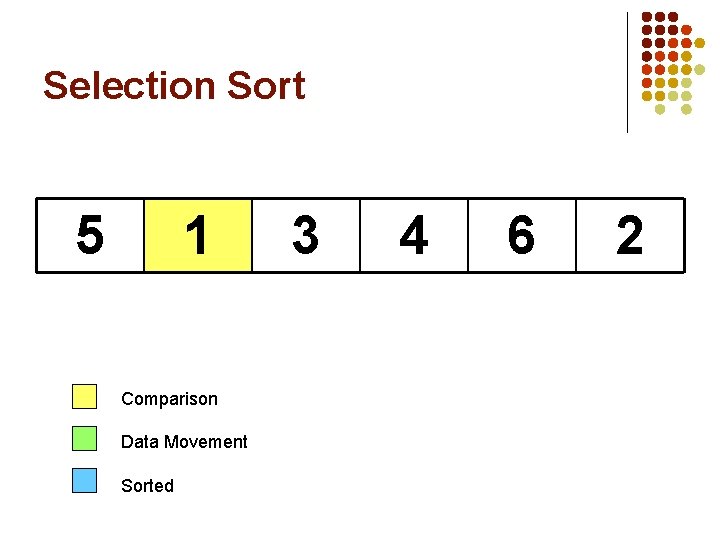
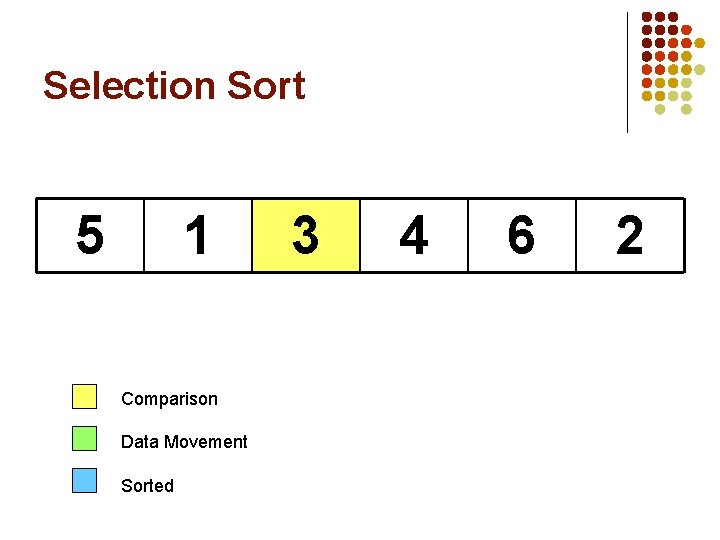
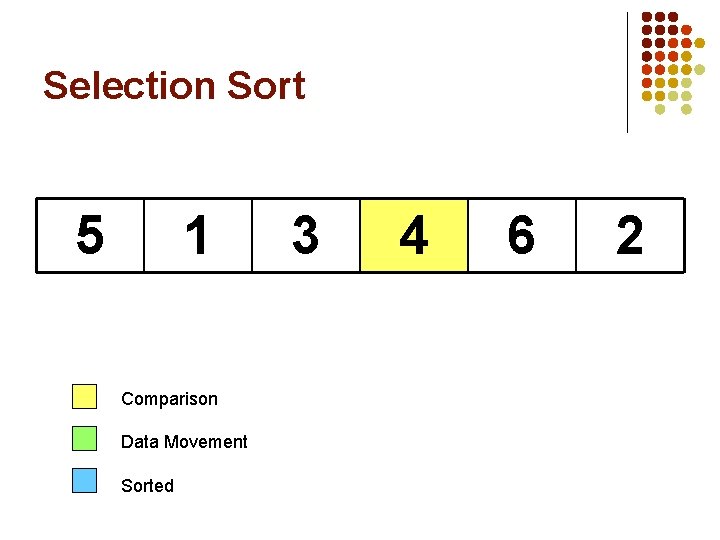
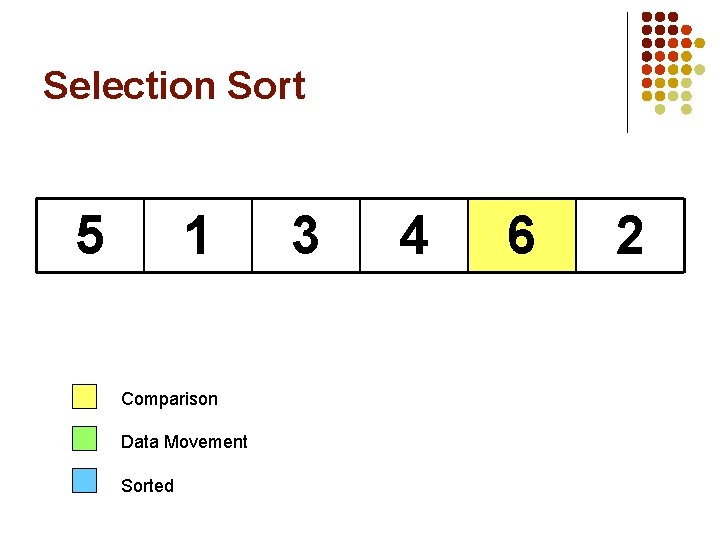
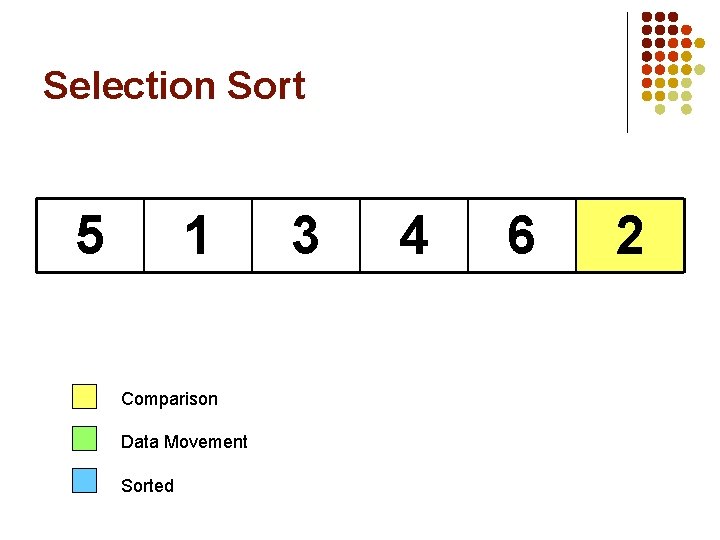
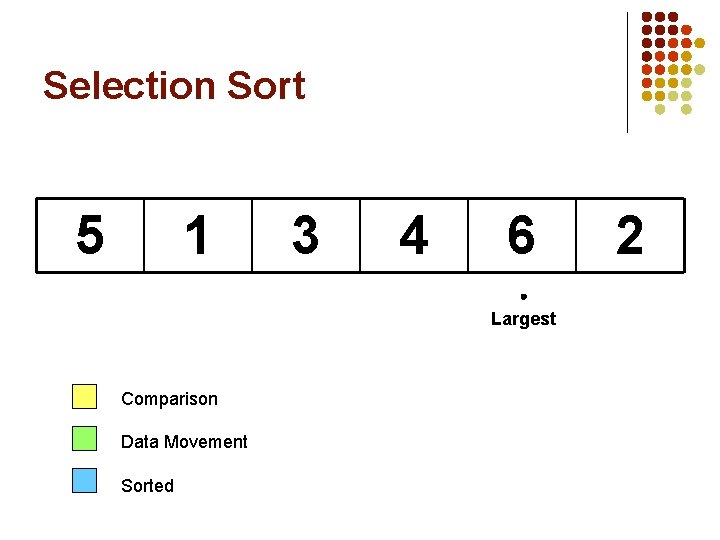
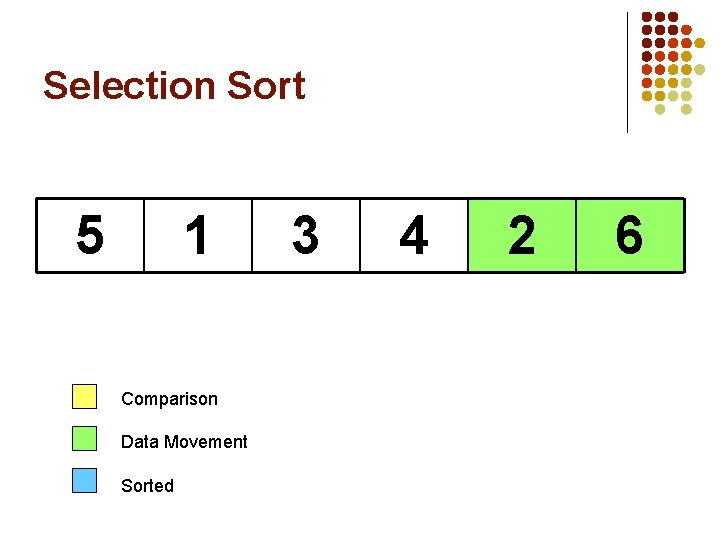
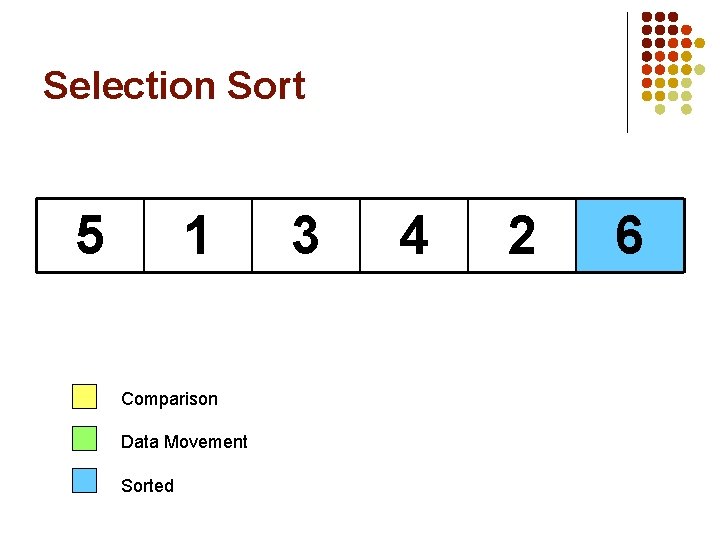
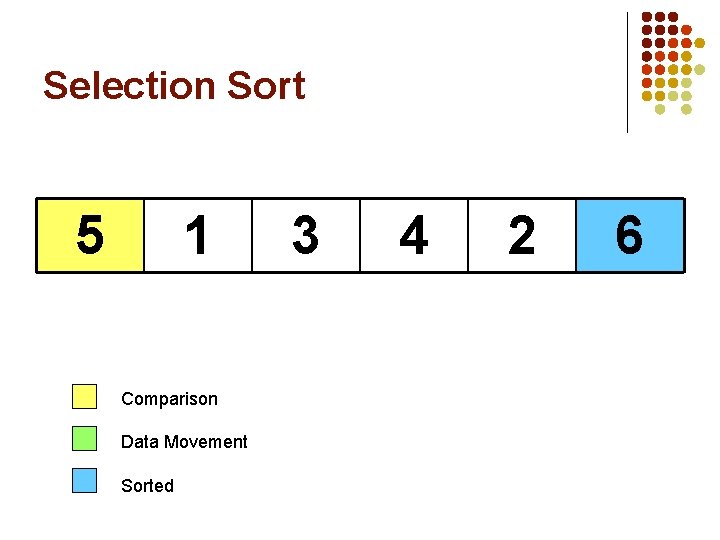
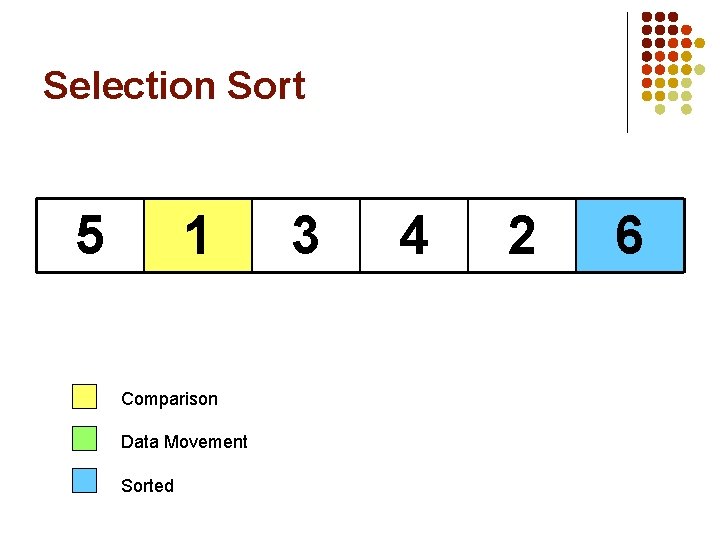
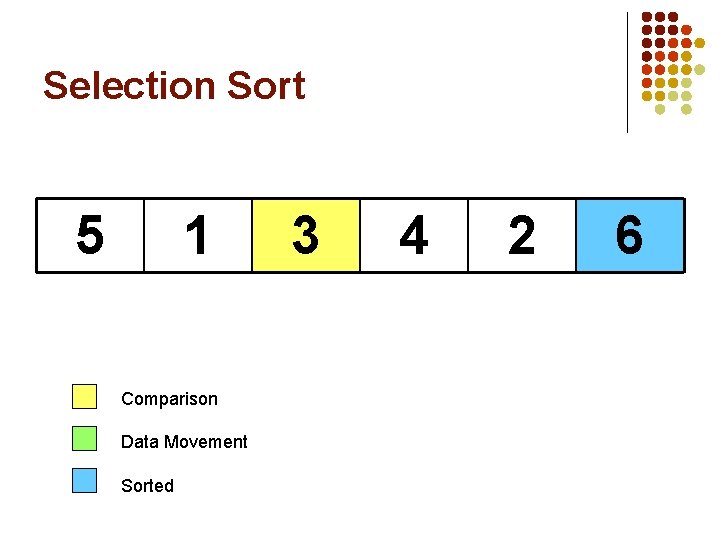
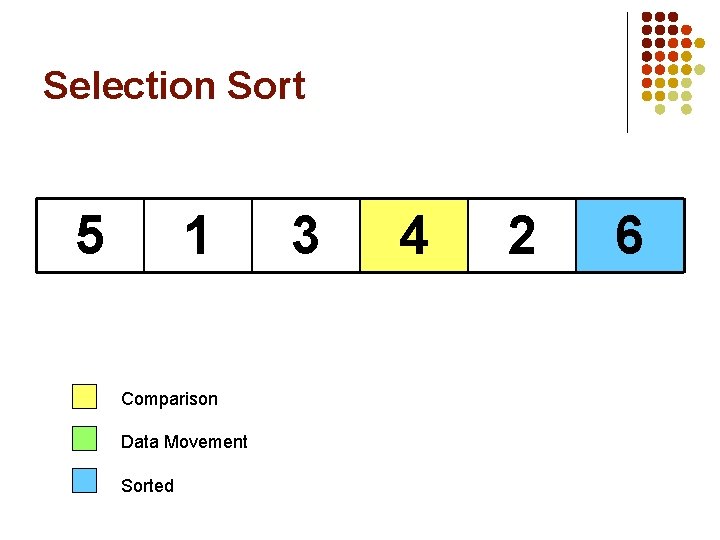
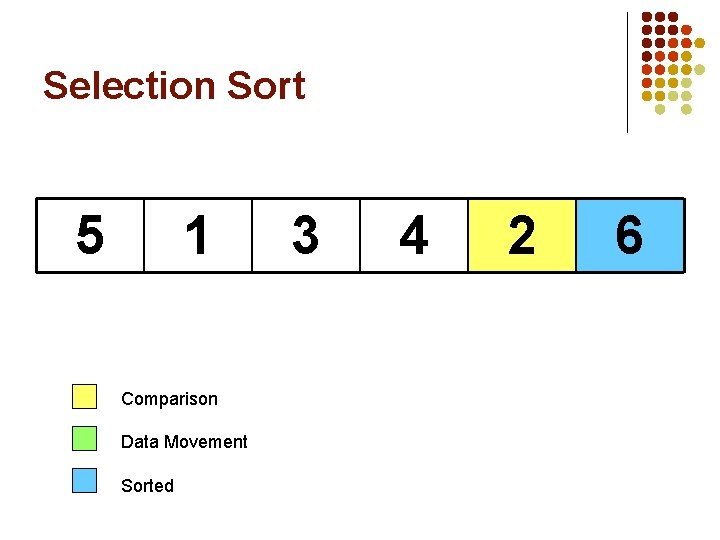
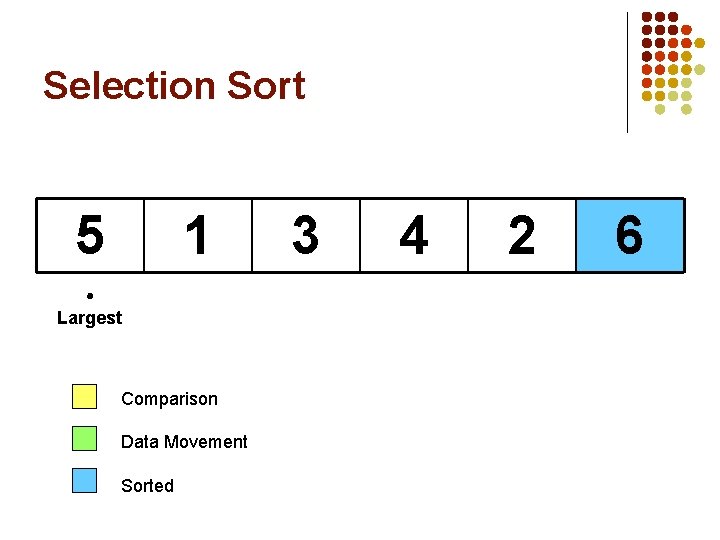
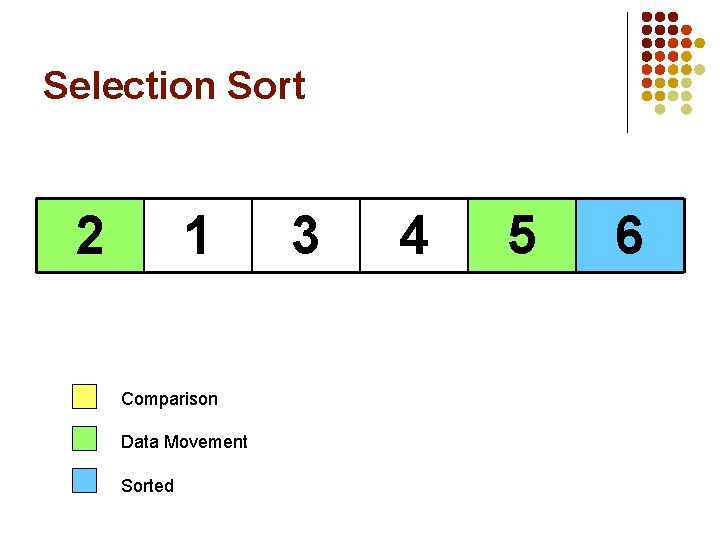
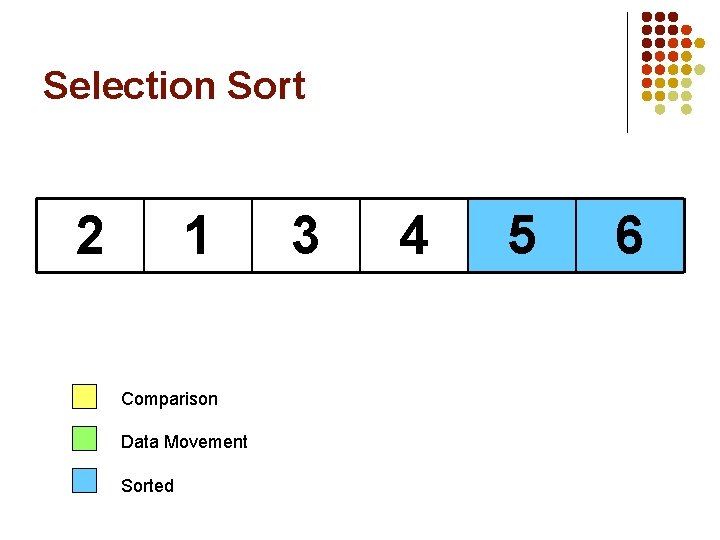
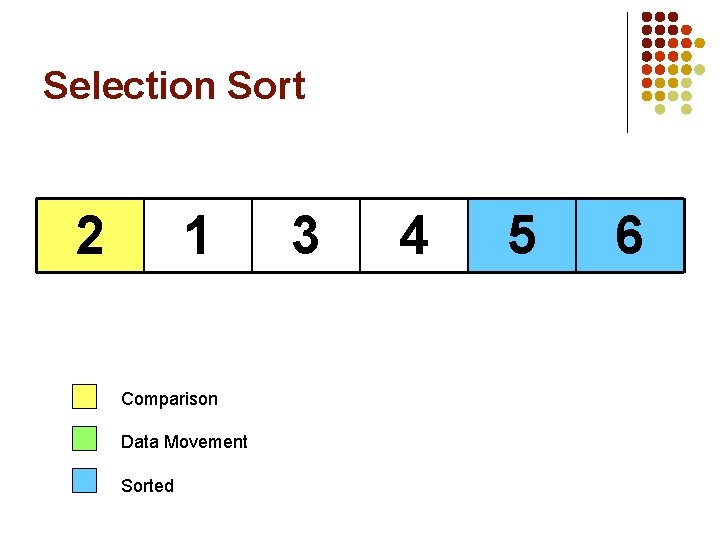
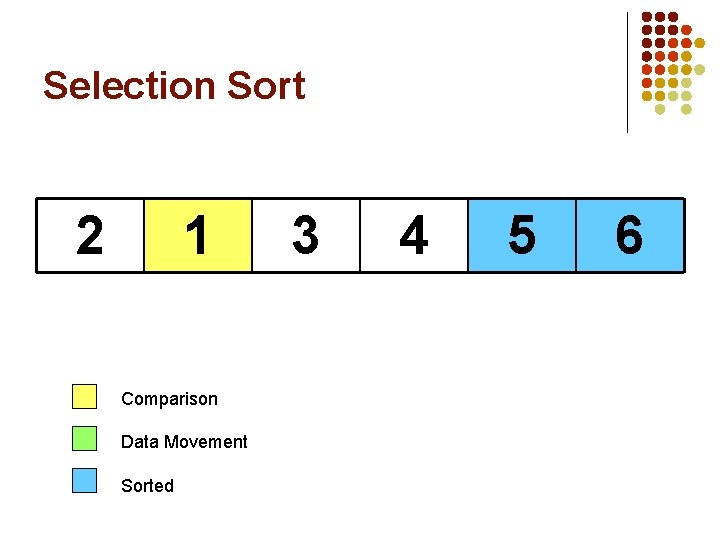
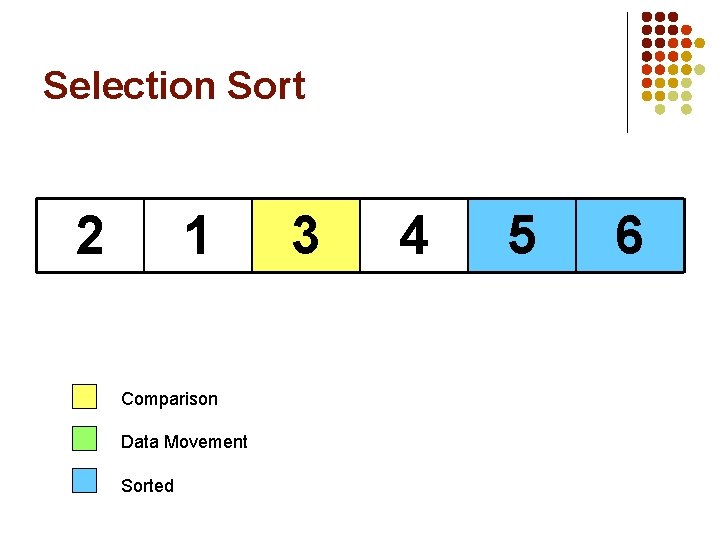
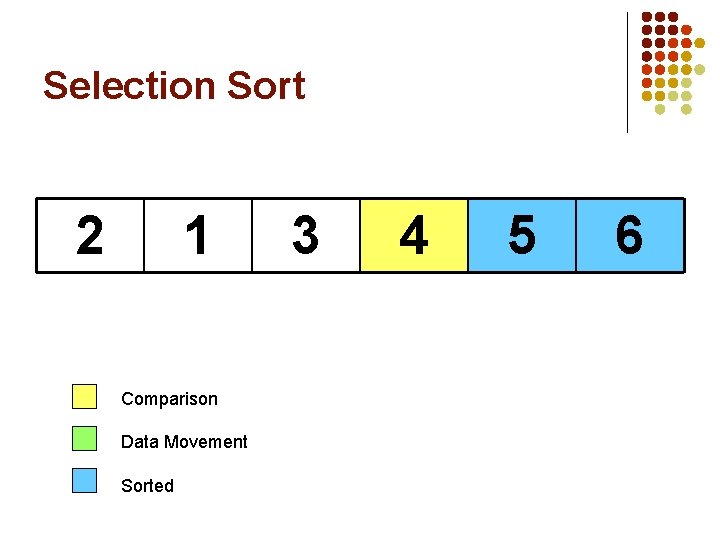
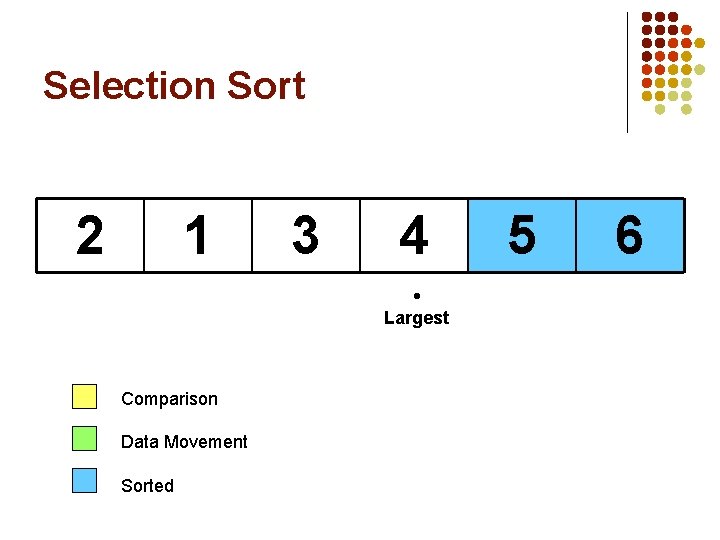
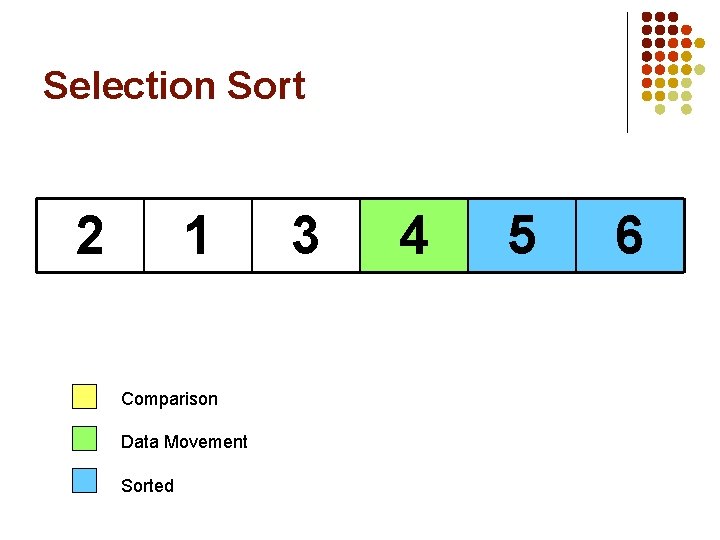
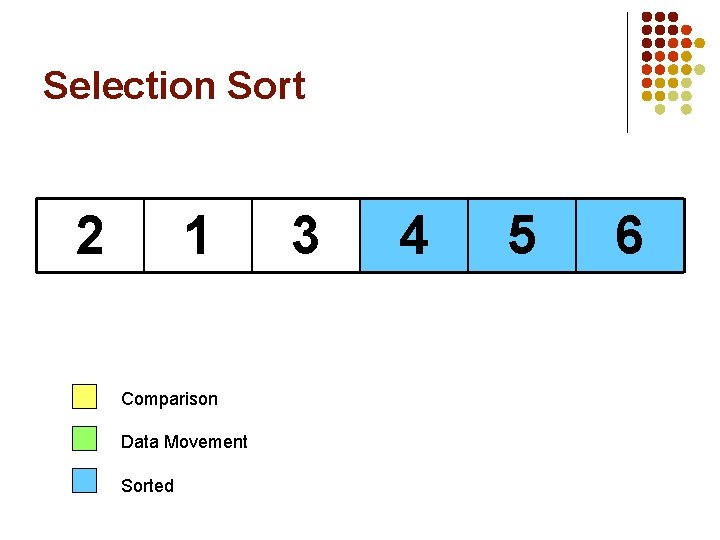
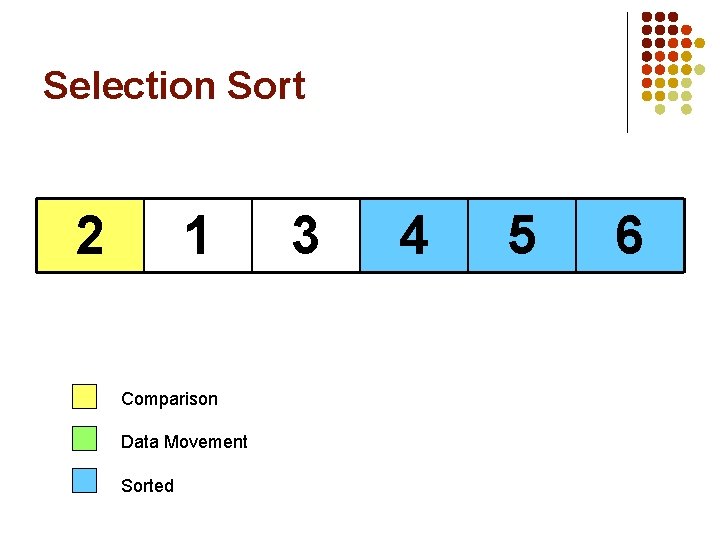
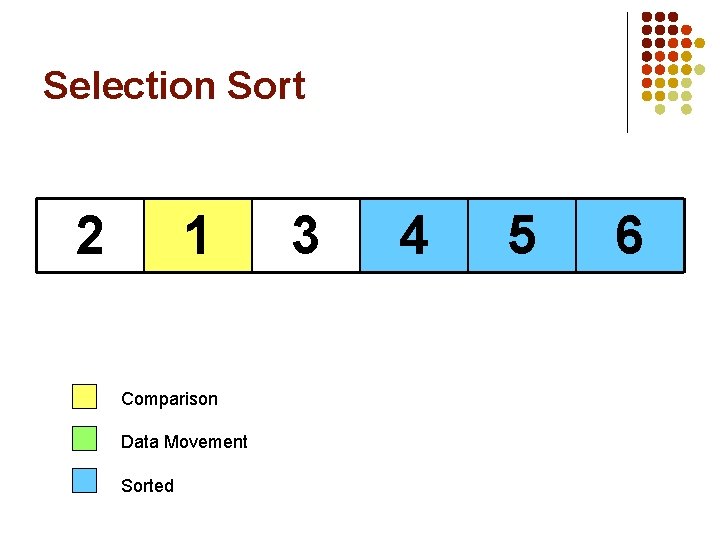
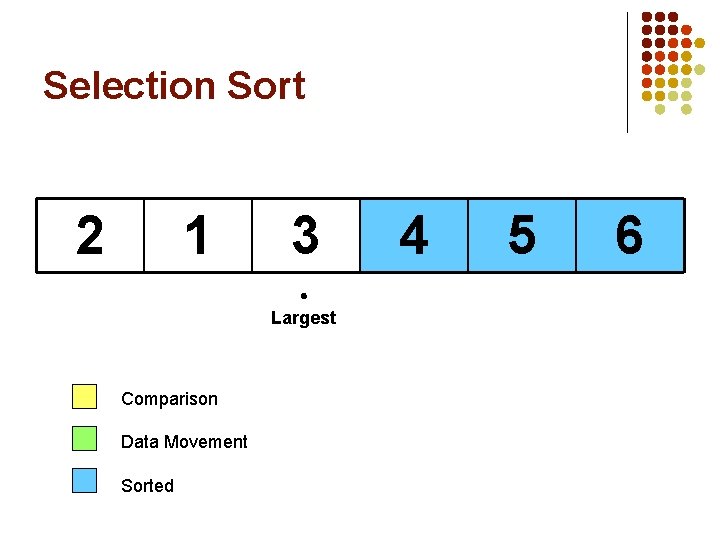
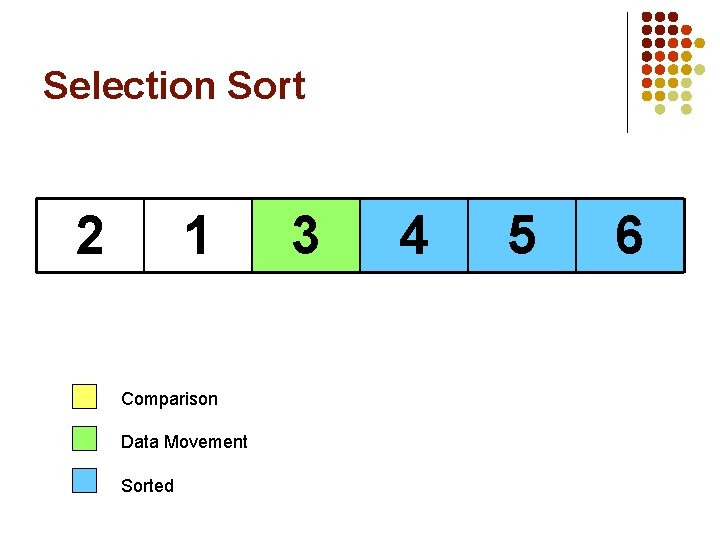
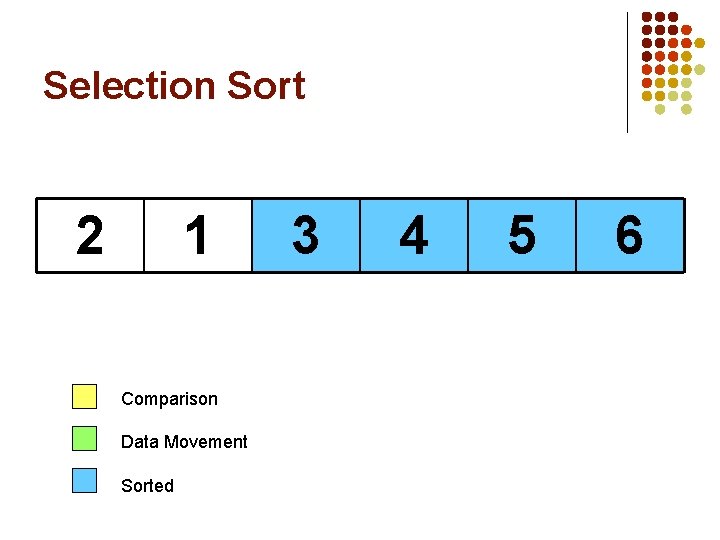
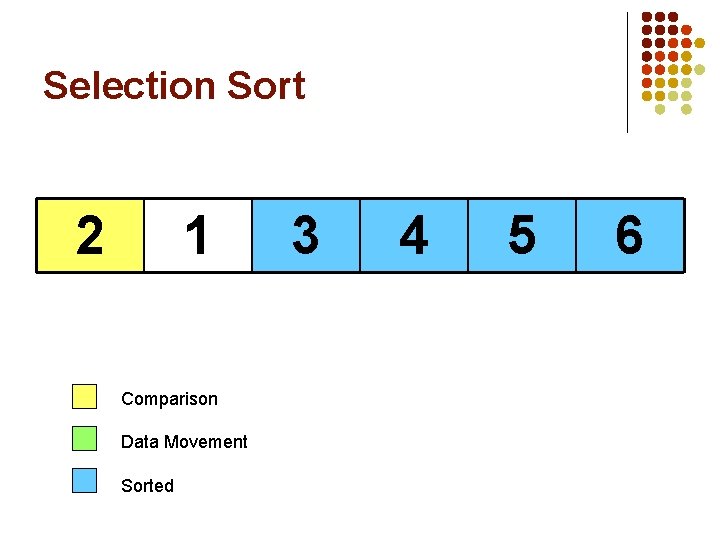
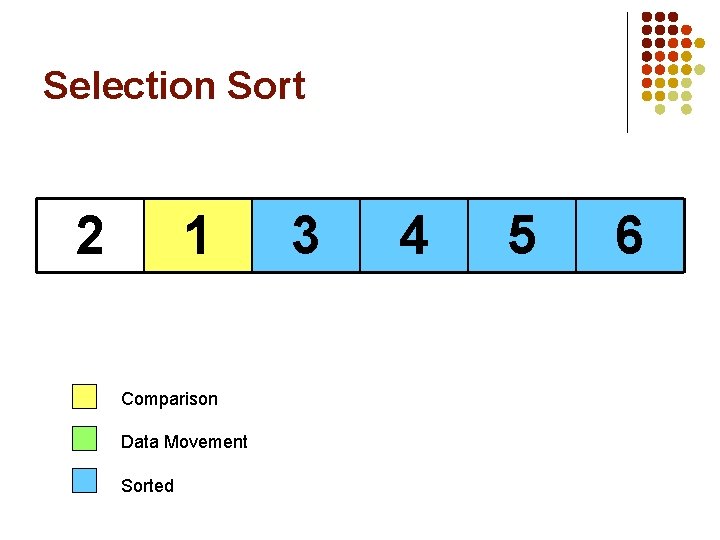
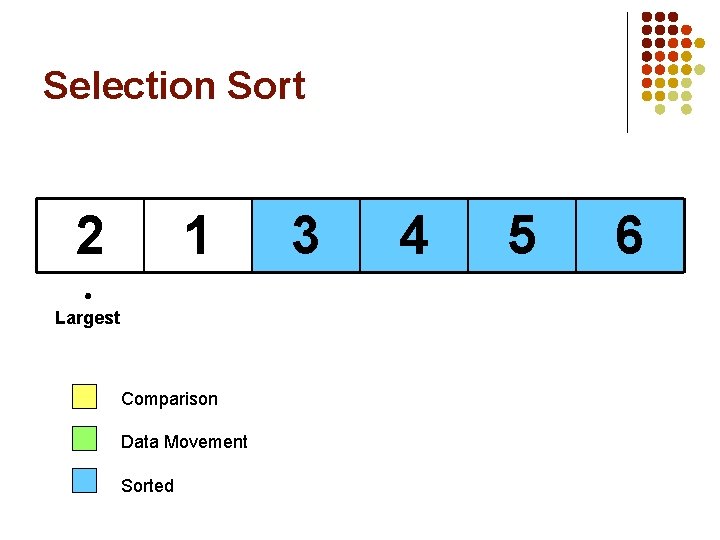
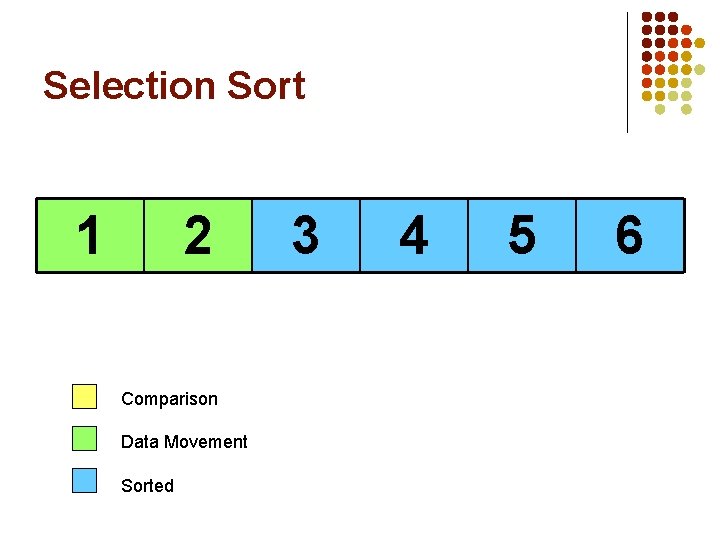
SELECTION SORT l Idea: l l l Find the smallest element in the array Exchange it with the element in the first position Find the second smallest element and exchange it with the element in the second position Continue until the array is sorted Disadvantage: l Running time depends only slightly on the amount of order in the file
Selection Sort 5 1 Comparison Data Movement Sorted 3 4 6 2
Selection Sort 5 1 Comparison Data Movement Sorted 3 4 6 2
Selection Sort 5 1 Comparison Data Movement Sorted 3 4 6 2
Selection Sort 5 1 Comparison Data Movement Sorted 3 4 6 2
Selection Sort 5 1 Comparison Data Movement Sorted 3 4 6 2
Selection Sort 5 1 Comparison Data Movement Sorted 3 4 6 2
Selection Sort 5 1 Comparison Data Movement Sorted 3 4 6 2
Selection Sort 5 1 3 4 6 Largest Comparison Data Movement Sorted 2
Selection Sort 5 1 Comparison Data Movement Sorted 3 4 2 6
Selection Sort 5 1 Comparison Data Movement Sorted 3 4 2 6
Selection Sort 5 1 Comparison Data Movement Sorted 3 4 2 6
Selection Sort 5 1 Comparison Data Movement Sorted 3 4 2 6
Selection Sort 5 1 Comparison Data Movement Sorted 3 4 2 6
Selection Sort 5 1 Comparison Data Movement Sorted 3 4 2 6
Selection Sort 5 1 Comparison Data Movement Sorted 3 4 2 6
Selection Sort 5 1 Largest Comparison Data Movement Sorted 3 4 2 6
Selection Sort 2 1 Comparison Data Movement Sorted 3 4 5 6
Selection Sort 2 1 Comparison Data Movement Sorted 3 4 5 6
Selection Sort 2 1 Comparison Data Movement Sorted 3 4 5 6
Selection Sort 2 1 Comparison Data Movement Sorted 3 4 5 6
Selection Sort 2 1 Comparison Data Movement Sorted 3 4 5 6
Selection Sort 2 1 Comparison Data Movement Sorted 3 4 5 6
Selection Sort 2 1 3 4 Largest Comparison Data Movement Sorted 5 6
Selection Sort 2 1 Comparison Data Movement Sorted 3 4 5 6
Selection Sort 2 1 Comparison Data Movement Sorted 3 4 5 6
Selection Sort 2 1 Comparison Data Movement Sorted 3 4 5 6
Selection Sort 2 1 Comparison Data Movement Sorted 3 4 5 6
Selection Sort 2 1 Comparison Data Movement Sorted 3 4 5 6
Selection Sort 2 1 3 Largest Comparison Data Movement Sorted 4 5 6
Selection Sort 2 1 Comparison Data Movement Sorted 3 4 5 6
Selection Sort 2 1 Comparison Data Movement Sorted 3 4 5 6
Selection Sort 2 1 Comparison Data Movement Sorted 3 4 5 6
Selection Sort 2 1 Comparison Data Movement Sorted 3 4 5 6
Selection Sort 2 1 Largest Comparison Data Movement Sorted 3 4 5 6
Selection Sort 1 2 Comparison Data Movement Sorted 3 4 5 6
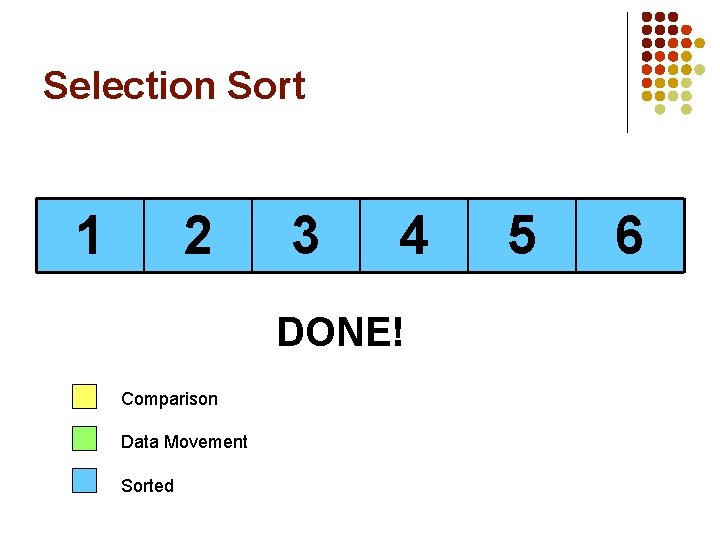
Selection Sort 1 2 3 4 DONE! Comparison Data Movement Sorted 5 6
Backup Slides
void selection_sort(int n, int list[]) { int min, temp; int k, l, index; for(index = 0; index< n - 1 ; index++) { min = index ; for(k = index + 1; k < n ; k ++) { if(list[min] > list[k]) min = k ; } if(min != index) { temp = `list [index]; list[index] = list[min]; list[min] = temp; } printf(" n Step : %d : ", (index+1)); for( l = 0 ; l < n; l++) printf(" %d", list[l]); } printf("n Sorted list is as follows: n"); for( index = 0 ; index < n; index++) printf(" %d", list[index]); return 0; }
Bubble Sort
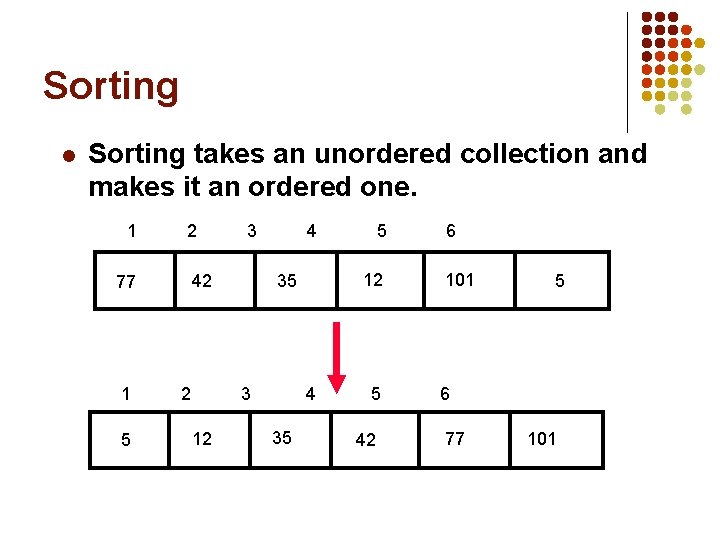
Sorting l Sorting takes an unordered collection and makes it an ordered one. 1 2 42 77 1 5 3 2 4 12 12 35 3 4 35 5 5 42 6 101 5 6 77 101
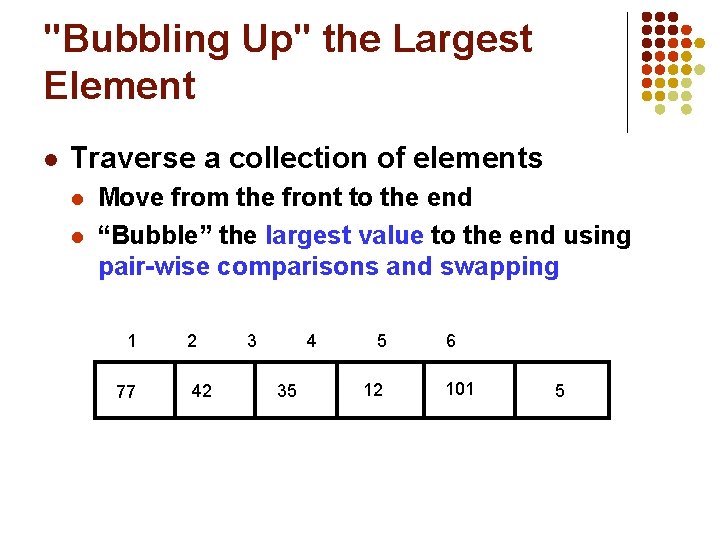
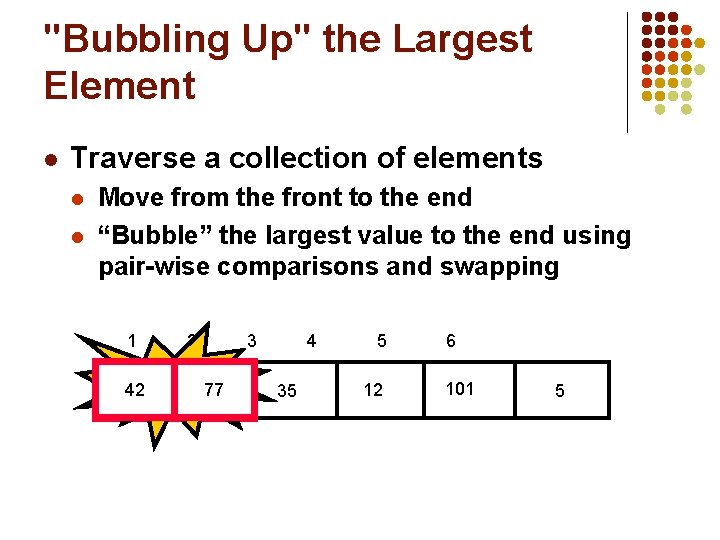
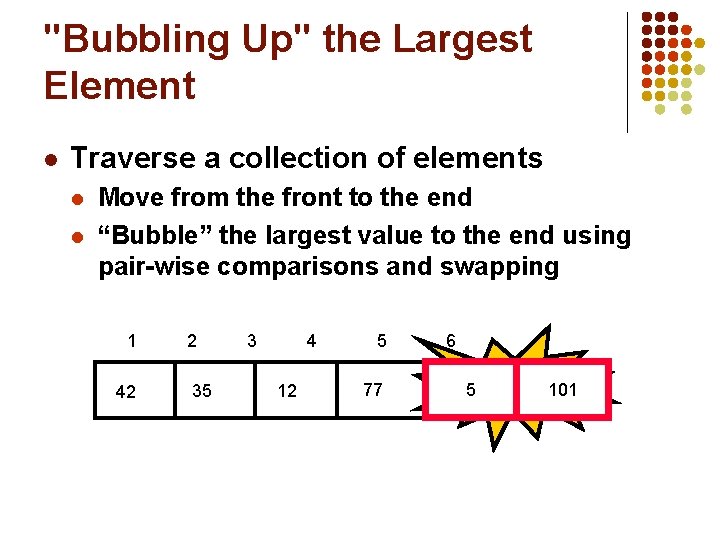
"Bubbling Up" the Largest Element l Traverse a collection of elements l l Move from the front to the end “Bubble” the largest value to the end using pair-wise comparisons and swapping 1 77 2 42 3 4 35 5 12 6 101 5
"Bubbling Up" the Largest Element l Traverse a collection of elements l l Move from the front to the end “Bubble” the largest value to the end using pair-wise comparisons and swapping 1 2 42 Swap 4277 77 3 4 35 5 12 6 101 5
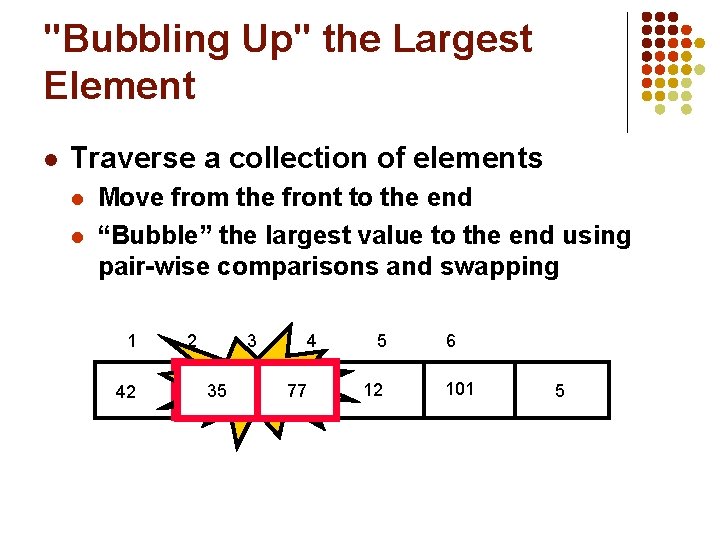
"Bubbling Up" the Largest Element l Traverse a collection of elements l l Move from the front to the end “Bubble” the largest value to the end using pair-wise comparisons and swapping 1 42 2 3 4 7735 Swap 35 77 5 12 6 101 5
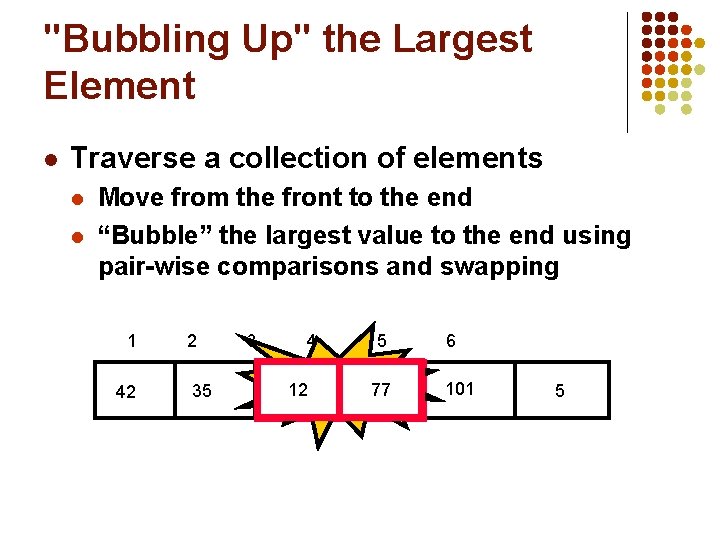
"Bubbling Up" the Largest Element l Traverse a collection of elements l l Move from the front to the end “Bubble” the largest value to the end using pair-wise comparisons and swapping 1 42 2 35 3 4 5 12 Swap 12 77 77 6 101 5
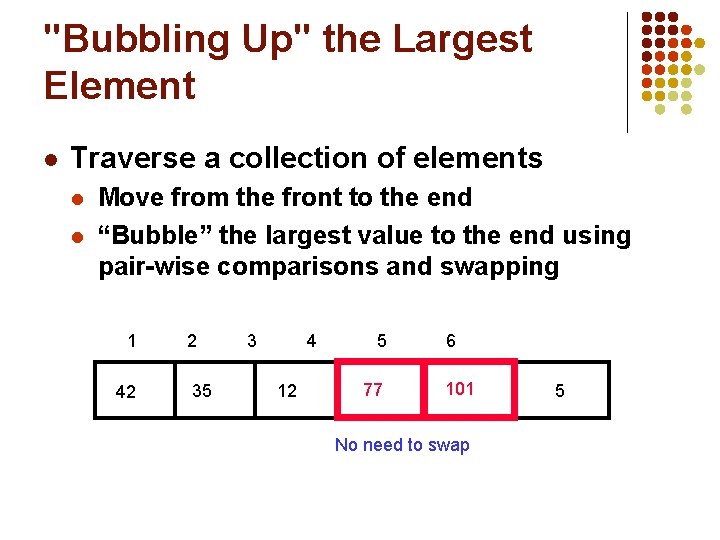
"Bubbling Up" the Largest Element l Traverse a collection of elements l l Move from the front to the end “Bubble” the largest value to the end using pair-wise comparisons and swapping 1 42 2 35 3 4 12 5 77 6 101 No need to swap 5
"Bubbling Up" the Largest Element l Traverse a collection of elements l l Move from the front to the end “Bubble” the largest value to the end using pair-wise comparisons and swapping 1 42 2 35 3 4 12 5 77 6 1015 Swap 101 5
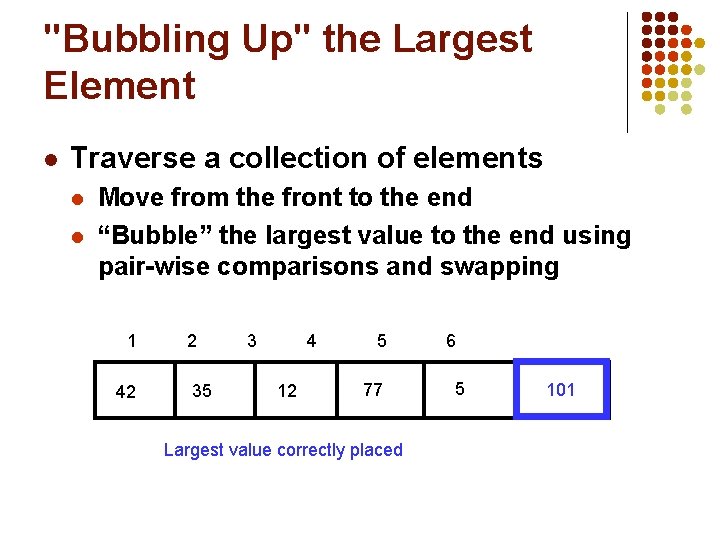
"Bubbling Up" the Largest Element l Traverse a collection of elements l l Move from the front to the end “Bubble” the largest value to the end using pair-wise comparisons and swapping 1 42 2 35 3 4 12 5 77 Largest value correctly placed 6 5 101
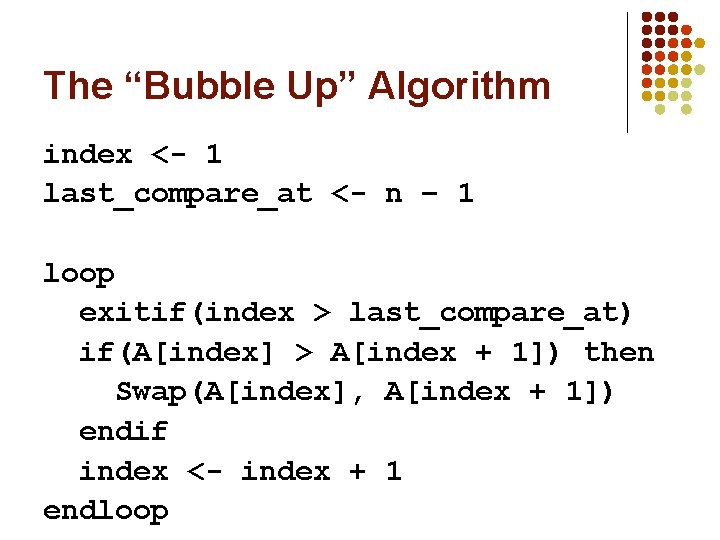
The “Bubble Up” Algorithm index <- 1 last_compare_at <- n – 1 loop exitif(index > last_compare_at) if(A[index] > A[index + 1]) then Swap(A[index], A[index + 1]) endif index <- index + 1 endloop
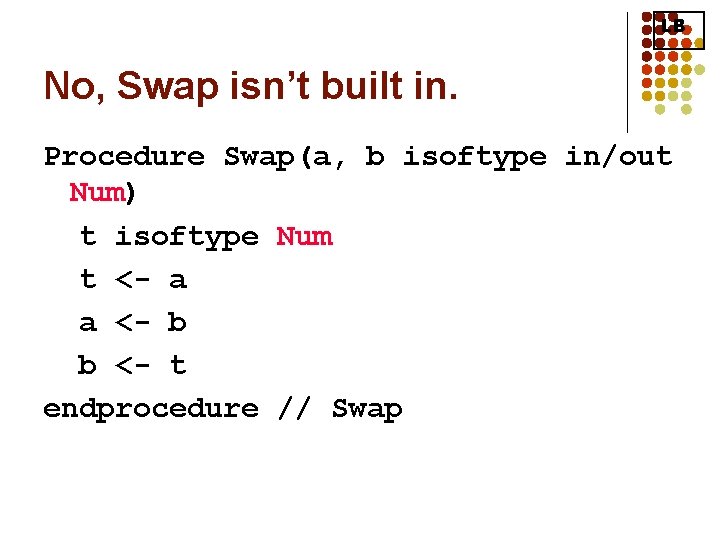
LB No, Swap isn’t built in. Procedure Swap(a, b isoftype in/out Num) t isoftype Num t <- a a <- b b <- t endprocedure // Swap
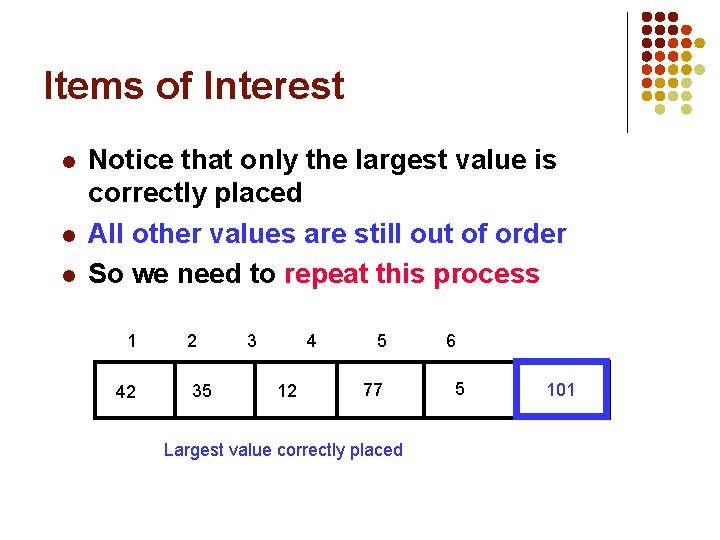
Items of Interest l l l Notice that only the largest value is correctly placed All other values are still out of order So we need to repeat this process 1 42 2 35 3 4 12 5 77 Largest value correctly placed 6 5 101
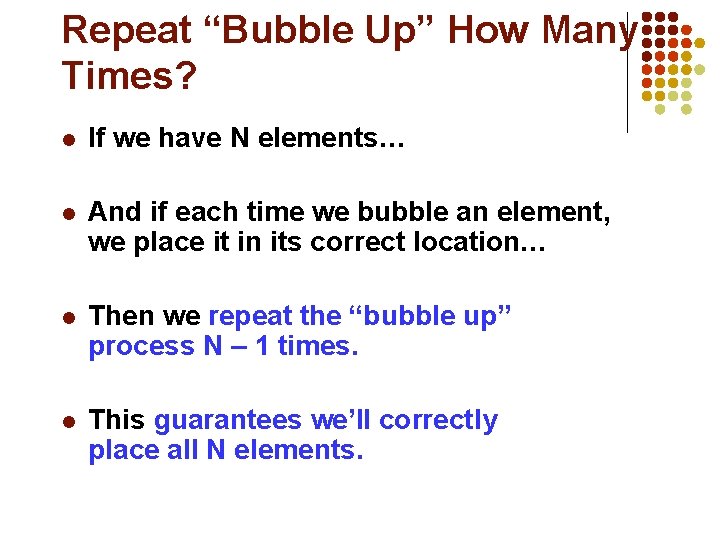
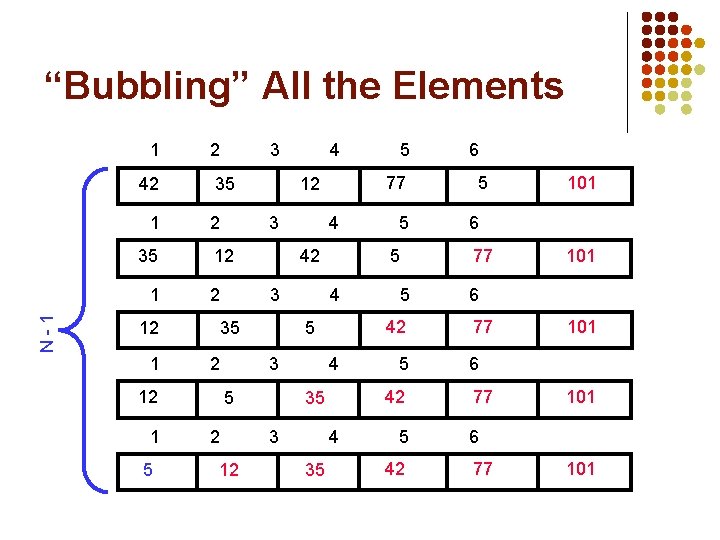
Repeat “Bubble Up” How Many Times? l If we have N elements… l And if each time we bubble an element, we place it in its correct location… l Then we repeat the “bubble up” process N – 1 times. l This guarantees we’ll correctly place all N elements.
“Bubbling” All the Elements 1 42 1 35 N-1 1 2 35 2 1 5 3 2 4 3 2 2 12 4 4 35 5 42 35 3 5 42 5 5 4 3 5 77 42 35 12 4 12 12 12 1 3 5 42 6 5 101 6 77 101
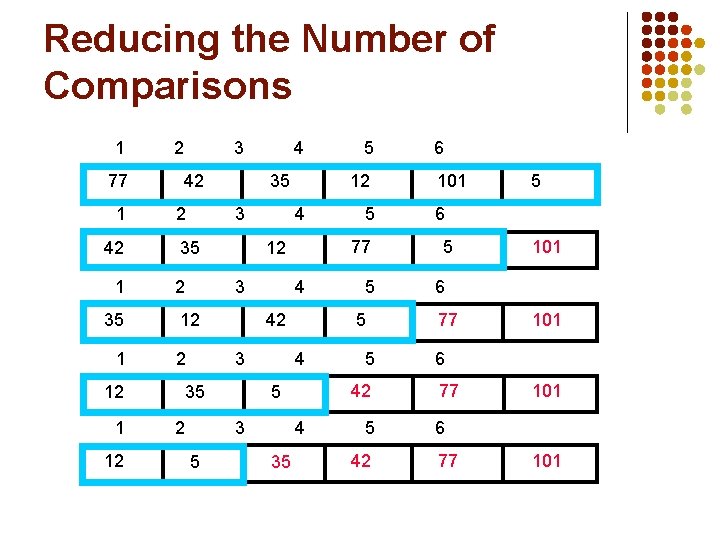
Reducing the Number of Comparisons 1 77 1 42 1 35 1 2 42 2 12 4 3 2 4 12 2 4 35 2 4 5 4 35 5 42 5 3 5 5 42 3 5 77 12 3 5 12 35 35 12 1 3 5 42 6 101 5 6 5 101 6 77 101
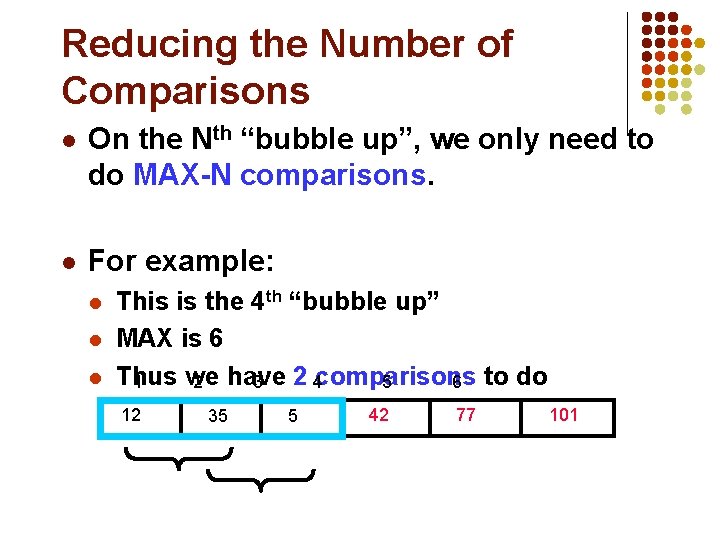
Reducing the Number of Comparisons l On the Nth “bubble up”, we only need to do MAX-N comparisons. l For example: l l l This is the 4 th “bubble up” MAX is 6 Thus we 2 4 comparisons 1 2 have 3 5 6 to do 12 35 5 42 77 101
Putting It All Together
N is … // Size of Array Arr_Type definesa Array[1. . N] of Num Procedure Swap(n 1, n 2 isoftype in/out Num) temp isoftype Num temp <- n 1 <- n 2 <- temp endprocedure // Swap
Outer loop exitif(to_do = 0) index <- 1 loop exitif(index > to_do) if(A[index] > A[index + 1]) then Swap(A[index], A[index + 1]) endif index <- index + 1 endloop to_do <- to_do - 1 endloop endprocedure // Bubblesort Inner loop procedure Bubblesort(A isoftype in/out Arr_Type) to_do, index isoftype Num to_do <- N – 1
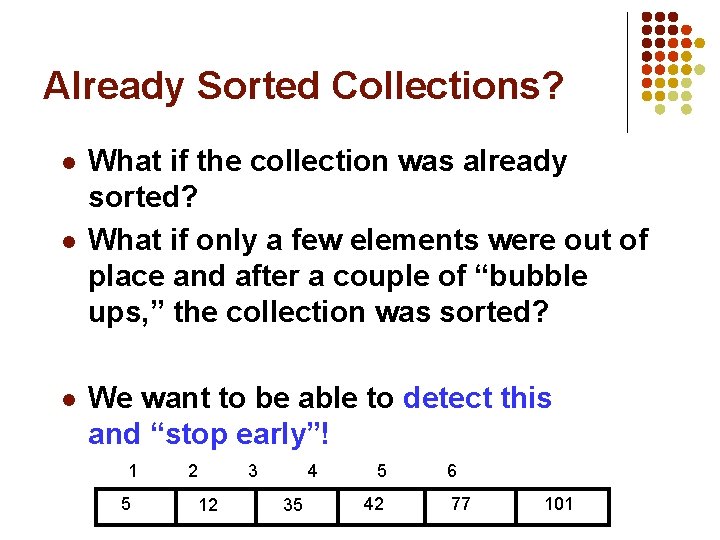
Already Sorted Collections? l l l What if the collection was already sorted? What if only a few elements were out of place and after a couple of “bubble ups, ” the collection was sorted? We want to be able to detect this and “stop early”! 1 5 2 12 3 4 35 5 42 6 77 101
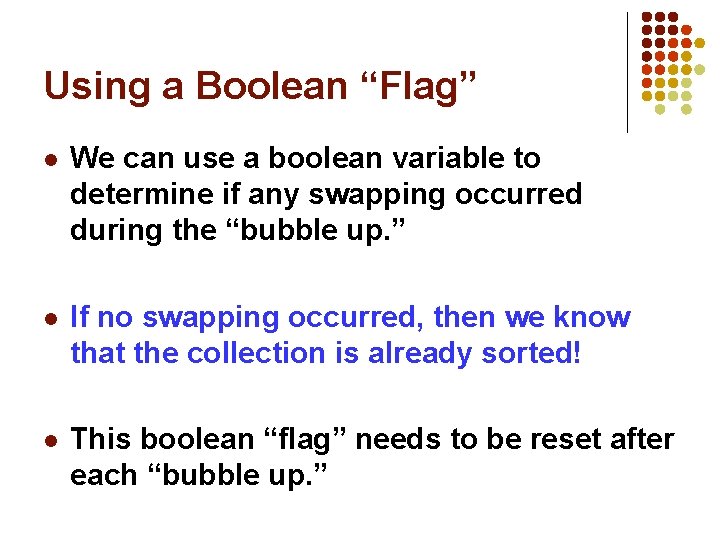
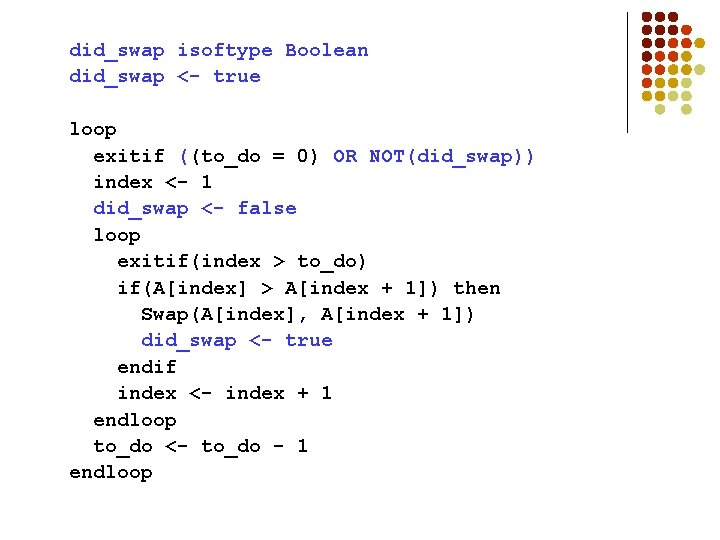
Using a Boolean “Flag” l We can use a boolean variable to determine if any swapping occurred during the “bubble up. ” l If no swapping occurred, then we know that the collection is already sorted! l This boolean “flag” needs to be reset after each “bubble up. ”
did_swap isoftype Boolean did_swap <- true loop exitif ((to_do = 0) OR NOT(did_swap)) index <- 1 did_swap <- false loop exitif(index > to_do) if(A[index] > A[index + 1]) then Swap(A[index], A[index + 1]) did_swap <- true endif index <- index + 1 endloop to_do <- to_do - 1 endloop