
Sorting Parallel Compare Exchange Operation A parallel compareexchange


- Slides: 9
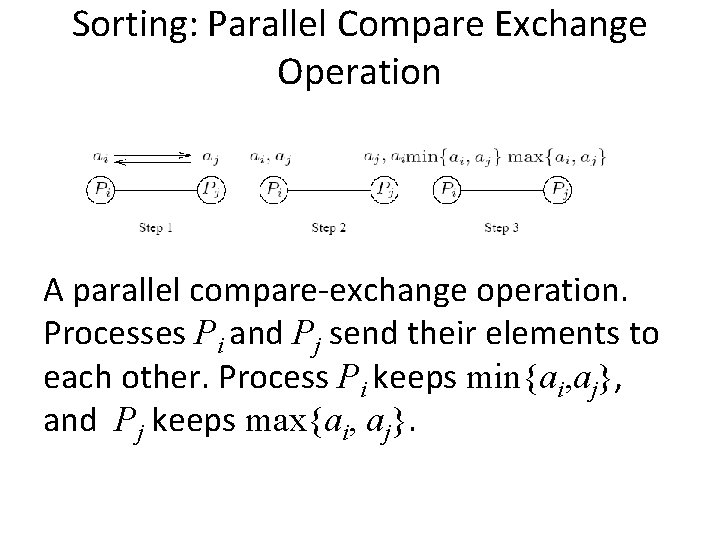
Sorting: Parallel Compare Exchange Operation A parallel compare-exchange operation. Processes Pi and Pj send their elements to each other. Process Pi keeps min{ai, aj}, and Pj keeps max{ai, aj}.
Sorting Networks: Bitonic Sort • A bitonic sorting network sorts n elements in Θ(log 2 n) time. • A bitonic sequence has two tones - increasing and decreasing, or vice versa. Any cyclic rotation of such networks is also considered bitonic. • 1, 2, 4, 7, 6, 0 is a bitonic sequence, because it first increases and then decreases. 8, 9, 2, 1, 0, 4 is another bitonic sequence, because it is a cyclic shift of 0, 4, 8, 9, 2, 1. • The kernel of the network is the rearrangement of a bitonic sequence into a sorted sequence.
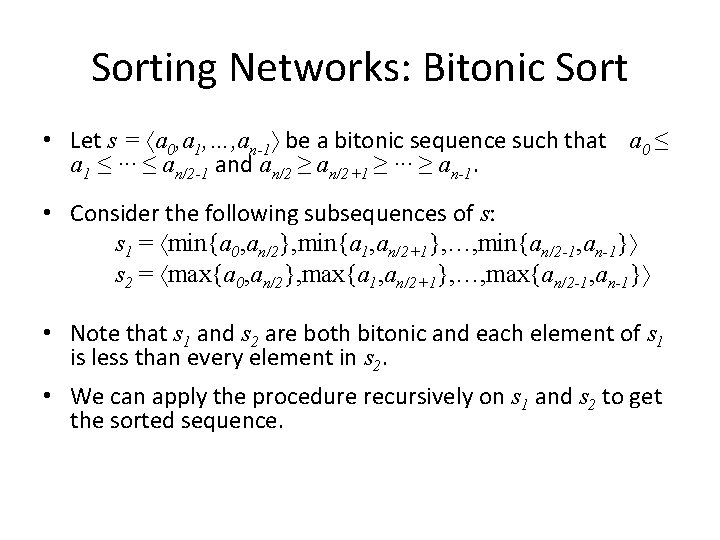
Sorting Networks: Bitonic Sort • Let s = a 0, a 1, …, an-1 be a bitonic sequence such that a 0 ≤ a 1 ≤ ··· ≤ an/2 -1 and an/2 ≥ an/2+1 ≥ ··· ≥ an-1. • Consider the following subsequences of s: s 1 = min{a 0, an/2}, min{a 1, an/2+1}, …, min{an/2 -1, an-1} s 2 = max{a 0, an/2}, max{a 1, an/2+1}, …, max{an/2 -1, an-1} • Note that s 1 and s 2 are both bitonic and each element of s 1 is less than every element in s 2. • We can apply the procedure recursively on s 1 and s 2 to get the sorted sequence.
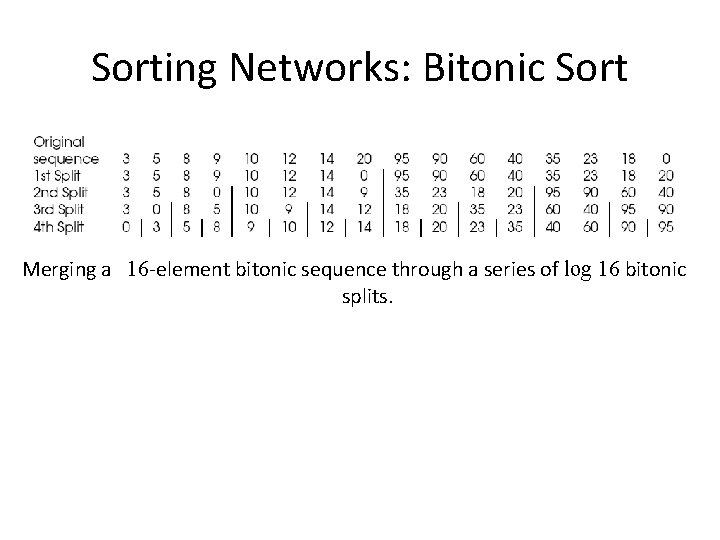
Sorting Networks: Bitonic Sort Merging a 16 -element bitonic sequence through a series of log 16 bitonic splits.
Sorting Networks: Bitonic Sort • We can easily build a sorting network to implement this bitonic merge algorithm. • Such a network is called a bitonic merging network. • The network contains log n columns. Each column contains n/2 comparators and performs one step of the bitonic merge. • We denote a bitonic merging network with n inputs by BM[n]. • Replacing the comparators by Ө comparators results in a decreasing output sequence; such a network is denoted by ӨBM[n].
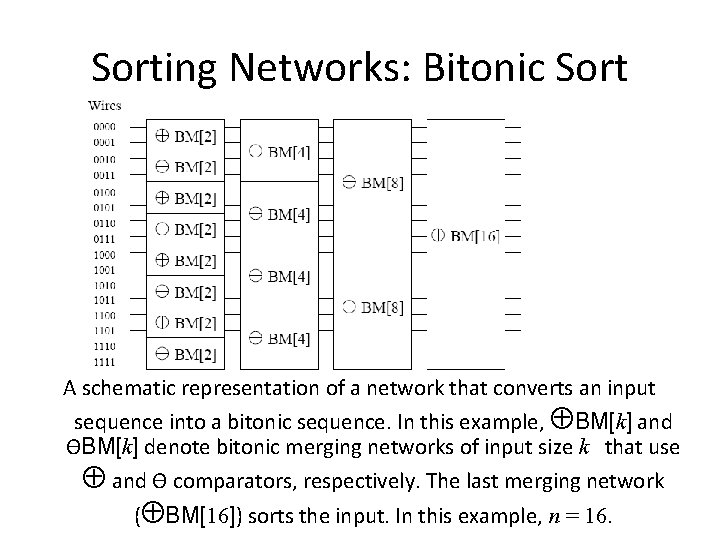
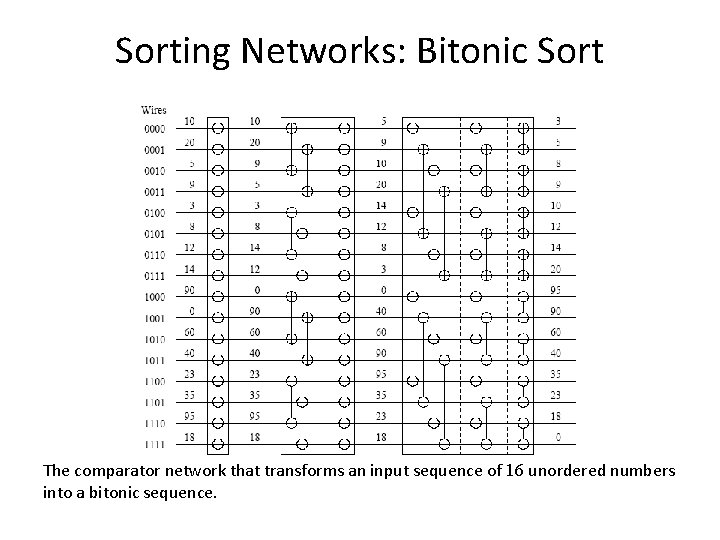
Sorting Networks: Bitonic Sort How do we sort an unsorted sequence using a bitonic merge? • We must first build a single bitonic sequence from the given sequence. • A sequence of length 2 is a bitonic sequence. • A bitonic sequence of length 4 can be built by sorting the first two elements using BM[2] and next two, using ӨBM[2]. • This process can be repeated to generate larger bitonic sequences.
Sorting Networks: Bitonic Sort A schematic representation of a network that converts an input sequence into a bitonic sequence. In this example, BM[k] and ӨBM[k] denote bitonic merging networks of input size k that use and Ө comparators, respectively. The last merging network ( BM[16]) sorts the input. In this example, n = 16.
Sorting Networks: Bitonic Sort The comparator network that transforms an input sequence of 16 unordered numbers into a bitonic sequence.
Sorting Networks: Bitonic Sort • The depth of the network is Θ(log 2 n). • Each stage of the network contains n/2 comparators. A serial implementation of the network would have complexity Θ(nlog 2 n).