
Sorting Lesson Outline 1 2 3 4 5
- Slides: 53
Sorting Lesson Outline 1. 2. 3. 4. 5. 6. 7. 8. 9. 10. 11. 12. 13. 14. 15. 16. 17. 18. 19. 20. 21. 22. 23. 24. 25. 26. 27. 28. 29. Sorting Lesson Outline How to Sort an Array? Many Sorting Algorithms Bubble Sort #1 Bubble Sort #2 Bubble Sort #3 Bubble Sort #4 Bubble Sort #5 Bubble Sort Run Start Bubble Sort Run Iteration #1 Bubble Sort Run Iteration #2 Bubble Sort Run Iteration #3 Bubble Sort Run Iteration #4 Bubble Sort Run Iteration #5 Bubble Sort Run Iteration #6 Bubble Sort Run Iteration #7 Bubble Sort Run Iteration #8 Bubble Sort Run End Time Complexity of Bubble Sort #1 Time Complexity of Bubble Sort #2 Selection Sort #1 Selection Sort #2 Selection Sort Run Start Selection Sort Run Minimum #1 Selection Sort Run Minimum #2 Selection Sort Run Minimum #3 Selection Sort Run Minimum #4 Selection Sort Run Minimum #5 30. 31. 32. 33. 34. 35. 36. 37. 38. 39. 40. 41. 42. 43. 44. 45. 46. 47. 48. 49. 50. 51. 52. 53. Selection Sort Run Minimum #6 Selection Sort Run Minimum #7 Selection Sort Run Minimum #8 Selection Sort Run End Time Complexity of Selection Sort #1 Time Complexity of Selection Sort #2 Quick Sort #1 Quick Sort #2 Quick Sort #3 Quick Sort #4 Quick Sort #5 Quick Sort Run Start Quick Sort Run Call: low 0, high 8 Quick Sort Run Call: low 0, high 3 Quick Sort Run Call: low 2, high 3 Quick Sort Run Call: low 0, high 3 End Quick Sort Run Call: low 5, high 8 Quick Sort Run Call: low 5, high 6 Quick Sort Run Call: low 7, high 8 Quick Sort Run Call: low 5, high 8 End Quick Sort Run Call: low 0, high 8 End Quick Sort Run End Time Complexity of Quick Sort #1 Time Complexity of Quick Sort #2 Sorting Lesson CS 1313 Spring 2009 1
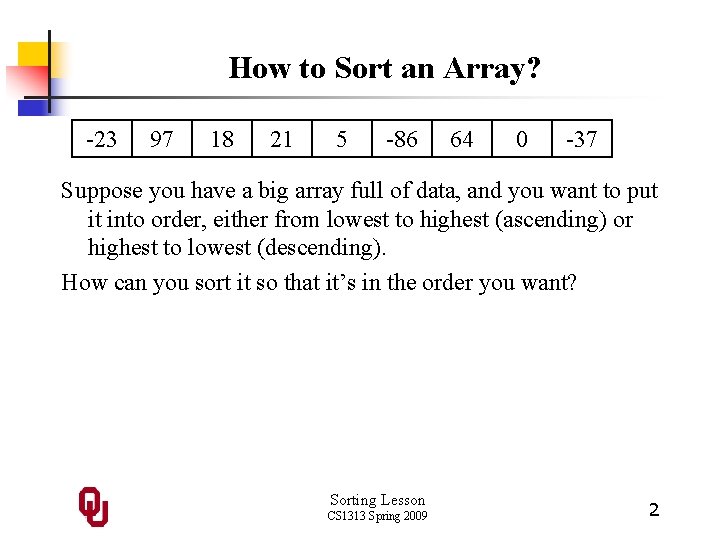
How to Sort an Array? -23 97 18 21 5 -86 64 0 -37 Suppose you have a big array full of data, and you want to put it into order, either from lowest to highest (ascending) or highest to lowest (descending). How can you sort it so that it’s in the order you want? Sorting Lesson CS 1313 Spring 2009 2
Many Sorting Algorithms Bubble Sort n Selection Sort n Quick Sort … and many more. n Sorting Lesson CS 1313 Spring 2009 3
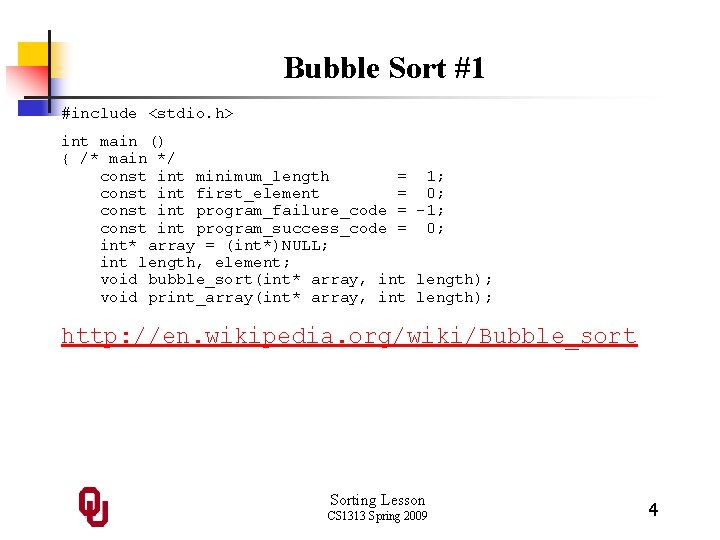
Bubble Sort #1 #include <stdio. h> int main () { /* main */ const int minimum_length = 1; const int first_element = 0; const int program_failure_code = -1; const int program_success_code = 0; int* array = (int*)NULL; int length, element; void bubble_sort(int* array, int length); void print_array(int* array, int length); http: //en. wikipedia. org/wiki/Bubble_sort Sorting Lesson CS 1313 Spring 2009 4
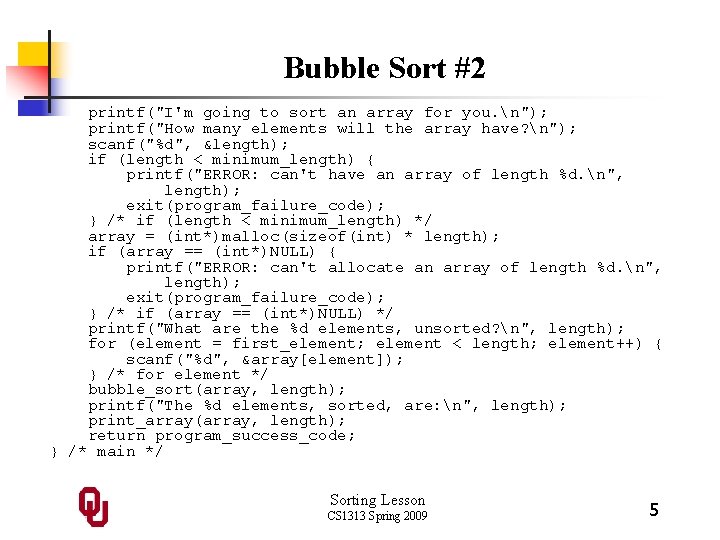
Bubble Sort #2 printf("I'm going to sort an array for you. n"); printf("How many elements will the array have? n"); scanf("%d", &length); if (length < minimum_length) { printf("ERROR: can't have an array of length %d. n", length); exit(program_failure_code); } /* if (length < minimum_length) */ array = (int*)malloc(sizeof(int) * length); if (array == (int*)NULL) { printf("ERROR: can't allocate an array of length %d. n", length); exit(program_failure_code); } /* if (array == (int*)NULL) */ printf("What are the %d elements, unsorted? n", length); for (element = first_element; element < length; element++) { scanf("%d", &array[element]); } /* for element */ bubble_sort(array, length); printf("The %d elements, sorted, are: n", length); print_array(array, length); return program_success_code; } /* main */ Sorting Lesson CS 1313 Spring 2009 5
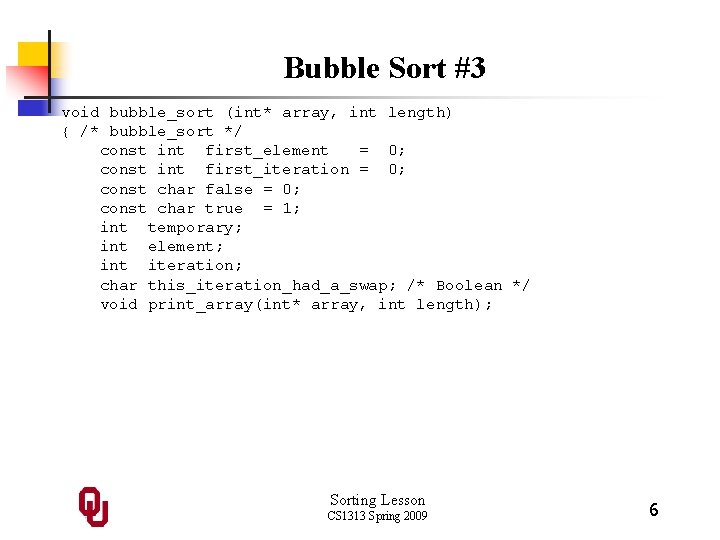
Bubble Sort #3 void bubble_sort (int* array, int length) { /* bubble_sort */ const int first_element = 0; const int first_iteration = 0; const char false = 0; const char true = 1; int temporary; int element; int iteration; char this_iteration_had_a_swap; /* Boolean */ void print_array(int* array, int length); Sorting Lesson CS 1313 Spring 2009 6
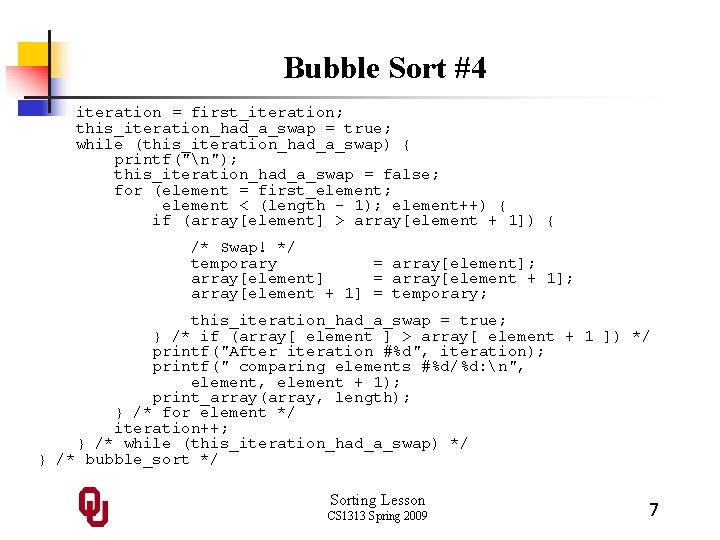
Bubble Sort #4 iteration = first_iteration; this_iteration_had_a_swap = true; while (this_iteration_had_a_swap) { printf("n"); this_iteration_had_a_swap = false; for (element = first_element; element < (length - 1); element++) { if (array[element] > array[element + 1]) { /* Swap! */ temporary = array[element]; array[element] = array[element + 1]; array[element + 1] = temporary; this_iteration_had_a_swap = true; } /* if (array[ element ] > array[ element + 1 ]) */ printf("After iteration #%d", iteration); printf(" comparing elements #%d/%d: n", element + 1); print_array(array, length); } /* for element */ iteration++; } /* while (this_iteration_had_a_swap) */ } /* bubble_sort */ Sorting Lesson CS 1313 Spring 2009 7
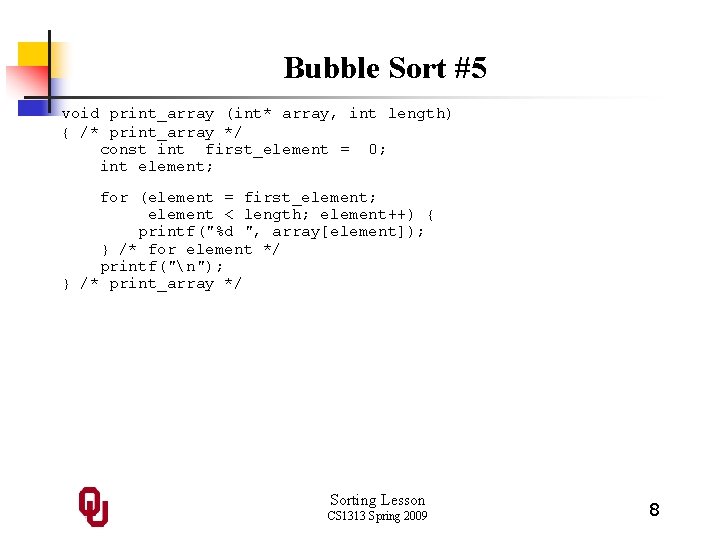
Bubble Sort #5 void print_array (int* array, int length) { /* print_array */ const int first_element = 0; int element; for (element = first_element; element < length; element++) { printf("%d ", array[element]); } /* for element */ printf("n"); } /* print_array */ Sorting Lesson CS 1313 Spring 2009 8
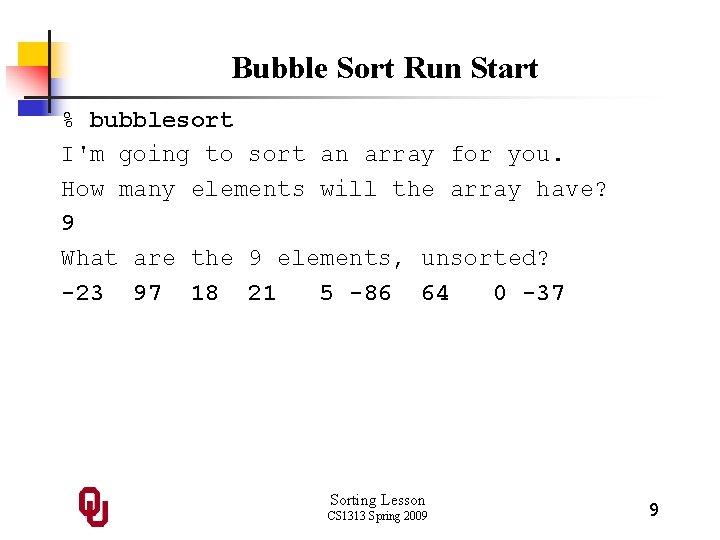
Bubble Sort Run Start % bubblesort I'm going to sort an array for you. How many elements will the array have? 9 What are the 9 elements, unsorted? -23 97 18 21 5 -86 64 0 -37 Sorting Lesson CS 1313 Spring 2009 9
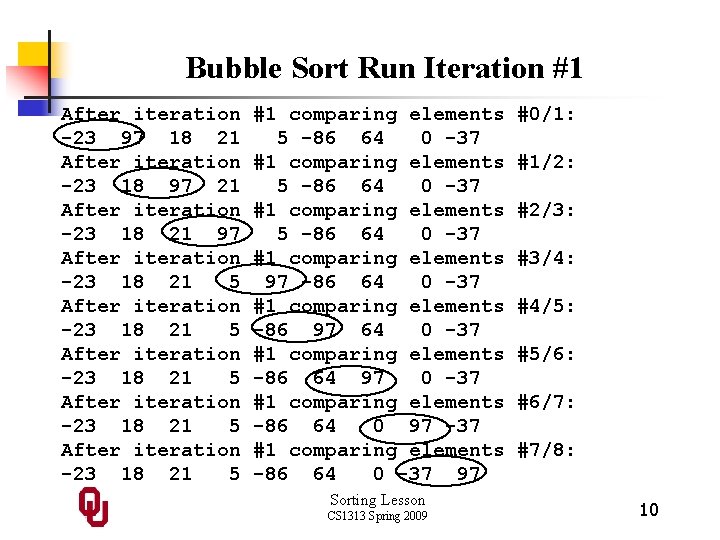
Bubble Sort Run Iteration #1 After iteration -23 97 18 21 After iteration -23 18 97 21 After iteration -23 18 21 97 After iteration -23 18 21 5 After iteration -23 18 21 5 #1 comparing elements 5 -86 64 0 -37 #1 comparing elements 97 -86 64 0 -37 #1 comparing elements -86 97 64 0 -37 #1 comparing elements -86 64 97 0 -37 #1 comparing elements -86 64 0 97 -37 #1 comparing elements -86 64 0 -37 97 Sorting Lesson CS 1313 Spring 2009 #0/1: #1/2: #2/3: #3/4: #4/5: #5/6: #6/7: #7/8: 10
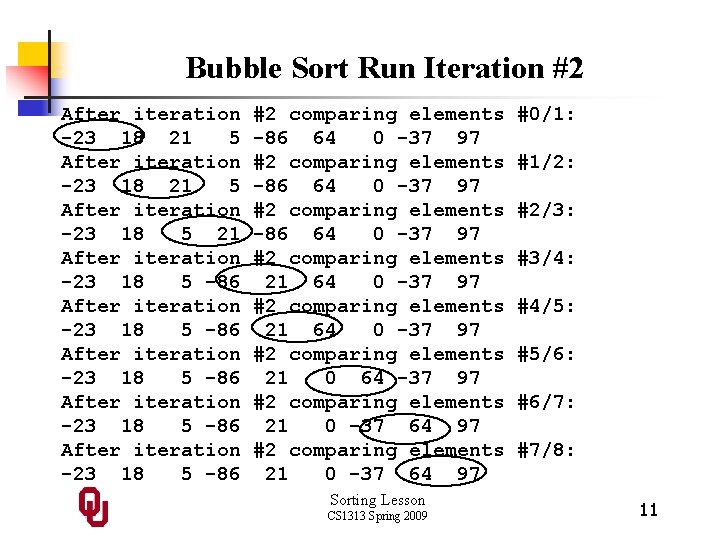
Bubble Sort Run Iteration #2 After iteration -23 18 21 5 After iteration -23 18 5 21 After iteration -23 18 5 -86 After iteration -23 18 5 -86 #2 comparing elements -86 64 0 -37 97 #2 comparing elements 21 64 0 -37 97 #2 comparing elements 21 0 64 -37 97 #2 comparing elements 21 0 -37 64 97 Sorting Lesson CS 1313 Spring 2009 #0/1: #1/2: #2/3: #3/4: #4/5: #5/6: #6/7: #7/8: 11
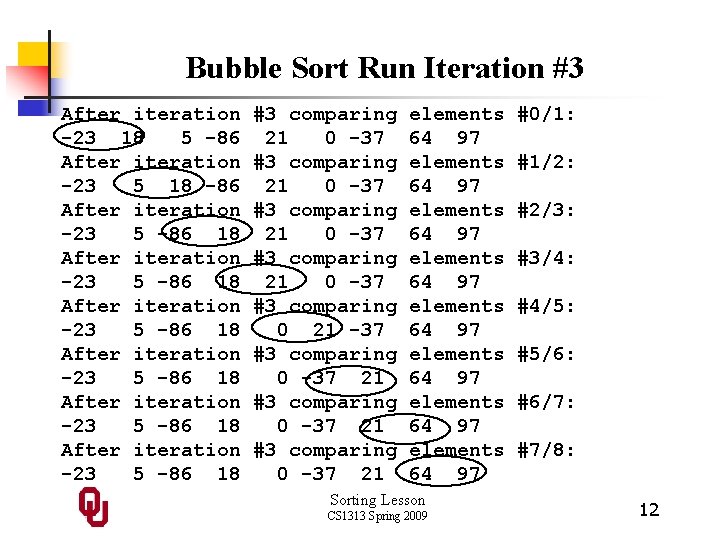
Bubble Sort Run Iteration #3 After iteration -23 18 5 -86 After iteration -23 5 18 -86 After iteration -23 5 -86 18 After iteration -23 5 -86 18 #3 comparing 21 0 -37 #3 comparing 0 21 -37 #3 comparing 0 -37 21 elements 64 97 elements 64 97 Sorting Lesson CS 1313 Spring 2009 #0/1: #1/2: #2/3: #3/4: #4/5: #5/6: #6/7: #7/8: 12
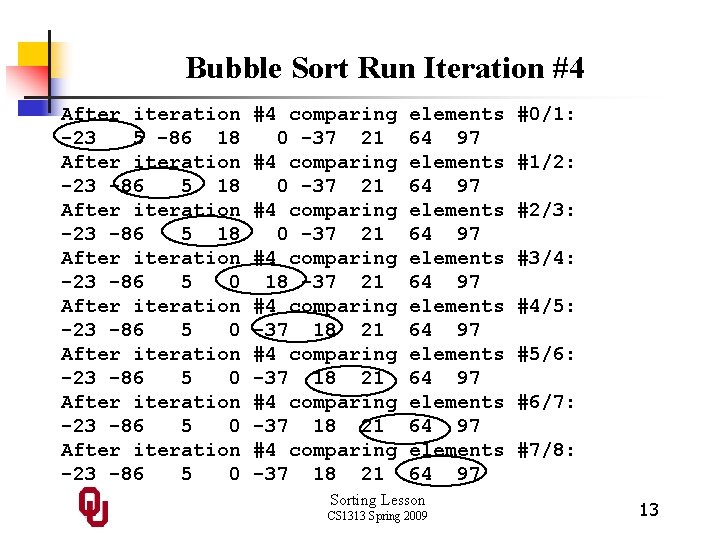
Bubble Sort Run Iteration #4 After iteration -23 5 -86 18 After iteration -23 -86 5 0 After iteration -23 -86 5 0 #4 comparing 0 -37 21 #4 comparing 18 -37 21 #4 comparing -37 18 21 elements 64 97 elements 64 97 Sorting Lesson CS 1313 Spring 2009 #0/1: #1/2: #2/3: #3/4: #4/5: #5/6: #6/7: #7/8: 13
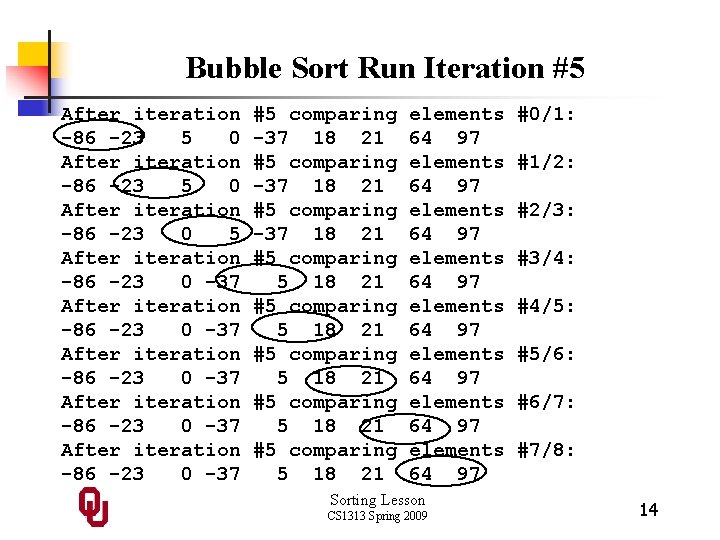
Bubble Sort Run Iteration #5 After iteration -86 -23 5 0 After iteration -86 -23 0 5 After iteration -86 -23 0 -37 After iteration -86 -23 0 -37 #5 comparing -37 18 21 #5 comparing 5 18 21 #5 comparing 5 18 21 elements 64 97 elements 64 97 Sorting Lesson CS 1313 Spring 2009 #0/1: #1/2: #2/3: #3/4: #4/5: #5/6: #6/7: #7/8: 14
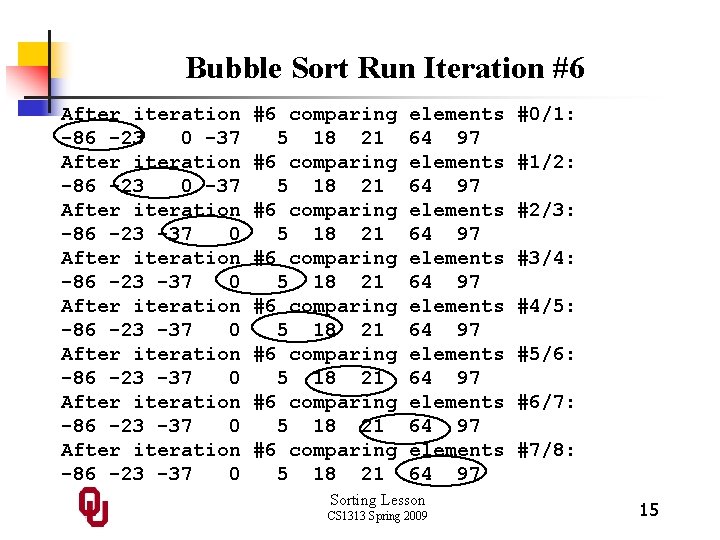
Bubble Sort Run Iteration #6 After iteration -86 -23 0 -37 After iteration -86 -23 -37 0 After iteration -86 -23 -37 0 #6 comparing 5 18 21 #6 comparing 5 18 21 elements 64 97 elements 64 97 Sorting Lesson CS 1313 Spring 2009 #0/1: #1/2: #2/3: #3/4: #4/5: #5/6: #6/7: #7/8: 15
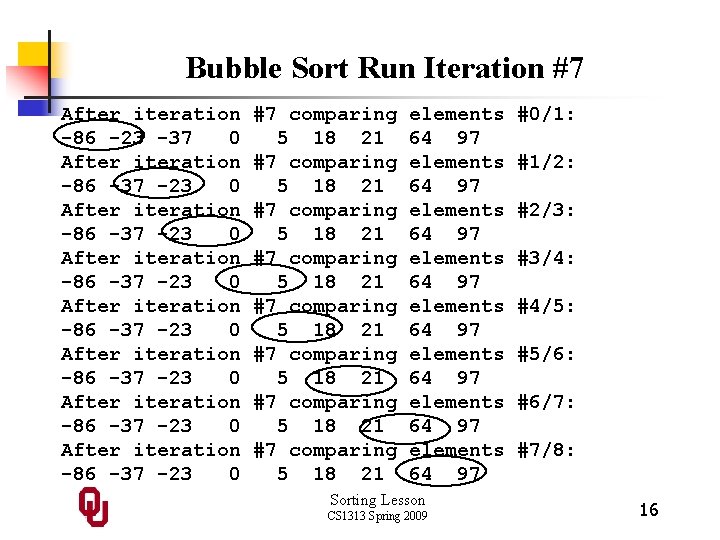
Bubble Sort Run Iteration #7 After iteration -86 -23 -37 0 After iteration -86 -37 -23 0 After iteration -86 -37 -23 0 #7 comparing 5 18 21 #7 comparing 5 18 21 elements 64 97 elements 64 97 Sorting Lesson CS 1313 Spring 2009 #0/1: #1/2: #2/3: #3/4: #4/5: #5/6: #6/7: #7/8: 16
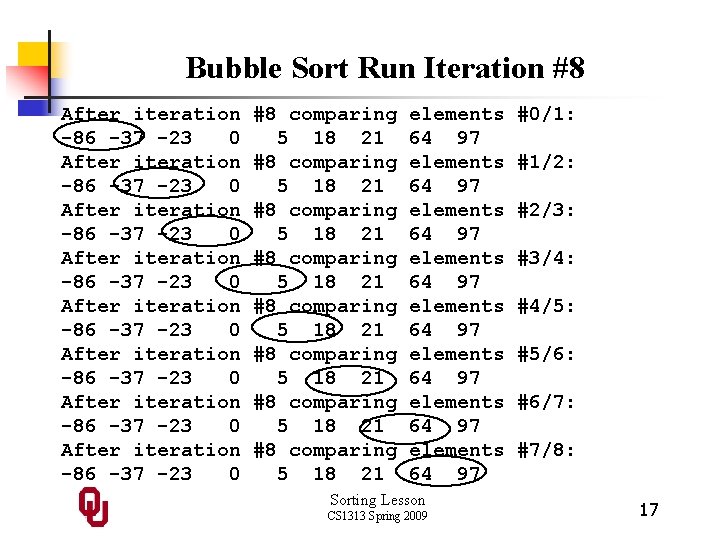
Bubble Sort Run Iteration #8 After iteration -86 -37 -23 0 After iteration -86 -37 -23 0 #8 comparing 5 18 21 #8 comparing 5 18 21 elements 64 97 elements 64 97 Sorting Lesson CS 1313 Spring 2009 #0/1: #1/2: #2/3: #3/4: #4/5: #5/6: #6/7: #7/8: 17
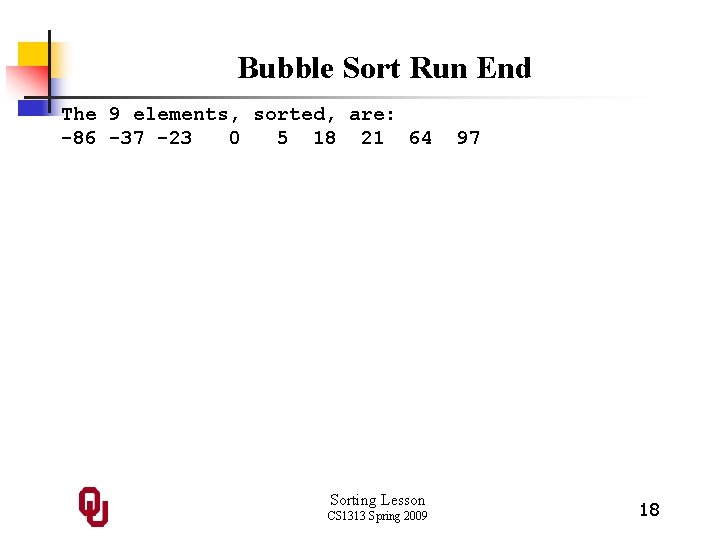
Bubble Sort Run End The 9 elements, sorted, are: -86 -37 -23 0 5 18 21 64 Sorting Lesson CS 1313 Spring 2009 97 18
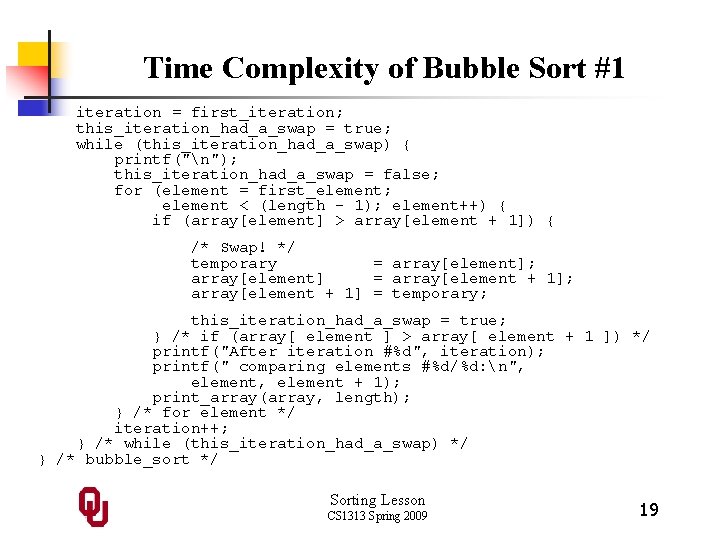
Time Complexity of Bubble Sort #1 iteration = first_iteration; this_iteration_had_a_swap = true; while (this_iteration_had_a_swap) { printf("n"); this_iteration_had_a_swap = false; for (element = first_element; element < (length - 1); element++) { if (array[element] > array[element + 1]) { /* Swap! */ temporary = array[element]; array[element] = array[element + 1]; array[element + 1] = temporary; this_iteration_had_a_swap = true; } /* if (array[ element ] > array[ element + 1 ]) */ printf("After iteration #%d", iteration); printf(" comparing elements #%d/%d: n", element + 1); print_array(array, length); } /* for element */ iteration++; } /* while (this_iteration_had_a_swap) */ } /* bubble_sort */ Sorting Lesson CS 1313 Spring 2009 19
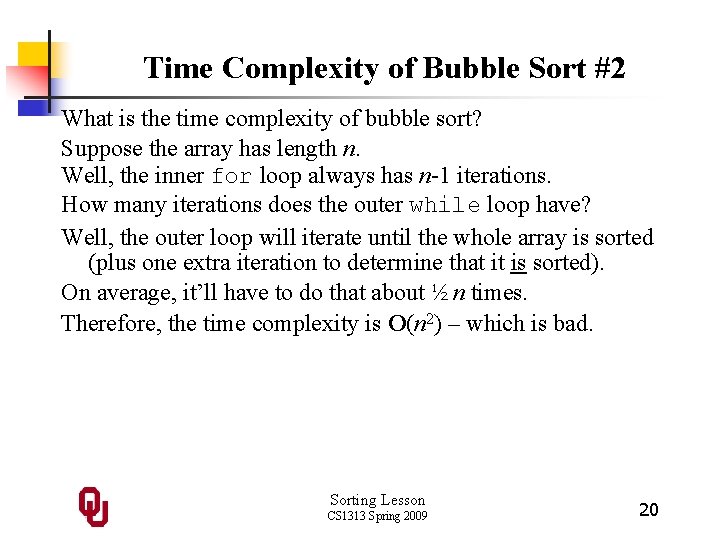
Time Complexity of Bubble Sort #2 What is the time complexity of bubble sort? Suppose the array has length n. Well, the inner for loop always has n-1 iterations. How many iterations does the outer while loop have? Well, the outer loop will iterate until the whole array is sorted (plus one extra iteration to determine that it is sorted). On average, it’ll have to do that about ½ n times. Therefore, the time complexity is O(n 2) – which is bad. Sorting Lesson CS 1313 Spring 2009 20
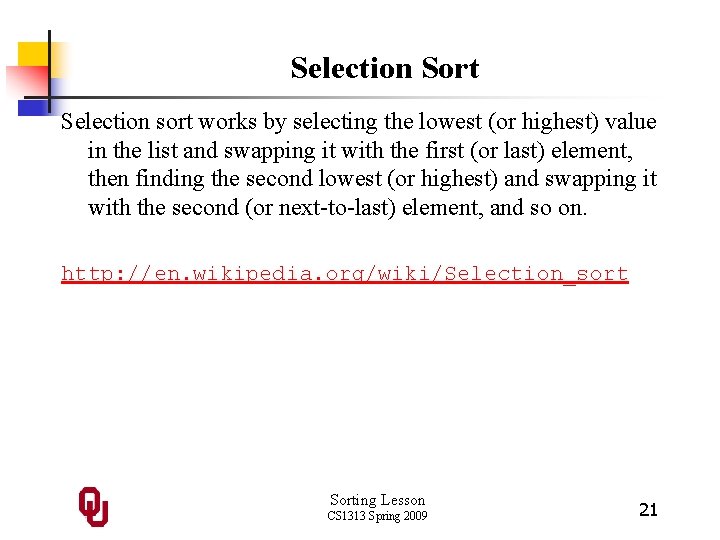
Selection Sort Selection sort works by selecting the lowest (or highest) value in the list and swapping it with the first (or last) element, then finding the second lowest (or highest) and swapping it with the second (or next-to-last) element, and so on. http: //en. wikipedia. org/wiki/Selection_sort Sorting Lesson CS 1313 Spring 2009 21
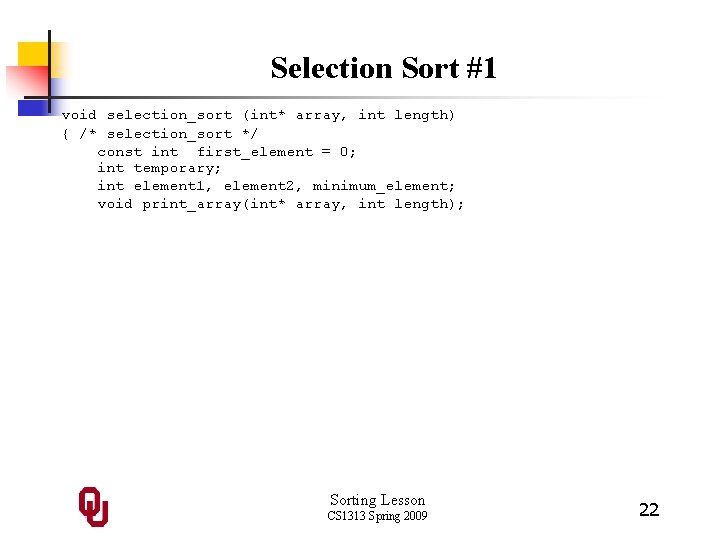
Selection Sort #1 void selection_sort (int* array, int length) { /* selection_sort */ const int first_element = 0; int temporary; int element 1, element 2, minimum_element; void print_array(int* array, int length); Sorting Lesson CS 1313 Spring 2009 22
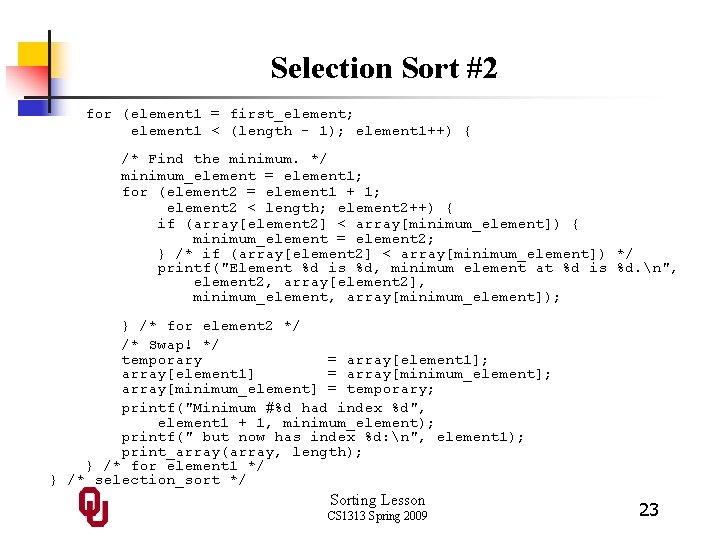
Selection Sort #2 for (element 1 = first_element; element 1 < (length - 1); element 1++) { /* Find the minimum. */ minimum_element = element 1; for (element 2 = element 1 + 1; element 2 < length; element 2++) { if (array[element 2] < array[minimum_element]) { minimum_element = element 2; } /* if (array[element 2] < array[minimum_element]) */ printf("Element %d is %d, minimum element at %d is %d. n", element 2, array[element 2], minimum_element, array[minimum_element]); } /* for element 2 */ /* Swap! */ temporary = array[element 1]; array[element 1] = array[minimum_element]; array[minimum_element] = temporary; printf("Minimum #%d had index %d", element 1 + 1, minimum_element); printf(" but now has index %d: n", element 1); print_array(array, length); } /* for element 1 */ } /* selection_sort */ Sorting Lesson CS 1313 Spring 2009 23
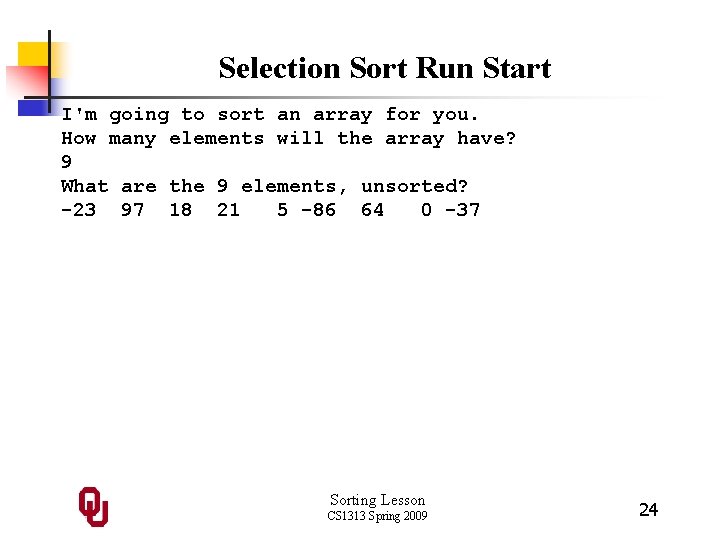
Selection Sort Run Start I'm going to sort an array for you. How many elements will the array have? 9 What are the 9 elements, unsorted? -23 97 18 21 5 -86 64 0 -37 Sorting Lesson CS 1313 Spring 2009 24
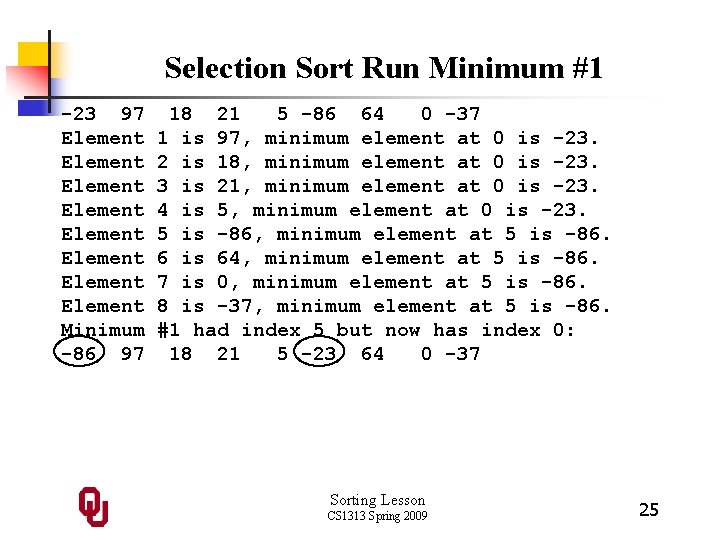
Selection Sort Run Minimum #1 -23 97 Element Element Minimum -86 97 18 21 5 -86 64 0 -37 1 is 97, minimum element at 0 is -23. 2 is 18, minimum element at 0 is -23. 3 is 21, minimum element at 0 is -23. 4 is 5, minimum element at 0 is -23. 5 is -86, minimum element at 5 is -86. 6 is 64, minimum element at 5 is -86. 7 is 0, minimum element at 5 is -86. 8 is -37, minimum element at 5 is -86. #1 had index 5 but now has index 0: 18 21 5 -23 64 0 -37 Sorting Lesson CS 1313 Spring 2009 25
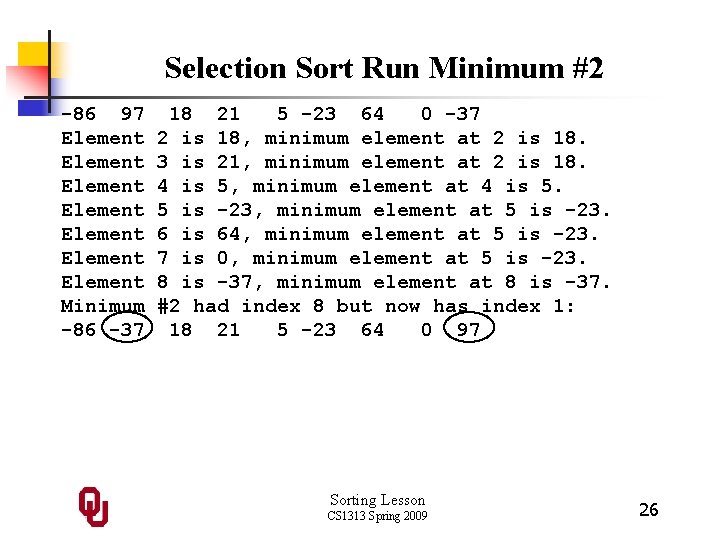
Selection Sort Run Minimum #2 -86 97 Element Element Minimum -86 -37 18 21 5 -23 64 0 -37 2 is 18, minimum element at 2 is 18. 3 is 21, minimum element at 2 is 18. 4 is 5, minimum element at 4 is 5. 5 is -23, minimum element at 5 is -23. 6 is 64, minimum element at 5 is -23. 7 is 0, minimum element at 5 is -23. 8 is -37, minimum element at 8 is -37. #2 had index 8 but now has index 1: 18 21 5 -23 64 0 97 Sorting Lesson CS 1313 Spring 2009 26
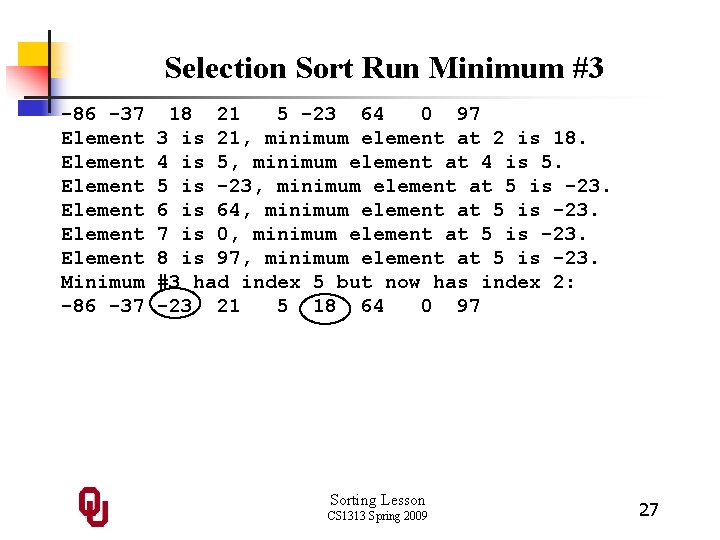
Selection Sort Run Minimum #3 -86 -37 Element Element Minimum -86 -37 18 21 5 -23 64 0 97 3 is 21, minimum element at 2 is 18. 4 is 5, minimum element at 4 is 5. 5 is -23, minimum element at 5 is -23. 6 is 64, minimum element at 5 is -23. 7 is 0, minimum element at 5 is -23. 8 is 97, minimum element at 5 is -23. #3 had index 5 but now has index 2: -23 21 5 18 64 0 97 Sorting Lesson CS 1313 Spring 2009 27
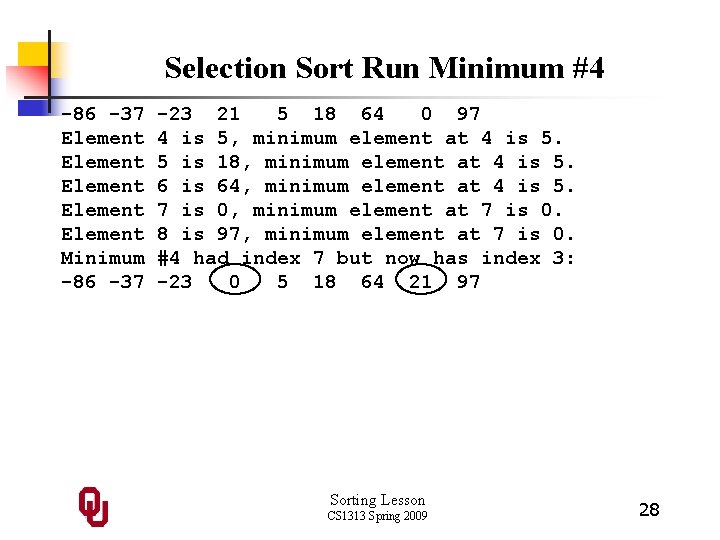
Selection Sort Run Minimum #4 -86 -37 Element Element Minimum -86 -37 -23 21 5 18 64 0 97 4 is 5, minimum element at 4 is 5. 5 is 18, minimum element at 4 is 5. 6 is 64, minimum element at 4 is 5. 7 is 0, minimum element at 7 is 0. 8 is 97, minimum element at 7 is 0. #4 had index 7 but now has index 3: -23 0 5 18 64 21 97 Sorting Lesson CS 1313 Spring 2009 28
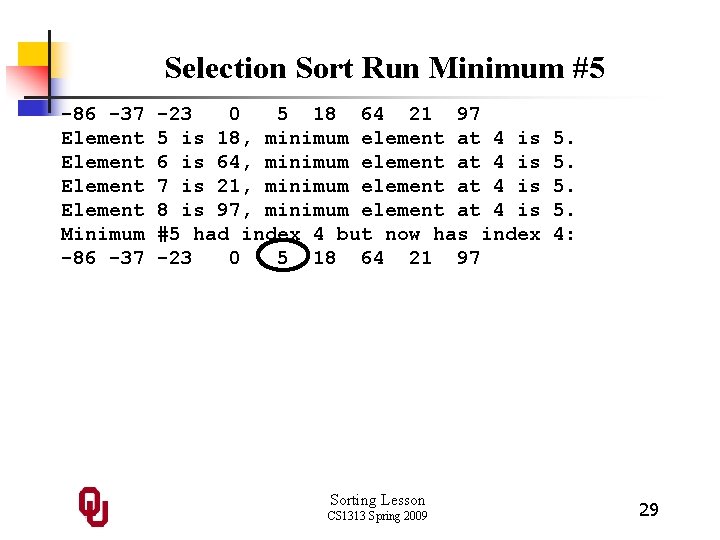
Selection Sort Run Minimum #5 -86 -37 Element Minimum -86 -37 -23 0 5 18 64 21 97 5 is 18, minimum element at 4 is 64, minimum element at 4 is 7 is 21, minimum element at 4 is 8 is 97, minimum element at 4 is #5 had index 4 but now has index -23 0 5 18 64 21 97 Sorting Lesson CS 1313 Spring 2009 5. 5. 4: 29
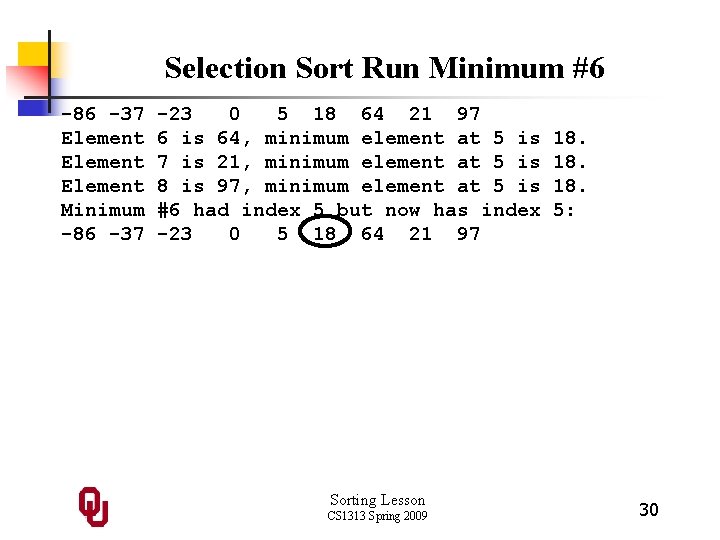
Selection Sort Run Minimum #6 -86 -37 Element Minimum -86 -37 -23 0 5 18 64 21 97 6 is 64, minimum element at 5 is 7 is 21, minimum element at 5 is 8 is 97, minimum element at 5 is #6 had index 5 but now has index -23 0 5 18 64 21 97 Sorting Lesson CS 1313 Spring 2009 18. 18. 5: 30
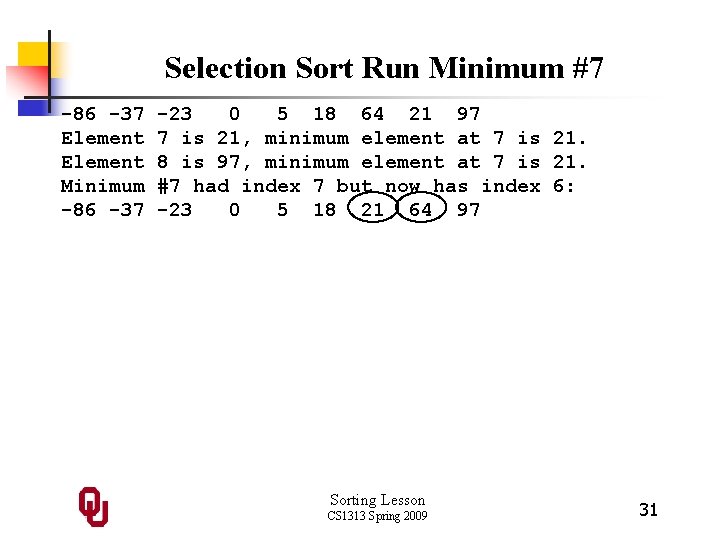
Selection Sort Run Minimum #7 -86 -37 Element Minimum -86 -37 -23 0 5 18 64 21 97 7 is 21, minimum element at 7 is 21. 8 is 97, minimum element at 7 is 21. #7 had index 7 but now has index 6: -23 0 5 18 21 64 97 Sorting Lesson CS 1313 Spring 2009 31
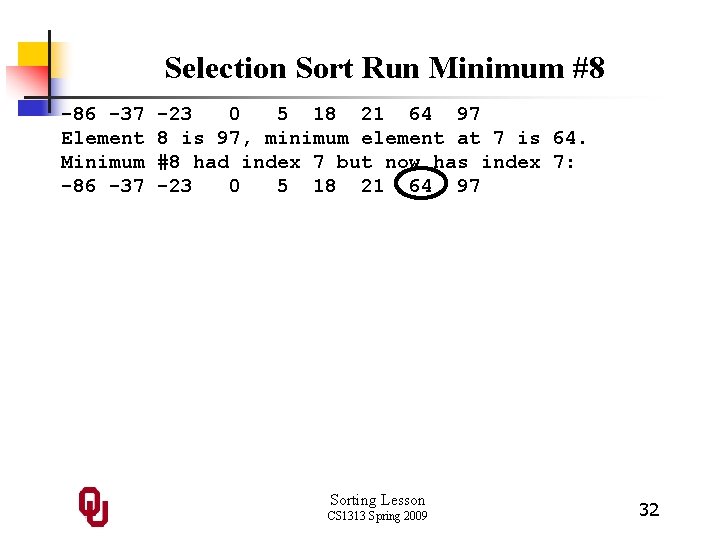
Selection Sort Run Minimum #8 -86 -37 Element Minimum -86 -37 -23 0 5 18 21 64 97 8 is 97, minimum element at 7 is 64. #8 had index 7 but now has index 7: -23 0 5 18 21 64 97 Sorting Lesson CS 1313 Spring 2009 32
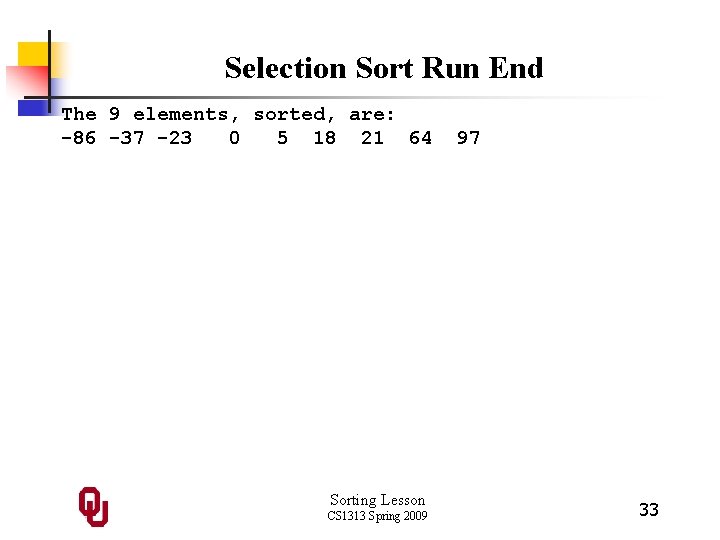
Selection Sort Run End The 9 elements, sorted, are: -86 -37 -23 0 5 18 21 64 Sorting Lesson CS 1313 Spring 2009 97 33
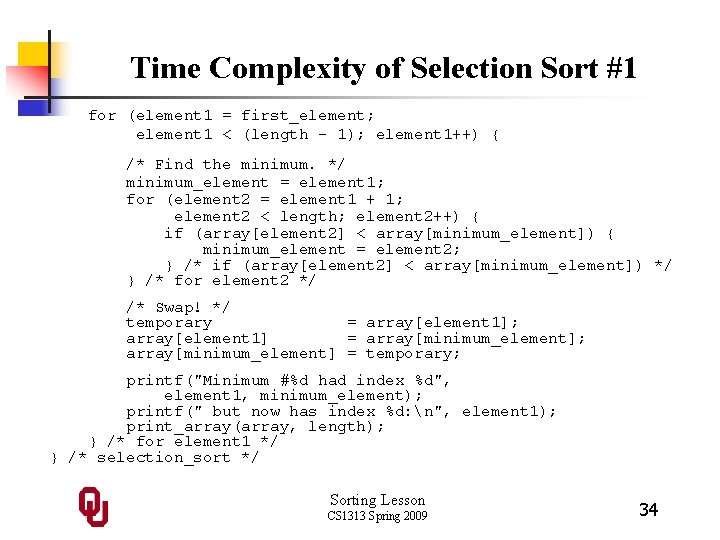
Time Complexity of Selection Sort #1 for (element 1 = first_element; element 1 < (length - 1); element 1++) { /* Find the minimum. */ minimum_element = element 1; for (element 2 = element 1 + 1; element 2 < length; element 2++) { if (array[element 2] < array[minimum_element]) { minimum_element = element 2; } /* if (array[element 2] < array[minimum_element]) */ } /* for element 2 */ /* Swap! */ temporary = array[element 1]; array[element 1] = array[minimum_element]; array[minimum_element] = temporary; printf("Minimum #%d had index %d", element 1, minimum_element); printf(" but now has index %d: n", element 1); print_array(array, length); } /* for element 1 */ } /* selection_sort */ Sorting Lesson CS 1313 Spring 2009 34
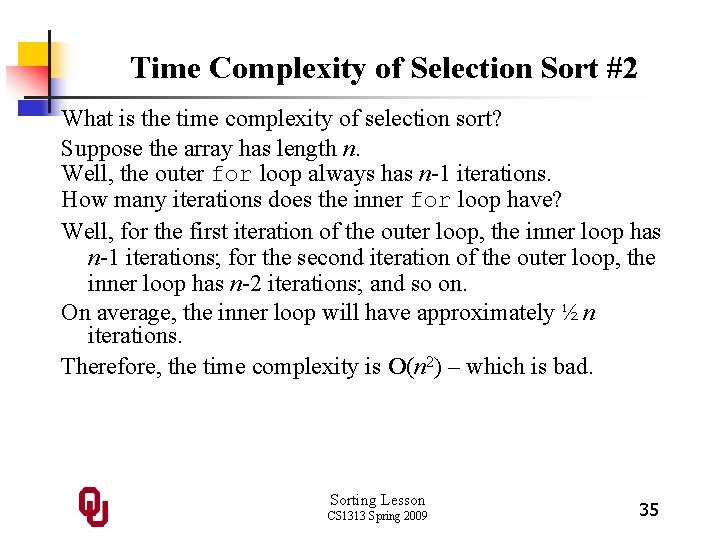
Time Complexity of Selection Sort #2 What is the time complexity of selection sort? Suppose the array has length n. Well, the outer for loop always has n-1 iterations. How many iterations does the inner for loop have? Well, for the first iteration of the outer loop, the inner loop has n-1 iterations; for the second iteration of the outer loop, the inner loop has n-2 iterations; and so on. On average, the inner loop will have approximately ½ n iterations. Therefore, the time complexity is O(n 2) – which is bad. Sorting Lesson CS 1313 Spring 2009 35
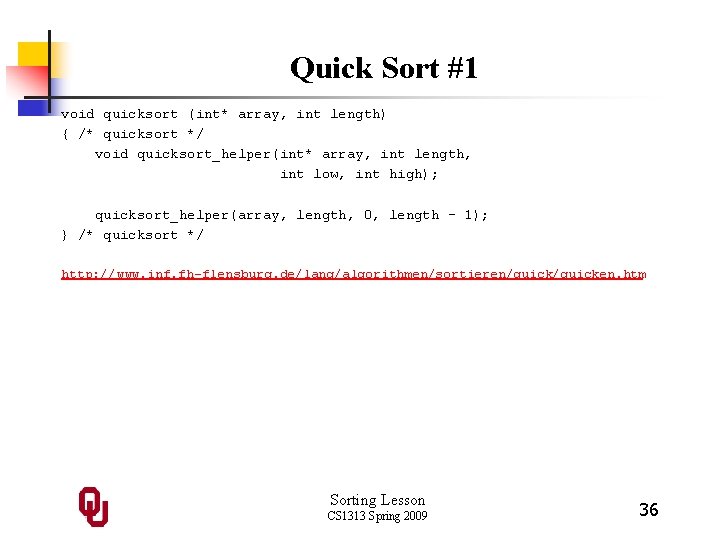
Quick Sort #1 void quicksort (int* array, int length) { /* quicksort */ void quicksort_helper(int* array, int length, int low, int high); quicksort_helper(array, length, 0, length - 1); } /* quicksort */ http: //www. inf. fh-flensburg. de/lang/algorithmen/sortieren/quicken. htm Sorting Lesson CS 1313 Spring 2009 36
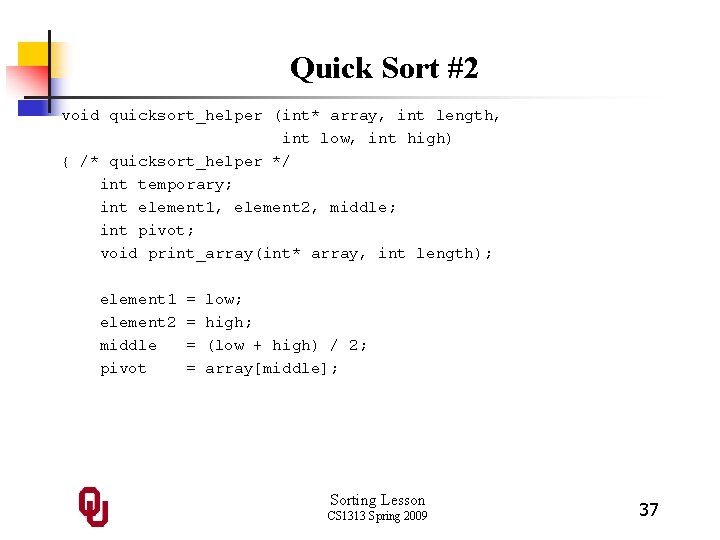
Quick Sort #2 void quicksort_helper (int* array, int length, int low, int high) { /* quicksort_helper */ int temporary; int element 1, element 2, middle; int pivot; void print_array(int* array, int length); element 1 element 2 middle pivot = = low; high; (low + high) / 2; array[middle]; Sorting Lesson CS 1313 Spring 2009 37
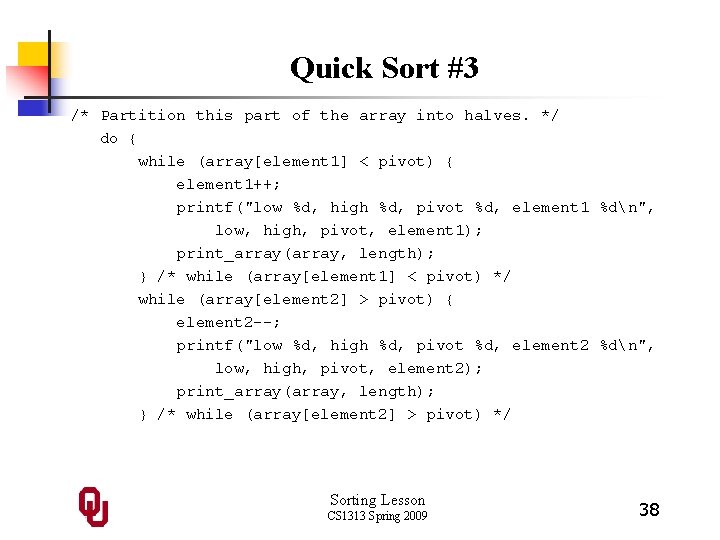
Quick Sort #3 /* Partition this part of the array into halves. */ do { while (array[element 1] < pivot) { element 1++; printf("low %d, high %d, pivot %d, element 1 %dn", low, high, pivot, element 1); print_array(array, length); } /* while (array[element 1] < pivot) */ while (array[element 2] > pivot) { element 2 --; printf("low %d, high %d, pivot %d, element 2 %dn", low, high, pivot, element 2); print_array(array, length); } /* while (array[element 2] > pivot) */ Sorting Lesson CS 1313 Spring 2009 38
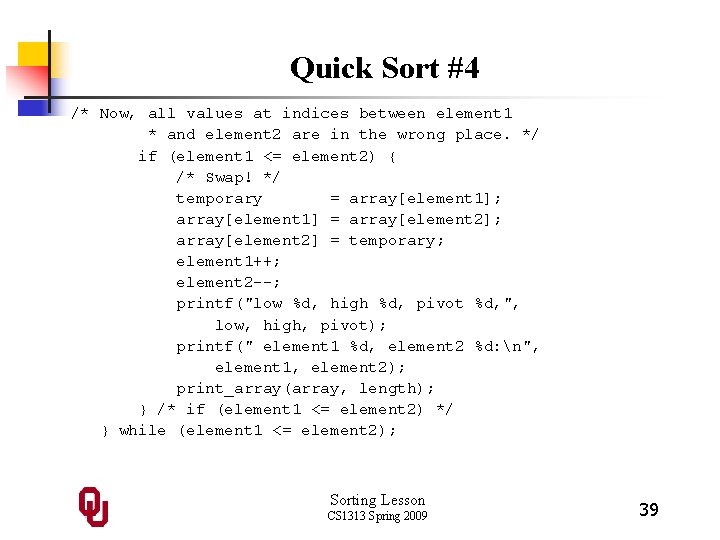
Quick Sort #4 /* Now, all values at indices between element 1 * and element 2 are in the wrong place. */ if (element 1 <= element 2) { /* Swap! */ temporary = array[element 1]; array[element 1] = array[element 2]; array[element 2] = temporary; element 1++; element 2 --; printf("low %d, high %d, pivot %d, ", low, high, pivot); printf(" element 1 %d, element 2 %d: n", element 1, element 2); print_array(array, length); } /* if (element 1 <= element 2) */ } while (element 1 <= element 2); Sorting Lesson CS 1313 Spring 2009 39
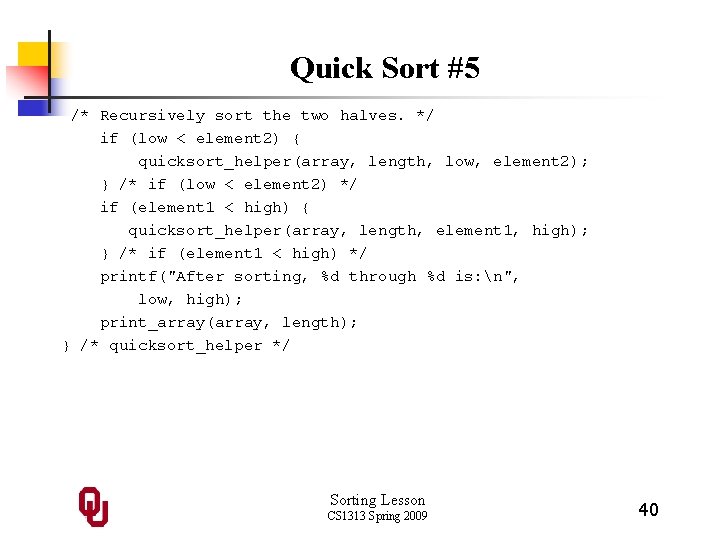
Quick Sort #5 /* Recursively sort the two halves. */ if (low < element 2) { quicksort_helper(array, length, low, element 2); } /* if (low < element 2) */ if (element 1 < high) { quicksort_helper(array, length, element 1, high); } /* if (element 1 < high) */ printf("After sorting, %d through %d is: n", low, high); print_array(array, length); } /* quicksort_helper */ Sorting Lesson CS 1313 Spring 2009 40
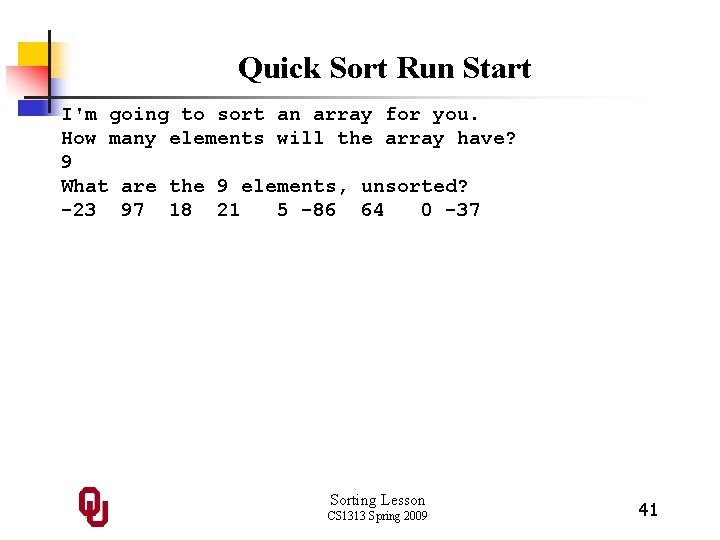
Quick Sort Run Start I'm going to sort an array for you. How many elements will the array have? 9 What are the 9 elements, unsorted? -23 97 18 21 5 -86 64 0 -37 Sorting Lesson CS 1313 Spring 2009 41
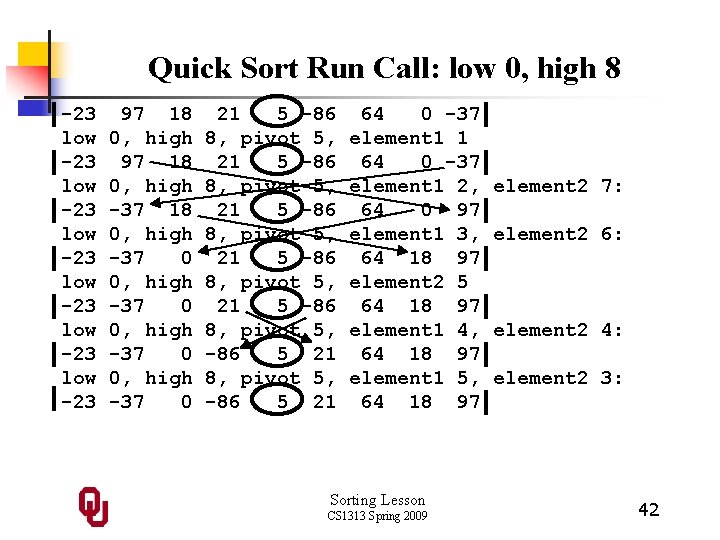
Quick Sort Run Call: low 0, high 8 -23 low -23 low -23 97 18 0, high -37 0 0, high -37 0 21 5 -86 8, pivot 5, 21 5 -86 8, pivot 5, -86 5 21 64 0 -37 element 1 2, 64 0 97 element 1 3, 64 18 97 element 2 5 64 18 97 element 1 4, 64 18 97 element 1 5, 64 18 97 Sorting Lesson CS 1313 Spring 2009 element 2 7: element 2 6: element 2 4: element 2 3: 42
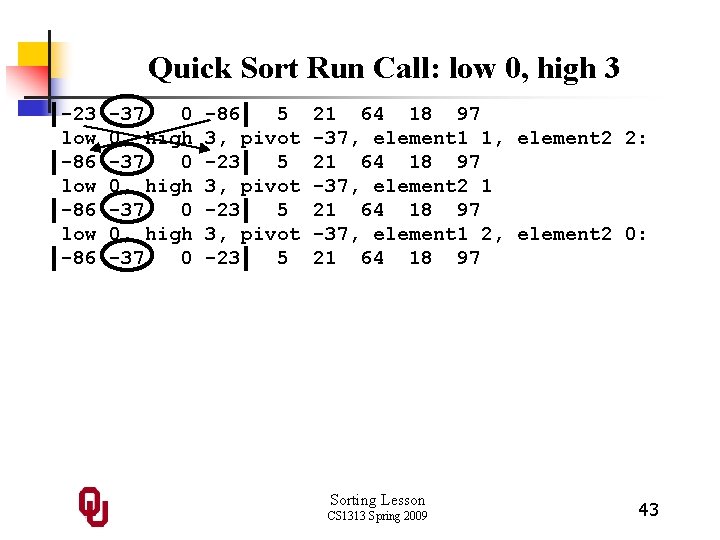
Quick Sort Run Call: low 0, high 3 -23 low -86 -37 0 0, high -37 0 -86 5 3, pivot -23 5 21 64 18 97 -37, element 1 1, element 2 2: 21 64 18 97 -37, element 2 1 21 64 18 97 -37, element 1 2, element 2 0: 21 64 18 97 Sorting Lesson CS 1313 Spring 2009 43
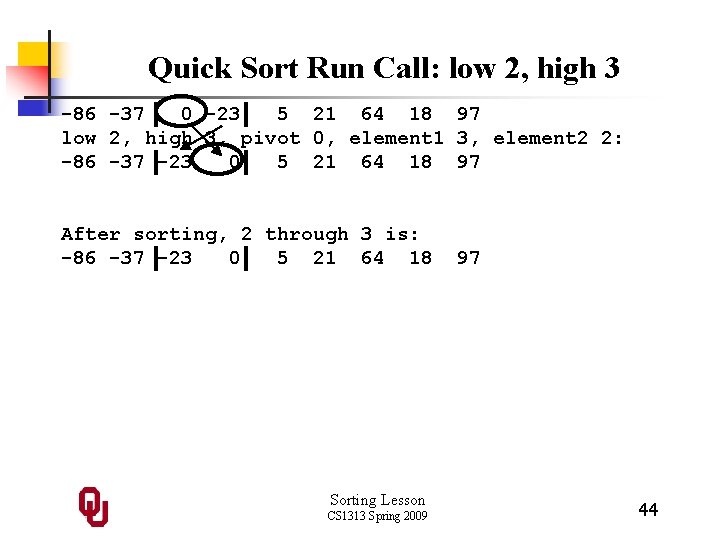
Quick Sort Run Call: low 2, high 3 -86 -37 0 -23 5 21 64 18 97 low 2, high 3, pivot 0, element 1 3, element 2 2: -86 -37 -23 0 5 21 64 18 97 After sorting, 2 through 3 is: -86 -37 -23 0 5 21 64 18 Sorting Lesson CS 1313 Spring 2009 97 44
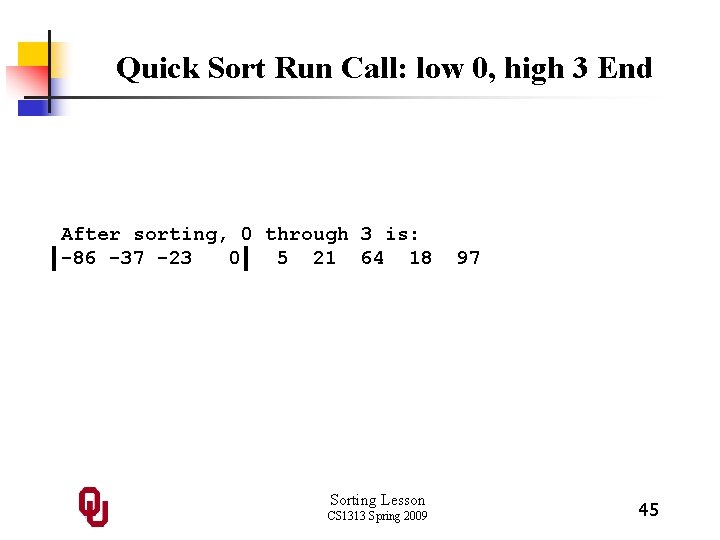
Quick Sort Run Call: low 0, high 3 End After sorting, 0 through 3 is: -86 -37 -23 0 5 21 64 18 Sorting Lesson CS 1313 Spring 2009 97 45
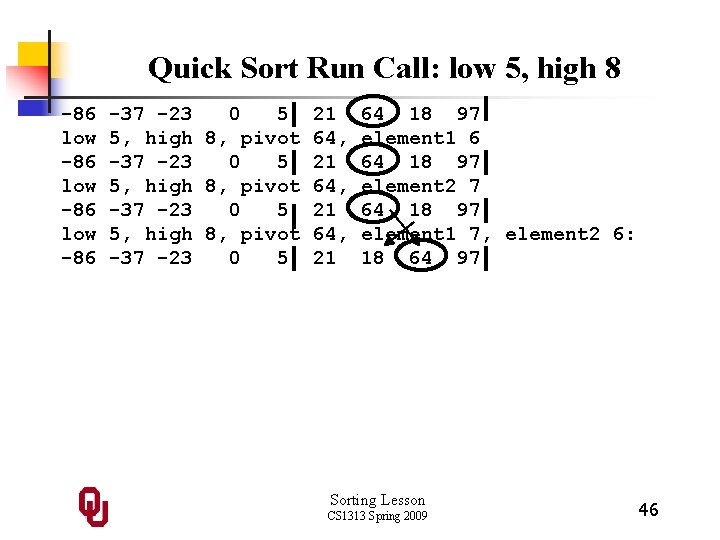
Quick Sort Run Call: low 5, high 8 -86 low -86 -37 -23 0 5 21 5, high 8, pivot 64, -37 -23 0 5 21 64 18 97 element 1 6 64 18 97 element 2 7 64 18 97 element 1 7, element 2 6: 18 64 97 Sorting Lesson CS 1313 Spring 2009 46
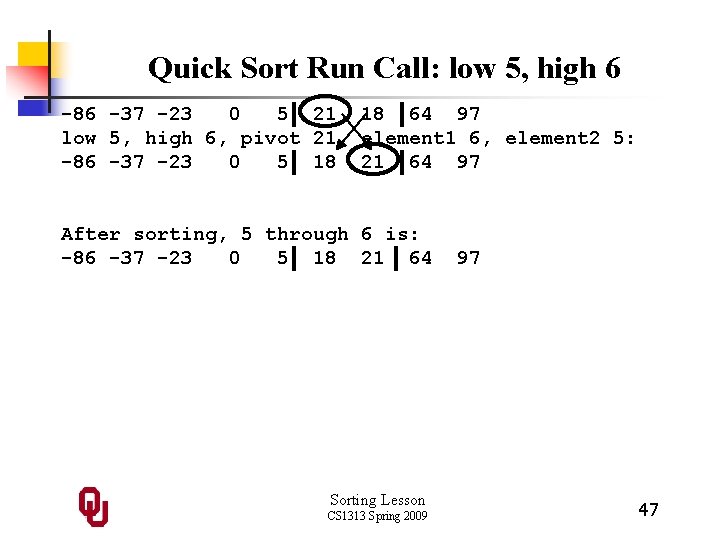
Quick Sort Run Call: low 5, high 6 -86 -37 -23 0 5 21 18 64 97 low 5, high 6, pivot 21, element 1 6, element 2 5: -86 -37 -23 0 5 18 21 64 97 After sorting, 5 through 6 is: -86 -37 -23 0 5 18 21 64 Sorting Lesson CS 1313 Spring 2009 97 47
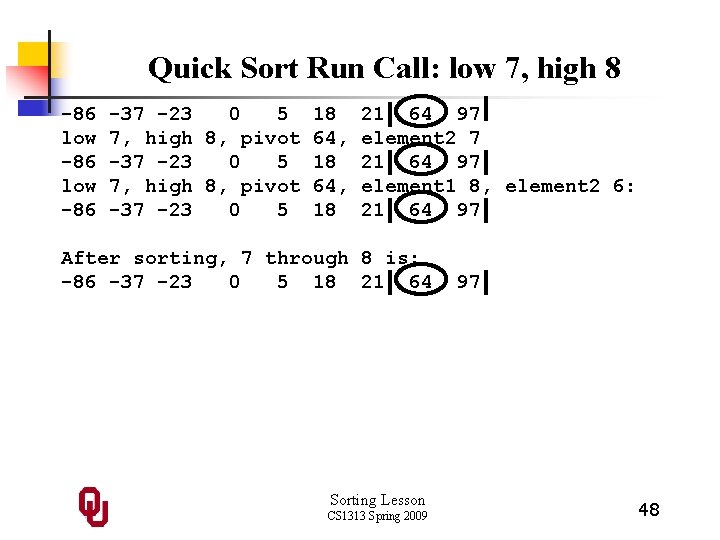
Quick Sort Run Call: low 7, high 8 -86 low -86 -37 -23 0 5 18 7, high 8, pivot 64, -37 -23 0 5 18 21 64 97 element 2 7 21 64 97 element 1 8, element 2 6: 21 64 97 After sorting, 7 through 8 is: -86 -37 -23 0 5 18 21 64 Sorting Lesson CS 1313 Spring 2009 97 48
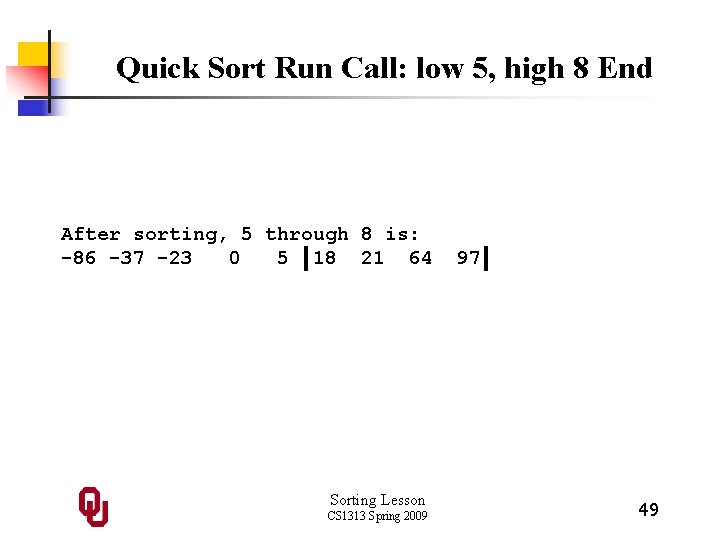
Quick Sort Run Call: low 5, high 8 End After sorting, 5 through 8 is: -86 -37 -23 0 5 18 21 64 Sorting Lesson CS 1313 Spring 2009 97 49
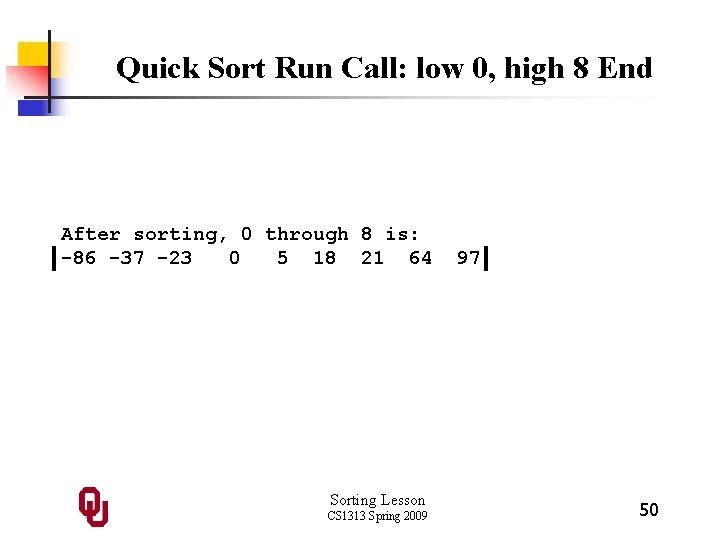
Quick Sort Run Call: low 0, high 8 End After sorting, 0 through 8 is: -86 -37 -23 0 5 18 21 64 Sorting Lesson CS 1313 Spring 2009 97 50
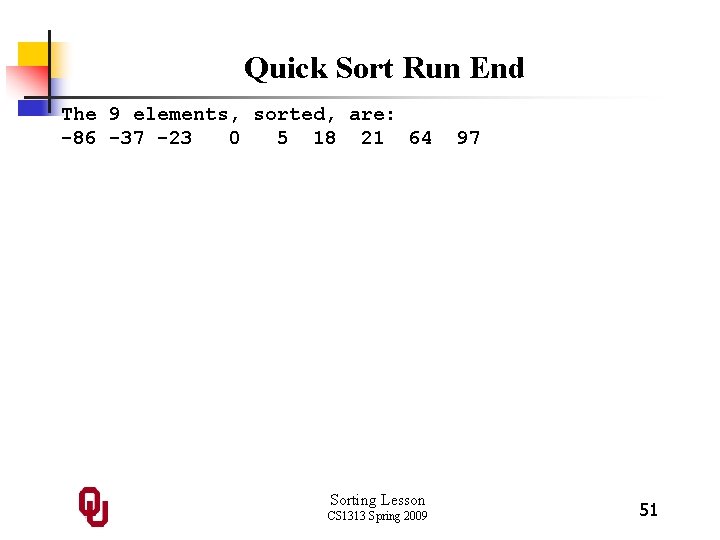
Quick Sort Run End The 9 elements, sorted, are: -86 -37 -23 0 5 18 21 64 Sorting Lesson CS 1313 Spring 2009 97 51
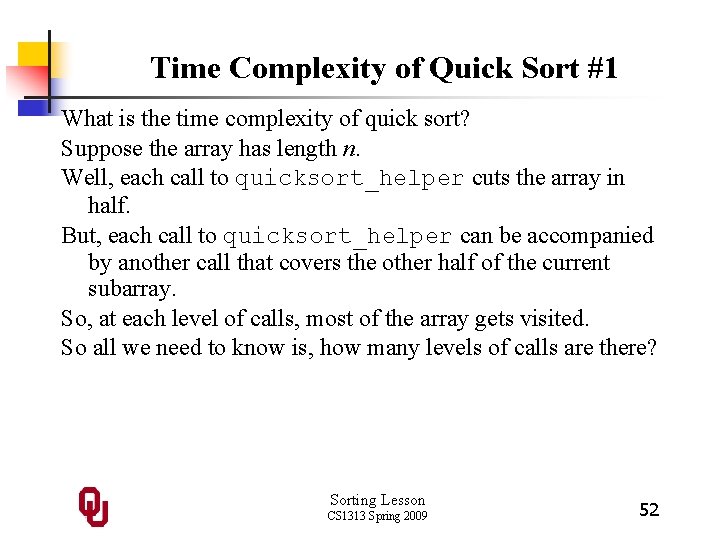
Time Complexity of Quick Sort #1 What is the time complexity of quick sort? Suppose the array has length n. Well, each call to quicksort_helper cuts the array in half. But, each call to quicksort_helper can be accompanied by another call that covers the other half of the current subarray. So, at each level of calls, most of the array gets visited. So all we need to know is, how many levels of calls are there? Sorting Lesson CS 1313 Spring 2009 52
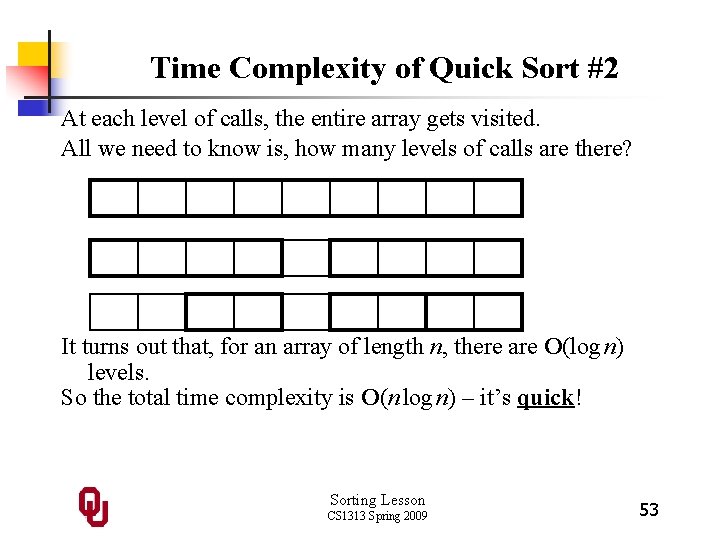
Time Complexity of Quick Sort #2 At each level of calls, the entire array gets visited. All we need to know is, how many levels of calls are there? It turns out that, for an array of length n, there are O(log n) levels. So the total time complexity is O(n log n) – it’s quick! Sorting Lesson CS 1313 Spring 2009 53