
Sorting and Shuffling Arrays CS 233 G Intermediate
![In Code int arr[5]={1, 2, 5, 4, 3}, i. Tmp; i. Tmp = arr[4];](https://slidetodoc.com/presentation_image_h2/50fa40c045eb9d70ba6ad3e4210b9668/image-8.jpg "In Code int arr[5]={1, 2, 5, 4, 3}, i. Tmp; i. Tmp = arr[4];")
![In C++ Playing. Card *tmp. Card, *deck[52]; . . . for(i=0; i<shfls; i++){ ndx](https://slidetodoc.com/presentation_image_h2/50fa40c045eb9d70ba6ad3e4210b9668/image-19.jpg "In C++ Playing. Card *tmp. Card, *deck[52]; . . . for(i=0; i<shfls; i++){ ndx")
- Slides: 20
Sorting and Shuffling Arrays CS 233 G Intermediate C++ Programming for Games
Linear Search • You already know how to do this • Start at the beginning and go through the array until you find what you're looking for • For min or max, you have to process the whole array • For a specific item, you stop when you find it
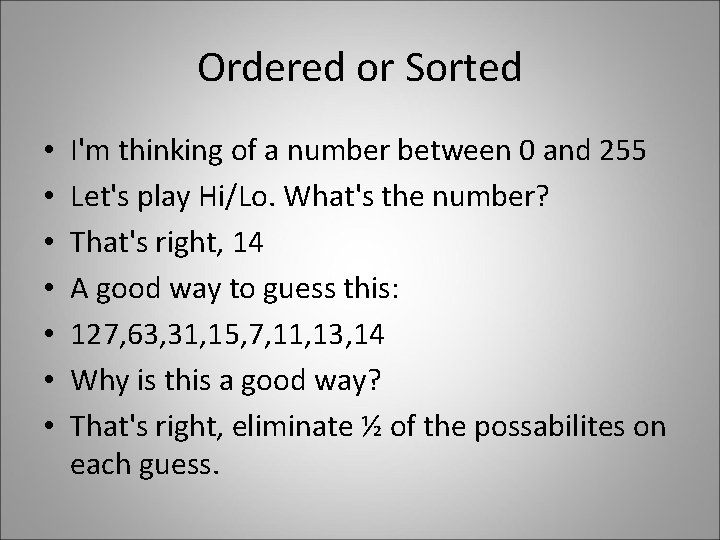
Ordered or Sorted • • I'm thinking of a number between 0 and 255 Let's play Hi/Lo. What's the number? That's right, 14 A good way to guess this: 127, 63, 31, 15, 7, 11, 13, 14 Why is this a good way? That's right, eliminate ½ of the possabilites on each guess.
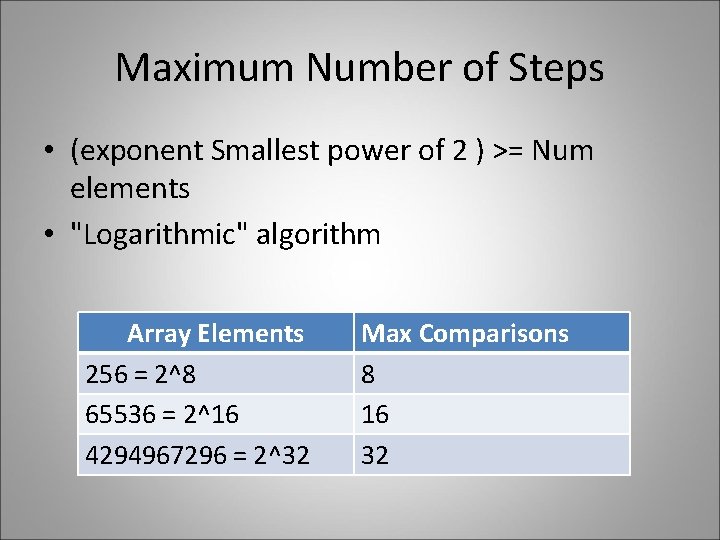
Maximum Number of Steps • (exponent Smallest power of 2 ) >= Num elements • "Logarithmic" algorithm Array Elements 256 = 2^8 65536 = 2^16 4294967296 = 2^32 Max Comparisons 8 16 32
Let's Look at Some Code • Bin. Search. cpp
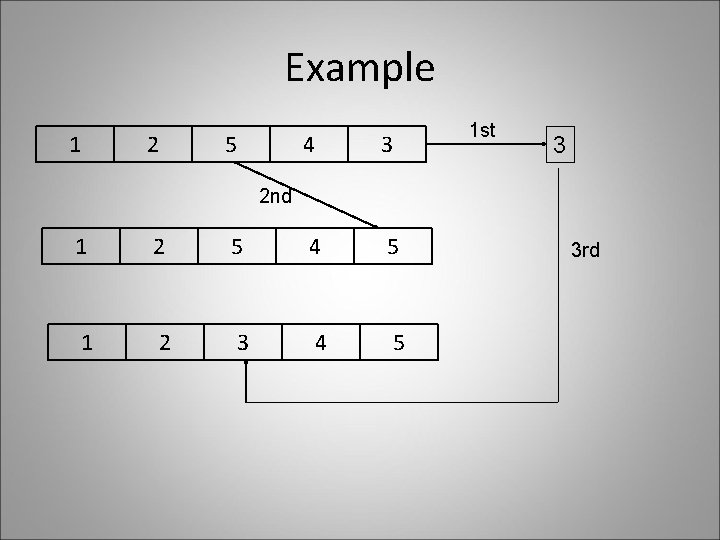
Exchanging 2 Array Elements • You have to have an a place to hold the first element while the second element is moved into its place • The first element can then be moved into the second element's original place
Example 1 2 5 4 3 1 st 3 2 nd 1 2 5 4 5 1 2 3 4 5 3 rd
In Code int arr[5]={1, 2, 5, 4, 3}, i. Tmp; i. Tmp = arr[4]; arr[4] = arr[2]; arr[2] = i. Tmp; • Notice that the array subscripts arrange on the diagonaly
In Place Manipulation • What we just did was rearrange data in place • We worked with the existing array
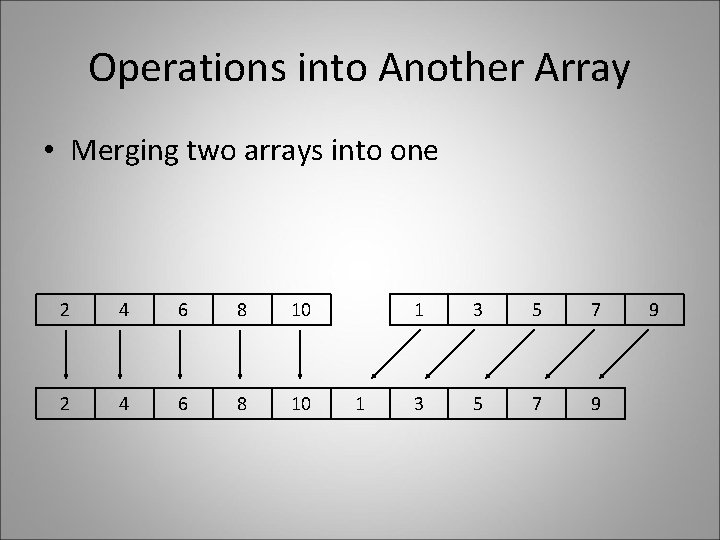
Operations into Another Array • Merging two arrays into one 2 4 6 8 10 1 1 3 5 7 9 9
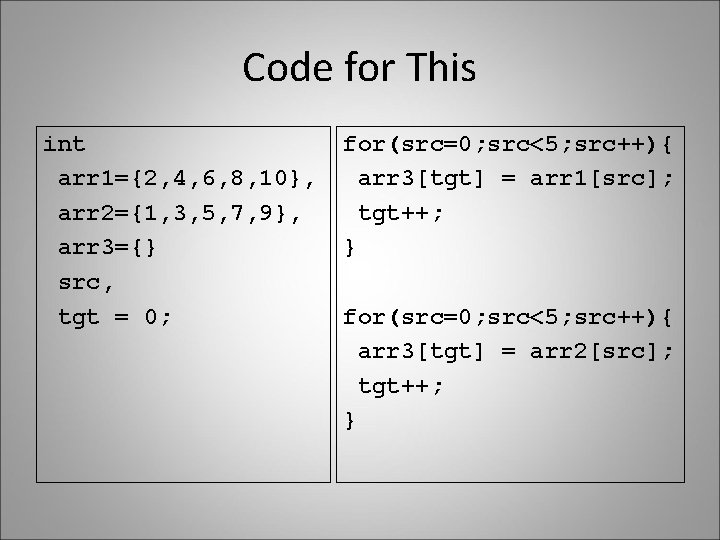
Code for This int arr 1={2, 4, 6, 8, 10}, arr 2={1, 3, 5, 7, 9}, arr 3={} src, tgt = 0; for(src=0; src<5; src++){ arr 3[tgt] = arr 1[src]; tgt++; } for(src=0; src<5; src++){ arr 3[tgt] = arr 2[src]; tgt++; }
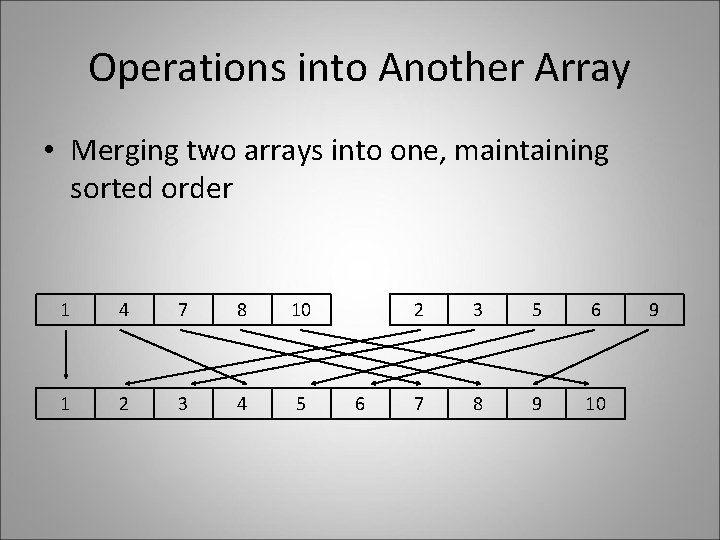
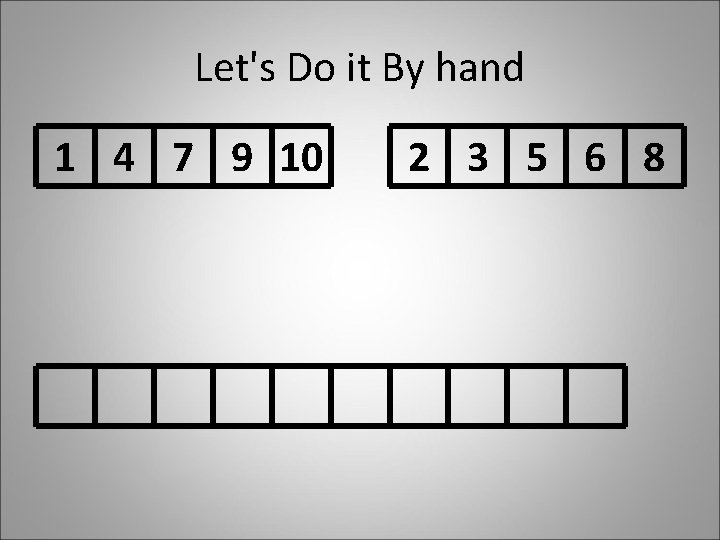
Operations into Another Array • Merging two arrays into one, maintaining sorted order 1 4 7 8 10 1 2 3 4 5 6 2 3 5 6 7 8 9 10 9
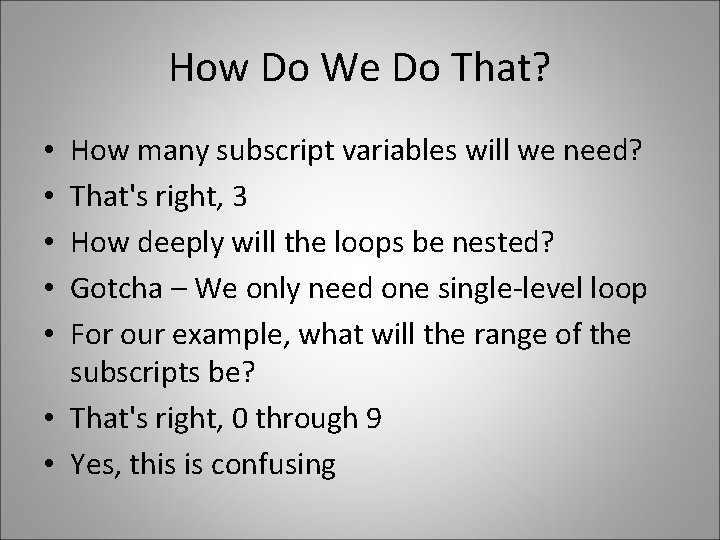
How Do We Do That? How many subscript variables will we need? That's right, 3 How deeply will the loops be nested? Gotcha – We only need one single-level loop For our example, what will the range of the subscripts be? • That's right, 0 through 9 • Yes, this is confusing • • •
Let's Do it By hand 1 4 7 9 10 2 3 5 6 8
How to do this in Code • You think that's going to fit in 2 panels on a slide? • Think again • Let's look at Merge. Sorted. cpp
Sorting/Exchanging Objects • You can sort based on anything you want • All you need is a relation based on value(s) in your data • The type of the data you sort or exchange can be anything • Even an object
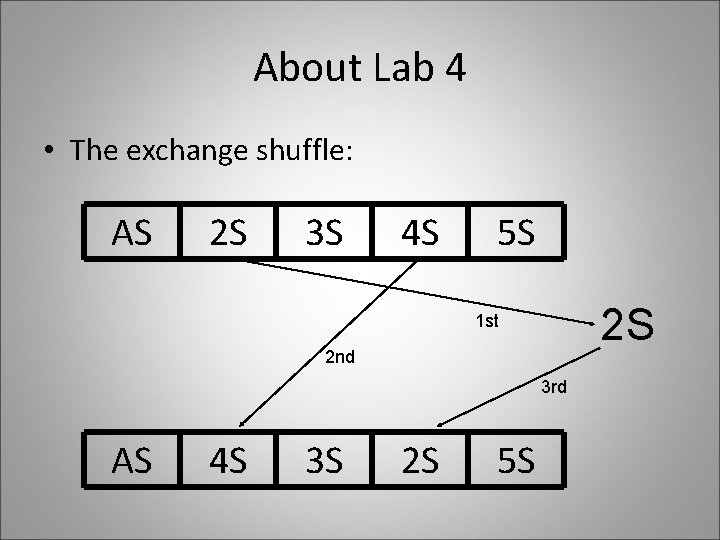
About Lab 4 • The exchange shuffle: AS 2 S 3 S 4 S 5 S 2 S 1 st 2 nd 3 rd AS 4 S 3 S 2 S 5 S
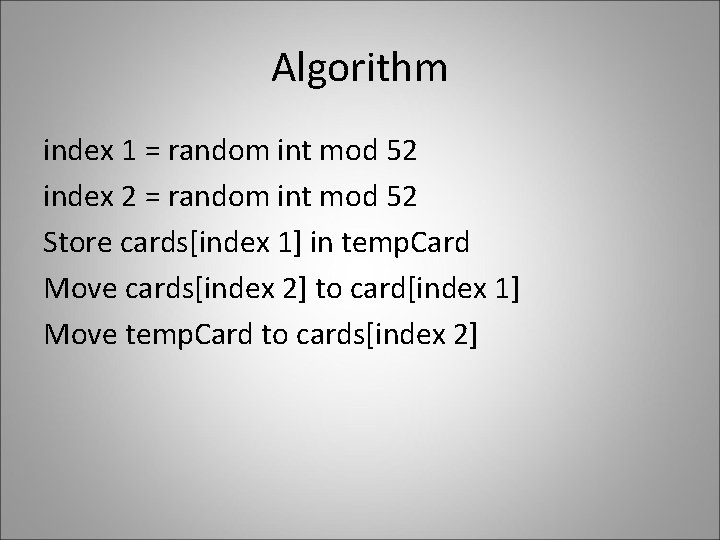
Algorithm index 1 = random int mod 52 index 2 = random int mod 52 Store cards[index 1] in temp. Card Move cards[index 2] to card[index 1] Move temp. Card to cards[index 2]
In C++ Playing. Card *tmp. Card, *deck[52]; . . . for(i=0; i<shfls; i++){ ndx 1=rand()%52; while((ndx 2=rand()%52) == ndx 1); tmp. Card = deck[ndx 1]; deck[ndx 1] = deck[ndx 2]; deck[ndx 2] = tmp. Card; }
Interleave Shuffle • How many arrays do you need? • How many arrays are you allowed? • How do you determine the number of cards to interleave? • How do you make sure you don't go beyond the bounds of the halves of the deck? • Do you count up or down?