
Sorting and Searching Initially prepared by Dr Ilyas
Sorting and Searching Initially prepared by Dr. Ilyas Cicekli; improved by various Bilkent CS 202 instructors. 10/20/2021 CS 202 - Fundamentals of Computer Science II 1

Problem of the Day 10/20/2021 CS 202 - Fundamentals of Computer Science II 2
![Sequential Search int sequential. Search( const int a[], int item, int n){ for (int](http://slidetodoc.com/presentation_image_h2/d8380cd80735a8adc9cbf513cf8d86f4/image-3.jpg "Sequential Search int sequential. Search( const int a[], int item, int n){ for (int")
Sequential Search int sequential. Search( const int a[], int item, int n){ for (int i = 0; i < n && a[i]!= item; i++); if (i == n) return – 1; return i; } Unsuccessful Search: O(n) Successful Search: Best-Case: item is in the first location of the array O(1) Worst-Case: item is in the last location of the array O(n) Average-Case: The number of key comparisons 1, 2, . . . , n O(n) 10/20/2021 CS 202 - Fundamentals of Computer Science II 3
![Binary Search int binary. Search( int a[], int size, int x) { int low](http://slidetodoc.com/presentation_image_h2/d8380cd80735a8adc9cbf513cf8d86f4/image-4.jpg "Binary Search int binary. Search( int a[], int size, int x) { int low")
Binary Search int binary. Search( int a[], int size, int x) { int low =0; int high = size – 1; int mid; // mid will be the index of // target when it’s found. while (low <= high) { mid = (low + high)/2; if (a[mid] < x) low = mid + 1; else if (a[mid] > x) high = mid – 1; else return mid; } return – 1; } 10/20/2021 CS 202 - Fundamentals of Computer Science II 4

Binary Search – Analysis • For an unsuccessful search: – The number of iterations in the loop is log 2 n + 1 O(log 2 n) • For a successful search: – Best-Case: The number of iterations is 1 O(1) – Worst-Case: The number of iterations is log 2 n +1 O(log 2 n) – Average-Case: The avg. # of iterations < log 2 n O(log 2 n) 0 3 1 2 2 3 3 1 4 3 5 2 6 3 7 4 an array with size 8 # of iterations The average # of iterations = 21/8 < log 28 10/20/2021 CS 202 - Fundamentals of Computer Science II 5
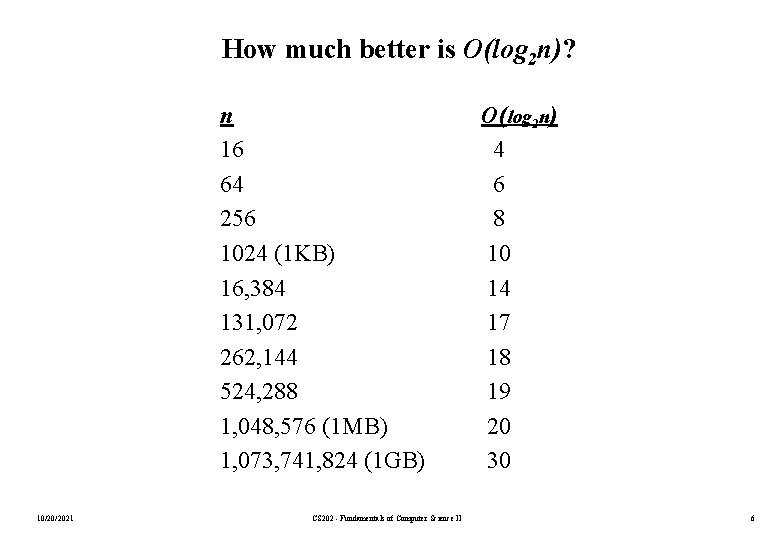
How much better is O(log 2 n)? n 16 64 256 1024 (1 KB) 16, 384 131, 072 262, 144 524, 288 1, 048, 576 (1 MB) 1, 073, 741, 824 (1 GB) 10/20/2021 CS 202 - Fundamentals of Computer Science II O(log 2 n) 4 6 8 10 14 17 18 19 20 30 6
Sorting 10/20/2021 CS 202 - Fundamentals of Computer Science II 7
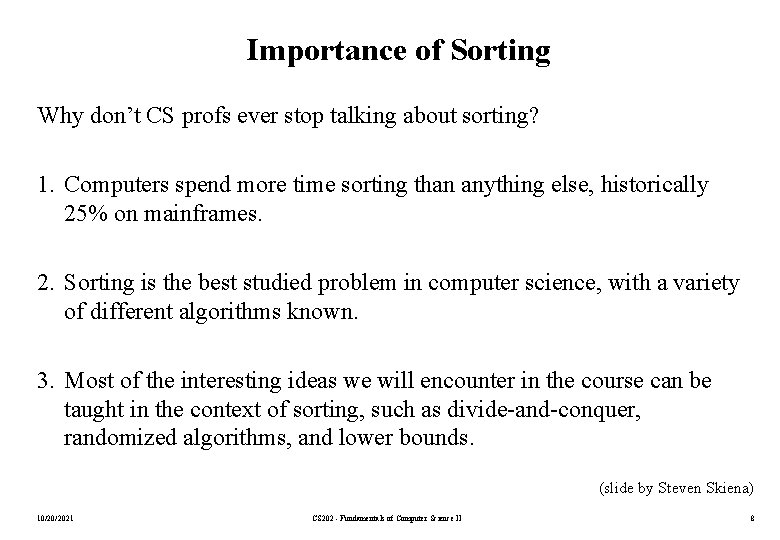
Importance of Sorting Why don’t CS profs ever stop talking about sorting? 1. Computers spend more time sorting than anything else, historically 25% on mainframes. 2. Sorting is the best studied problem in computer science, with a variety of different algorithms known. 3. Most of the interesting ideas we will encounter in the course can be taught in the context of sorting, such as divide-and-conquer, randomized algorithms, and lower bounds. (slide by Steven Skiena) 10/20/2021 CS 202 - Fundamentals of Computer Science II 8

Sorting • Organize data into ascending / descending order – Useful in many applications – Any examples can you think of? • Internal sort vs. external sort – We will analyze only internal sorting algorithms • Sorting also has other uses. It can make an algorithm faster. – e. g. , find the intersection of two sets 10/20/2021 CS 202 - Fundamentals of Computer Science II 9

Efficiency of Sorting • Sorting is important because that once a set of items is sorted, many other problems become easy. • Further, using O(n log n) sorting algorithms leads naturally to subquadratic algorithms for these problems. • Large-scale data processing would be impossible if sorting took O(n 2) time. (slide by Steven Skiena) 10/20/2021 CS 202 - Fundamentals of Computer Science II 10

Applications of Sorting • Closest Pair: Given n numbers, find the pair which are closest to each other. – Once the numbers are sorted, the closest pair will be next to each other in sorted order, so an O(n) linear scan completes the job. – Complexity of this process: O(? ? ) • Element Uniqueness: Given a set of n items, are they all unique or are there any duplicates? – Sort them and do a linear scan to check all adjacent pairs. – This is a special case of closest pair above. – Complexity? • Mode: Given a set of n items, which element occurs the largest number of times? More generally, compute the frequency distribution. – How would you solve it? 10/20/2021 CS 202 - Fundamentals of Computer Science II 11

Sorting Algorithms • There are many sorting algorithms, such as: – Selection Sort – Insertion Sort – Bubble Sort – Merge Sort – Quick Sort • First three sorting algorithms are not so efficient, but last two are efficient sorting algorithms. 10/20/2021 CS 202 - Fundamentals of Computer Science II 12
Selection Sort 10/20/2021 CS 202 - Fundamentals of Computer Science II 13
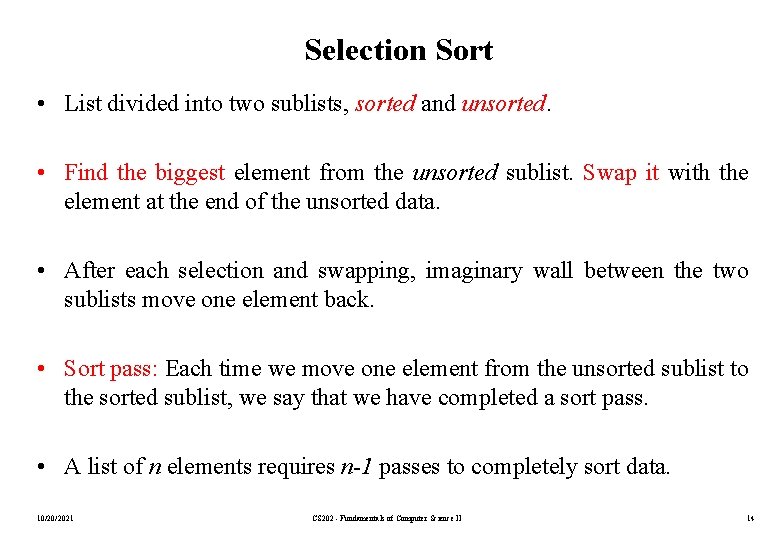
Selection Sort • List divided into two sublists, sorted and unsorted. • Find the biggest element from the unsorted sublist. Swap it with the element at the end of the unsorted data. • After each selection and swapping, imaginary wall between the two sublists move one element back. • Sort pass: Each time we move one element from the unsorted sublist to the sorted sublist, we say that we have completed a sort pass. • A list of n elements requires n-1 passes to completely sort data. 10/20/2021 CS 202 - Fundamentals of Computer Science II 14
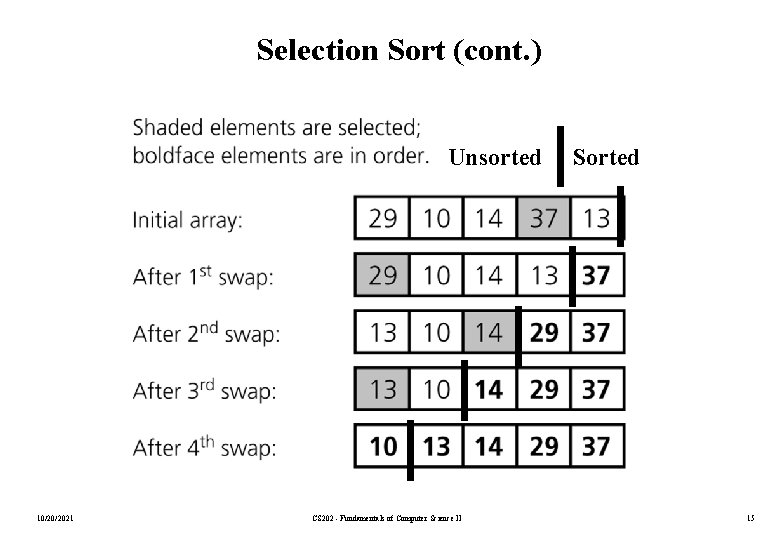
Selection Sort (cont. ) Unsorted 10/20/2021 CS 202 - Fundamentals of Computer Science II Sorted 15
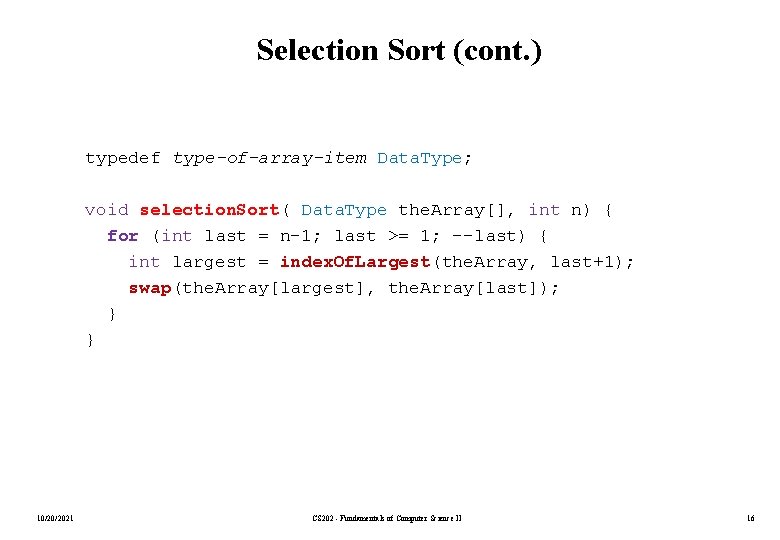
Selection Sort (cont. ) typedef type-of-array-item Data. Type; void selection. Sort( Data. Type the. Array[], int n) { for (int last = n-1; last >= 1; --last) { int largest = index. Of. Largest(the. Array, last+1); swap(the. Array[largest], the. Array[last]); } } 10/20/2021 CS 202 - Fundamentals of Computer Science II 16
![Selection Sort (cont. ) int index. Of. Largest(const Data. Type the. Array[], int size)](http://slidetodoc.com/presentation_image_h2/d8380cd80735a8adc9cbf513cf8d86f4/image-17.jpg "Selection Sort (cont. ) int index. Of. Largest(const Data. Type the. Array[], int size)")
Selection Sort (cont. ) int index. Of. Largest(const Data. Type the. Array[], int size) { int index. So. Far = 0; for (int current. Index=1; current. Index<size; ++current. Index) { if (the. Array[current. Index] > the. Array[index. So. Far]) index. So. Far = current. Index; } return index. So. Far; } ----------------------------void swap(Data. Type &x, Data. Type &y) { Data. Type temp = x; x = y; y = temp; } 10/20/2021 CS 202 - Fundamentals of Computer Science II 17
Selection Sort -- Analysis • To analyze sorting, count simple operations • For sorting, important simple operations: key comparisons and number of moves • In selection. Sort() function, the for loop executes n-1 times. • In selection. Sort() function, we invoke swap() once at each iteration. Total Swaps: n-1 Total Moves: 3*(n-1) (Each swap has three moves) 10/20/2021 CS 202 - Fundamentals of Computer Science II 18
Selection Sort – Analysis (cont. ) • In index. Of. Largest() function, the for loop executes (from n-1 to 1), and each iteration we make one key comparison. # of key comparisons = 1+2+. . . +n-1 = n*(n-1)/2 So, Selection sort is O(n 2) • The best case, worst case, and average case are the same all O(n 2) – Meaning: behavior of selection sort does not depend on initial organization of data. – Since O(n 2) grows so rapidly, the selection sort algorithm is appropriate only for small n. • Although selection sort requires O(n 2) key comparisons, it only requires O(n) moves. – Selection sort is good choice if data moves are costly but key comparisons are not costly (short keys, long records). 10/20/2021 CS 202 - Fundamentals of Computer Science II 19
Insertion Sort 10/20/2021 CS 202 - Fundamentals of Computer Science II 20

Insertion Sort • Insertion sort is a simple sorting algorithm appropriate for small inputs. – Most common sorting technique used by card players. • List divided into two parts: sorted and unsorted. • In each pass, the first element of the unsorted part is picked up, transferred to the sorted sublist, and inserted in place. • List of n elements will take at most n-1 passes to sort data. 10/20/2021 CS 202 - Fundamentals of Computer Science II 21
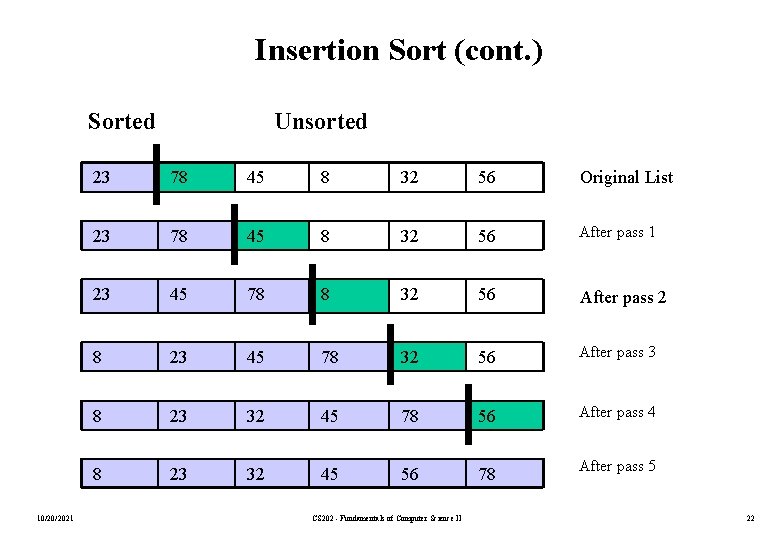
Insertion Sort (cont. ) Sorted 10/20/2021 Unsorted 23 78 45 8 32 56 Original List 23 78 45 8 32 56 After pass 1 23 45 78 8 32 56 After pass 2 8 23 45 78 32 56 After pass 3 8 23 32 45 78 56 After pass 4 8 23 32 45 56 78 After pass 5 CS 202 - Fundamentals of Computer Science II 22
![Insertion Sort (cont. ) void insertion. Sort(Data. Type the. Array[], int n) { for](http://slidetodoc.com/presentation_image_h2/d8380cd80735a8adc9cbf513cf8d86f4/image-23.jpg "Insertion Sort (cont. ) void insertion. Sort(Data. Type the. Array[], int n) { for")
Insertion Sort (cont. ) void insertion. Sort(Data. Type the. Array[], int n) { for (int unsorted = 1; unsorted < n; ++unsorted) { Data. Type next. Item = the. Array[unsorted]; int loc = unsorted; for ( ; (loc > 0) && (the. Array[loc-1] > next. Item); --loc) the. Array[loc] = the. Array[loc-1]; the. Array[loc] = next. Item; } } 10/20/2021 CS 202 - Fundamentals of Computer Science II 23
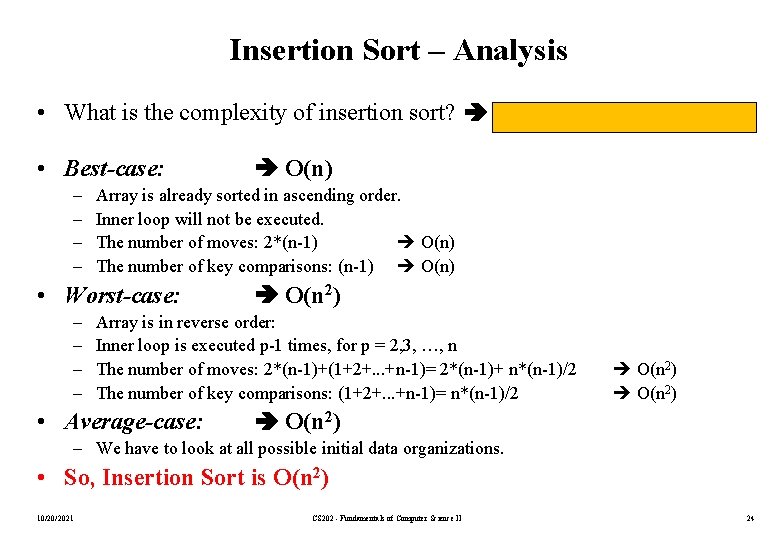
Insertion Sort – Analysis • What is the complexity of insertion sort? Depends on array contents • Best-case: – – Array is already sorted in ascending order. Inner loop will not be executed. The number of moves: 2*(n-1) O(n) The number of key comparisons: (n-1) O(n) • Worst-case: – – O(n) O(n 2) Array is in reverse order: Inner loop is executed p-1 times, for p = 2, 3, …, n The number of moves: 2*(n-1)+(1+2+. . . +n-1)= 2*(n-1)+ n*(n-1)/2 The number of key comparisons: (1+2+. . . +n-1)= n*(n-1)/2 • Average-case: O(n 2) – We have to look at all possible initial data organizations. • So, Insertion Sort is O(n 2) 10/20/2021 CS 202 - Fundamentals of Computer Science II 24
Insertion Sort – Analysis • Which running time will be used to characterize this algorithm? – Best, worst or average? Worst case: – Longest running time (this is the upper limit for the algorithm) – It is guaranteed that the algorithm will not be worst than this. • Sometimes we are interested in average case. But there are problems: – Difficult to figure out average case. i. e. what is the average input? – Are we going to assume all possible inputs are equally likely? – In fact, for most algorithms average case is the same as the worst case. 10/20/2021 CS 202 - Fundamentals of Computer Science II 25
Bubble Sort 10/20/2021 CS 202 - Fundamentals of Computer Science II 26
Bubble Sort • List divided into two sublists: sorted and unsorted. • The largest element is bubbled from the unsorted list and moved to the sorted sublist. • After that, the wall moves one element back, increasing the number of sorted elements and decreasing the number of unsorted ones. • One sort pass: each time an element moves from the unsorted part to the sorted part. • Given a list of n elements, bubble sort requires up to n-1 passes (maximum passes) to sort data. 10/20/2021 CS 202 - Fundamentals of Computer Science II 27
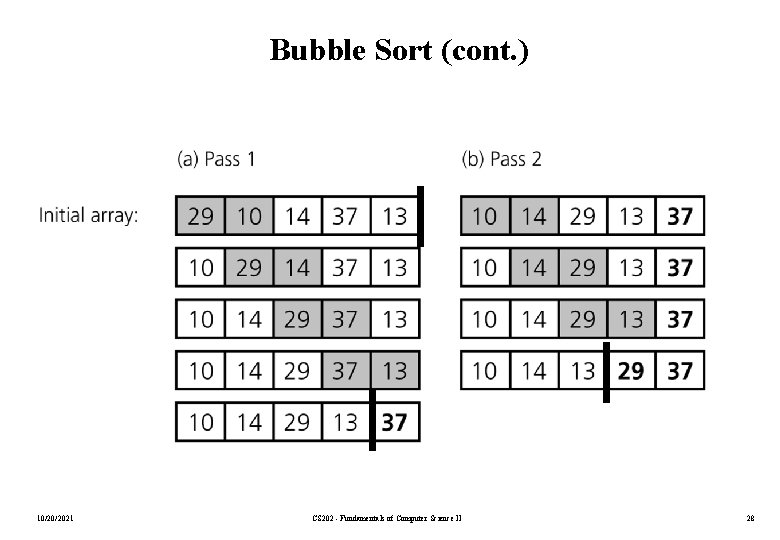
Bubble Sort (cont. ) 10/20/2021 CS 202 - Fundamentals of Computer Science II 28
![Bubble Sort (cont. ) void bubble. Sort( Data. Type the. Array[], int n) {](http://slidetodoc.com/presentation_image_h2/d8380cd80735a8adc9cbf513cf8d86f4/image-29.jpg "Bubble Sort (cont. ) void bubble. Sort( Data. Type the. Array[], int n) {")
Bubble Sort (cont. ) void bubble. Sort( Data. Type the. Array[], int n) { bool sorted = false; for (int pass = 1; (pass < n) && !sorted; ++pass) { sorted = true; for (int index = 0; index < n-pass; ++index) { int next. Index = index + 1; if (the. Array[index] > the. Array[next. Index]) { swap(the. Array[index], the. Array[next. Index]); sorted = false; // signal exchange } } 10/20/2021 CS 202 - Fundamentals of Computer Science II 29
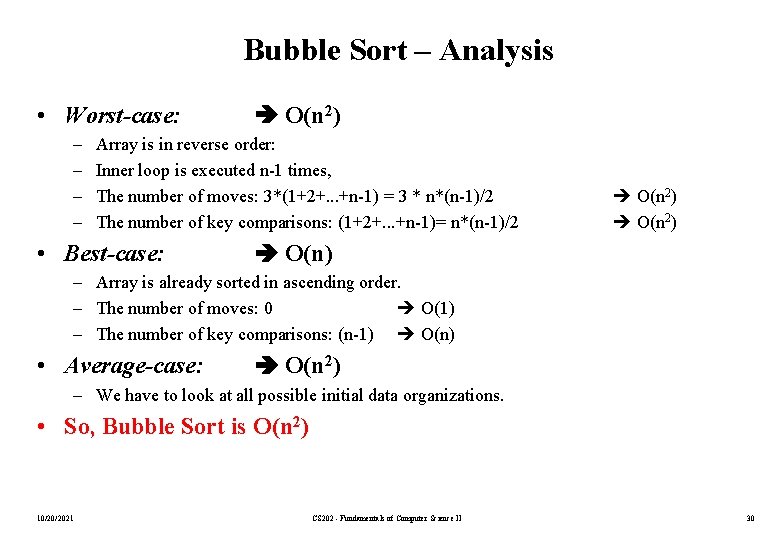
Bubble Sort – Analysis • Worst-case: – – O(n 2) Array is in reverse order: Inner loop is executed n-1 times, The number of moves: 3*(1+2+. . . +n-1) = 3 * n*(n-1)/2 The number of key comparisons: (1+2+. . . +n-1)= n*(n-1)/2 • Best-case: O(n 2) O(n) – Array is already sorted in ascending order. – The number of moves: 0 O(1) – The number of key comparisons: (n-1) O(n) • Average-case: O(n 2) – We have to look at all possible initial data organizations. • So, Bubble Sort is O(n 2) 10/20/2021 CS 202 - Fundamentals of Computer Science II 30
Merge Sort 10/20/2021 CS 202 - Fundamentals of Computer Science II 31
Mergesort • One of two important divide-and-conquer sorting algorithms – Other one is Quicksort • It is a recursive algorithm. – Divide the list into halves, – Sort each half separately, and – Then merge the sorted halves into one sorted array. 10/20/2021 CS 202 - Fundamentals of Computer Science II 32
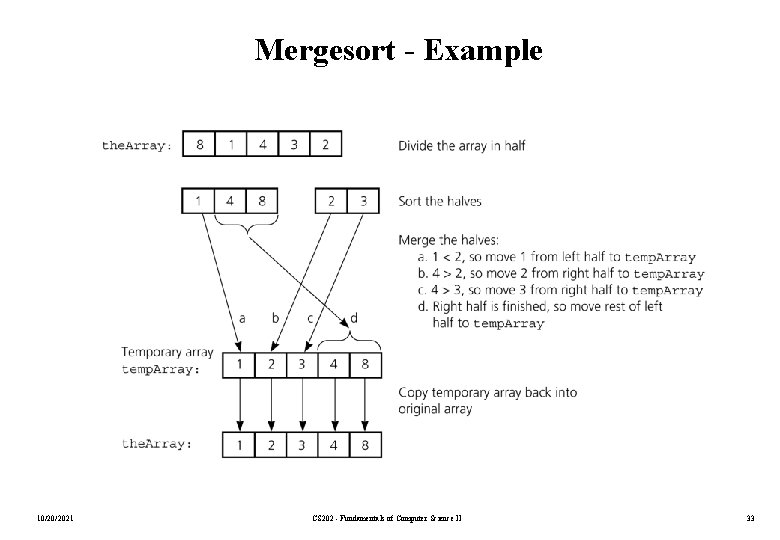
Mergesort - Example 10/20/2021 CS 202 - Fundamentals of Computer Science II 33
![Mergesort void mergesort( Data. Type the. Array[], int first, int last) { if (first](http://slidetodoc.com/presentation_image_h2/d8380cd80735a8adc9cbf513cf8d86f4/image-34.jpg "Mergesort void mergesort( Data. Type the. Array[], int first, int last) { if (first")
Mergesort void mergesort( Data. Type the. Array[], int first, int last) { if (first < last) { int mid = (first + last)/2; // index of midpoint mergesort(the. Array, first, mid); mergesort(the. Array, mid+1, last); // merge the two halves merge(the. Array, first, mid, last); } } // end mergesort 10/20/2021 CS 202 - Fundamentals of Computer Science II 34
![Merge const int MAX_SIZE = maximum-number-of-items-in-array; void merge( Data. Type the. Array[], int first,](http://slidetodoc.com/presentation_image_h2/d8380cd80735a8adc9cbf513cf8d86f4/image-35.jpg "Merge const int MAX_SIZE = maximum-number-of-items-in-array; void merge( Data. Type the. Array[], int first,")
Merge const int MAX_SIZE = maximum-number-of-items-in-array; void merge( Data. Type the. Array[], int first, int mid, int last) { Data. Type temp. Array[MAX_SIZE]; int int int // temporary array first 1 = first; // beginning of first subarray last 1 = mid; // end of first subarray first 2 = mid + 1; // beginning of second subarray last 2 = last; // end of second subarray index = first 1; // next available location in temp. Array for ( ; (first 1 <= last 1) && (first 2 <= last 2); ++index) { if (the. Array[first 1] < the. Array[first 2]) { temp. Array[index] = the. Array[first 1]; ++first 1; } else { temp. Array[index] = the. Array[first 2]; ++first 2; } 10/20/2021 CS 202 - Fundamentals of Computer Science II } … 35

Merge (cont. ) … // finish off the first subarray, if necessary for (; first 1 <= last 1; ++first 1, ++index) temp. Array[index] = the. Array[first 1]; // finish off the second subarray, if necessary for (; first 2 <= last 2; ++first 2, ++index) temp. Array[index] = the. Array[first 2]; // copy the result back into the original array for (index = first; index <= last; ++index) the. Array[index] = temp. Array[index]; } // end merge 10/20/2021 CS 202 - Fundamentals of Computer Science II 36
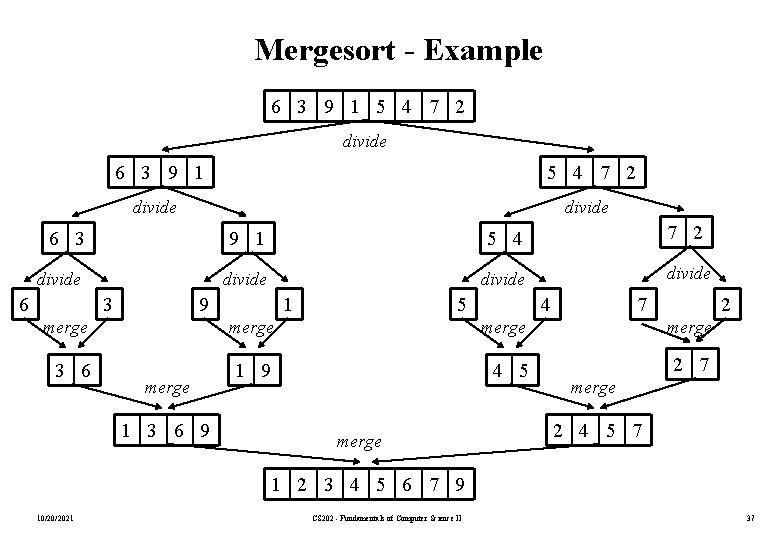
Mergesort - Example 6 3 9 1 5 4 7 2 divide divide 6 3 9 1 5 4 7 2 merge 3 6 1 9 4 5 2 7 merge 1 3 6 9 merge 2 4 5 7 1 2 3 4 5 6 7 9 10/20/2021 CS 202 - Fundamentals of Computer Science II 37
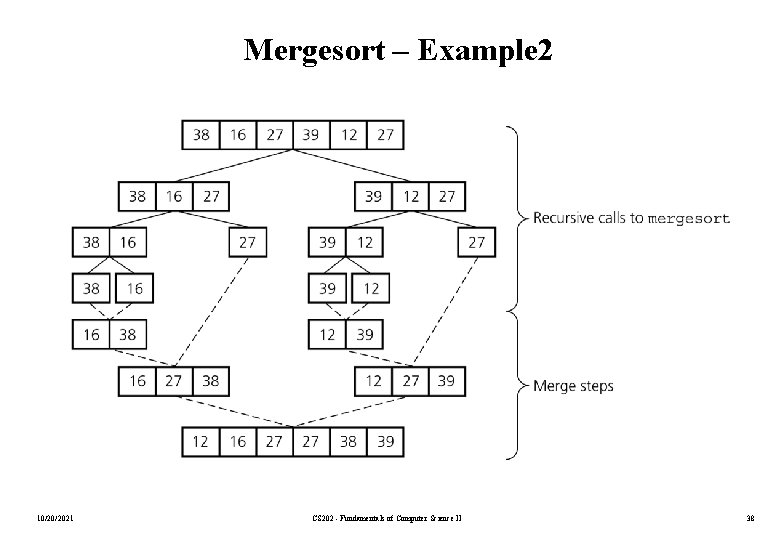
Mergesort – Example 2 10/20/2021 CS 202 - Fundamentals of Computer Science II 38
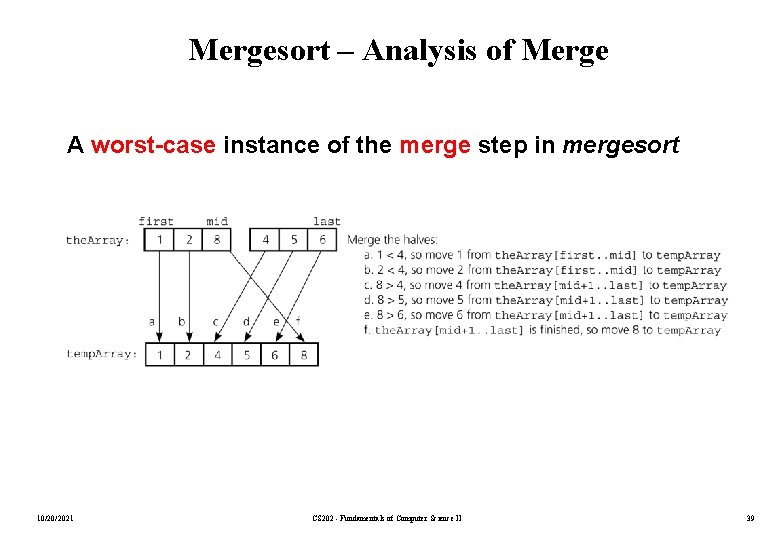
Mergesort – Analysis of Merge A worst-case instance of the merge step in mergesort 10/20/2021 CS 202 - Fundamentals of Computer Science II 39
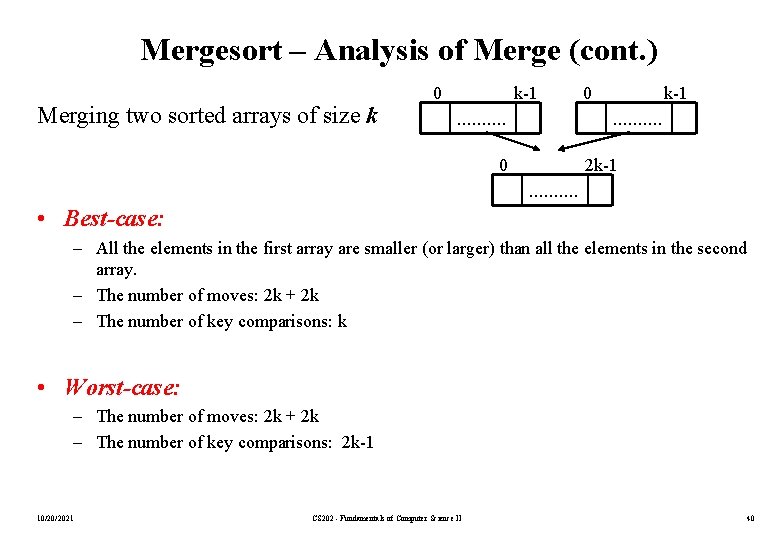
Mergesort – Analysis of Merge (cont. ) Merging two sorted arrays of size k 0 k-1 . . 0 2 k-1 . . • Best-case: – All the elements in the first array are smaller (or larger) than all the elements in the second array. – The number of moves: 2 k + 2 k – The number of key comparisons: k • Worst-case: – The number of moves: 2 k + 2 k – The number of key comparisons: 2 k-1 10/20/2021 CS 202 - Fundamentals of Computer Science II 40
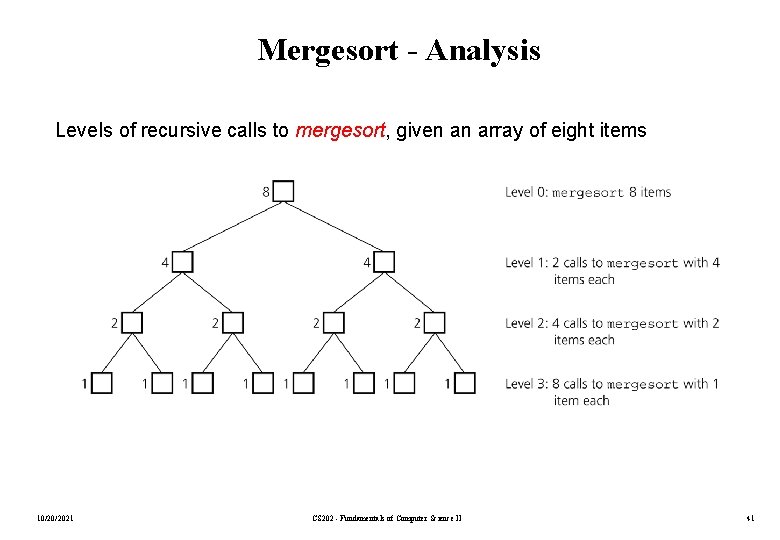
Mergesort - Analysis Levels of recursive calls to mergesort, given an array of eight items 10/20/2021 CS 202 - Fundamentals of Computer Science II 41
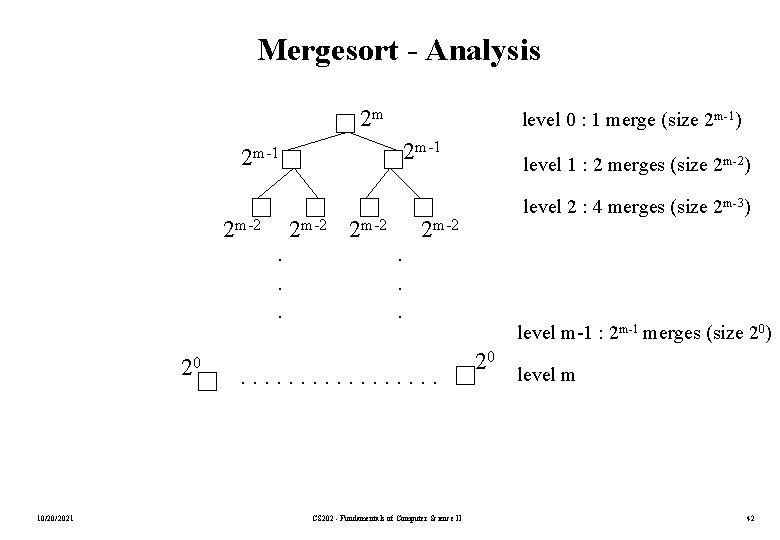
Mergesort - Analysis 2 m level 0 : 1 merge (size 2 m-1) 2 m-1 2 m-2 20 10/20/2021 . . . 2 m-2 . . . level 1 : 2 merges (size 2 m-2) level 2 : 4 merges (size 2 m-3) 2 m-2 . . . . CS 202 - Fundamentals of Computer Science II level m-1 : 2 m-1 merges (size 20) 20 level m 42
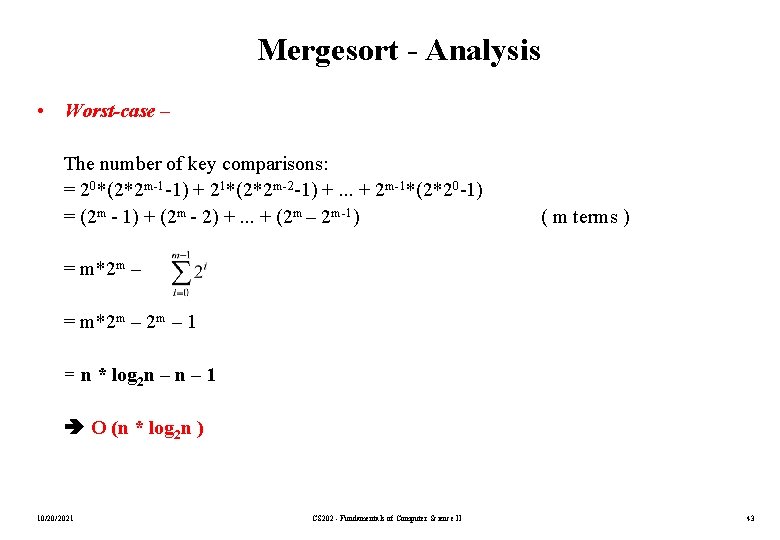
Mergesort - Analysis • Worst-case – The number of key comparisons: = 20*(2*2 m-1 -1) + 21*(2*2 m-2 -1) +. . . + 2 m-1*(2*20 -1) = (2 m - 1) + (2 m - 2) +. . . + (2 m – 2 m-1) ( m terms ) = m*2 m – 1 = n * log 2 n – 1 O (n * log 2 n ) 10/20/2021 CS 202 - Fundamentals of Computer Science II 43
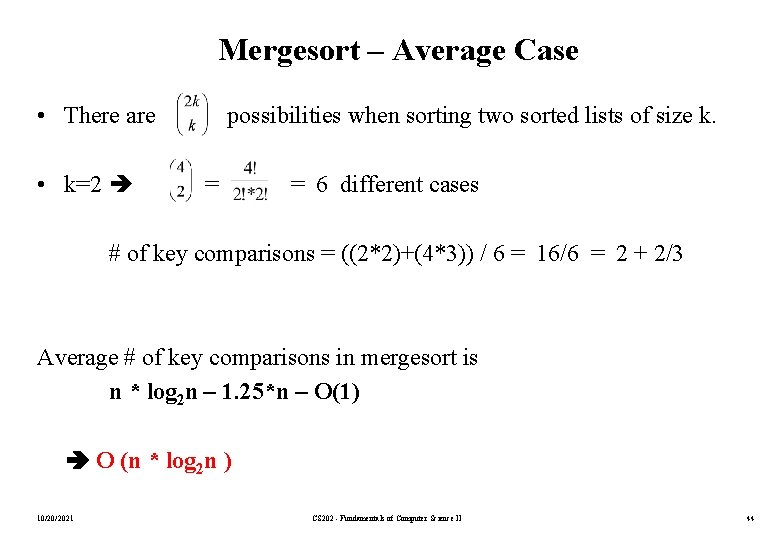
Mergesort – Average Case • There are • k=2 possibilities when sorting two sorted lists of size k. = = 6 different cases # of key comparisons = ((2*2)+(4*3)) / 6 = 16/6 = 2 + 2/3 Average # of key comparisons in mergesort is n * log 2 n – 1. 25*n – O(1) O (n * log 2 n ) 10/20/2021 CS 202 - Fundamentals of Computer Science II 44
Mergesort – Analysis • Mergesort is extremely efficient algorithm with respect to time. – Both worst case and average cases are O (n * log 2 n ) • But, mergesort requires an extra array whose size equals to the size of the original array. • If we use a linked list, we do not need an extra array – But, we need space for the links – And, it will be difficult to divide the list into half ( O(n) ) 10/20/2021 CS 202 - Fundamentals of Computer Science II 45
Quicksort 10/20/2021 CS 202 - Fundamentals of Computer Science II 46
Quicksort • Like Mergesort, Quicksort is based on divide-and-conquer paradigm. • But somewhat opposite to Mergesort – – • Mergesort: Hard work done after recursive call Quicksort: Hard work done before recursive call Algorithm 1. First, partition an array into two parts, 2. Then, sort each part independently, 3. Finally, combine sorted parts by a simple concatenation. 10/20/2021 CS 202 - Fundamentals of Computer Science II 47
Quicksort (cont. ) The quick-sort algorithm consists of the following three steps: 1. Divide: Partition the list. 1. 1 Choose some element from list. Call this element the pivot. - We hope about half the elements will come before and half after. 1. 2 Then partition the elements so that all those with values less than the pivot come in one sublist and all those with greater values come in another. 2. Recursion: Recursively sort the sublists separately. 3. Conquer: Put the sorted sublists together. 10/20/2021 CS 202 - Fundamentals of Computer Science II 48
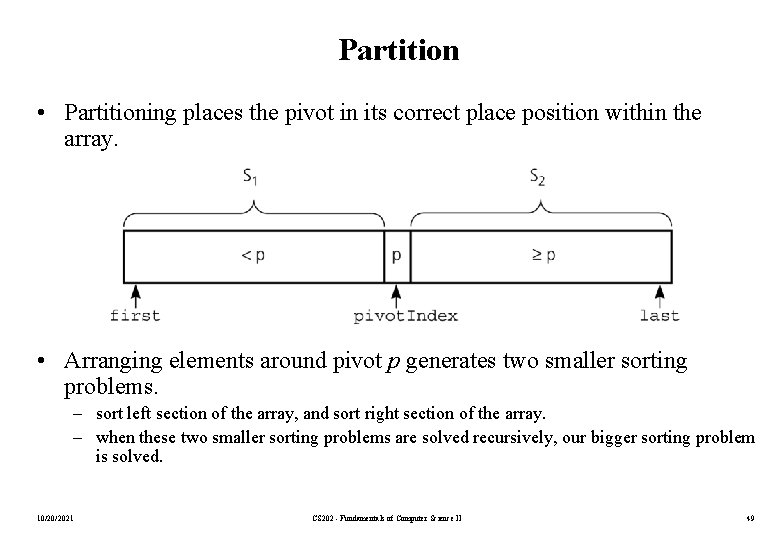
Partition • Partitioning places the pivot in its correct place position within the array. • Arranging elements around pivot p generates two smaller sorting problems. – sort left section of the array, and sort right section of the array. – when these two smaller sorting problems are solved recursively, our bigger sorting problem is solved. 10/20/2021 CS 202 - Fundamentals of Computer Science II 49

Partition – Choosing the pivot • First, select a pivot element among the elements of the given array, and put pivot into first location of the array before partitioning. • Which array item should be selected as pivot? – Somehow we have to select a pivot, and we hope that we will get a good partitioning. – If the items in the array arranged randomly, we choose a pivot randomly. – We can choose the first or last element as a pivot (it may not give a good partitioning). – We can use different techniques to select the pivot. 10/20/2021 CS 202 - Fundamentals of Computer Science II 50
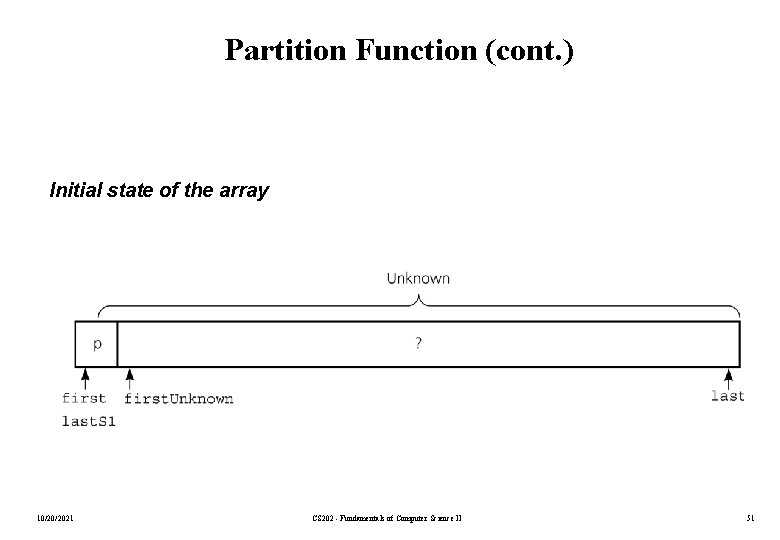
Partition Function (cont. ) Initial state of the array 10/20/2021 CS 202 - Fundamentals of Computer Science II 51
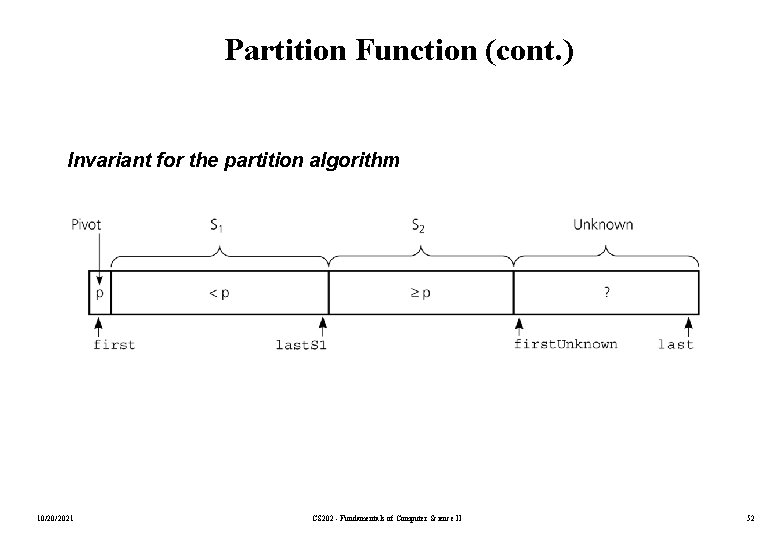
Partition Function (cont. ) Invariant for the partition algorithm 10/20/2021 CS 202 - Fundamentals of Computer Science II 52
![Partition Function (cont. ) Moving the. Array[first. Unknown] into S 1 by swapping it](http://slidetodoc.com/presentation_image_h2/d8380cd80735a8adc9cbf513cf8d86f4/image-53.jpg "Partition Function (cont. ) Moving the. Array[first. Unknown] into S 1 by swapping it")
Partition Function (cont. ) Moving the. Array[first. Unknown] into S 1 by swapping it with the. Array[last. S 1+1] and by incrementing both last. S 1 and first. Unknown. 10/20/2021 CS 202 - Fundamentals of Computer Science II 53
![Partition Function (cont. ) Moving the. Array[first. Unknown] into S 2 by incrementing first.](http://slidetodoc.com/presentation_image_h2/d8380cd80735a8adc9cbf513cf8d86f4/image-54.jpg "Partition Function (cont. ) Moving the. Array[first. Unknown] into S 2 by incrementing first.")
Partition Function (cont. ) Moving the. Array[first. Unknown] into S 2 by incrementing first. Unknown. 10/20/2021 CS 202 - Fundamentals of Computer Science II 54
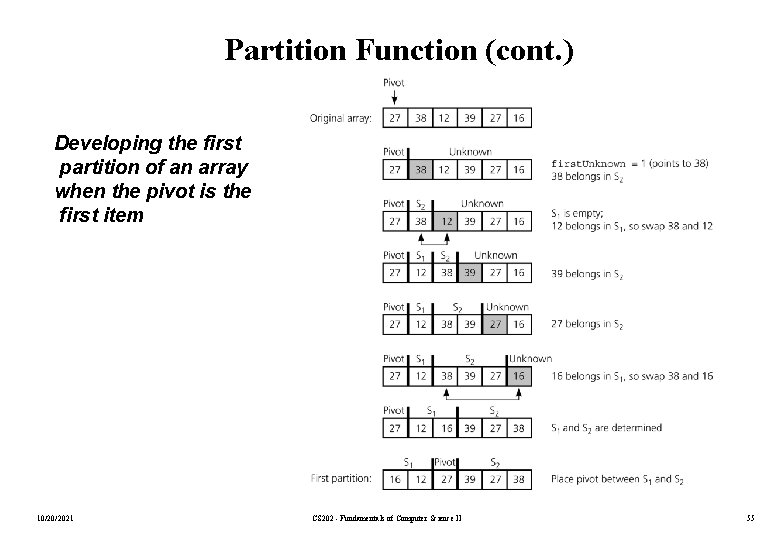
Partition Function (cont. ) Developing the first partition of an array when the pivot is the first item 10/20/2021 CS 202 - Fundamentals of Computer Science II 55
![Quicksort Function void quicksort(Data. Type the. Array[], int first, int last) { // Precondition:](http://slidetodoc.com/presentation_image_h2/d8380cd80735a8adc9cbf513cf8d86f4/image-56.jpg "Quicksort Function void quicksort(Data. Type the. Array[], int first, int last) { // Precondition:")
Quicksort Function void quicksort(Data. Type the. Array[], int first, int last) { // Precondition: the. Array[first. . last] is an array. // Postcondition: the. Array[first. . last] is sorted. int pivot. Index; if (first < last) { // create the partition: S 1, pivot, S 2 partition(the. Array, first, last, pivot. Index); // sort regions S 1 and S 2 quicksort(the. Array, first, pivot. Index-1); quicksort(the. Array, pivot. Index+1, last); } } 10/20/2021 CS 202 - Fundamentals of Computer Science II 56
![Partition Function void partition(Data. Type the. Array[], int first, int last, int &pivot. Index)](http://slidetodoc.com/presentation_image_h2/d8380cd80735a8adc9cbf513cf8d86f4/image-57.jpg "Partition Function void partition(Data. Type the. Array[], int first, int last, int &pivot. Index)")
Partition Function void partition(Data. Type the. Array[], int first, int last, int &pivot. Index) { // Precondition: the. Array[first. . last] is an array; first <= last. // Postcondition: Partitions the. Array[first. . last] such that: // S 1 = the. Array[first. . pivot. Index-1] < pivot // the. Array[pivot. Index] == pivot // S 2 = the. Array[pivot. Index+1. . last] >= pivot // place pivot in the. Array[first] choose. Pivot(the. Array, first, last); Data. Type pivot = the. Array[first]; // copy pivot … 10/20/2021 CS 202 - Fundamentals of Computer Science II 57
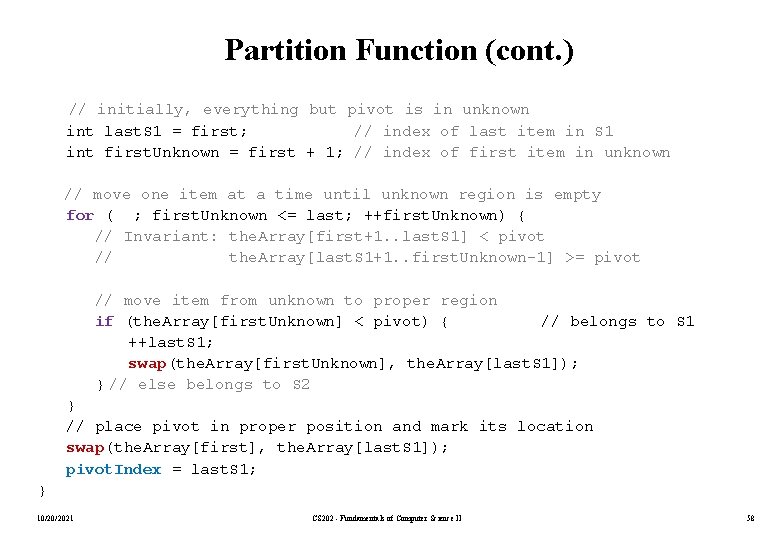
Partition Function (cont. ) // initially, everything but pivot is in unknown int last. S 1 = first; // index of last item in S 1 int first. Unknown = first + 1; // index of first item in unknown // move one item at a time until unknown region is empty for ( ; first. Unknown <= last; ++first. Unknown) { // Invariant: the. Array[first+1. . last. S 1] < pivot // the. Array[last. S 1+1. . first. Unknown-1] >= pivot // move item from unknown to proper region if (the. Array[first. Unknown] < pivot) { // belongs to S 1 ++last. S 1; swap(the. Array[first. Unknown], the. Array[last. S 1]); } // else belongs to S 2 } // place pivot in proper position and mark its location swap(the. Array[first], the. Array[last. S 1]); pivot. Index = last. S 1; } 10/20/2021 CS 202 - Fundamentals of Computer Science II 58
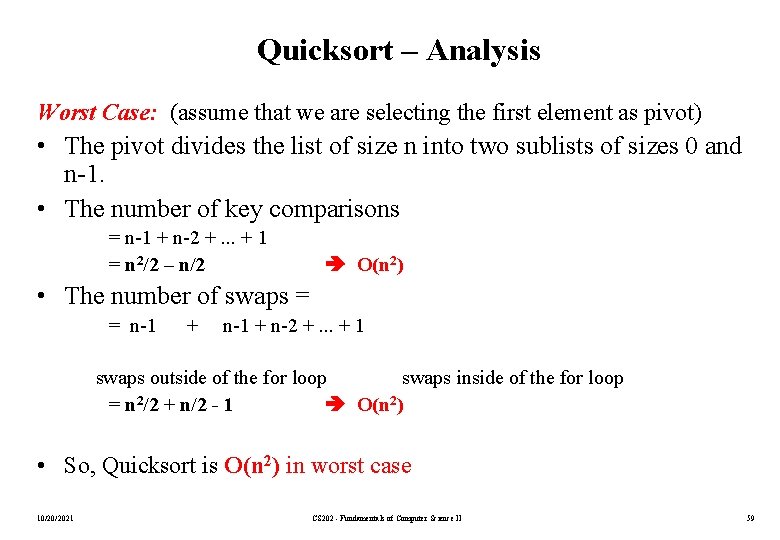
Quicksort – Analysis Worst Case: (assume that we are selecting the first element as pivot) • The pivot divides the list of size n into two sublists of sizes 0 and n-1. • The number of key comparisons = n-1 + n-2 +. . . + 1 = n 2/2 – n/2 O(n 2) • The number of swaps = = n-1 + n-2 +. . . + 1 swaps outside of the for loop swaps inside of the for loop = n 2/2 + n/2 - 1 O(n 2) • So, Quicksort is O(n 2) in worst case 10/20/2021 CS 202 - Fundamentals of Computer Science II 59
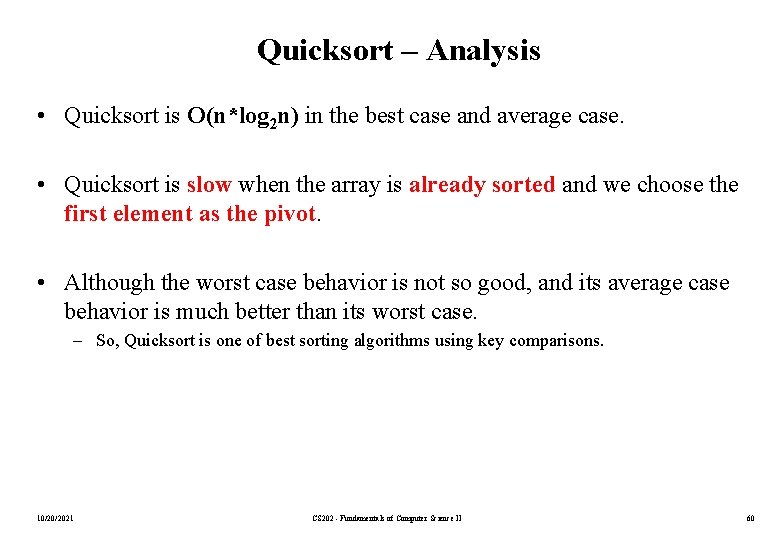
Quicksort – Analysis • Quicksort is O(n*log 2 n) in the best case and average case. • Quicksort is slow when the array is already sorted and we choose the first element as the pivot. • Although the worst case behavior is not so good, and its average case behavior is much better than its worst case. – So, Quicksort is one of best sorting algorithms using key comparisons. 10/20/2021 CS 202 - Fundamentals of Computer Science II 60
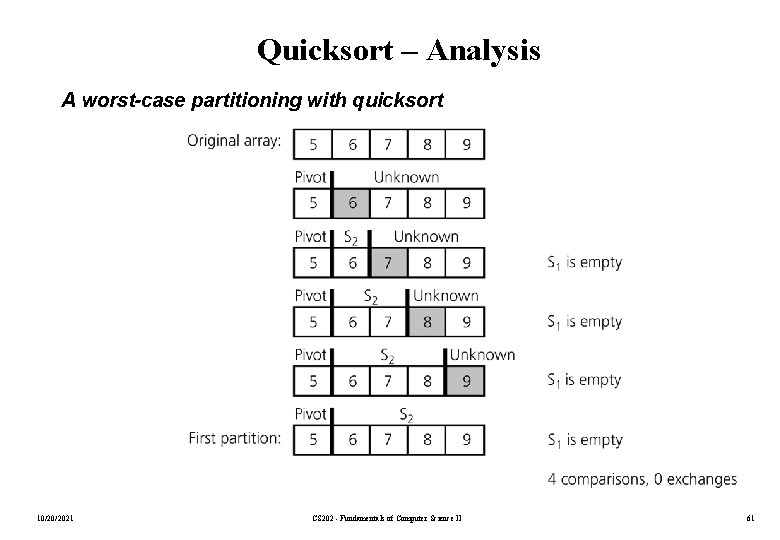
Quicksort – Analysis A worst-case partitioning with quicksort 10/20/2021 CS 202 - Fundamentals of Computer Science II 61
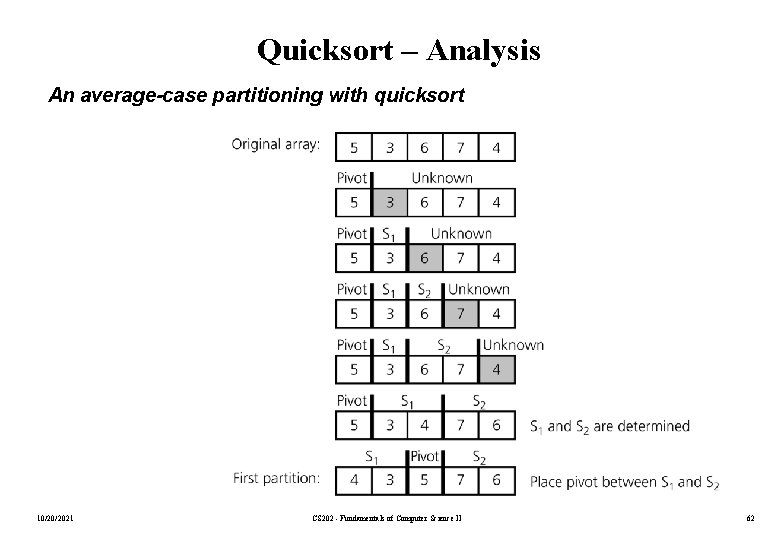
Quicksort – Analysis An average-case partitioning with quicksort 10/20/2021 CS 202 - Fundamentals of Computer Science II 62
Other Sorting Algorithms? 10/20/2021 CS 202 - Fundamentals of Computer Science II 63
Other Sorting Algorithms? Many! For example: • Shell sort • Comb sort • Heapsort • Counting sort • Bucket sort • Distribution sort • Timsort • e. g. Check http: //en. wikipedia. org/wiki/Sorting_algorithm for a table comparing sorting algorithms. 10/20/2021 CS 202 - Fundamentals of Computer Science II 64
Radix Sort • Radix sort algorithm different than other sorting algorithms that we talked. – It does not use key comparisons to sort an array. • The radix sort : – Treats each data item as a character string. – First group data items according to their rightmost character, and put these groups into order w. r. t. this rightmost character. – Then, combine these groups. – Repeat these grouping and combining operations for all other character positions in the data items from the rightmost to the leftmost character position. – At the end, the sort operation will be completed. 10/20/2021 CS 202 - Fundamentals of Computer Science II 65
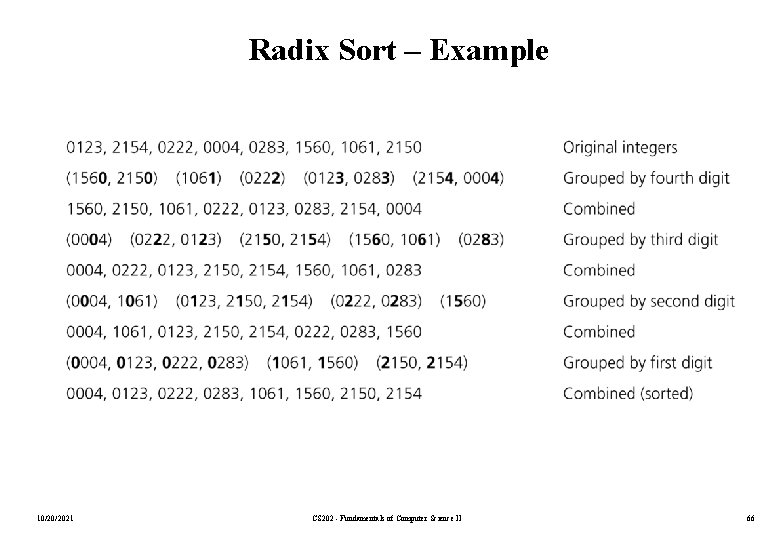
Radix Sort – Example 10/20/2021 CS 202 - Fundamentals of Computer Science II 66
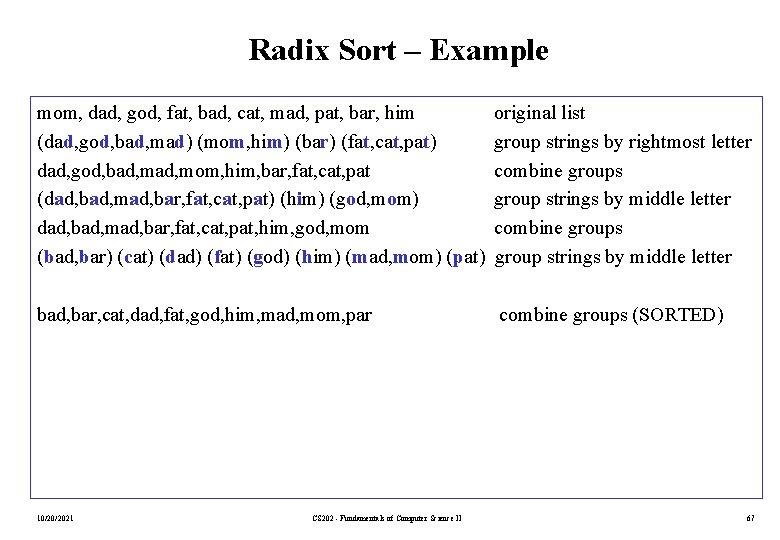
Radix Sort – Example mom, dad, god, fat, bad, cat, mad, pat, bar, him (dad, god, bad, mad) (mom, him) (bar) (fat, cat, pat) dad, god, bad, mom, him, bar, fat, cat, pat (dad, bad, mad, bar, fat, cat, pat) (him) (god, mom) dad, bad, mad, bar, fat, cat, pat, him, god, mom (bad, bar) (cat) (dad) (fat) (god) (him) (mad, mom) (pat) original list group strings by rightmost letter combine groups group strings by middle letter bad, bar, cat, dad, fat, god, him, mad, mom, par combine groups (SORTED) 10/20/2021 CS 202 - Fundamentals of Computer Science II 67
![Radix Sort - Algorithm radix. Sort( int the. Array[], in n: integer, in d:](http://slidetodoc.com/presentation_image_h2/d8380cd80735a8adc9cbf513cf8d86f4/image-68.jpg "Radix Sort - Algorithm radix. Sort( int the. Array[], in n: integer, in d:")
Radix Sort - Algorithm radix. Sort( int the. Array[], in n: integer, in d: integer) // sort n d-digit integers in the array the. Array for (j=d down to 1) { Initialize 10 groups to empty Initialize a counter for each group to 0 for (i=0 through n-1) { k = jth digit of the. Array[i] Place the. Array[i] at the end of group k Increase kth counter by 1 } Replace the items in the. Array with all the items in group 0, followed by all the items in group 1, and so on. } 10/20/2021 CS 202 - Fundamentals of Computer Science II 68
Radix Sort -- Analysis • The radix sort algorithm requires 2*n*d moves to sort n strings of d characters each. So, Radix Sort is O(n) • Although the radix sort is O(n), it is not appropriate as a generalpurpose sorting algorithm. – Its memory requirement is d * original size of data (because each group should be big enough to hold the original data collection. ) – For example, to sort string of uppercase letters. we need 27 groups. – The radix sort is more appropriate for a linked list than an array. (we will not need the huge memory in this case) 10/20/2021 CS 202 - Fundamentals of Computer Science II 69
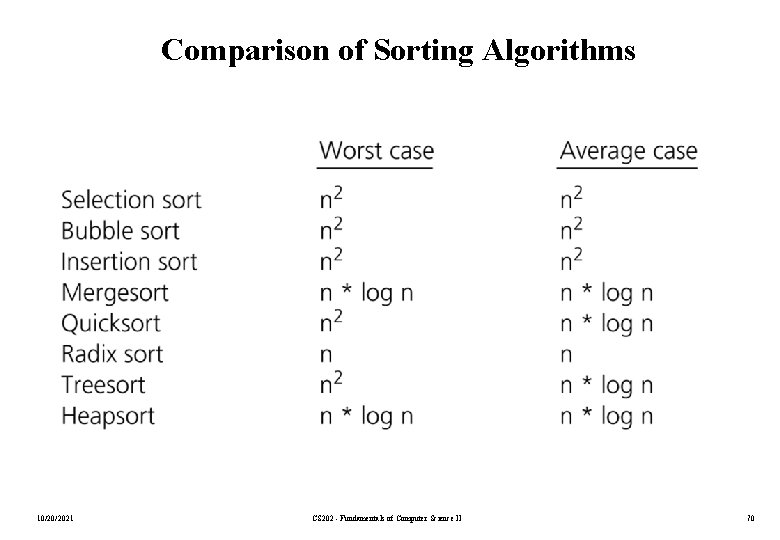
Comparison of Sorting Algorithms 10/20/2021 CS 202 - Fundamentals of Computer Science II 70
- Slides: 70