
Sorting Algorithms Sorting Given n elements rearrange in



![Exercícios Solucao: Ideia: Para cada elemento A[i], procure por seu “par” x – A[i]](https://slidetodoc.com/presentation_image_h2/35814060564df45ba25fef4d1d618852/image-31.jpg "Exercícios Solucao: Ideia: Para cada elemento A[i], procure por seu “par” x – A[i]")
![Counting Sort Input: List of integers A[1], A[2], …, A[n] with values between 1](https://slidetodoc.com/presentation_image_h2/35814060564df45ba25fef4d1d618852/image-36.jpg "Counting Sort Input: List of integers A[1], A[2], …, A[n] with values between 1")
![Counting Sort Input: List of integers A[1], A[2], …, A[n] with values between 1](https://slidetodoc.com/presentation_image_h2/35814060564df45ba25fef4d1d618852/image-37.jpg "Counting Sort Input: List of integers A[1], A[2], …, A[n] with values between 1")
- Slides: 45
Sorting Algorithms
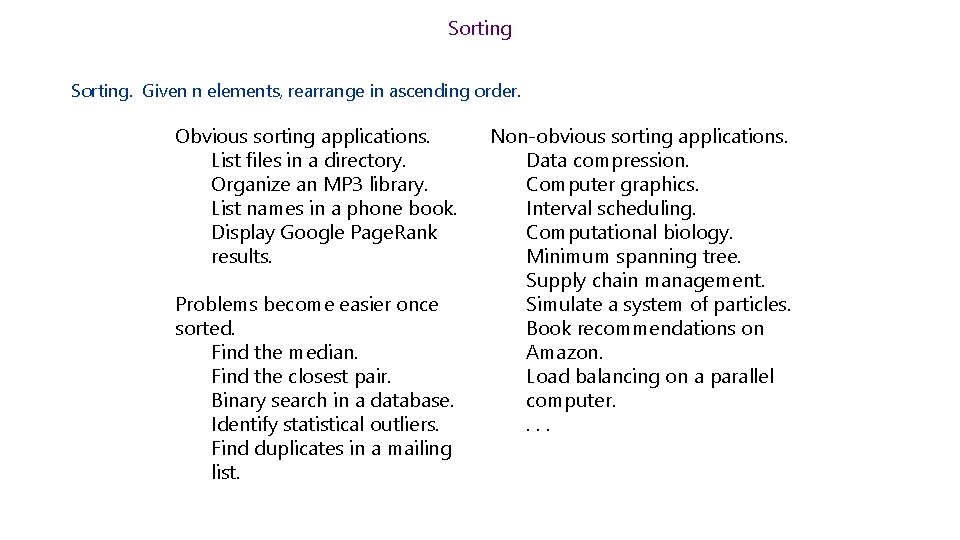
Sorting. Given n elements, rearrange in ascending order. Obvious sorting applications. List files in a directory. Organize an MP 3 library. List names in a phone book. Display Google Page. Rank results. Problems become easier once sorted. Find the median. Find the closest pair. Binary search in a database. Identify statistical outliers. Find duplicates in a mailing list. Non-obvious sorting applications. Data compression. Computer graphics. Interval scheduling. Computational biology. Minimum spanning tree. Supply chain management. Simulate a system of particles. Book recommendations on Amazon. Load balancing on a parallel computer. .
1. Basic Algorithms: Bubble Sort
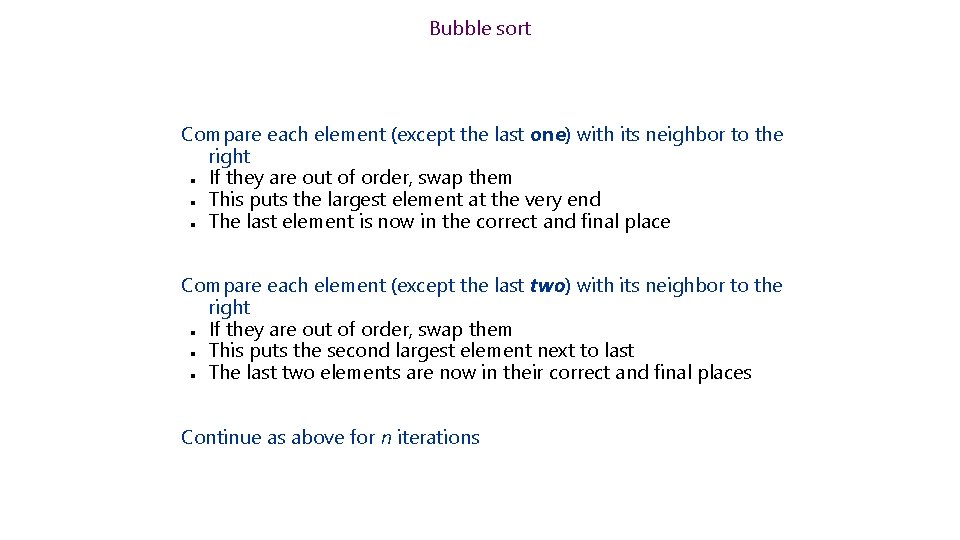
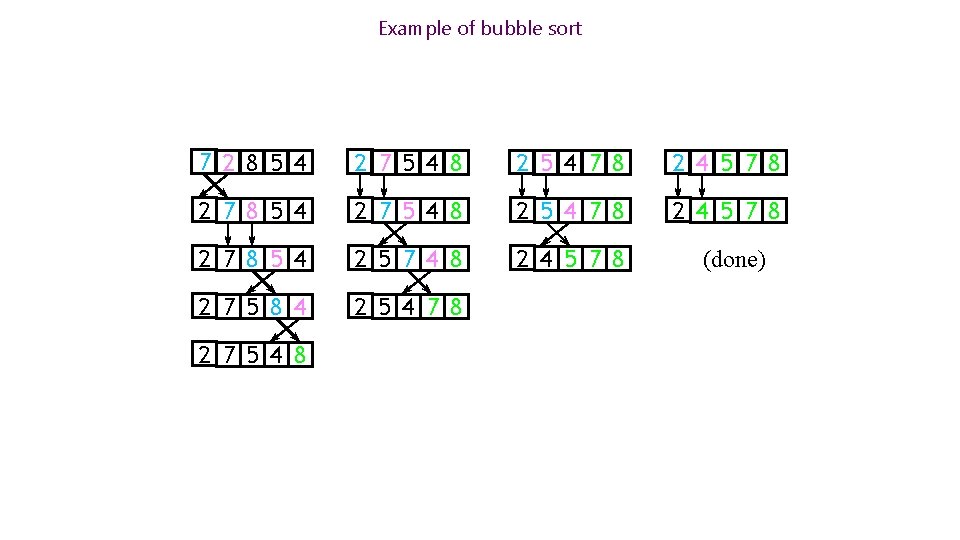
Bubble sort Compare each element (except the last one) with its neighbor to the right If they are out of order, swap them This puts the largest element at the very end The last element is now in the correct and final place n n n Compare each element (except the last two) with its neighbor to the right If they are out of order, swap them This puts the second largest element next to last The last two elements are now in their correct and final places n n n Continue as above for n iterations
Example of bubble sort 7 2 8 5 4 2 7 5 4 8 2 5 4 7 8 2 4 5 7 8 2 7 8 5 4 2 5 7 4 8 2 4 5 7 8 2 7 5 8 4 2 5 4 7 8 2 7 5 4 8 (done)
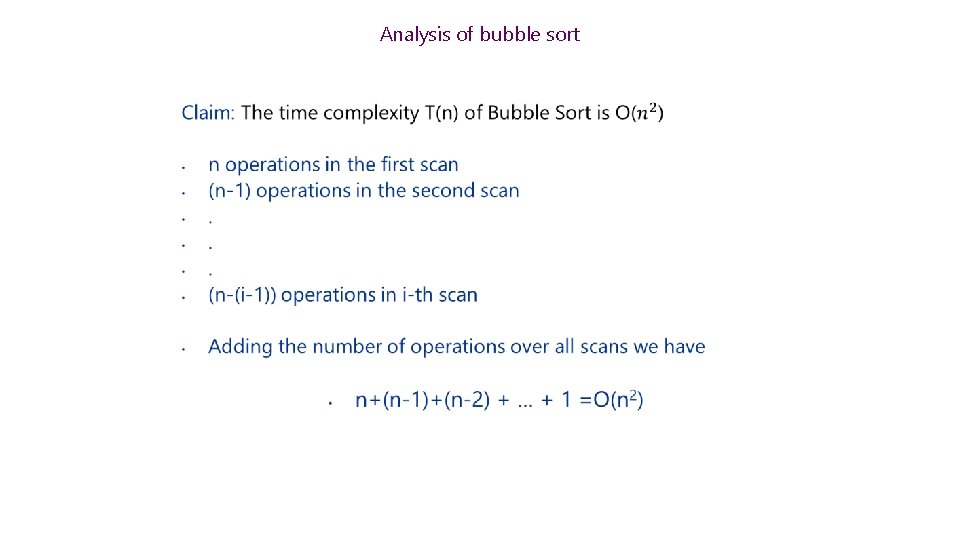
Analysis of bubble sort
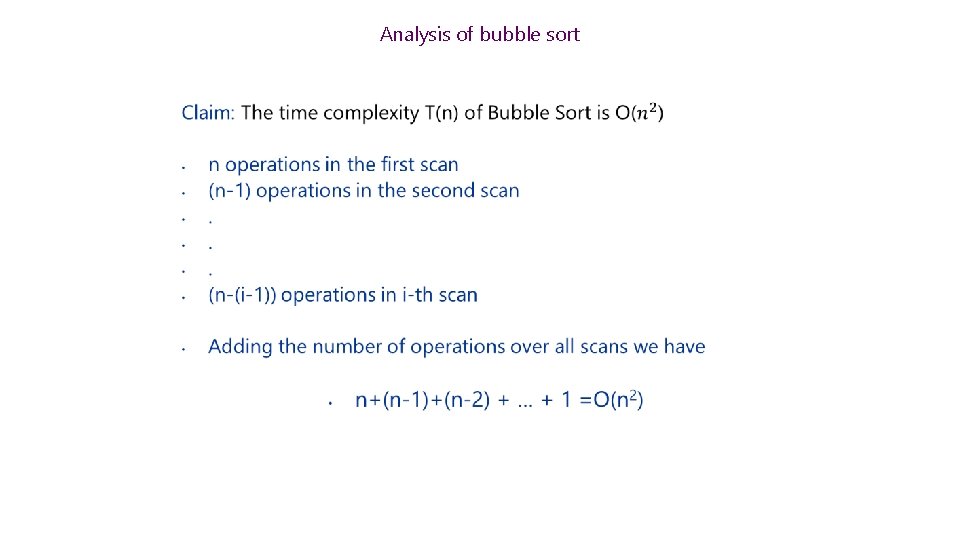
Analysis of bubble sort
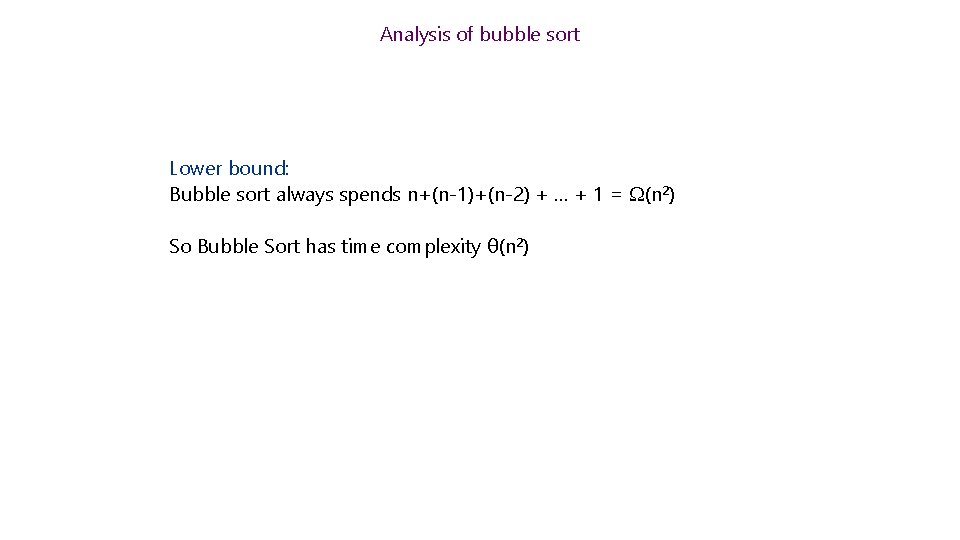
Analysis of bubble sort Lower bound: Bubble sort always spends n+(n-1)+(n-2) + … + 1 = (n 2) So Bubble Sort has time complexity θ(n 2)
2. Mergesort
Building block: Merge. Combine two sorted lists A = a 1, a 2, …, an with B = b 1, b 2, …, bn (increasing order) into sorted whole. i = 1, j = 1 while (i <= |A| and j <= |B|) { if (ai bj) append ai to output list and increment i else(ai bj)append bj to output list and increment j } append remainder of nonempty list to output list Claim. Merging two lists of size n takes O(n) time Pf. After at most 2 n iterations, both pointers i, j reach n, can’t go any further 10
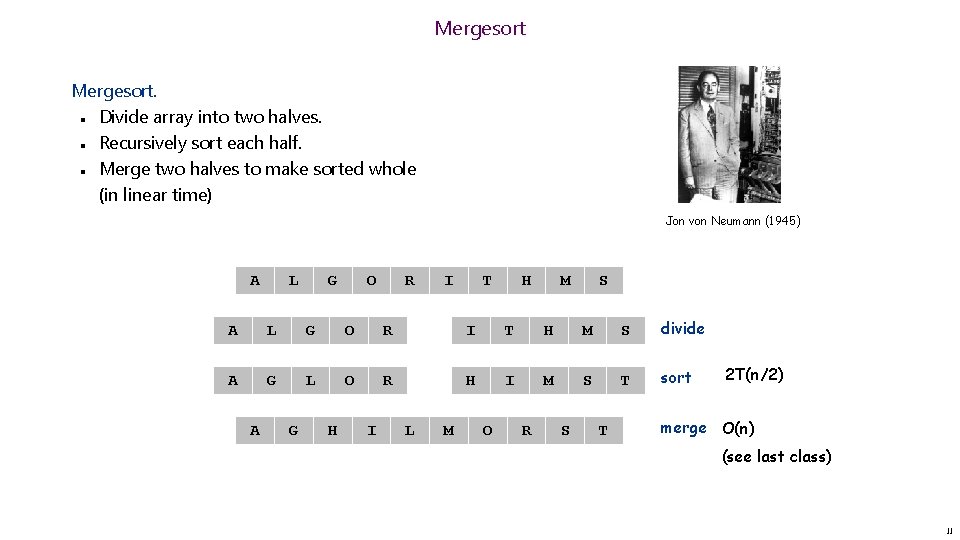
Mergesort. Divide array into two halves. Recursively sort each half. Merge two halves to make sorted whole (in linear time) n n n Jon von Neumann (1945) A L G O R I T H M S divide A G L O R H I M S T sort A G H I L M O R S T 2 T(n/2) merge O(n) (see last class) 11
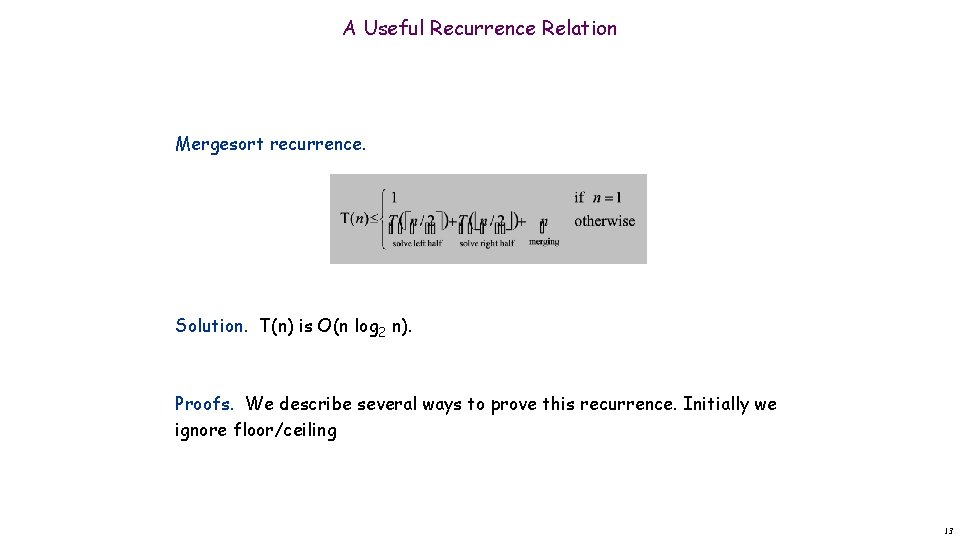
A Useful Recurrence Relation Mergesort recurrence. Solution. T(n) is O(n log 2 n). Proofs. We describe several ways to prove this recurrence. Initially we ignore floor/ceiling 13
Proof by Recursion Tree
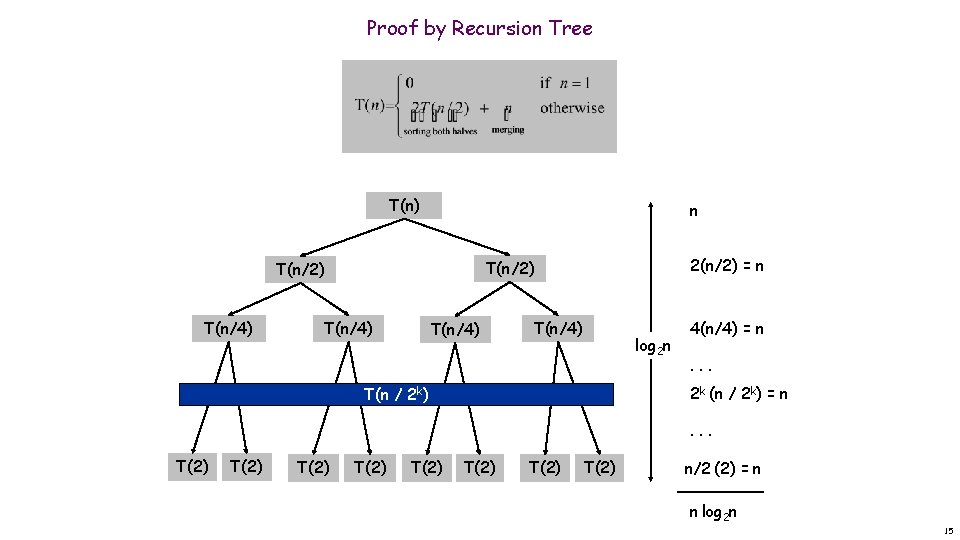
Proof by Recursion Tree T(n) n T(n/4) 2(n/2) = n T(n/2) T(n/4) log 2 n 4(n/4) = n. . . 2 k (n / 2 k) = n T(n / 2 k) . . . T(2) T(2) n/2 (2) = n n log 2 n 15
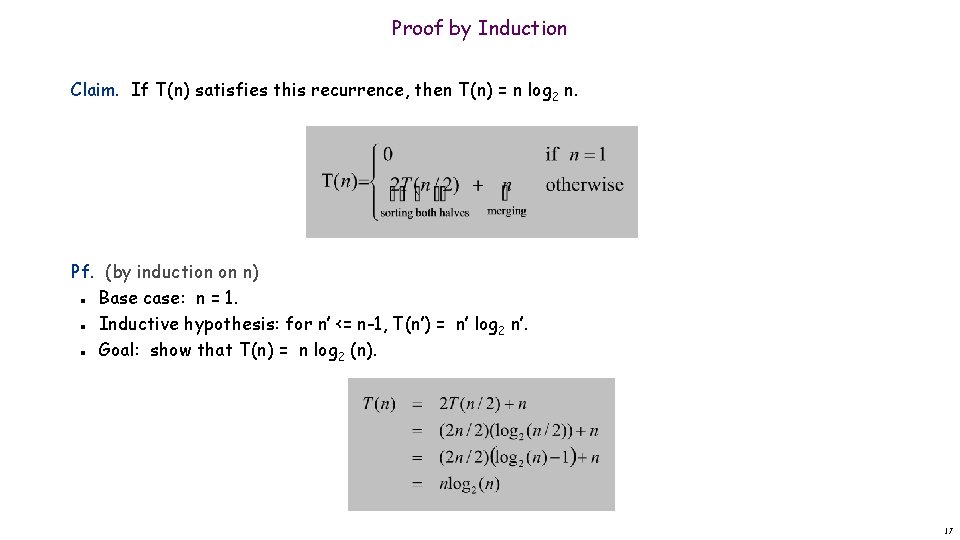
Proof by Induction Claim. If T(n) satisfies this recurrence, then T(n) = n log 2 n. Pf. (by induction on n) Base case: n = 1. Inductive hypothesis: for n’ <= n-1, T(n’) = n’ log 2 n’. Goal: show that T(n) = n log 2 (n). n n n 17
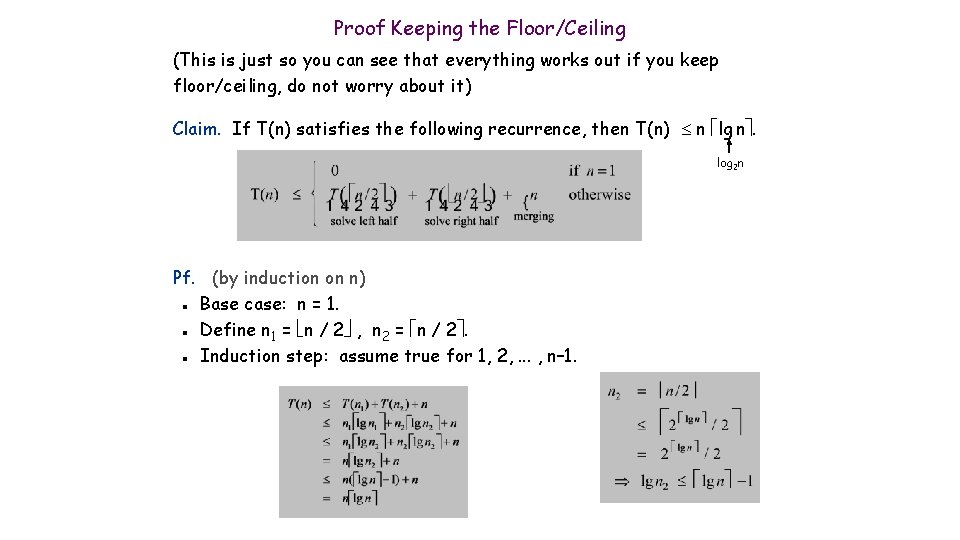
Proof Keeping the Floor/Ceiling (This is just so you can see that everything works out if you keep floor/ceiling, do not worry about it) Claim. If T(n) satisfies the following recurrence, then T(n) n lg n. log 2 n Pf. (by induction on n) Base case: n = 1. Define n 1 = n / 2 , n 2 = n / 2. Induction step: assume true for 1, 2, . . . , n– 1. n n n
Mergesort
2. Quicksort
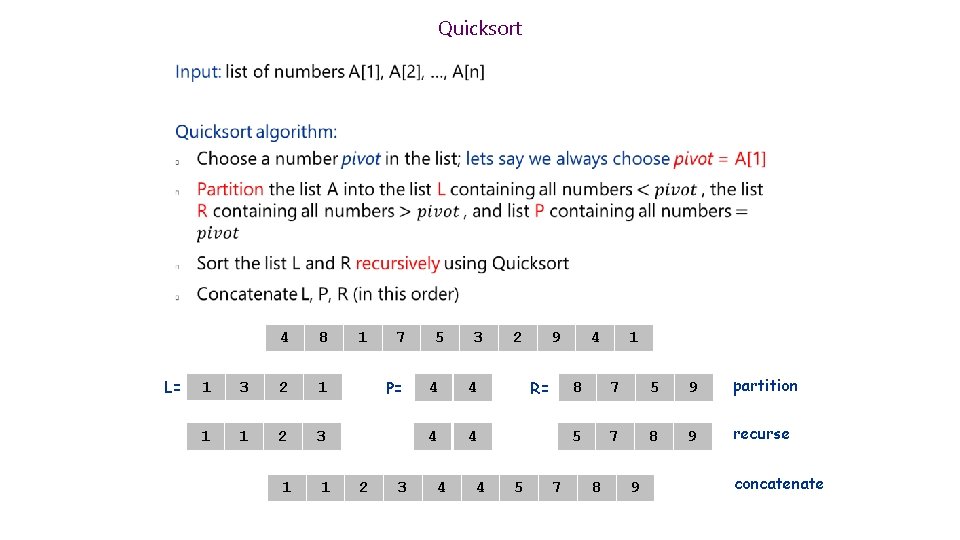
Quicksort • Sorts O(n lg n) in the average case (we will not prove) • Sorts θ(n 2) in the worst case So why would people use it instead of Mergesort? • Very simple to implement • In practice is very fast (worst case is quite rare and constants are low)
Quicksort L= 4 8 1 3 2 1 1 1 2 3 1 1 1 7 P= 2 3 5 3 4 4 4 2 9 R= 5 7 4 1 8 7 5 9 partition 5 7 8 9 recurse 8 9 concatenate
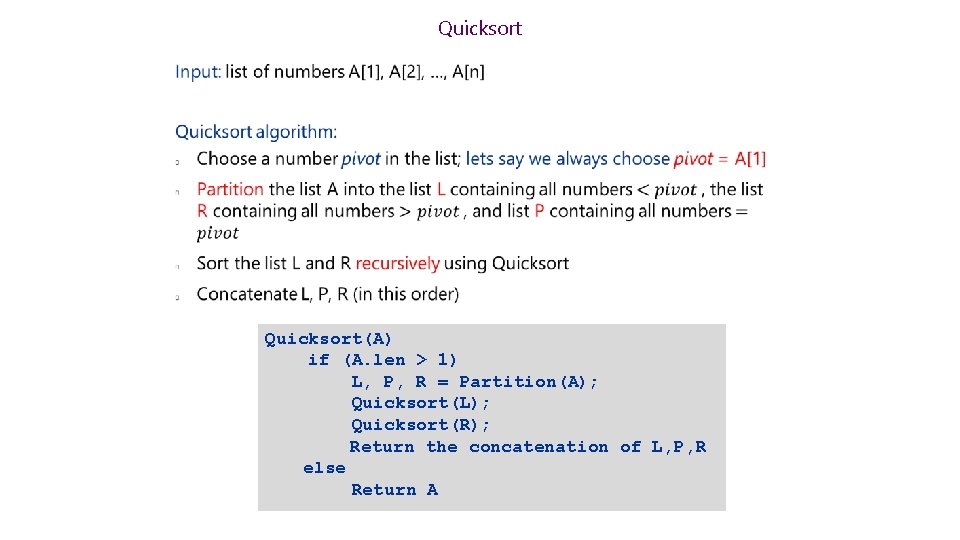
Quicksort(A) if (A. len > 1) L, P, R = Partition(A); Quicksort(L); Quicksort(R); Return the concatenation of L, P, R else Return A
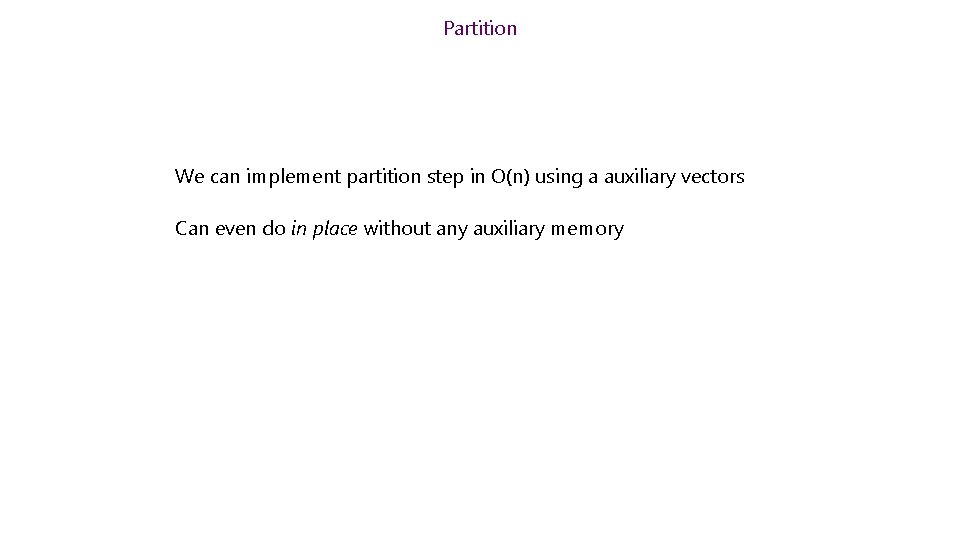
Partition We can implement partition step in O(n) using a auxiliary vectors Can even do in place without any auxiliary memory
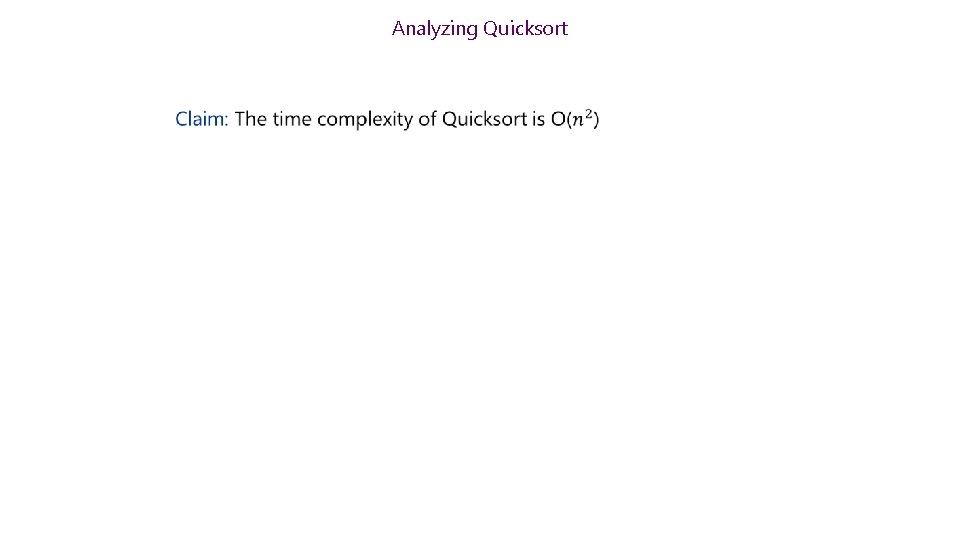
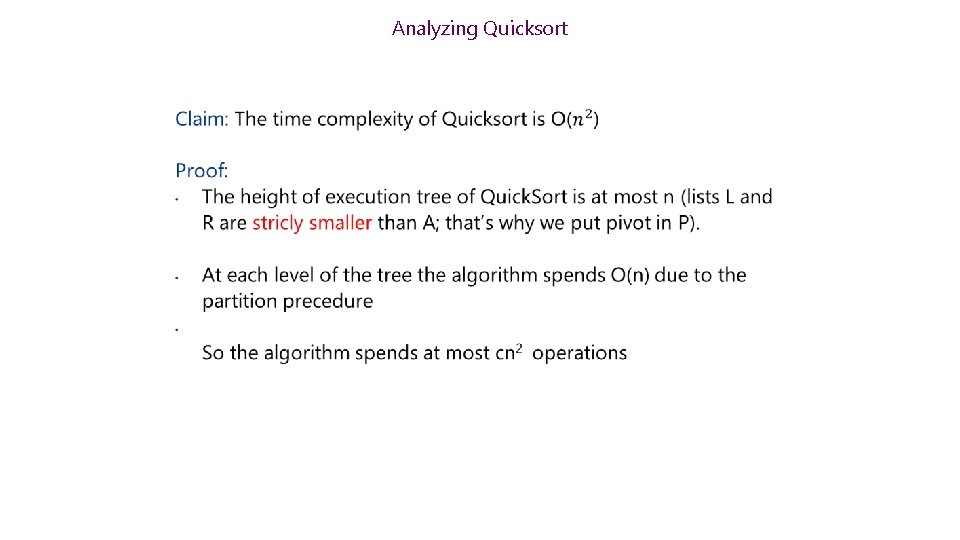
Analyzing Quicksort
Analyzing Quicksort
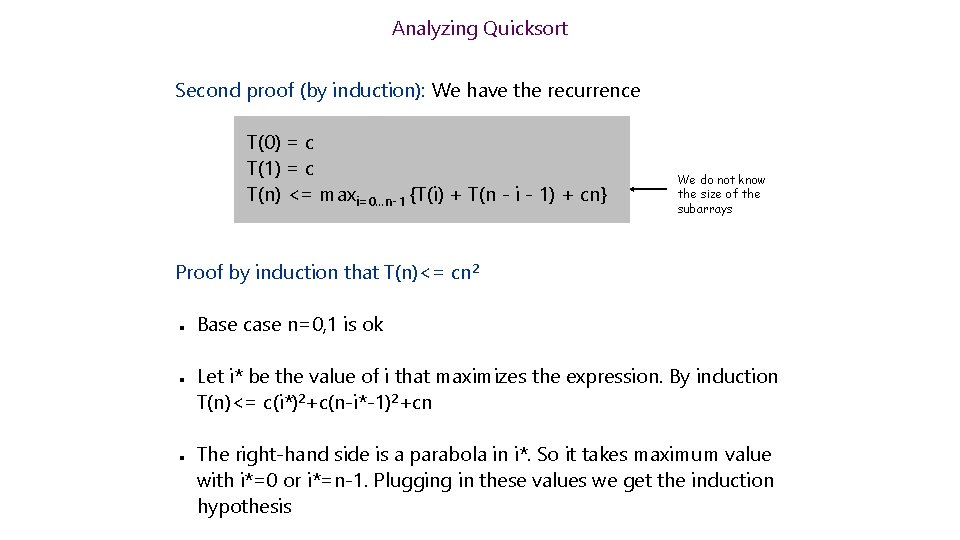
Analyzing Quicksort Second proof (by induction): We have the recurrence T(0) = c T(1) = c T(n) <= maxi=0…n-1 {T(i) + T(n - i - 1) + cn} We do not know the size of the subarrays Proof by induction that T(n)<= cn 2 n n n Base case n=0, 1 is ok Let i* be the value of i that maximizes the expression. By induction T(n)<= c(i*)2+c(n-i*-1)2+cn The right-hand side is a parabola in i*. So it takes maximum value with i*=0 or i*=n-1. Plugging in these values we get the induction hypothesis
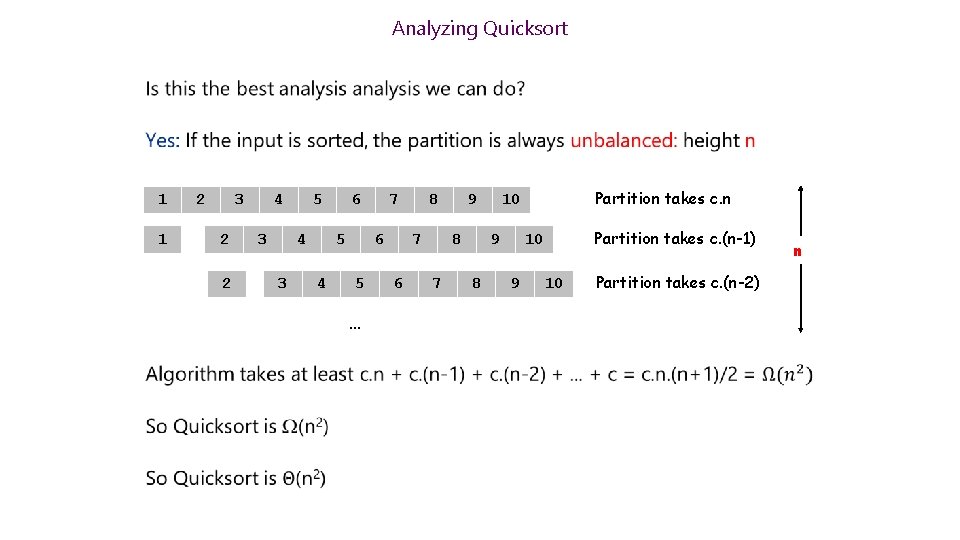
Analyzing Quicksort 1 1 2 3 2 2 4 3 5 4 3 6 5 4 7 6 5 … 8 7 6 9 8 7 9 8 Partition takes c. n 10 Partition takes c. (n-1) 10 9 10 Partition takes c. (n-2) n
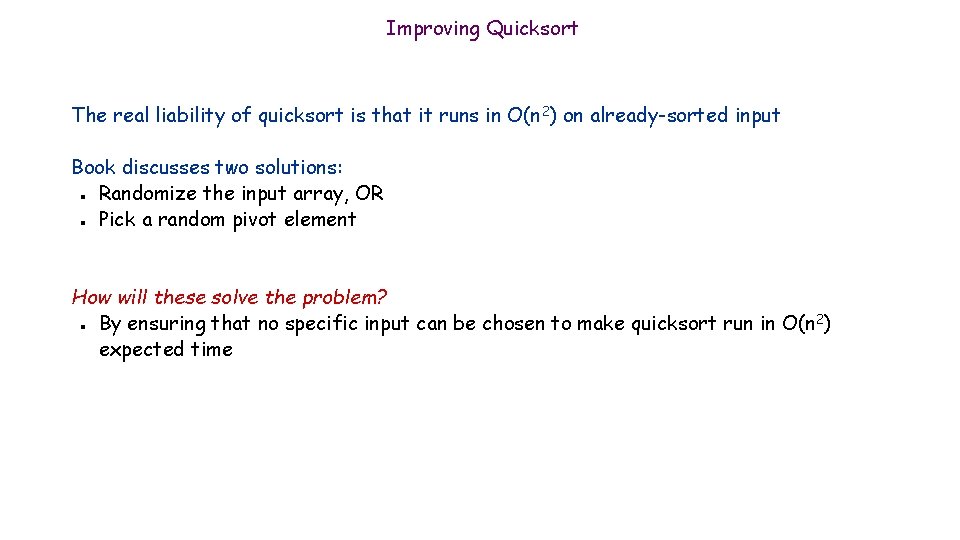
Improving Quicksort The real liability of quicksort is that it runs in O(n 2) on already-sorted input Book discusses two solutions: Randomize the input array, OR Pick a random pivot element n n How will these solve the problem? By ensuring that no specific input can be chosen to make quicksort run in O(n 2) expected time n
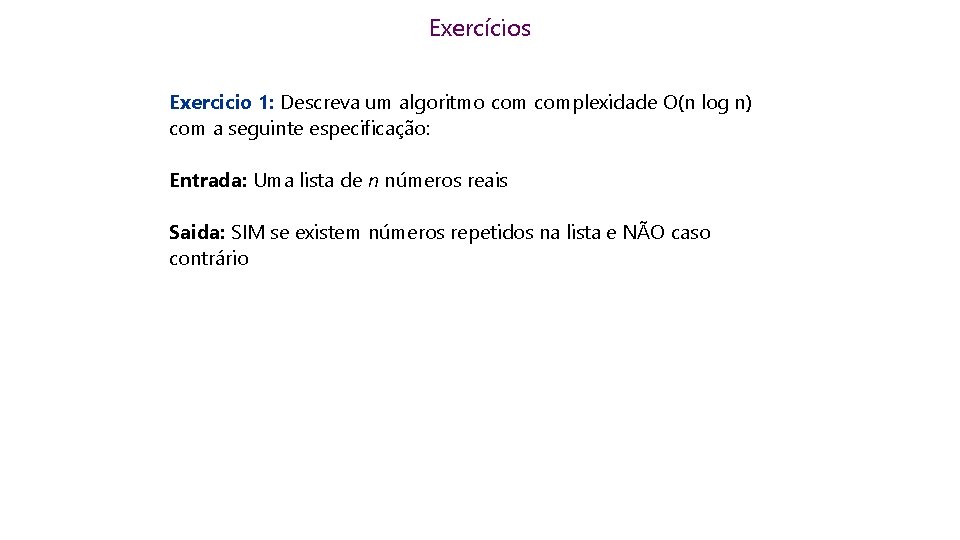
Exercícios Exercicio 1: Descreva um algoritmo complexidade O(n log n) com a seguinte especificação: Entrada: Uma lista de n números reais Saida: SIM se existem números repetidos na lista e NÃO caso contrário
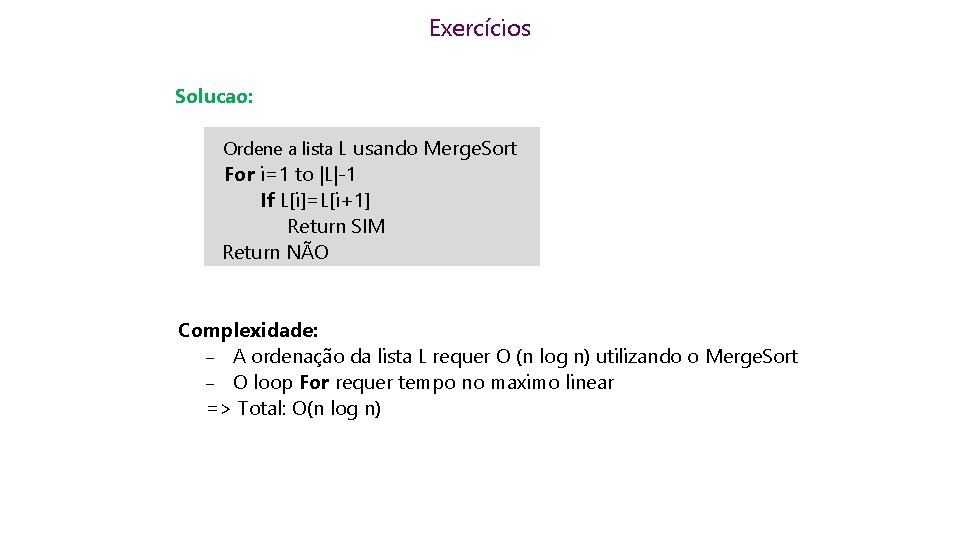
Exercícios Solucao: Ordene a lista L usando Merge. Sort For i=1 to |L|-1 If L[i]=L[i+1] Return SIM Return NÃO Complexidade: – A ordenação da lista L requer O (n log n) utilizando o Merge. Sort – O loop For requer tempo no maximo linear => Total: O(n log n)
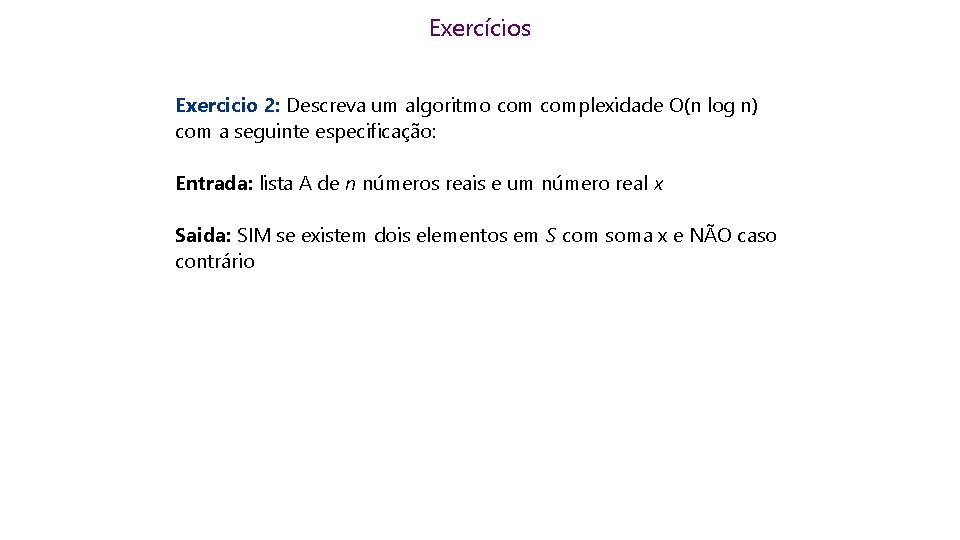
Exercícios Exercicio 2: Descreva um algoritmo complexidade O(n log n) com a seguinte especificação: Entrada: lista A de n números reais e um número real x Saida: SIM se existem dois elementos em S com soma x e NÃO caso contrário
Exercícios Solucao: Ideia: Para cada elemento A[i], procure por seu “par” x – A[i] (ou seja, por um elemento tal que somado com A[i] de igual a x) Ordene o conjunto A usando Merge. Sort For i = 1 to len(A) Binary. Search(A, A[i] – x) If busca binaria encontrou tal elemento Return SIM Return NÃO Complexidade: – Ordenacao gasta O(n log n) operacoes – Cada iteracao do For gasta O(log n) operacoes (devido a busca bin. ) – For gasta no total O(n log n) => Total: O(n log n)
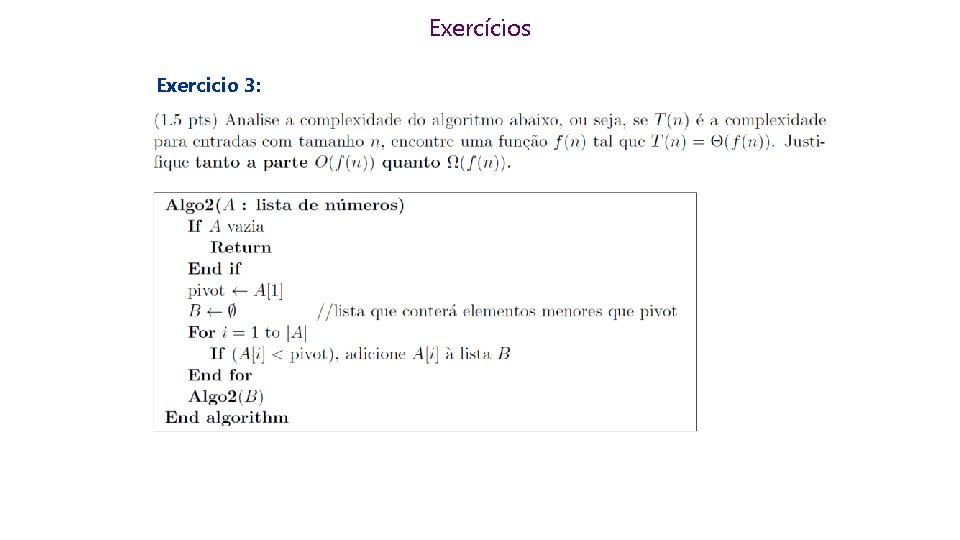
Exercícios Exercicio 3:
5. 4 Sorting in linear time
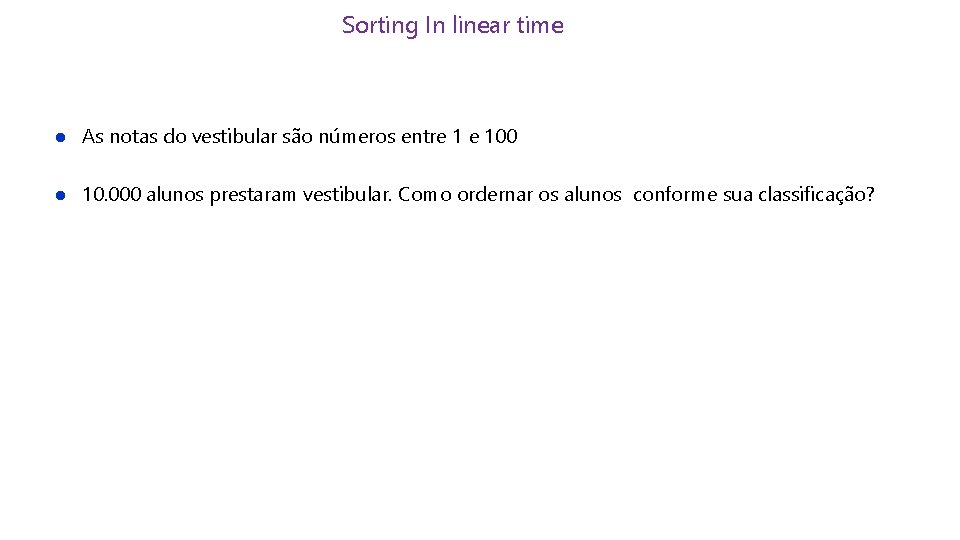
Sorting In linear time l As notas do vestibular são números entre 1 e 100 l 10. 000 alunos prestaram vestibular. Como ordernar os alunos conforme sua classificação?
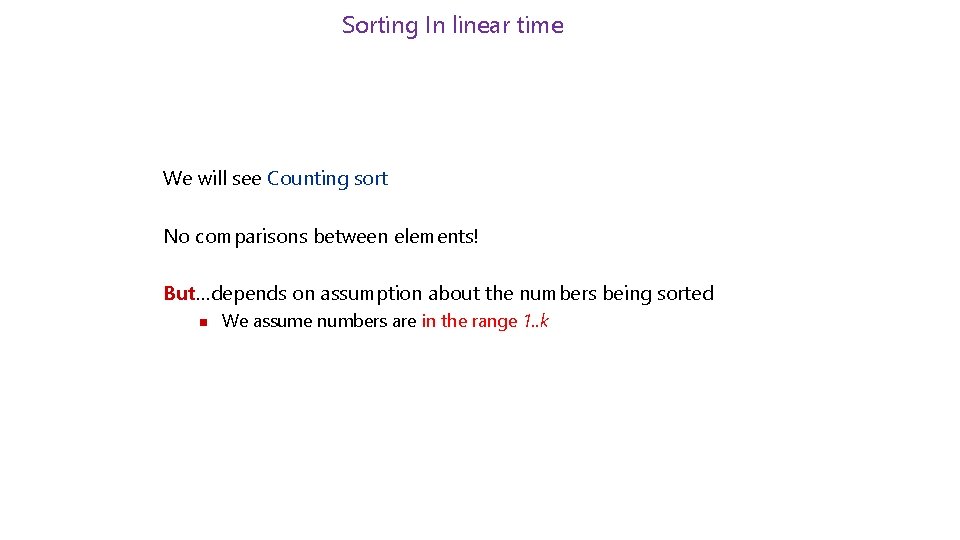
Sorting In linear time We will see Counting sort No comparisons between elements! But…depends on assumption about the numbers being sorted n We assume numbers are in the range 1. . k
Counting Sort Input: List of integers A[1], A[2], …, A[n] with values between 1 and k Main idea: Compute vector C where C[i] is number of elements in the list at most i How can we use this to sort? Ex 1: Consider distinct numbers A = [3, 1, 5, 10, 7] l Counting vector is C = [1, 1, 2, 2, 3, 3, 4, 4, 4, 5] l C[3] = 2 2 elements in the input with value at most “ 3” is the second smallest element should put “ 3” on the second position of output! l Put number “ 3” in position C[3], number “ 1” in position C[1], … output: 3
Counting Sort Input: List of integers A[1], A[2], …, A[n] with values between 1 and k Main idea: Compute vector C where C[i] is number of elements in the list at most i How can we use this to sort? Ex 1: Consider distinct numbers A = [3, 1, 5, 10, 7] l Counting vector is C = [1, 1, 2, 2, 3, 3, 4, 4, 4, 5] l C[3] = 2 2 elements in the input with value at most “ 3” is the second smallest element should put “ 3” on the second position of output! l Put number “ 3” in position C[3], number “ 1” in position C[1], … output: 3
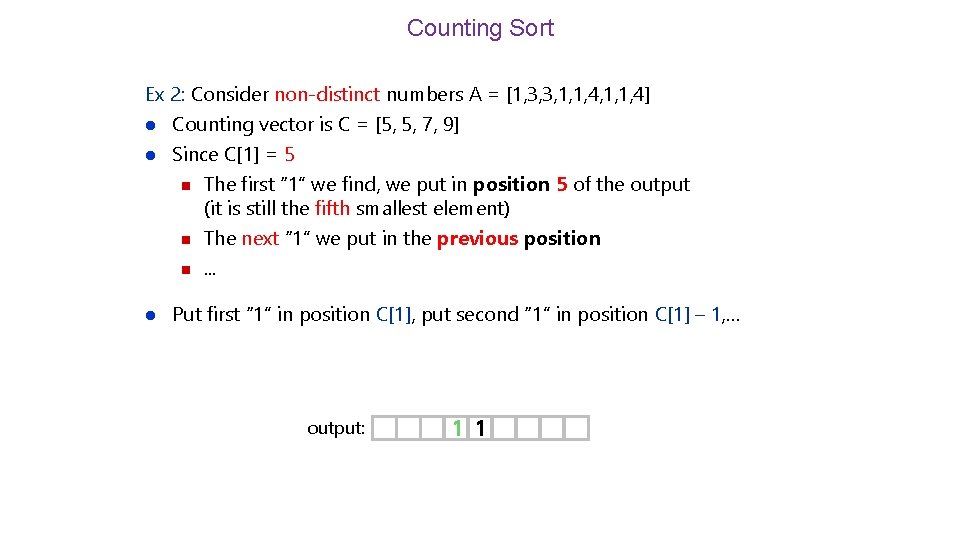
Counting Sort Ex 2: Consider non-distinct numbers A = [1, 3, 3, 1, 1, 4] l l l Counting vector is C = [5, 5, 7, 9] Since C[1] = 5 n The first “ 1” we find, we put in position 5 of the output (it is still the fifth smallest element) n The next “ 1” we put in the previous position n. . . Put first “ 1” in position C[1], put second “ 1” in position C[1] – 1, … output: 1 1
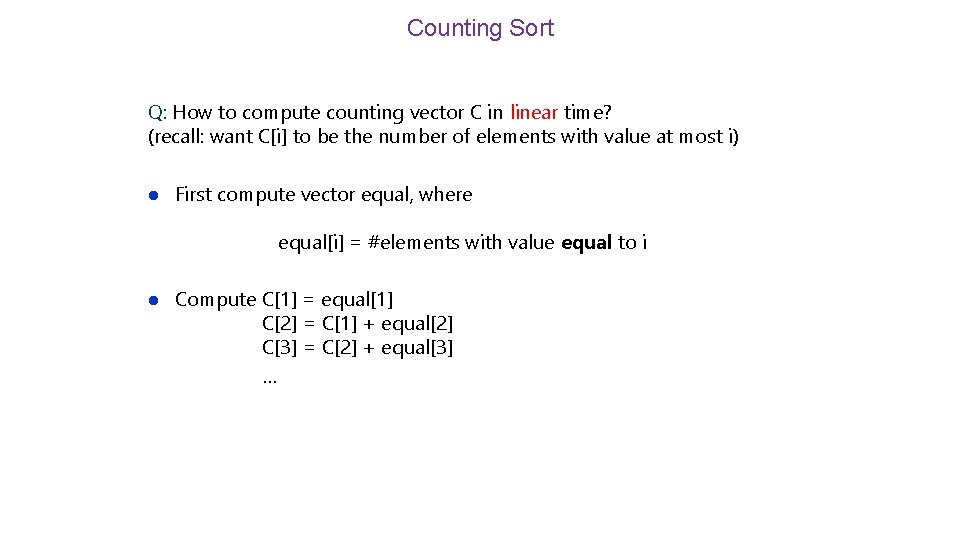
Counting Sort Q: How to compute counting vector C in linear time? (recall: want C[i] to be the number of elements with value at most i) l First compute vector equal, where equal[i] = #elements with value equal to i l Compute C[1] = equal[1] C[2] = C[1] + equal[2] C[3] = C[2] + equal[3] …
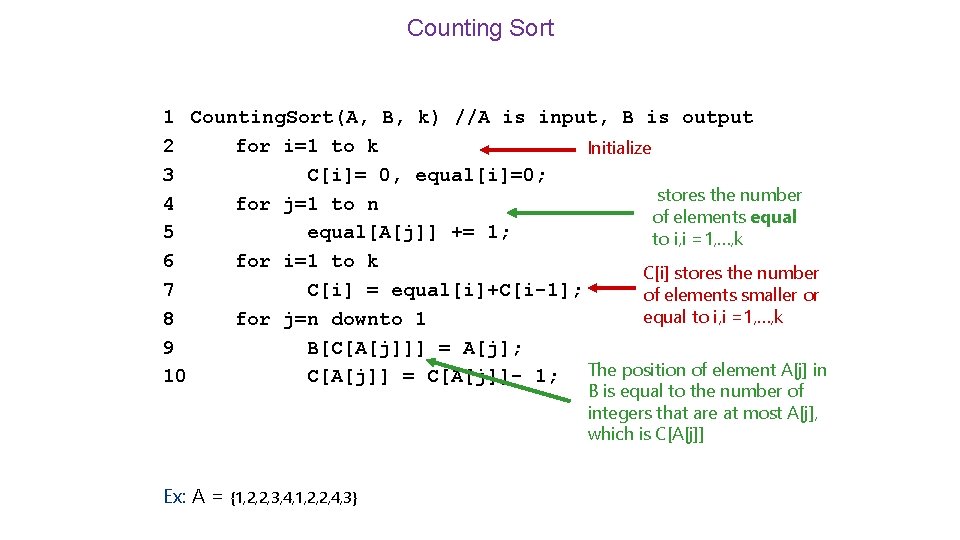
Counting Sort 1 Counting. Sort(A, B, k) //A is input, B is output 2 for i=1 to k Initialize 3 C[i]= 0, equal[i]=0; stores the number 4 for j=1 to n of elements equal 5 equal[A[j]] += 1; to i, i =1, …, k 6 for i=1 to k C[i] stores the number 7 C[i] = equal[i]+C[i-1]; of elements smaller or equal to i, i =1, …, k 8 for j=n downto 1 9 B[C[A[j]]] = A[j]; 10 C[A[j]] = C[A[j]]- 1; The position of element A[j] in B is equal to the number of integers that are at most A[j], which is C[A[j]] Ex: A = {1, 2, 2, 3, 4, 1, 2, 2, 4, 3}
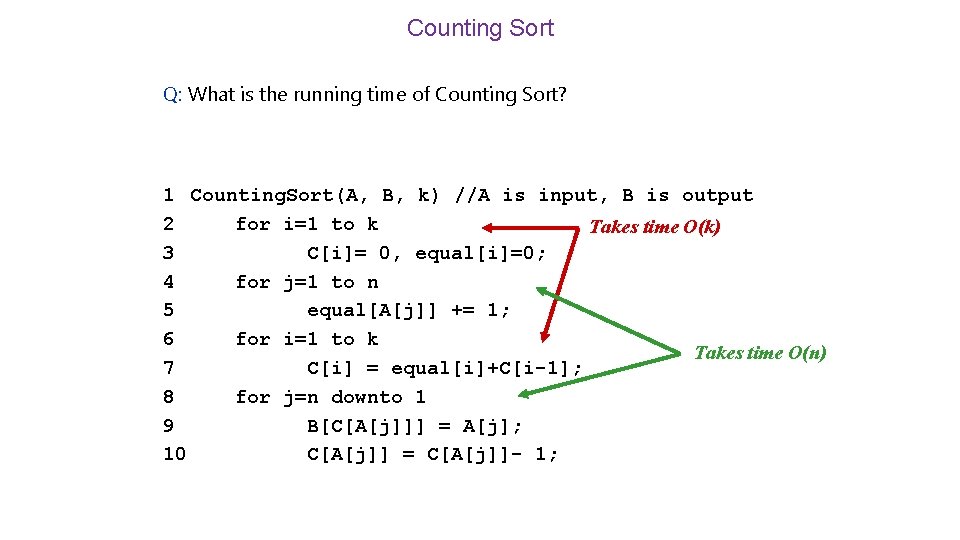
Counting Sort Q: What is the running time of Counting Sort? 1 Counting. Sort(A, B, k) //A is input, B is output 2 for i=1 to k Takes time O(k) 3 C[i]= 0, equal[i]=0; 4 for j=1 to n 5 equal[A[j]] += 1; 6 for i=1 to k Takes time O(n) 7 C[i] = equal[i]+C[i-1]; 8 for j=n downto 1 9 B[C[A[j]]] = A[j]; 10 C[A[j]] = C[A[j]]- 1;
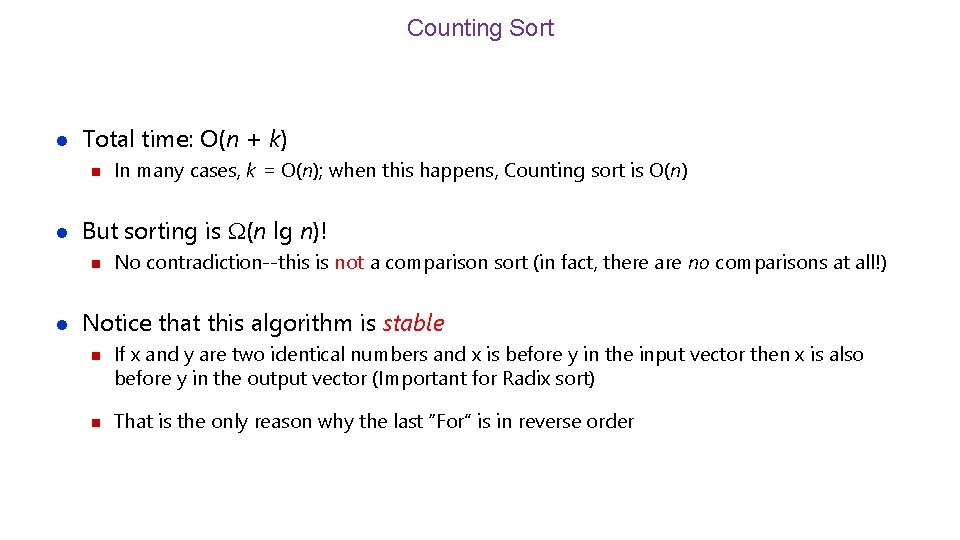
Counting Sort l Total time: O(n + k) n l But sorting is (n lg n)! n l In many cases, k = O(n); when this happens, Counting sort is O(n) No contradiction--this is not a comparison sort (in fact, there are no comparisons at all!) Notice that this algorithm is stable n n If x and y are two identical numbers and x is before y in the input vector then x is also before y in the output vector (Important for Radix sort) That is the only reason why the last “For” is in reverse order
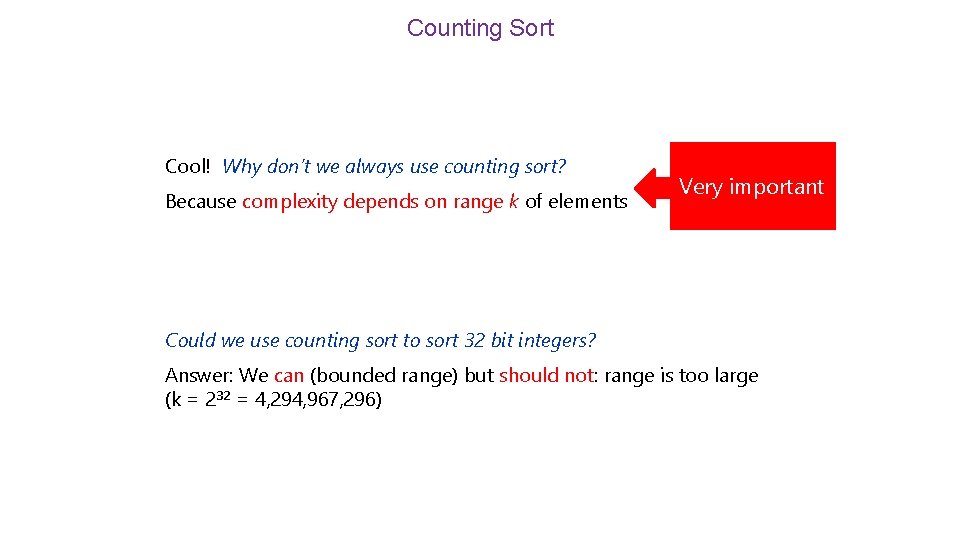
Counting Sort Cool! Why don’t we always use counting sort? Because complexity depends on range k of elements Very important Could we use counting sort to sort 32 bit integers? Answer: We can (bounded range) but should not: range is too large (k = 232 = 4, 294, 967, 296)
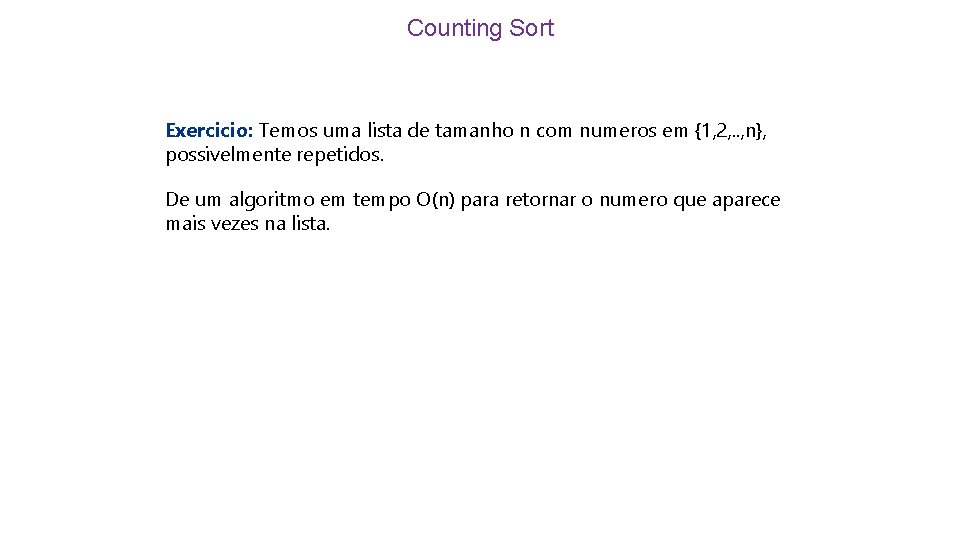
Counting Sort Exercicio: Temos uma lista de tamanho n com numeros em {1, 2, . . , n}, possivelmente repetidos. De um algoritmo em tempo O(n) para retornar o numero que aparece mais vezes na lista.
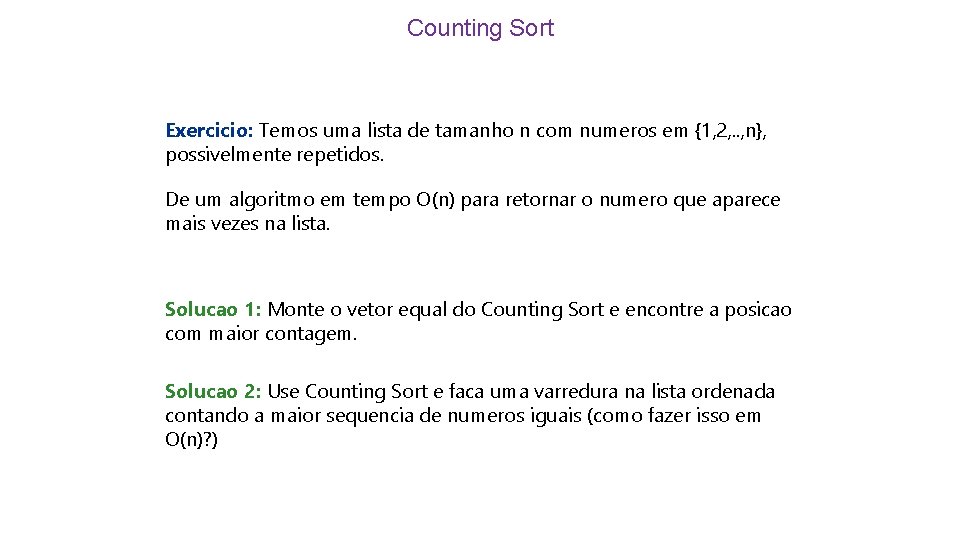
Counting Sort Exercicio: Temos uma lista de tamanho n com numeros em {1, 2, . . , n}, possivelmente repetidos. De um algoritmo em tempo O(n) para retornar o numero que aparece mais vezes na lista. Solucao 1: Monte o vetor equal do Counting Sort e encontre a posicao com maior contagem. Solucao 2: Use Counting Sort e faca uma varredura na lista ordenada contando a maior sequencia de numeros iguais (como fazer isso em O(n)? )