
Sophocles 495 405 B C was one of
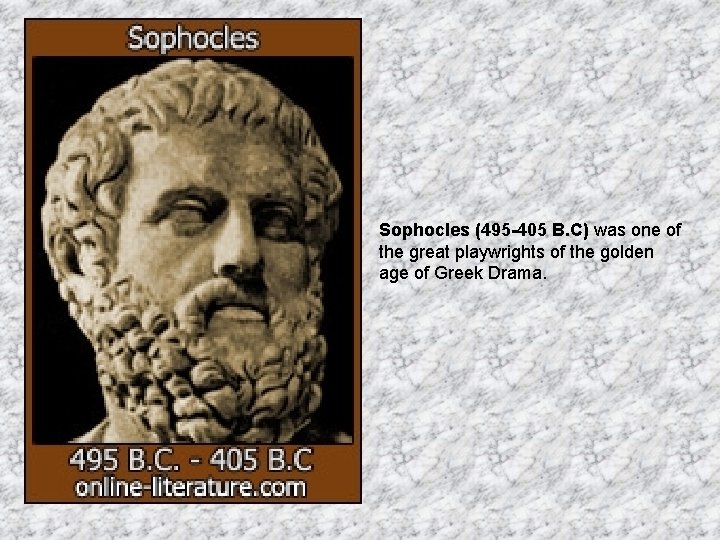
Sophocles (495 -405 B. C) was one of the great playwrights of the golden age of Greek Drama.
son of a wealthy merchant studied all of the arts At sixteen, he led a boys choir at a celebration. Twelve years later, his studies complete, he was ready to compete in the City Dionysia--a festival held every year at the Theatre of Dionysus in which new plays were presented. In his first competition, in 468 B. C. , Sophocles won first prize!
He wrote more than 120 plays. He won at least eighteen first prizes. An actor, Sophocles performed in many of his own plays. He had a weak voice—gave up his acting career for other things.
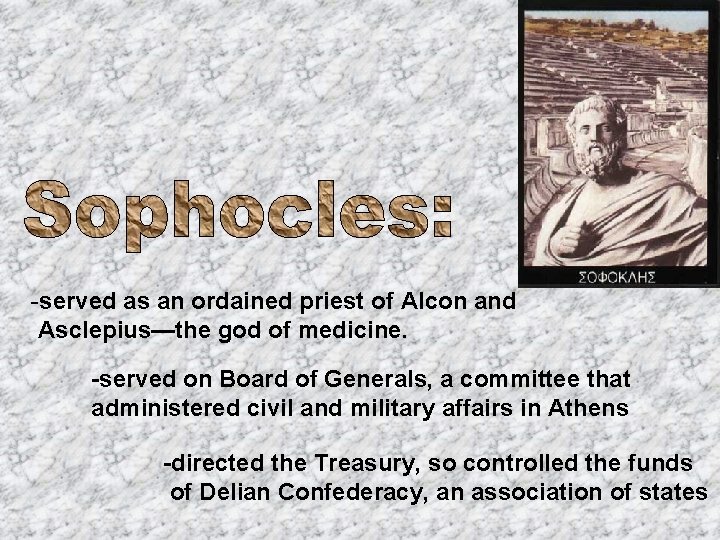
-served as an ordained priest of Alcon and Asclepius—the god of medicine. -served on Board of Generals, a committee that administered civil and military affairs in Athens -directed the Treasury, so controlled the funds of Delian Confederacy, an association of states
• One of the great innovators of theatre • the first to add a third actor • abolished the trilogic form • chose to pack all of his action into the shorter form • Only 7 of his 120 plays still survive. • Improved stage scenery • Aristotle praised him above all playwrights. • Oedipus the King considered his greatest work.
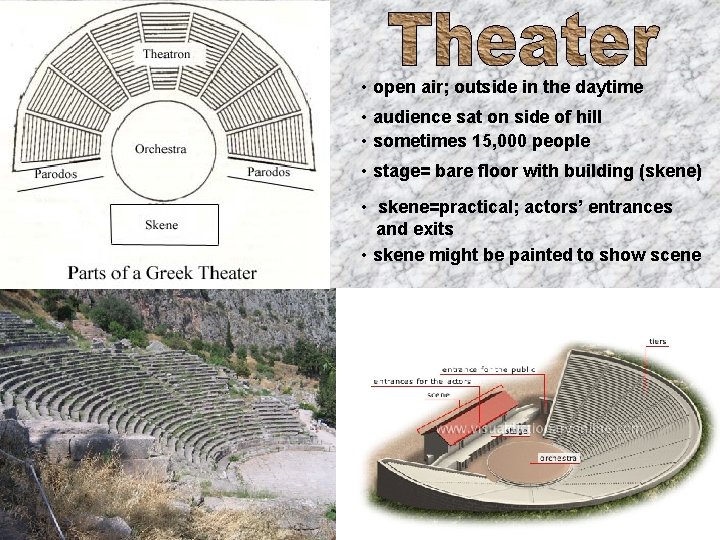
• open air; outside in the daytime • audience sat on side of hill • sometimes 15, 000 people • stage= bare floor with building (skene) • skene=practical; actors’ entrances and exits • skene might be painted to show scene
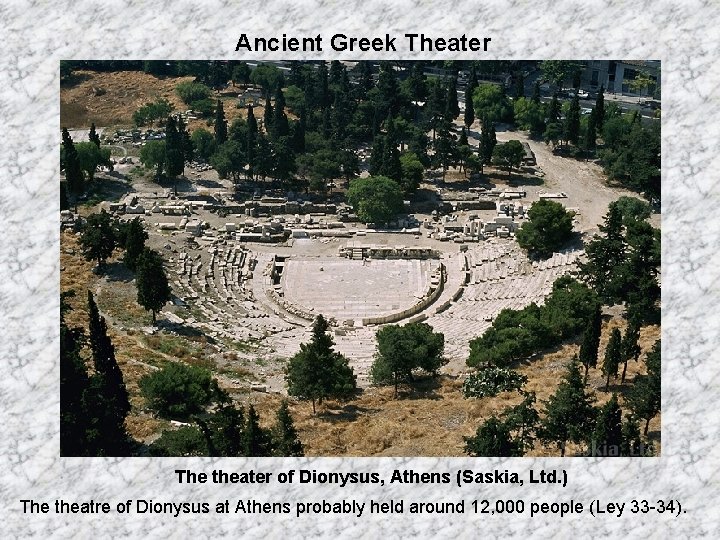
Ancient Greek Theater The theater of Dionysus, Athens (Saskia, Ltd. ) The theatre of Dionysus at Athens probably held around 12, 000 people (Ley 33 -34).
1. a social, political, and religious experience. 2. public unity 3. most plays based on Ancient Greek myth—drew people together because of shared heritage 4. religious significance/sacred art–started as choral performance for god of wine and fertility: Dionysius 5. Thespis started drama when took one man out to speak alone— 534 B. C. Thespis produced first tragedy at Dionysius’s festival. 6. Theater festivals honored Dionysius.
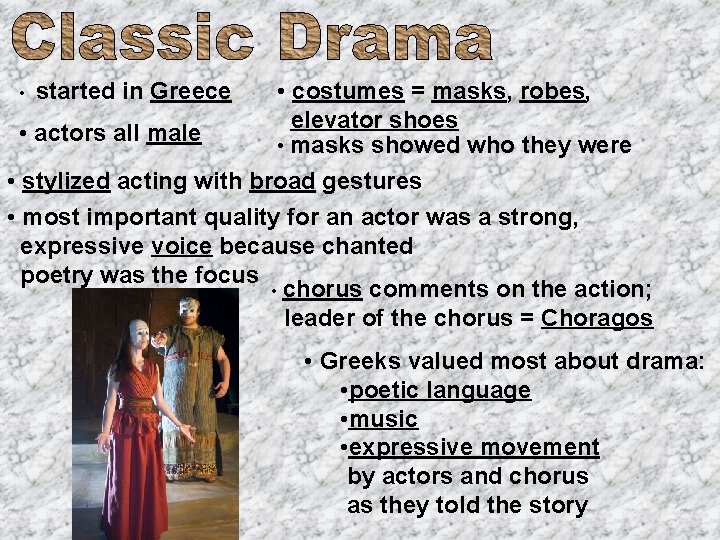
• costumes = masks, robes, elevator shoes • actors all male • masks showed who they were • stylized acting with broad gestures • most important quality for an actor was a strong, expressive voice because chanted poetry was the focus • chorus comments on the action; leader of the chorus = Choragos • started in Greece • Greeks valued most about drama: • poetic language • music • expressive movement by actors and chorus as they told the story
1. King Laius and Queen Jocaste have a son—Oedipus—in their home at Thebes. 2. Oracle at Delphi warns them that this son will kill his father. 3. Laius pierces his son’s feet and gives him to a shepherd with instructions to leave the baby in the mountains to die. 4. The shepherd pities the baby and gives him to a herdsman who takes the boy far from Thebes to Corinth. There the childless king and queen of Corinth adopt the baby and name him Oedipus, which means “swollen-foot. ” 5. Oedipus grows up a prince in Corinth, but learns from the same oracle that he will kill his father and marry his mother. Horrified, he decides never to return home so the prophecy won’t come true. 6. Near Thebes, Oedipus encounters an old man in a chariot who insults and strikes Oedipus in anger. Oedipus kills him.
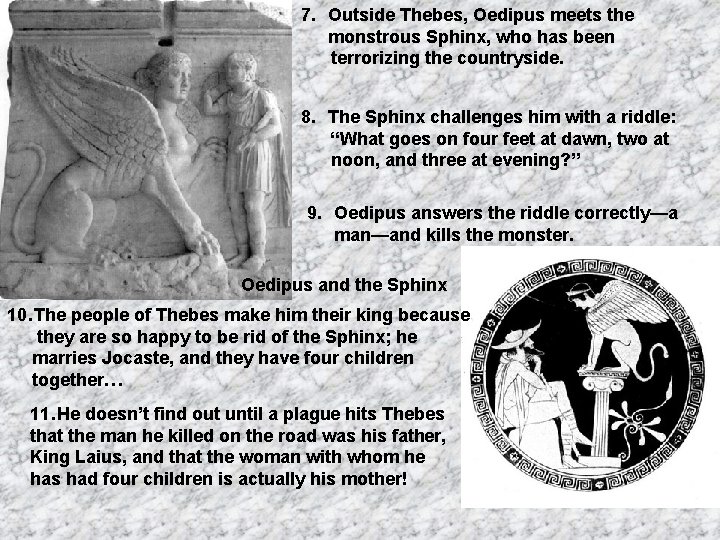
7. Outside Thebes, Oedipus meets the monstrous Sphinx, who has been terrorizing the countryside. 8. The Sphinx challenges him with a riddle: “What goes on four feet at dawn, two at noon, and three at evening? ” 9. Oedipus answers the riddle correctly—a man—and kills the monster. Oedipus and the Sphinx 10. The people of Thebes make him their king because they are so happy to be rid of the Sphinx; he marries Jocaste, and they have four children together… 11. He doesn’t find out until a plague hits Thebes that the man he killed on the road was his father, King Laius, and that the woman with whom he has had four children is actually his mother!
When the play Antigone opens, Oedipus, her father, has gouged his eyes out with Jocaste’s needles after he learns that he has fulfilled the prophecy after all. He is banished by Creon the king, and Antigone stays with him on the outskirts of the city until he dies. She has returned home from that duty.
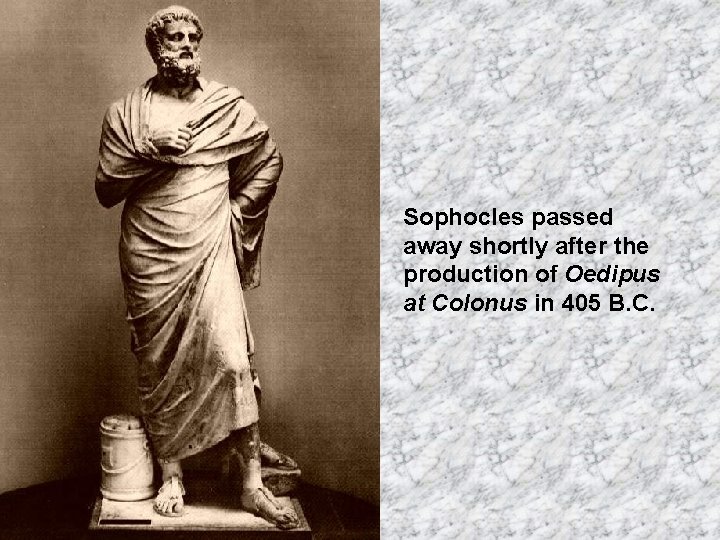
Sophocles passed away shortly after the production of Oedipus at Colonus in 405 B. C.
The protagonist of a tragedy is called the Tragic Hero: • person of noble birth or great stature • has a tragic flaw • suffers a reversal of fortune— or downfall—high to low • major event leading to the downfall is called the catastrophe
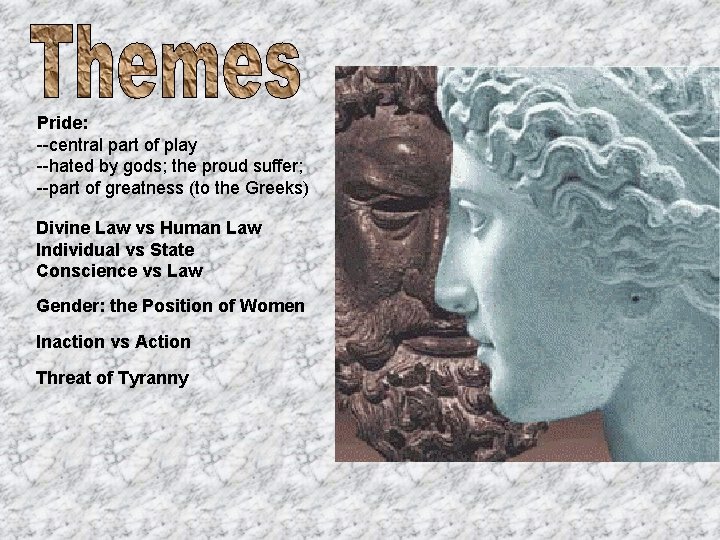
Pride: --central part of play --hated by gods; the proud suffer; --part of greatness (to the Greeks) Divine Law vs Human Law Individual vs State Conscience vs Law Gender: the Position of Women Inaction vs Action Threat of Tyranny
Creon – Jocaste’s brother, so ruler of Thebes after death of Oedipus; uncle of Oedipus’s two daughters and two sons Eurydice – wife of Creon, new Queen of Thebes Haemon – Creon’s son, prince of Thebes, and fiance of Antigone – young daughter of the incestuous relationship of Oedipus and his mother; probably young— 13 -15 years old Ismene – young daughter of Oedipus and Jocaste; sister of Antigone; niece of Creon Polynices – son of Oedipus and Jocaste; brother to Antigone, Ismene, and Ereocles; kills Ereocles – son of Oedipus and Jocaste; brother to Antigone, Ismene, and Polynices; kills Polynices Jocaste – Oedipus’s mother, Creon’s sister, Queen of Thebes, also mother and grandmother to Antigone and her siblings Tiresias – the blind prophet (just as in The Odyssey) ; represents the truth rejected by a willful and proud king; almost of symbol for Fate
The Greeks believed that the spirit of a dead person could enter Hades only after the body had been purified and buried. Until the proper rites were performed, the person hovered at the gate of Hades, neither alive nor completely dead. *** Women in ancient Greece had to depend on male relatives for support. Girls married when they were thirteen or fourteen, and their husbands often were more than twice their age. Women in wealthy households were secluded, had no legal rights, and did not inherit property. If a woman's husband died, a man in her family, her guardian, would try to find her another husband. Critic Bernard Knox points out that funeral rites in ancient Greece were "the duty and privilege of the women. " As Antigone and Ismene are the last survivors of Oedipus's family, ". . . it seems to Antigone that Creon's decree is aimed specifically at them. . She takes it for granted Ismene will help her and turns. . . contemptuously and harshly against her when she refuses. "
- Slides: 17