
Sophia Stone Lynn University SCIENCE OF NUMBER IN
Sophia Stone, Lynn University SCIENCE OF NUMBER IN PLATO’S PARMENIDES
Luc Brisson An interpretation of Plato’s Parmenides must address these three questions: 1. What weight should be lent to the staging around Parmenides and Zeno? 1. How should the critique of Forms, in Part I be interpreted? [T 1, T 2] 1. How do the two parts of the dialogue relate to each other? [T 1 -T 2: T 3] Historical and theoretical aspects should be taken together.
Parmenides, b 7 …hold your thought back from this route of inquiry and do not let habit, rich in experience, compel you along this route to direct an aimless eye and an echoing ear and tongue but judge by reasoning (logos) the much contested examination spoken by me. Tr. Richard Mc. Kirahan
Parmenides, b 8 Just one story of a route is still left: that it is. On this there are signs very many, that what –is is ungenerated and imperishable, a whole of a single kind, unshaken, and complete… Tr. Richard Mc. Kirahan
Parmenides, b 8 From what-is-not I will allow you neither to say nor to think: For it is not to be said or thought that it is not. Tr. Richard Mc. Kirahan Zeno’s work is a defense of Parmenides’s monism
Árpád Szabó on Zeno According to Simplicius, Zeno was engaged in contrasting one hypothesis with another: � ἡ ὑπόθεσις ἡ λέγουσα πολλά ἐστιν ‘the hypothesis which states that what exists is many’ with � ἡ τοῦ ἓν εἶναι ‘the hypothesis ‘which states that what exists is one. ’ This is the method of dialectic
Mathematics and Dialectic � Dialectic came before mathematics (Szabó) � Aristotle claims that Zeno invented the method. � Dialectic is a debate. �αἴτημα | aitēma (a ‘request’ or ‘demand’) synonyms: �ὑπόθεσις | hypothesis �ὑποκείμενον | hypokeimenon But it is a debate about definitions
Mathematics and Dialectic � Szabó (1978, p. 269): A joint investigation could not be based on an assumption or hypothesis unless both participants agreed to it. Hence one of them had to ask for the agreement of the other. An agreed definition could be called homologēma or hypothesis. Ex: Meno 86 e 3; Theaetetus; Parmenides This explains the format for Part II of the Parmenides, but what about the objects? Let’s go back to the pebbles.
Mathematics and Dialectic � Mathē/mathēmata �Μάθημα “learning matter” �Μάθησις “study, discipline” � Μαθηματικά “mathematical objects” Before theoretical, there was the practical
Proclus � ‘Keeping count’ started with the Phoenicians for bookkeeping grain stores. � Geometry “land measure” began with the Egyptians to measure the land to levy taxes against it. Let’s play with pebbles
Ancient Greek Mathematical Concepts � even/odd �Artios: that which can be divided into two �Perittos: the one left over � arithmos/monas �ἀριθμός : a limited multitude �mονάς : “unit”, the least definite thing “of all possible partitions” (Klein 1967: 42) You’ll see how these concepts apply to Forms
Szabó on Form or Eidos � The Greek word for ‘to define’ (ὁρίζεσθαι) … means to mark off. �A definition was intended to mark off the Form or Eidos of an object from that which it was not and in this way secure the consistency of the Form in question. So let’s apply what we’ve learned to Plato’s Parmenides
Plato’s Parmenides, Part II � Deductions are a dialectical exercise �Starting with contrary hypotheses of The One � The One is the subject of every deduction � The One is a Form, but does not stand for every Form � The ‘exercise’ helps determine what can be said of the One and its instantiations
Plato’s Parmenides, Part II � Since the One is � And everything participates in the One � It follows that � If an object participates in the One and another Form, then the object is an arithmos. So what does this tell us?
Plato’s Parmenides, Part II � The deductions tell us how the world is affected by a single form, the One. � We learn a general account of the Formparticular relation. � This account is not different from the account we first received from Plato in the Phaedo. [T 1 : T 4]
Conclusion � The theory of forms is a precursor to ancient Greek mathematics, founded upon an Eleatic account of Being. � To understand the Form-particular relation, one must understand the Greek concept of arithmos and its properties.
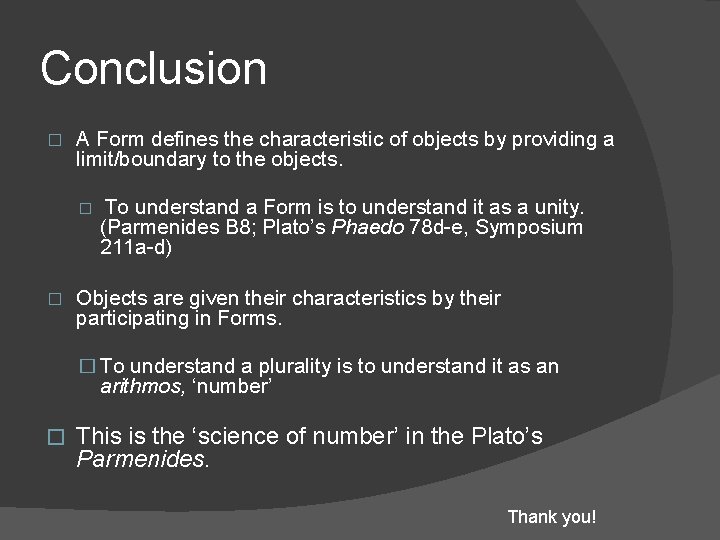
Conclusion � A Form defines the characteristic of objects by providing a limit/boundary to the objects. � � To understand a Form is to understand it as a unity. (Parmenides B 8; Plato’s Phaedo 78 d-e, Symposium 211 a-d) Objects are given their characteristics by their participating in Forms. � To understand a plurality is to understand it as an arithmos, ‘number’ � This is the ‘science of number’ in the Plato’s Parmenides. Thank you!
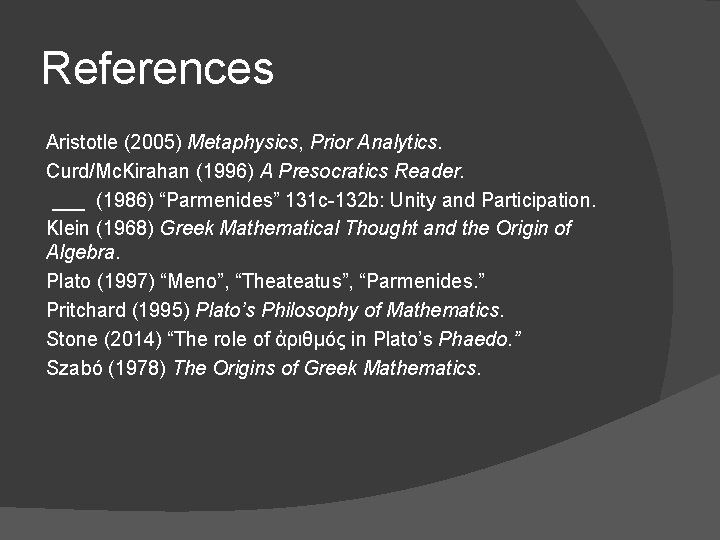
References Aristotle (2005) Metaphysics, Prior Analytics. Curd/Mc. Kirahan (1996) A Presocratics Reader. ___ (1986) “Parmenides” 131 c-132 b: Unity and Participation. Klein (1968) Greek Mathematical Thought and the Origin of Algebra. Plato (1997) “Meno”, “Theateatus”, “Parmenides. ” Pritchard (1995) Plato’s Philosophy of Mathematics. Stone (2014) “The role of ἀριθμός in Plato’s Phaedo. ” Szabó (1978) The Origins of Greek Mathematics.
- Slides: 18