
Sonography of the Breast Part III Lecture 10
Sonography of the Breast Part III Lecture 10 Other Breast Imaging and Testing Harry H. Holdorf Ph. D, MPA, RDMS (Ab, Ob/Gyn, Br), RVT, LRT(AS)

Module Eight- Other Breast Imaging and Testing
Digital Mammography �Digital Mammography, also known as Full Field Digital Mammography (FFDM), allows mammography to use a digital platform in breast imaging offering superior tissue detail. �Advantages: �Ability to manipulate the image once it is obtained �Possibly eliminate retakes and decrease patient exposure �Transferability of images �Disadvantages: �Cost �Requires new mammography equipment
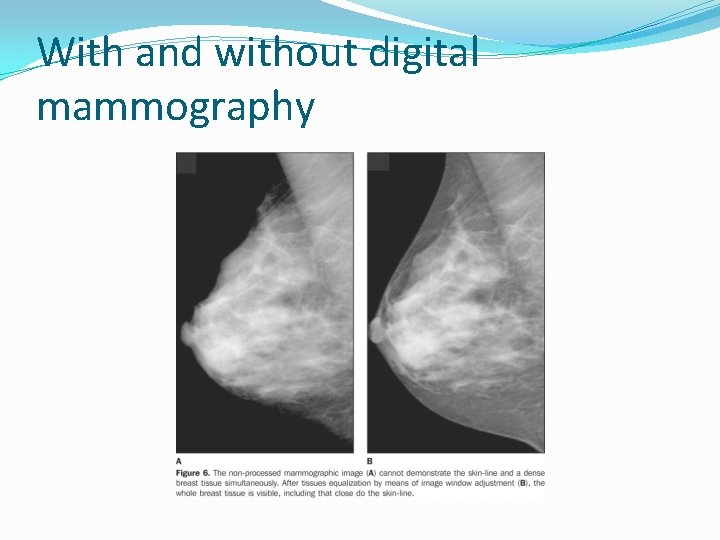
With and without digital mammography
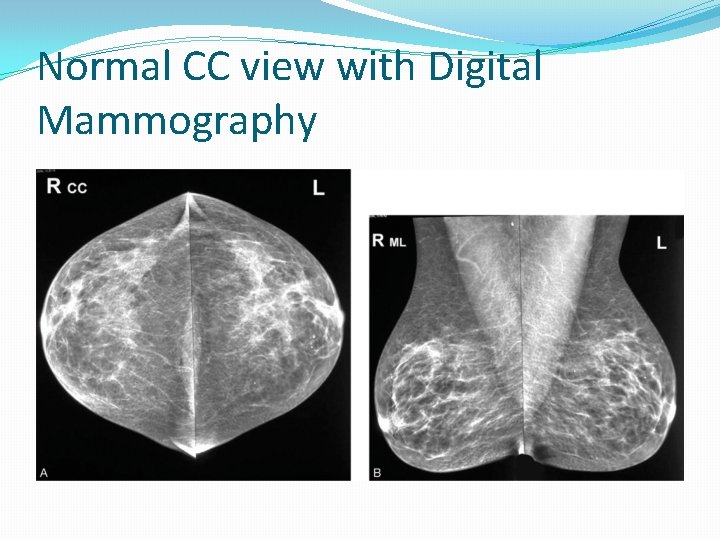
Normal CC view with Digital Mammography
Computer Aided Detection (CAD) �Due to advances in computer technology, including Image Processing (IP), CAD has become a reality in medicine. �Computer Aided Detection (CAD) is used in combination with mammography and other imaging modalities to provide a computer assisted interpretation following the physician’s initial reading. �Studies in breast imaging suggest there is an 8 to 15% increase in breast cancer detection on mammography using CAD.
�CAD advantages: �Ability to detect small microcalcifications and spiculated masses (sometimes missed by radiologists) �Computer readings are reliable and consistent �Decreased human error �Technology will continue to improve �Caution regarding CAD �CAD should never be used as a diagnostic tool alone �Radiologists should initially interpret the study then use CAD �If CAD marks an additional area, the images should be re-evaluated to decide whether follow-up is needed.

Mammography with CAD
Magnetic Resonance Imaging (MRI) plays a significant role in evaluating breast disease. 1. MRI is often used as a follow-up to breast lesions found by mammography, physical examination, and other imaging studies. 2. MRI is the most accurate modality in evaluating the augmented breast. 3. MRI is useful for staging breast cancer (especially evaluating the extent of lymph node involvement) 4. Studies are underway to investigate the use of MRI as a screening tool for women under age 40 (especially women with a strong family history and or positive BRCA 1 and BRCA 1 Genes).
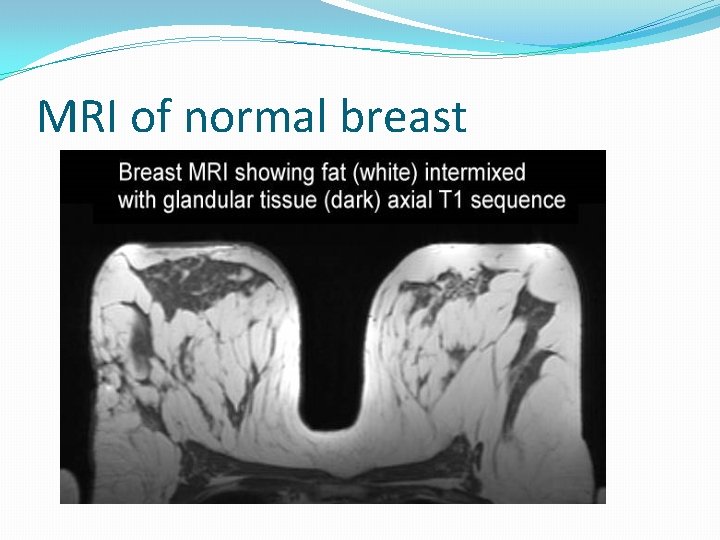
MRI of normal breast

MRI of normal silicone implant

MRI of implant rupture-black arrow (Linguine sign)

Linguine sign

�The Linguine Sign is one of the imaging signs of intracapsular rupture of a breast implant. �After implantation of a silicone breast implant, a fibrous capsule (scar) forms around the implant shell. �In an intracapsular rupture, the contents of the implant are contained by a fibrous scar, while the shell appears as a group of wavy lines. �This has been termed the “Linguine Sign” and has been most commonly described with MR imaging.
�The benefits of MR breast imaging include: �Creating image slices from any plane �Providing a landscape image �Demonstrating both breasts simultaneously �Effectively evaluating dense breasts �Sensitivity to small lesions �Sensitivity to malignant lesions with the use of Gadolinium (contrast agent) �Detecting breast implant ruptures �Detecting residual cancer after lumpectomy MRI is the most accurate imaging modality in the detection of implant rupture
Some disadvantages of MR breast imaging include: �Difficulty in distinguishing benign from malignant lesions �Cannot image microcalcifications �Requires the use of contrast injection �Claustrophobic patients may not tolerate the study �More time-consuming than mammography �Expensive and not widely available.
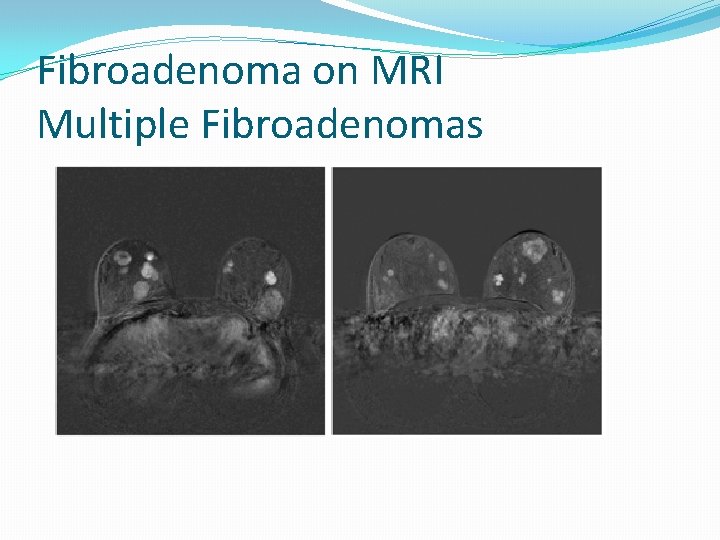
Fibroadenoma on MRI Multiple Fibroadenomas
Nuclear Medicine �Nuclear Medicine breast imaging is also known as Scintimammography. �It offers a physiological approach to the diagnosis of breast disease. �A radioactive element is injected into the patient’s opposite arm and the tracer isolates cancers in the breast.
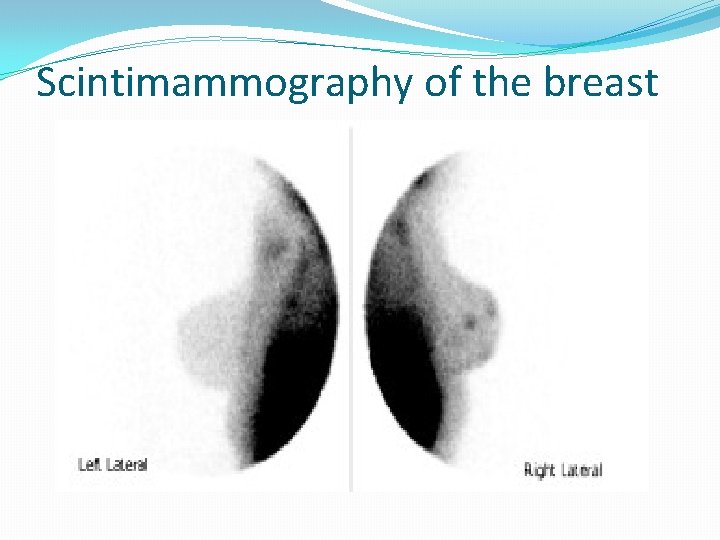
Scintimammography of the breast
�Uses technetium-99 m MIBI compound � 6 MIBI molecules – Sestamibi �MIBI trade Name – Miraluma �Scintimammography is helpful in evaluating �Patients with dense breasts �Palpable abnormalities not well imaged mammography and sonography �Multifocal and multicentric cancer by
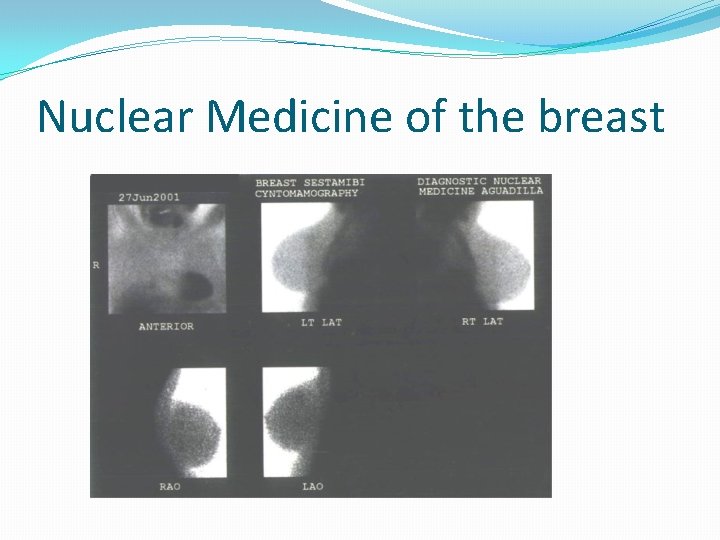
Nuclear Medicine of the breast
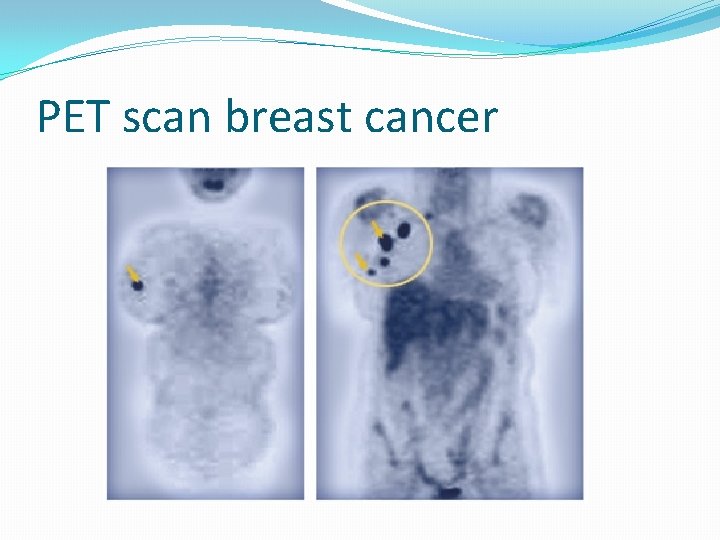
PET Scan �Positron Emission Tomography (PET) is a physiologic technique that provides information regarding the metabolism of tissue and organs. �A PET scan involves an injection of glucose tagged to a radioactive tracer. �Most cancers, including breast cancer, metabolize glucose more rapidly than normal tissue. �Thus, the PET scan detect the increase in sugar metabolism and show sites of tumor involvement using a whole-body imaging approach.
�PET scan be used for: �Differentiating benign from malignant lesions �Staging of newly diagnosed cancers �Detecting local and distant metastases �Evaluating tumor response to therapy �Identifying recurrences �Limitations of PET Scanning include: �Inability to consistently detect small lesions (<1 cm) �False-positive findings
PET scan breast cancer

Ductography �Ductography, known as Galactography, is an effective means of imaging the lactiferous ducts of the breast. �In the case of a suspicious, single-duct nipple discharge, this procedure is often done to identify an intraductal mass.

�The primary indication for Ductography is nipple discharge in the non-pregnant and non-lactating patient. �The procedure involves: �Inserting a small needle (30 Gauge) into the duct orifice where the discharge was noted. �A small amount of radiopaque dye is injected into the duct �The duct is imaged under Mammographic or Fluoroscopic Technique �A Cranio-Caudal (CC) Mammographic view with light compression is often used.

�Findings: �If the duct fills completely with no internal deviation of the dye, the duct is normal �If the dye is obstructed or a “filling defect” is noted within the duct, the study is positive �Filling defects usually represent an intraductal papilloma �Approximately 1 in 10 studies reveal a papillary Carcinoma

Normal Ductogram

Ductogram showing Intraductal papilloma
Ductoscopy �Mammary ductoscopy utilizes a microendoscope to directly visualize the ductal lining of the breast, as well as provide access for retrieval of cells. �Relatively new to US physicians, the procedure has been performed in Japan and Europe for several years. �The newest generation mammary ductoscope is 0. 9 mm in diameter. �Patients can undergo the procedure either in an office setting or operating room.
The procedure: �A nipple block is performed 30 minutes prior to the procedure �The breast is massaged or suctioned to promote fluid from the nipple �The scope is advanced into the duct opening and the procedure may be videotaped �If intraluminal pathology is identified, biopsy, surgical removal, or marker placement for core biopsy or surgery may be performed. �Cells are sent for cytologic analysis Future applications of mammary ductoscopy are quite possible
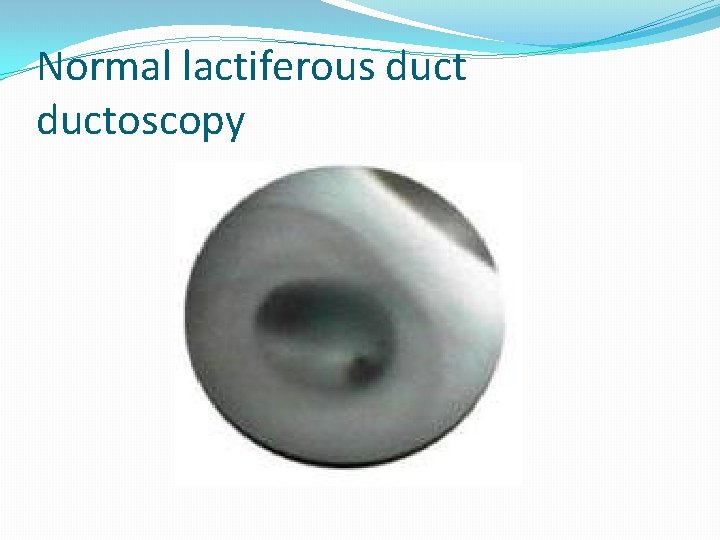
Normal lactiferous ductoscopy

Intraductal Papilloma on Ductoscopy
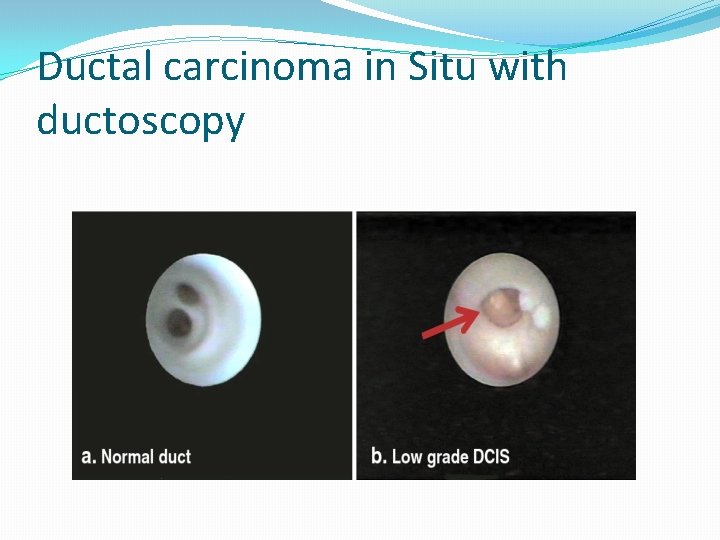
Ductal carcinoma in Situ with ductoscopy
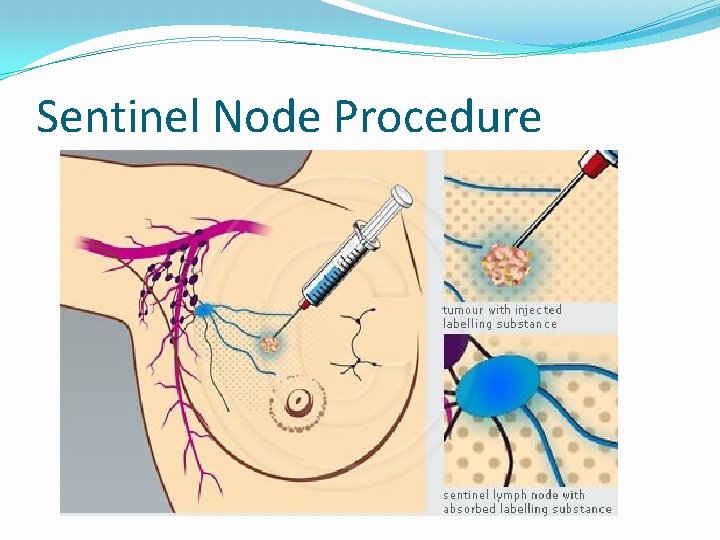
Sentinel Node Procedure �The sentinel Node Procedure uses a dye and radioisotope that are injected around a previously confirmed breast cancer. �By following the flow of dye and radioactivity to the lymph nodes, the sentinel node can be identified and biopsies. �If this node is free of cancer, chances are great the cancer has not metastasized to the lymph nodes.
�The SENTINEL NODE is the first node that drains lymphatic fluid from a specific area of the breast. �Since 75% of lymphatic drainage is to the axillary lymph nodes, the sentinel node is usually found in the axilla. �Sentinel / Definition: One that keeps guard �Lymph is essentially recycled blood plasma
The procedure: �Takes place 2 to 24 hours prior to surgery �A combination of dye, saline, and radioactive isotope (technetium 99 m sulfur colloid) is used �The physician injects the solution into the breast tissues surrounding the cancer �Sonography may be used to help locate the cancer, guide injection techniques, and evaluate regional lymph node basins prior to biopsy of sentinel node. �In surgery, a gamma probe is used to trace the radioactivity to the sentinel node �Through a surgical incision, the node is identified (via Dye) and removed �Biopsy is performed an immediate reading confirming the presence or absence of metastasis
�If the Sentinel Node is cancer free: �There is 95 to 100% likelihood of clear axillary nodes �Axillary lymph Node dissection (ALND) may be alleviated �Lumpectomy may be considered �If the Sentinel Node is cancerous �ALND is performed �Mastectomy may be considered
Sentinel Node Procedure
Cytology and Histology �Cytology and histology are the study of cells of normal and abnormal tissues under a microscope �Both techniques are used for breast biopsy purposes �Different techniques are used for the retrieval of tissue and preparation of the slides �CYTOLOGY is performed following a Fine Needle Aspiration (FNA). �Slide preparation involves “Spraying” a bloody tissue sample onto a slide, then smearing the cells randomly �The architecture of the tissue as it appeared in the breast is, therefore, not maintained
HISTOLOGY �Follows a Core Biopsy procedure. �The pathologist will carefully slice the core of tissue and place different layers onto the slide for staining �This technique maintains the architecture of the tissue as it was found within the breast �With BOTH cytology and histologic evaluation, pathologists can classify cancers based on the type of cells and patterns seen.
�Cytology �Smear of cells �Possible false-negative �Less invasive retrieval (FNA) �Cost effective �Results in 1 -2 hours �Histology �True tissue sample “as is” �More accurate diagnosis - provides differentiation between invasive and non-invasive cancer �More invasive retrieval (CNB) �Expensive �Results in 2 -3 days

�FIN
- Slides: 43