
Sonnet 116 Learning Objective To understand the language

Sonnet 116 Learning Objective: • To understand the language & imagery of Sonnet 116.
Summary • This sonnet attempts to define love, by telling both what it is and is not.
Quatrain 1 • In the first quatrain, the speaker says that love—”the marriage of true minds”—is perfect and unchanging; it does not “admit impediments, ” and it does not change when it find changes in the loved one.
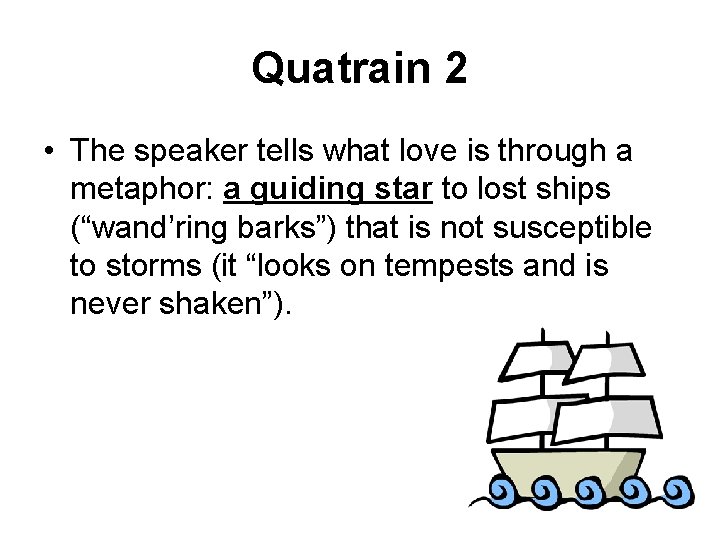
Quatrain 2 • The speaker tells what love is through a metaphor: a guiding star to lost ships (“wand’ring barks”) that is not susceptible to storms (it “looks on tempests and is never shaken”).
Quatrain 3 • The speaker again describes what love is not: it is not susceptible to time. Though beauty fades in time as rosy lips and cheeks come within “his bending sickle’s compass, ” love does not change with hours and weeks: instead, it “bears it out ev’n to the edge of doom. ”
The Couplet • In the couplet, the speaker attests to his certainty that love is as he says: if his statements can be proved to be error, he declares, he must never have written a word, and no man can ever have been in love.
Symbols • Marriage • Navigation: love as a guiding star. • Time / age / death Find a quote to go with each of these symbols!
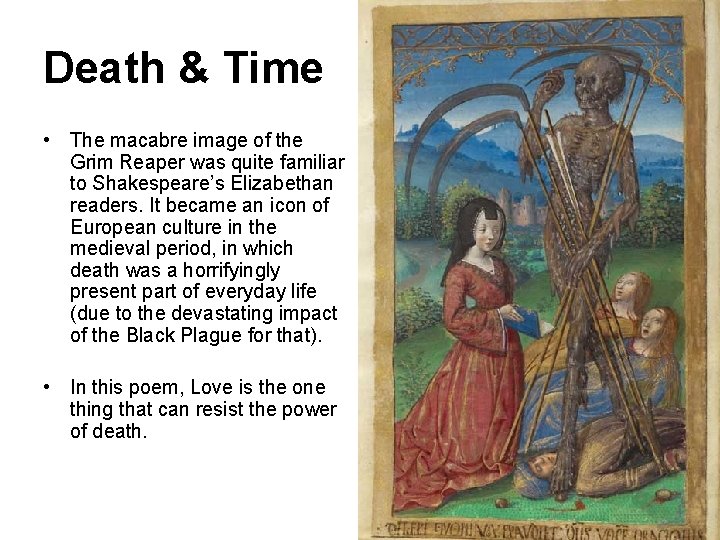
Death & Time • The macabre image of the Grim Reaper was quite familiar to Shakespeare’s Elizabethan readers. It became an icon of European culture in the medieval period, in which death was a horrifyingly present part of everyday life (due to the devastating impact of the Black Plague for that). • In this poem, Love is the one thing that can resist the power of death.
Now summarise the poem in 8 images and quotations
- Slides: 9