
Sonar System Development Background With an increased awareness
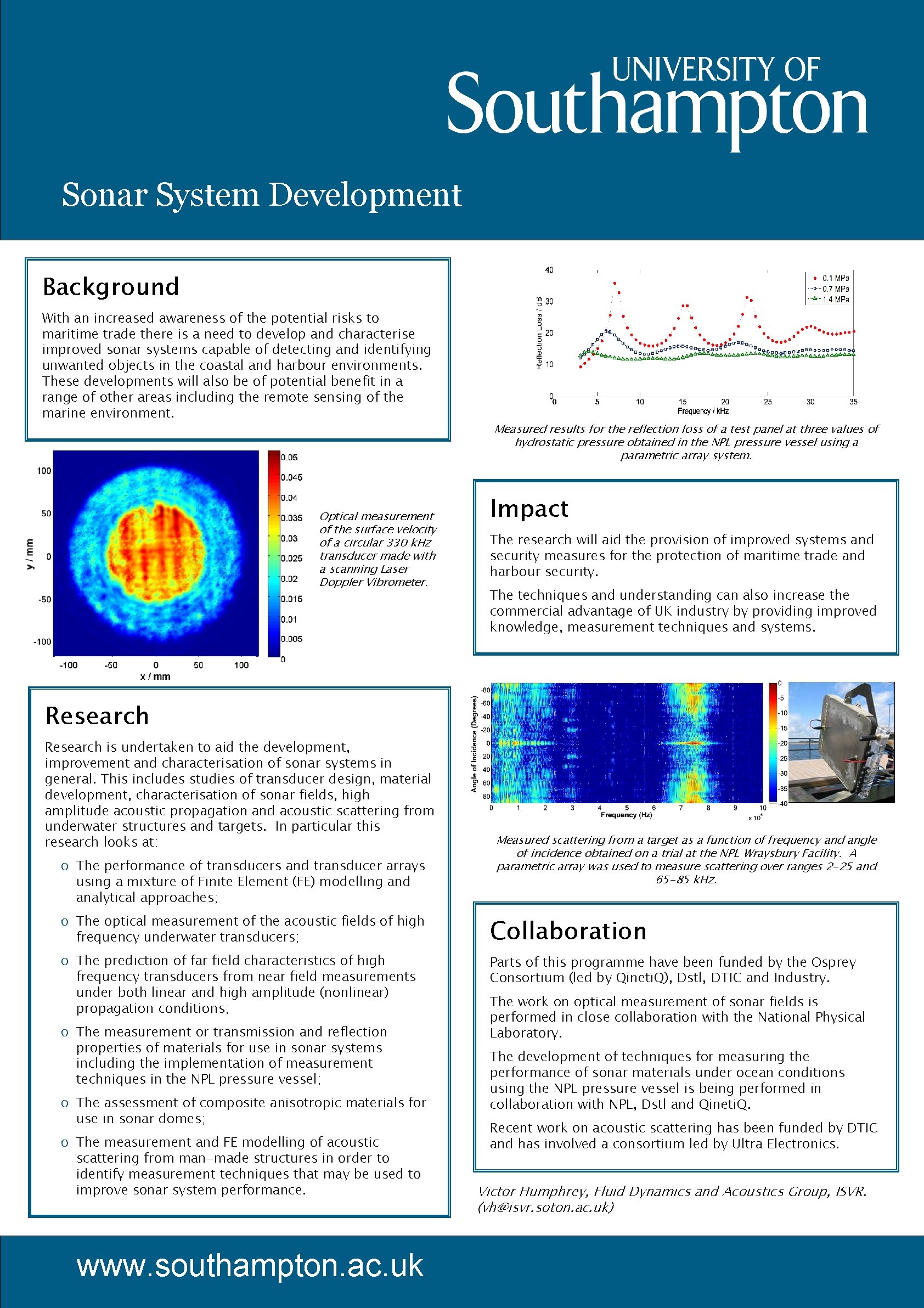
Sonar System Development Background With an increased awareness of the potential risks to maritime trade there is a need to develop and characterise improved sonar systems capable of detecting and identifying unwanted objects in the coastal and harbour environments. These developments will also be of potential benefit in a range of other areas including the remote sensing of the marine environment. Optical measurement of the surface velocity of a circular 330 k. Hz transducer made with a scanning Laser Doppler Vibrometer. Measured results for the reflection loss of a test panel at three values of hydrostatic pressure obtained in the NPL pressure vessel using a parametric array system. Impact The research will aid the provision of improved systems and security measures for the protection of maritime trade and harbour security. The techniques and understanding can also increase the commercial advantage of UK industry by providing improved knowledge, measurement techniques and systems. Research is undertaken to aid the development, improvement and characterisation of sonar systems in general. This includes studies of transducer design, material development, characterisation of sonar fields, high amplitude acoustic propagation and acoustic scattering from underwater structures and targets. In particular this research looks at: o The performance of transducers and transducer arrays using a mixture of Finite Element (FE) modelling and analytical approaches; Measured scattering from a target as a function of frequency and angle of incidence obtained on a trial at the NPL Wraysbury Facility. A parametric array was used to measure scattering over ranges 2 -25 and 65 -85 k. Hz. o The optical measurement of the acoustic fields of high frequency underwater transducers; Collaboration o The prediction of far field characteristics of high frequency transducers from near field measurements under both linear and high amplitude (nonlinear) propagation conditions; Parts of this programme have been funded by the Osprey Consortium (led by Qineti. Q), Dstl, DTIC and Industry. o The measurement or transmission and reflection properties of materials for use in sonar systems including the implementation of measurement techniques in the NPL pressure vessel; o The assessment of composite anisotropic materials for use in sonar domes; o The measurement and FE modelling of acoustic scattering from man-made structures in order to identify measurement techniques that may be used to improve sonar system performance. www. southampton. ac. uk The work on optical measurement of sonar fields is performed in close collaboration with the National Physical Laboratory. The development of techniques for measuring the performance of sonar materials under ocean conditions using the NPL pressure vessel is being performed in collaboration with NPL, Dstl and Qineti. Q. Recent work on acoustic scattering has been funded by DTIC and has involved a consortium led by Ultra Electronics. Victor Humphrey, Fluid Dynamics and Acoustics Group, ISVR. (vh@isvr. soton. ac. uk)
- Slides: 1