
Something Interesting About Finding Something Interesting COSC 6335
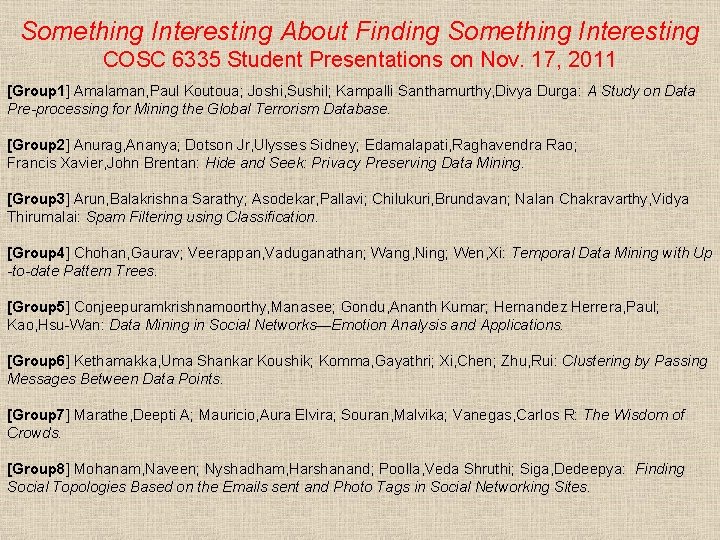
Something Interesting About Finding Something Interesting COSC 6335 Student Presentations on Nov. 17, 2011 [Group 1] Amalaman, Paul Koutoua; Joshi, Sushil; Kampalli Santhamurthy, Divya Durga: A Study on Data Pre-processing for Mining the Global Terrorism Database. [Group 2] Anurag, Ananya; Dotson Jr, Ulysses Sidney; Edamalapati, Raghavendra Rao; Francis Xavier, John Brentan: Hide and Seek: Privacy Preserving Data Mining. [Group 3] Arun, Balakrishna Sarathy; Asodekar, Pallavi; Chilukuri, Brundavan; Nalan Chakravarthy, Vidya Thirumalai: Spam Filtering using Classification. [Group 4] Chohan, Gaurav; Veerappan, Vaduganathan; Wang, Ning; Wen, Xi: Temporal Data Mining with Up -to-date Pattern Trees. [Group 5] Conjeepuramkrishnamoorthy, Manasee; Gondu, Ananth Kumar; Hernandez Herrera, Paul; Kao, Hsu-Wan: Data Mining in Social Networks—Emotion Analysis and Applications. [Group 6] Kethamakka, Uma Shankar Koushik; Komma, Gayathri; Xi, Chen; Zhu, Rui: Clustering by Passing Messages Between Data Points. [Group 7] Marathe, Deepti A; Mauricio, Aura Elvira; Souran, Malvika; Vanegas, Carlos R: The Wisdom of Crowds. [Group 8] Mohanam, Naveen; Nyshadham, Harshanand; Poolla, Veda Shruthi; Siga, Dedeepya: Finding Social Topologies Based on the Emails sent and Photo Tags in Social Networking Sites.
Improving the Classification of Terrorist Attacks A Study on Data Pre-processing for Mining the Global Terrorism Database From: José V. Pagán Electrical & Computer Engineering and Computer Science Department Polytechnic University of Puerto Rico San Juan, Puerto Rico By Amalaman, Paul Koutoua Joshi, Sushil Kampalli Santhamurthy, Divya Durga 2
INTRODUCTION Terrorism- Evolution, causes and growth A case study to illustrate how data mining technique can be used Main source of data: GTD Global Terrorism Database -open-source database including information on terrorist events around the world since 1970 3
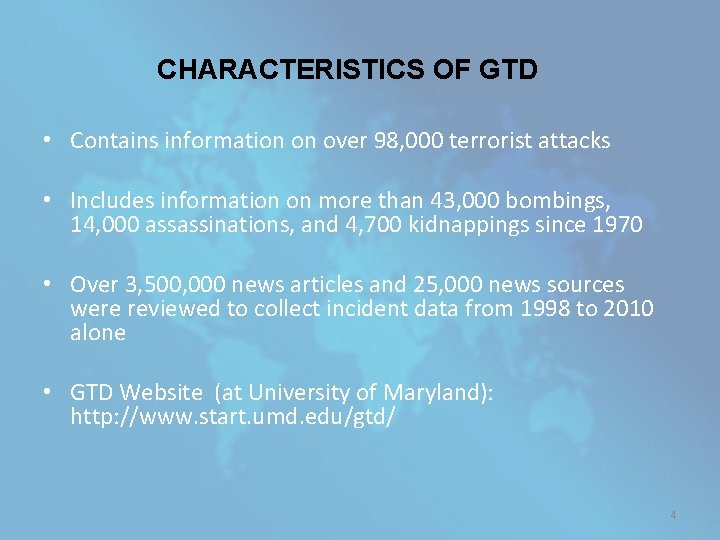
CHARACTERISTICS OF GTD • Contains information on over 98, 000 terrorist attacks • Includes information on more than 43, 000 bombings, 14, 000 assassinations, and 4, 700 kidnappings since 1970 • Over 3, 500, 000 news articles and 25, 000 news sources were reviewed to collect incident data from 1998 to 2010 alone • GTD Website (at University of Maryland): http: //www. start. umd. edu/gtd/ 4
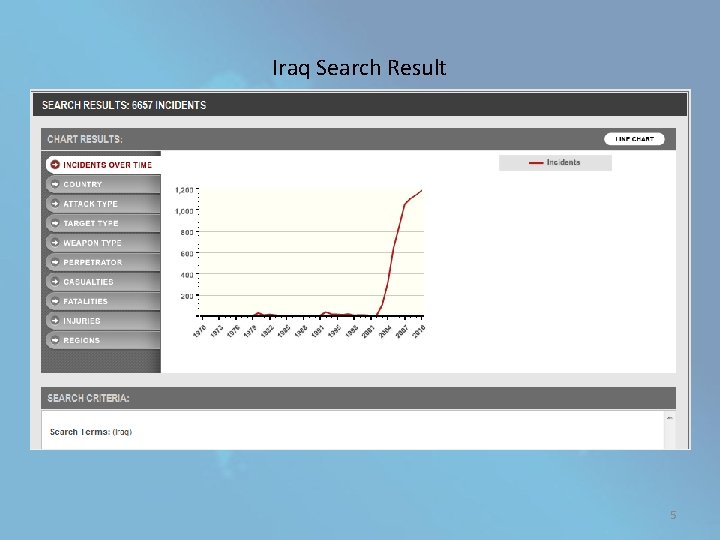
Iraq Search Result 5
“Terrorism data is often incomplete or inaccurate and only represents the outcome, not the process ” To counter these limitations, new approaches for visual & computational analysis have been developed Reveal unknown trends and help the analyst gain insights to formulate better hypotheses and models 6
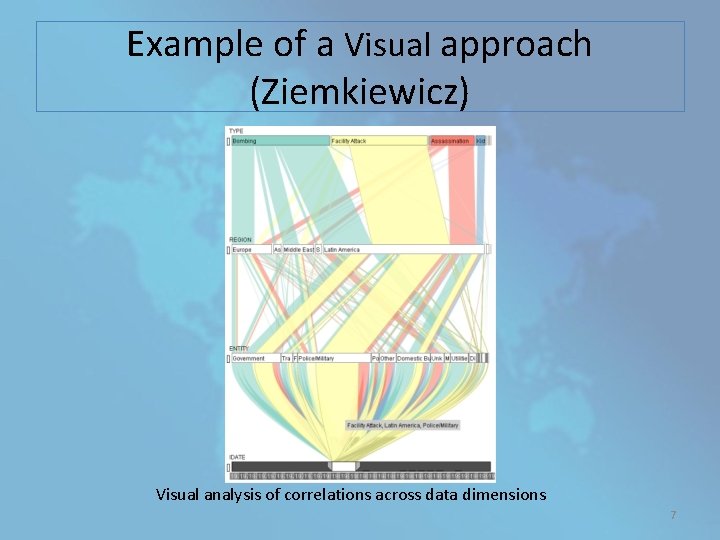
Example of a Visual approach (Ziemkiewicz) Visual analysis of correlations across data dimensions 7
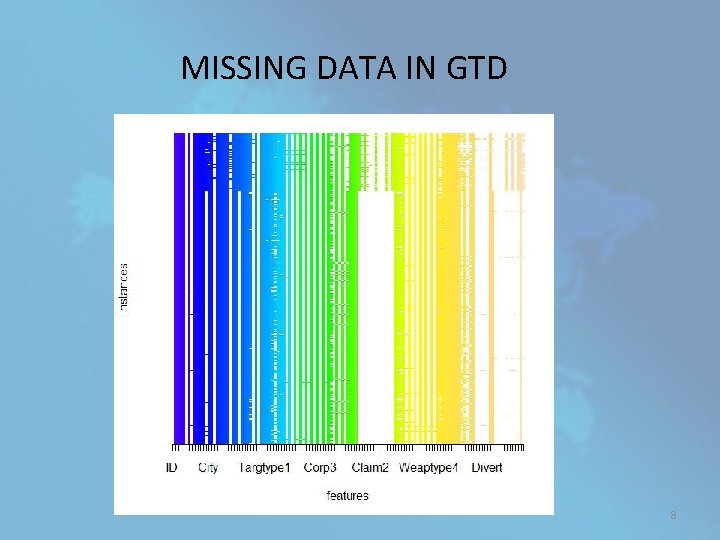
MISSING DATA IN GTD 8
DATA PREPROCESSING • Why Pre-processing? • Tasks – Data cleaning, Data integration, Data transformation, Data reduction, Data discretization • Main concentrations in this study-Eliminating Outliers, Treating Missing Data & Discretization Techniques • classifiers considered are Linear Discriminant Analysis (LDA), K-Nearest Neighbor (KNN), and Recursive Partitioning (RPART) 9
Eliminating Outliers • Clustering-groups attribute values, detects and removes outliers • Binning- sorts attribute values and partitions into bins; • Regression-smoothes data by using regression functions. 10
Treating Missing Data Case deletion • discards instances with missing values for at least one feature • Applied(exclusive)->data missing completely at random (class label) Mean Imputation • replacing the missing data by mean of all known values • Drawback-> deflate variance & inflate the significance statistical tests Median Imputation (MDI) • replacing the missing data by median of all known values • Recommend-> when the distribution of the values of a given feature is skewed KNN Imputation (KNNI) • imputing the missing values of an instance using similarity in instance of interest • ? -> distance function 11
Discretization Techniques • Splitting methods ->Starts with empty list of cut points and adds new ones • Merging methods ->Starts with complete list (cont. values) and removes them • Supervised methods use the class information when selecting discretization cut points, while unsupervised methods do not • 3 methods used in the study-> IR discretization, Entropy discretization & Equal width discretization 12
1 R discretization • binning • after data is sorted, continuous values number of disjoint intervals • boundaries adjusted based on the class labels Entropy discretization • finds the best split (bins pure) as possible • majority values -> same class label (information gain) Equal Width discretization • divides the range of each feature into k intervals of equal size • straight forward • outliers dominated • handle skewed data 13
Attributes selected -The date and city location of the incident, -The type of weapons used to commit the terrorist act -The number of casualties -The amount of wounded victims -The type of attack and - the identified terrorist group responsible 14
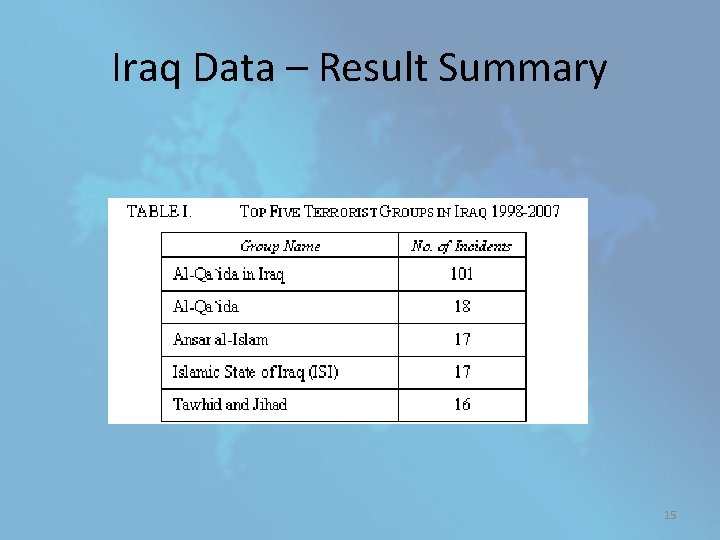
Iraq Data – Result Summary 15
• These five groups account for 169 instances or 60% of all incidents with a known perpetrator in Iraq • The resulting dataset has 1. 5% of missing values, with 28. 6% of the features and 9. 9% of the instances missing at least one value. • After data cleansed, 4 methods for treating missing values and 3 discretization methods applied • misclassification error for the LDA, KNN and RPART classifiers is computed 16
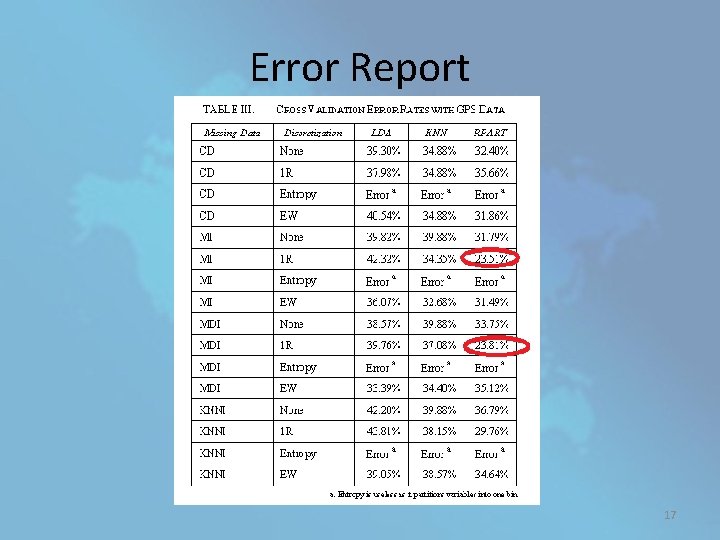
Error Report 17
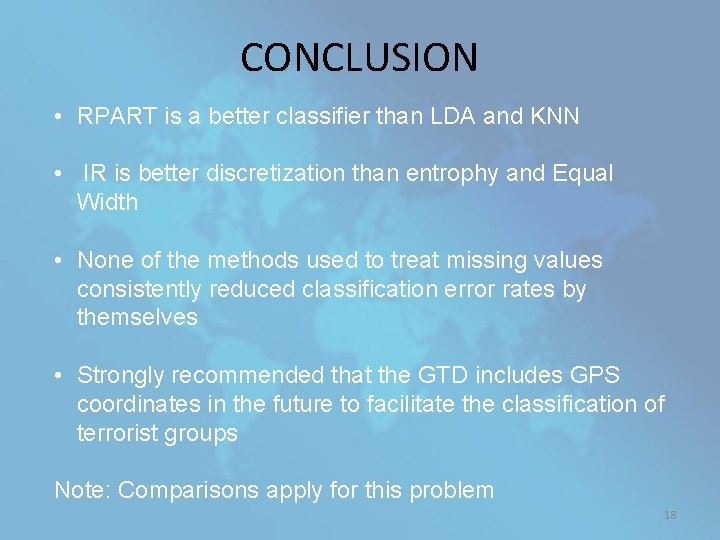
CONCLUSION • RPART is a better classifier than LDA and KNN • IR is better discretization than entrophy and Equal Width • None of the methods used to treat missing values consistently reduced classification error rates by themselves • Strongly recommended that the GTD includes GPS coordinates in the future to facilitate the classification of terrorist groups Note: Comparisons apply for this problem 18

Please Evaluate Our Presentation… 19

Hide and Seek PRIVACY PRESERVING DATA MINING
PRIVACY � What is privacy as related to data mining? � Why are concerns of privacy so important? � Laws � Business Interests � What benefits can be gained?
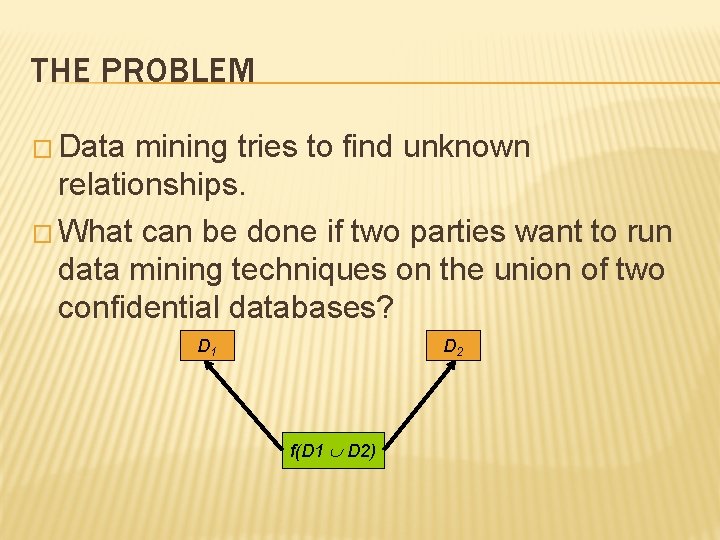
THE PROBLEM � Data mining tries to find unknown relationships. � What can be done if two parties want to run data mining techniques on the union of two confidential databases? D 1 D 2 f(D 1 D 2)
DISTRIBUTED PRIVACY-PRESERVING DATA MINING: Horizontal partitioning � Vertical partitioning � � Distributed privacy-preserving data mining overlaps closely with cryptography field � The broad approach to these methods tends to compute functions over inputs provided by multiple recipients without actually sharing the inputs with one another
CONT. . . Two kinds of adversarial behavior: � Semi-honest Adversaries: � Malicious Adversaries 1 out of 2 oblivious-transfer protocol � two parties: a sender, and a receiver. The sender’s input is a pair � (x 0, x 1), and the receiver’s input is a bit value σ {0, 1}. � Solution for semi honest adversaries
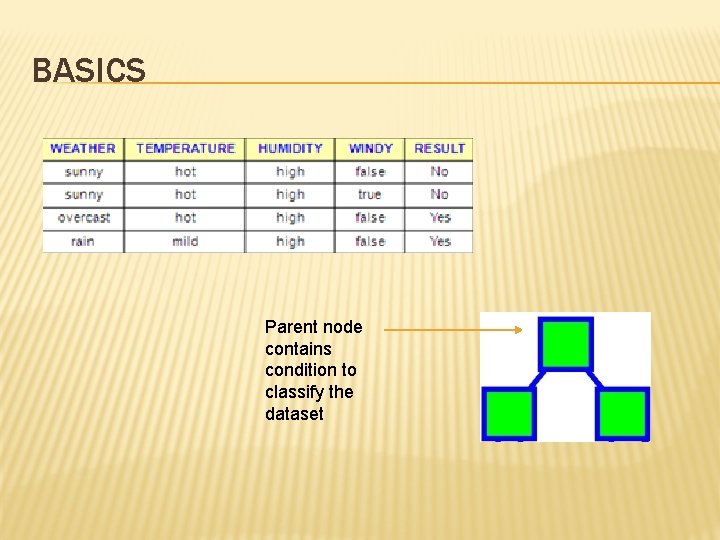
BASICS Parent node contains condition to classify the dataset
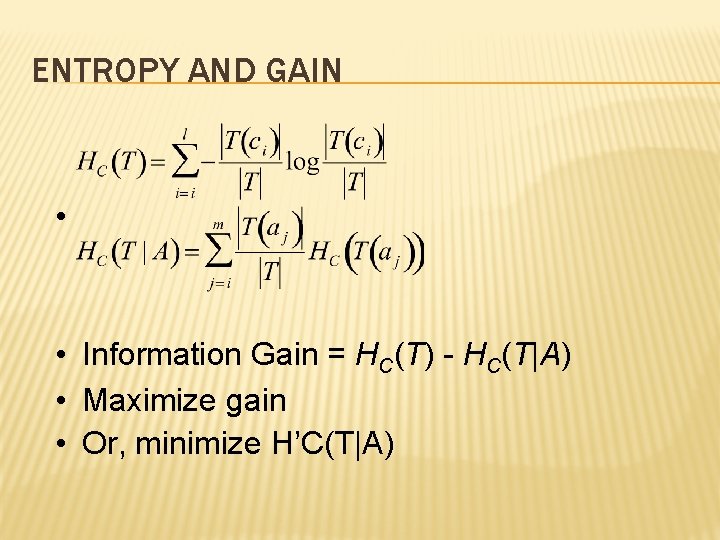
ENTROPY AND GAIN • • Information Gain = HC(T) - HC(T|A) • Maximize gain • Or, minimize H’C(T|A)
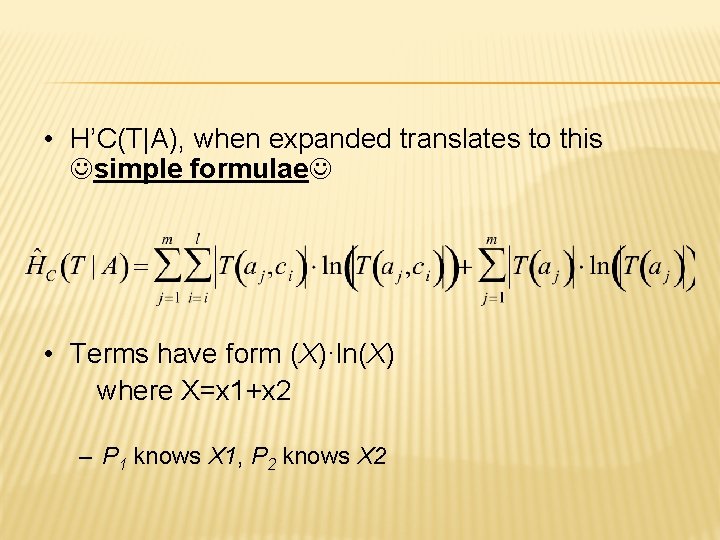
• H’C(T|A), when expanded translates to this simple formulae • Terms have form (X)·ln(X) where X=x 1+x 2 – P 1 knows X 1, P 2 knows X 2
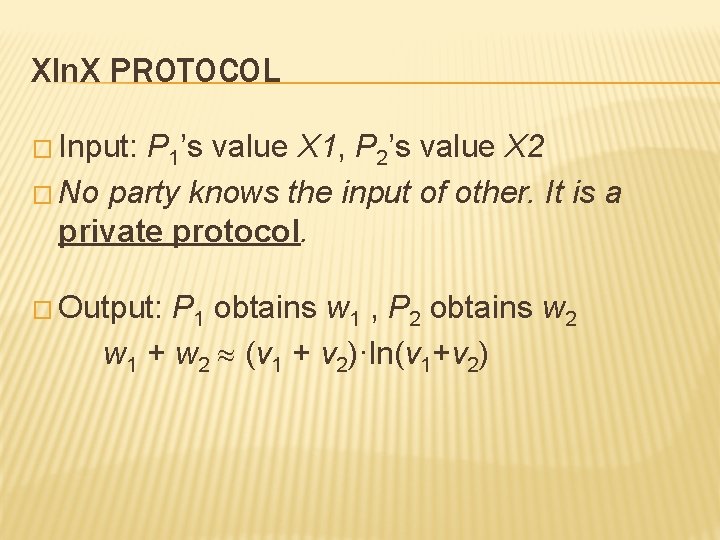
Xln. X PROTOCOL � Input: P 1’s value X 1, P 2’s value X 2 � No party knows the input of other. It is a private protocol. � Output: P 1 obtains w 1 , P 2 obtains w 2 w 1 + w 2 (v 1 + v 2)·ln(v 1+v 2)
FUTURE CHALLENGES � Understand what privacy means and what we really want � � � A very non-trivial task and one that requires interdisciplinary cooperation between the participating parties. Computer scientists should help to formalize the notion, but lawyers, policy-makers, social scientists should be involved in understanding the concerns. Some challenges here: � Reconciling cultural and legal differences relating to privacy in different countries. � Understanding when privacy is “allowed” to be breached (should searching data require a warrant, cause and so on).
CHALLENGES � Secure computation can be used in many cases to improve privacy, � If the function itself preserves sufficient privacy, then this provides a “full solution” � If the function does not preserve privacy, but there is no choice but to compute it, using secure computation minimizes damage.
FINAL WORD � Privacy-preserving data mining is truly needed � Data mining is being used: by security agencies, governmental bodies and corporations � Privacy advocates and citizen outcry often prevents positive use of data mining.
REFERENCES � http: //www. todaysengineer. org/2003/Oct/data -mining. asp � Benny Pinkas. “Cryptographic techniques for privacy preserving data mining” HP Labs � www. cs. utexas. edu/~shmat/courses/cs 395 t_f all 04/brickell. ppt

PLEASE EVALUATE GROUP 2
Spam filtering using classification GROUP 3 Balakrishna Sarathy Arun Brundavani Chilukuri Pallavi Asodekar Vidya Nalan Chakravarthy
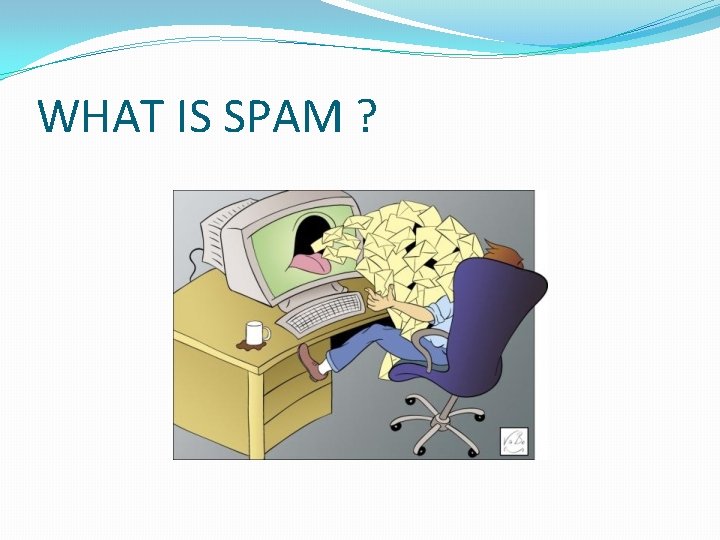
WHAT IS SPAM ?
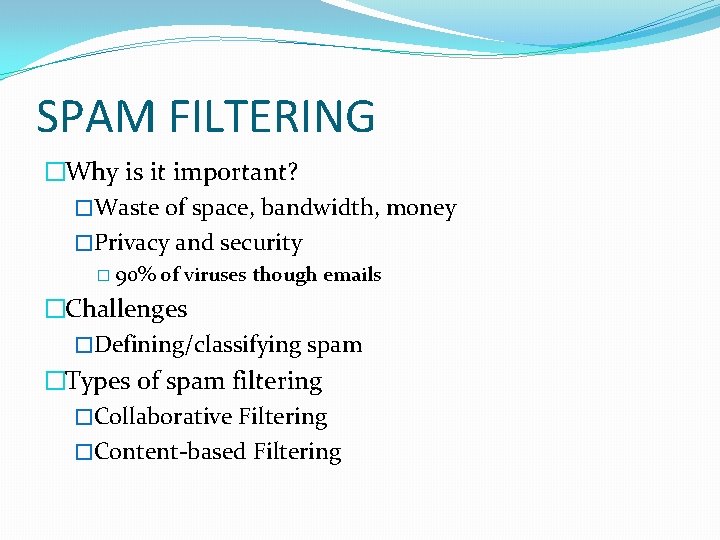
SPAM FILTERING �Why is it important? �Waste of space, bandwidth, money �Privacy and security � 90% of viruses though emails �Challenges �Defining/classifying spam �Types of spam filtering �Collaborative Filtering �Content-based Filtering
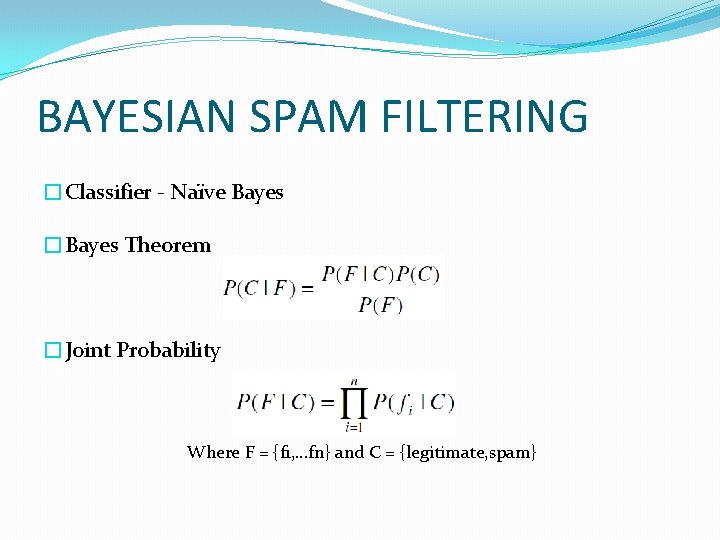
BAYESIAN SPAM FILTERING �Classifier - Naïve Bayes �Bayes Theorem �Joint Probability Where F = {f 1, …fn} and C = {legitimate, spam}
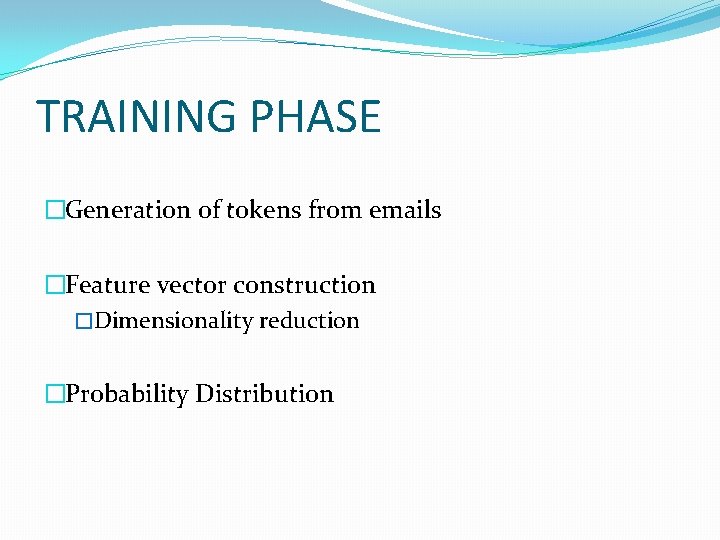
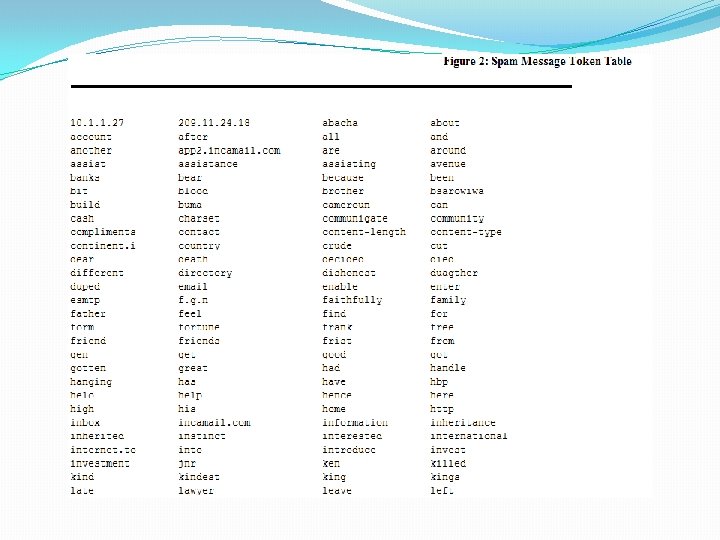
TRAINING PHASE �Generation of tokens from emails �Feature vector construction �Dimensionality reduction �Probability Distribution
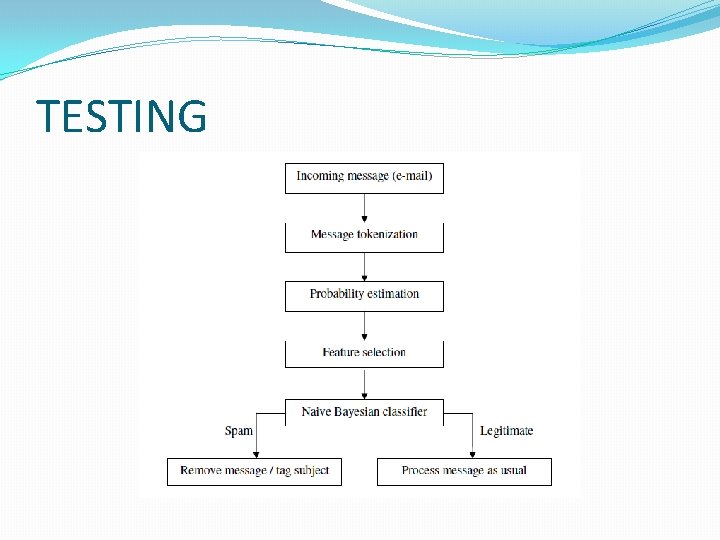
TESTING
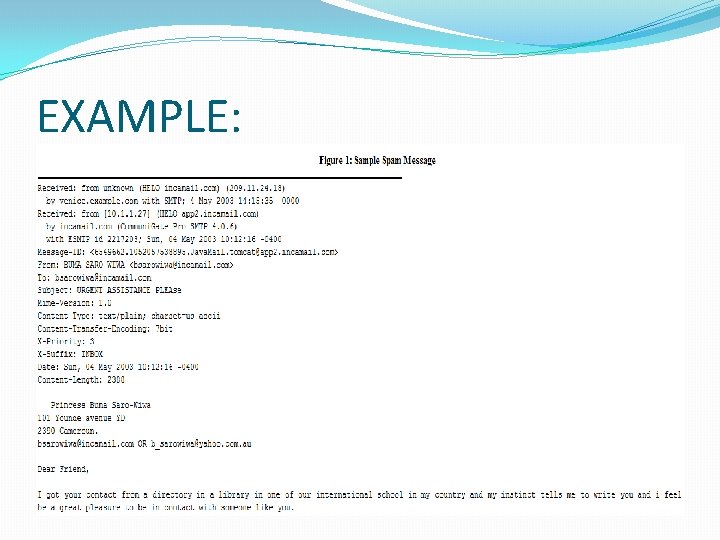
EXAMPLE:
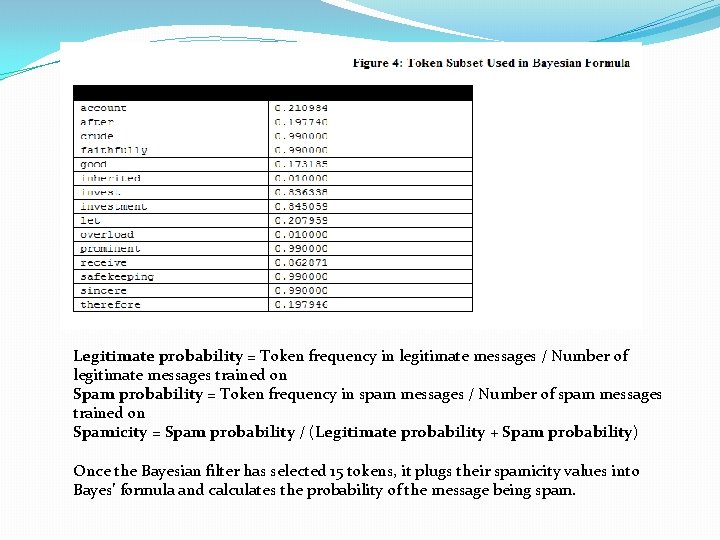
Legitimate probability = Token frequency in legitimate messages / Number of legitimate messages trained on Spam probability = Token frequency in spam messages / Number of spam messages trained on Spamicity = Spam probability / (Legitimate probability + Spam probability) Once the Bayesian filter has selected 15 tokens, it plugs their spamicity values into Bayes’ formula and calculates the probability of the message being spam.
ADVANTAGES �Can be customized on a per-user basis �Very effective �Performance Improvement with usage �Superior to other algorithms
DISADVANTAGES �Bayesian Poisoning �Takes time to learn �Filter initialization �Tricking Bayesian Filters with the usage of pictures
CONCLUSIONS �Usage of classifiers for spam filtering �Performance of Naïve Bayes compared to other techniques
![REFERENCES � [1]http: //en. wikipedia. org/wiki/Bayesian_spam_filtering � [2] Konstantin Tretyakov “Machine Learning Techniques in](http://slidetodoc.com/presentation_image_h/d3bc1e7bb29d68c8c38600e6478b47cf/image-46.jpg "REFERENCES � [1]http: //en. wikipedia. org/wiki/Bayesian_spam_filtering � [2] Konstantin Tretyakov “Machine Learning Techniques in")
REFERENCES � [1]http: //en. wikipedia. org/wiki/Bayesian_spam_filtering � [2] Konstantin Tretyakov “Machine Learning Techniques in Spam Filtering”, May 2004 � [3] Jon Kågström, “Improving Naïve Bayesian Spam Filtering”, 2005 � [4] http: //www. process. com/precisemail/bayesian_example. htm

Evaluate Group 3 Thank you!
Temporal data mining with upto-date pattern trees Presentation By Group 4: Vaduganathan V Veerappan Gaurav Chohan Shelly Xi Wen Ning Wang
• • 1. Introduction 2. Experimentation 3. Experimental results 4. Conclusions and future works
Introduction • What is Temporal Data Mining ? • Up-to-date Pattern ({Itemset}, {Lifetime}) • Frequent itemset
Frequent Itemset • An itemset that occurs frequently !! REALLY ? ? ? ? • How frequent is enough frequent ? 10 ? 200? 500? • All Based on Threshold value.
Motivation • Ever growing database • Mining Decision made on recent data should be more significant. • Sliding window Approach – NOT very Efficient • Solution : UDP tree : Efficient
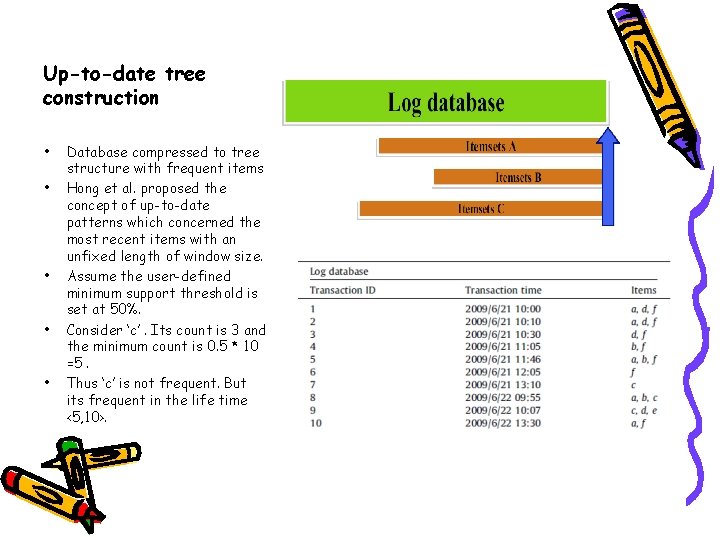
Up-to-date tree construction • • • Database compressed to tree structure with frequent items Hong et al. proposed the concept of up-to-date patterns which concerned the most recent items with an unfixed length of window size. Assume the user-defined minimum support threshold is set at 50%. Consider ‘c’. Its count is 3 and the minimum count is 0. 5 * 10 =5. Thus ‘c’ is not frequent. But its frequent in the life time <5, 10>.
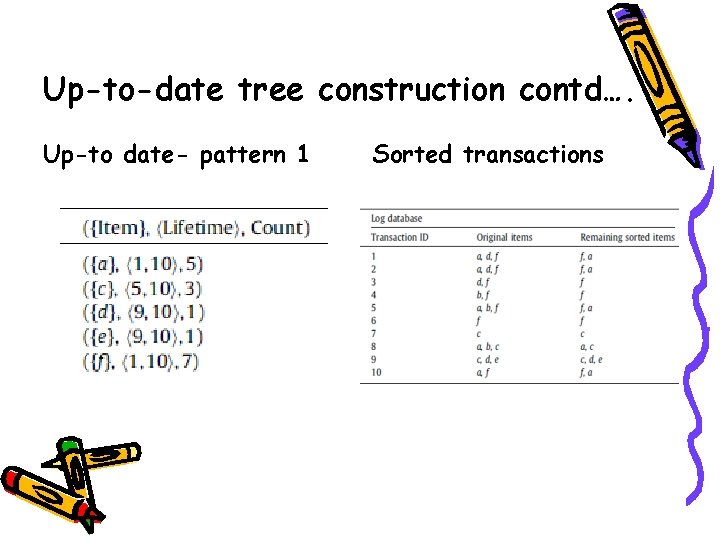
Up-to-date tree construction contd…. Up-to date- pattern 1 Sorted transactions
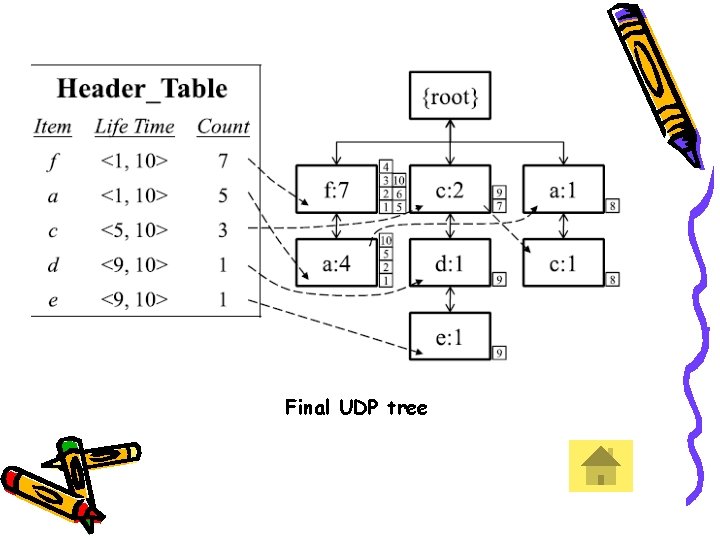
Final UDP tree
Experimental results • Purpose compare the performance of the UDP-tree and the up-to-date approach. • Two real datasets were used BMS-POS: from a large electronics retailer Retail
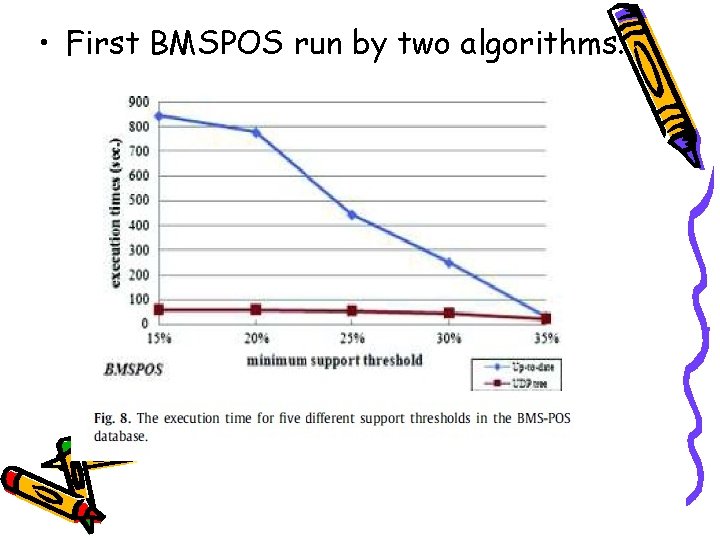
• First BMSPOS run by two algorithms.
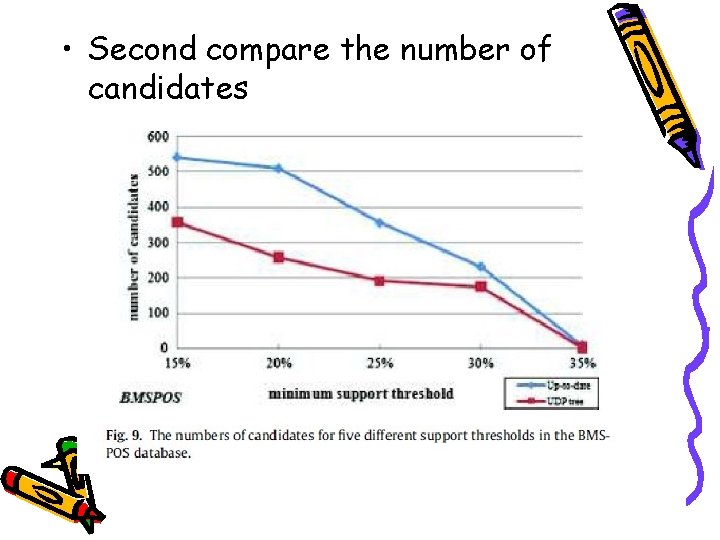
• Second compare the number of candidates
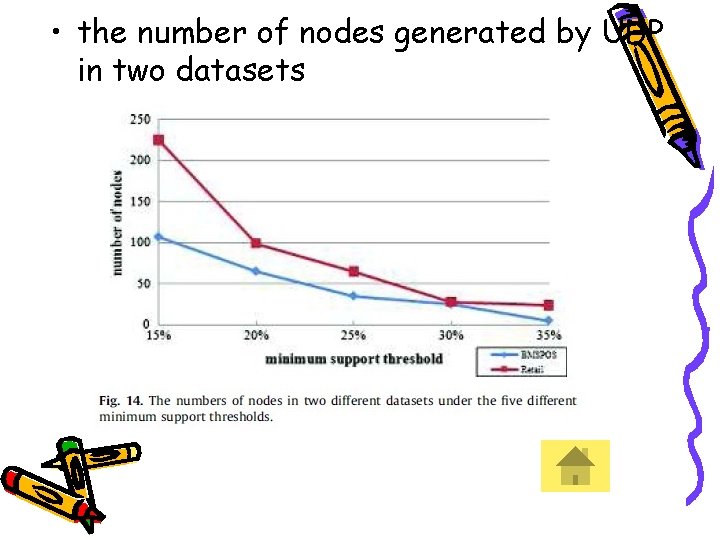
• the number of nodes generated by UDP in two datasets
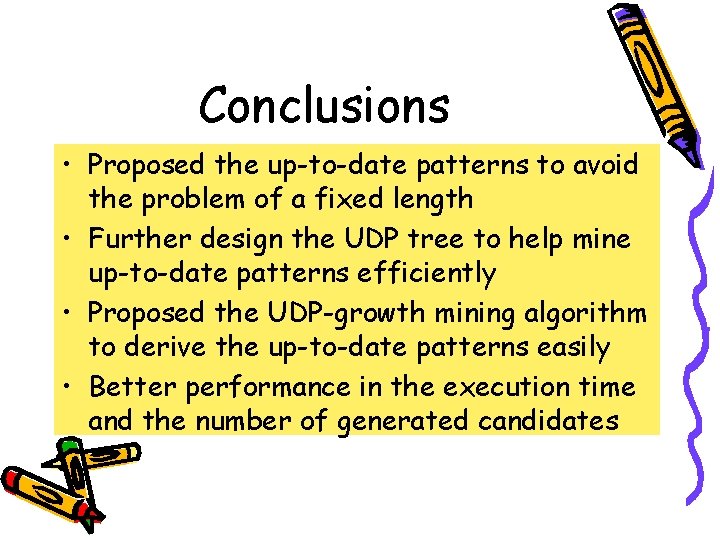
Conclusions • Proposed the up-to-date patterns to avoid the problem of a fixed length • Further design the UDP tree to help mine up-to-date patterns efficiently • Proposed the UDP-growth mining algorithm to derive the up-to-date patterns easily • Better performance in the execution time and the number of generated candidates
Future works • Try to maintain the up-to-date patterns efficiently and effectively when the database changes rapidly • Use other appropriate models to speed up the execution time of an updated database

Thank you ~~ Please give the evaluation~

Data Mining in Social Networks – Emotion Analysis and Applications Presentation by Manasee Conjeepuram Krishnamoorthy Ananth Kumar Gondu Paul Hernandez Herrera Hsu-Wan Kao Time: 15 s
Emotion analysis – Why? � � Growth in popularity of online social networks has affected the way people interact with friends and acquaintances Predict the relationship strength between two individuals Purpose – NOT to identify emotion but to indicate if the text contains emotions or not Obtain great insight on social relationships and social behavior Time: 30 s
Introduction Online Social Networks are a major component of an individual’s social interaction � Extract emotion content of text in online social networks � Goal– Ascertain if the text is an expression of the writer’s emotions or not � Text Mining techniques are performed on comments retrieved from a social network � Time: 25 s
Introduction contd… � Framework – includes a model for data collection, data base schemas, data processing and data mining steps � Technique adopted – unsupervised learning � Algorithm used – k-means � Case study – Lebanese facebook users Time: 15 s
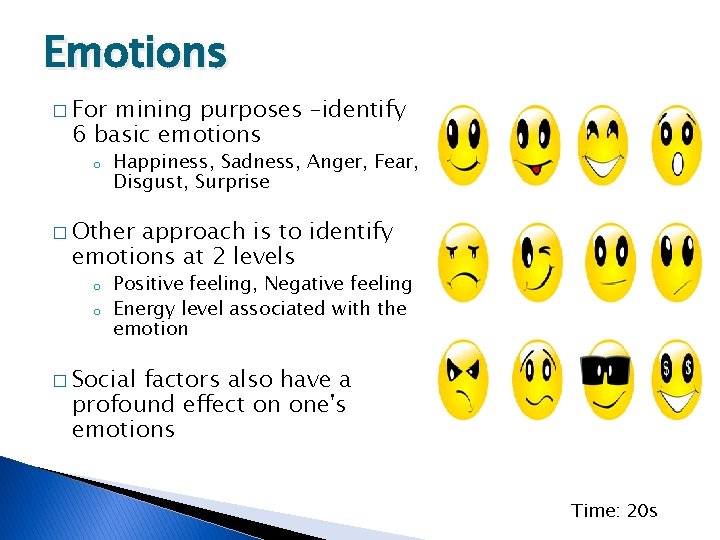
Emotions � For mining purposes –identify 6 basic emotions o Happiness, Sadness, Anger, Fear, Disgust, Surprise � Other approach is to identify emotions at 2 levels o o Positive feeling, Negative feeling Energy level associated with the emotion � Social factors also have a profound effect on one's emotions Time: 20 s
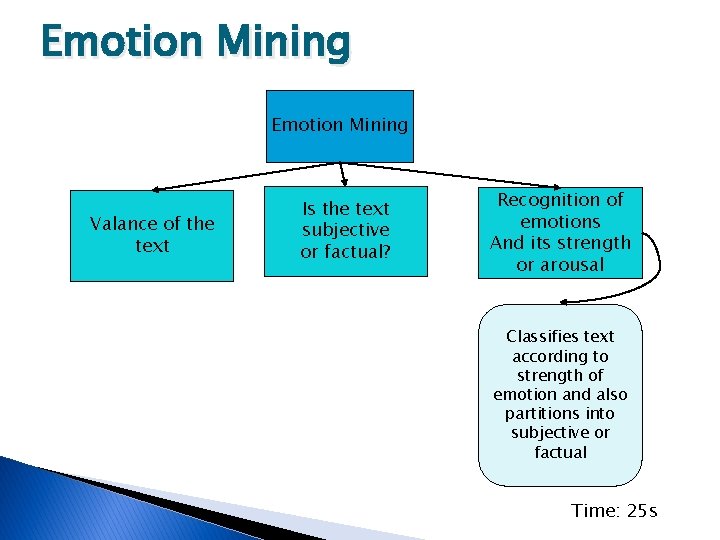
Emotion Mining Valance of the text Is the text subjective or factual? Recognition of emotions And its strength or arousal Classifies text according to strength of emotion and also partitions into subjective or factual Time: 25 s
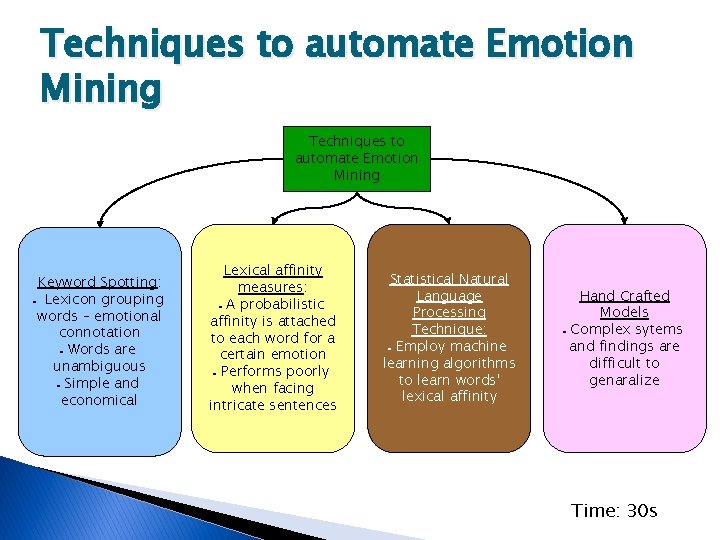
Techniques to automate Emotion Mining Keyword Spotting: Lexicon grouping words – emotional connotation Words are unambiguous Simple and economical Lexical affinity measures: A probabilistic affinity is attached to each word for a certain emotion Performs poorly when facing intricate sentences Statistical Natural Language Processing Technique: Employ machine learning algorithms to learn words' lexical affinity Hand Crafted Models Complex sytems and findings are difficult to genaralize Time: 30 s
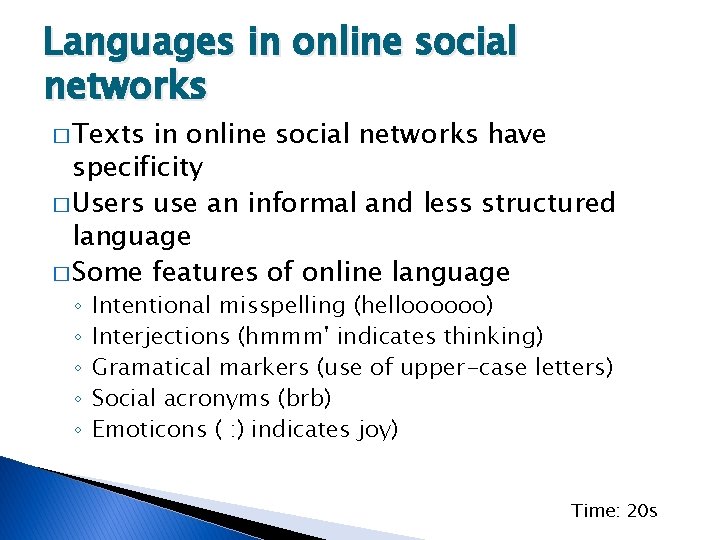
Languages in online social networks � Texts in online social networks have specificity � Users use an informal and less structured language � Some features of online language ◦ ◦ ◦ Intentional misspelling (helloooooo) Interjections (hmmm' indicates thinking) Gramatical markers (use of upper-case letters) Social acronyms (brb) Emoticons ( : ) indicates joy) Time: 20 s
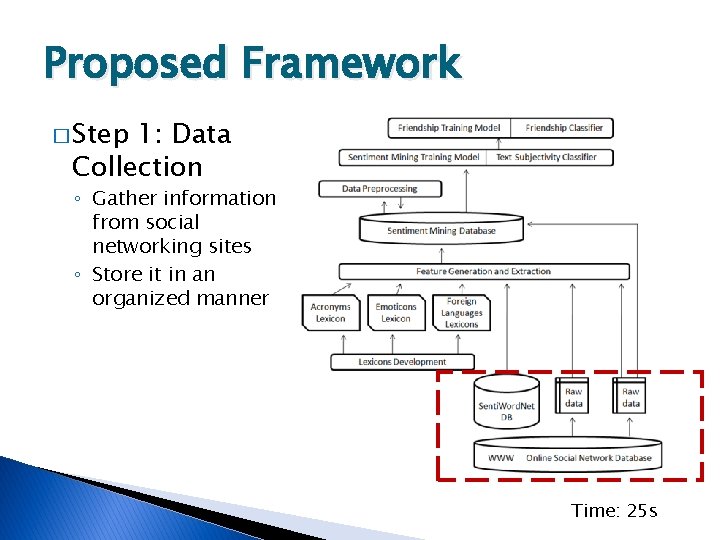
Proposed Framework � Step 1: Data Collection ◦ Gather information from social networking sites ◦ Store it in an organized manner Time: 25 s
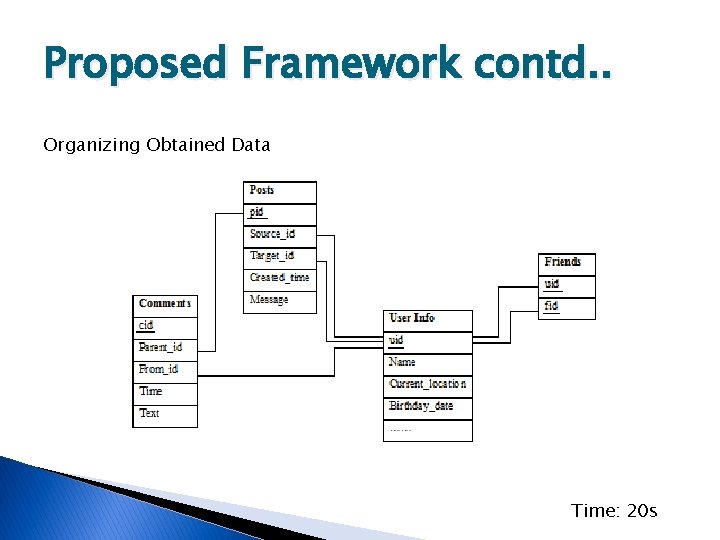
Proposed Framework contd. . Organizing Obtained Data Time: 20 s
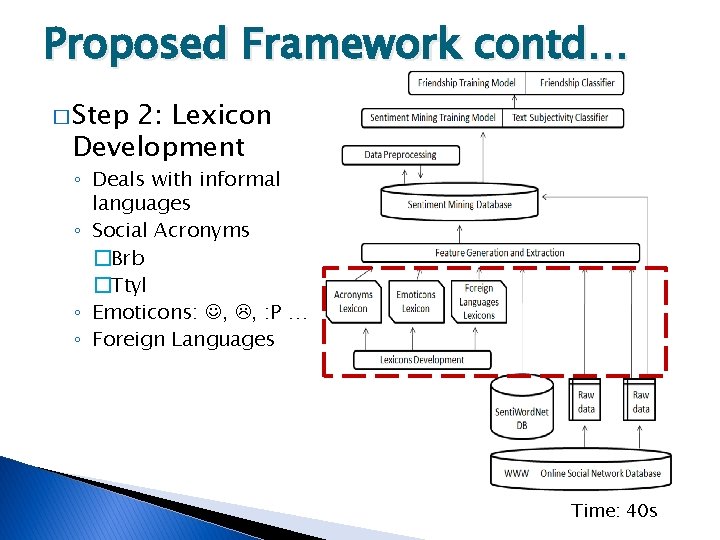
Proposed Framework contd… � Step 2: Lexicon Development ◦ Deals with informal languages ◦ Social Acronyms �Brb �Ttyl ◦ Emoticons: , , : P … ◦ Foreign Languages Time: 40 s
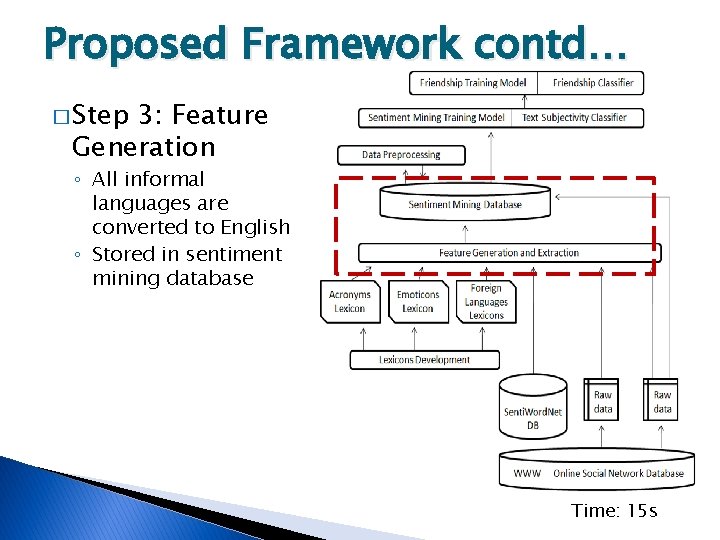
Proposed Framework contd… � Step 3: Feature Generation ◦ All informal languages are converted to English ◦ Stored in sentiment mining database Time: 15 s
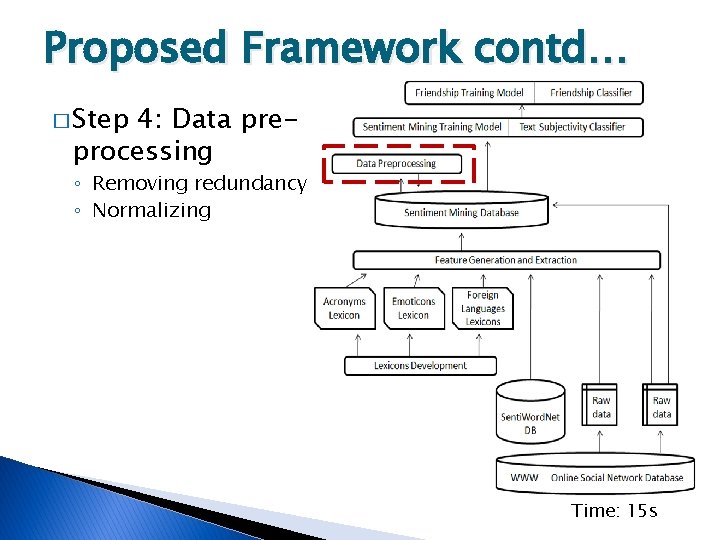
Proposed Framework contd… � Step 4: Data preprocessing ◦ Removing redundancy ◦ Normalizing Time: 15 s
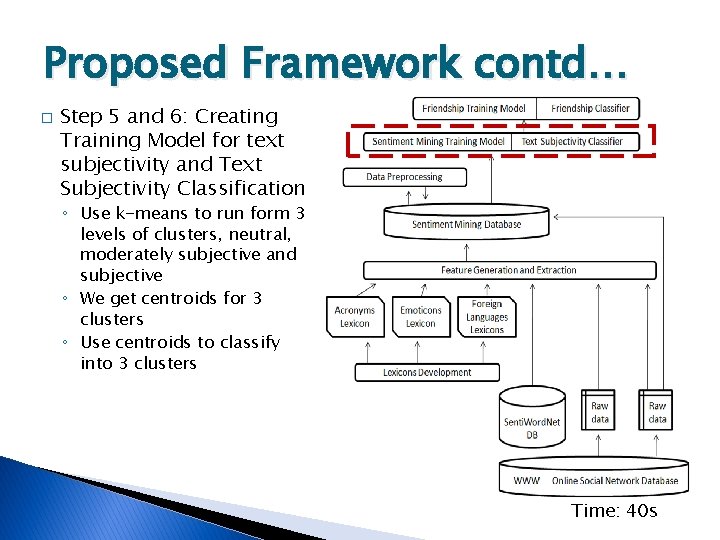
Proposed Framework contd… � Step 5 and 6: Creating Training Model for text subjectivity and Text Subjectivity Classification ◦ Use k-means to run form 3 levels of clusters, neutral, moderately subjective and subjective ◦ We get centroids for 3 clusters ◦ Use centroids to classify into 3 clusters Time: 40 s
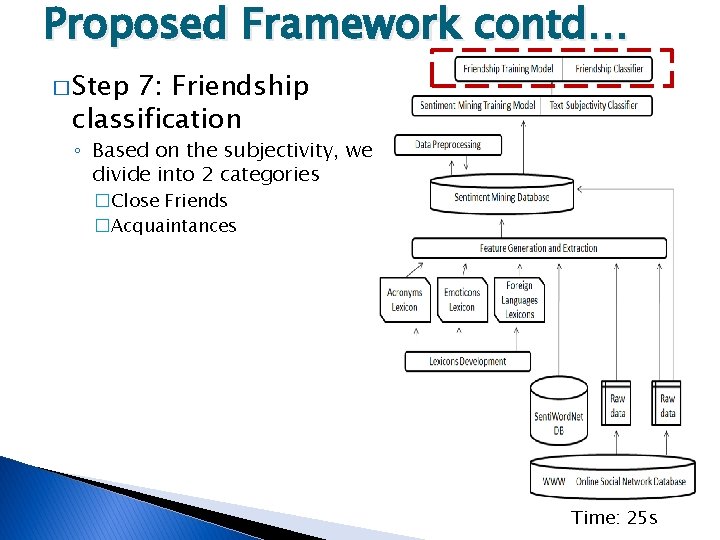
Proposed Framework contd… � Step 7: Friendship classification ◦ Based on the subjectivity, we divide into 2 categories �Close Friends �Acquaintances Time: 25 s
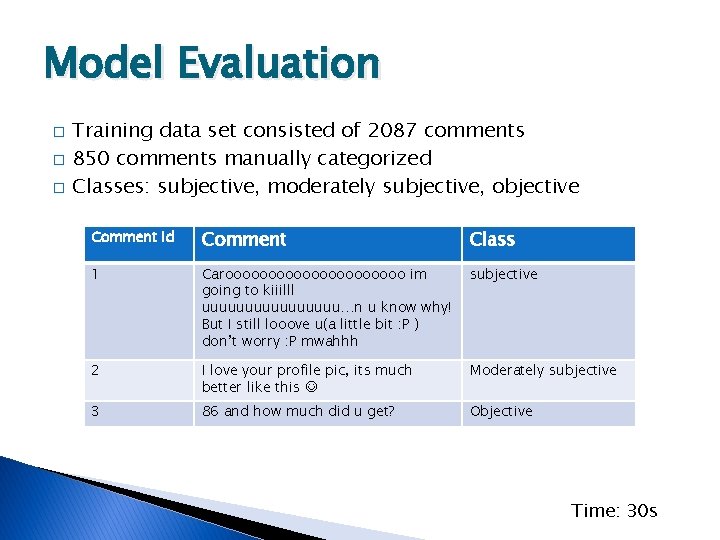
Model Evaluation � � � Training data set consisted of 2087 comments 850 comments manually categorized Classes: subjective, moderately subjective, objective Comment Id Comment Class 1 Carooooooooooo im going to kiiilll uuuuuuuu…n u know why! But I still looove u(a little bit : P ) don’t worry : P mwahhh subjective 2 I love your profile pic, its much better like this Moderately subjective 3 86 and how much did u get? Objective Time: 30 s
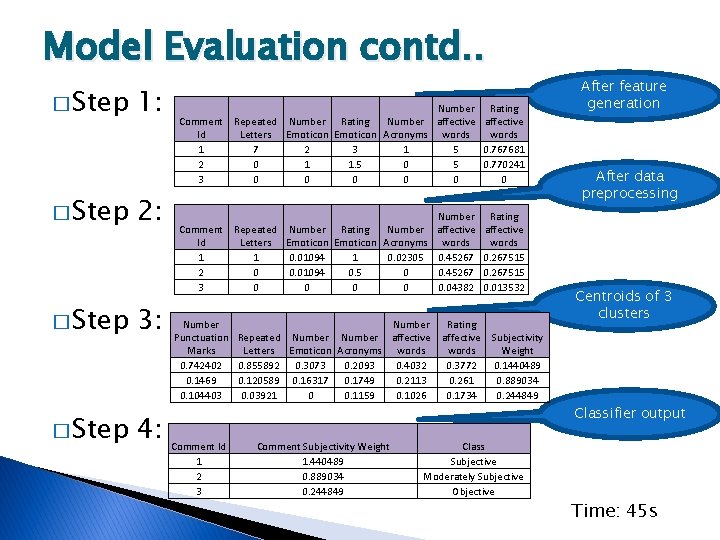
Model Evaluation contd. . � Step 1: 2: 3: 4: Number Rating Comment Repeated Number Rating Number affective Id Letters Emoticon Acronyms words 1 7 2 3 1 5 0. 767681 2 0 1 1. 5 0. 770241 3 0 0 0 Number Comment Repeated Number Rating Number affective Id Letters Emoticon Acronyms words 1 1 0. 01094 1 0. 02305 0. 45267 2 0 0. 01094 0. 5 0 0. 45267 3 0 0 0. 04382 Number Punctuation Marks 0. 742402 0. 1469 0. 104403 Rating affective words 0. 267515 0. 013532 Number Rating Repeated Number affective Subjectivity Letters Emoticon Acronyms words Weight 0. 855892 0. 3073 0. 2093 0. 4032 0. 3772 0. 1440489 0. 120589 0. 16317 0. 1749 0. 2113 0. 261 0. 889034 0. 03921 0 0. 1159 0. 1026 0. 1734 0. 244849 After feature generation After data preprocessing Centroids of 3 clusters Classifier output Comment Id 1 2 3 Comment Subjectivity Weight 1. 440489 0. 889034 0. 244849 Class Subjective Moderately Subjective Objective Time: 45 s
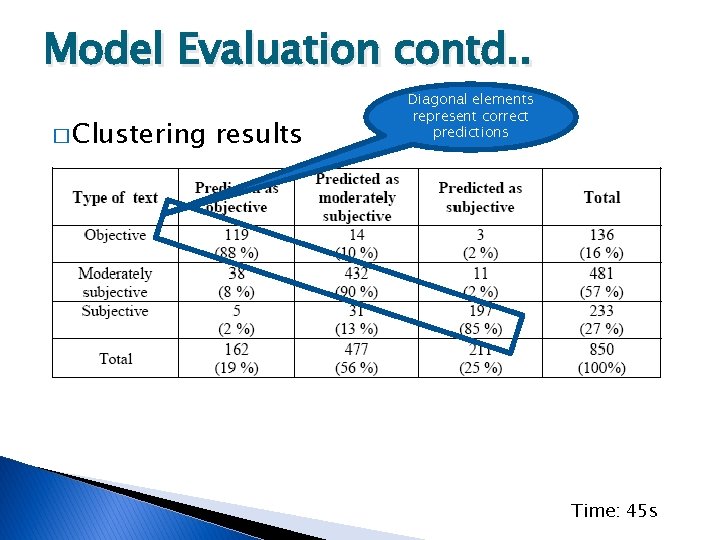
Model Evaluation contd. . � Clustering results Diagonal elements represent correct predictions Time: 45 s
Conclusion and future work � � � This framework provides high accuracy on emotion analysis on text. It has good prediction on the friendship between people. Unstructured language on the internet (new lexicons) Variety of languages The consideration of sentence structures and syntax New ways for learning and coping with the changes of language used online Time: 50 s
References � � Slides based on: “A framework for Emotion Mining from Text in Online Social Networks – Mohammad Yassine, Hazem Hajj – 2010 IEEE International Conference on Data Mining Workshops M. Thelwall, D. Wilkinson and S. Uppal. “Data Mining emotion in social network communication: Gender differences in My. Space”. In journal of the American Society for Information Science and Technology Time: 10 s

Clustering by Passing Messages Between Data Points Brendan J. Frey, et al. Science 315, 972 (2007) Presented by Group 6
True Representative clustering by Koushik • seeks “exemplars”: the representatives selected from actual data points. • Initial step: randomly picking exemplars randomly pick mayor candidates from a city • assigns the remaining objects to the closest exemplars. • Examples: – k-medioid – DBSCAN
Problem with Conventional Approaches by Koushik • sensitive to initial selection of exemplars what if picked candidates are not qualified for mayor ? • Local optimal: multiple runs to avoid bad selection of exemplars pick candidates again and again …… • works well only when the number of clusters is small
Affinity Propagation Overview by Koushik • considering all the data points as potential exemplars All people in the city can be mayor candidate • Initial network established based on similarity between all data points • Message passing between data points along network people communicate to each other to find out who is qualify for mayor • Most reachable data points will finally be the exemplars people vote for their closest candidates
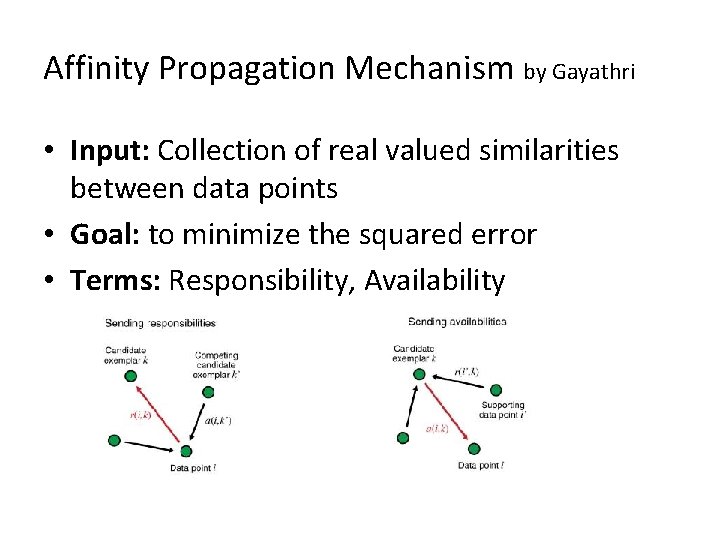
Affinity Propagation Mechanism by Gayathri • Input: Collection of real valued similarities between data points • Goal: to minimize the squared error • Terms: Responsibility, Availability
Affinity Propagation Mechanism by Gayathri Steps: • Create a network based on the similarities between the data points. • Find the availabilities and responsibilities of the data points. • The data point which has the maximum value (sum of availability and responsibility) is considered as an exemplar for that point. • Repeat the above steps until the decision of exemplar remains constant.
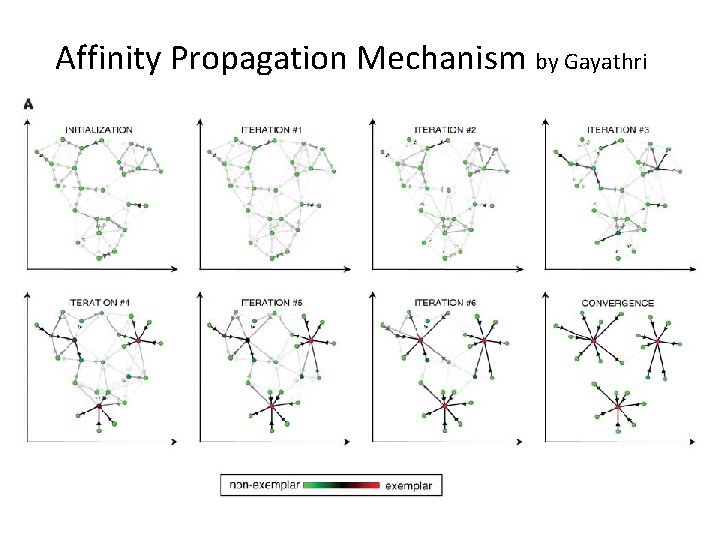
Affinity Propagation Mechanism by Gayathri
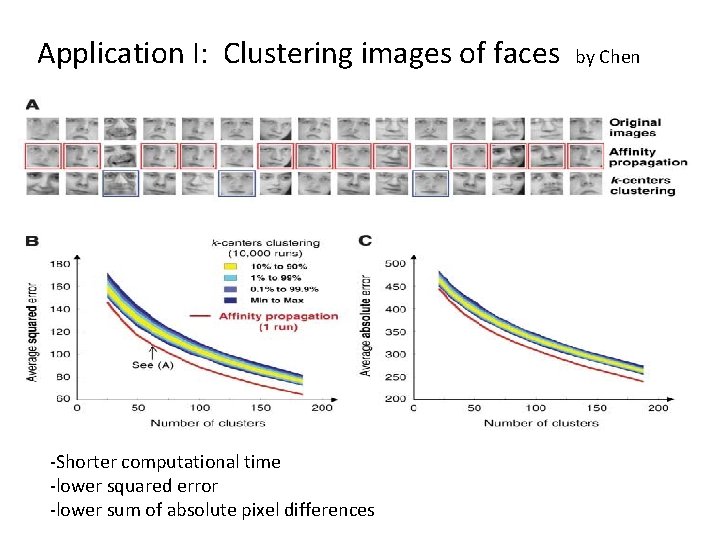
Application I: Clustering images of faces by Chen -Shorter computational time -lower squared error -lower sum of absolute pixel differences
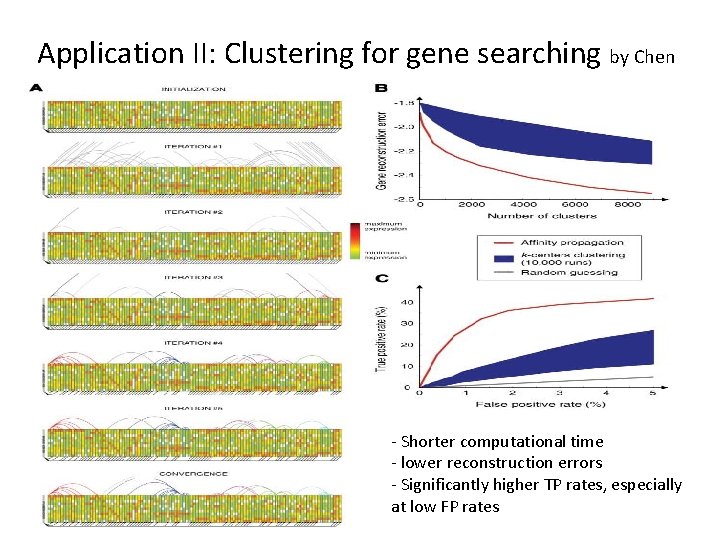
Application II: Clustering for gene searching by Chen - Shorter computational time - lower reconstruction errors - Significantly higher TP rates, especially at low FP rates
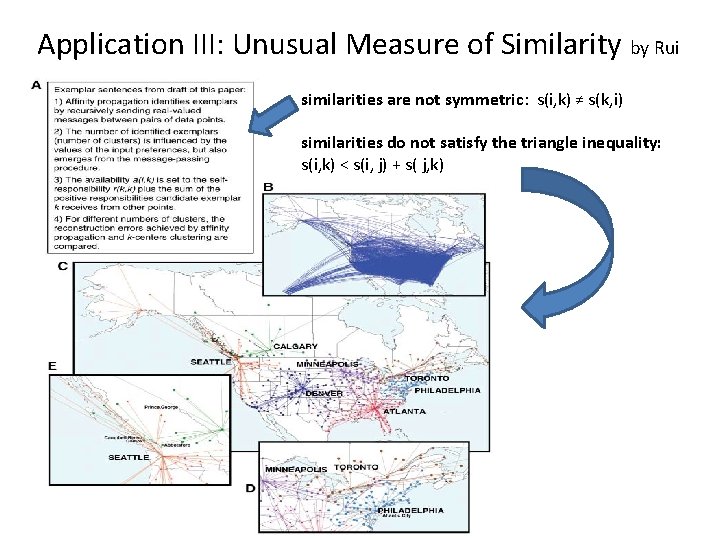
Application III: Unusual Measure of Similarity by Rui similarities are not symmetric: s(i, k) ≠ s(k, i) similarities do not satisfy the triangle inequality: s(i, k) < s(i, j) + s( j, k)
Summary by Rui • Affinity propagation has several advantages over related techniques: – Considering all data points to avoid unlucky initialization – Applicable to unusual measures of similarity • Disadvantage: – require precomputation of pair-wise similarities among data points

Please Grade Group 6! Thank you!
the wisdom of crowds data mining team 7 introduction ensemble methods wisdom of crowds / uses wisdom of crowds failures conclusion
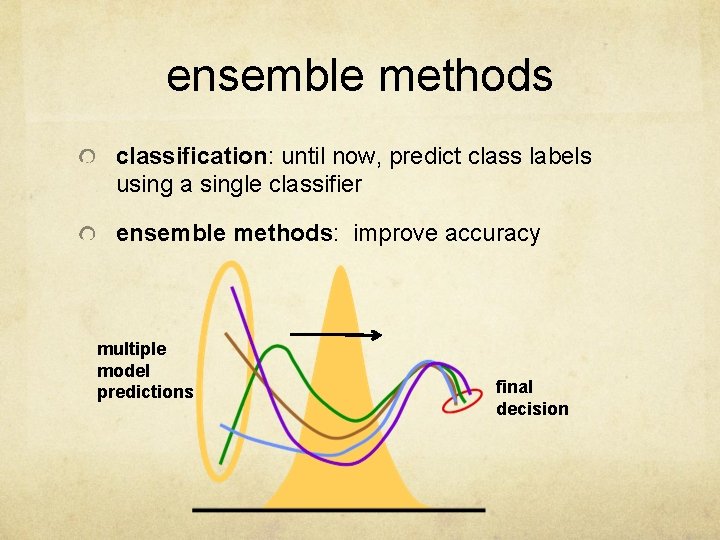
ensemble methods classification: until now, predict class labels using a single classifier ensemble methods: improve accuracy multiple model predictions final decision
ensemble methods necessary conditions independent classifiers base classifiers perform better than random guessing key base classifiers make different errors improvement of accuracy can be proven mathematically
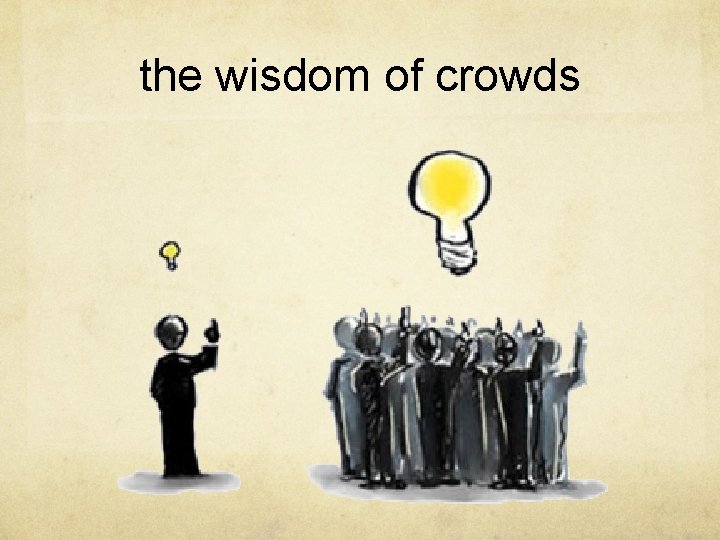
the wisdom of crowds
elements for a wise crowd diversity decentralization independence aggregation
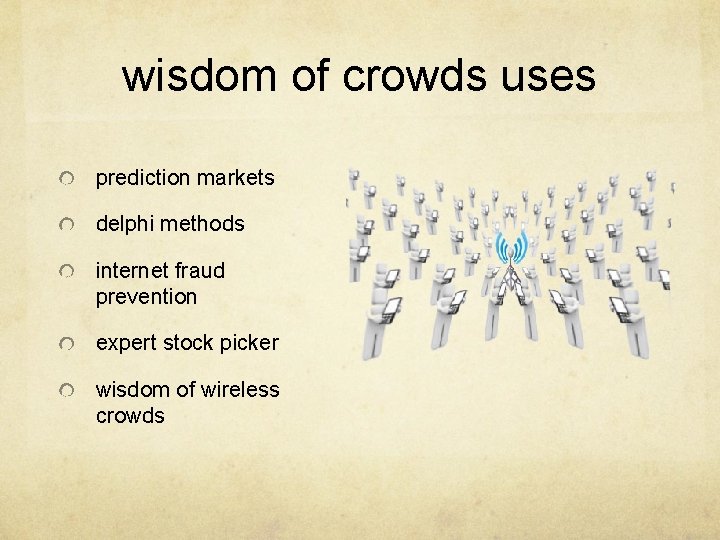
wisdom of crowds uses prediction markets delphi methods internet fraud prevention expert stock picker wisdom of wireless crowds
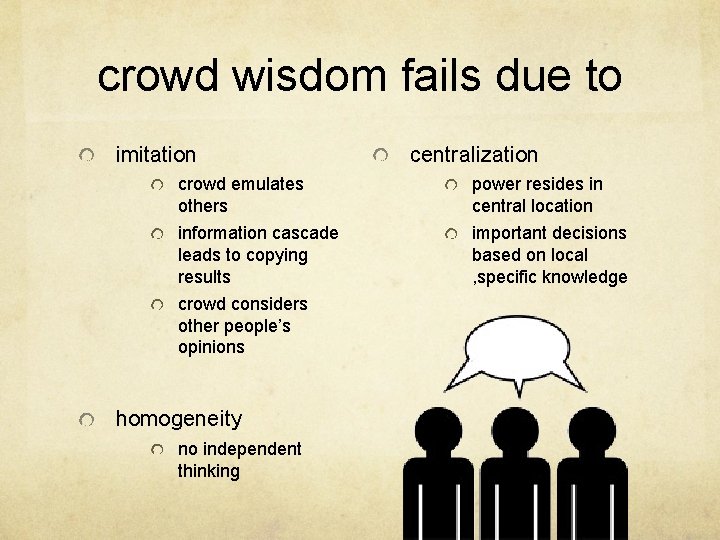
crowd wisdom fails due to imitation centralization crowd emulates others power resides in central location information cascade leads to copying results important decisions based on local , specific knowledge crowd considers other people’s opinions homogeneity no independent thinking
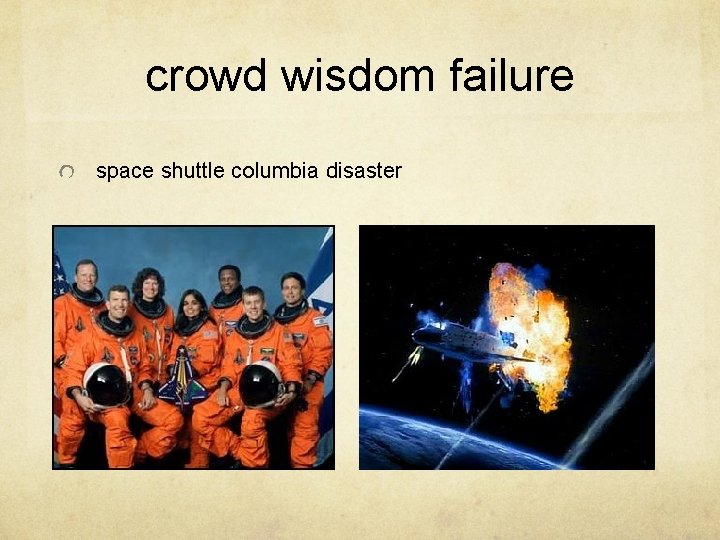
crowd wisdom failure space shuttle columbia disaster
conclusion elements of a wise crowds diversity independence decentralization aggregation uses prediction markets delphi methods internet fraud prevention expert stock picker wisdom of wireless crowds
evaluate team 7, please !
Finding Social topologies based on the emails sent & photo tags in Social Networking site A Knowledge Discovery & Data Mining problem Group 8 Mohanam, Naveen Nyshadham, Harshanand Poolla, Veda Shruthi Siga, Dedeepya Source : An accepted paper from Social Network Mining and Analysis – KDD 2011 Conference Paper Title: An Algorithm and Analysis of Social Topologies from Email and Photo Tag T. J. Purtell , Diana Mac. Lean , Seng Keat The , Sudheendra Hangal , Monica S. Lam & Jeffrey Heer Computer Science Department , Stanford University
Introduction • As People’s Participation in social media increases, Online social identities accumulate contacts and data. • Need a mechanism for creating a succinct but contextually rich representation of a person’s “social landscape” • Social landscape should facilitate activities such as browsing personal social media feeds or sharing data with nuanced social groups. 107
Author’s Contribution • Formulated the social topology extraction problem as the compression of a group-tagged data set in which each group has a significance value, into a set containing a smaller number of overlapping and nested groups that best represent the value of the initial data set. • Four variants of a greedy algorithm that constructs a user’s social topology based on egocentric, group communication data. • Experiments conducted on 2, 000 personal email accounts and 1, 100 tagged Face book photograph collections to find the algorithm variants producing different topologies. 108
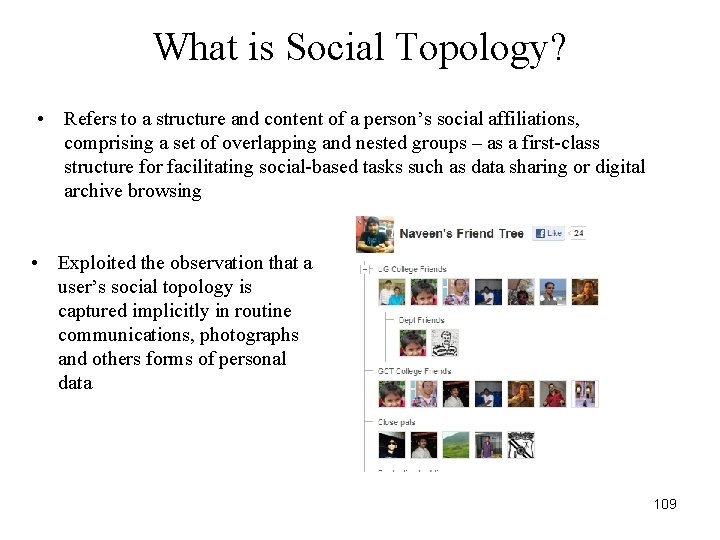
What is Social Topology? • Refers to a structure and content of a person’s social affiliations, comprising a set of overlapping and nested groups – as a first-class structure for facilitating social-based tasks such as data sharing or digital archive browsing • Exploited the observation that a user’s social topology is captured implicitly in routine communications, photographs and others forms of personal data 109
Related work to this problem • Clustering algorithms – Assumes global structure of network is available – Networks are evaluated based on public information – Input model of the graph is reduced to edges between individuals • Visualization and interface – Derives overlapping and hierarchical groups – Requires many parameter settings • Association Rule mining – Finds related item datasets using a specific seed – develop an interactions rank metric that gives an ordering over unique recipient groups • Graph summarization – Focuses on reducing the size and complexity of network data 110
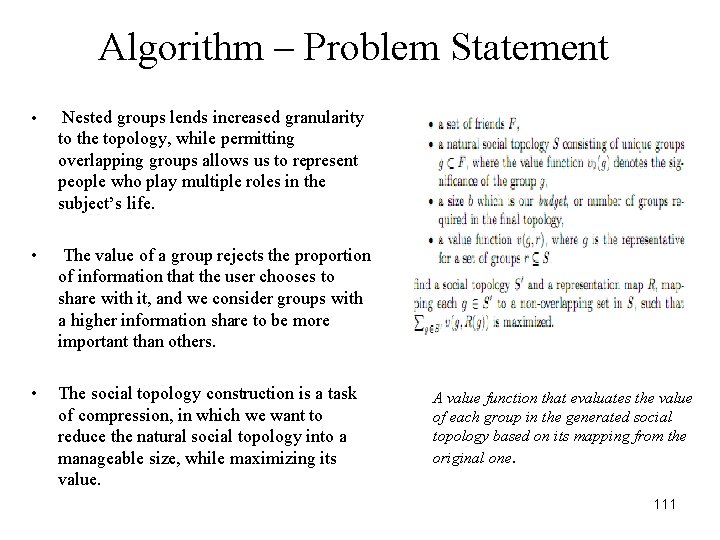
Algorithm – Problem Statement • Nested groups lends increased granularity to the topology, while permitting overlapping groups allows us to represent people who play multiple roles in the subject’s life. • The value of a group rejects the proportion of information that the user chooses to share with it, and we consider groups with a higher information share to be more important than others. • The social topology construction is a task of compression, in which we want to reduce the natural social topology into a manageable size, while maximizing its value. A value function that evaluates the value of each group in the generated social topology based on its mapping from the original one. 111
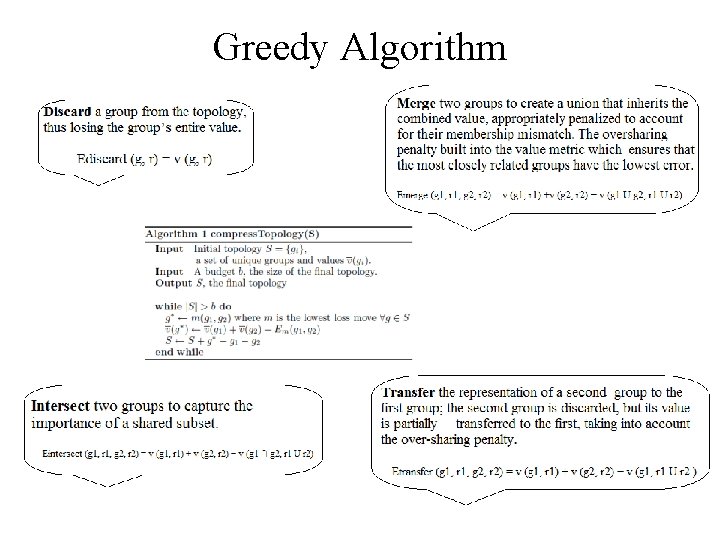
Greedy Algorithm 112
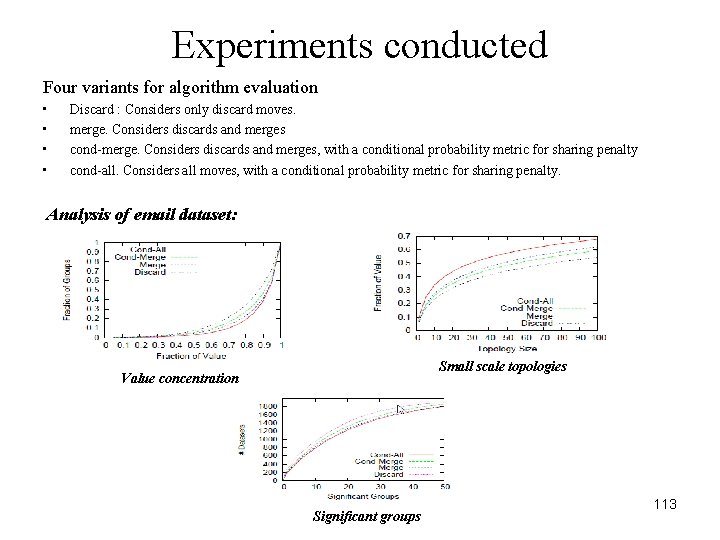
Experiments conducted Four variants for algorithm evaluation • • Discard : Considers only discard moves. merge. Considers discards and merges cond-merge. Considers discards and merges, with a conditional probability metric for sharing penalty cond-all. Considers all moves, with a conditional probability metric for sharing penalty. Analysis of email dataset: Small scale topologies Value concentration Significant groups 113
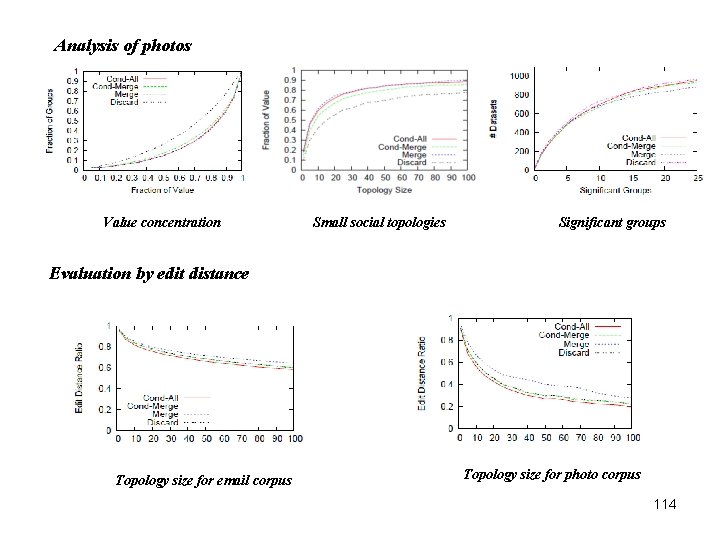
Analysis of photos Value concentration Small social topologies Significant groups Evaluation by edit distance Topology size for email corpus Topology size for photo corpus 114
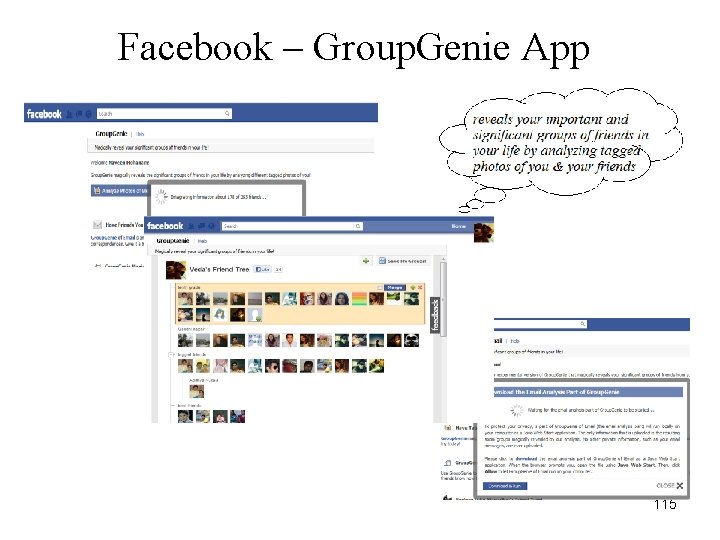
Facebook – Group. Genie App 115
Conclusion • Unlike most other social network analysis algorithms that detect groups from global network data, this algorithm helps individuals automatically identify and use their social groups by analyzing their online social actions. • This greedy algorithm can be used to produce the best representation of social topology in a given space budget. Offers insight into people’s social relationships as captured by their online activities • The results demonstrate the ability of the algorithm to distill out a small number of groups from thousands of emails and hundreds of photos. • Algorithm is incorporated in a Facebook application called Group. Genie. • Algorithm and source code are publicly available, and can be downloaded at the URL http: //mobisocial. stanford. edu/groupgenie 116

Evaluate Group 8 Thank You ! 117
- Slides: 117