
Some Thoughts on the Hydrophobic Interaction P Pincus

Some Thoughts on the Hydrophobic Interaction P. Pincus Physics, Materials, Biomolecular Science & Engineering UCSB “The magnitude, range and origin of the hydrophobic interaction have been a mystery ever since the pioneering work by Kauzman and Tanford……. ” J. Israelachvili, 2005
What is it? Ø Strong short range (~ 1 nm) attractive force between hydrophobic surfaces in water (Tanford, Clausson, Wennerstrøm, F. Evans ……. ) Ø Why oil is insoluble in water. ARE THESE UNRELATED?
OUTLINE Ø Interfaces – Patches E. Meyer, Q. Lin, J. Israelachvili (Israelachvili Group) A. Naydenov, P. Pincus Ø Molecules – H-Bonding Network Disruption D. Hone, P. Pincus
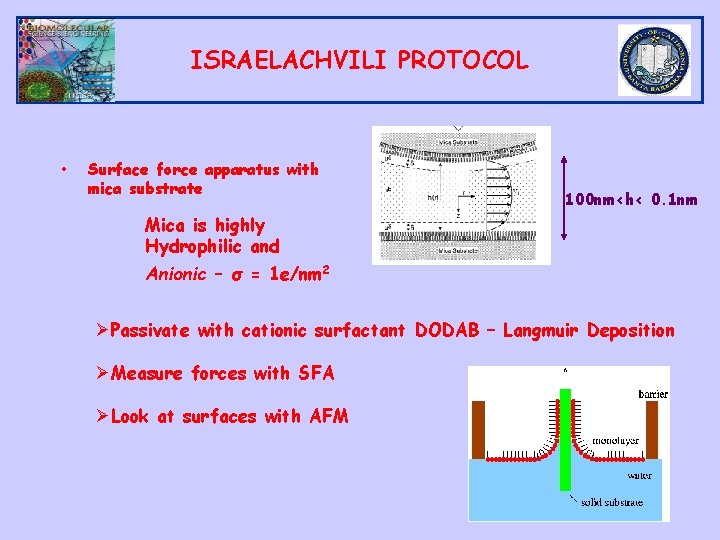
ISRAELACHVILI PROTOCOL • Surface force apparatus with mica substrate 100 nm<h< 0. 1 nm Mica is highly Hydrophilic and Anionic – σ = 1 e/nm 2 ØPassivate with cationic surfactant DODAB – Langmuir Deposition ØMeasure forces with SFA ØLook at surfaces with AFM
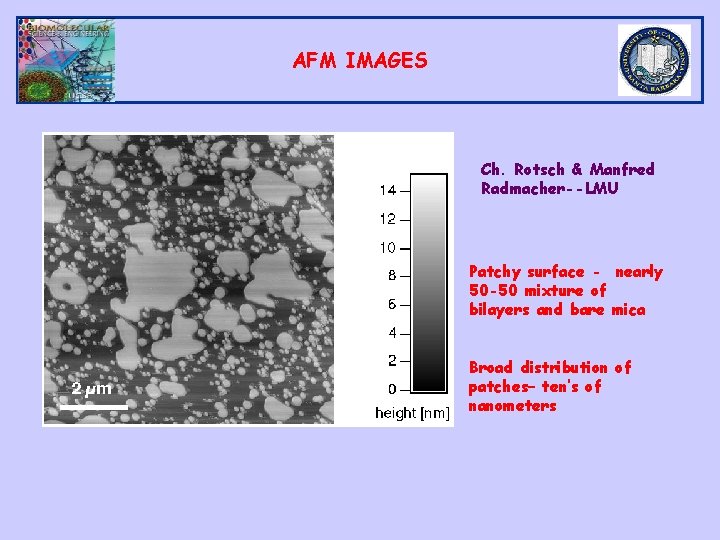
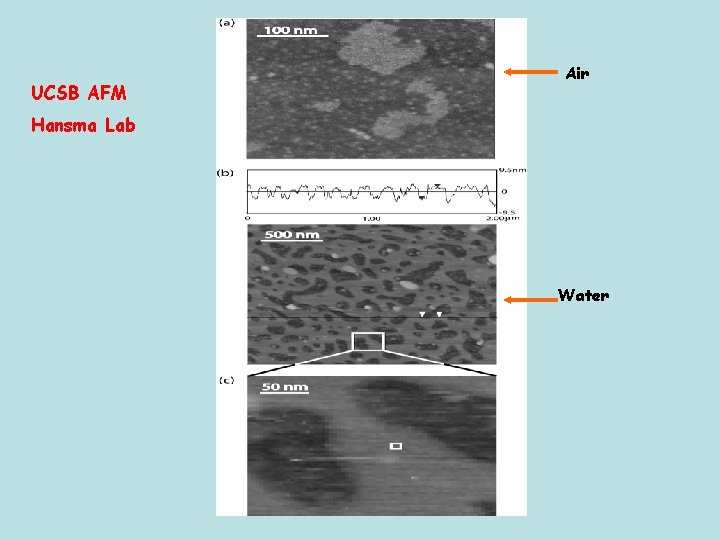
AFM IMAGES Ch. Rotsch & Manfred Radmacher--LMU Patchy surface - nearly 50 -50 mixture of bilayers and bare mica Broad distribution of patches– ten’s of nanometers
UCSB AFM Air Hansma Lab Water
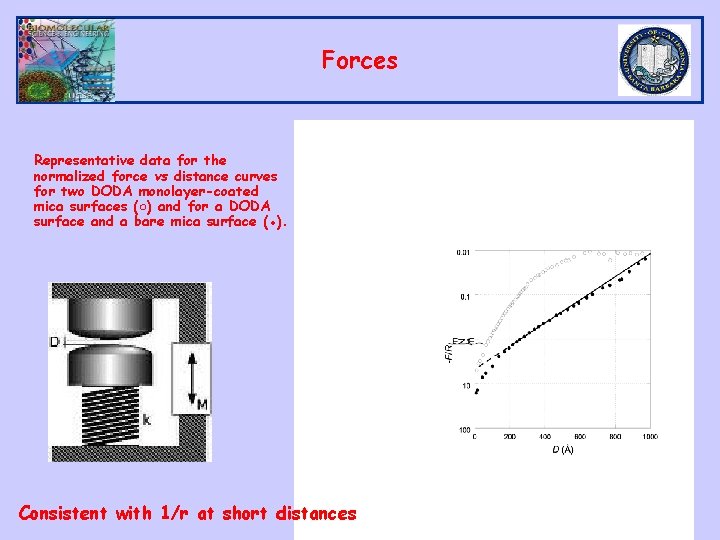
Forces Representative data for the normalized force vs distance curves for two DODA monolayer-coated mica surfaces (○) and for a DODA surface and a bare mica surface (●). Consistent with 1/r at short distances
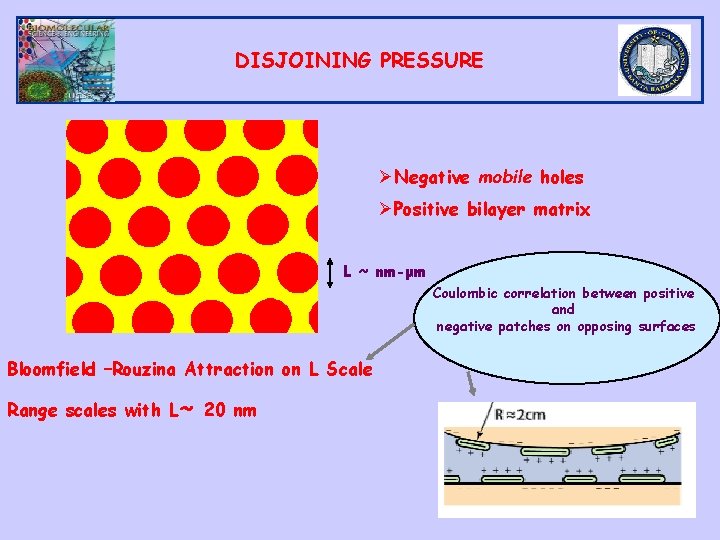
DISJOINING PRESSURE ØNegative mobile holes ØPositive bilayer matrix L ~ nm-μm Coulombic correlation between positive and negative patches on opposing surfaces Bloomfield –Rouzina Attraction on L Scale Range scales with L~ 20 nm
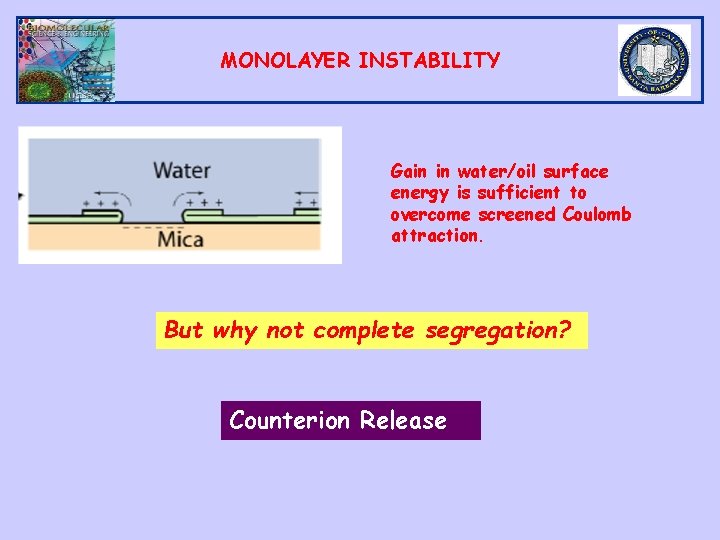
MONOLAYER INSTABILITY Gain in water/oil surface energy is sufficient to overcome screened Coulomb attraction. But why not complete segregation? Counterion Release
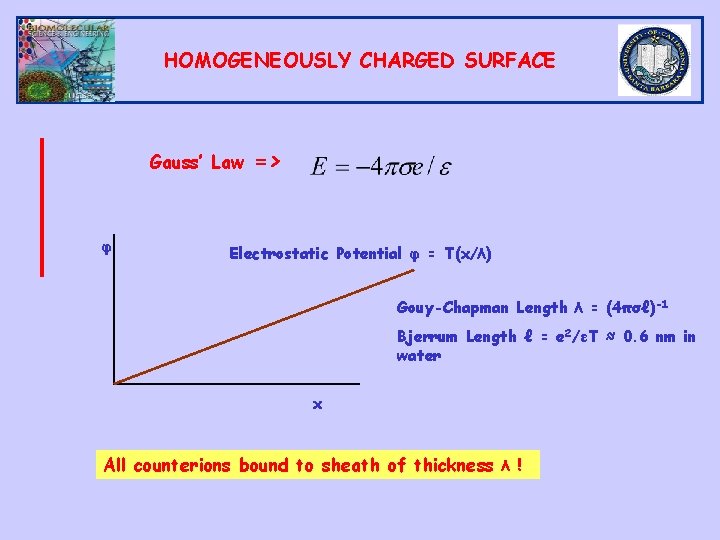
HOMOGENEOUSLY CHARGED SURFACE Gauss’ Law φ => Electrostatic Potential φ = T(x/λ) Gouy-Chapman Length λ = (4πσℓ)-1 Bjerrum Length ℓ = e 2/εT ≈ 0. 6 nm in water x All counterions bound to sheath of thickness λ !
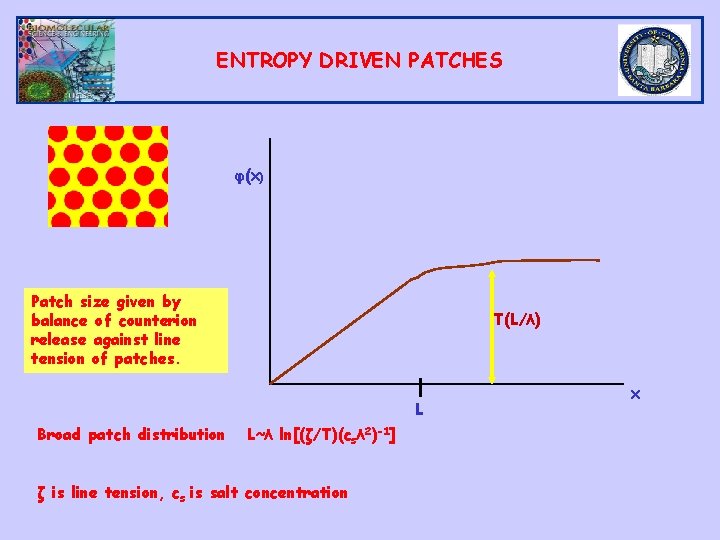
ENTROPY DRIVEN PATCHES φ(X) Patch size given by balance of counterion release against line tension of patches. T(L/λ) L Broad patch distribution L~λ ln[(ζ/T)(csλ 2)-1] ζ is line tension, cs is salt concentration X
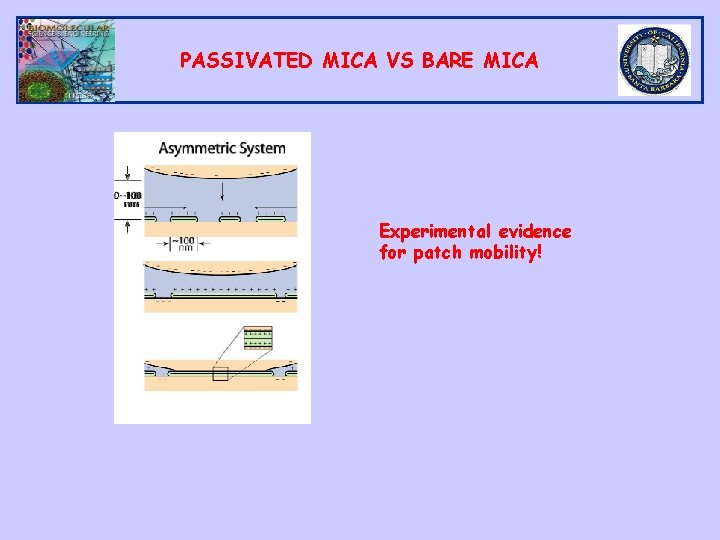
PASSIVATED MICA VS BARE MICA Experimental evidence for patch mobility!
What is it? Ø Strong short range (~ 1 nm) attractive force between hydrophobic surfaces in water (Tanford, Clausson, Wennerstrøm, F. Evans ……. ) Ø Why oil is insoluble in water. ARE THESE UNRELATED?
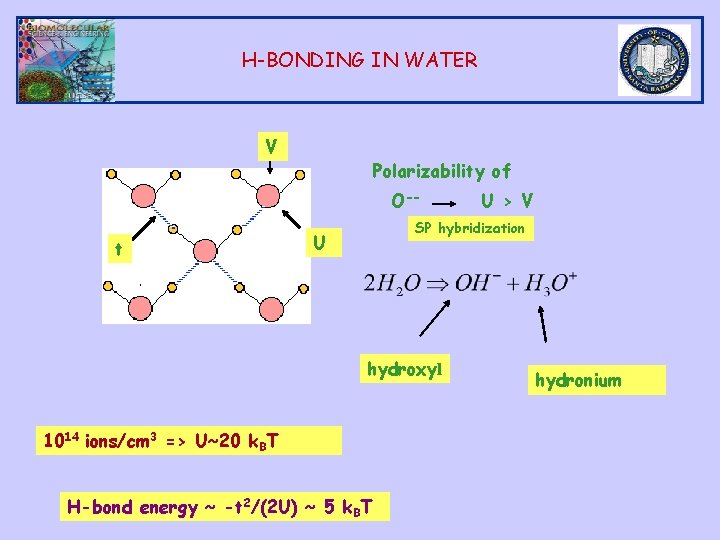
H-BONDING IN WATER V Polarizability of O-- t U > V SP hybridization U hydroxyl 1014 ions/cm 3 => U~20 k. BT H-bond energy ~ -t 2/(2 U) ~ 5 k. BT hydronium
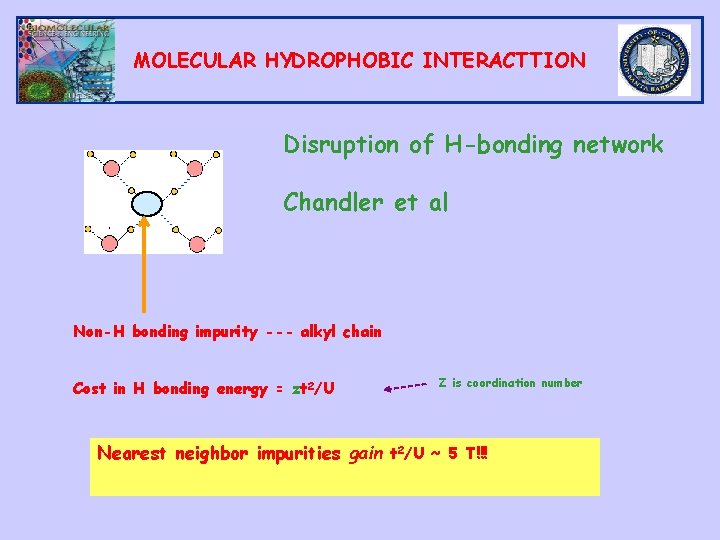
MOLECULAR HYDROPHOBIC INTERACTTION Disruption of H-bonding network Chandler et al Non-H bonding impurity --- alkyl chain Cost in H bonding energy = zt 2/U Z is coordination number Nearest neighbor impurities gain t 2/U ~ 5 T!!!
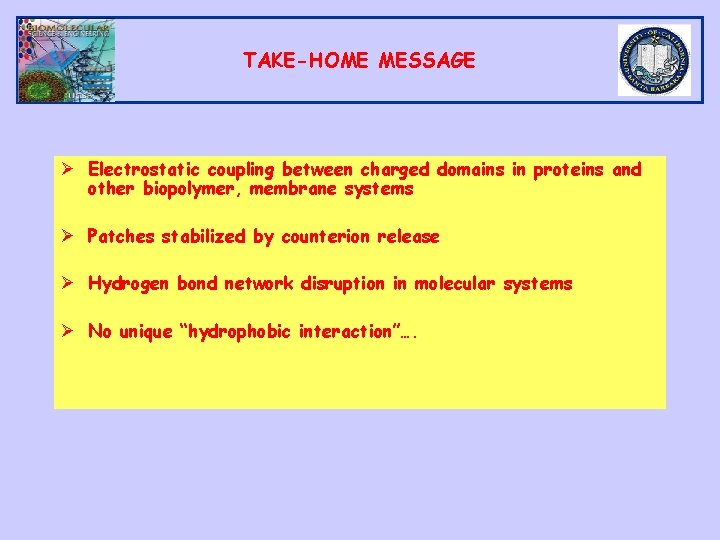
TAKE-HOME MESSAGE Ø Electrostatic coupling between charged domains in proteins and other biopolymer, membrane systems Ø Patches stabilized by counterion release Ø Hydrogen bond network disruption in molecular systems Ø No unique “hydrophobic interaction”….
- Slides: 16