
Some Thoughts on Accounting Research Robert Bushman CUHK

Some Thoughts on Accounting Research Robert Bushman CUHK Talk May 2018 1
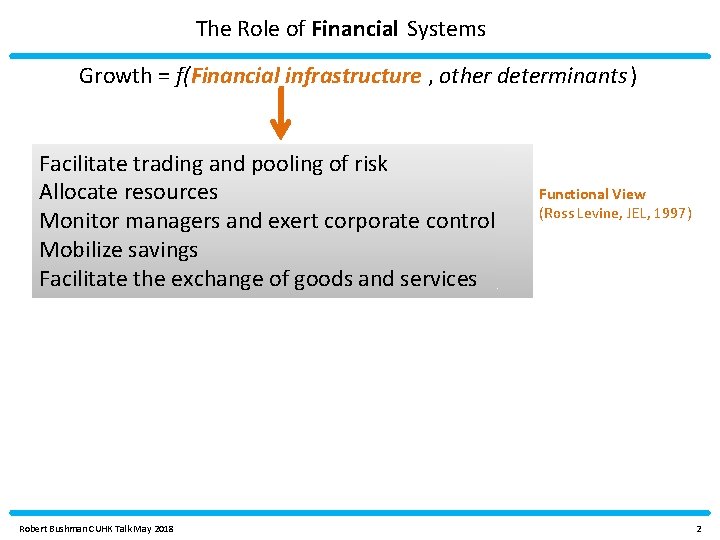
The Role of Financial Systems Growth = f(Financial infrastructure , other determinants ) Facilitate trading and pooling of risk Allocate resources Monitor managers and exert corporate control Mobilize savings Facilitate the exchange of goods and services Robert Bushman CUHK Talk May 2018 Functional View (Ross Levine, JEL, 1997) 2
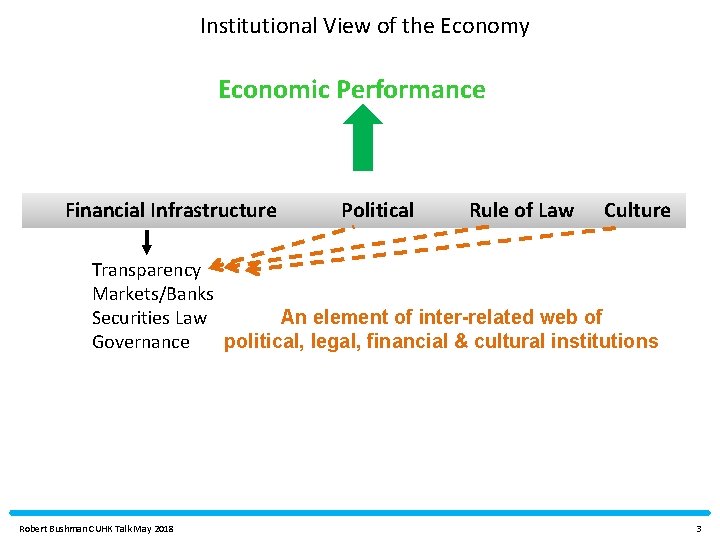
Institutional View of the Economy Economic Performance Financial Infrastructure Political Rule of Law Culture Transparency Markets/Banks An element of inter-related web of Securities Law political, legal, financial & cultural institutions Governance Robert Bushman CUHK Talk May 2018 3
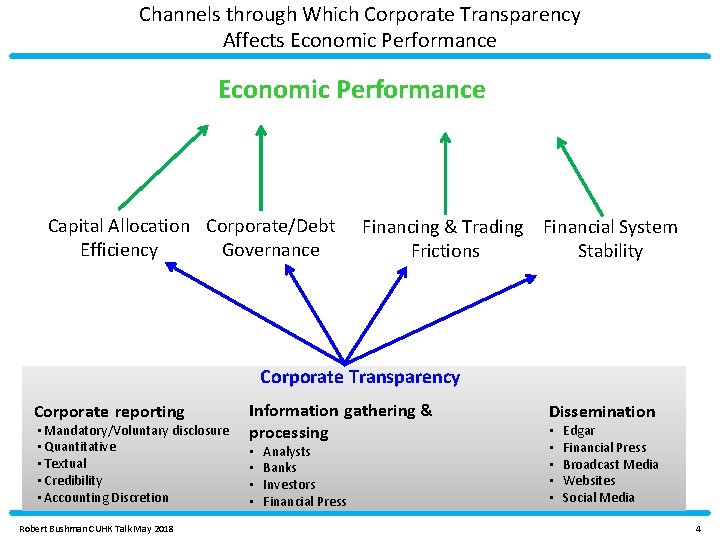
Channels through Which Corporate Transparency Affects Economic Performance Capital Allocation Corporate/Debt Efficiency Governance Financing & Trading Financial System Stability Frictions Corporate Transparency Corporate reporting • Mandatory/Voluntary disclosure • Quantitative • Textual • Credibility • Accounting Discretion Robert Bushman CUHK Talk May 2018 Information gathering & processing • • Analysts Banks Investors Financial Press Dissemination • • • Edgar Financial Press Broadcast Media Websites Social Media 4
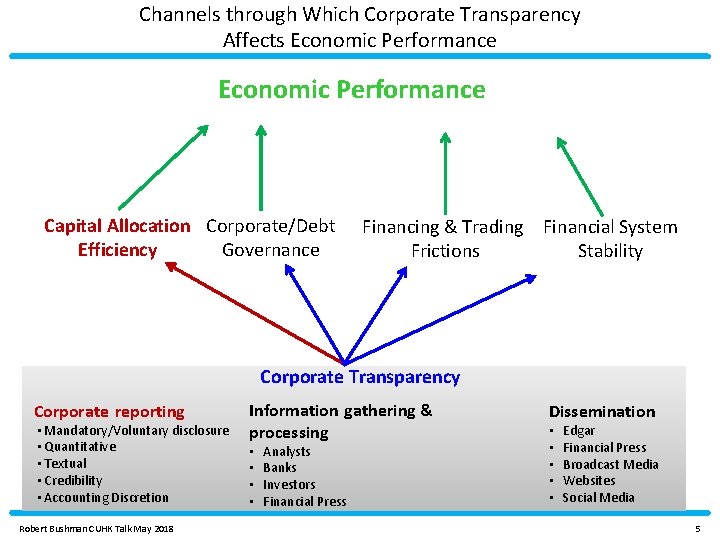
Channels through Which Corporate Transparency Affects Economic Performance Capital Allocation Corporate/Debt Efficiency Governance Financing & Trading Financial System Stability Frictions Corporate Transparency Corporate reporting • Mandatory/Voluntary disclosure • Quantitative • Textual • Credibility • Accounting Discretion Robert Bushman CUHK Talk May 2018 Information gathering & processing • • Analysts Banks Investors Financial Press Dissemination • • • Edgar Financial Press Broadcast Media Websites Social Media 5
If managers know ex ante that negative consequences of current decisions will be recognized during their tenure and trigger swift and decisive intervention by outside stakeholders => less likely to engage in value destroying investments in the first place and more likely to exit losing projects on a timely basis. Hypothesize that TLR will asymmetrically influence investment behavior Will discipline investment decisions in face of declining investment opportunities more than for increasing investment opportunities Robert Bushman CUHK Talk May 2018 6
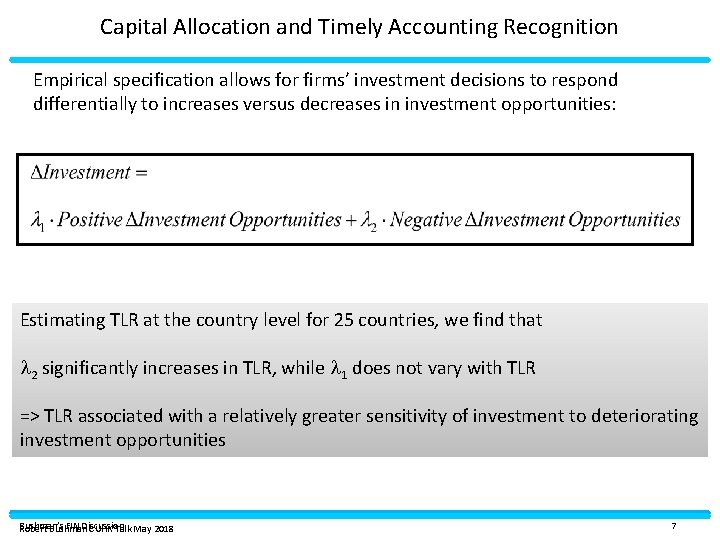
Capital Allocation and Timely Accounting Recognition Empirical specification allows for firms’ investment decisions to respond differentially to increases versus decreases in investment opportunities: Estimating TLR at the country level for 25 countries, we find that 2 significantly increases in TLR, while 1 does not vary with TLR => TLR associated with a relatively greater sensitivity of investment to deteriorating investment opportunities Bushman’s FIN Discussion Robert Bushman CUHK Talk May 2018 7
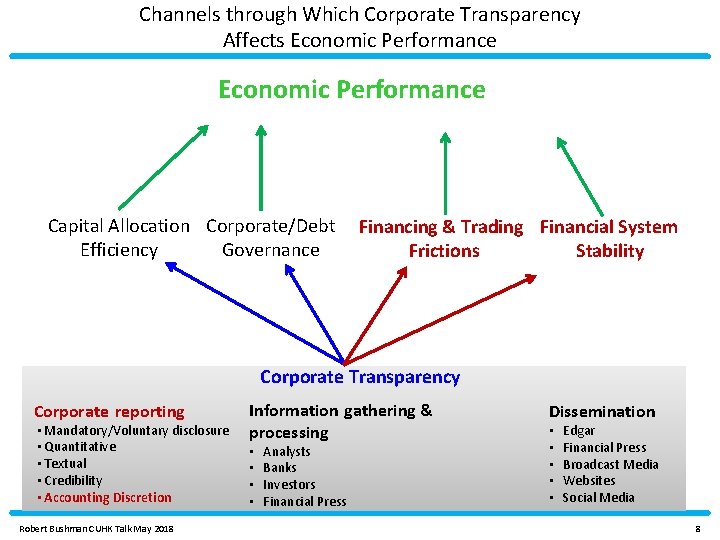
Channels through Which Corporate Transparency Affects Economic Performance Capital Allocation Corporate/Debt Efficiency Governance Financing & Trading Financial System Stability Frictions Corporate Transparency Corporate reporting • Mandatory/Voluntary disclosure • Quantitative • Textual • Credibility • Accounting Discretion Robert Bushman CUHK Talk May 2018 Information gathering & processing • • Analysts Banks Investors Financial Press Dissemination • • • Edgar Financial Press Broadcast Media Websites Social Media 8
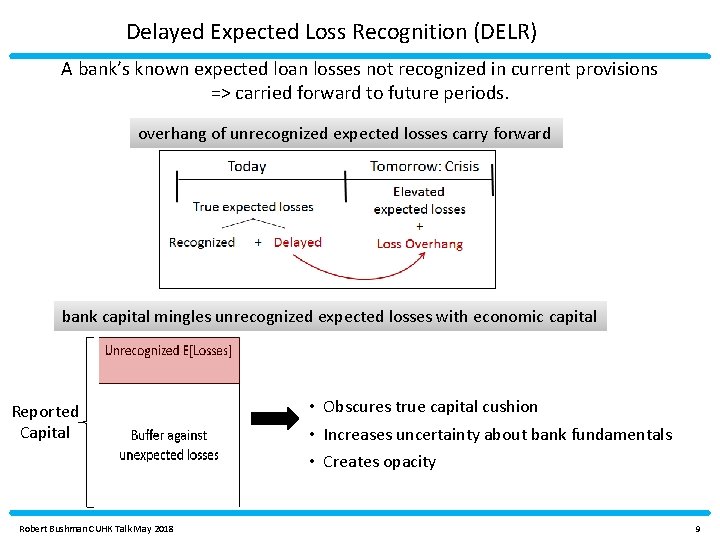
Delayed Expected Loss Recognition (DELR) A bank’s known expected loan losses not recognized in current provisions => carried forward to future periods. overhang of unrecognized expected losses carry forward bank capital mingles unrecognized expected losses with economic capital Reported Capital Robert Bushman CUHK Talk May 2018 • Obscures true capital cushion • Increases uncertainty about bank fundamentals • Creates opacity 9

Bushman & Williams: Accounting discretion, loan loss provisioning, and discipline of banks’ risk-taking (JAE 2012) • Banks from 27 countries; • In countries with regimes characterized by high levels of smoothing and DELR: ¨ Disciplinary pressure on bank risk-taking is dampened; ¨ Consistent with diminished transparency inhibiting outside monitoring. Market Discipline => Outside forces discipline banks to increase capital in response to increased risk. Bank Capital = 0 + 1* Risk 1 > 0 captures intensity of disciplinary response to risk increase 1 decreasing in DELR and Smoothing => Lower sensitivity of capital to change in bank riskiness Robert Bushman CUHK Talk May 2018 10
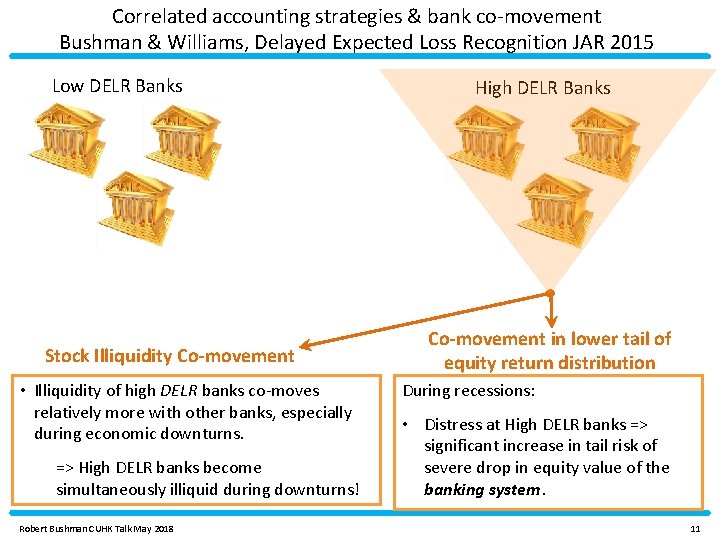
Correlated accounting strategies & bank co-movement Bushman & Williams, Delayed Expected Loss Recognition JAR 2015 Low DELR Banks Stock Illiquidity Co-movement • Illiquidity of high DELR banks co-moves relatively more with other banks, especially during economic downturns. => High DELR banks become simultaneously illiquid during downturns! Robert Bushman CUHK Talk May 2018 High DELR Banks Co-movement in lower tail of equity return distribution During recessions: • Distress at High DELR banks => significant increase in tail risk of severe drop in equity value of the banking system. 11
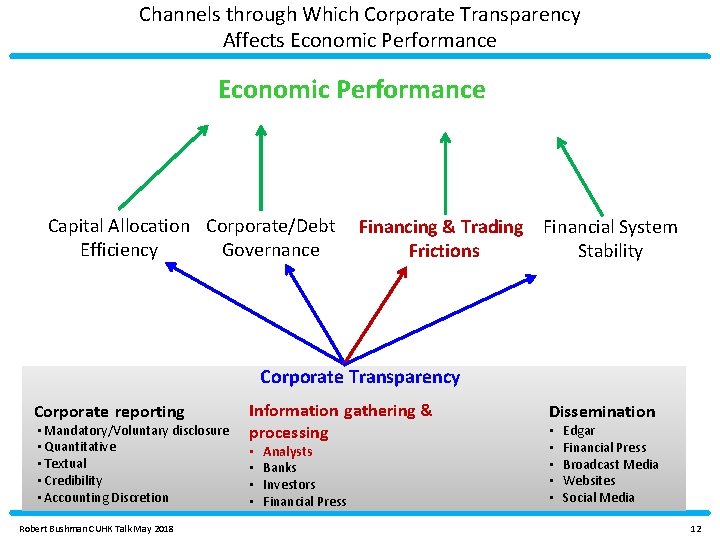
Channels through Which Corporate Transparency Affects Economic Performance Capital Allocation Corporate/Debt Efficiency Governance Financing & Trading Financial System Stability Frictions Corporate Transparency Corporate reporting • Mandatory/Voluntary disclosure • Quantitative • Textual • Credibility • Accounting Discretion Robert Bushman CUHK Talk May 2018 Information gathering & processing • • Analysts Banks Investors Financial Press Dissemination • • • Edgar Financial Press Broadcast Media Websites Social Media 12
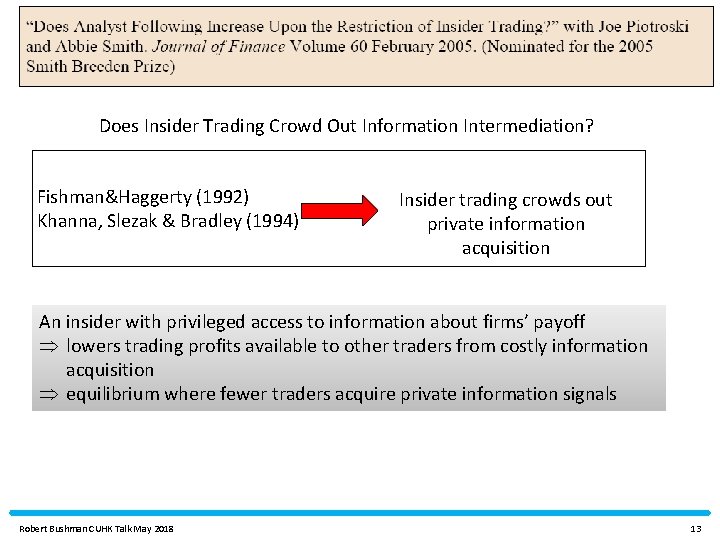
Does Insider Trading Crowd Out Information Intermediation? Fishman&Haggerty (1992) Khanna, Slezak & Bradley (1994) Insider trading crowds out private information acquisition An insider with privileged access to information about firms’ payoff Þ lowers trading profits available to other traders from costly information acquisition Þ equilibrium where fewer traders acquire private information signals Robert Bushman CUHK Talk May 2018 13
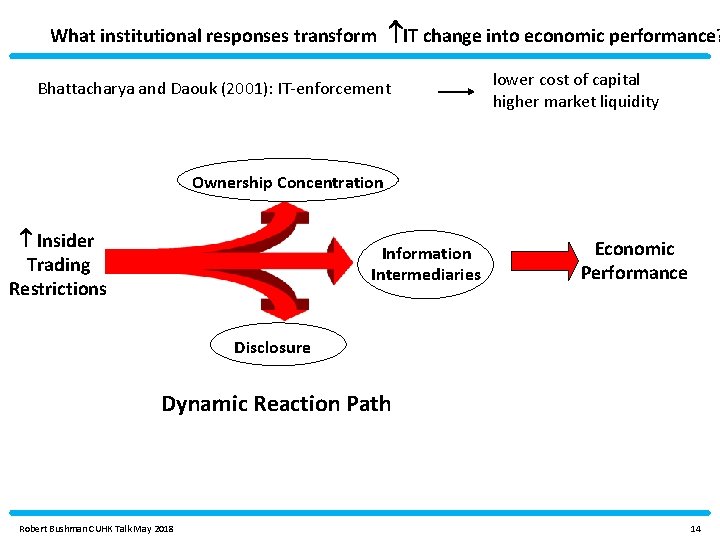
What institutional responses transform IT change into economic performance? Bhattacharya and Daouk (2001): IT-enforcement lower cost of capital higher market liquidity Ownership Concentration Insider Trading Restrictions Information Intermediaries Economic Performance Disclosure Dynamic Reaction Path Robert Bushman CUHK Talk May 2018 14
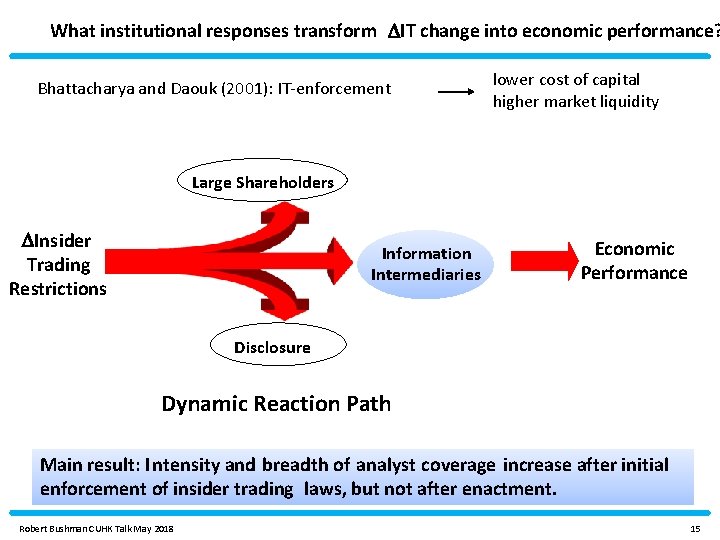
What institutional responses transform IT change into economic performance? Bhattacharya and Daouk (2001): IT-enforcement lower cost of capital higher market liquidity Large Shareholders Insider Trading Restrictions Information Intermediaries Economic Performance Disclosure Dynamic Reaction Path Main result: I ntensity and breadth of analyst coverage increase after initial enforcement of insider trading laws, but not after enactment. Robert Bushman CUHK Talk May 2018 15
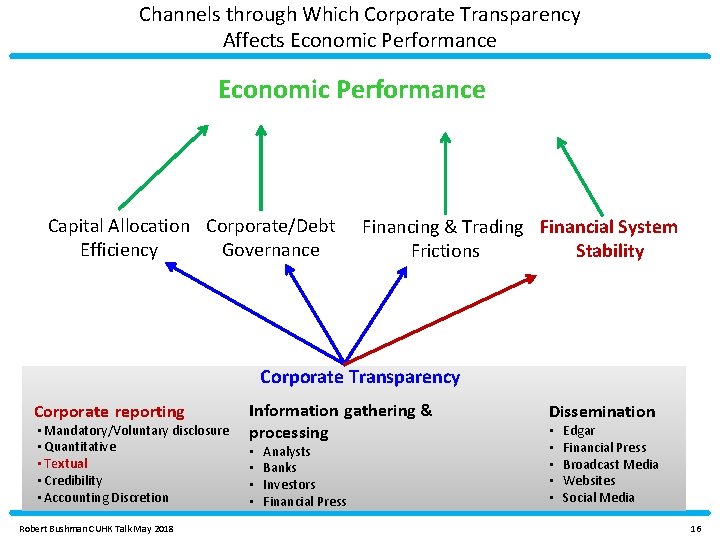
Channels through Which Corporate Transparency Affects Economic Performance Capital Allocation Corporate/Debt Efficiency Governance Financing & Trading Financial System Stability Frictions Corporate Transparency Corporate reporting • Mandatory/Voluntary disclosure • Quantitative • Textual • Credibility • Accounting Discretion Robert Bushman CUHK Talk May 2018 Information gathering & processing • • Analysts Banks Investors Financial Press Dissemination • • • Edgar Financial Press Broadcast Media Websites Social Media 16
• Diverse range of complex interconnections between banks can coalesce and expose groups of banks to comovement in downside outcomes and the economy to systemic risk. • Develop bank-specific, time varying measures of bank connectedness based on textual similarity of 10 -K disclosures across banks (Business Description and MD&A sections). • We examine whether these measures are incrementally informative for predicting future comovement in downside tail outcomes. Robert Bushman CUHK Talk May 2018 17
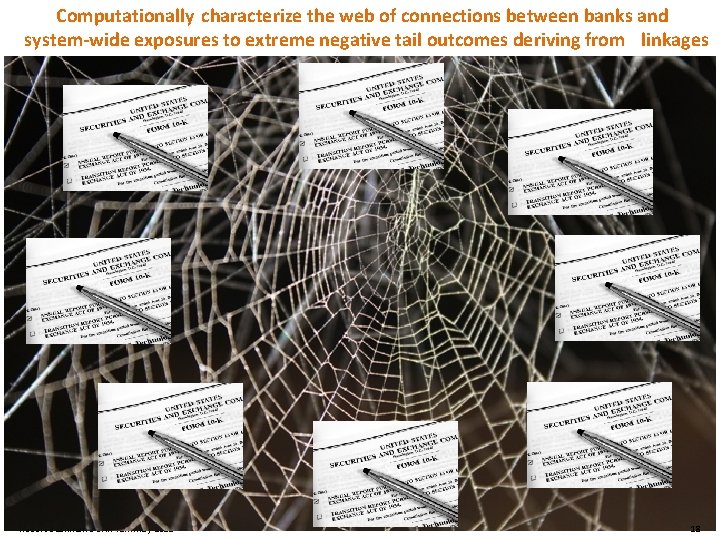
Computationally characterize the web of connections between banks and system-wide exposures to extreme negative tail outcomes deriving from linkages Robert Bushman CUHK Talk May 2018 18
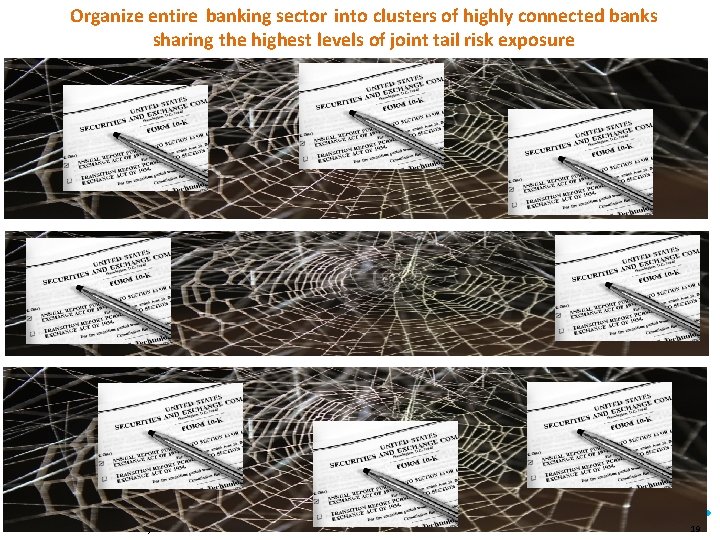
Organize entire banking sector into clusters of highly connected banks sharing the highest levels of joint tail risk exposure Robert Bushman CUHK Talk May 2018 19
Find that a bank co-moves significantly more in the tails with banks within its highest textual similarity cluster than with banks in more distant clusters. Robert Bushman CUHK Talk May 2018 20
Clustering output can be viewed as a novel, system-wide aspect of transparency. • Where transparency usually conceptualized as availability of firm-specific information to those outside of a firm • We conceptualize it as system-wide transparency derived from entire corpus of banking sector disclosures • Cluster transparency provides information that can • mitigate panic by helping lenders avoid indiscriminate withdrawal of funds; • aid traders in assessing portfolio tail risks; • guide regulators in targeting scarce resources towards preventing contagion within connected clusters. Robert Bushman CUHK Talk May 2018 21
Similarity in Boilerplate and Non-Boilerplate While Boilerplate disclosures may generally be uninformative, it is plausible that textual similarity across banks in Boilerplate language would be informative about shared vulnerabilities to tail risk. If Boilerplate sentences emanate from fundamental economic circumstances banks using similar Boilerplate sentences plausibly share similar exposures Sentence defined as boilerplate if Cross Sectional: it contains a 4 -word phrase that appear in > 60% of disclosures of all banks in a given year. Time Series: a sentence is defined as boilerplate if the exact same sentence existed in a firm’s report in the previous year. We compute similarity of all boilerplate and non-boilerplate sentences across all banks for each year. Robert Bushman CUHK Talk May 2018 22
Similarity in Boilerplate and Non-Boilerplate While Dyer et al. (2017) document an increasing trend in firms’ use of Boilerplate, we find that this phenomenon does not translate into trends in Boilerplate similarity, which has not significantly changed in recent years. Surprisingly, we find that Boilerplate similarity reflects incremental information about future comovement in downside outcomes. Suggests that fully understanding the informativeness of corporate disclosures will require transcending contexts focused on standalone disclosures of firms and also considering contexts that focus on interconnections across firms. Robert Bushman CUHK Talk May 2018 23
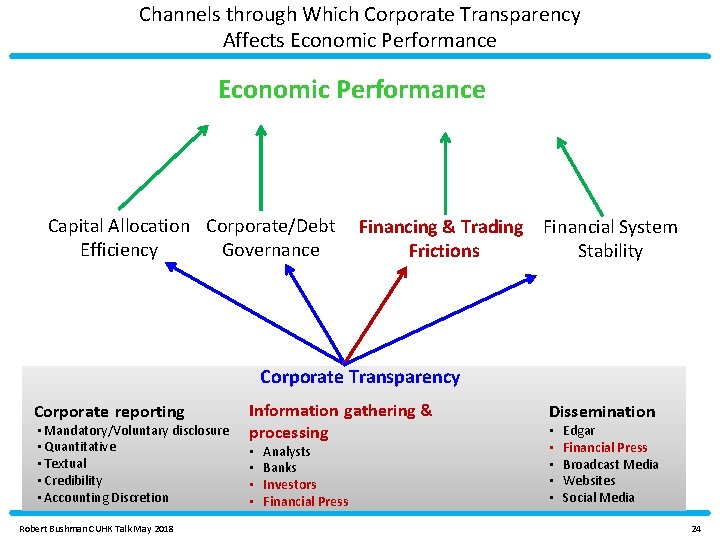
Channels through Which Corporate Transparency Affects Economic Performance Capital Allocation Corporate/Debt Efficiency Governance Financing & Trading Financial System Stability Frictions Corporate Transparency Corporate reporting • Mandatory/Voluntary disclosure • Quantitative • Textual • Credibility • Accounting Discretion Robert Bushman CUHK Talk May 2018 Information gathering & processing • • Analysts Banks Investors Financial Press Dissemination • • • Edgar Financial Press Broadcast Media Websites Social Media 24
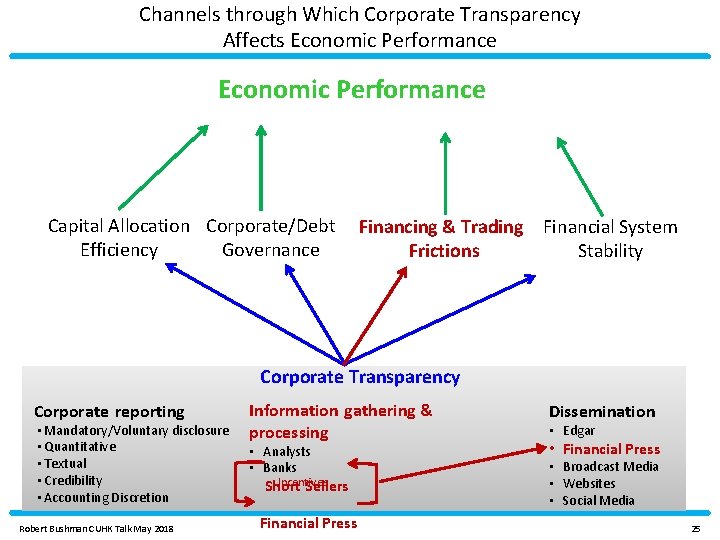
Channels through Which Corporate Transparency Affects Economic Performance Capital Allocation Corporate/Debt Efficiency Governance Financing & Trading Financial System Stability Frictions Corporate Transparency Corporate reporting • Mandatory/Voluntary disclosure • Quantitative • Textual • Credibility • Accounting Discretion Robert Bushman CUHK Talk May 2018 Information gathering & processing • Analysts • Banks Incentives Short Sellers Financial Press Dissemination • Edgar • Financial Press • Broadcast Media • Websites • Social Media 25
Short Selling Constraints and the Negative Tilt of Media Coverage Robert Bushman Jedson Pinto UNC-Kenan Flagler Business School April 2018 Robert Bushman CUHK Talk May 2018 26
Main research question How do market frictions affect the flow of information to capital markets? ¨ Do changes in short selling costs affect the flow of negative news reported by the financial press? ¨ Do short selling costs influence relations between negative news coverage and speed of price adjustment? Robert Bushman CUHK Talk May 2018 27
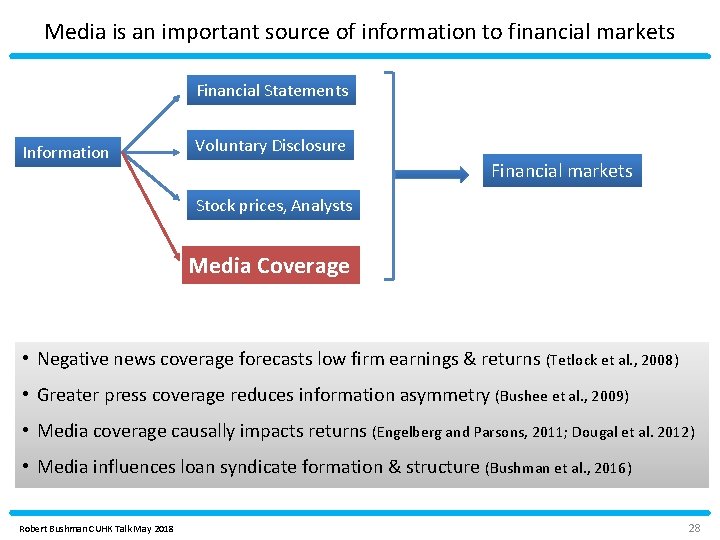
Media is an important source of information to financial markets Financial Statements Information Voluntary Disclosure Financial markets Stock prices, Analysts Media Coverage • Negative news coverage forecasts low firm earnings & returns (Tetlock et al. , 2008) • Greater press coverage reduces information asymmetry (Bushee et al. , 2009) • Media coverage causally impacts returns (Engelberg and Parsons, 2011; Dougal et al. 2012) • Media influences loan syndicate formation & structure (Bushman et al. , 2016) Robert Bushman CUHK Talk May 2018 28
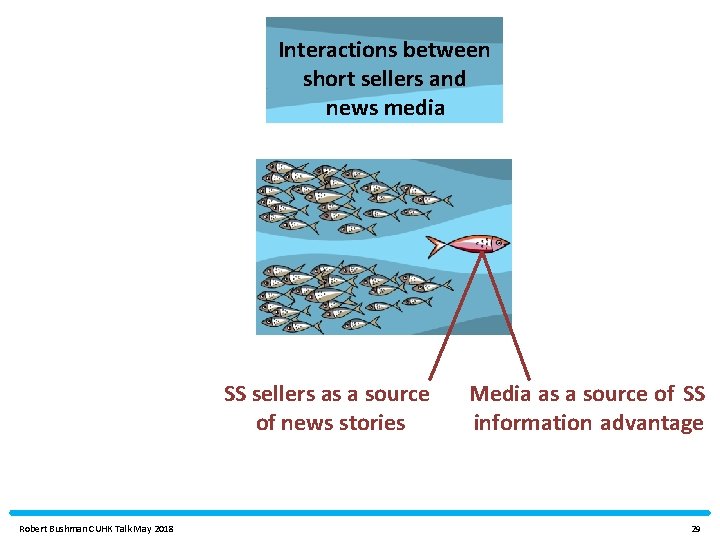
Interactions between short sellers and news media SS sellers as a source of news stories Robert Bushman CUHK Talk May 2018 Media as a source of SS information advantage 29
Short sellers as providers of news to financial press SS uncover negative information about firm Þ Þ sell short if price > fundamental value communicate info to media investigates and gets the story out fast if credible if media credible to trading public => price declines Fox, Glosten, and Tetlock (2010) Abnormally high levels of short selling followed by significant elevation in the level of negative news about a firm. Robert Bushman CUHK Talk May 2018 30
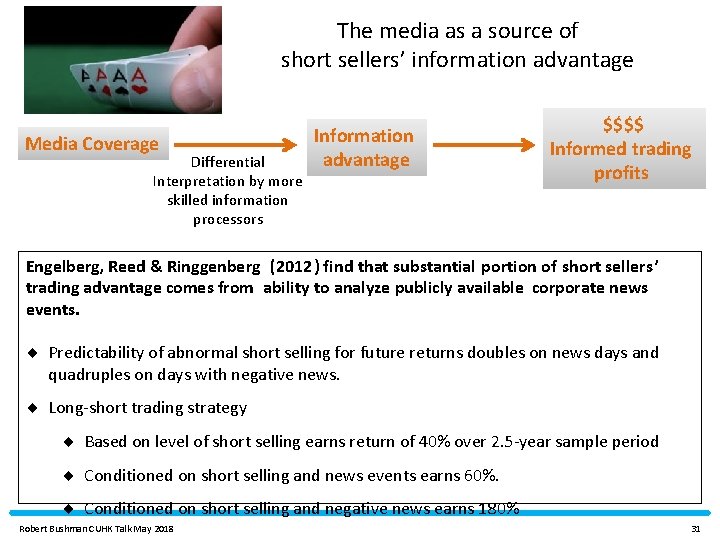
The media as a source of short sellers’ information advantage Media Coverage Differential Interpretation by more skilled information processors Information advantage $$$$ Informed trading profits Engelberg, Reed & Ringgenberg (2012) find that substantial portion of short sellers ’ trading advantage comes from ability to analyze publicly available corporate news events. ¨ Predictability of abnormal short selling for future returns doubles on news days and quadruples on days with negative news. ¨ Long-short trading strategy ¨ Based on level of short selling earns return of 40% over 2. 5 -year sample period ¨ Conditioned on short selling and news events earns 60%. ¨ Conditioned on short selling and negative news earns 180% Robert Bushman CUHK Talk May 2018 31
Amount and content of media coverage shaped by incentives of utility maximizing agents Niessner and So (2017) hypothesize that competition for investing public’s attention creates incentives for the financial press to tilt coverage negative. They find that: • Greater media coverage foreshadows declines in firms’ profitability and negative earnings surprises; • Media more likely to cover earnings announcements if they convey poor operating performance; • Investment strategy that shorts firms with high coverage and buys low coverage firms produces factor-adjusted alpha of 30 basis points per month. Robert Bushman CUHK Talk May 2018 32
Putting it together: Influence of reduced short selling constraints on incentives of short sellers & financial press Short Sellers ¨ Significantly increase level of shorting activity (Diether, Lee, and Werner , 2009) ¨ Increased demand for negative news ¨ Enhanced incentives to seek out negative news and communicate it to financial press Financial Press Competitive pressure from demands of short selling clientele generates heightened incentives to tilt coverage more towards negative news events. We predict that following reduction in short selling constraints news coverage will tilt more negative Robert Bushman CUHK Talk May 2018 33
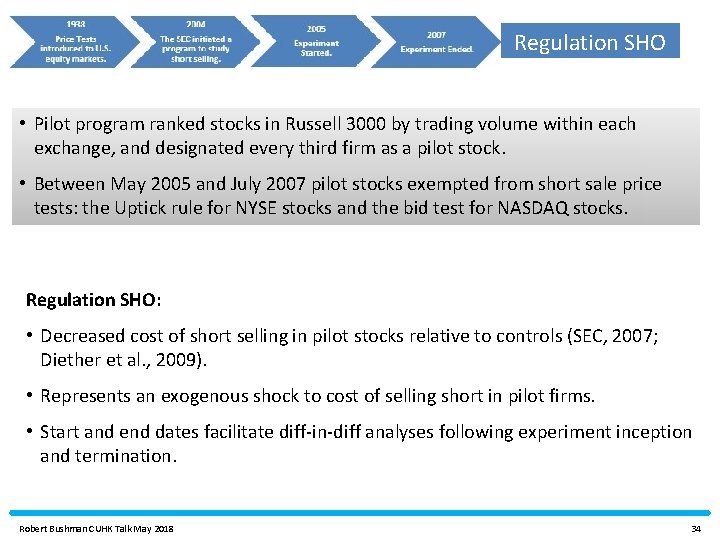
Regulation SHO • Pilot program ranked stocks in Russell 3000 by trading volume within each exchange, and designated every third firm as a pilot stock. • Between May 2005 and July 2007 pilot stocks exempted from short sale price tests: the Uptick rule for NYSE stocks and the bid test for NASDAQ stocks. Regulation SHO: • Decreased cost of short selling in pilot stocks relative to controls (SEC, 2007; Diether et al. , 2009). • Represents an exogenous shock to cost of selling short in pilot firms. • Start and end dates facilitate diff-in-diff analyses following experiment inception and termination. Robert Bushman CUHK Talk May 2018 34
Measuring Media Sentiment • Composite Sentiment Score (CSS): reflects assessment of news tone in an article (positive/negative news) as well as strength of the news. • CSS ranges between 0 to 100 where score above 50 => positive news; a score of 50 => neutral news; and a score below 50 => negative news. • Media sentiment computed as average CSS over a quarter. • Also split coverage into financial media-initiated and firm-initiated press releases Robert Bushman CUHK Talk May 2018 35
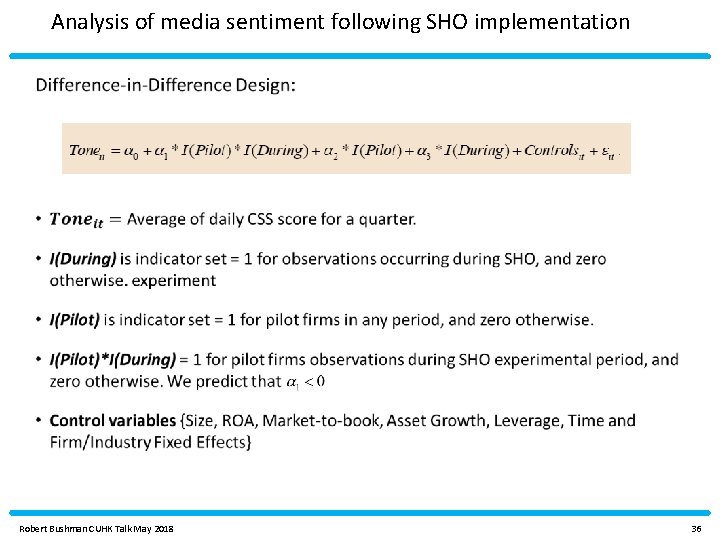
Analysis of media sentiment following SHO implementation Robert Bushman CUHK Talk May 2018 36
Preview of Results Media sentiment following implementation of SHO • Decrease in sentiment and increase in probability of receiving negative news. • Difference between pilots & controls disappears when experiment ends. • Drop in sentiment greater for firms with low media coverage intensity, low institutional ownership and high bid-ask spreads. • No evidence that firms’ press release sentiment responds to lower short selling costs, whereas the sentiment of media-initiated articles drops significantly. • The number of firm press releases drops while media-initiated articles increases. Robert Bushman CUHK Talk May 2018 37
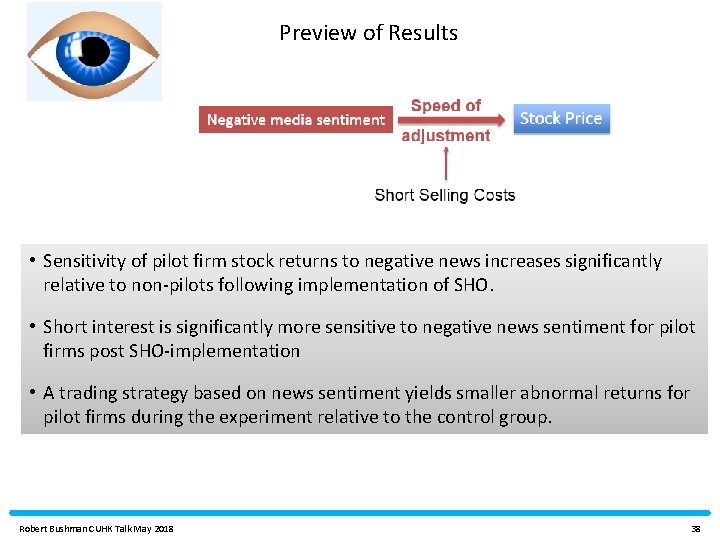
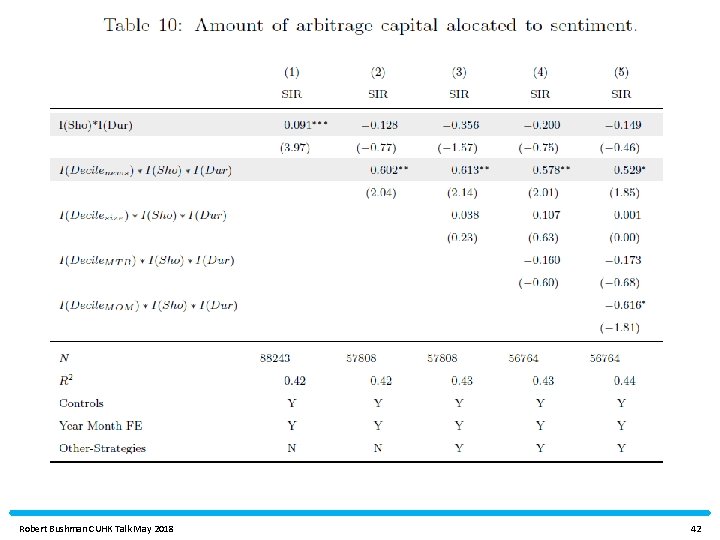
Preview of Results • Sensitivity of pilot firm stock returns to negative news increases significantly relative to non-pilots following implementation of SHO. • Short interest is significantly more sensitive to negative news sentiment for pilot firms post SHO-implementation • A trading strategy based on news sentiment yields smaller abnormal returns for pilot firms during the experiment relative to the control group. Robert Bushman CUHK Talk May 2018 38
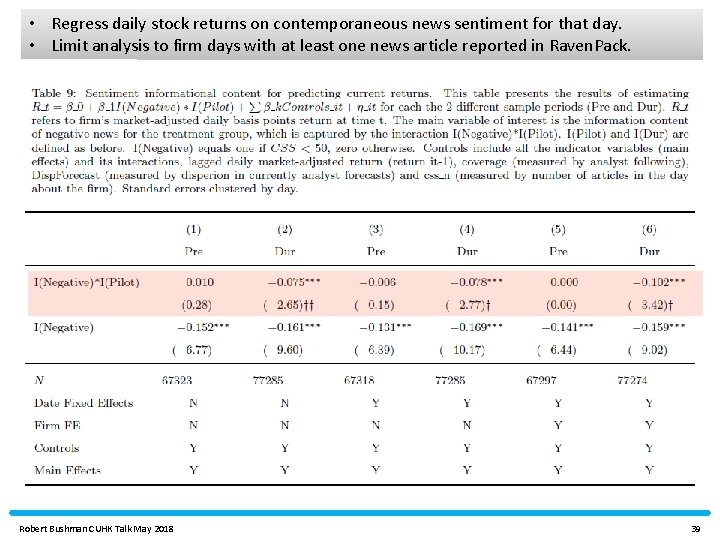
• Regress daily stock returns on contemporaneous news sentiment for that day. • Limit analysis to firm days with at least one news article reported in Raven. Pack. Robert Bushman CUHK Talk May 2018 39
SS costs and flows of arbitrage capital to news sentiment-based strategies • If lower SS costs reduce limits to arbitrage, expect more arbitrage capital to flow to trading strategies that exploit overpricing revealed by news media coverage • Use methodology from Hanson and Sunderam (2014) to infer arbitrage capital allocation Robert Bushman CUHK Talk May 2018 40
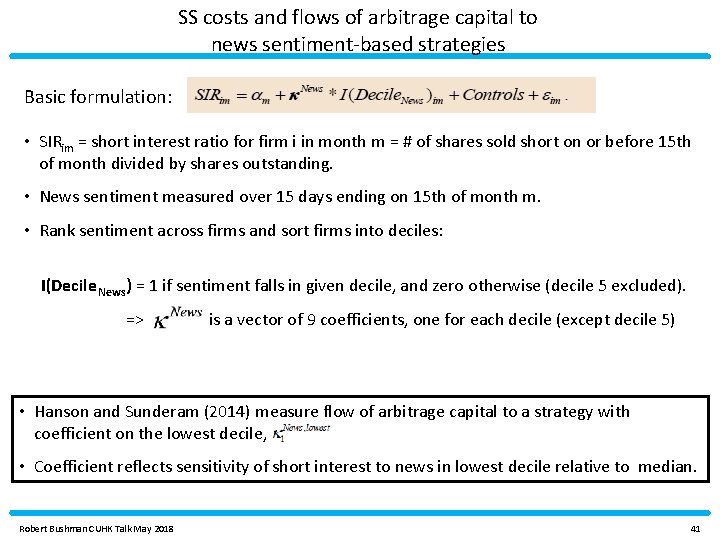
SS costs and flows of arbitrage capital to news sentiment-based strategies Basic formulation: • SIRim = short interest ratio for firm i in month m = # of shares sold short on or before 15 th of month divided by shares outstanding. • News sentiment measured over 15 days ending on 15 th of month m. • Rank sentiment across firms and sort firms into deciles: I(Decile News) = 1 if sentiment falls in given decile, and zero otherwise (decile 5 excluded). => is a vector of 9 coefficients, one for each decile (except decile 5) • Hanson and Sunderam (2014) measure flow of arbitrage capital to a strategy with coefficient on the lowest decile, • Coefficient reflects sensitivity of short interest to news in lowest decile relative to median. Robert Bushman CUHK Talk May 2018 41
Robert Bushman CUHK Talk May 2018 42
- Slides: 42