
Some thoughts about Accessors Nate Moehring CLA Lab
Some thoughts about Accessors Nate Moehring CLA, Lab. VIEW Champion 9/24/2014
OOP 101 • What are the main features/benefits provided by OOP compared to procedural programming? • What is the definition of encapsulation? • What are some benefits of encapsulation?
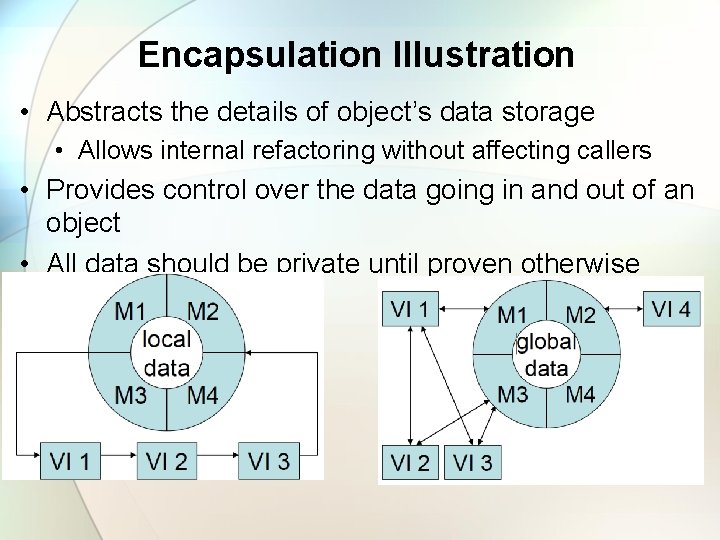
Encapsulation Illustration • Abstracts the details of object’s data storage • Allows internal refactoring without affecting callers • Provides control over the data going in and out of an object • All data should be private until proven otherwise
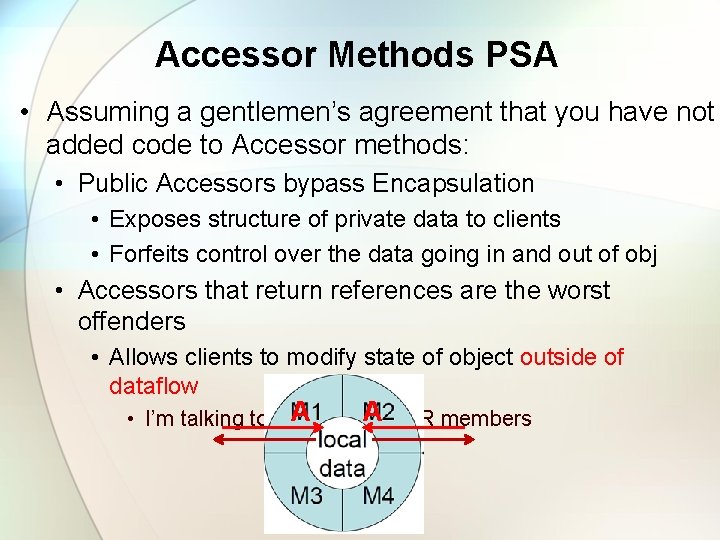
Accessor Methods PSA • Assuming a gentlemen’s agreement that you have not added code to Accessor methods: • Public Accessors bypass Encapsulation • Exposes structure of private data to clients • Forfeits control over the data going in and out of obj • Accessors that return references are the worst offenders • Allows clients to modify state of object outside of dataflow A notifier/DVR A • I’m talking to you members
Accessors as Properties • Accessors are particularly tempting when wanting to read/write data from an object stored in a DVR • This convenience encourages bad practice • Breaks encapsulation • Potentially locks and unlocks the DVR in multiple calls in what should be a single atomic action.
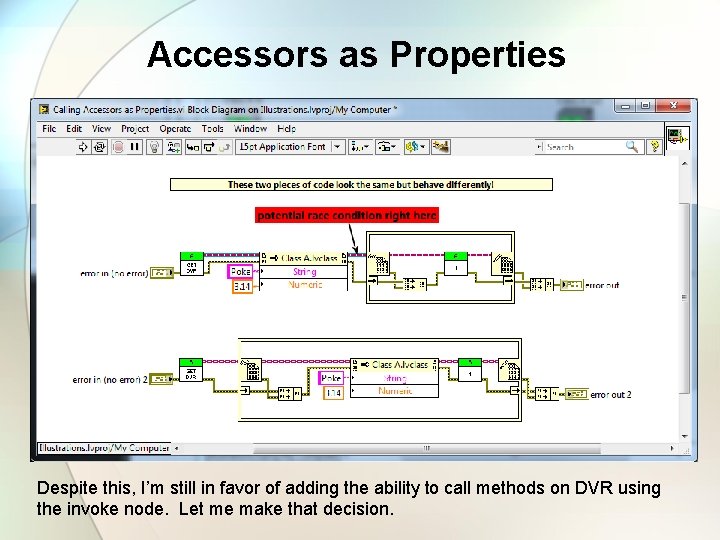
Accessors as Properties Despite this, I’m still in favor of adding the ability to call methods on DVR using the invoke node. Let me make that decision.
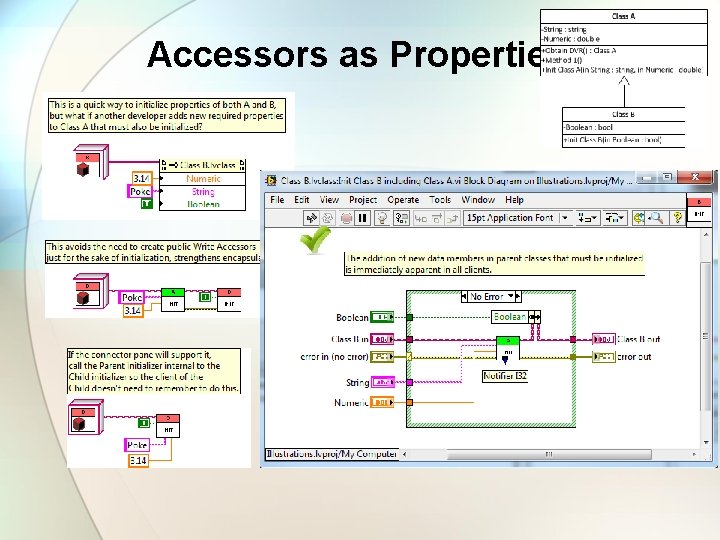
Accessors as Properties • Accessors are not substitutes for method parameters • It is tempting to create a set of properties and expand them in a property node as a quick way to initialize a lot of data within an object (especially parent data since they cannot be set with a bundle node). • However, that action is likely better served by creating a method with inputs for the required parameters, and performs sanity checks on the input data. • Ie: What if a new required parameter is introduced?
Accessors as Properties
Rules of Thumb for Accessors • Data should stay in the class whenever possible. • Allow the object to do the work for you, rather than having the client operate on the data. • Favor methods over accessors. • Better access control and abstraction. • Think really hard before creating a public Write accessor. • Consider making accessors protected so only child classes can call them.
Rules of Thumb for Accessors (cont’d) • Avoid returning references if possible. Instead, the method should act on the reference inside the method call. • Classes should either be all by-value or all by-reference. • Mixing the two has undesirable results when branching or comparing objects. • [Consider use of GDS for creating by-ref classes that have better support for dynamic dispatch than DVR of object. ] • Use Init methods for initialization, not properties • Use bundle nodes to avoid creating accessors that are not needed for protected/private access. • Should someone ever need to set this value outside of the class? • I understand that people like accessors for searchability and debuggability. That’s fine, just make them private or
Suggested Notation • Read/Write for Accessors • Get/Set for methods that act like Accessors but do not guarantee a straight pass-thru of data. Additional operations may be performed. • Find/Lookup/Store/etc methods for true methods that operate on the object data.
Thoughts about References in Classes • Storing a reference in an object is risky because it breaks encapsulation • The object has no control over the lifetime of the reference • Lab. VIEW reference lifetime: destroy when creator stops • Parallel process could destroy reference anytime • Data can be updated at any time outside of the methods • Creating references internal to an object is risky because it may not be obvious to the user • If the object looks by value, the user may not be aware that forking the wire is not creating a copy of ALL the data • A Read accessor that returns a reference is more dangerous than a by-val Write accessor. • Both of these may be by-design, but both the author and the user need to be well aware of it.
- Slides: 12