
Some Terminology experiment vs correlational study IV vs
- Slides: 20
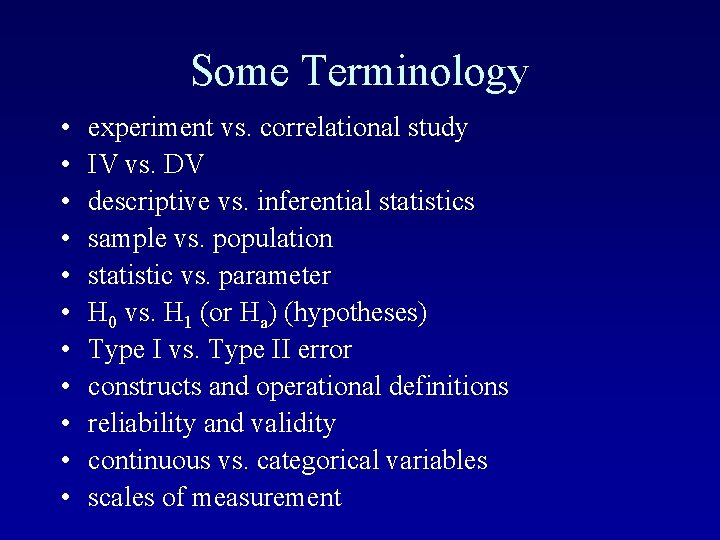
Some Terminology • • • experiment vs. correlational study IV vs. DV descriptive vs. inferential statistics sample vs. population statistic vs. parameter H 0 vs. H 1 (or Ha) (hypotheses) Type I vs. Type II error constructs and operational definitions reliability and validity continuous vs. categorical variables scales of measurement
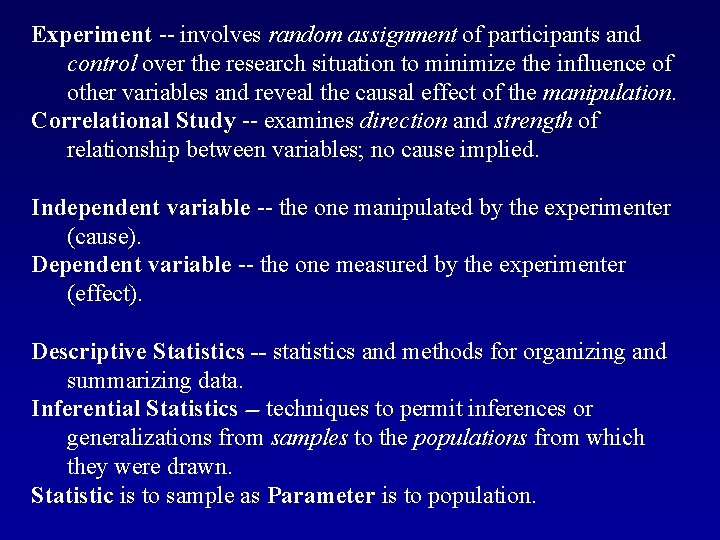
Experiment -- involves random assignment of participants and control over the research situation to minimize the influence of other variables and reveal the causal effect of the manipulation. Correlational Study -- examines direction and strength of relationship between variables; no cause implied. Independent variable -- the one manipulated by the experimenter (cause). Dependent variable -- the one measured by the experimenter (effect). Descriptive Statistics -- statistics and methods for organizing and summarizing data. Inferential Statistics -- techniques to permit inferences or generalizations from samples to the populations from which they were drawn. Statistic is to sample as Parameter is to population.
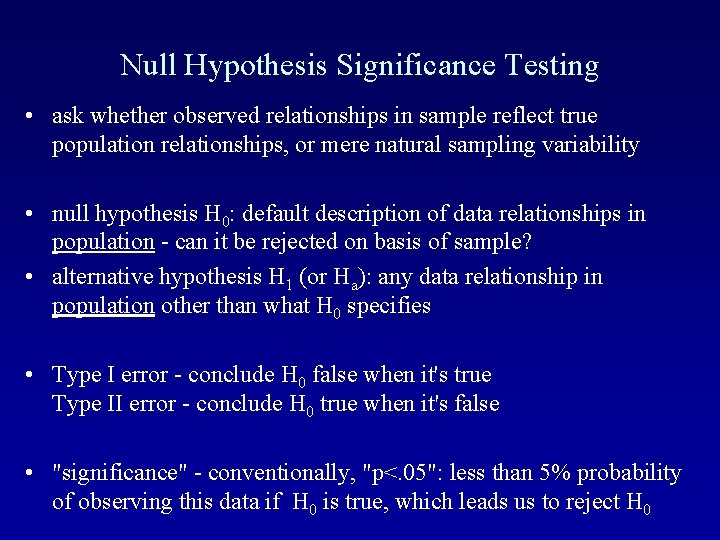
Null Hypothesis Significance Testing • ask whether observed relationships in sample reflect true population relationships, or mere natural sampling variability • null hypothesis H 0: default description of data relationships in population - can it be rejected on basis of sample? • alternative hypothesis H 1 (or Ha): any data relationship in population other than what H 0 specifies • Type I error - conclude H 0 false when it's true Type II error - conclude H 0 true when it's false • "significance" - conventionally, "p<. 05": less than 5% probability of observing this data if H 0 is true, which leads us to reject H 0
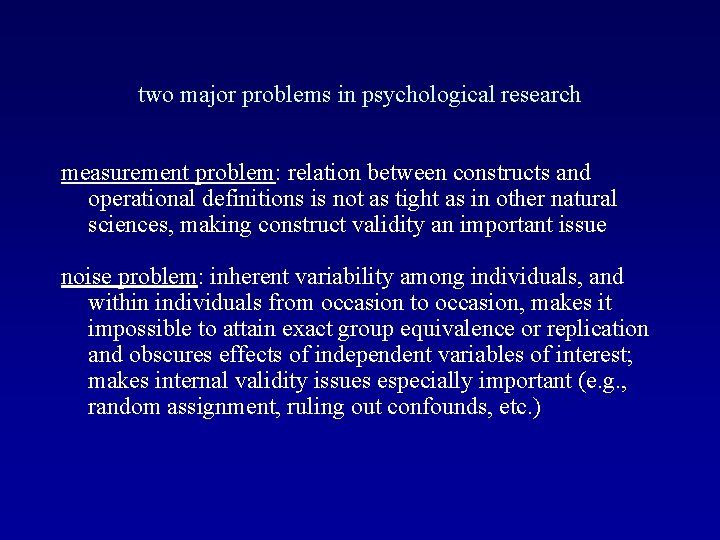
two major problems in psychological research measurement problem: relation between constructs and operational definitions is not as tight as in other natural sciences, making construct validity an important issue noise problem: inherent variability among individuals, and within individuals from occasion to occasion, makes it impossible to attain exact group equivalence or replication and obscures effects of independent variables of interest; makes internal validity issues especially important (e. g. , random assignment, ruling out confounds, etc. )
Reliability • The consistency or repeatability of a measure • The degree to which a measure would give you the same result over and over, assuming the phenomenon being measured is not changing • Cannot be calculated, only estimated • [Based on true score theory of measurement (Trochim pp. 60 -72)]
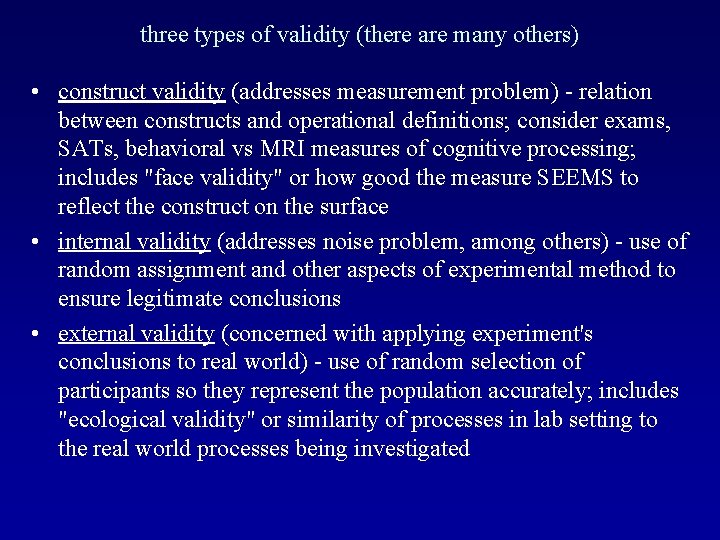
three types of validity (there are many others) • construct validity (addresses measurement problem) - relation between constructs and operational definitions; consider exams, SATs, behavioral vs MRI measures of cognitive processing; includes "face validity" or how good the measure SEEMS to reflect the construct on the surface • internal validity (addresses noise problem, among others) - use of random assignment and other aspects of experimental method to ensure legitimate conclusions • external validity (concerned with applying experiment's conclusions to real world) - use of random selection of participants so they represent the population accurately; includes "ecological validity" or similarity of processes in lab setting to the real world processes being investigated
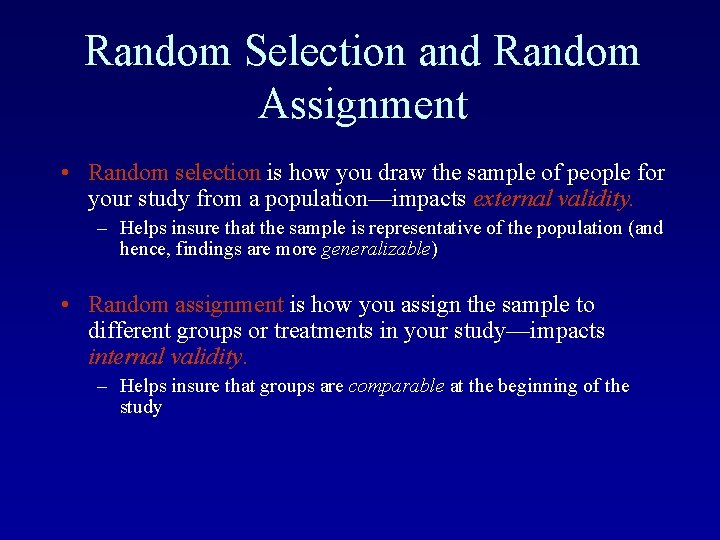
Random Selection and Random Assignment • Random selection is how you draw the sample of people for your study from a population—impacts external validity. – Helps insure that the sample is representative of the population (and hence, findings are more generalizable) • Random assignment is how you assign the sample to different groups or treatments in your study—impacts internal validity. – Helps insure that groups are comparable at the beginning of the study
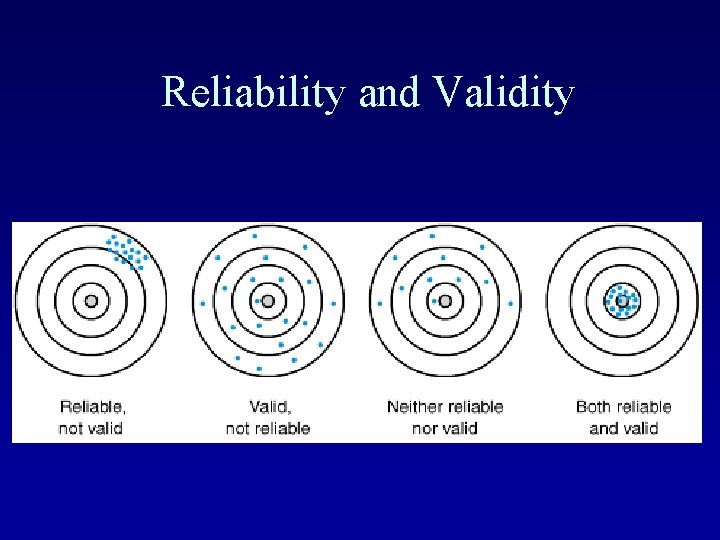
Reliability and Validity
types of research design: correlational vs. experimental correlational design • typically examines how 2 variables go together in a single group • no casuality implied because no control is assumed, and confounds and spurious or coincidental relationships are probably present
types of research design: correlational vs. experimental design • typically compares mean DV scores of 2 or more groups • intent is to change one thing between the groups and then attribute group differences on the dependent variable to the difference in treatments (independent variable) • "change ONE thing" (manipulation) implies "keep everything else the same" (control) • when random assignment and other appropriate controls are in place, the manipulation of the IV allows causal conclusions to be drawn • when participants are not randomly assigned to treatments, the method is only superficially experimental and is called "quasi-experimental"
experimental control • physical control (for environmental variables, not participant variables): temperature, lighting conditions, time of day, noise levels • control by experimental design. . .
experimental control: control by experimental design • hold constant (for environmental variables, some subject variables): temperature, lighting; age, sex; not really IQ (even if measurement were accurate, you wouldn't choose only people with IQ = 126); definitely not anxiety or authoritarianism or depression • matching (for environmental variables and explicitly measured participant variables): have corresponding subjects (e. g. , similar IQ) in each treatment group so groups are equal on average (equated at individual or group level); groups may still differ on unsuspected variables • random assignment (for all variables): all characteristics, known or unknown, are randomly spread across all groups so they're the same on average
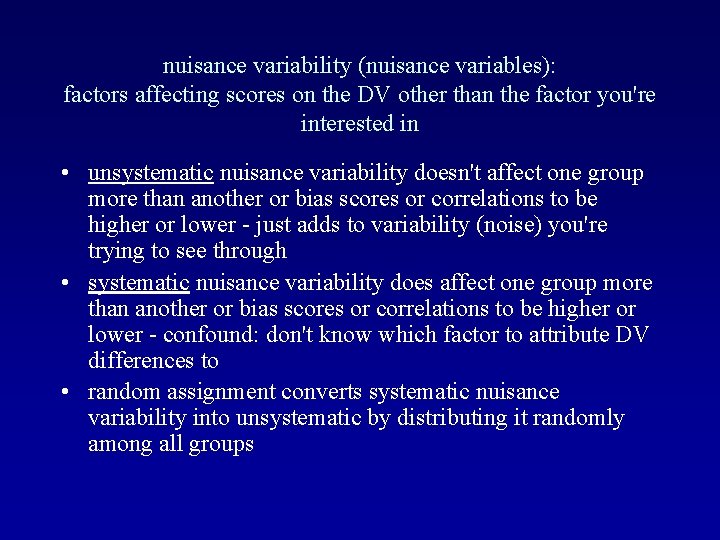
nuisance variability (nuisance variables): factors affecting scores on the DV other than the factor you're interested in • unsystematic nuisance variability doesn't affect one group more than another or bias scores or correlations to be higher or lower - just adds to variability (noise) you're trying to see through • systematic nuisance variability does affect one group more than another or bias scores or correlations to be higher or lower - confound: don't know which factor to attribute DV differences to • random assignment converts systematic nuisance variability into unsystematic by distributing it randomly among all groups
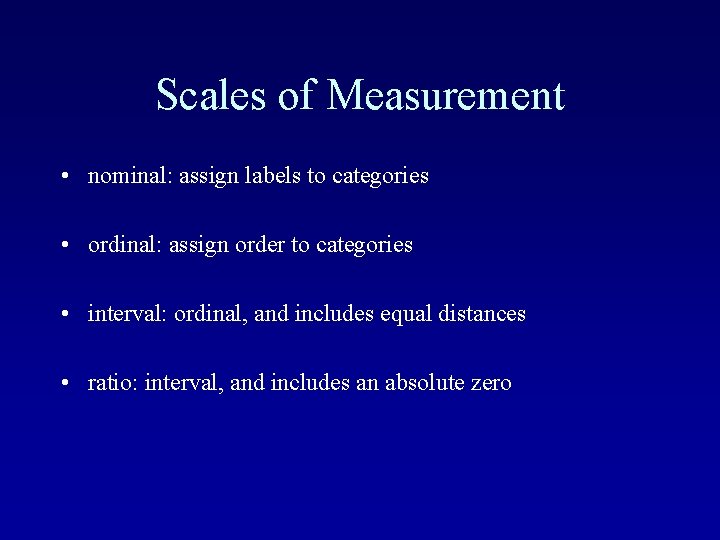
Scales of Measurement • nominal: assign labels to categories • ordinal: assign order to categories • interval: ordinal, and includes equal distances • ratio: interval, and includes an absolute zero
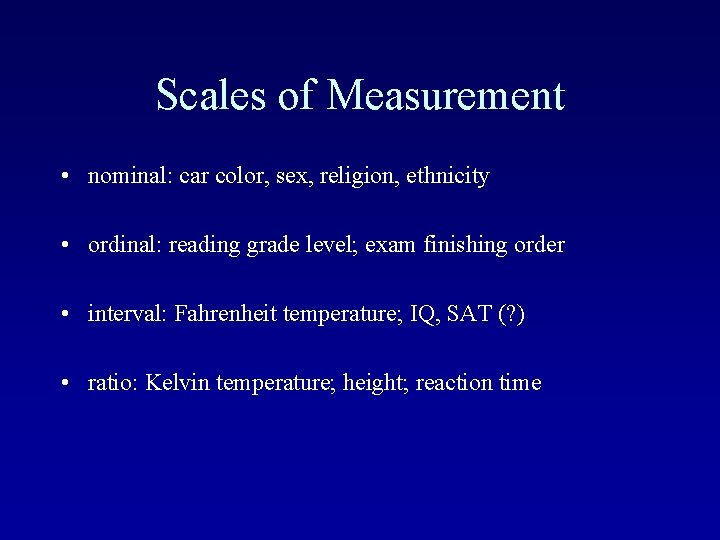
Scales of Measurement • nominal: car color, sex, religion, ethnicity • ordinal: reading grade level; exam finishing order • interval: Fahrenheit temperature; IQ, SAT (? ) • ratio: Kelvin temperature; height; reaction time
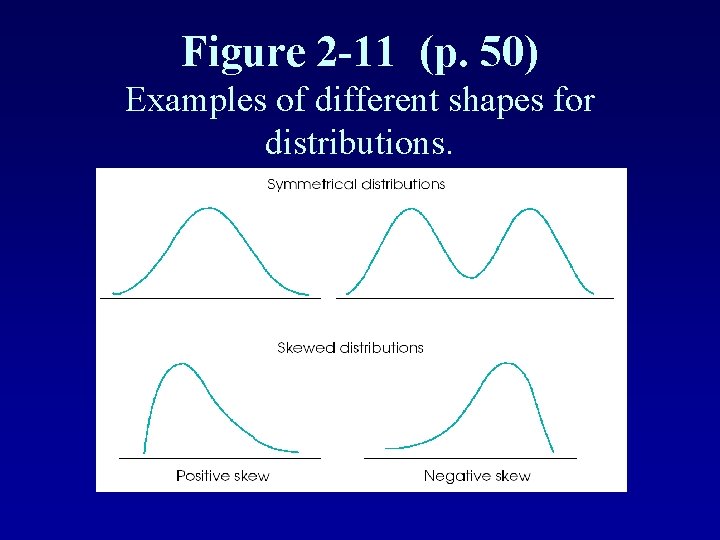
Figure 2 -11 (p. 50) Examples of different shapes for distributions.
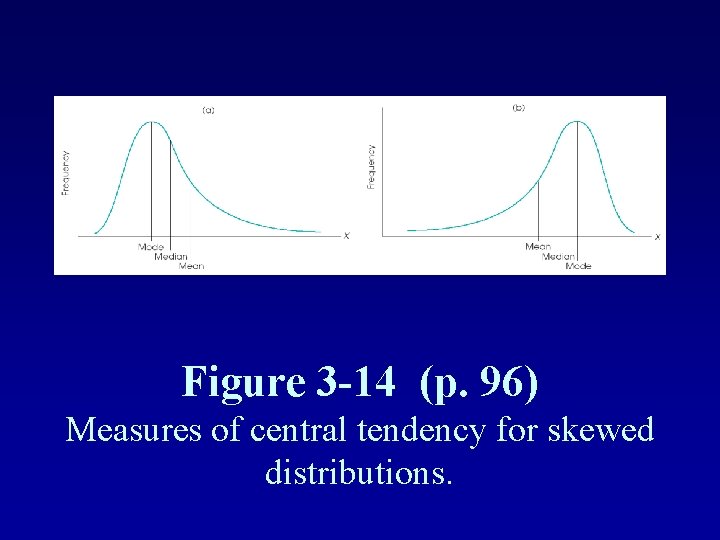
Figure 3 -14 (p. 96) Measures of central tendency for skewed distributions.
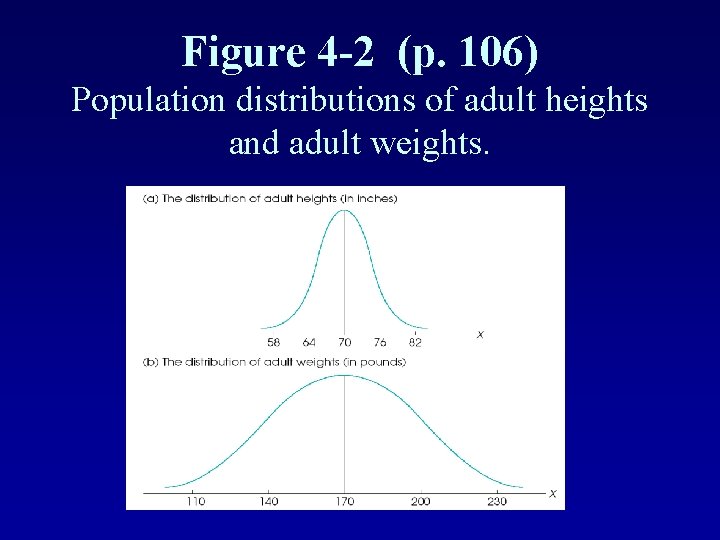
Figure 4 -2 (p. 106) Population distributions of adult heights and adult weights.
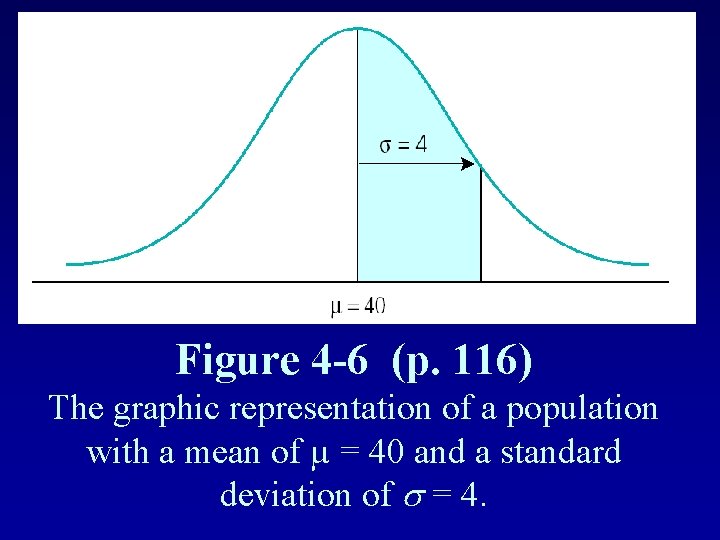
Figure 4 -6 (p. 116) The graphic representation of a population with a mean of µ = 40 and a standard deviation of = 4.
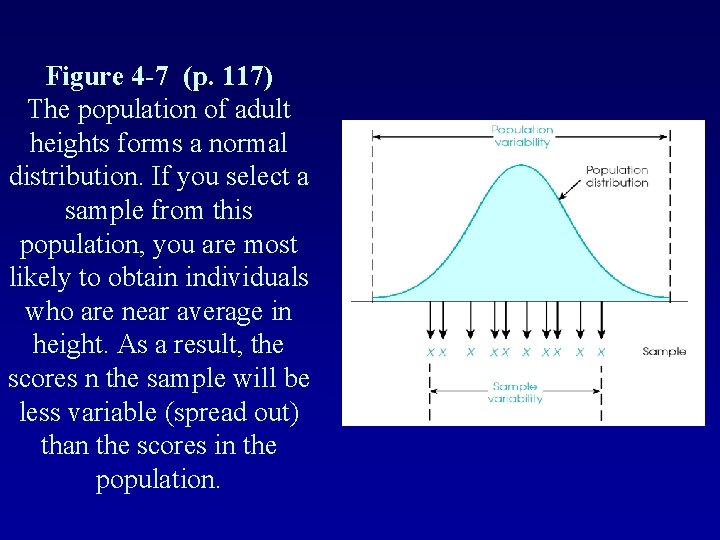
Figure 4 -7 (p. 117) The population of adult heights forms a normal distribution. If you select a sample from this population, you are most likely to obtain individuals who are near average in height. As a result, the scores n the sample will be less variable (spread out) than the scores in the population.