
SOME MODULAR PROPERTIES OF SUPERSTRING SCATTERING AMPLITUDES Michael
- Slides: 25
SOME MODULAR PROPERTIES OF SUPERSTRING SCATTERING AMPLITUDES Michael B. Green University of Cambridge AMPLITUDES 2016, STOCKHOLM July 05 , 2016
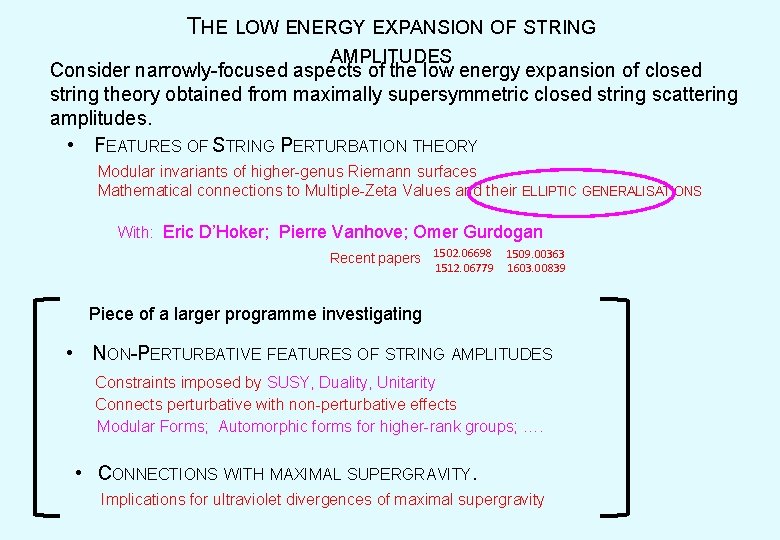
THE LOW ENERGY EXPANSION OF STRING AMPLITUDES Consider narrowly-focused aspects of the low energy expansion of closed string theory obtained from maximally supersymmetric closed string scattering amplitudes. • FEATURES OF STRING PERTURBATION THEORY Modular invariants of higher-genus Riemann surfaces Mathematical connections to Multiple-Zeta Values and their ELLIPTIC GENERALISATIONS With: Eric D’Hoker; Pierre Vanhove; Omer Gurdogan Recent papers 1502. 06698 1512. 06779 1509. 00363 1603. 00839 Piece of a larger programme investigating • NON-PERTURBATIVE FEATURES OF STRING AMPLITUDES Constraints imposed by SUSY, Duality, Unitarity Connects perturbative with non-perturbative effects Modular Forms; Automorphic forms for higher-rank groups; …. • CONNECTIONS WITH MAXIMAL SUPERGRAVITY. Implications for ultraviolet divergences of maximal supergravity
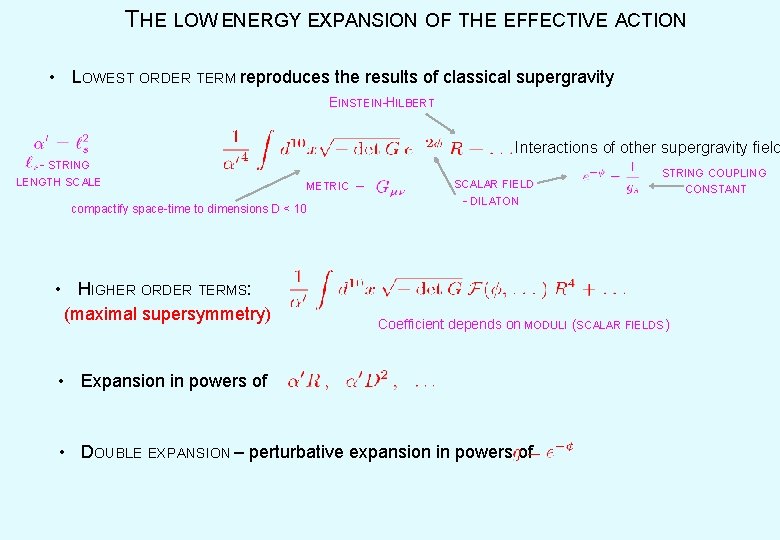
THE LOW ENERGY EXPANSION OF THE EFFECTIVE ACTION • LOWEST ORDER TERM reproduces the results of classical supergravity EINSTEIN-HILBERT Interactions of other supergravity field - STRING LENGTH SCALE METRIC compactify space-time to dimensions D < 10 • HIGHER ORDER TERMS: (maximal supersymmetry) – SCALAR FIELD STRING COUPLING - DILATON Coefficient depends on MODULI (SCALAR FIELDS) • Expansion in powers of • DOUBLE EXPANSION – perturbative expansion in powers of CONSTANT
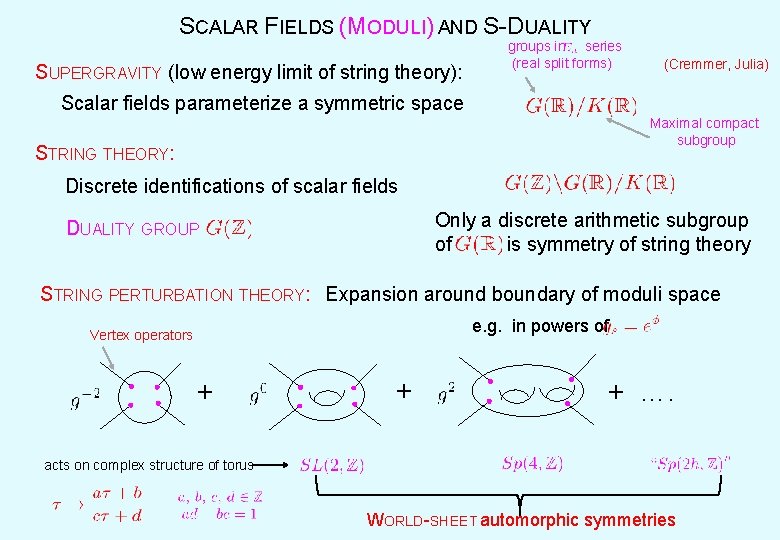
SCALAR FIELDS (MODULI) AND S-DUALITY SUPERGRAVITY (low energy limit of string theory): groups in series (real split forms) (Cremmer, Julia) Scalar fields parameterize a symmetric space Maximal compact subgroup STRING THEORY: Discrete identifications of scalar fields Only a discrete arithmetic subgroup of is symmetry of string theory DUALITY GROUP STRING PERTURBATION THEORY: Expansion around boundary of moduli space e. g. in powers of Vertex operators + + + …. acts on complex structure of torus WORLD-SHEET automorphic symmetries
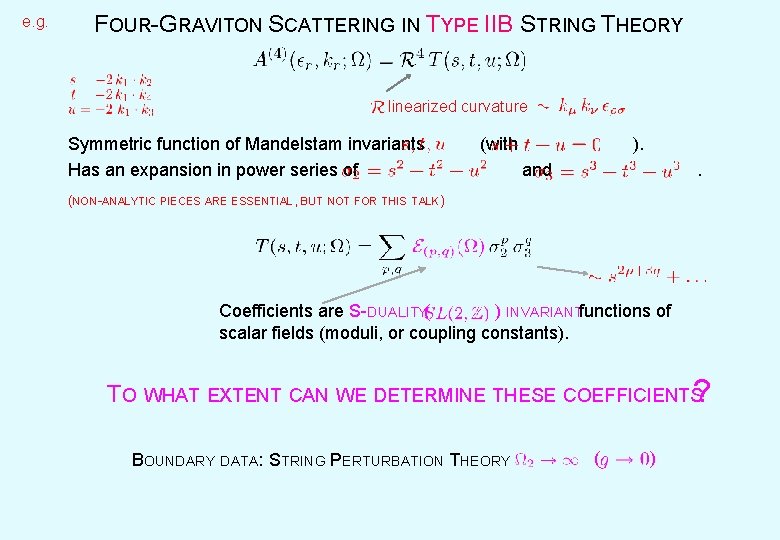
e. g. FOUR-GRAVITON SCATTERING IN TYPE IIB STRING THEORY linearized curvature Symmetric function of Mandelstam invariants Has an expansion in power series of (with ). and . (NON-ANALYTIC PIECES ARE ESSENTIAL, BUT NOT FOR THIS TALK) Coefficients are S-DUALITY( ) INVARIANTfunctions of scalar fields (moduli, or coupling constants). TO WHAT EXTENT CAN WE DETERMINE THESE COEFFICIENTS? BOUNDARY DATA: STRING PERTURBATION THEORY ( )
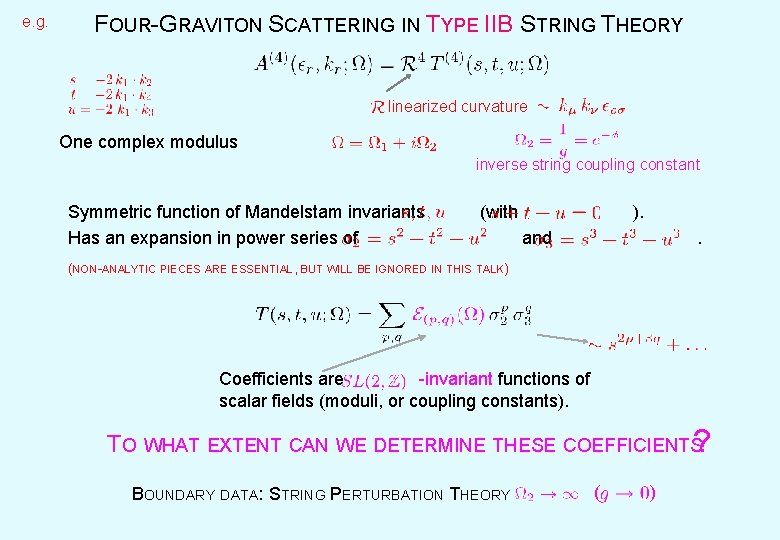
e. g. FOUR-GRAVITON SCATTERING IN TYPE IIB STRING THEORY linearized curvature One complex modulus inverse string coupling constant Symmetric function of Mandelstam invariants Has an expansion in power series of (with ). and . (NON-ANALYTIC PIECES ARE ESSENTIAL, BUT WILL BE IGNORED IN THIS TALK) Coefficients are -invariant functions of scalar fields (moduli, or coupling constants). TO WHAT EXTENT CAN WE DETERMINE THESE COEFFICIENTS? BOUNDARY DATA: STRING PERTURBATION THEORY ( )
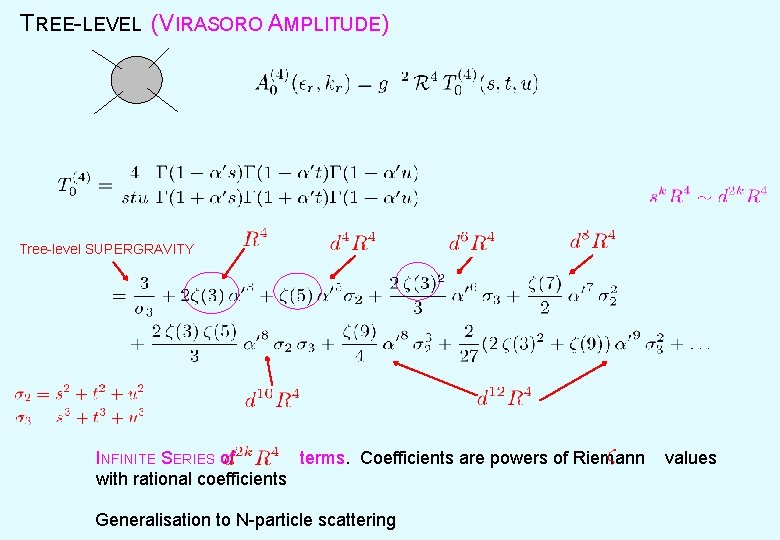
TREE-LEVEL (VIRASORO AMPLITUDE) Tree-level SUPERGRAVITY INFINITE SERIES of terms. Coefficients are powers of Riemann with rational coefficients Generalisation to N-particle scattering values
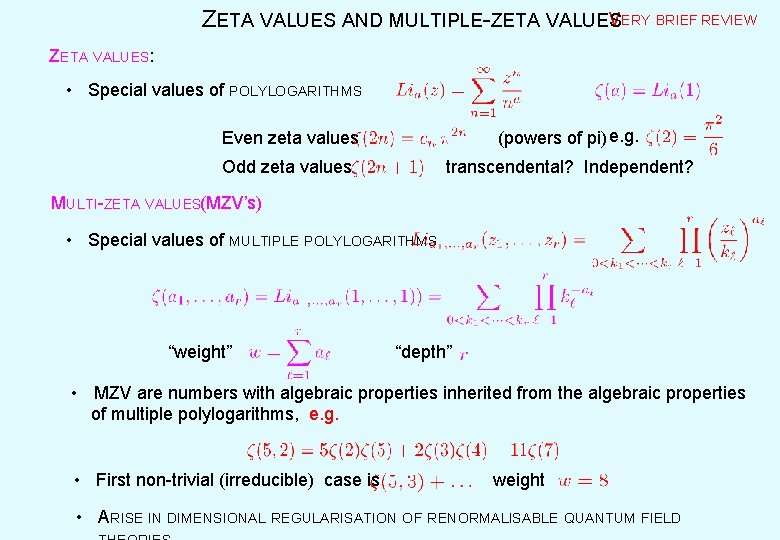
VERY BRIEF REVIEW ZETA VALUES AND MULTIPLE-ZETA VALUES: • Special values of POLYLOGARITHMS Even zeta values (powers of pi) e. g. Odd zeta values transcendental? Independent? MULTI-ZETA VALUES(MZV’s) • Special values of MULTIPLE POLYLOGARITHMS “weight” “depth” • MZV are numbers with algebraic properties inherited from the algebraic properties of multiple polylogarithms, e. g. • First non-trivial (irreducible) case is weight • ARISE IN DIMENSIONAL REGULARISATION OF RENORMALISABLE QUANTUM FIELD
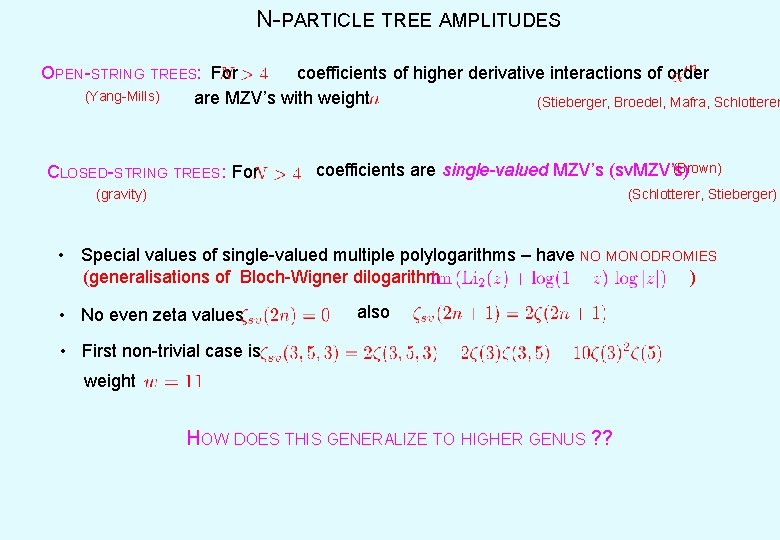
N-PARTICLE TREE AMPLITUDES OPEN-STRING TREES: For coefficients of higher derivative interactions of order (Yang-Mills) are MZV’s with weight (Stieberger, Broedel, Mafra, Schlotterer CLOSED-STRING TREES: For (Brown) coefficients are single-valued MZV’s (sv. MZV’s) (Schlotterer, Stieberger) (gravity) • Special values of single-valued multiple polylogarithms – have NO MONODROMIES (generalisations of Bloch-Wigner dilogarithm ) • No even zeta values also • First non-trivial case is weight HOW DOES THIS GENERALIZE TO HIGHER GENUS ? ?
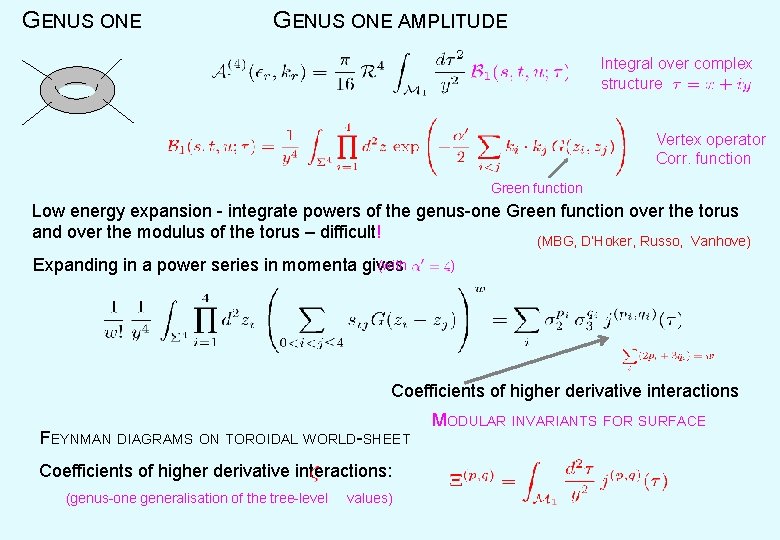
GENUS ONE AMPLITUDE Integral over complex structure Vertex operator Corr. function Green function Low energy expansion - integrate powers of the genus-one Green function over the torus and over the modulus of the torus – difficult! (MBG, D’Hoker, Russo, Vanhove) (with Expanding in a power series in momenta gives ) Coefficients of higher derivative interactions FEYNMAN DIAGRAMS ON TOROIDAL WORLD-SHEET Coefficients of higher derivative interactions: (genus-one generalisation of the tree-level values) MODULAR INVARIANTS FOR SURFACE
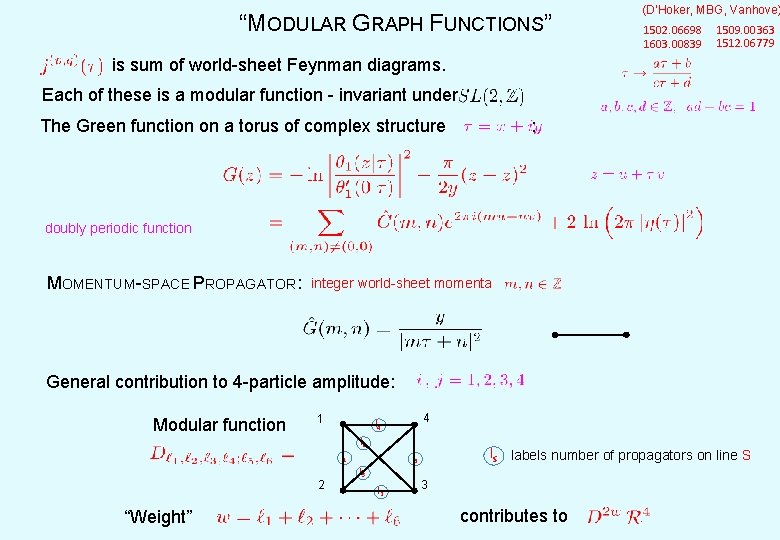
“MODULAR GRAPH FUNCTIONS” (D’Hoker, MBG, Vanhove) 1502. 06698 1603. 00839 1509. 00363 1512. 06779 is sum of world-sheet Feynman diagrams. Each of these is a modular function - invariant under The Green function on a torus of complex structure : doubly periodic function MOMENTUM-SPACE PROPAGATOR: integer world-sheet momenta General contribution to 4 -particle amplitude: Modular function 1 4 l 6 l 1 2 “Weight” l. S labels number of propagators on line S l 3 l 5 l 2 3 contributes to
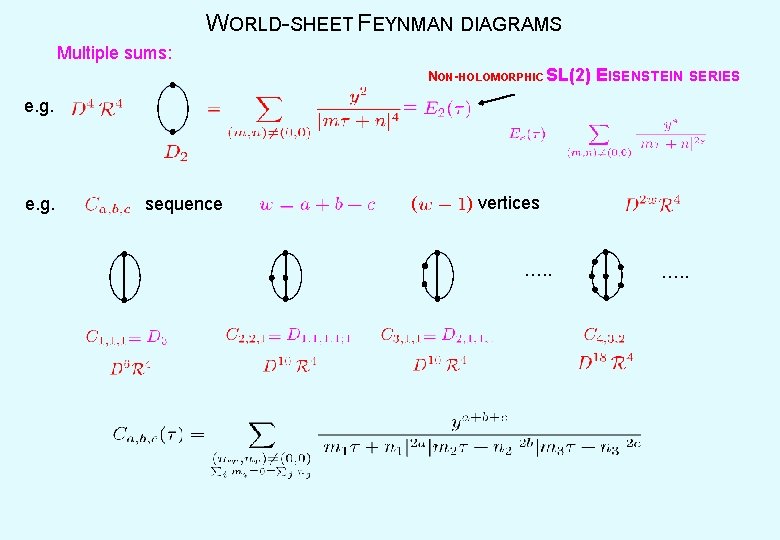
WORLD-SHEET FEYNMAN DIAGRAMS Multiple sums: NON-HOLOMORPHIC SL(2) EISENSTEIN SERIES e. g. sequence ( ) vertices …. .
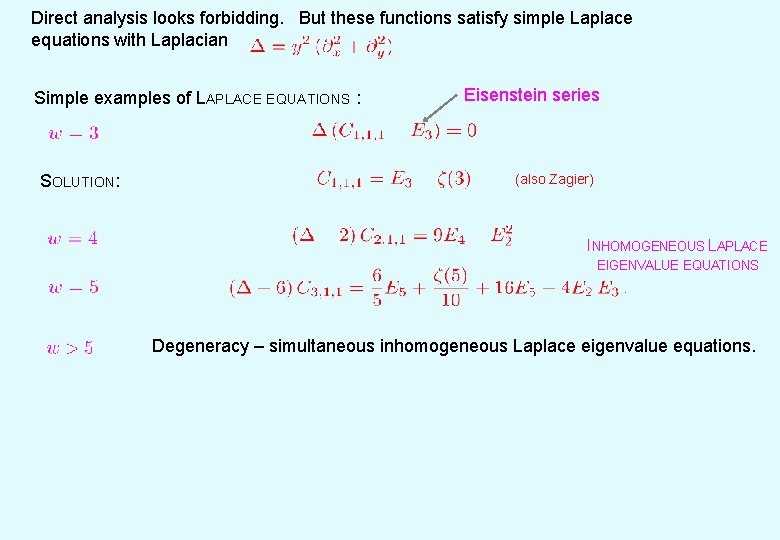
Direct analysis looks forbidding. But these functions satisfy simple Laplace equations with Laplacian Simple examples of LAPLACE EQUATIONS : SOLUTION: Eisenstein series (also Zagier) INHOMOGENEOUS LAPLACE EIGENVALUE EQUATIONS Degeneracy – simultaneous inhomogeneous Laplace eigenvalue equations.
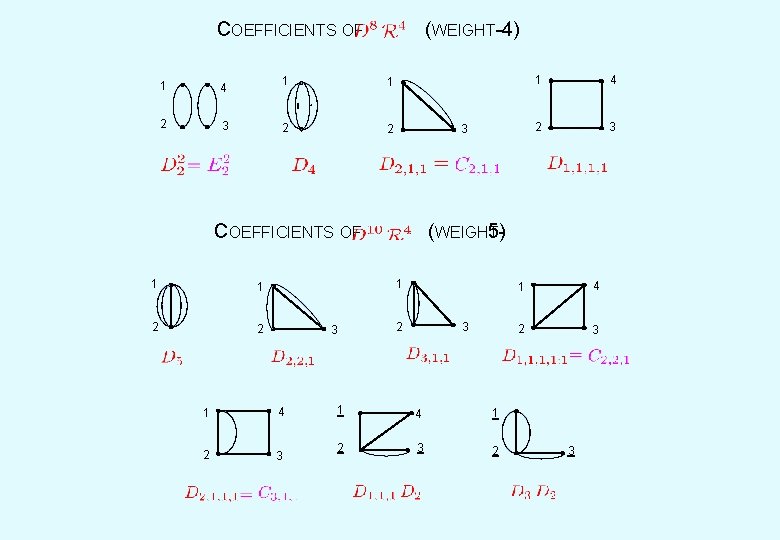
COEFFICIENTS OF 4 2 3 1 1 1 4 2 3 ` 1 (WEIGHT-4) 2 2 3 COEFFICIENTS OF 1 1 2 2 (WEIGHT 5)1 3 1 4 2 3 1 4 1 2 3 2 1 4 2 3 3
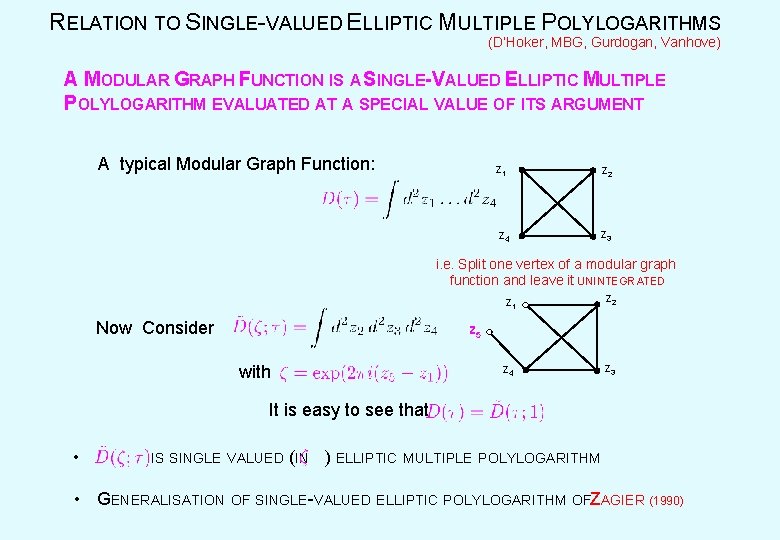
RELATION TO SINGLE-VALUED ELLIPTIC MULTIPLE POLYLOGARITHMS (D’Hoker, MBG, Gurdogan, Vanhove) A MODULAR GRAPH FUNCTION IS A SINGLE-VALUED ELLIPTIC MULTIPLE POLYLOGARITHM EVALUATED AT A SPECIAL VALUE OF ITS ARGUMENT A typical Modular Graph Function: z 1 z 2 z 4 z 3 i. e. Split one vertex of a modular graph function and leave it UNINTEGRATED Now Consider z 1 z 2 z 4 z 3 z 5 with It is easy to see that • IS SINGLE VALUED (IN ) ELLIPTIC MULTIPLE POLYLOGARITHM • GENERALISATION OF SINGLE-VALUED ELLIPTIC POLYLOGARITHM OFZAGIER (1990)
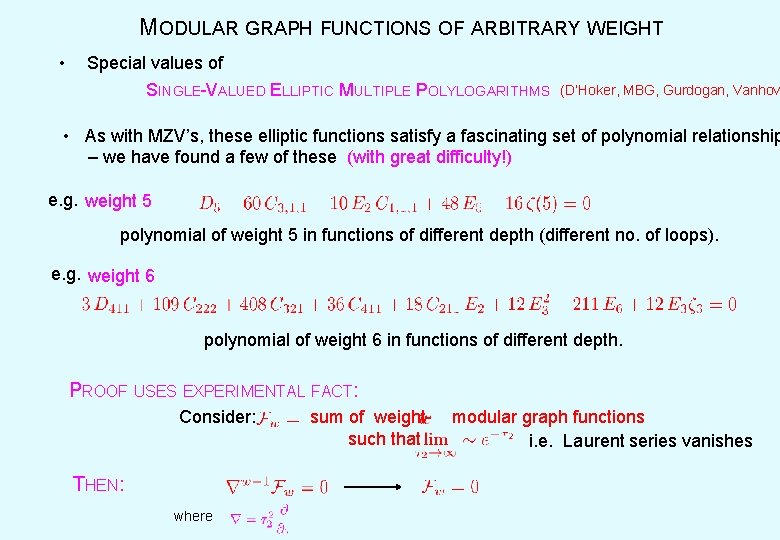
MODULAR GRAPH FUNCTIONS OF ARBITRARY WEIGHT • Special values of SINGLE-VALUED ELLIPTIC MULTIPLE POLYLOGARITHMS (D’Hoker, MBG, Gurdogan, Vanhov • As with MZV’s, these elliptic functions satisfy a fascinating set of polynomial relationship – we have found a few of these (with great difficulty!) e. g. weight 5 polynomial of weight 5 in functions of different depth (different no. of loops). e. g. weight 6 polynomial of weight 6 in functions of different depth. PROOF USES EXPERIMENTAL FACT: Consider: THEN: where sum of weightsuch that modular graph functions i. e. Laurent series vanishes
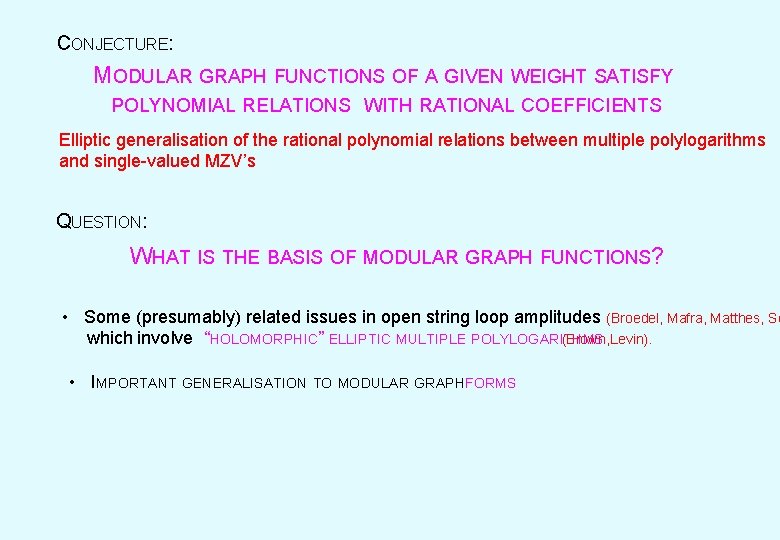
CONJECTURE: MODULAR GRAPH FUNCTIONS OF A GIVEN WEIGHT SATISFY POLYNOMIAL RELATIONS WITH RATIONAL COEFFICIENTS Elliptic generalisation of the rational polynomial relations between multiple polylogarithms and single-valued MZV’s QUESTION: WHAT IS THE BASIS OF MODULAR GRAPH FUNCTIONS? • Some (presumably) related issues in open string loop amplitudes (Broedel, Mafra, Matthes, Sc which involve “HOLOMORPHIC” ELLIPTIC MULTIPLE POLYLOGARITHMS (Brown, Levin). • IMPORTANT GENERALISATION TO MODULAR GRAPHFORMS
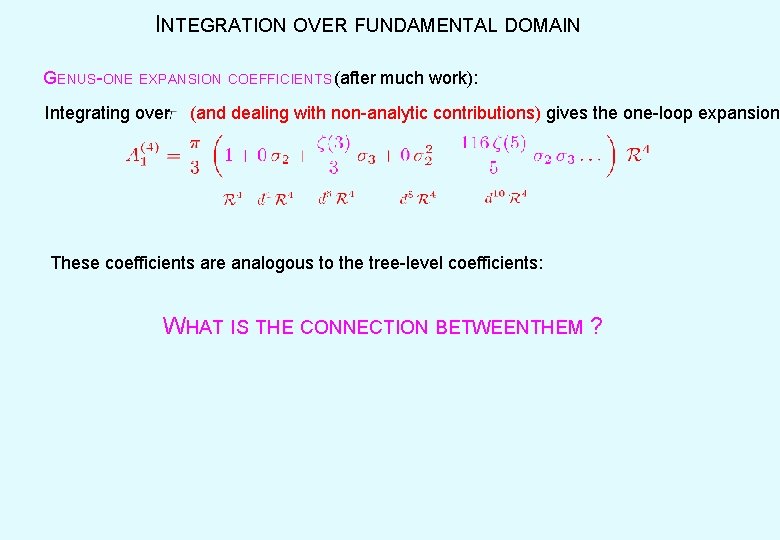
INTEGRATION OVER FUNDAMENTAL DOMAIN GENUS-ONE EXPANSION COEFFICIENTS (after much work): Integrating over (and dealing with non-analytic contributions) gives the one-loop expansion These coefficients are analogous to the tree-level coefficients: WHAT IS THE CONNECTION BETWEENTHEM ?
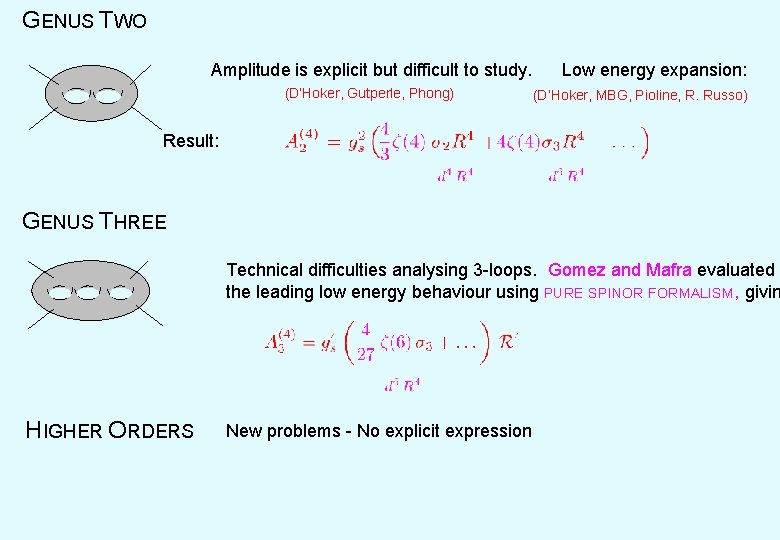
GENUS TWO Amplitude is explicit but difficult to study. (D’Hoker, Gutperle, Phong) Low energy expansion: (D’Hoker, MBG, Pioline, R. Russo) Result: GENUS THREE Technical difficulties analysing 3 -loops. Gomez and Mafra evaluated the leading low energy behaviour using PURE SPINOR FORMALISM, givin HIGHER ORDERS New problems - No explicit expression
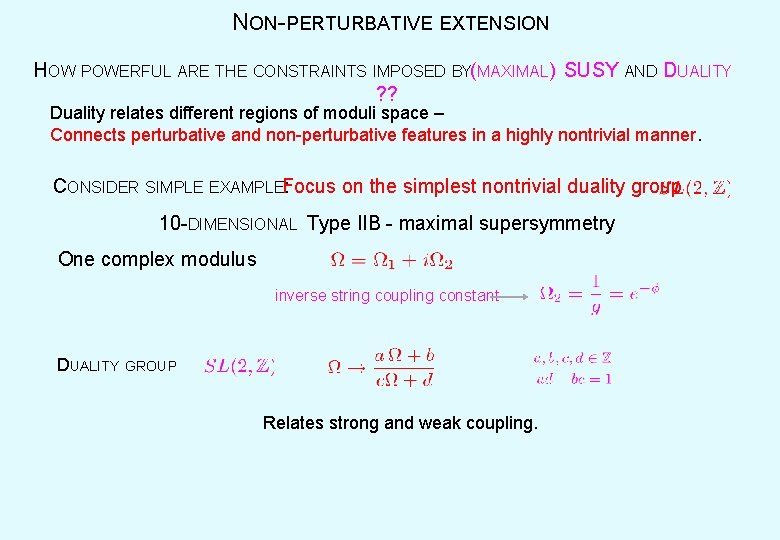
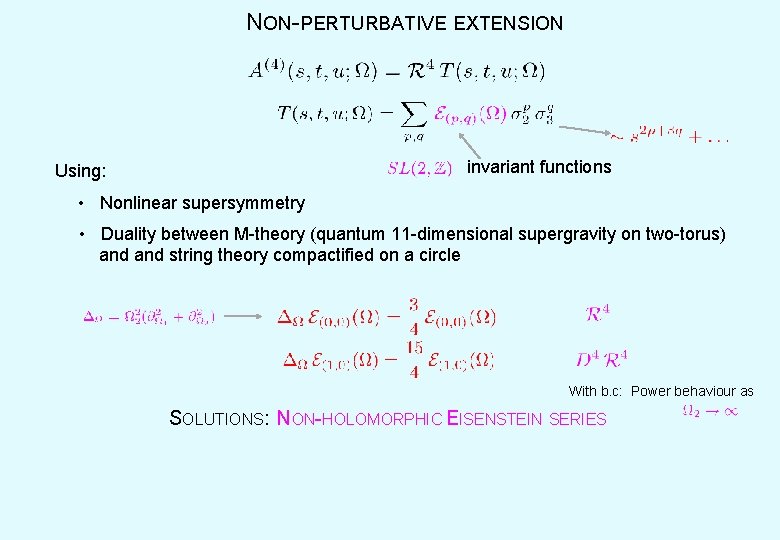
NON-PERTURBATIVE EXTENSION HOW POWERFUL ARE THE CONSTRAINTS IMPOSED BY(MAXIMAL) SUSY AND DUALITY ? ? Duality relates different regions of moduli space – Connects perturbative and non-perturbative features in a highly nontrivial manner. CONSIDER SIMPLE EXAMPLEFocus : on the simplest nontrivial duality group 10 -DIMENSIONAL Type IIB - maximal supersymmetry One complex modulus inverse string coupling constant DUALITY GROUP Relates strong and weak coupling.
NON-PERTURBATIVE EXTENSION invariant functions Using: • Nonlinear supersymmetry • Duality between M-theory (quantum 11 -dimensional supergravity on two-torus) and string theory compactified on a circle With b. c: Power behaviour as SOLUTIONS: NON-HOLOMORPHIC EISENSTEIN SERIES
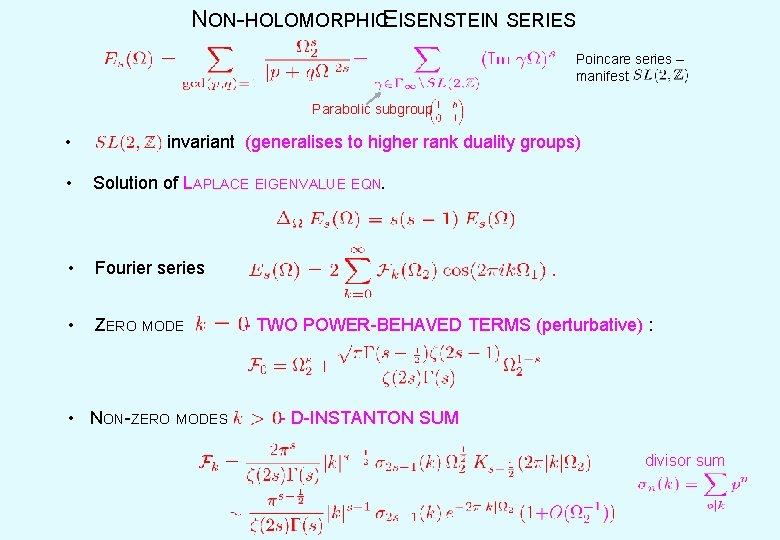
NON-HOLOMORPHICEISENSTEIN SERIES Poincare series – manifest Parabolic subgroup • invariant (generalises to higher rank duality groups) • Solution of LAPLACE EIGENVALUE EQN. • Fourier series • ZERO MODE • NON-ZERO MODES - TWO POWER-BEHAVED TERMS (perturbative) : - D-INSTANTON SUM divisor sum
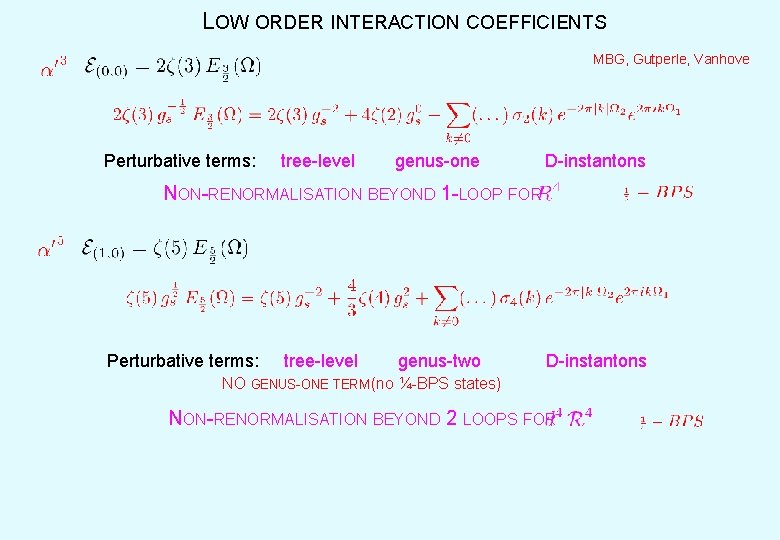
LOW ORDER INTERACTION COEFFICIENTS MBG, Gutperle, Vanhove Perturbative terms: tree-level genus-one D-instantons NON-RENORMALISATION BEYOND 1 -LOOP FOR Perturbative terms: tree-level genus-two D-instantons NO GENUS-ONE TERM (no ¼-BPS states) NON-RENORMALISATION BEYOND 2 LOOPS FOR
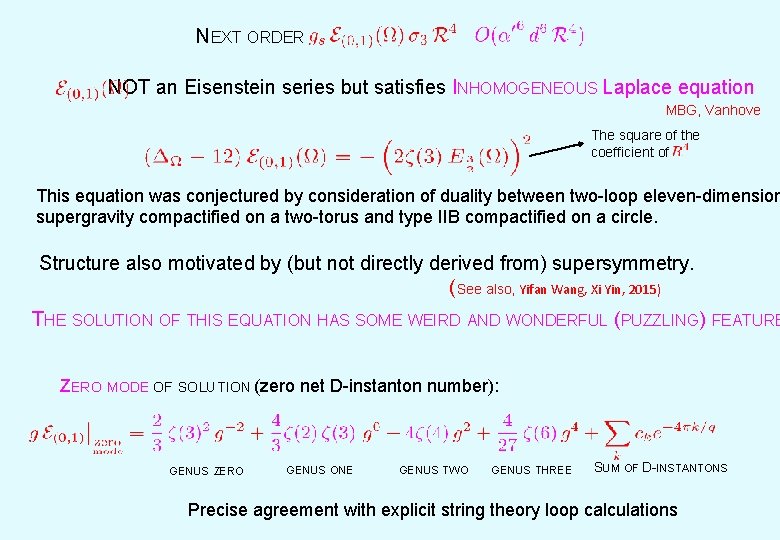
NEXT ORDER NOT an Eisenstein series but satisfies INHOMOGENEOUS Laplace equation MBG, Vanhove The square of the coefficient of This equation was conjectured by consideration of duality between two-loop eleven-dimension supergravity compactified on a two-torus and type IIB compactified on a circle. Structure also motivated by (but not directly derived from) supersymmetry. ( See also, Yifan Wang, Xi Yin, 2015) THE SOLUTION OF THIS EQUATION HAS SOME WEIRD AND WONDERFUL (PUZZLING) FEATURE ZERO MODE OF SOLUTION (zero net D-instanton number): GENUS ZERO GENUS ONE GENUS TWO GENUS THREE SUM OF D-INSTANTONS Precise agreement with explicit string theory loop calculations
A FANTASY CONCERNING UV PROPERTIES OF SUPERGRAVITY The coefficients of the UV divergences in maximal supergravity up to 3 loops in various dimensions > 4 are precisely reproduced by log terms in modular coefficients. More Generally: To WHAT EXTENT DO STRING THEORY DUALITIES CONSTRAIN THE STRUCTURE OF PERTURBATIVE SUPERGRAVITY? – ULTRAVIOLET DIVERGENCES? ? FANTASY: SUPERSTRING PERTURBATION THEORY IS FREE OFUV DIVERGENCES. CAN WE UNDERSTA THE UV PROPERTIES OF SUPERGRAVITY BY CAREFUL CONSIDERATION OF THE LOW ENER LIMIT OF STRING THEORY?