
Some hints for exam preparation Go through section
- Slides: 7
Some hints for exam preparation • • • Go through section 2 lecture notes “Key Concepts” and make sure you understand these in a precise way (check if you are able to describe an equation in your own words) – Many of these are contrary to every day language and pre-conceptions you got in high school – If you have difficulty, read the relevant sections in the book again, or/and your lecture notes Prepare a smart equation sheet – Group equations by classes of problems – Focus on basic equations, not the equations for a specific problem – Develop your equation sheets throughout the course. Prepare a set of equations before you do homework and then check whether this set is sufficient for you (and expand accordingly) – If you haven’t done this start now, prior to exam preparation Practice with fresh problems and do them completely on your own – Use your equation sheet – this is a good test for whether you have a good equation sheet – Do only get help if you are really stuck – If you need help try a new problem on the same topic until you can do problems on your own – A problem you did before is spoiled. Redoing old problems is ok, but in addition you should check whether you can do a fresh problem on the same topic without help. 9/8/2021 Physics 231 Spring 2011 1
Practice problem solving strategy 1. Make a drawing (for some problems a initial and final drawing is helpful, for others draw the object at different locations in the same drawing) 2. Introduce a coordinate system and chose t=0 situation 3. Give names (letters) to all relevant lengths, times, forces, energies and put them into the drawing. For motion do this at all critical points of the motion. 4. Classify the problem (so far we had: 1 D Motion, 2 D Motion, Projectile Motion, Energy, Power, Forceacceleration, Force-acceleration for connected masses, Equilibrium) - can be more than one class 5. Write down the general equations for this class of problems For some classes of problems there are specific approaches – examples: • 2 D motion/projectile motion: setup equations for x- and y-motion separately • Force-acceleration: separate free body force diagram for all masses involved, each diagram gives an equation (or 2 in xand y-direction) • Equilibrium: free body force diagram for all critical points (each diagram gives 2 equations, one in x and one in y direction) 6. Adapt the equations to the specifics of the problem 7. Mark knowns and unknowns 8. Develop a strategy to get from the knowns to the unknowns 9. Execute that strategy, ideally using algebra without numbers 10. Convert all quantities in mks units and plug in numbers 9/8/2021 Physics 231 Spring 2011 2
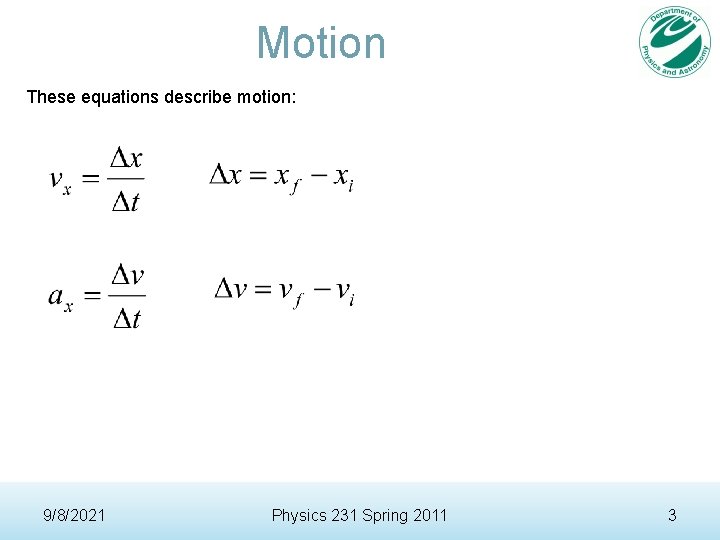
Motion These equations describe motion: 9/8/2021 Physics 231 Spring 2011 3
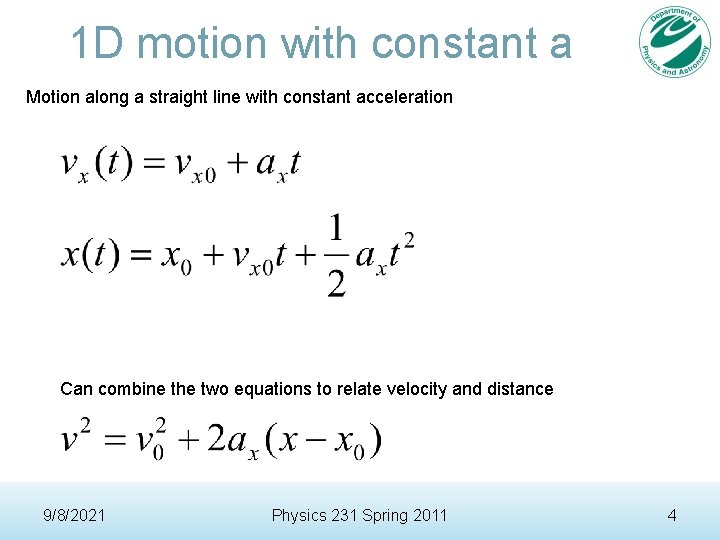
1 D motion with constant a Motion along a straight line with constant acceleration Can combine the two equations to relate velocity and distance 9/8/2021 Physics 231 Spring 2011 4
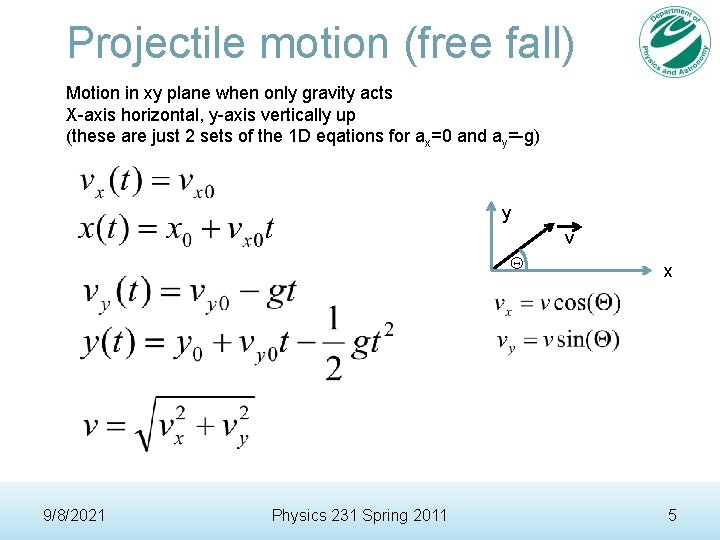
Projectile motion (free fall) Motion in xy plane when only gravity acts X-axis horizontal, y-axis vertically up (these are just 2 sets of the 1 D eqations for ax=0 and ay=-g) y v Q 9/8/2021 Physics 231 Spring 2011 x 5
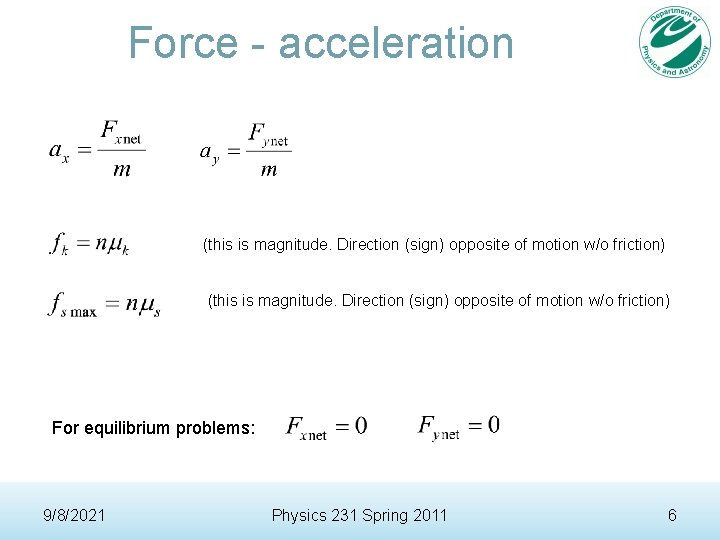
Force - acceleration (this is magnitude. Direction (sign) opposite of motion w/o friction) For equilibrium problems: 9/8/2021 Physics 231 Spring 2011 6
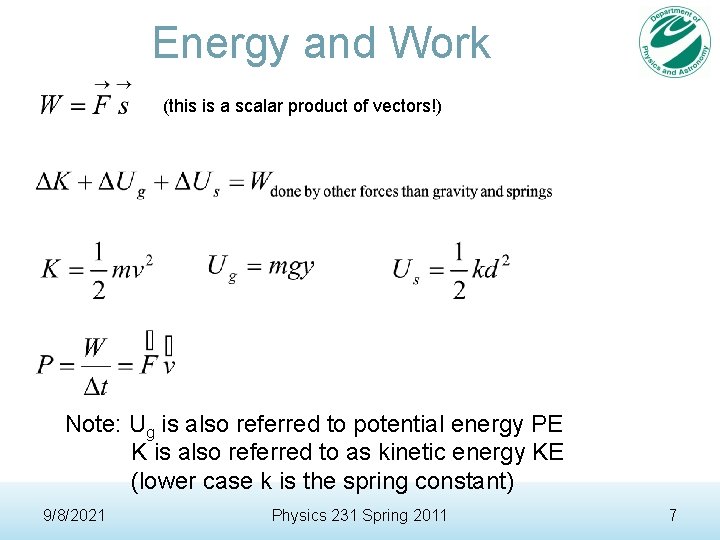
Energy and Work (this is a scalar product of vectors!) Note: Ug is also referred to potential energy PE K is also referred to as kinetic energy KE (lower case k is the spring constant) 9/8/2021 Physics 231 Spring 2011 7