
Some Fundamentals of Doppler Radar Velocity Analysis L

- Slides: 44
Some Fundamentals of Doppler Radar Velocity Analysis L. Jay Miller (May 2011) Data Preparation and Gridding for Wind Synthesis Using REORDER, SPRINT, and CEDRIC PROGRAMS
TRADITIONAL FORMULATION Radial velocity is projection of particle motion (u, v, w+Vt) onto radar beam (A, E) at several ranges [Vr = (u*sin. A + v*cos. A)*cos. E + W*sin. E] Map measurements from (R, A, E) to Cartesian (x, y, z) or coplane (r, s, c) analysis domain Correct each radar for fallspeed contribution Vt = a*(Z^b) * (density correction) Solve 2 or 3 equations Vr = Vr(u, v) or Vr(u, v, w) Include mass continuity equation to obtain the vertical air motion Specify boundary conditions (upper and lower)
Considerations before Gridding Develop overview of radar scans in context of research goals Display with SOLOII or CIDD or similar program Select radar(s) to be used in wind synthesis Operations in radar sample space before gridding (asymmetries in pulse volume shape) Preliminary Range-Angle filling and filtering Correct for fall-speed contribution to Vr Formats readable by NCAR gridders REORDER – Universal and Dorade sweep files SPRINT – Older RP 2 -7, Universal, Dorade, and NEXRAD Level II (Build 9, MSG 1; pre-MSG 30)
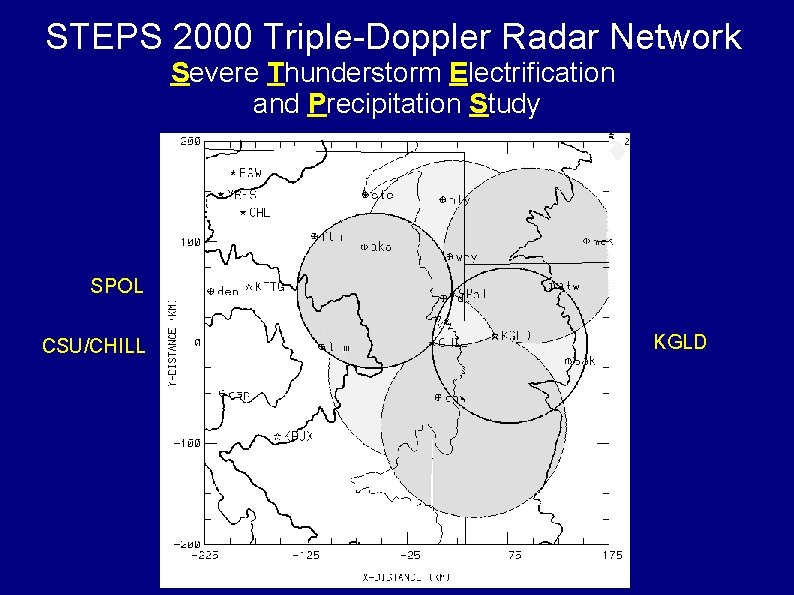
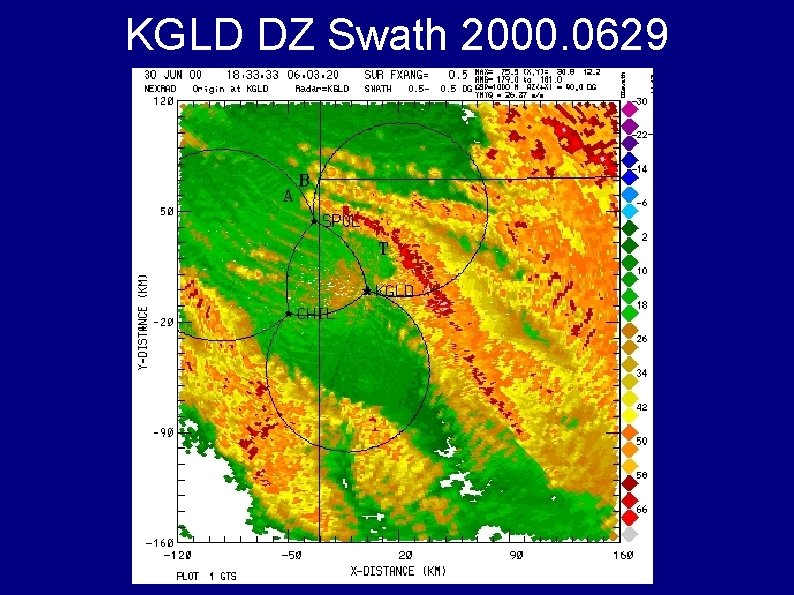
STEPS 2000 Triple-Doppler Radar Network Severe Thunderstorm Electrification and Precipitation Study SPOL CSU/CHILL KGLD
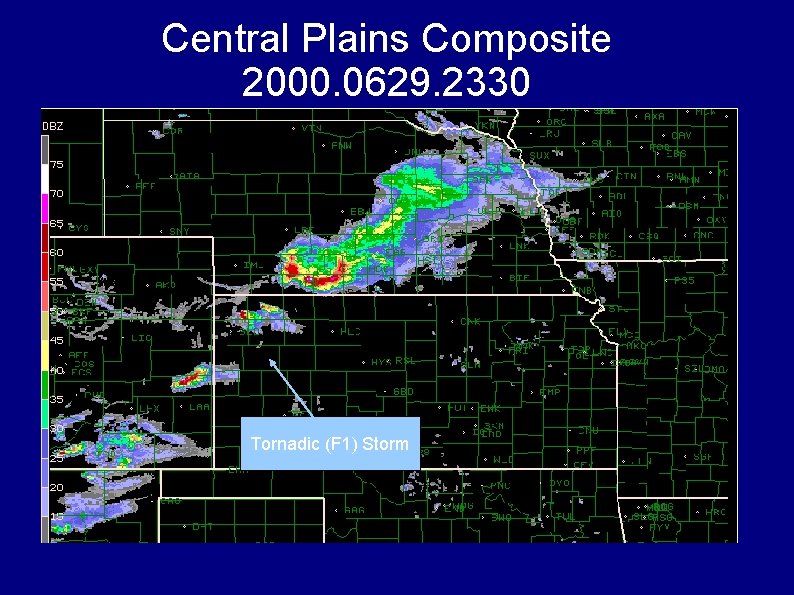
Central Plains Composite 2000. 0629. 2330 Tornadic (F 1) Storm
KGLD DZ Swath 2000. 0629
Considerations for Gridding Identify characteristics of radar scans Azimuth-Elevation angle bounds and increments Range-Height bounds Determine fields to be interpolated Radar measured fields (DZ, VE, SW, …) Ancillary fields (AZ, EL, TIME, …) Determine latitudes, longitudes of origin and radar(s) to obtain their grid locations Decide on output grids common to radars
Considerations for Gridding (cont'd) Issues that control fields to be gridded Degree of space-time overlap of radar scans Types and durations of scans (ppi, rhi, …) Radars (ground-based research, operational, and airborne) CEDRIC formulation of wind synthesis Advection needs time field Airborne needs azimuth and elevation angles Gridder to be used (SPRINT or REORDER)
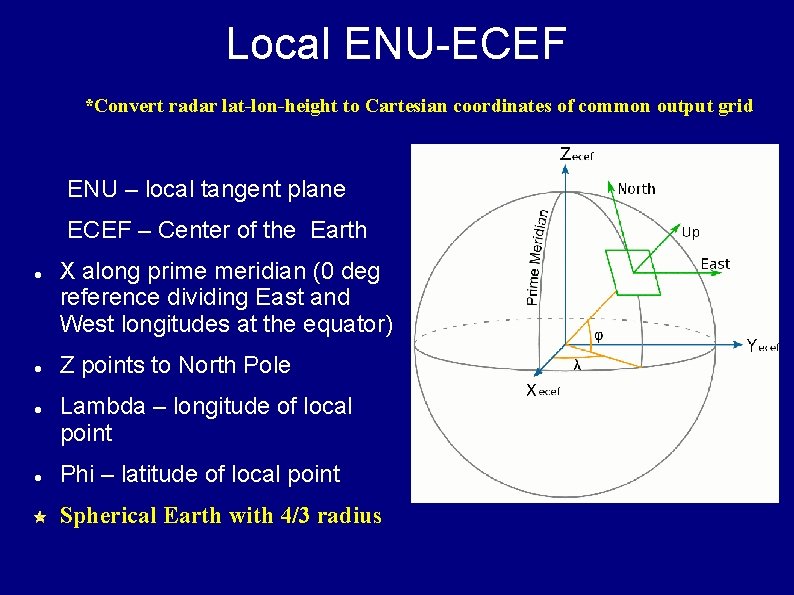
Local ENU-ECEF *Convert radar lat-lon-height to Cartesian coordinates of common output grid ENU – local tangent plane ECEF – Center of the Earth X along prime meridian (0 deg reference dividing East and West longitudes at the equator) Z points to North Pole Lambda – longitude of local point Phi – latitude of local point Spherical Earth with 4/3 radius
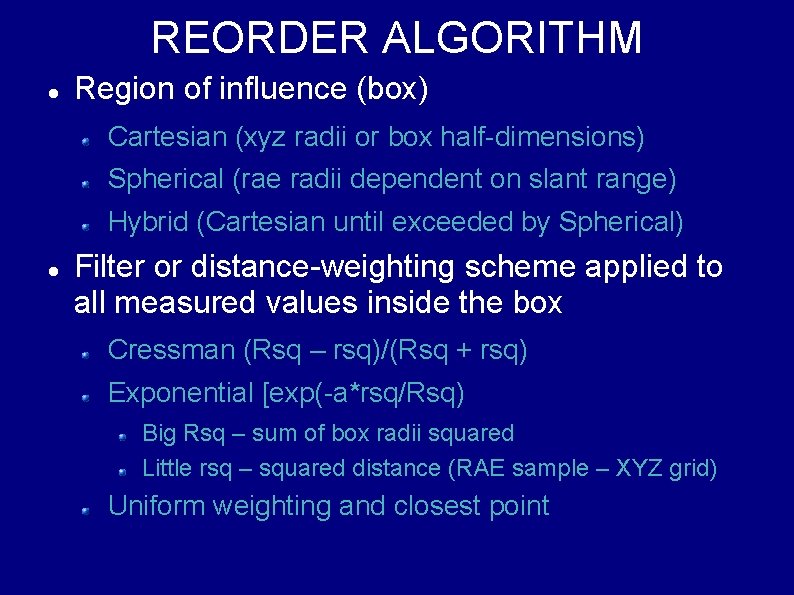
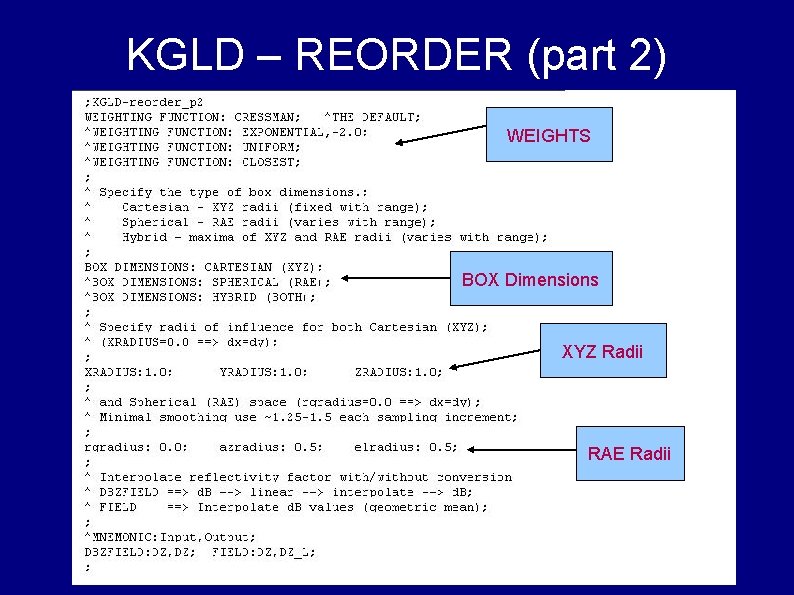
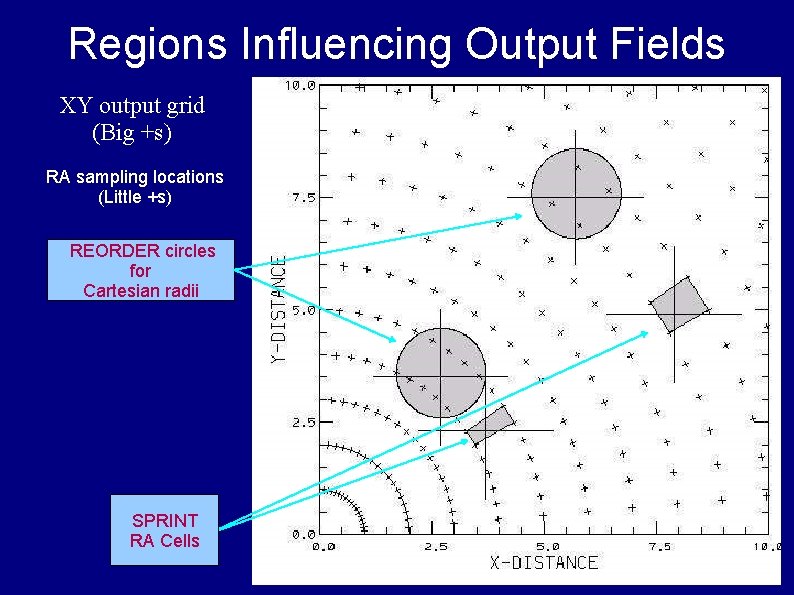
REORDER ALGORITHM Region of influence (box) Cartesian (xyz radii or box half-dimensions) Spherical (rae radii dependent on slant range) Hybrid (Cartesian until exceeded by Spherical) Filter or distance-weighting scheme applied to all measured values inside the box Cressman (Rsq – rsq)/(Rsq + rsq) Exponential [exp(-a*rsq/Rsq) Big Rsq – sum of box radii squared Little rsq – squared distance (RAE sample – XYZ grid) Uniform weighting and closest point
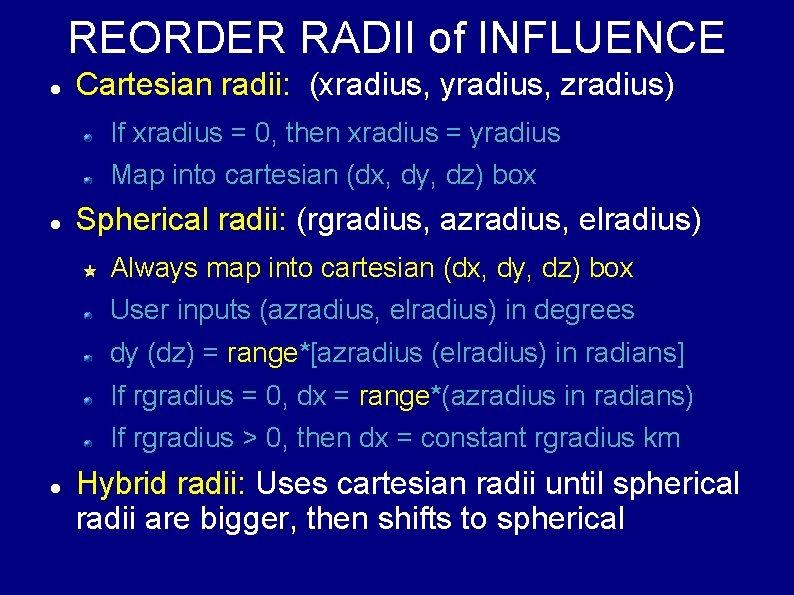
REORDER RADII of INFLUENCE Cartesian radii: (xradius, yradius, zradius) If xradius = 0, then xradius = yradius Map into cartesian (dx, dy, dz) box Spherical radii: (rgradius, azradius, elradius) Always map into cartesian (dx, dy, dz) box User inputs (azradius, elradius) in degrees dy (dz) = range*[azradius (elradius) in radians] If rgradius = 0, dx = range*(azradius in radians) If rgradius > 0, then dx = constant rgradius km Hybrid radii: Uses cartesian radii until spherical radii are bigger, then shifts to spherical
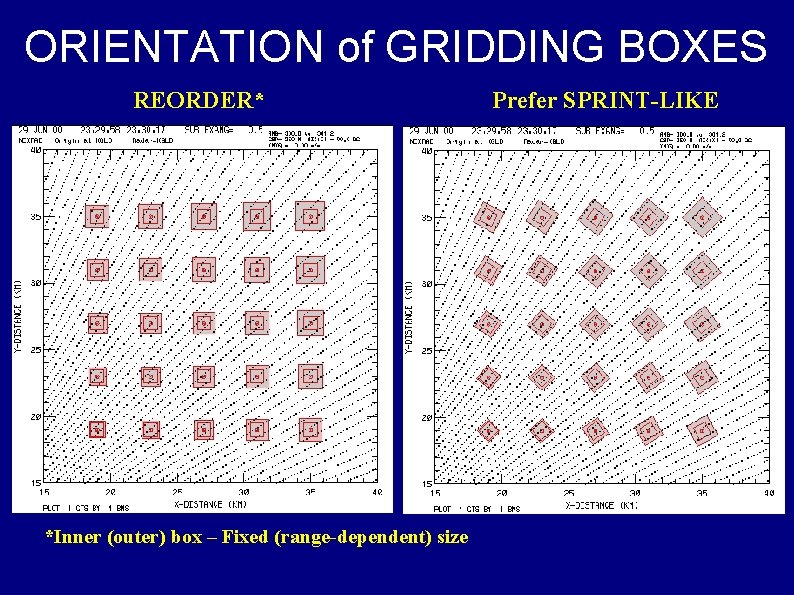
ORIENTATION of GRIDDING BOXES REORDER* *Inner (outer) box – Fixed (range-dependent) size Prefer SPRINT-LIKE
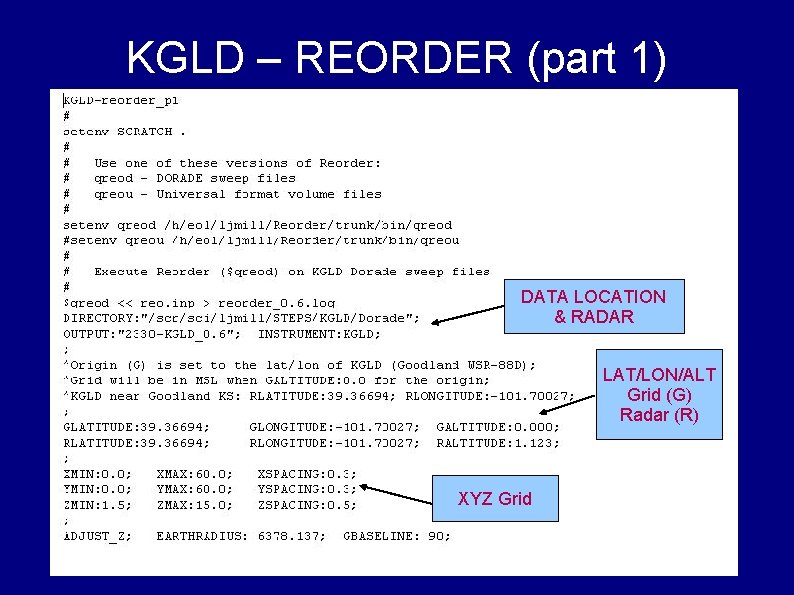
KGLD – REORDER (part 1) DATA LOCATION & RADAR LAT/LON/ALT Grid (G) Radar (R) XYZ Grid
KGLD – REORDER (part 2) WEIGHTS BOX Dimensions XYZ Radii RAE Radii
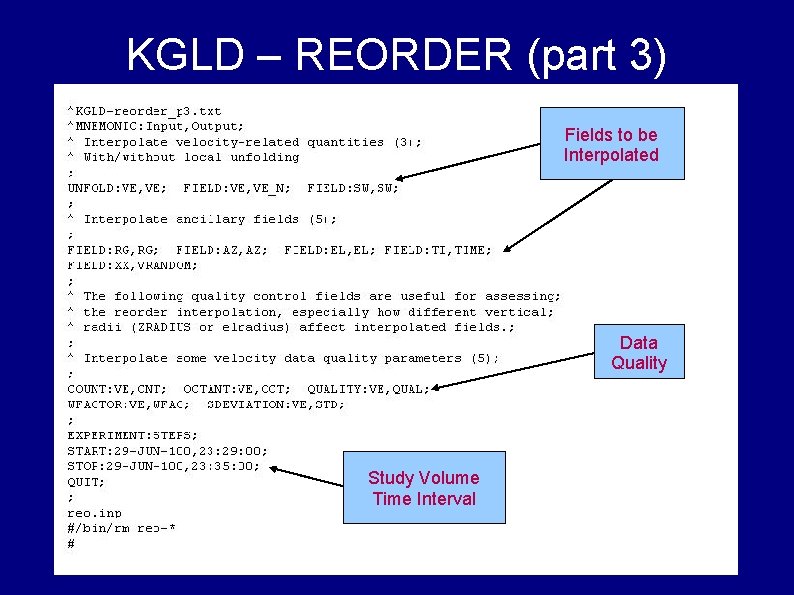
KGLD – REORDER (part 3) Fields to be Interpolated Data Quality Study Volume Time Interval
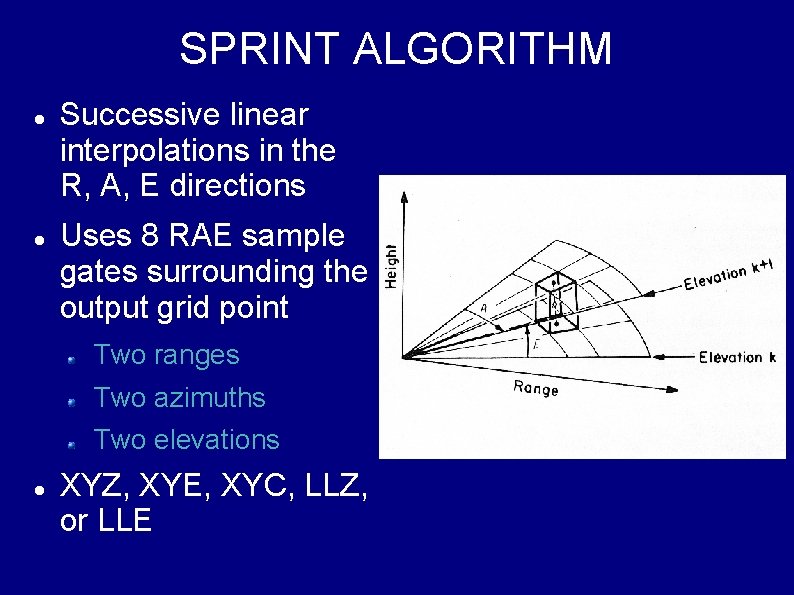
SPRINT ALGORITHM Successive linear interpolations in the R, A, E directions Uses 8 RAE sample gates surrounding the output grid point Two ranges Two azimuths Two elevations XYZ, XYE, XYC, LLZ, or LLE
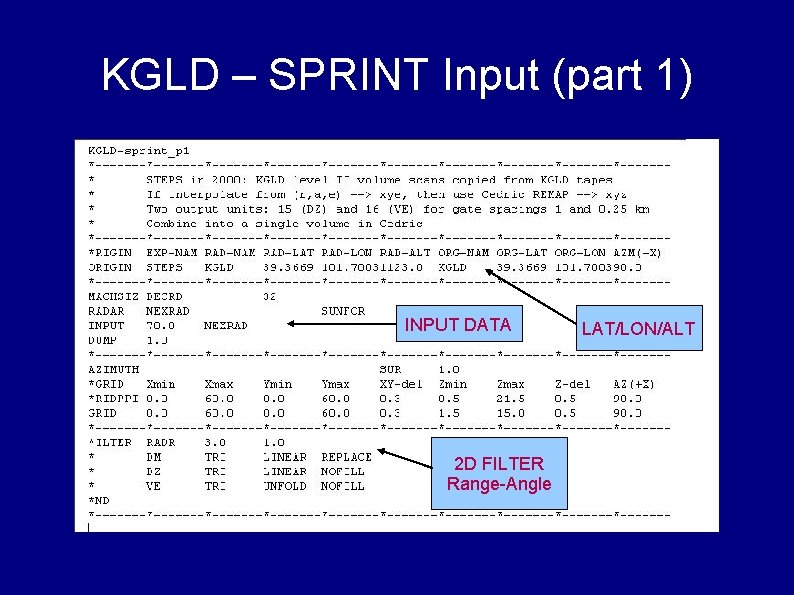
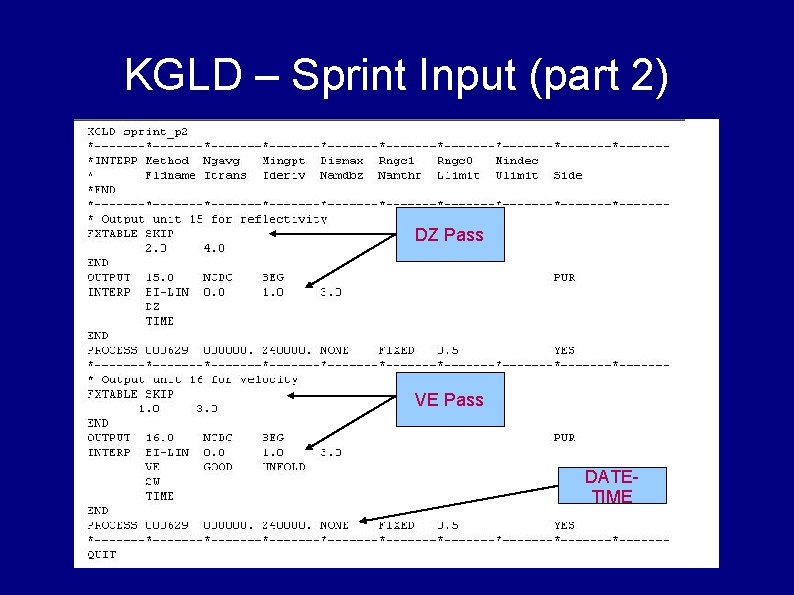
KGLD – SPRINT Input (part 1) INPUT DATA 2 D FILTER Range-Angle LAT/LON/ALT
KGLD – Sprint Input (part 2) DZ Pass VE Pass DATETIME
Regions Influencing Output Fields XY output grid (Big +s) RA sampling locations (Little +s) REORDER circles for Cartesian radii SPRINT RA Cells
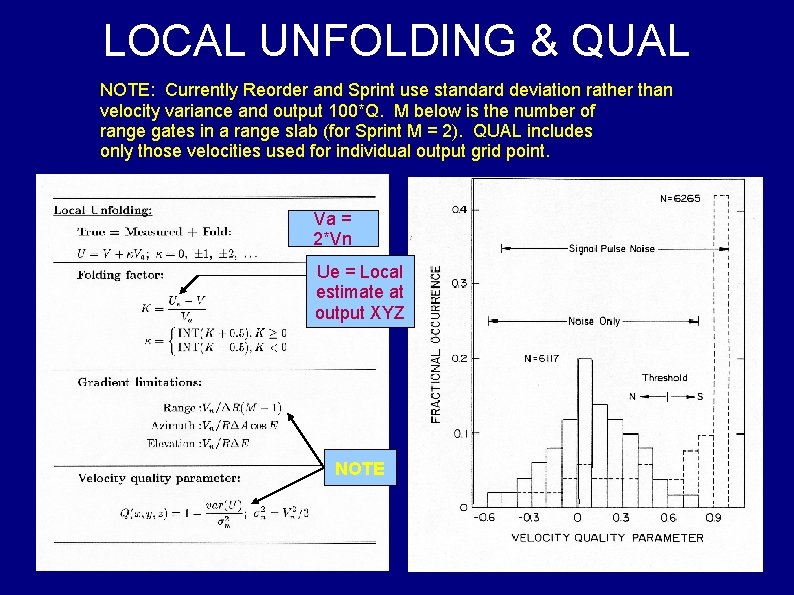
LOCAL UNFOLDING & QUAL NOTE: Currently Reorder and Sprint use standard deviation rather than velocity variance and output 100*Q. M below is the number of range gates in a range slab (for Sprint M = 2). QUAL includes only those velocities used for individual output grid point. Va = 2*Vn Ue = Local estimate at output XYZ NOTE
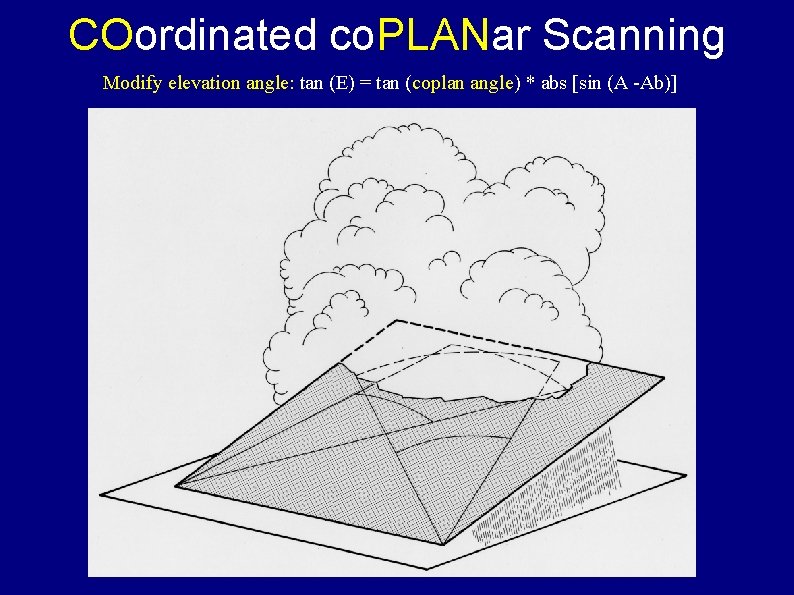
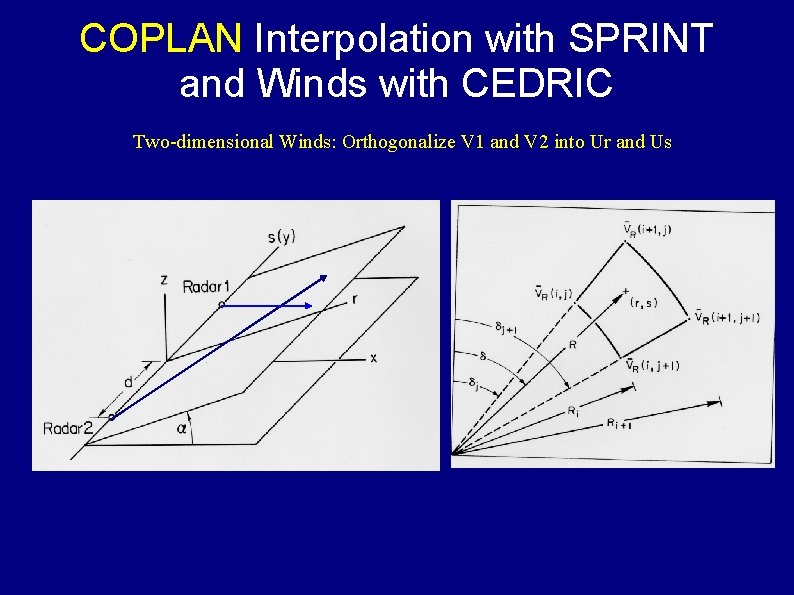
COordinated co. PLANar Scanning Modify elevation angle: tan (E) = tan (coplan angle) * abs [sin (A -Ab)]
COPLAN Interpolation with SPRINT and Winds with CEDRIC Two-dimensional Winds: Orthogonalize V 1 and V 2 into Ur and Us
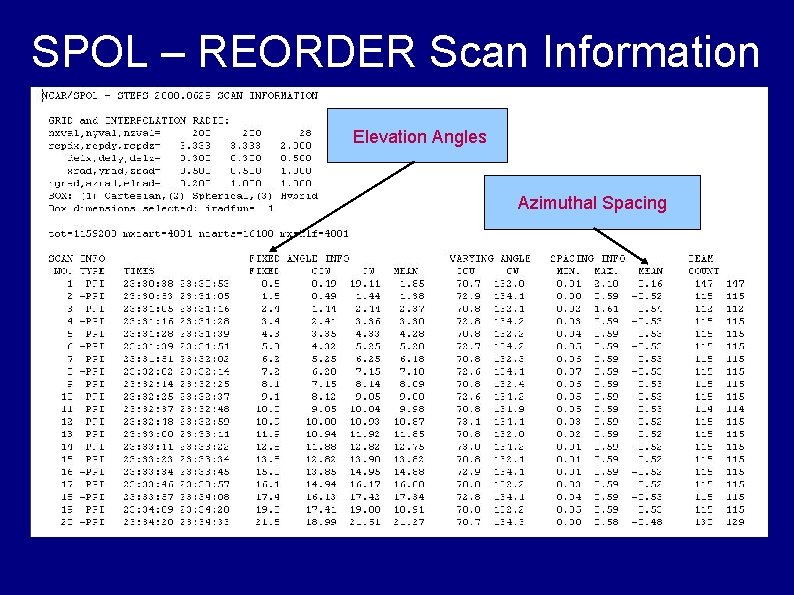
SPOL – REORDER Scan Information Elevation Angles Azimuthal Spacing
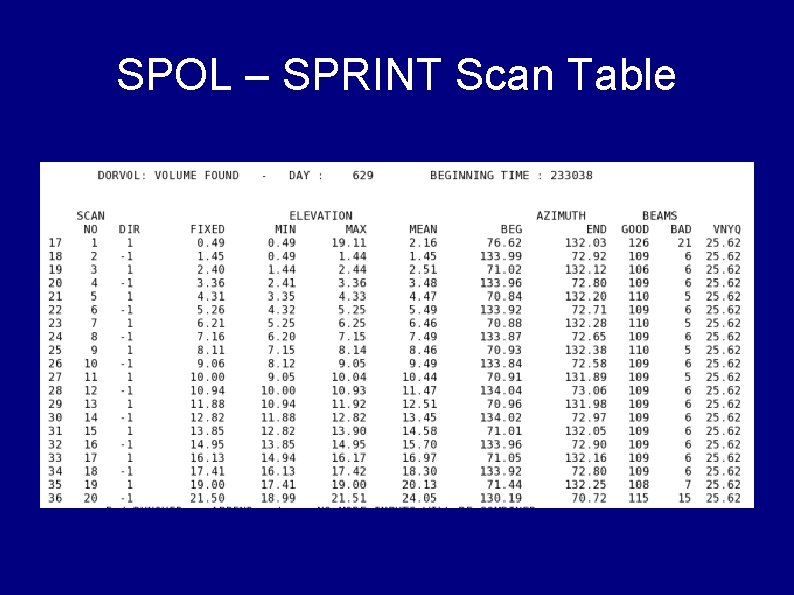
SPOL – SPRINT Scan Table
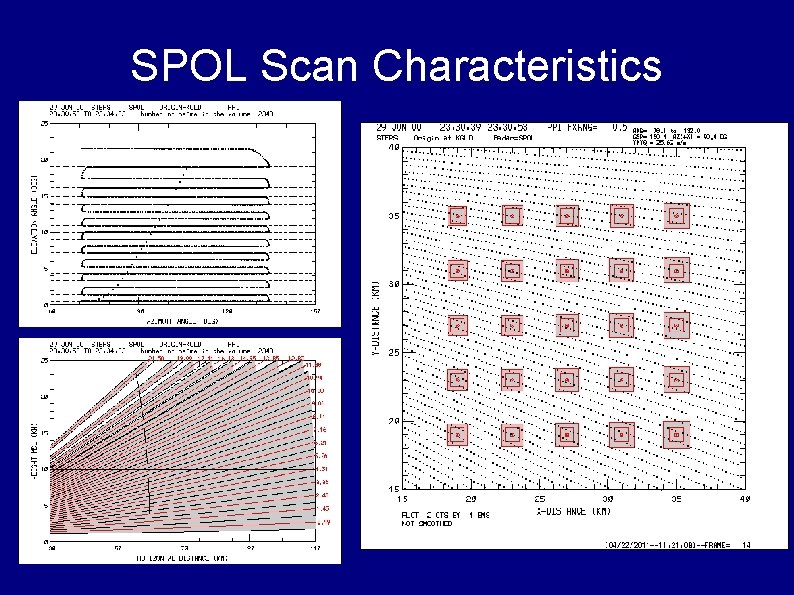
SPOL Scan Characteristics
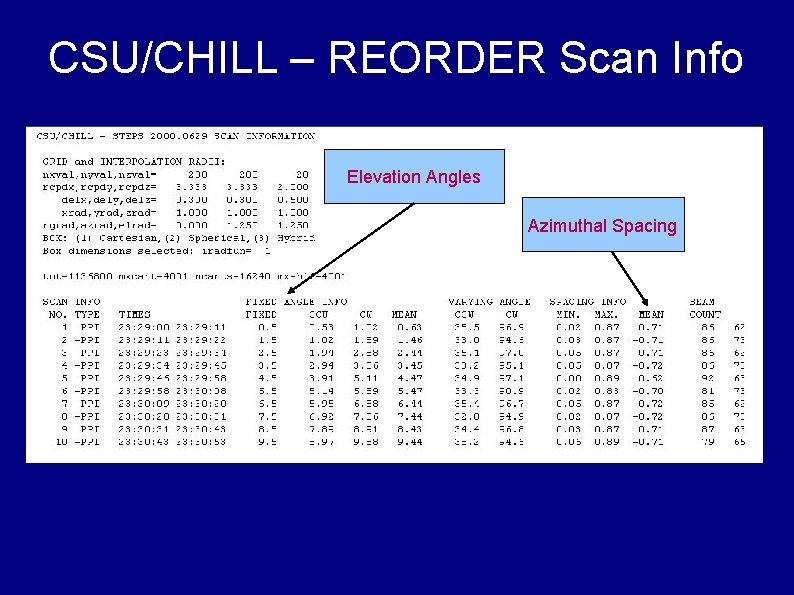
CSU/CHILL – REORDER Scan Info Elevation Angles Azimuthal Spacing
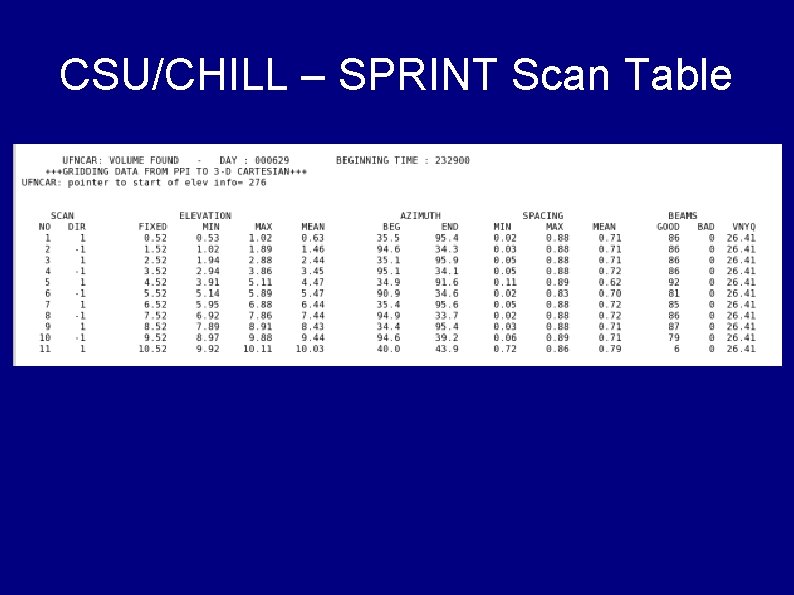
CSU/CHILL – SPRINT Scan Table
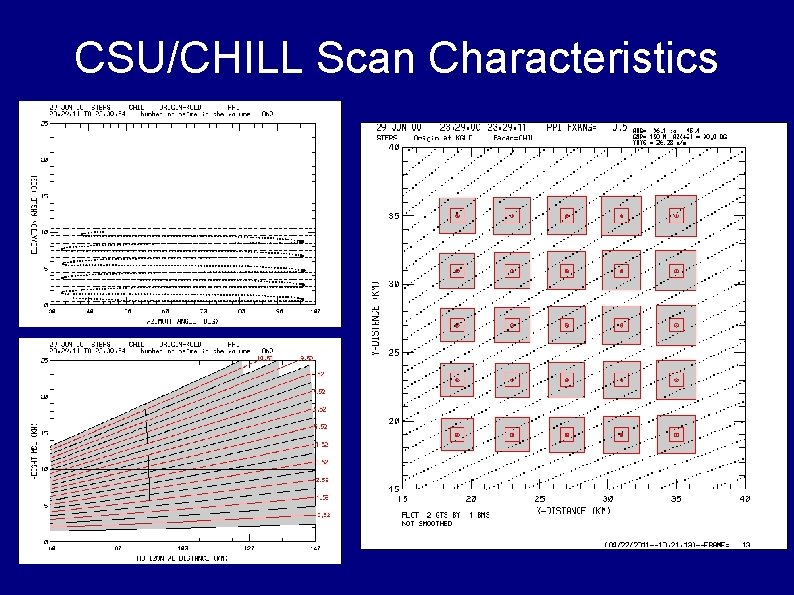
CSU/CHILL Scan Characteristics
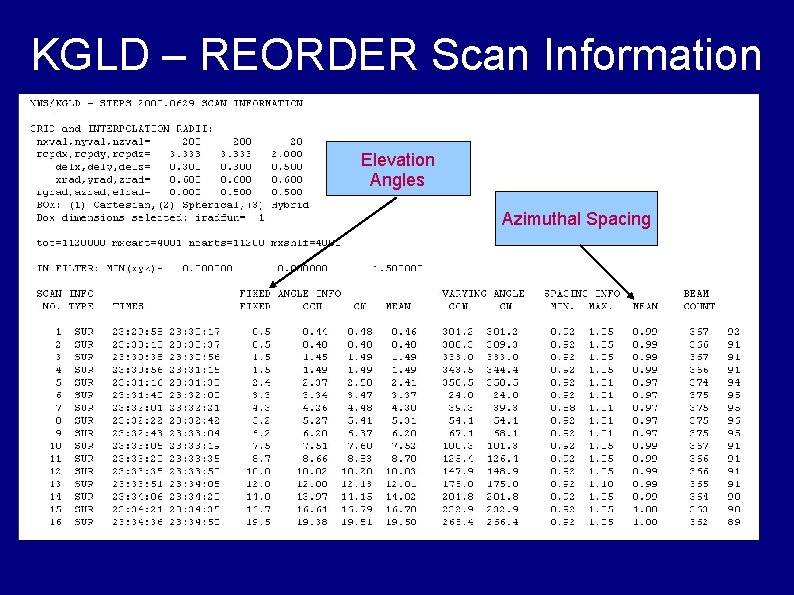
KGLD – REORDER Scan Information Elevation Angles Azimuthal Spacing
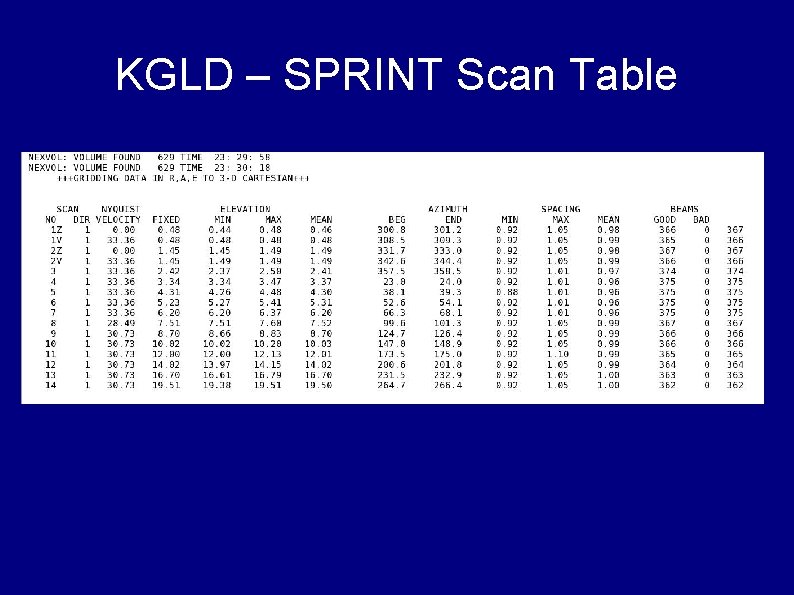
KGLD – SPRINT Scan Table
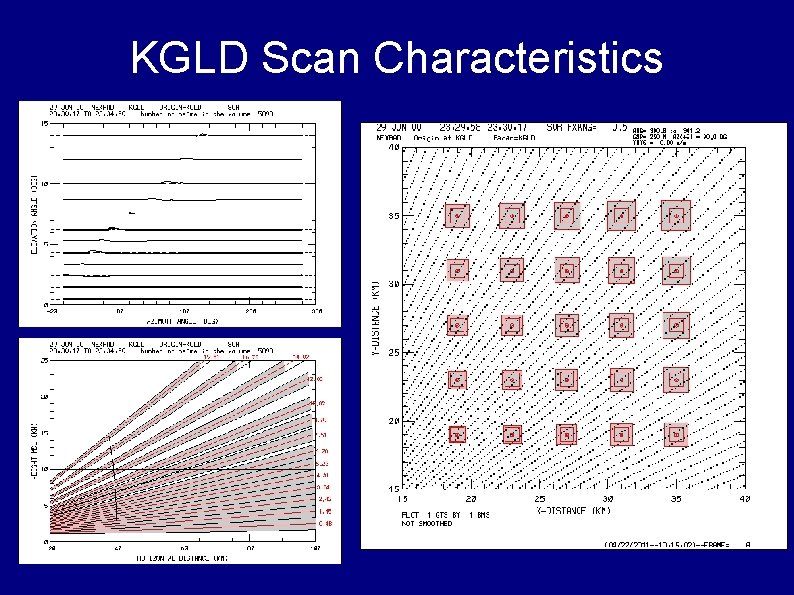
KGLD Scan Characteristics
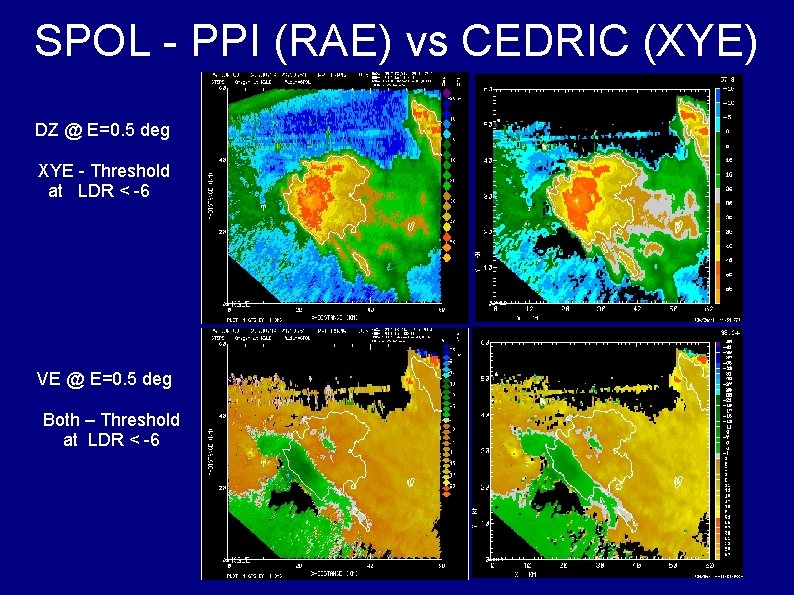
SPOL - PPI (RAE) vs CEDRIC (XYE) DZ @ E=0. 5 deg XYE - Threshold at LDR < -6 VE @ E=0. 5 deg Both – Threshold at LDR < -6
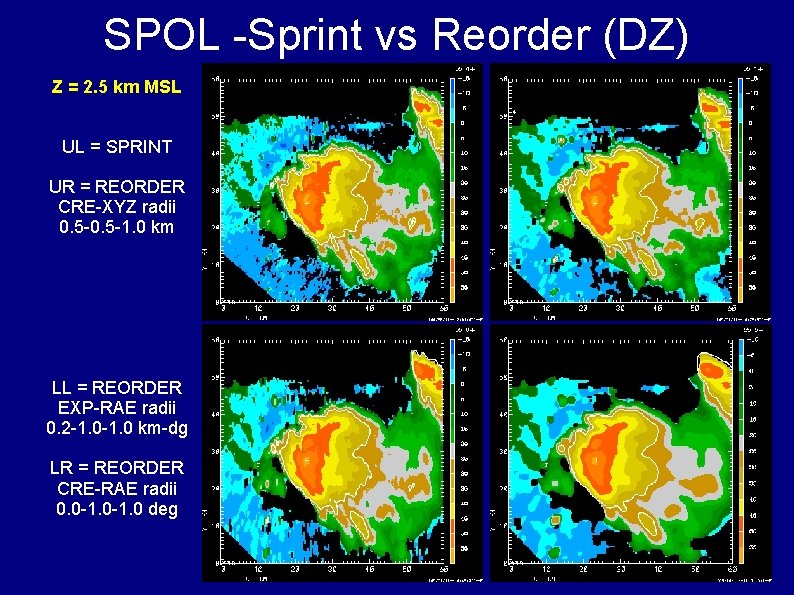
SPOL -Sprint vs Reorder (DZ) Z = 2. 5 km MSL UL = SPRINT UR = REORDER CRE-XYZ radii 0. 5 -1. 0 km LL = REORDER EXP-RAE radii 0. 2 -1. 0 km-dg LR = REORDER CRE-RAE radii 0. 0 -1. 0 deg
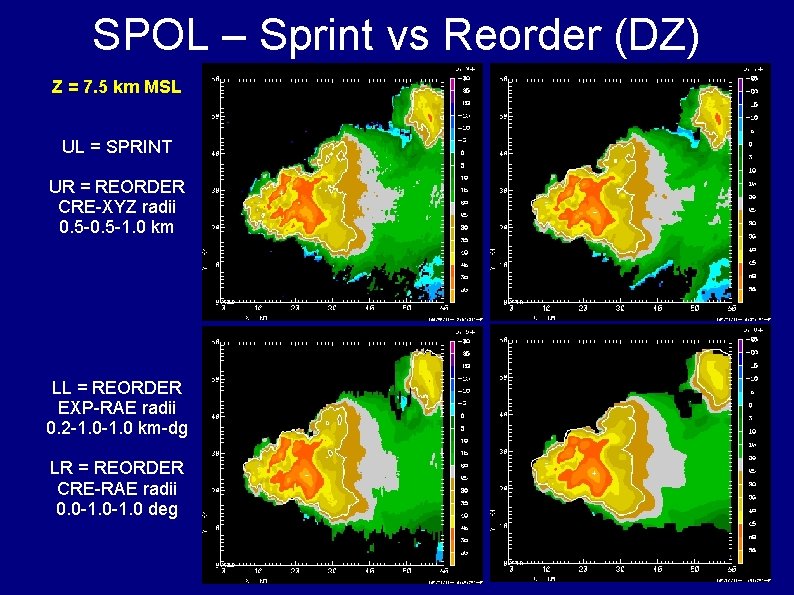
SPOL – Sprint vs Reorder (DZ) Z = 7. 5 km MSL UL = SPRINT UR = REORDER CRE-XYZ radii 0. 5 -1. 0 km LL = REORDER EXP-RAE radii 0. 2 -1. 0 km-dg LR = REORDER CRE-RAE radii 0. 0 -1. 0 deg
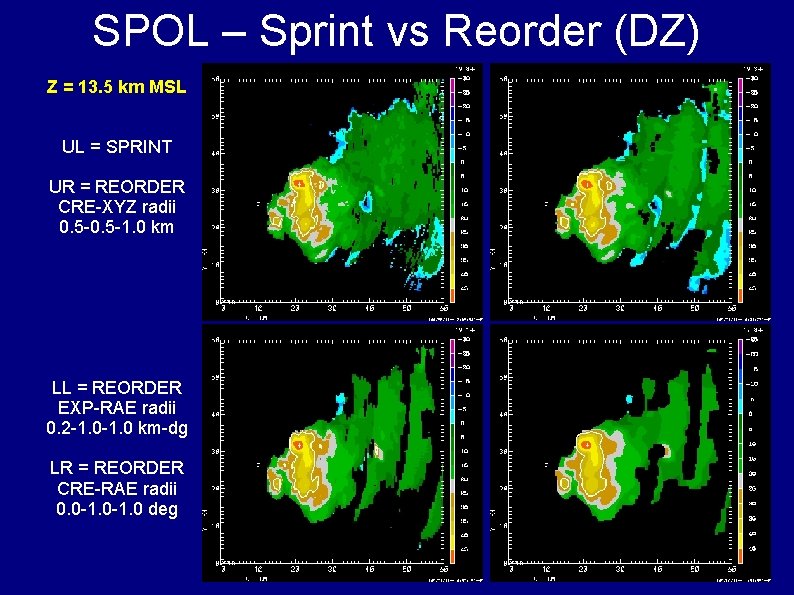
SPOL – Sprint vs Reorder (DZ) Z = 13. 5 km MSL UL = SPRINT UR = REORDER CRE-XYZ radii 0. 5 -1. 0 km LL = REORDER EXP-RAE radii 0. 2 -1. 0 km-dg LR = REORDER CRE-RAE radii 0. 0 -1. 0 deg
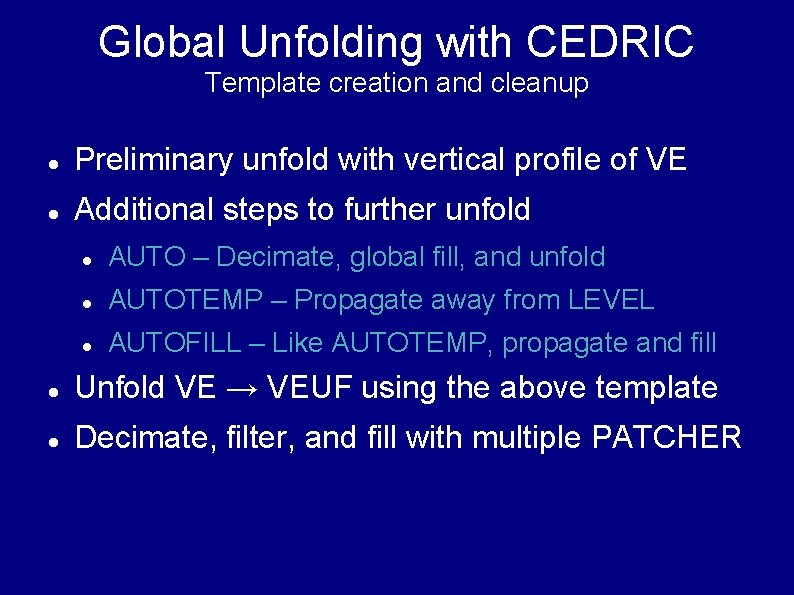
Global Unfolding with CEDRIC Template creation and cleanup Preliminary unfold with vertical profile of VE Additional steps to further unfold AUTO – Decimate, global fill, and unfold AUTOTEMP – Propagate away from LEVEL AUTOFILL – Like AUTOTEMP, propagate and fill Unfold VE → VEUF using the above template Decimate, filter, and fill with multiple PATCHER
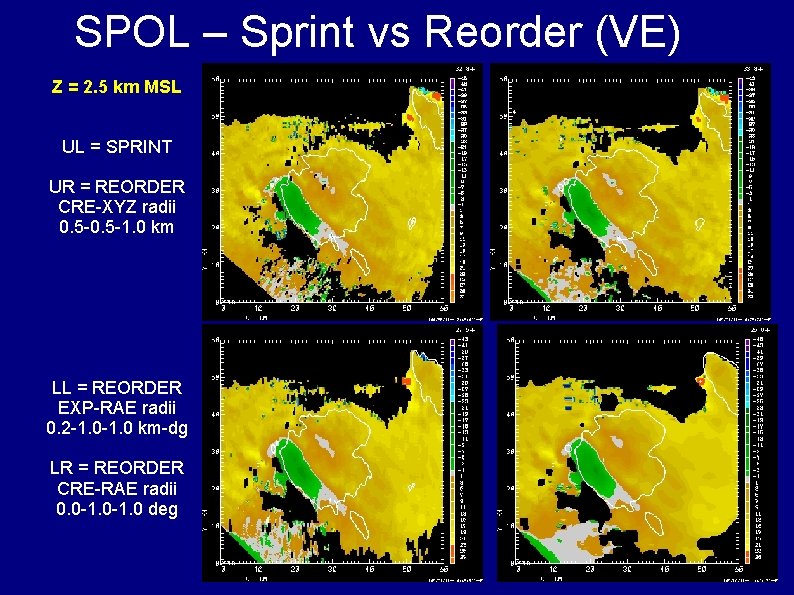
SPOL – Sprint vs Reorder (VE) Z = 2. 5 km MSL UL = SPRINT UR = REORDER CRE-XYZ radii 0. 5 -1. 0 km LL = REORDER EXP-RAE radii 0. 2 -1. 0 km-dg LR = REORDER CRE-RAE radii 0. 0 -1. 0 deg
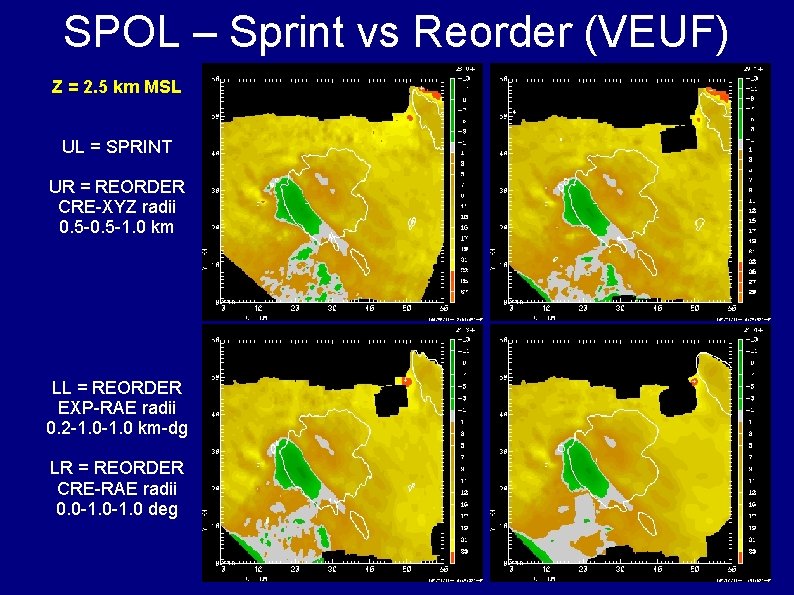
SPOL – Sprint vs Reorder (VEUF) Z = 2. 5 km MSL UL = SPRINT UR = REORDER CRE-XYZ radii 0. 5 -1. 0 km LL = REORDER EXP-RAE radii 0. 2 -1. 0 km-dg LR = REORDER CRE-RAE radii 0. 0 -1. 0 deg
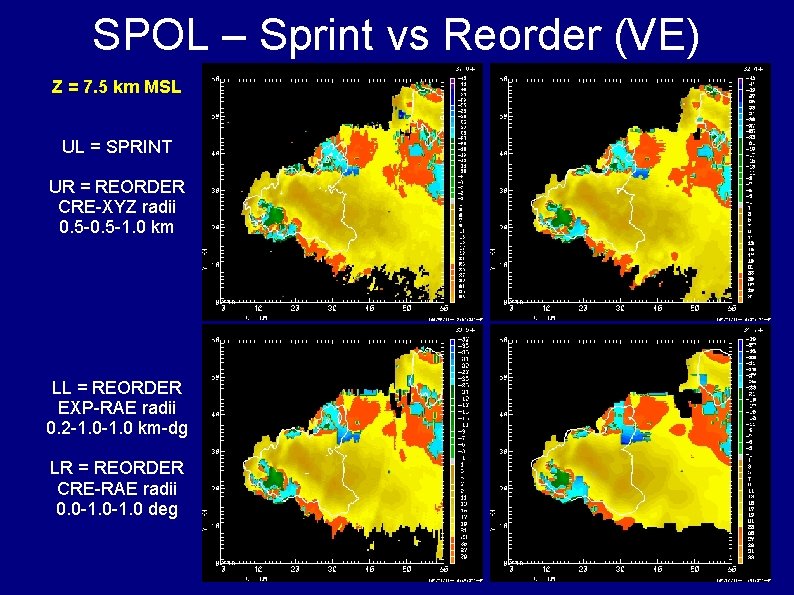
SPOL – Sprint vs Reorder (VE) Z = 7. 5 km MSL UL = SPRINT UR = REORDER CRE-XYZ radii 0. 5 -1. 0 km LL = REORDER EXP-RAE radii 0. 2 -1. 0 km-dg LR = REORDER CRE-RAE radii 0. 0 -1. 0 deg
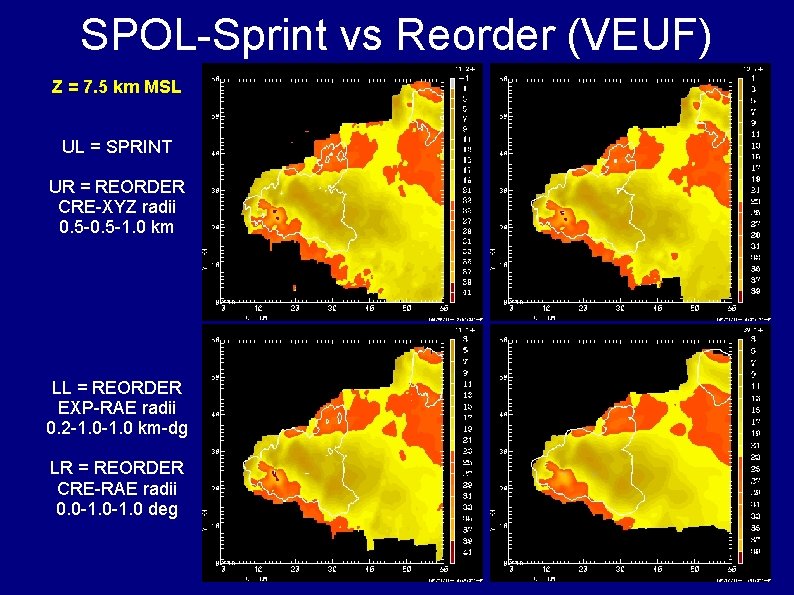
SPOL-Sprint vs Reorder (VEUF) Z = 7. 5 km MSL UL = SPRINT UR = REORDER CRE-XYZ radii 0. 5 -1. 0 km LL = REORDER EXP-RAE radii 0. 2 -1. 0 km-dg LR = REORDER CRE-RAE radii 0. 0 -1. 0 deg
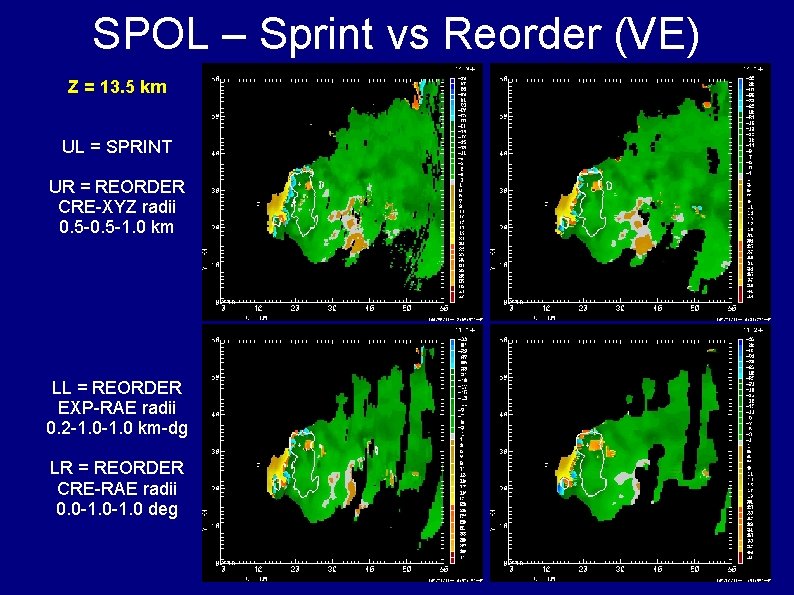
SPOL – Sprint vs Reorder (VE) Z = 13. 5 km UL = SPRINT UR = REORDER CRE-XYZ radii 0. 5 -1. 0 km LL = REORDER EXP-RAE radii 0. 2 -1. 0 km-dg LR = REORDER CRE-RAE radii 0. 0 -1. 0 deg
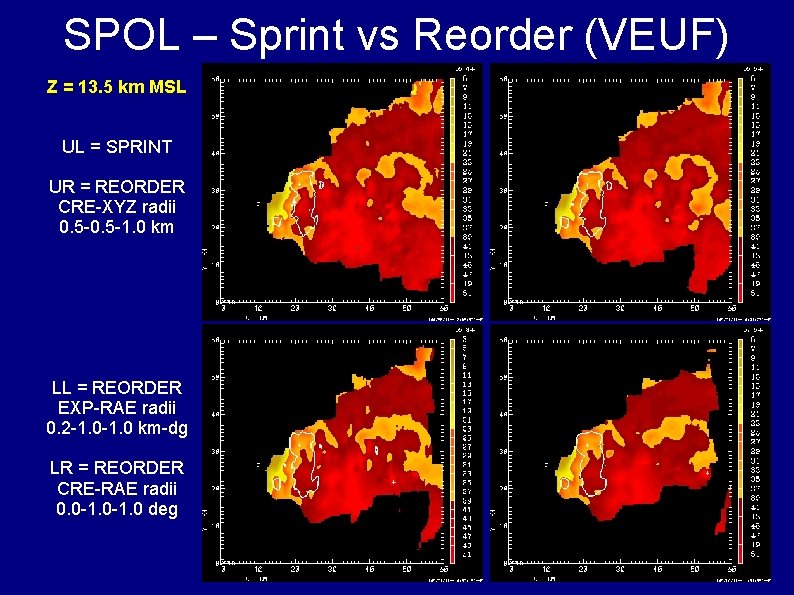
SPOL – Sprint vs Reorder (VEUF) Z = 13. 5 km MSL UL = SPRINT UR = REORDER CRE-XYZ radii 0. 5 -1. 0 km LL = REORDER EXP-RAE radii 0. 2 -1. 0 km-dg LR = REORDER CRE-RAE radii 0. 0 -1. 0 deg
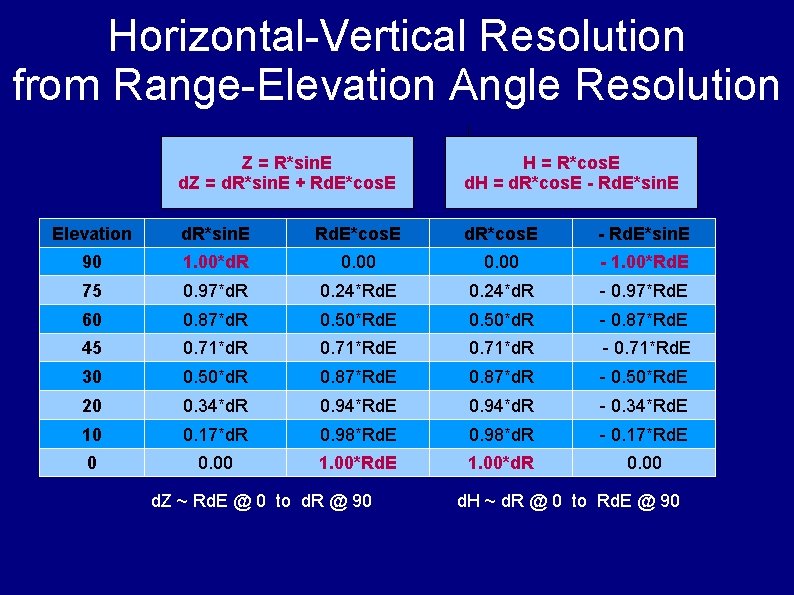
Horizontal-Vertical Resolution from Range-Elevation Angle Resolution Z = R*sin. E d. Z = d. R*sin. E + Rd. E*cos. E H = R*cos. E d. H = d. R*cos. E - Rd. E*sin. E Elevation d. R*sin. E Rd. E*cos. E d. R*cos. E - Rd. E*sin. E 90 1. 00*d. R 0. 00 - 1. 00*Rd. E 75 0. 97*d. R 0. 24*Rd. E 0. 24*d. R - 0. 97*Rd. E 60 0. 87*d. R 0. 50*Rd. E 0. 50*d. R - 0. 87*Rd. E 45 0. 71*d. R 0. 71*Rd. E 0. 71*d. R - 0. 71*Rd. E 30 0. 50*d. R 0. 87*Rd. E 0. 87*d. R - 0. 50*Rd. E 20 0. 34*d. R 0. 94*Rd. E 0. 94*d. R - 0. 34*Rd. E 10 0. 17*d. R 0. 98*Rd. E 0. 98*d. R - 0. 17*Rd. E 0 0. 00 1. 00*Rd. E 1. 00*d. R 0. 00 d. Z ~ Rd. E @ 0 to d. R @ 90 d. H ~ d. R @ 0 to Rd. E @ 90
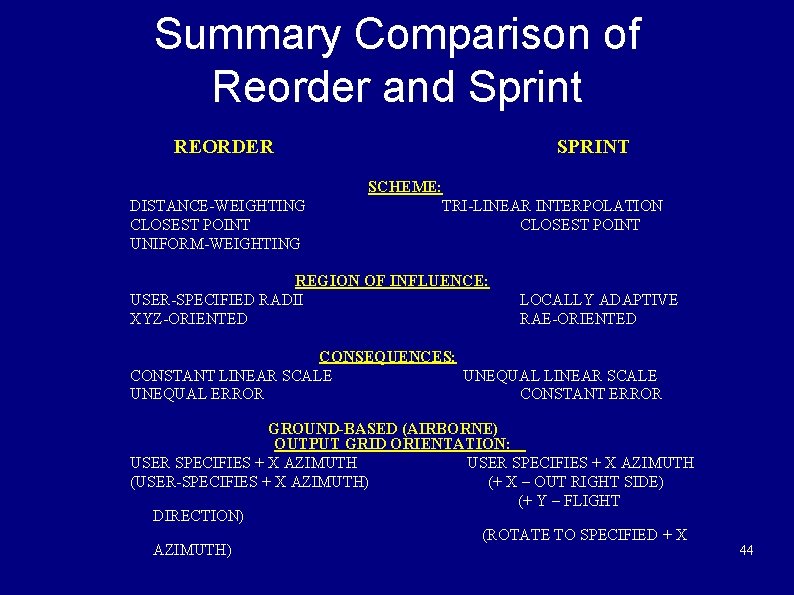
Summary Comparison of Reorder and Sprint REORDER DISTANCE-WEIGHTING CLOSEST POINT UNIFORM-WEIGHTING SPRINT SCHEME: TRI-LINEAR INTERPOLATION CLOSEST POINT REGION OF INFLUENCE: USER-SPECIFIED RADII XYZ-ORIENTED LOCALLY ADAPTIVE RAE-ORIENTED CONSEQUENCES: CONSTANT LINEAR SCALE UNEQUAL ERROR CONSTANT ERROR GROUND-BASED (AIRBORNE) OUTPUT GRID ORIENTATION: USER SPECIFIES + X AZIMUTH (USER-SPECIFIES + X AZIMUTH) (+ X – OUT RIGHT SIDE) (+ Y – FLIGHT DIRECTION) (ROTATE TO SPECIFIED + X AZIMUTH) 44