
SOME FACTS ABOUT ROMANIA Facts and Statistics Location
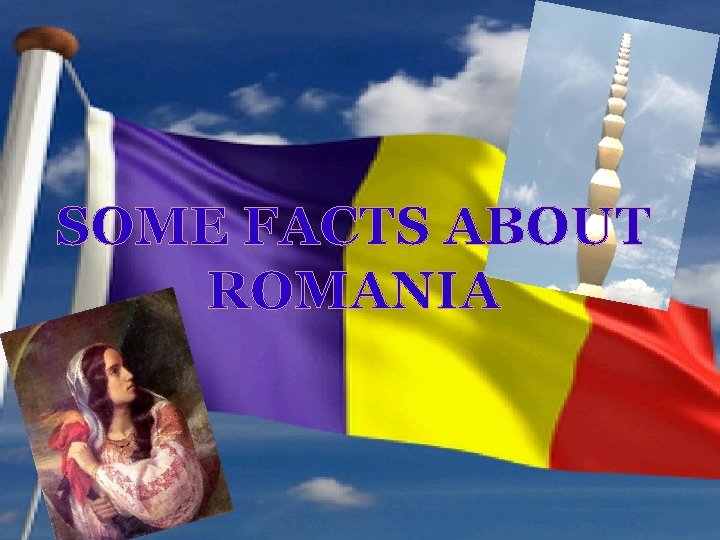
SOME FACTS ABOUT ROMANIA
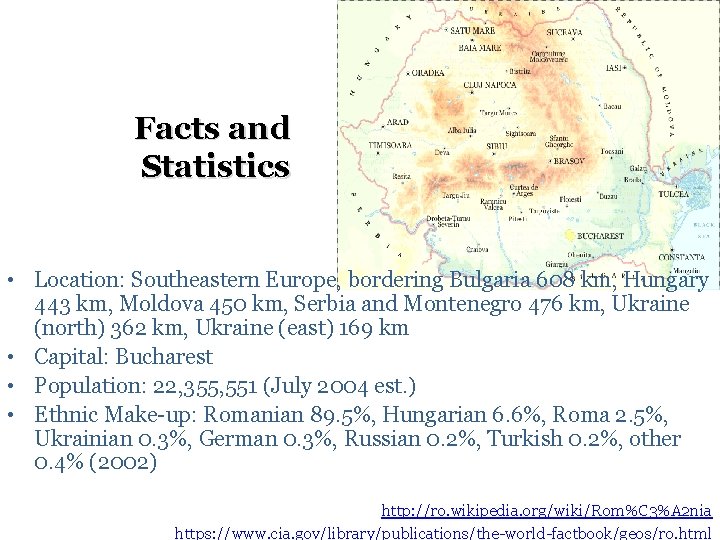
Facts and Statistics • Location: Southeastern Europe, bordering Bulgaria 608 km, Hungary 443 km, Moldova 450 km, Serbia and Montenegro 476 km, Ukraine (north) 362 km, Ukraine (east) 169 km • Capital: Bucharest • Population: 22, 355, 551 (July 2004 est. ) • Ethnic Make-up: Romanian 89. 5%, Hungarian 6. 6%, Roma 2. 5%, Ukrainian 0. 3%, German 0. 3%, Russian 0. 2%, Turkish 0. 2%, other 0. 4% (2002) http: //ro. wikipedia. org/wiki/Rom%C 3%A 2 nia https: //www. cia. gov/library/publications/the-world-factbook/geos/ro. html
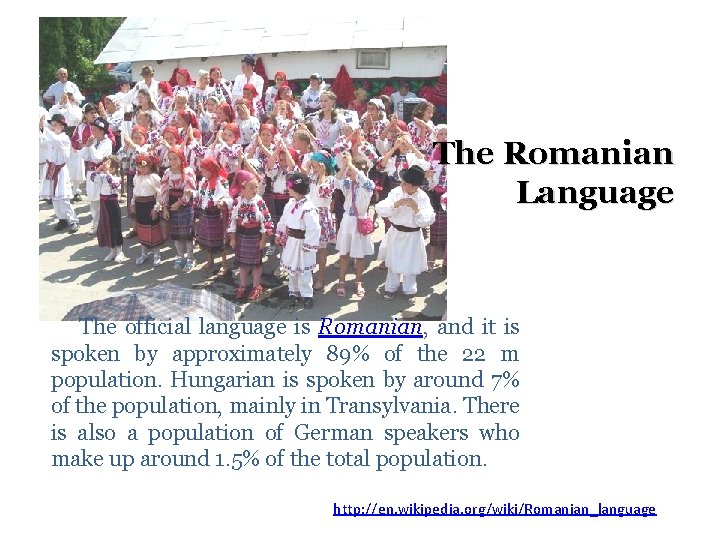
The Romanian Language The official language is Romanian, and it is spoken by approximately 89% of the 22 m population. Hungarian is spoken by around 7% of the population, mainly in Transylvania. There is also a population of German speakers who make up around 1. 5% of the total population. http: //en. wikipedia. org/wiki/Romanian_language
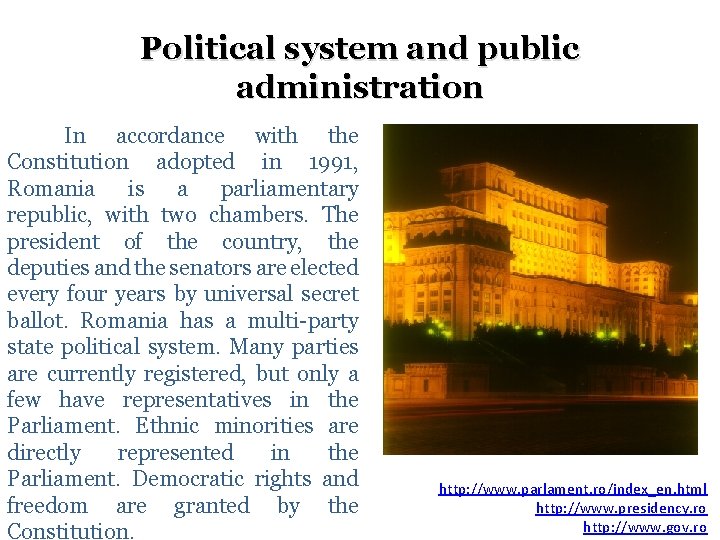
Political system and public administration In accordance with the Constitution adopted in 1991, Romania is a parliamentary republic, with two chambers. The president of the country, the deputies and the senators are elected every four years by universal secret ballot. Romania has a multi-party state political system. Many parties are currently registered, but only a few have representatives in the Parliament. Ethnic minorities are directly represented in the Parliament. Democratic rights and freedom are granted by the Constitution. http: //www. parlament. ro/index_en. html http: //www. presidency. ro http: //www. gov. ro
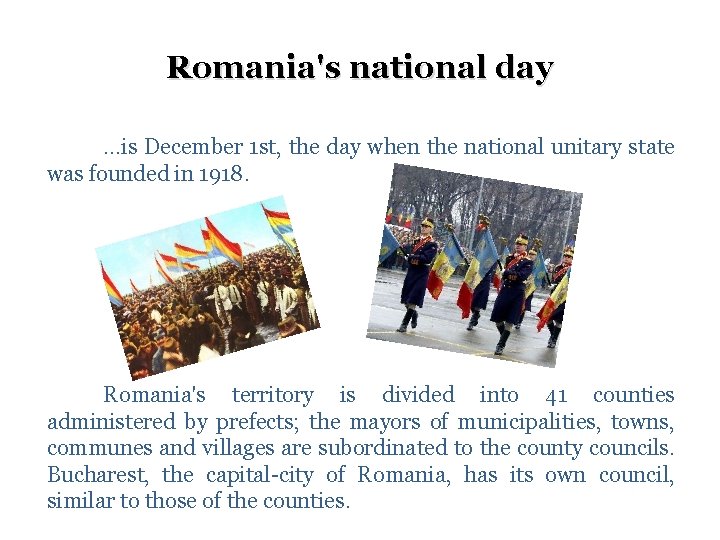
Romania's national day …is December 1 st, the day when the national unitary state was founded in 1918. Romania's territory is divided into 41 counties administered by prefects; the mayors of municipalities, towns, communes and villages are subordinated to the county councils. Bucharest, the capital-city of Romania, has its own council, similar to those of the counties.
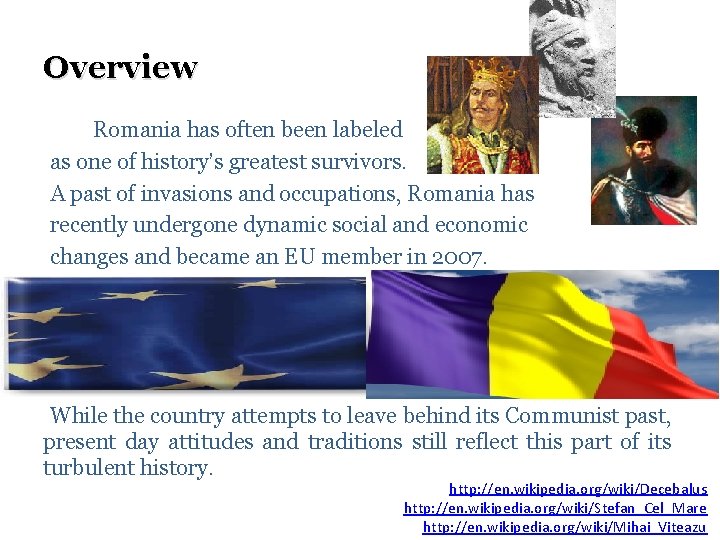
Overview Romania has often been labeled as one of history’s greatest survivors. A past of invasions and occupations, Romania has recently undergone dynamic social and economic changes and became an EU member in 2007. While the country attempts to leave behind its Communist past, present day attitudes and traditions still reflect this part of its turbulent history. http: //en. wikipedia. org/wiki/Decebalus http: //en. wikipedia. org/wiki/Stefan_Cel_Mare http: //en. wikipedia. org/wiki/Mihai_Viteazu
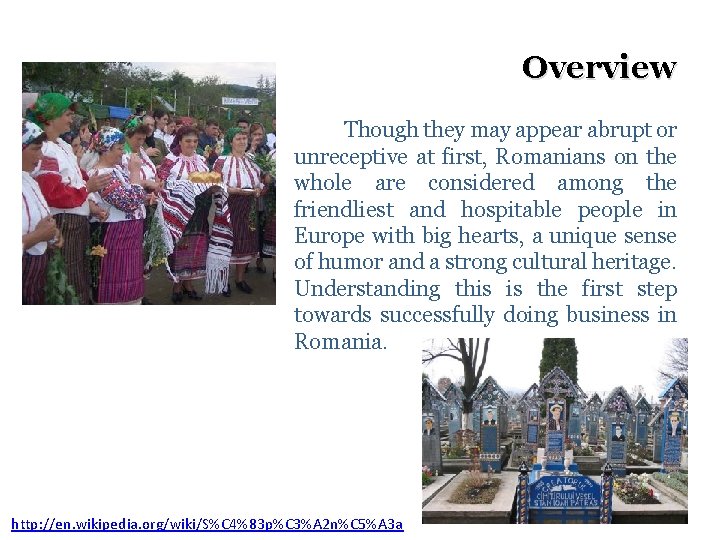
Overview Though they may appear abrupt or unreceptive at first, Romanians on the whole are considered among the friendliest and hospitable people in Europe with big hearts, a unique sense of humor and a strong cultural heritage. Understanding this is the first step towards successfully doing business in Romania. http: //en. wikipedia. org/wiki/S%C 4%83 p%C 3%A 2 n%C 5%A 3 a
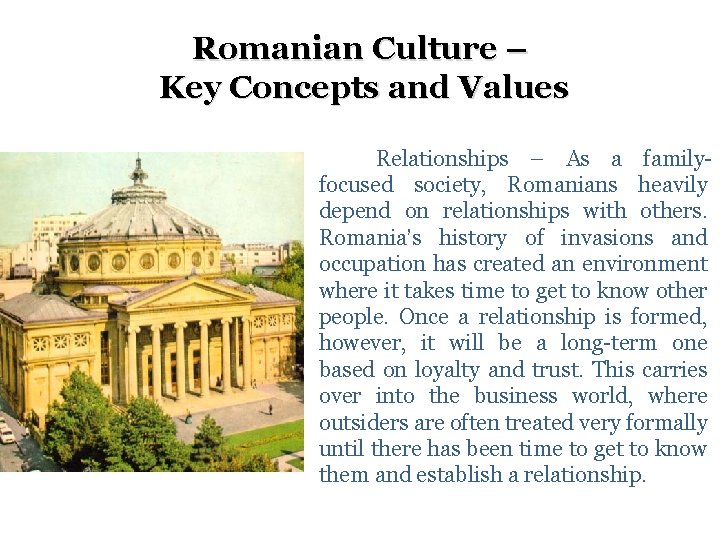
Romanian Culture – Key Concepts and Values Relationships – As a familyfocused society, Romanians heavily depend on relationships with others. Romania’s history of invasions and occupation has created an environment where it takes time to get to know other people. Once a relationship is formed, however, it will be a long-term one based on loyalty and trust. This carries over into the business world, where outsiders are often treated very formally until there has been time to get to know them and establish a relationship.
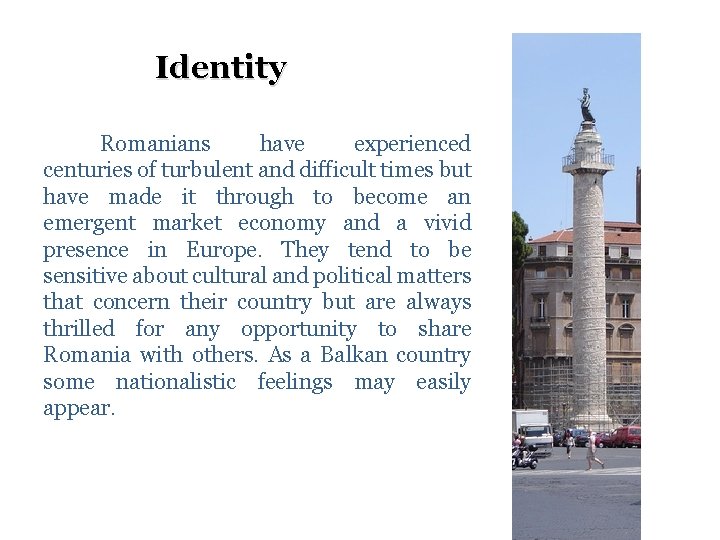
Identity Romanians have experienced centuries of turbulent and difficult times but have made it through to become an emergent market economy and a vivid presence in Europe. They tend to be sensitive about cultural and political matters that concern their country but are always thrilled for any opportunity to share Romania with others. As a Balkan country some nationalistic feelings may easily appear.
Doing Business with Romanians Romania was controlled by a totalitarian communist government for over four decades before it had the chance, in the late 80 s, to start making the transition to the market economy it is today. It has since made many efforts to revamp its economy, tackle widespread corruption and implement social reforms in an attempt to prepare itself for its entry into the European Union at the beginning of 2007. Free market economy rules are already functioning in Romania.
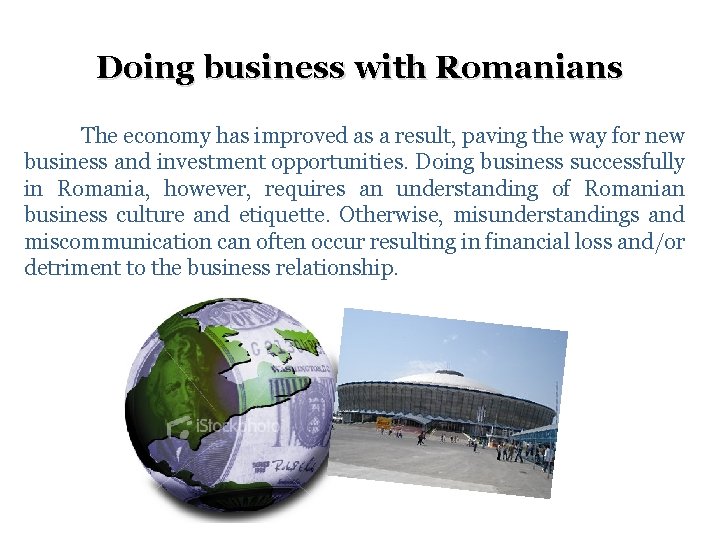
Doing business with Romanians The economy has improved as a result, paving the way for new business and investment opportunities. Doing business successfully in Romania, however, requires an understanding of Romanian business culture and etiquette. Otherwise, misunderstandings and miscommunication can often occur resulting in financial loss and/or detriment to the business relationship.
Working practices in Romania • Punctuality is valued, though not always honored • Business appointments are necessary and should be planned two to three weeks in advance and not during the summer or other holiday periods • Traditional working hours are 9: 00 am to 5. 00 pm, Monday to Friday • Meetings tend to be formal and follow a strict routine of introductions, handshakes and an exchange of business cards
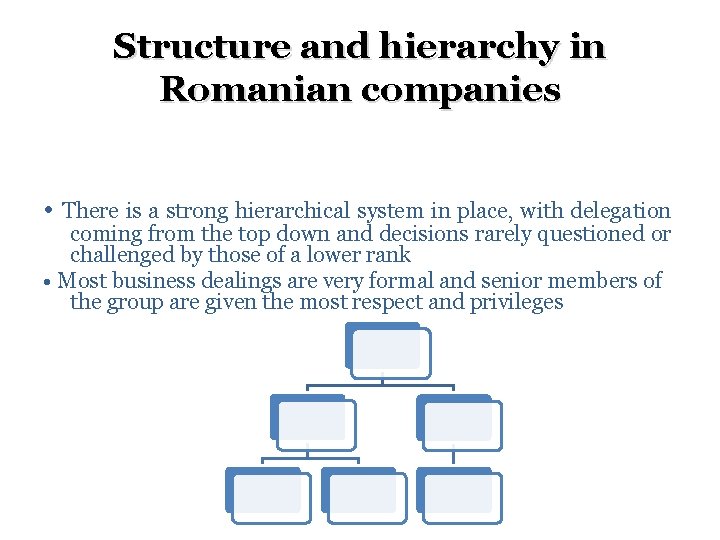
Structure and hierarchy in Romanian companies • There is a strong hierarchical system in place, with delegation coming from the top down and decisions rarely questioned or challenged by those of a lower rank • Most business dealings are very formal and senior members of the group are given the most respect and privileges
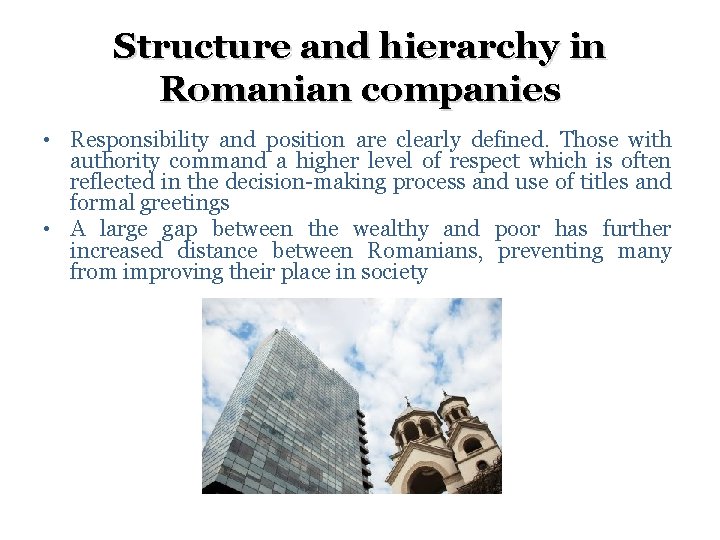
Structure and hierarchy in Romanian companies • Responsibility and position are clearly defined. Those with authority command a higher level of respect which is often reflected in the decision-making process and use of titles and formal greetings • A large gap between the wealthy and poor has further increased distance between Romanians, preventing many from improving their place in society
Working relationships in Romanians keep their distance from those they do not know and maintain high levels of formality. Developing relationships therefore takes time but once a Romanian feels comfortable with someone, that person is wholly accepted and trusted Formal titles are extremely important. Romanian colleagues of equal status tend to drop the surname for the first name but the title is still used. First names are primarily used among close friends and family only, even the “American style” is sometimes used
Romanian Business Etiquette (Do’s and Don’ts) • DO expect business dealings to take a long time. An extensive system of rules and regulations results in a very bureaucratic society. Patience and relationships are essential for successful business ventures in Romania • DO enquire in advance about which language will be used. Romanian is the official language but business is often conducted in English, French or German • DO provide background information and detailed facts and figures. Romanians tend to be very direct and explicit and like to have as much information as possible
Romanian Business Etiquette (Do’s and Don’ts) • DON’T expect meetings to be a time for brainstorming and discussion. Meetings are a time where the senior can demonstrate his/her authority • DON’T inquire too deeply into a Romanian’s background or personal life until you get to know them well since Romanians are relatively private people • DON’T underestimate Romanian tendency to take a direct approach. Despite their reserved reputation, communication in business situations is more direct and succinct.
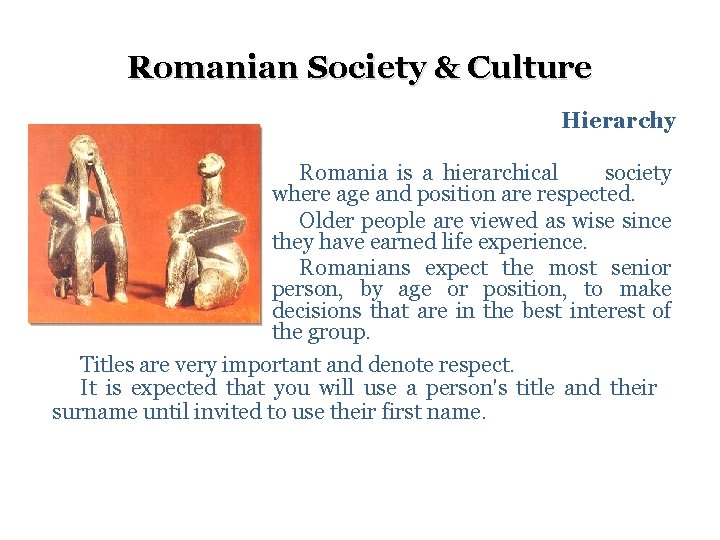
Romanian Society & Culture Hierarchy Romania is a hierarchical society where age and position are respected. Older people are viewed as wise since they have earned life experience. Romanians expect the most senior person, by age or position, to make decisions that are in the best interest of the group. Titles are very important and denote respect. It is expected that you will use a person's title and their surname until invited to use their first name.
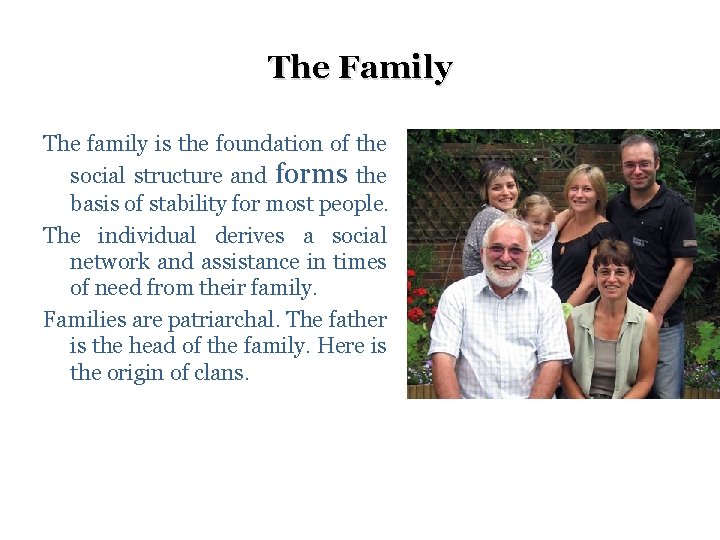
The Family The family is the foundation of the social structure and forms the basis of stability for most people. The individual derives a social network and assistance in times of need from their family. Families are patriarchal. The father is the head of the family. Here is the origin of clans.
Romanians are formal and reserved with a strong need for privacy. Most do not trust strangers readily. They are generally shy and quiet when you first meet and admire modesty and humility in themselves and others. Once you develop a personal relationship Romanians will open up slightly. Although always polite, they seldom move to a first-name basis with people outside their extended family or very close friends. Privacy
Conclusion • Romania is the perfect land of contrasts and paradoxes, the country of Constantin Brancusi, Eugene Ionesco, Emil Cioran, Mircea Eliade, Ilie Nastase and Nadia Comaneci, but also of Dracula and Nicolae Ceausescu. • The Old World of Romania is a vast museum of ancient heritage and still alive even if only through its famous painted churches and monasteries, its folk art, or its feudal castles in the Carpathian Mountains. • The New World may be embodied by the Parliament Palace and the subway network in Bucharest, or by the Western styles of life adopted by Romania's townsfolk.
- Slides: 21