
Some Facts About Psalms Part 2 2 O
Some Facts About Psalms Part 2 关于诗篇的一些事实 - 2 O God; and renew Pss. 51: 10 -12 “Create in me a clean heart, n a right spirit within me. Cast me not away from thy presence; and take not thy holy spirit from me. Restore unto me the joy of thy salvation; and uphold me with thy free spirit. ” 詩 51: 10 -12 “神阿、求你為我造清潔的心、使 我裏面重新有正直的靈。不要丟棄我、使我離開 你的面.不要從我收回你的聖靈。求你使我仍得 救恩之樂、賜我樂意的靈扶持我。” Pastor Chui http: //Christ. Center. Gospel. org ckchui 1@yahoo. com
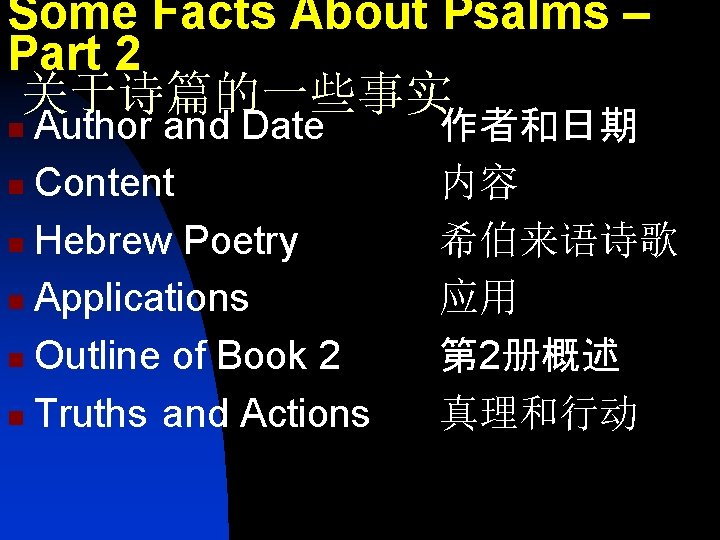
Some Facts About Psalms – Part 2 关于诗篇的一些事实 Author and Date n Content n Hebrew Poetry n Applications n Outline of Book 2 n Truths and Actions n 作者和日期 内容 希伯来语诗歌 应用 第 2册概述 真理和行动
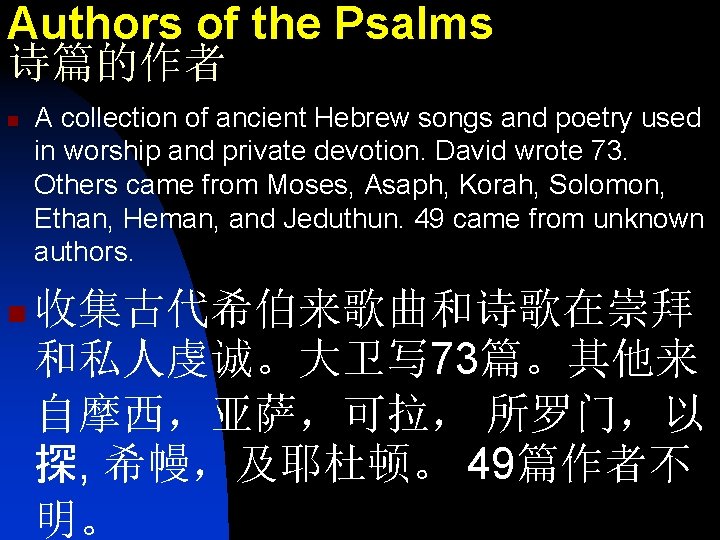
Authors of the Psalms 诗篇的作者 n n A collection of ancient Hebrew songs and poetry used in worship and private devotion. David wrote 73. Others came from Moses, Asaph, Korah, Solomon, Ethan, Heman, and Jeduthun. 49 came from unknown authors. 收集古代希伯来歌曲和诗歌在崇拜 和私人虔诚。大卫写 73篇。其他来 自摩西,亚萨,可拉, 所罗门,以 探, 希幔,及耶杜顿。 49篇作者不 明。
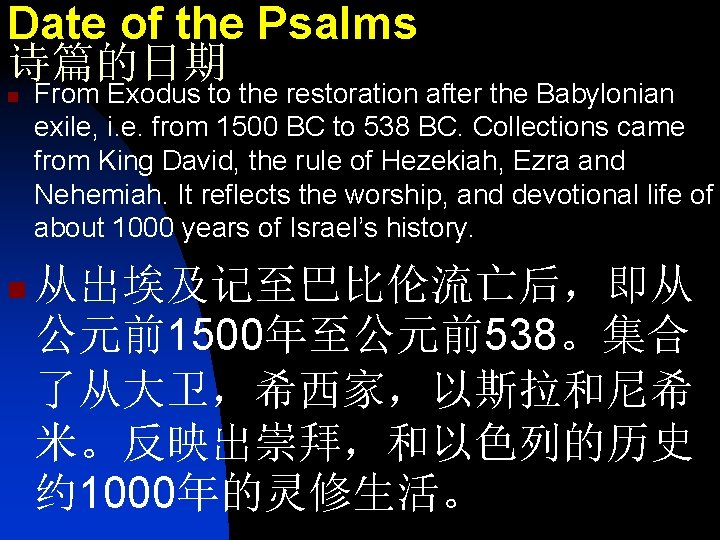
Date of the Psalms 诗篇的日期 n n From Exodus to the restoration after the Babylonian exile, i. e. from 1500 BC to 538 BC. Collections came from King David, the rule of Hezekiah, Ezra and Nehemiah. It reflects the worship, and devotional life of about 1000 years of Israel’s history. 从出埃及记至巴比伦流亡后,即从 公元前1500年至公元前538。集合 了从大卫,希西家,以斯拉和尼希 米。反映出崇拜,和以色列的历史 约 1000年的灵修生活。
Content of the Book of Psalms 诗篇的内容 n n In Hebrew, it is the Book of Praises. It contains temple songs and hymns of praise. It includes elegies, laments, personal and national prayers, petitions, meditations, instructions, historical anthems, and acrostic tributes to noble themes. 在希伯来文,这是赞颂的书。它包含了 圣殿的歌曲和赞美诗。它包括哀歌 ,感 叹,个人和国家的祈祷,请愿, 沉思 , 教导 ,历史的国歌,离合悼念和崇高主 题。
Content of the Book of Psalms 诗篇的内容 n n Psalms is the second of three Old Testament books designated as poetical: Job, Psalms, and Proverbs. These three were also called “books of truth. ” 诗篇是三本旧约诗的书籍的第二本 : 約 伯記,诗篇, 和箴言。这三本书也 被称为“真理的书。”
Content of the Book of Psalms 诗篇的内容 n n Psalms is divided into five smaller books. Each is a compilation of several ancient collections of songs, and poems. A doxology is at the end of each book. Book 1 (Pss. 1 -41) mostly came from David. Book 2 (Pss. 42 -72) is a collection from Korah, Asaph, David, and Solomon, and four unknown authors. 诗篇分为五本小书。每一本是一些古老的 歌曲集,和诗歌。三一颂是在每本书的结 束。第一本书(诗 1 -41)大多来自大卫。 第二本书(诗 42 -72)是可拉,亚萨,大卫, 所罗门,和四个未知名作者的集合。
Content of the Book of Psalms 诗篇的内容 n n Book 3 (Pss. 73 -89) came largely from Asaph. He was David’s choirmaster. Book 4 (Pss. 90 -106) came from Moses, David, Solomon and others. These were collected during Exile. Book 5 (Pss. 107 -150) contains mostly David’s songs. The final songs (Pss. 146 -150) are called the “Great Hallel” series. Each begins and ends with Hallelujah! 书 3(诗 73 -89)主要从亚萨。他是大卫的诗班指挥。 书 4来自摩西,大卫,所罗门和其他(诗 90 -106)。 这些是在被流亡期间收集。书 5(诗 107 -150)主要 包含大卫的歌曲。最后的歌曲(诗 146 -150)被称 为“伟大的赞美”系列。每个歌曲开始和结束就是哈 利路亚!
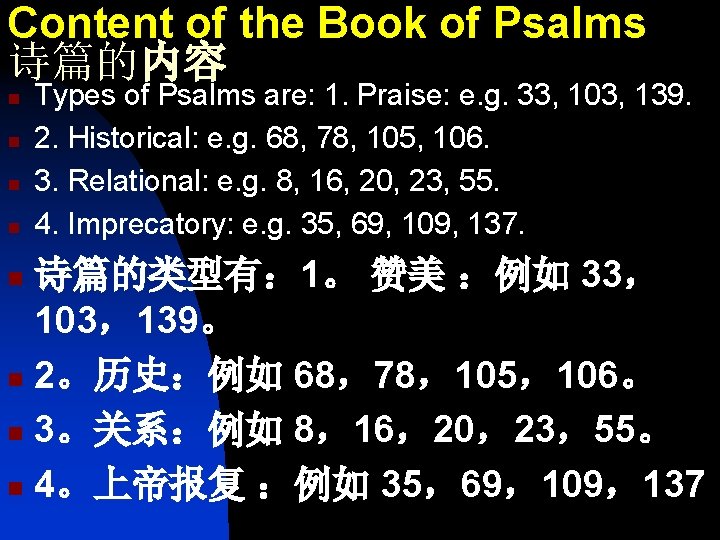
Content of the Book of Psalms 诗篇的内容 n n Types of Psalms are: 1. Praise: e. g. 33, 103, 139. 2. Historical: e. g. 68, 78, 105, 106. 3. Relational: e. g. 8, 16, 20, 23, 55. 4. Imprecatory: e. g. 35, 69, 109, 137. 诗篇的类型有: 1。 赞美 :例如 33, 103,139。 n 2。历史:例如 68,78,105,106。 n 3。关系:例如 8,16,20,23,55。 n 4。上帝报复 :例如 35,69,109,137 n
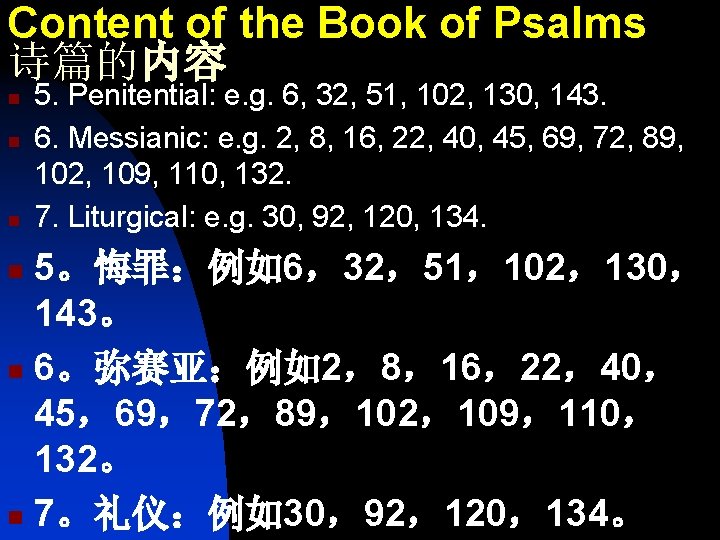
Content of the Book of Psalms 诗篇的内容 n n n 5. Penitential: e. g. 6, 32, 51, 102, 130, 143. 6. Messianic: e. g. 2, 8, 16, 22, 40, 45, 69, 72, 89, 102, 109, 110, 132. 7. Liturgical: e. g. 30, 92, 120, 134. 5。悔罪:例如6,32,51,102,130, 143。 n 6。弥赛亚:例如2,8,16,22,40, 45,69,72,89,102,109,110, 132。 n 7。礼仪:例如30,92,120,134。 n
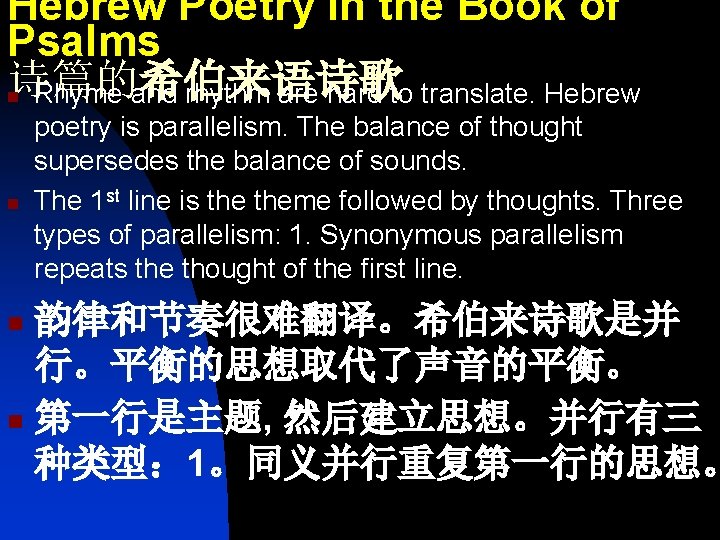
Hebrew Poetry in the Book of Psalms 诗篇的希伯来语诗歌 Rhyme and rhythm are hard to translate. Hebrew n n poetry is parallelism. The balance of thought supersedes the balance of sounds. The 1 st line is theme followed by thoughts. Three types of parallelism: 1. Synonymous parallelism repeats the thought of the first line. 韵律和节奏很难翻译。希伯来诗歌是并 行。平衡的思想取代了声音的平衡。 n 第一行是主题, 然后建立思想。并行有三 种类型: 1。同义并行重复第一行的思想。 n
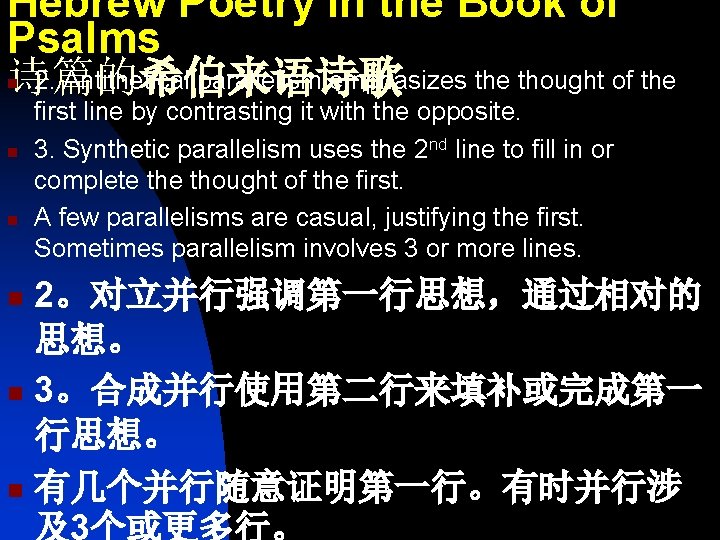
Hebrew Poetry in the Book of Psalms 2. Antithetical parallelism emphasizes the thought of the 诗篇的希伯来语诗歌 n n n first line by contrasting it with the opposite. 3. Synthetic parallelism uses the 2 nd line to fill in or complete thought of the first. A few parallelisms are casual, justifying the first. Sometimes parallelism involves 3 or more lines. 2。对立并行强调第一行思想,通过相对的 思想。 n 3。合成并行使用第二行来填补或完成第一 行思想。 n 有几个并行随意证明第一行。有时并行涉 n
Applications of the Book of Psalms 诗篇的应用 n New Testament apostles often used Psalms to teach Christian doctrines, such as the forgiveness of sins, the faithfulness of God, the sins of humanity, the inclusion of gentiles in the church, the existence of angels, and Christian conduct. n 新约的使徒经常使用诗篇教导基督教 教义,如赦罪,神的信实,人类的罪 孽,接受外邦人在教堂,天使的存在, 和基督徒的行为。
Applications of the Book of Psalms 诗篇的应用 Throughout the centuries, Psalms have been a source of n inspiration and spiritual strength. The Psalms release us from frustration, pain, and anguish. Psalm writers express the yearnings of our deepest thoughts. By song and Spirit they comfort the lonely, strengthen the weary, bind the brokenhearted, and turn the eyes of the downcast to the Creator. n 在许多世纪里,诗篇一直是灵感和精神力 量的源泉。诗篇释放我们从挫折,疼痛和 痛苦。诗篇作家表达我们最深的渴望。通 过歌曲和精神安慰寂寞,改变疲倦,绑定 伤心,和打开低垂的眼睛, 想望造物主。
Applications of the Book of Psalms 诗篇的应用 Psalms help us see how to praise God and pray to Him. n The inner life and emotions are shared freely with God. For each emotion expressed by the worshipper, Psalms point to an attribute of God. He is an anchor when we are buffeted, a comfort when we feel abandoned, and encouragement when support is needed. n 诗篇帮助我们如何赞美和祈祷上帝。内心 生活和情感与神自由共享。每个崇拜者的 情感表达,诗篇提示神的属性。当我们遭 受冲击时,上帝是一个锚; 当我们感到被遗 弃, 上帝安慰我们; 当我们需要支持时,上 帝给我们舒适和鼓励。
Applications of the Book of Psalms 诗篇的应用 The Psalms also have a rich history of liturgical and n congregational use. King David organized choirs and orchestras, and appointed skilled conductors and composers to lead the worship. He not only composed many psalms, but also invented musical instruments. 55 psalms are addressed to the Chief Musician. n 诗篇有丰富的礼仪和堂会的使用。大 卫王举办的合唱团和管弦乐团,并任 命了熟练的指挥家和作曲家来带领崇 拜。他不但写出许多诗篇,而且他还 发明了乐器。 55篇诗篇交给音乐家。
Applications of the Book of Psalms 诗篇的应用 This orchestrated worship was continued in Solomon’s temple. n With the destruction of the second temple in AD 70, the singing of psalms took place in synagogue worship services. The early Christian churches were mainly Jewish people. They incorporated the singing of psalms, hymns, and spiritual songs into their worship. Now the churches have clapping, lifting up hands, bowing, standing, shouting, and dancing. n 这个精心策划的崇拜,继续在所罗门圣殿 推进 。公元70年第二圣殿毁灭, 犹太教堂 在崇拜时唱诗篇。 早期基督教教堂主要是 犹太人。他们使用诗篇,圣诗,灵歌,歌 唱来崇拜。在教会有鼓掌,举起双手,鞠 躬,站立,喊叫, 及跳舞。
Outline of Book 2 of Psalms 42: 1 – 72: 20 诗篇书 2的概述 42: 1(42: 1 – 72: 20 1. Songs of the sons of Korah – 49: 20) n n n 2. Song of Asaph (50: 1 -23) 3. Songs of David (51: 1 - 71: 24) 4. Song of Solomon (72: 1 -17) 5. Doxology (72: 18 -19) 6. Concluding verse (72: 20) n 1。可拉儿子的歌曲(42: 1 - 49: 20) 2。亚萨之歌(50: 1 -23) 3。大卫的歌曲(51: 1 - 71: 24) 4。所罗门之歌(72: 1 -17) 5。三一颂(72: 18 -19) n 6。总结诗句(72: 20) n n
Truths and Actions in Book 2 of Psalms 诗篇书 2的真理 和行动 Truth 1. Guidelines for Growing in Godliness: n n Those who choose to live godly lives will not go unrewarded and will look for opportunities to share with others what God is doing in and through them. Action 1 62: 12 Understand know that God will reward everyone according to his deeds. 64: 1; 69: 9 Voice any complaints to God alone. Be zealous that the purposes of God be fulfilled in and through the church. 45: 17 Be faithful to bear witness to Jesus Christ as Lord and Savior.
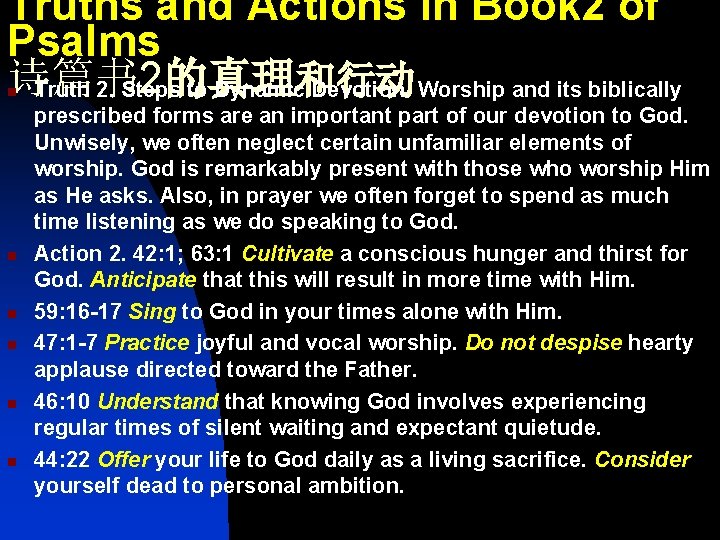
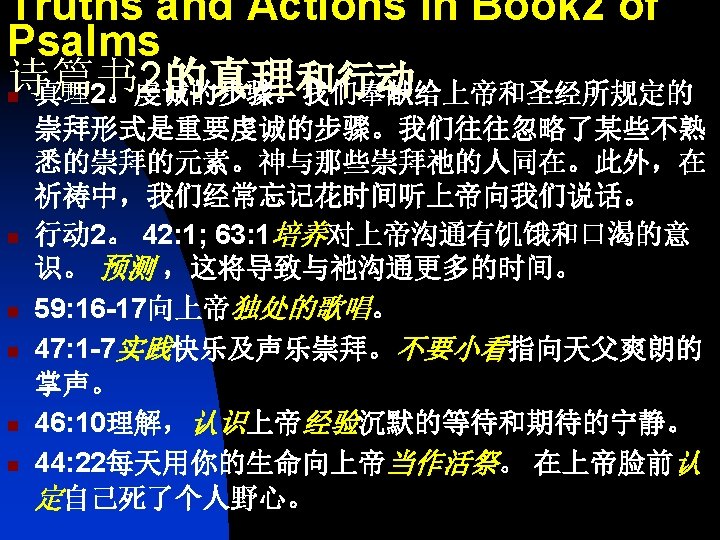
Truths and Actions in Book 2 of Psalms 诗篇书 2的真理 Truth 2. Steps to Dynamic和行动 Devotion. Worship and its biblically n n n prescribed forms are an important part of our devotion to God. Unwisely, we often neglect certain unfamiliar elements of worship. God is remarkably present with those who worship Him as He asks. Also, in prayer we often forget to spend as much time listening as we do speaking to God. Action 2. 42: 1; 63: 1 Cultivate a conscious hunger and thirst for God. Anticipate that this will result in more time with Him. 59: 16 -17 Sing to God in your times alone with Him. 47: 1 -7 Practice joyful and vocal worship. Do not despise hearty applause directed toward the Father. 46: 10 Understand that knowing God involves experiencing regular times of silent waiting and expectant quietude. 44: 22 Offer your life to God daily as a living sacrifice. Consider yourself dead to personal ambition.
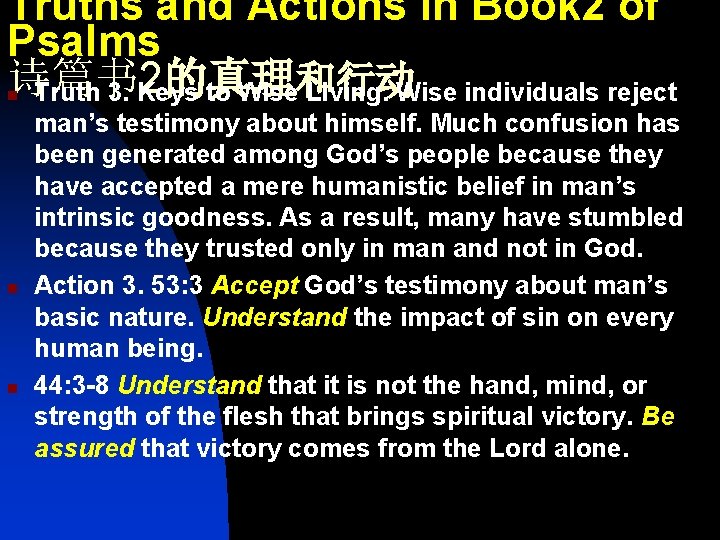
Truths and Actions in Book 2 of Psalms 诗篇书 2的真理 Truth 3. Keys to Wise和行动 Living. Wise individuals reject n n n man’s testimony about himself. Much confusion has been generated among God’s people because they have accepted a mere humanistic belief in man’s intrinsic goodness. As a result, many have stumbled because they trusted only in man and not in God. Action 3. 53: 3 Accept God’s testimony about man’s basic nature. Understand the impact of sin on every human being. 44: 3 -8 Understand that it is not the hand, mind, or strength of the flesh that brings spiritual victory. Be assured that victory comes from the Lord alone.
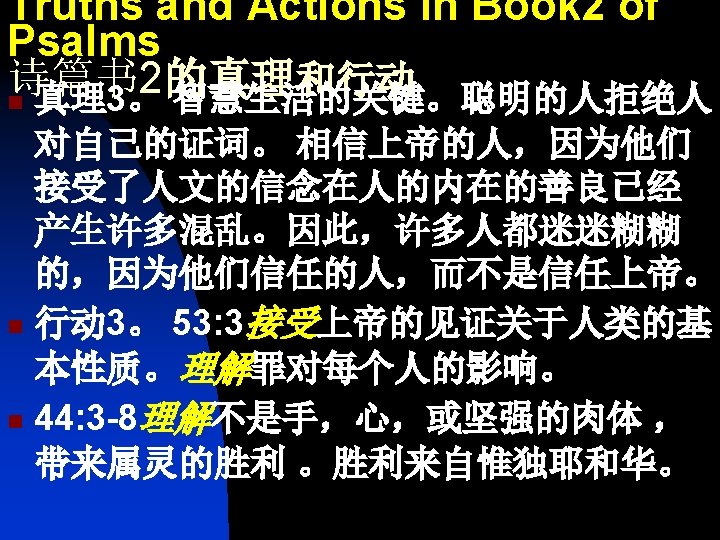
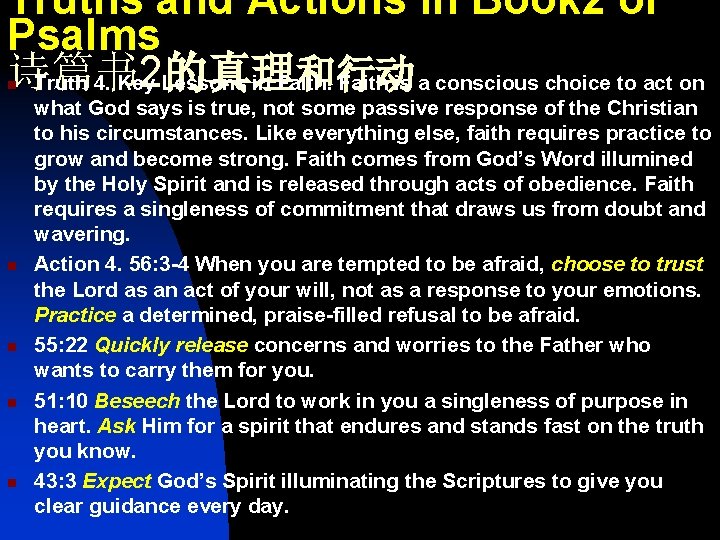
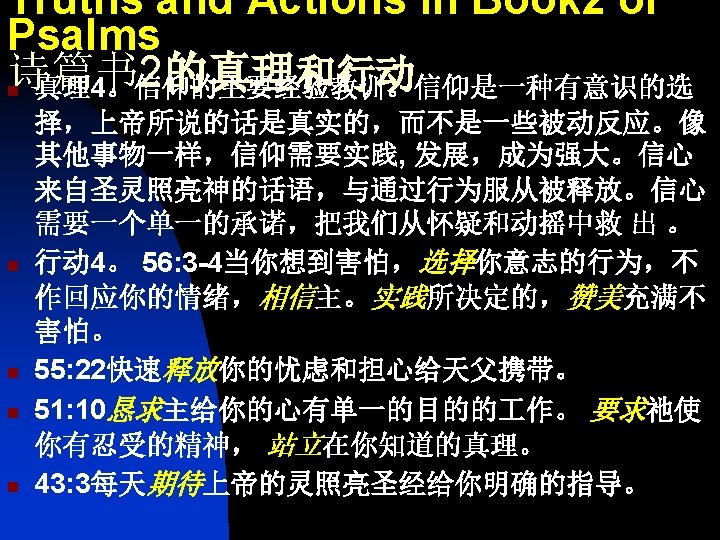
Truths and Actions in Book 2 of Psalms 诗篇书 2的真理 和行动 Truth 4. Key Lessons in Faith is a conscious choice to act on n n what God says is true, not some passive response of the Christian to his circumstances. Like everything else, faith requires practice to grow and become strong. Faith comes from God’s Word illumined by the Holy Spirit and is released through acts of obedience. Faith requires a singleness of commitment that draws us from doubt and wavering. Action 4. 56: 3 -4 When you are tempted to be afraid, choose to trust the Lord as an act of your will, not as a response to your emotions. Practice a determined, praise-filled refusal to be afraid. 55: 22 Quickly release concerns and worries to the Father who wants to carry them for you. 51: 10 Beseech the Lord to work in you a singleness of purpose in heart. Ask Him for a spirit that endures and stands fast on the truth you know. 43: 3 Expect God’s Spirit illuminating the Scriptures to give you clear guidance every day.
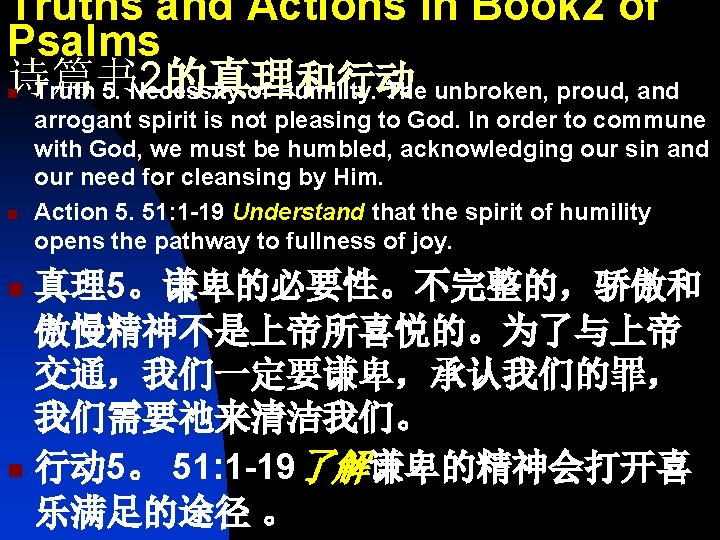
Truths and Actions in Book 2 of Psalms 诗篇书 2的真理 和行动 Truth 5. Necessity of Humility. The unbroken, proud, and n n arrogant spirit is not pleasing to God. In order to commune with God, we must be humbled, acknowledging our sin and our need for cleansing by Him. Action 5. 51: 1 -19 Understand that the spirit of humility opens the pathway to fullness of joy. 真理5。谦卑的必要性。不完整的,骄傲和 傲慢精神不是上帝所喜悦的。为了与上帝 交通,我们一定要谦卑,承认我们的罪, 我们需要祂来清洁我们。 n 行动 5。 51: 1 -19了解谦卑的精神会打开喜 乐满足的途径 。 n
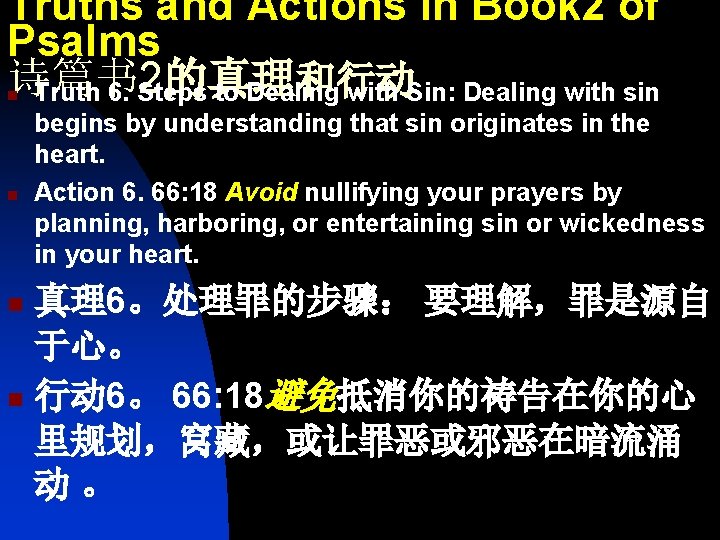
Truths and Actions in Book 2 of Psalms 诗篇书 2的真理 和行动 Truth 6. Steps to Dealing with Sin: Dealing with sin n n begins by understanding that sin originates in the heart. Action 6. 66: 18 Avoid nullifying your prayers by planning, harboring, or entertaining sin or wickedness in your heart. 真理6。处理罪的步骤: 要理解,罪是源自 于心。 n 行动 6。 66: 18避免抵消你的祷告在你的心 里规划,窝藏,或让罪恶或邪恶在暗流涌 动。 n
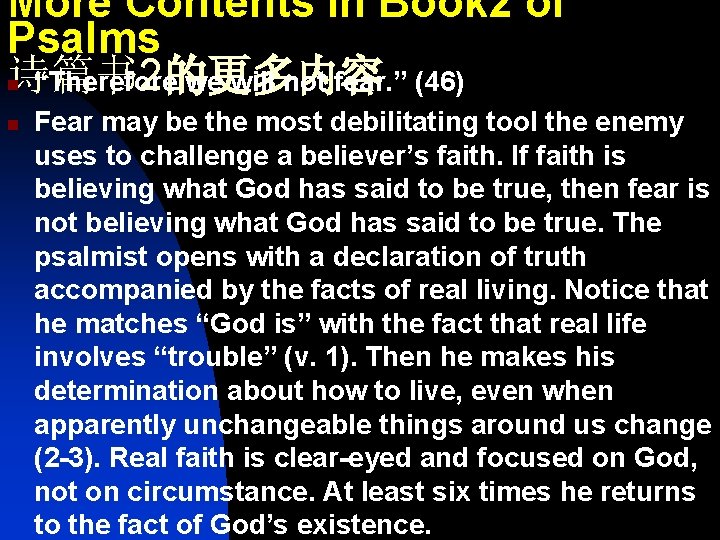
More Contents in Book 2 of Psalms 诗篇书 2的更多内容 “Therefore we will not fear. ” (46) n n Fear may be the most debilitating tool the enemy uses to challenge a believer’s faith. If faith is believing what God has said to be true, then fear is not believing what God has said to be true. The psalmist opens with a declaration of truth accompanied by the facts of real living. Notice that he matches “God is” with the fact that real life involves “trouble” (v. 1). Then he makes his determination about how to live, even when apparently unchangeable things around us change (2 -3). Real faith is clear-eyed and focused on God, not on circumstance. At least six times he returns to the fact of God’s existence.
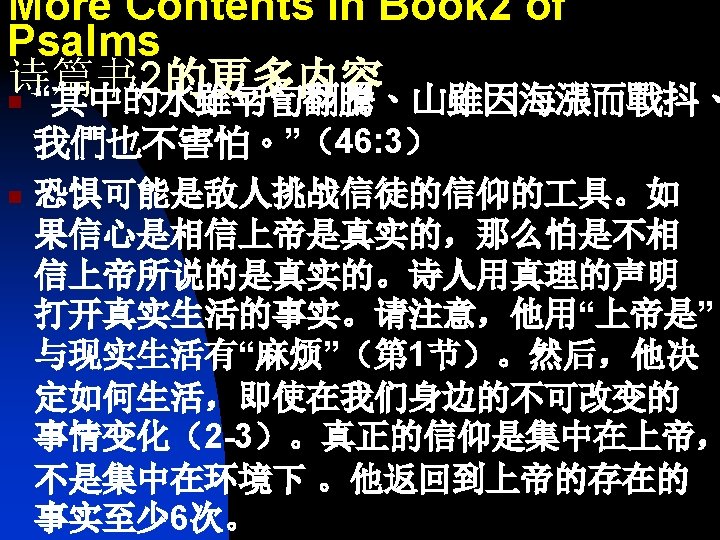
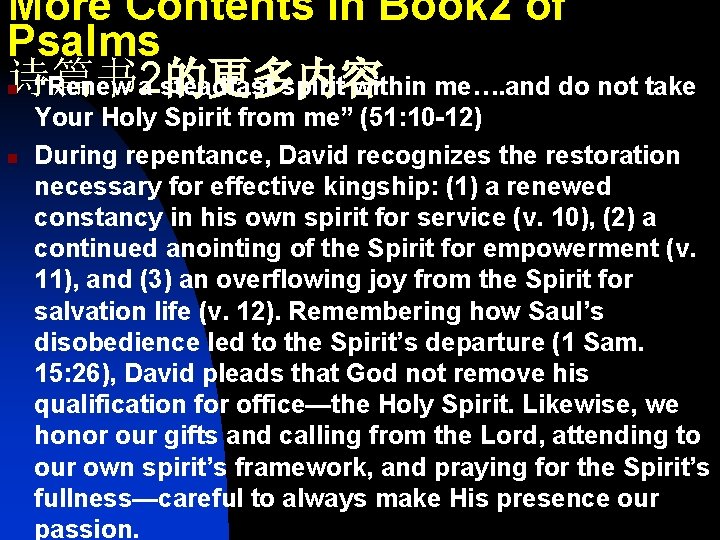
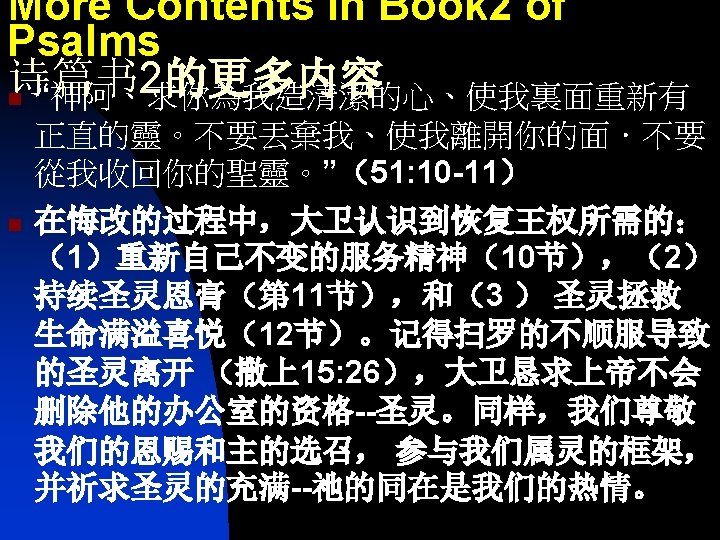
More Contents in Book 2 of Psalms 诗篇书 2的更多内容 “Renew a steadfast spirit within me…. and do not take n n Your Holy Spirit from me” (51: 10 -12) During repentance, David recognizes the restoration necessary for effective kingship: (1) a renewed constancy in his own spirit for service (v. 10), (2) a continued anointing of the Spirit for empowerment (v. 11), and (3) an overflowing joy from the Spirit for salvation life (v. 12). Remembering how Saul’s disobedience led to the Spirit’s departure (1 Sam. 15: 26), David pleads that God not remove his qualification for office—the Holy Spirit. Likewise, we honor our gifts and calling from the Lord, attending to our own spirit’s framework, and praying for the Spirit’s fullness—careful to always make His presence our passion.
More Contents in Book 2 of Psalms 诗篇书 2的更多内容 n “I will lift up m hands in Your name. ” (63: 4) n Human hands represent what we do. They are instruments whereby we accomplish things. In this passage they represent one way we bless God. By lifting them in praise, we acknowledge that without God’s presence in our lives we can accomplish nothing of lasting value. It is also a way of pointing to the Lord or reaching up to Him. In this way we acknowledge our weakness and express our need. Raised hands are an admission that we are not able to manage our own lives. We raise our hands in surrender to His power.
More Contents in Book 2 of Psalms 诗篇书 2的更多内容 n “Let all the peoples praise You. ” (67: 3) n The psalmist passes from a prayer for blessings upon Israel (v. 1 -2) to a prayer for the nations. He prays that they might receive revelation (v. 2), praise God (v. 3) and submit as impassioned when we pray, “Your kingdom come” (Matt. 6: 10) God wants all peoples and nations to know Him (Matt. 28: 19) and to praise Him.
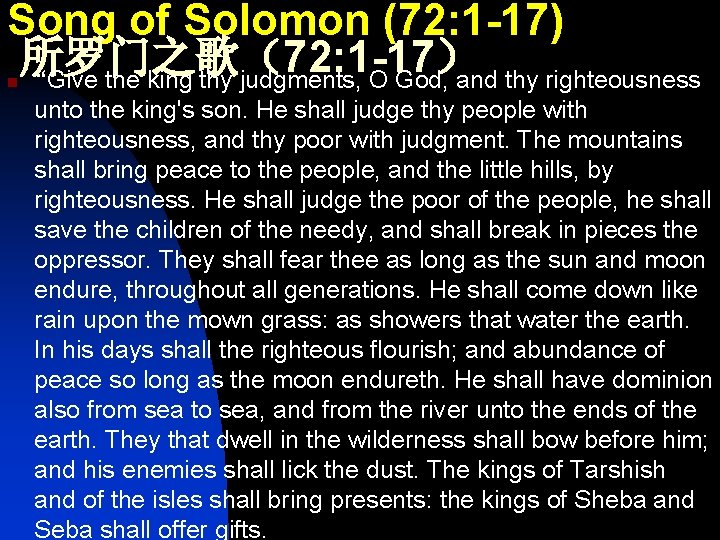
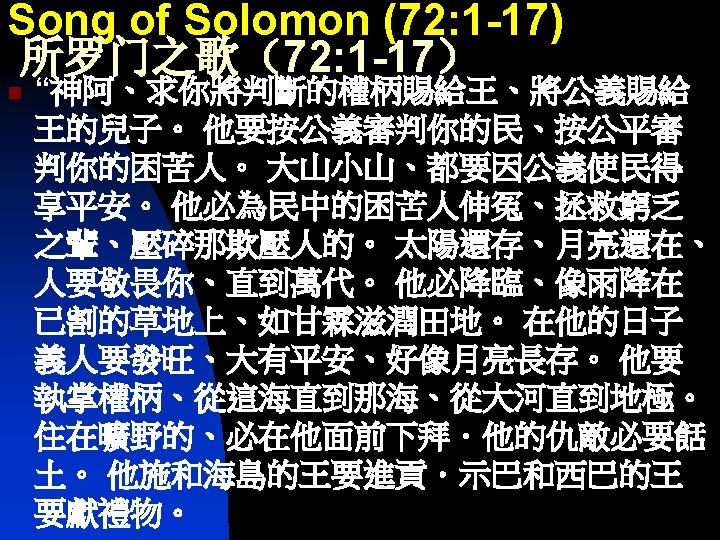
Song of Solomon (72: 1 -17) 所罗门之歌(72: 1 -17) “Give the king thy judgments, O God, and thy righteousness n unto the king's son. He shall judge thy people with righteousness, and thy poor with judgment. The mountains shall bring peace to the people, and the little hills, by righteousness. He shall judge the poor of the people, he shall save the children of the needy, and shall break in pieces the oppressor. They shall fear thee as long as the sun and moon endure, throughout all generations. He shall come down like rain upon the mown grass: as showers that water the earth. In his days shall the righteous flourish; and abundance of peace so long as the moon endureth. He shall have dominion also from sea to sea, and from the river unto the ends of the earth. They that dwell in the wilderness shall bow before him; and his enemies shall lick the dust. The kings of Tarshish and of the isles shall bring presents: the kings of Sheba and Seba shall offer gifts.
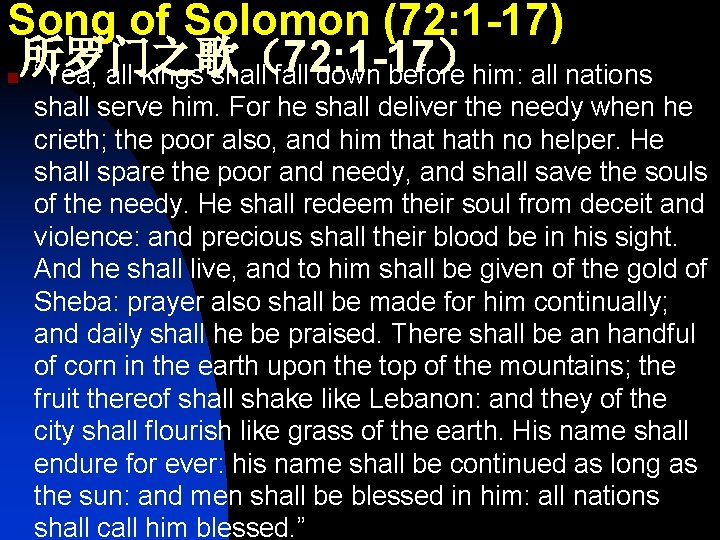
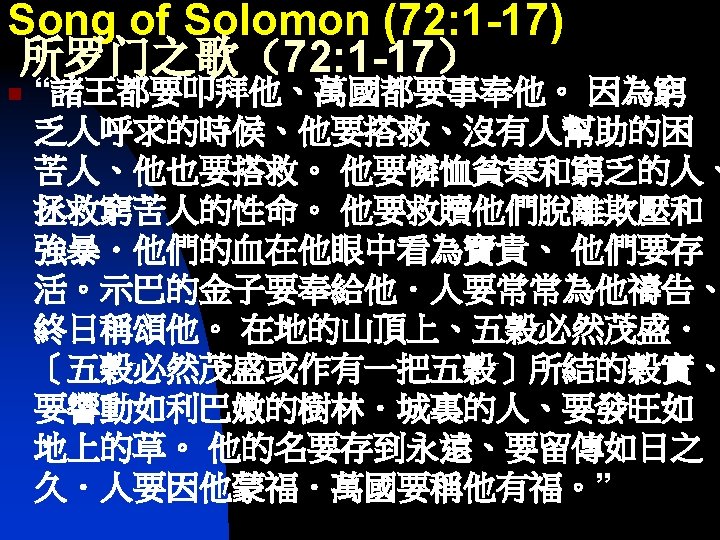
Song of Solomon (72: 1 -17) 所罗门之歌(72: 1 -17) “Yea, all kings shall fall down before him: all nations n shall serve him. For he shall deliver the needy when he crieth; the poor also, and him that hath no helper. He shall spare the poor and needy, and shall save the souls of the needy. He shall redeem their soul from deceit and violence: and precious shall their blood be in his sight. And he shall live, and to him shall be given of the gold of Sheba: prayer also shall be made for him continually; and daily shall he be praised. There shall be an handful of corn in the earth upon the top of the mountains; the fruit thereof shall shake like Lebanon: and they of the city shall flourish like grass of the earth. His name shall endure for ever: his name shall be continued as long as the sun: and men shall be blessed in him: all nations shall call him blessed. ”
References: 参考文献: 1. Various Internet sources. n 2. Various versions of the Bible. n 3. Hayford’s Bible Handbook, 1995. n 1。各种互联网资源。 n 2。各种版本的圣经。 n 3。海福德圣经手册,1995年。 n

n Gloria Deo 愿荣耀归上帝
- Slides: 42